Chindia Alert: You’ll be Living in their World Very Soon
aims to alert you to the threats and opportunities that China and India present. China and India require serious attention; case of ‘hidden dragon and crouching tiger’.
Without this attention, governments, businesses and, indeed, individuals may find themselves at a great disadvantage sooner rather than later.
The POSTs (front webpages) are mainly 'cuttings' from reliable sources, updated continuously.
The PAGEs (see Tabs, above) attempt to make the information more meaningful by putting some structure to the information we have researched and assembled since 2006.
A government task force has estimated a US$5 billion loss if Chinese students – angered and frustrated by the ban – cannot enrol for university
The tourism sector is also likely to be hit by restrictions on travel from the mainland as Chinese visitors spend about U$8 billion in Australia each year
Some 150,000 Chinese nationals are enrolled at Australian universities, making up around 11 per cent of the student population. Photo: Shutterstock
Abbey Shi knows first hand the anger and frustration felt by Chinese students left stranded by the Australian government’s decision to ban travel from the mainland in response to the coronavirus outbreak.
Shi, general secretary of the Students’ Representative Council at the University of Sydney, is in contact with more than 2,000 Chinese students who went home for the Lunar New Year holiday and now cannot return to Australia with just weeks to go until the start of the new academic year.
“There is a lot of confusion about the ban and anger towards the government,” said Shi, an international student from Shanghai. Currently in Australia, she is sharing information with the stranded students via WeChat.
How to beat the coronavirus? Re-creating it in Singapore, Australia is vital first step
3 Feb 2020
“The education sector in Australia is being commercialised and students are being treated like cash cows,” she said. “Universities don’t care about our affected career path, life, tenancy issues, our pets at home.”
Prime Minister Scott Morrison on Saturday announced that non-citizens – excluding permanent residents and their immediate family members – who arrived from or passed through mainland China within the previous 14 days would be denied entry to Australia as part of efforts to halt the spread of the coronavirus, which was first detected in December in the Chinese city of Wuhan.
Other countries including the United States, Singapore and the Philippines have introduced similar travel restrictions in response to the outbreak, which has sickened more than 19,000 people in at least 26 countries and territories outside mainland China and claimed 425 lives.
The travel ban, which is due to be reviewed on February 15, has upended the plans of numerous Chinese students who were due to begin or return to their studies from late February following the summer break.
Tony Yan, a mathematics undergraduate at Australian National University (ANU), said he had been left out of pocket for several weeks’ rent after being stranded in his home province of Jiangsu, but hoped he could return before classes started on February 24.
“I think the Australian government should have given a few days earlier notice,” Yan said. “I haven’t paid the tuition yet, many others haven’t as well.”
About 150,000 Chinese nationals are enrolled at Australian universities, making up around 11 per cent of the student population – a far greater proportion than in Britain and the United States, which came in at 6 per cent and 2 per cent respectively, in a 2017 report from an Australian think tank.
Coronavirus: Australia evacuates 243 people from China as deaths mount
3 Feb 2020
ANU Vice-Chancellor Brian Schmidt on Saturday described the travel ban as “disappointing”, pledging that the university would be “generous and flexible in supporting our students” through the coming weeks.
Monash University in Melbourne has delayed the start of its academic year, while other universities are exploring options such as online tuition and intensive summer courses.
Australian universities, some of which rely on Chinese students for nearly one-quarter of their revenue, are bracing to take a major financial hit due to the ban.
Phil Honeywood, the head of a government task force initially set up to manage the reputation of Australia’s international education sector in the wake of the country’s bush fires crisis, on Sunday warned the ban could cost universities A$8 billion (US$5.34 billion) if Chinese students could not enrol for the first semester of the year.
Coronavirus: what we know so far about the outbreak spreading in China and abroad
Education minister Dan Tehan on Monday met with peak body Universities Australia to discuss ways to minimise fallout for the sector.
“Australia will remain an attractive study destination for Chinese students, but it may take several years for Chinese student numbers to recover,” said Salvatore Babones, associate professor at the University of Sydney and adjunct scholar at the Centre for Independent Studies. “Students who are already in the middle of a degree are likely to return at the first possible opportunity, even at the cost of missing one semester, but students who have not yet started may make other plans.”
But ANU tertiary education expert Andrew Norton said there remained too many unknowns, including the number of Chinese students stranded abroad, to gauge the impact of the ban.
How the coronavirus spread anti-Chinese racism like a disease through Asia
17 Feb 2020
“This travel ban is a short-term policy to minimise the risk of disease spreading, which would be a more serious problem than a disruption to university timetables,” he said. “One of Australia’s major [education] competitors – the US – has a similar policy, and due to travel restrictions within China and the cancelling of commercial flights to and from China Australia’s competitors are unlikely to be able to take advantage.”
Norton noted that the sector had weathered previous outbreaks such as the 2003 outbreak of severe acute respiratory syndrome (Sars), and “although there were sometimes short-term dips in numbers, none of them have changed the long-term trend towards growth”.
The ban has also sent jitters throughout the tourism industry, which relies on Chinese visitors for a quarter of international spending. Nearly 1.5 million
visited Australia in 2018-19, Australian Bureau of Statistics records show, accounting for about one in eight arrivals.
Nearly 1.5 million Chinese nationals visited Australia in 2018-19, according to Australian Bureau of Statistics records. Photo: SCMP / Alkira Reinfrank
With Chinese tourists spending about A$12 billion (US$8 billion) in Australia each year, according to Tourism Research Australia, every month the travel ban remains in place could amount to billion-dollar losses for the sector.
Tourism Tropical North Queensland on Monday said the outbreak had already cost operators for Cairns and the Great Barrier Reef 25,000 direct bookings worth A$10 million. Chief executive Mark Olsen said the situation constituted a crisis for the industry that called for “unprecedented action” by the government.
David Beirman, senior lecturer in tourism at the University of Technology Sydney, said the ban was especially damaging for the industry as it came on the heels of devastating bush fires that had kept visitors away.
Coronavirus: how Facebook clickbait fuels a perfect storm of fake news
15 Feb 2020
“There is no doubt that the coronavirus outbreak following on so closely to the bush fires will combine to hit international tourism to Australia very hard,” Beirman said. “Later this month the Australian Bureau of Statistics will reveal the December 2019 tourism figures, which are expected to show at best a 25 per cent downturn in international visitor arrivals compared to December 2018. January 2020 is likely to be far worse as the impact of coronavirus will certainly be a factor.”
Others have raised concerns about the impact of the travel restrictions on public attitudes toward Chinese and Chinese-Australians, warning they could stoke latent prejudices.
“This is an overreaction from the Australian government, and in many ways it feels like it is a form of racial targeting,” said Erin Chew, national convenor of the Asian Australian Alliance. “When previous viruses happened such as mad cow disease or the swine flu, Australia didn’t ban non-citizens from Britain and the US. Nor was the blame placed on the people in [those countries].
“Since the coronavirus outbreak it has been coined that this virus is the fault of Chinese people, not just in mainland China, but really all over the world.”
Forty countries will be able to diagnose the disease, and the Africa CDC is training health workers
Until two weeks ago, there were only two laboratories on the continent that could test for the virus, in Senegal and South Africa
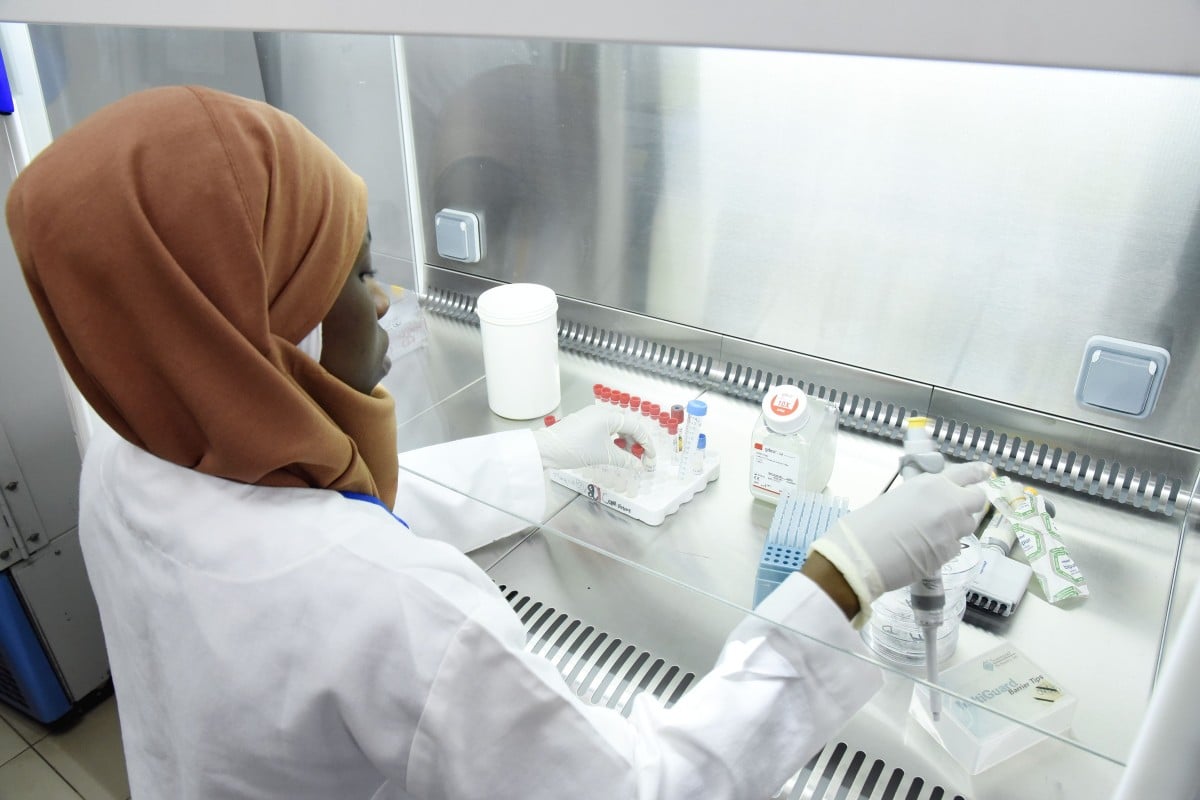
A scientist researches the coronavirus at the Pasteur Institute in Dakar, Senegal, which until two weeks ago was one of just two labs in Africa that could test for the disease. Photo: AFP
Forty countries in Africa will be able to test for the deadly new coronavirus
by the end of the week, the WHO said, after Egypt confirmed the first case on the continent last week.
The World Health Organisation said many of those nations had been sending samples elsewhere for testing and waiting several days for results.
“Now they can do it themselves, within 24 to 48 hours,” WHO director general Tedros Adhanom Ghebreyesus said in a media briefing on Tuesday.
Until about two weeks ago, there were only two laboratories in the continent of 54 countries – in Senegal and South Africa – with the reagents needed to test for the virus. That meant dozens of nations that had quarantined suspected patients were sending samples to South Africa or Senegal to be tested.
The WHO earlier this week sent reagent kits for coronavirus diagnosis to more than 20 countries in Africa to step up diagnosis of the virus, which causes a disease now known as Covid-19. The global health body said more countries in Africa were expected to receive testing kits this week.
In addition, the WHO last week sent testing kits to Cameroon, Ivory Coast, the Democratic Republic of Congo, Egypt, Ethiopia, Gabon, Ghana, Kenya, Morocco, Nigeria, Tunisia, Uganda and Zambia.
Coronavirus: WHO urges caution over study showing ‘decline’ in new Covid-19 cases in China
Tedros said some countries in Africa, including the Democratic Republic of Congo, were using systems developed to test for the deadly Ebola virus to now test for the coronavirus.
“This is a great example of how investing in health systems can pay dividends for health security,” Tedros said.
Several countries, including Ethiopia and South Sudan, were prioritising surveillance and monitoring at ports of entry, he said. “We’re also working with partners in some of the most fragile contexts, from Syria to the Central African Republic, to prepare countries for the arrival of the virus,” he said.
The WHO and Egyptian health officials on Friday confirmed that a 33-year-old foreigner had tested positive for the coronavirus. Egypt’s health ministry said the patient had tested positive for the virus without any symptoms, raising concern that there could be undetected cases on the continent, as countries scramble to equip labs to test for the disease.
The asymptomatic patient in Egypt was identified through contact screening of an index case who travelled to Cairo on a business trip from January 21 to February 4 and tested positive for the virus on February 11 in China, the WHO regional office said.
The new virus strain has killed more than 2,000 people and infected over 74,000 since the outbreak began in central China in December. It has spread to more than 20 countries.
Screening measures have been stepped up across Africa, including quarantining all passengers arriving from Chinese cities, amid fears that poorer countries with weaker health systems may struggle to cope if the virus spreads on the continent. More than a dozen countries still do not have the capacity to test for the pneumonia-like illness.
There are concerns that Africa’s close links with China put it at high risk for the spread of the new virus. Africa has become home to millions of Chinese since Beijing started looking to the continent for raw materials for its industries and markets for its products. China has been Africa’s largest trading partner since 2009, after it overtook the United States, with two-way trade standing at US$108 billion last year, according to China’s commerce ministry.
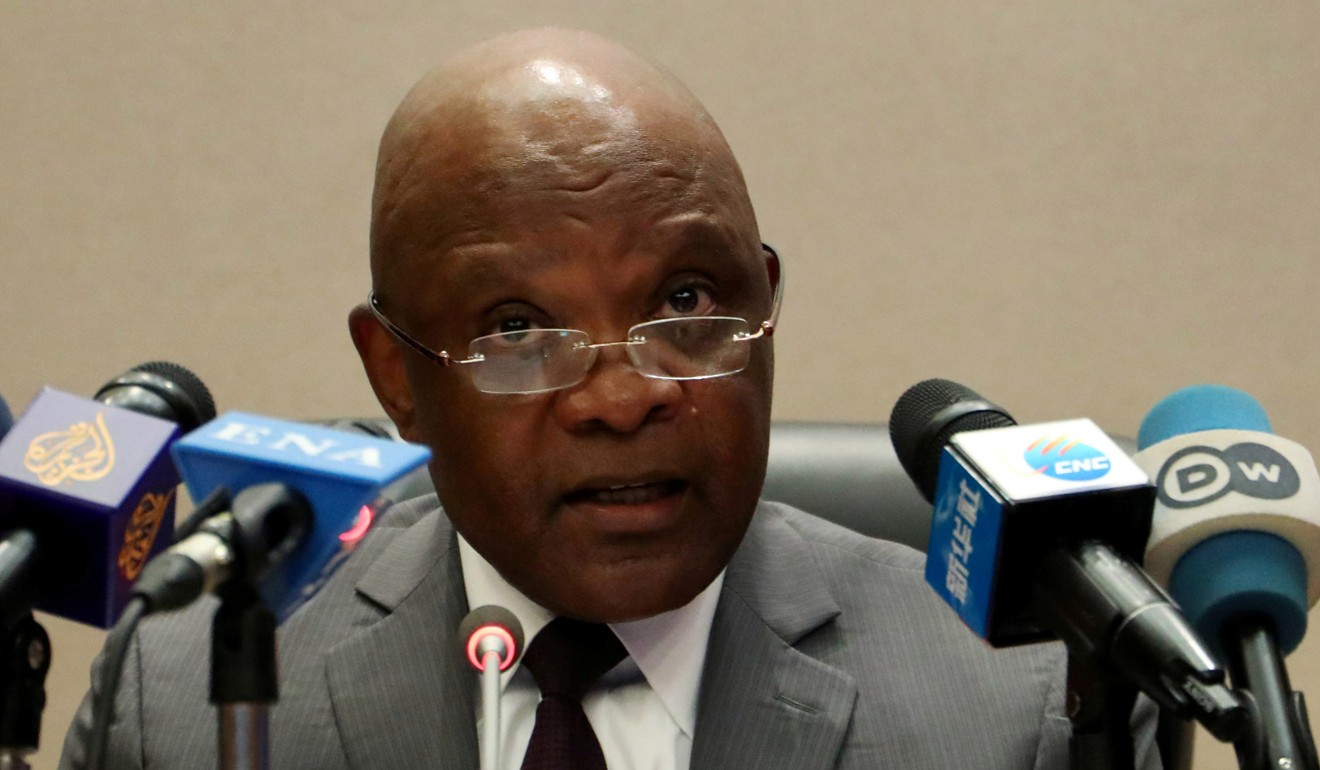
Africa CDC director John Nkengasong said it had been “investing in preparedness and response to the disease”. Photo: Reuters
John Nkengasong, director of the Africa Centres for Disease Control and Prevention (Africa CDC), said it was working closely with the WHO and other partners to ensure that Egypt had the diagnostic tools it needed, and that the right actions were taken to contain the spread of the virus.
“We anticipated that the Covid-19 outbreak would inevitably impact Africa. That is why the Africa CDC has been working actively with African Union member states and partners in the past four weeks and investing in preparedness and response to the disease,” he said.
“[Last week in Dakar, Senegal] we conducted training and supplied test kits to 16 African laboratories, including from Egypt. Egypt also received additional test kits from the WHO,” Nkengasong said.
The Africa CDC would train 40 health workers from nine countries, including Egypt, in Nairobi this week, he said, on “enhancing detection and investigation of Covid-19 at points of entry”.
The Chinese medical workers on the front line of the coronavirus fight in Wuhan
On Monday, Ethiopia, home to one of the continent’s busiest airports, said it had received equipment and reagents for virus detection and control. “We are working hard day and night with the government to improve the critical measures needed to ensure that the country is ready to effectively respond to an outbreak of Covid-19,” said Boureima Hama Sambo, the WHO representative in Ethiopia.
despite pressure for it to suspend services to the country. Many countries on the continent have restricted travel to and from mainland China, while six out of eight African airlines with Chinese routes have halted flights until the virus is contained, including EgyptAir.
Egypt has suspended all flights to and from the mainland until the end of the month and has evacuated more than 300 Egyptians from Wuhan, the epicentre of the epidemic.
Taiwan sends fighters to intercept mainland military aircraft after they cross dividing line in Taiwan Strait
Incursion comes at end of visit to Washington by vice-president-elect William Lai that angered Beijing
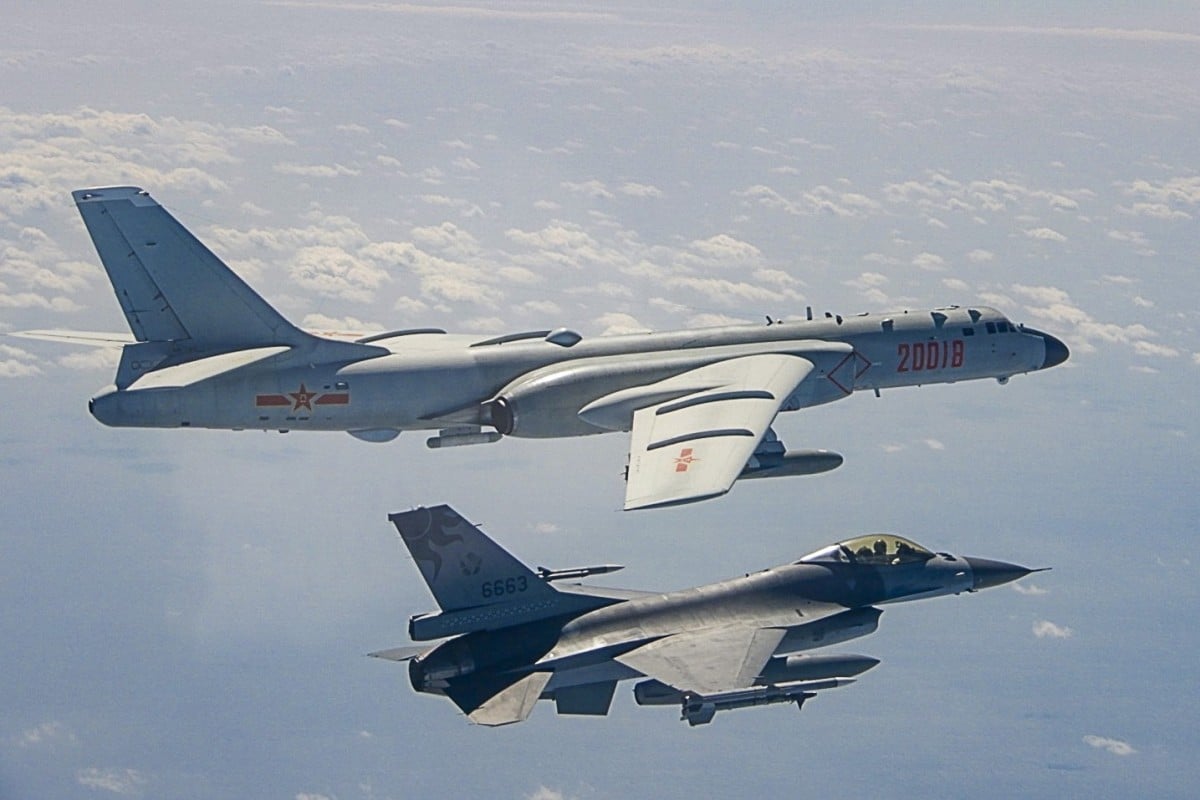
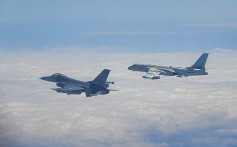
A Taiwanese fighter jet shadows a mainland Chinese bomber over the Taiwan Strait on Monday. Photo: Military News Agency, ROC
Taiwan sent warplanes to intercept a group of mainland Chinese jets that had briefly approached the island on Monday, the second such incident in two days.
The incident came as the island’s vice-president-designate William Lai Ching-te concluded an eight-day visit to the US that had angered Beijing.
The mainland warplanes, including H-6 bombers, briefly crossed the median line in the Taiwan Strait on their way to the western Pacific through the Bashi Channel in the morning for long-haul training exercises, Taiwan’s defence ministry said in a statement on Monday.
“Our air force scrambled fighter jets to shadow, intercept and disperse the communist warplanes through radio broadcasting,” the ministry said, adding the mainland planes later left the area.
The mainland warplanes later returned to their home base after their morning drill, the military said.
It was the second day in a row that the mainland warplanes flew past Taiwan after a group of aircraft, including J-11 fighter jets, KJ-500 early warning aircraft and H-6 bombers, flew over the Bashi Channel on Sunday before returning to their bases via the Miyako Strait northeast of Taiwan, the ministry said.
“The military has full surveillance and control of the communist long-haul training activities and the public can rest assured of our capability to uphold security or our national territory,” it said.
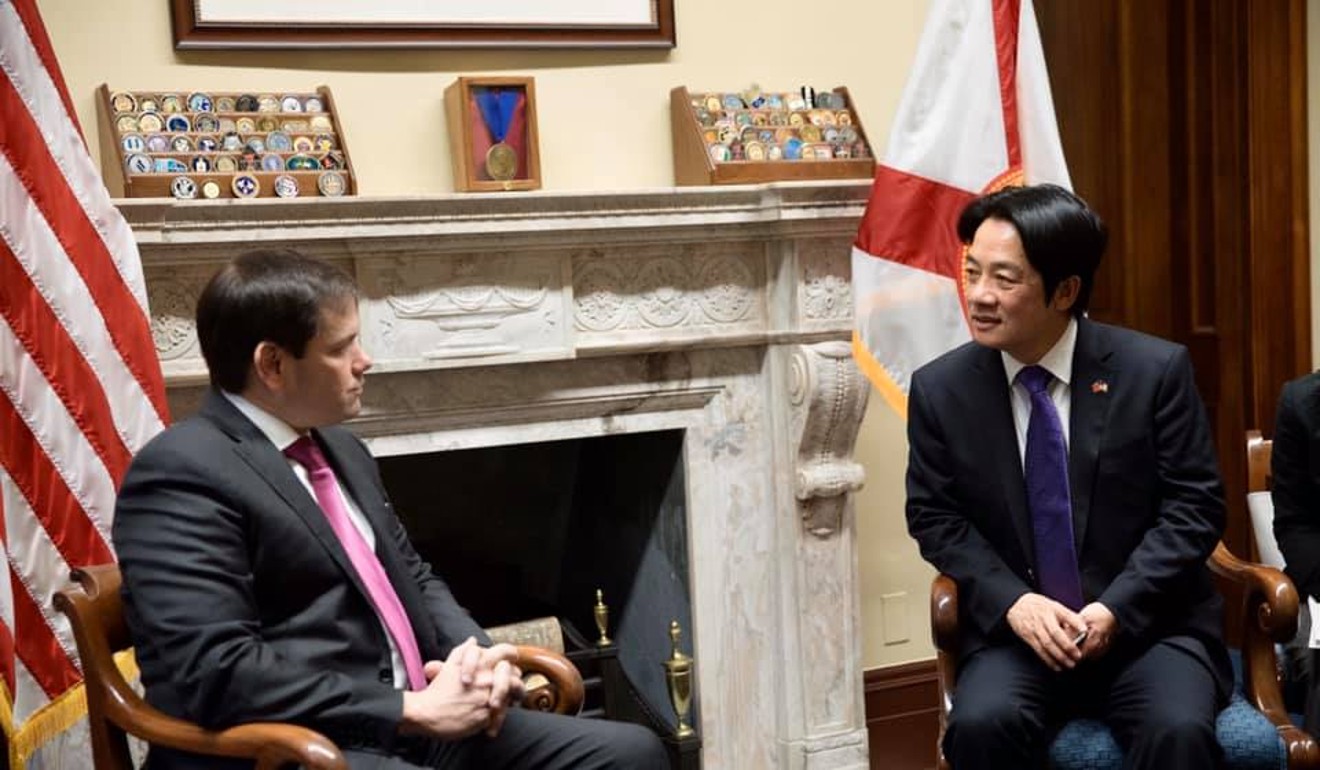
Meanwhile, Lai completed his eight-day “private” visit to Washington, during which he met the National Security Council and other US officials and senators.
Lai, who left for the US last Sunday to attend the National Prayer Breakfast – an annual gathering of political and religious leaders in Washington – was considered the highest-level Taiwanese official to meet with National Security Council officials since the US switched diplomatic recognition to Beijing from Taipei in 1979.
The visit was hailed as a diplomatic breakthrough for the island because until now Washington has been reluctant to allow such exchanges for fear of angering Beijing, which has repeatedly demanded that the US adhere to the “one-China” policy.
Taiwan scrambles jets as mainland Chinese air force flies around island
9 Feb 2020
Beijing views Taiwan as a wayward province that must be brought back to the mainland fold – by force if necessary.
It has suspended official exchanges with Taiwan since Tsai Ing-wen of the independence-leaning Democratic Progressive Party was first elected president in 2016 and refused to accept the one-China principle as the basis for cross-strait exchanges.
Since then, Beijing has staged war games close to the island and poached seven of Taiwan’s allies to heap pressure on the president, who was reelected last month.
A People’s Liberation Army spokesperson said on Sunday the flight was a “necessary action” under “current security situation across the Taiwan Strait”.
Vice-President-elect William Lai Ching-te met National Security Council officials on his visit to the White House. Photo: Facebook
Observers said Lai’s US visit was made possible due to a new US policy to allow high-level official and military exchanges with Taiwan, which has been included in the US security alliance to counter the mainland’s military expansion in the Indo-Pacific region.
They said Lai is still technically a civilian until he takes office in May, and the US can always use this status to defend its move, although the visit has prompted strong protests from the Chinese foreign ministry.
Observers also said Taiwan’s efforts in seeking to join the World Health Organisation amid the deadly coronavirus outbreak have also riled Beijing, which has repeatedly said the island is a mainland province with no right to join international bodies which require statehood for membership.
Taipei complains to World Health Organisation after coronavirus case is classed as ‘Taiwan, China’
23 Jan 2020
On Monday, Ma Xiaoguang, a spokesman for the mainland’s Taiwan Affairs Office, warned the Tsai government against “playing with fire” by “trying to use its strengthening ties with the US to plot independence”.
“This is a sheer provocation,” Ma said, adding what the People’s Liberation Army did was to protect the national sovereignty and territorial integrity of the mainland and to maintain cross-strait peace.
Song Zhongping, a military commentator for Hong Kong Phoenix Television, said the patrol was aimed at the separatist movement on the island.
“Such a patrol is for war-preparedness … and has become a routine practice and a resolution to effectively attack the pro-independence force,” said Song, a former instructor for the PLA’s Second Artillery, the predecessor of the Rocket Force.
A Beijing-based military source close to the PLA, who requested anonymity, said the warplanes were equipped with missiles, which has become a standard procedure for PLA’s air drills.
Some companies polled by Shanghai’s American Chamber of Commerce said they were speeding up plans to move operations out of mainland
Transport bans and strict public health measures have disrupted economic activity
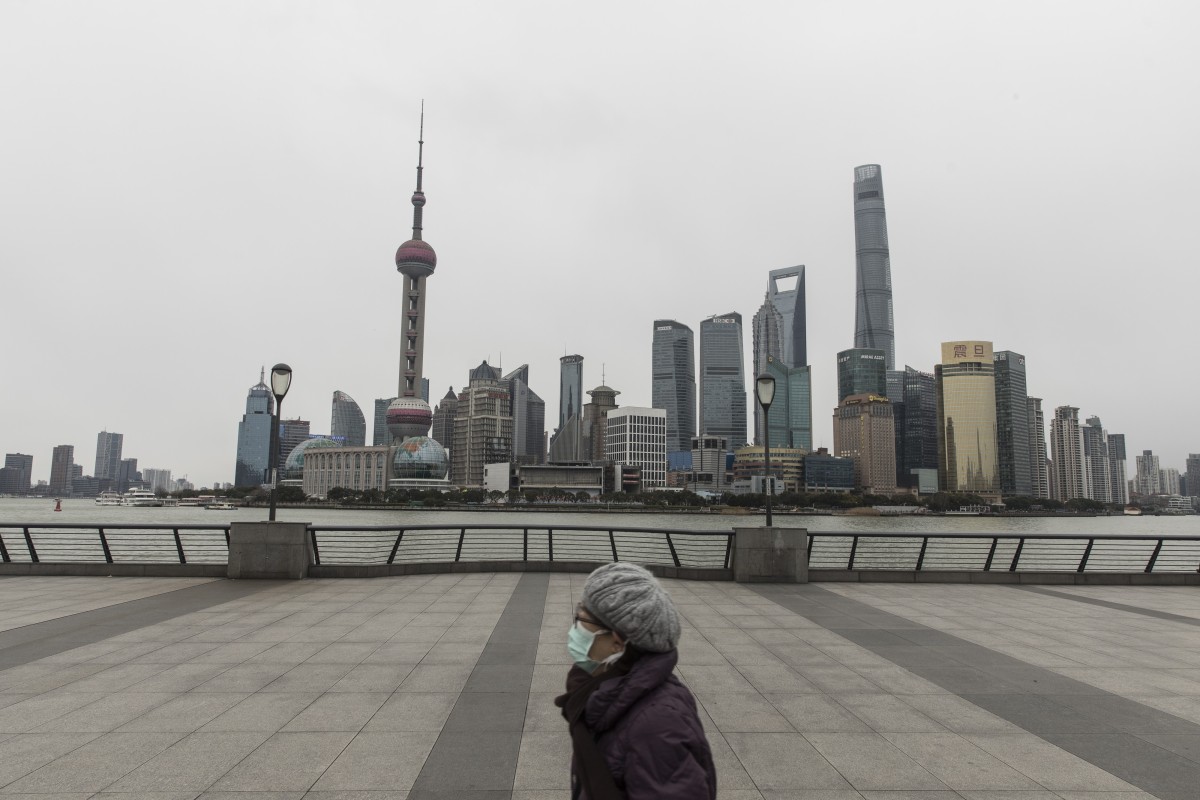
China’s economic growth may drop to 5 per cent or lower because of the outbreak, according to a government economist. Photo: Bloomberg
The majority of US firms with operations in China expect a virus outbreak
to cut revenue this year, and some are accelerating plans to shift their supply chains out of the country, according to a poll by Shanghai’s American Chamber of Commerce.
Nearly a quarter of the firms forecast revenue would fall by at least 16 per cent this year due to the outbreak, while over a fifth said it would decline by 11-15 per cent. Only 13 per cent of respondents said revenue would see very little or no impact from the virus.
The survey covered 127 companies, including 20 with China-sourced revenues of over US$500 million and 27 with China revenues of US$100 million to US$500 million.
Sixteen per cent of respondents expected China’s gross domestic product to fall by more than 2 per cent due to the outbreak.
China tries to get back to work amid coronavirus outbreak
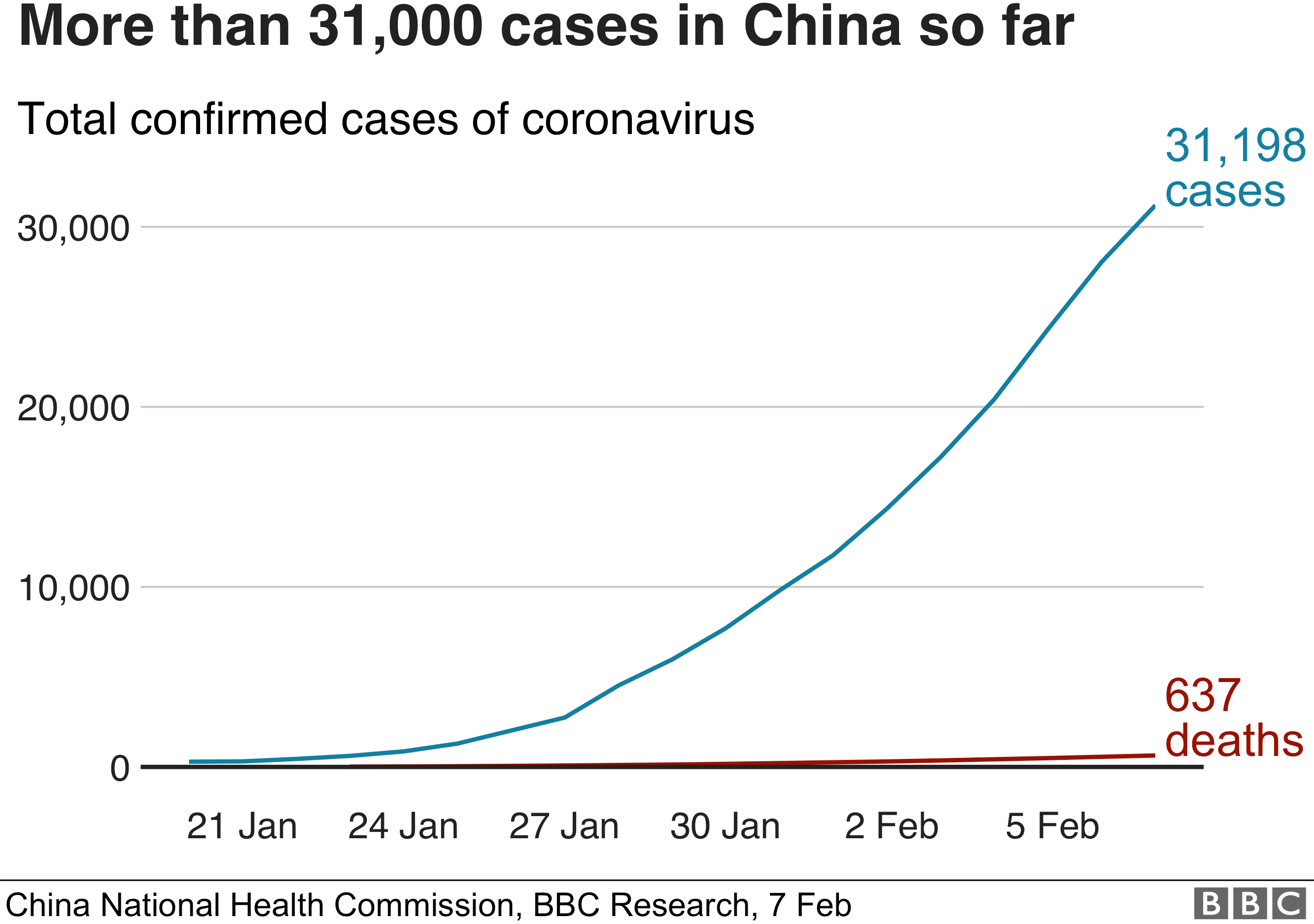
The death toll from the virus in China has topped 600, with more than 31,000 people infected. Widespread transport bans and strict public health measures have disrupted economic activity in much of the country, and factory closures are starting to ripple through global supply chains.
China faces dilemma as it tries to get back to work amid coronavirus outbreak fears
7 Feb 2020
A government economist said last week that China’s economic growth may drop to 5 per cent or even lower due to the outbreak, possibly pushing policymakers into introducing more stimulus measures.
Sources said Chinese policymakers were preparing measures, including more fiscal spending and interest rate cuts, amid expectations the outbreak would have a devastating impact on first-quarter growth.
In response to the virus, some survey respondents said they were shifting operations out of China and moving more production to other areas, including India.
“Not innovative, but our suppliers are moving operations to Taiwan. This has been considered before, options and planning were being made, but they are pulling the trigger now,” according to one respondent in the survey.
“Our company will directly source from Taiwan and eliminate the mainland China supply chain for more and more products.”
News of his death was met with an intense outpouring of grief on Chinese social media site Weibo – but this quickly turned into anger.
There had already been accusations against the government of downplaying the severity of the virus – and initially trying to keep it secret.
Dr Li’s death has fuelled this further and triggered a conversation about the lack of freedom of speech in China.
The country’s anti-corruption body has now said it will open an investigation into “issues involving Dr Li”.
The Chinese government has previously admitted “shortcomings and deficiencies” in its response to the virus, which has now killed 636 people and infected 31,161 in mainland China.
According to Chinese site Pear Video, Dr Li’s wife is due to give birth in June.
What has the public reaction been?
Chinese social media has been flooded with anger – it is hard to recall an event in recent years that has triggered as much grief, rage and mistrust against the government.
The top two trending hashtags on the website were “Wuhan government owes Dr Li Wenliang an apology” and “We want freedom of speech”.
Both hashtags were quickly censored. When the BBC searched Weibo on Friday, hundreds of thousands of comments had been wiped. Only a handful remain.
“This is not the death of a whistleblower. This is the death of a hero,” said one comment on Weibo.
A photo circulating on Twitter reportedly sourced from messaging platform WeChat also shows a message in Chinese saying “Farewell Li Wenliang” written in the snow on a riverbank.
Many have now taken to posting under the hashtag “Can you manage, do you understand?” – a reference to the letter Dr Li was told to sign when he was accused of disturbing “social order”.
These comments do not directly name him – but are telling of the mounting anger and distrust towards the government.
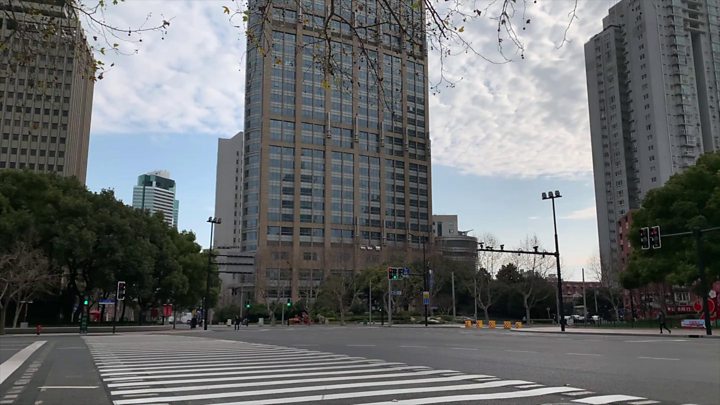
Media caption Coronavirus: Shanghai’s deserted streets and metro
“Do not forget how you feel now. Do not forget this anger. We must not let this happen again,” said one comment on Weibo.
“The truth will always be treated as a rumour. How long are you going to lie? What else do you have to hide?” another said.
“If you are angry with what you see, stand up,” one said. “To the young people of this generation, the power of change is with you.”
An epic political disaster
The death of Dr Li Wenliang has been a heart-breaking moment for this country. For the Chinese leadership it is an epic political disaster.
It lays bare the worst aspects of China’s command and control system of governance under Xi Jinping – and the Communist Party would have to be blind not to see it.
If your response to a dangerous health emergency is for the police to harass a doctor trying to blow the whistle, then your structure is obviously broken.
The city’s mayor – reaching for excuses – said he needed clearance to release critical information which all Chinese people were entitled to receive.
Now the spin doctors and censors will try to find a way to convince 1.4 billion people that Dr Li’s death is not a clear example of the limits to the party’s ability to manage an emergency – when openness can save lives, and restricting it can kill.
He was initially declared dead at 21:30 on Thursday (13:30GMT) by state media outlets the Global Times, People’s Daily and others.
Hours later the Global Times contradicted this report – saying he had been given a treatment known as ECMO, which keeps a person’s heart pumping.
Journalists and doctors at the scene said government officials had intervened – and official media outlets had been told to change their reports to say the doctor was still being treated.
But early on Friday, reports said doctors could not save Dr Li and his time of death was 02:58 on Friday.
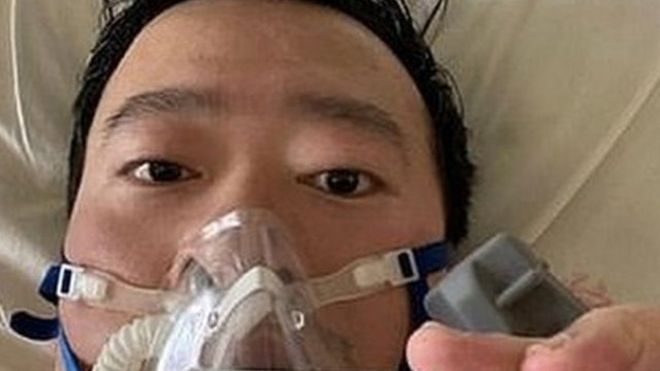
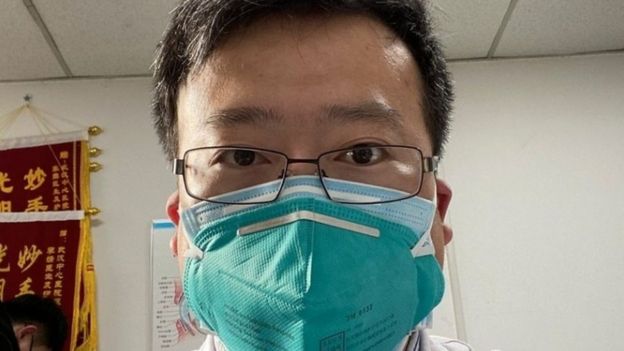
Image copyright LI WENLIANGImage caption Li Wenliang contracted the virus while working at Wuhan Central Hospital
What did Li Wenliang do?
Dr Li, an ophthalmologist, posted his story on Weibo from a hospital bed a month after sending out his initial warning.
He had noticed seven cases of a virus that he thought looked like Sars – the virus that led to a global epidemic in 2003.
On 30 December he sent a message to fellow doctors in a chat group warning them to wear protective clothing to avoid infection.
Four days later he was summoned to the Public Security Bureau where he was told to sign a letter.
In the letter he was accused of “making false comments” that had “severely disturbed the social order”. Local authorities later apologised to Dr Li.
In his Weibo post he describes how on 10 January he started coughing, the next day he had a fever and two days later he was in hospital. He was diagnosed with the coronavirus on 30 January.
Media caption The BBC’s online health editor on what we know about the virus
Singapore has raised its Disease Outbreak Response System Condition (Dorscon) level from yellow to orange. This means that the disease is deemed severe and spreads easily from person to person but has not spread widely and is being contained
Chinese President Xi Jinping has told his US counterpart Donald Trump that China is “fully confident and capable of defeating the epidemic”. The country has introduced more restrictive measures to try to control the outbreak:
The capital Beijing has banned group dining for events such as birthdays. Cities including Hangzhou and Nanchang are limiting how many family members can leave home each day
Hubei province has switched off lifts in high-rise buildings to discourage residents from going outside.
The virus has now spread to more than 25 countries. There have been more than 28,000 cases worldwide but only two of the deaths have been outside mainland China.
The new coronavirus has been declared a global emergency by the World Health Organization, as the outbreak continues to spread outside China.
“The main reason for this declaration is not what is happening in China but what is happening in other countries,” said WHO chief Tedros Adhanom Ghebreyesus.
The concern is that it could spread to countries with weaker health systems.
Meanwhile, the US has told its citizens not to travel to China.
The state department issued a level four warning – having previously urged Americans to “reconsider” travel to China – and said any citizens in China “should consider departing using commercial means”.
China has said it will send charter plans to bring back Hubei province residents who are overseas “as soon as possible”.
A foreign ministry spokesman said this was because of the “practical difficulties” Chinese citizens have faced abroad. Hubei is where the virus emerged.
At least 213 people in the China have died from the virus, mostly in Hubei, with almost 10,000 cases nationally.
The WHO said there had been 98 cases in 18 other countries, but no deaths.
Most international cases are in people who had been to Wuhan in Hubei.
However in eight cases – in Germany, Japan, Vietnam and the United States – patients were infected by people who had travelled to China.
Getty Coronavirus outbreak outside China
18 The number of countries with cases
14 Cases in Thailand and Japan
13 Singapore
11 South Korea
8 Australia and Malaysia
5 France and USA
Source: WHO and local authorities
Speaking at a news conference in Geneva, Dr Tedros described the virus as an “unprecedented outbreak” that has been met with an “unprecedented response”.
He praised the “extraordinary measures” Chinese authorities had taken, and said there was no reason to limit trade or travel to China.
The US Commerce Secretary, Wilbur Ross, has said the outbreak could “accelerate the return of jobs to North America”.
Preparing other countries
What happens if this virus finds its way into a country that cannot cope?
Many low- and middle-income countries simply lack the tools to spot or contain it. The fear is it could spread uncontrollably and that it may go unnoticed for some time.
Remember this is a disease which emerged only last month – and yet there are already almost 10,000 confirmed cases in China.
The 2014 Ebola outbreak in West Africa – the largest in human history – showed how easily poorer countries can be overwhelmed by such outbreaks.
And if novel coronavirus gets a significant foothold in such places, then it would be incredibly difficult to contain.
We are not at that stage yet – 99% of cases are in China and the WHO is convinced the country can control the outbreak there.
But declaring a global emergency allows the WHO to support lower- and middle-income countries to strengthen their disease surveillance – and prepare them for cases.
How unusual is this declaration?
The WHO declares a Public Health Emergency of International Concern when there is “an extraordinary event which is determined… to constitute a public health risk to other states through the international spread of disease”.
It has previously declared five global public health emergencies:
Swine flu, 2009 – The H1N1 virus spread across the world in 2009, with death toll estimates ranging from 123,000 to 575,400
Polio, 2014 – Although closer than ever to eradication in 2012, polio numbers rose in 2013
Zika, 2016 – The WHO declared Zika a public health emergency in 2016 after the disease spread rapidly through the Americas
Ebola, 2014 and 2019 – The first emergency over the virus lasted from August 2014 to March 2016 as almost 30,000 people were infected and more than 11,000 died in West Africa. A second emergency was declared last year as an outbreak spread in DR Congo
Media caption Inside the US laboratory developing a coronavirus vaccine
How is China handling the outbreak?
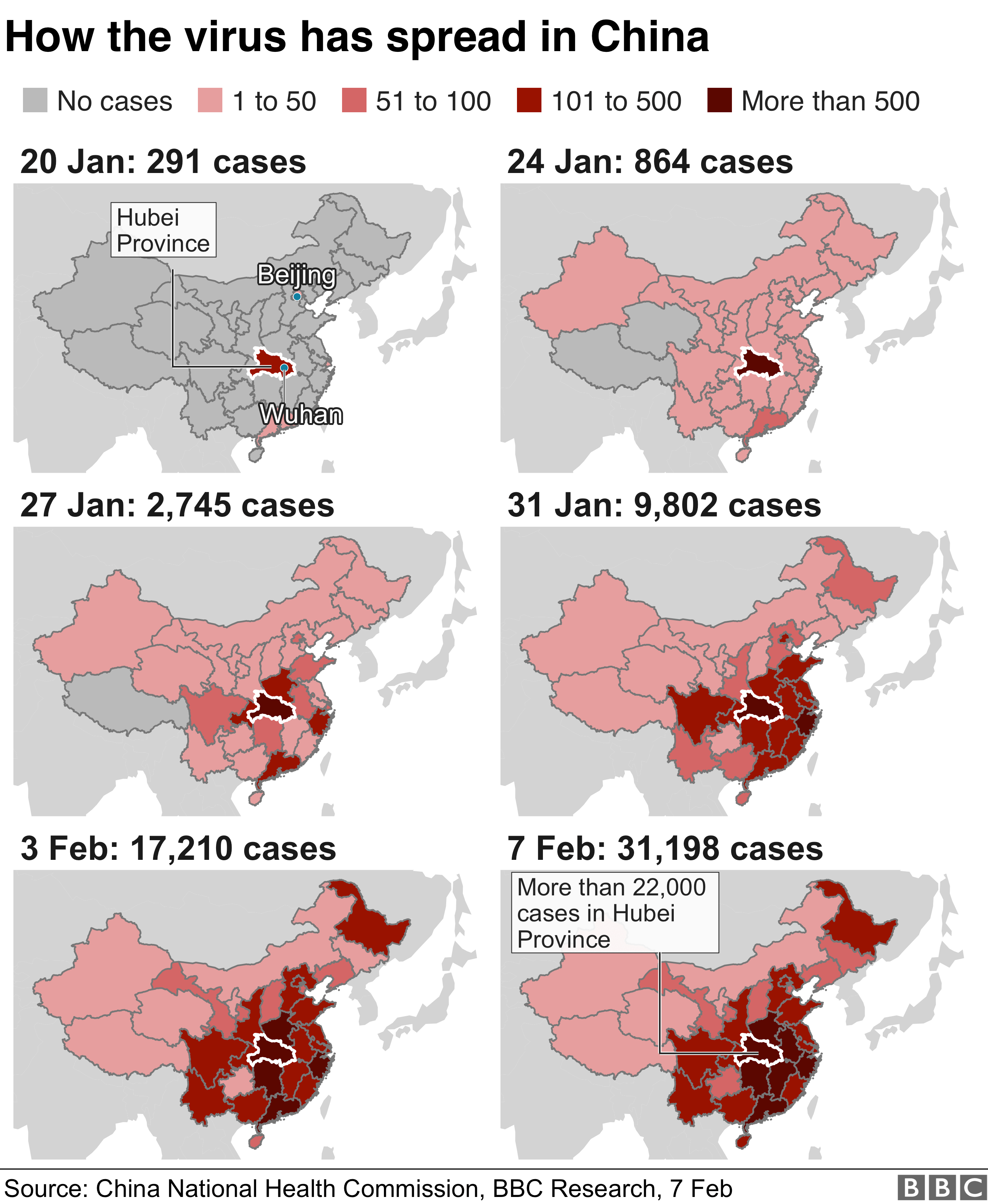
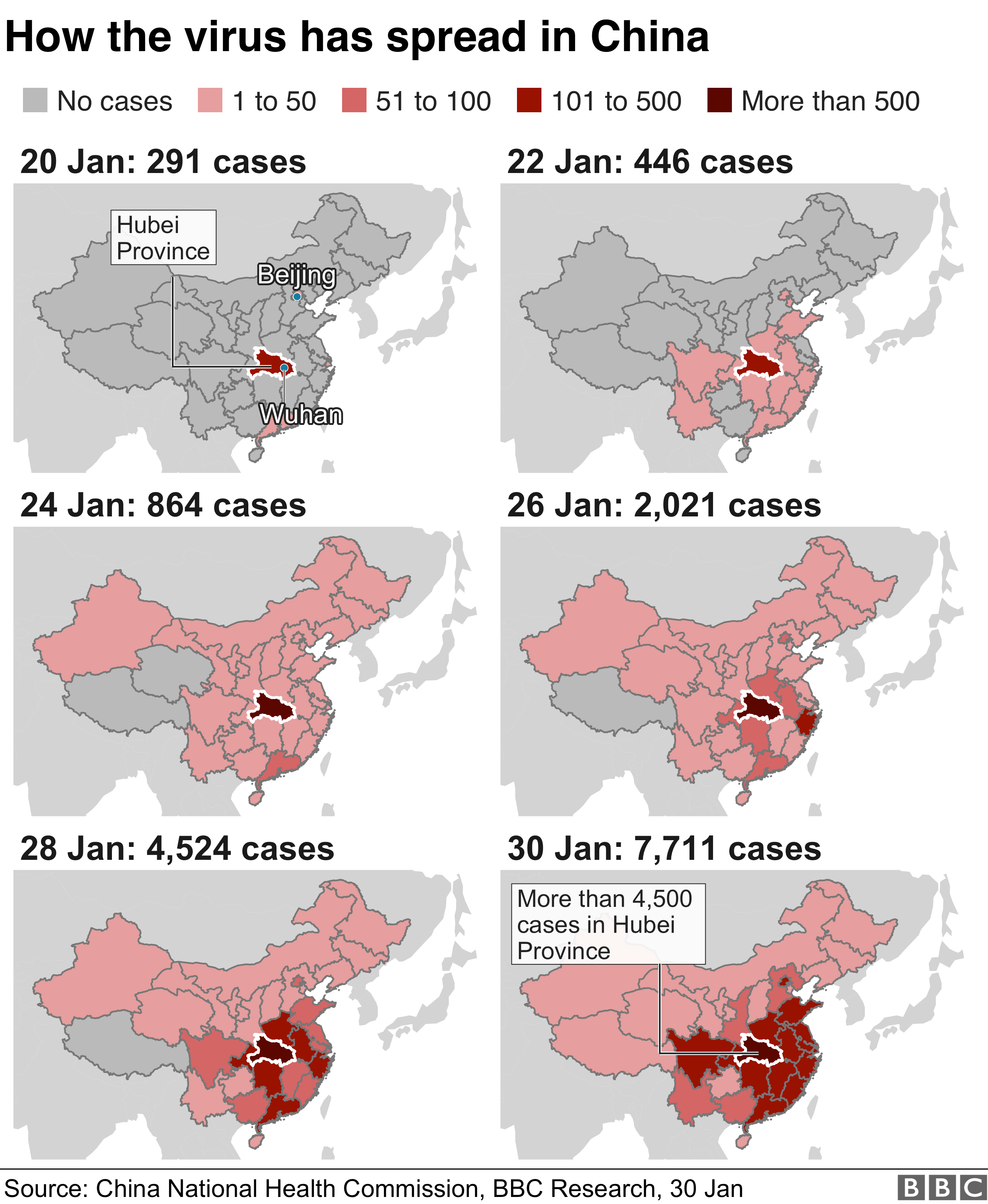
A confirmed case in Tibet means the virus has reached every region in mainland China. According to the country’s National Health Commission, 9,692 cases have tested positive.
The central province of Hubei, where nearly all deaths have occurred, is in a state of lockdown. The province of 60 million people is home to Wuhan, the heart of the outbreak.
The city has effectively been sealed off and China has put numerous transport restrictions in place to curb the spread of the virus.
People who have been in Hubei are also being told to work from home until it is considered safe for them to return.
The virus is affecting China’s economy, the world’s second-largest, with a growing number of countries advising their citizens to avoid all non-essential travel to the country.
How is the world responding?
Voluntary evacuations of hundreds of foreign nationals from Wuhan are under way.
The UK, Australia, South Korea, Singapore and New Zealand are expected to quarantine all evacuees for two weeks to monitor them for symptoms and avoid contagion.
Australia plans to quarantine its evacuees on Christmas Island, 2,000km (1,200 miles) from the mainland in a detention centre that has been used to house asylum seekers.
In other recent developments:
Italy suspended flights to China after two Chinese tourists in Rome were diagnosed with the virus; earlier 6,000 people on board a cruise ship were temporarily barred from disembarking
In the US, Chicago health officials have reported the first US case of human-to-human transmission. Around 200 US citizens have been flown out of Wuhan and are being isolated at a Californian military base for at least 72 hours
Russia has decided to close its 4,300km (2,670-mile) far-eastern border with China
Two flights to Japan have already landed in Tokyo. Japan has now raised its infectious disease advisory level for China
Some 250 French nationals have been evacuated from Wuhan
India has confirmed its first case of the virus – a student in the southern state of Kerala who was studying in Wuhan
Israel has barred all flight connections with China
Papua New Guinea has banned all visitors from “Asian ports”
will close its borders to all new visitors from mainland China, including foreigners who have been there within the past 14 days, becoming the first Southeast Asian country to do so in a bid to stem the spread of the deadly coronavirus
.
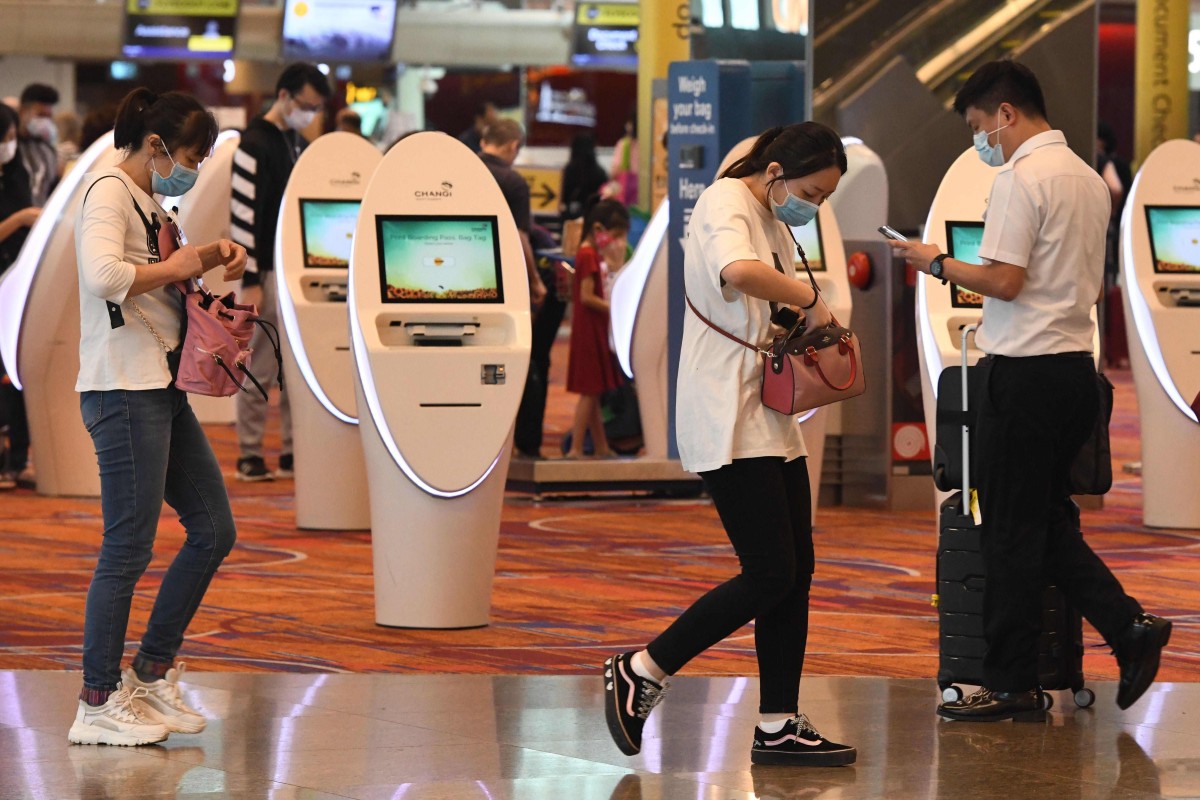
The island nation has China as one of its biggest trading partners and is a popular destination for Chinese tourists. Figures from the Singapore Tourism Board showed that 248,000 travellers from the mainland entered Singapore last November, while 3.42 million mainland Chinese tourists visited in 2018.
How Wuhan coronavirus spread anti-Chinese racism like a disease through Asia
30 Jan 2020
The visa suspension will come into effect immediately so travellers can be informed in advance, while the travel restriction will start at 11.59pm on Saturday.
As of Friday, Singapore has 13 confirmed cases of the novel coronavirus, all of whom are travellers from the Chinese city of Wuhan. Health authorities have stressed that there is no evidence of community spread within the city state as of now.
The coronavirus has infected almost 10,000 people around the world, killing 213. The World Health Organisation has declared the outbreak an international public health emergency.
The move is an escalation of Wednesday’s announcement that Singapore was stopping the entry of new travellers who had been to Hubei province, the epicentre of the outbreak. Wuhan is Hubei’s capital.
China coronavirus: Singapore’s seven habits for good hygiene
30 Jan 2020
Residents and citizens of Singapore who have been to China will be able to come into the city state, but will be subject to a 14-day leave of absence during which they are encouraged to stay at home.
The move to close its borders to Chinese visitors comes on the back of local authorities’ assessment that more people in other parts of China are and will be affected by the virus.
The Singapore government will on Saturday announce a fiscal package to help businesses and citizens during the crisis.
Coronavirus: global travel restrictions imposed on Chinese travellers
31 Jan 2020
National development minister Lawrence Wong, who co-chairs a multi-ministry task force to deal with the virus, said the outbreak had already impacted the economy and “will be going on for some time”.
Said Prime Minister Lee Hsien Loong: “It’s going to hurt us. China is a very big source of tourists for Singapore. [With the outbreak], that’s tailed off already considerably.”
Lee said tourism from other sources would also be affected as people took precautions, pinpointing the food and beverage, travel and hotel industries as those that were “bound to be significantly affected”.
“I expect the rest of the economy also to be affected because with China in semi-lockdown mode now, their economy is bound to slow down and our economy is quite tightly engaged with theirs, they are our biggest trading partner.”
has further bolstered its defence links with the United States with plans to build an F-16 fighter jet maintenance centre, as the Taipei government continues to resist Beijing’s objective of unification.
The self-ruled island’s Aerospace Industrial Development Corporation (AIDC) and US defence contractor Lockheed Martin signed a strategic partnership agreement on Tuesday that aimed to promote the establishment of an F-16 fighter jet maintenance centre in Taiwan, to be completed by 2023.
It is the latest of several significant agreements with the US during Donald Trump’s presidency. Trump approved a US$2.2 billion arms sale on July 8 that included 108 American-made M1A2T Abrams tanks and 250 Stinger missiles.
He was quicker to approve F-16 sales than his predecessors, agreeing in August to sell the island 66 F-16V jets, which will mean Taiwan owns the most F-16s in the Asia-Pacific region.
Trump also approved, in September last year, a US$330 million deal to provide spare parts and other logistics for several types of the island’s military aircraft – less than a year after the US agreed to sell US$1.4 billion of missiles, torpedoes and an early warning system to Taiwan.
Beijing views Taiwan as a breakaway province to be reunited with the mainland by force if necessary.
‘Fighter jets trump battle tanks’ in Taiwan’s US arms priorities
Collin Koh, a research fellow at the S. Rajaratnam School of International Studies with Nanyang Technological University in Singapore, said the planned maintenance centre underlined how Taiwan-US military ties had become stronger under the more enthusiastic US administration of Trump and the Taiwanese presidency of
“The [F-16 fighter jet maintenance] centre, by improving the availability and readiness of the F-16 fleet, allows Taiwan to sustain its combat aviation, not only for daily operation but also for training,” Koh said.
“This does represent a step up. Taiwan is no longer just an end-user operating the American hardware, but will also be empowered to service it. It is designed to help Taiwan achieve better defence self-sufficiency, one of the key pledges by the Tsai administration.”
Tang Shaocheng, a senior researcher in international relations at Taiwan’s National Cheng-chi University, said the increasingly close relations between Taipei and Washington made dealing with the island more tricky for Beijing.
Beijing ‘interferes daily’ in Taiwan’s election, says Tsai Ing-wen
“The Tsai administration cares about what the US thinks but not what Beijing thinks, paving the way for ever-closer ties,” Tang said. “That definitely leaves less room for Beijing to get Taipei into its orbit, by using various economic measures.”
Beijing has suspended exchanges with Taipei and staged a series of war games around Taiwan to intimidate the island since Tsai, of the independence-leaning Democratic Progressive Party, became president in 2016 and refused to accept its one-China policy.
Beijing has also tried to isolate Taiwan internationally by poaching its diplomatic allies
since Tsai took office, has repeatedly warned Washington against seeking closer military ties with Taipei, and has protested against every arms deal the two have made.
The US acknowledges the Chinese claim that it has sovereignty over Taiwan, which split from the mainland in 1949 and is self-governing. However, the US regards the status of Taiwan as unsettled and supports the island with arms sales and other measures, such as by sending warships through the Taiwan Strait that separates the island from China.
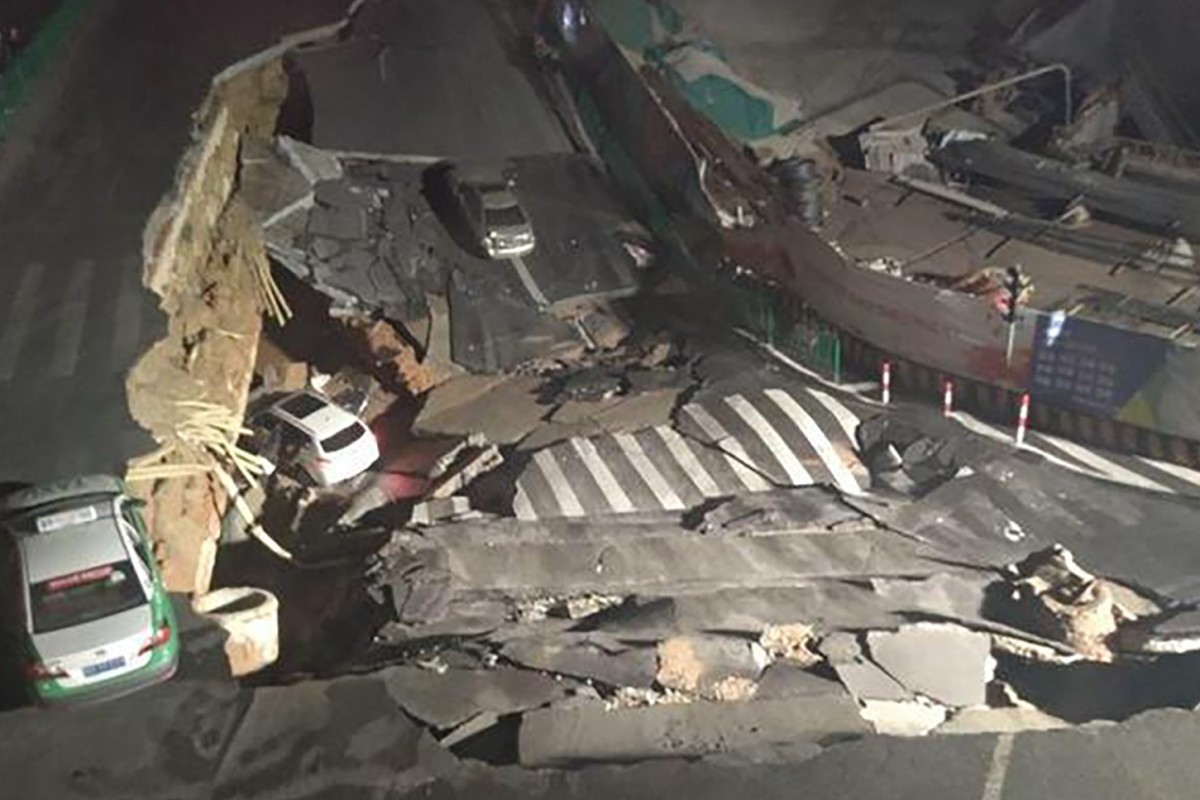
Sinkhole suddenly opened up near subway station in city of Xiamen but no one is killed or injured
Taxi driver whose vehicle was swallowed up says he and his passenger were able to pull themselves free unaided
The hole opened up at a site in Xiamen. Photo: Weibo
Two cars have been swallowed by a hole that opened up in the ground near a subway station in southeast China.
It is the latest of a string of ground collapses involving subway projects in mainland cities this year.
The 500 square metre hole opened up just before 10pm on Thursday near Lucuo station in Xiamen, a city in Fujian province.
The city’s subway operator said no one had died or been injured in the accident and the people in the two cars had been able to get out on their own.
The accident also caused water pipes to burst, flooding the station.
No injuries were reported after the incident. Photo: Weibo
The road and station were temporarily closed after the accident, but normal services resumed on Friday morning.
One of the cars swallowed was a taxi, and the driver told Beijing News he had been driving along the road when he suddenly found the vehicle falling into the hole.
The man, surnamed Chang, dragged his passenger free and they were able to climb out of the pit unaided. He said the car had not been seriously damaged.
Three people are still missing after a similar accident in the southern city of Guangzhou earlier this month that swallowed a truck and electric bike.
Five workers were also killed in the eastern port city of Qingdao in May in an accident at a subway construction site.
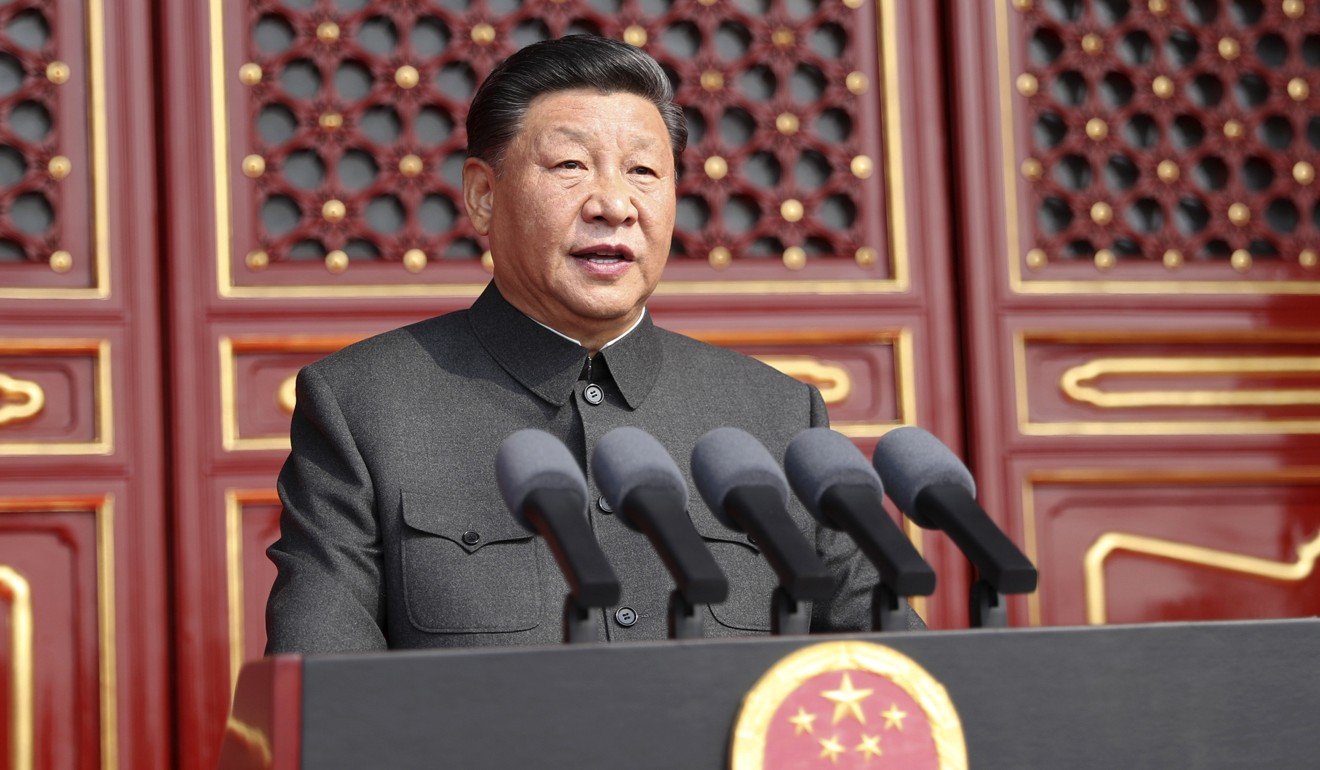
on Saturday reiterated his promise to keep opening up the nation’s markets to companies and investors from around the world.
“The door of China’s opening up will only open wider and wider, the business environment will only get better and better, and the opportunities for global multinational companies will only be more and more,” he said in a congratulatory letter read out by Vice-Premier Han Zheng at the inaugural Qingdao Multinationals Summit in the east China city.
The two-day event, which ends on Sunday, was organised by China’s commerce ministry and the provincial government of Shandong with the aim, according to its website, of giving multinational companies “the opportunity to articulate their business values and vision” and “promote cooperation with host countries”.
In his letter, Xi praised multinational companies for the role they had played in China’s opening up and reform over the past four decades, describing them as “important participants, witnesses and beneficiaries”.
China was willing to continue opening up to benefit not only itself but the world as a whole, he said.
“Only when the world is good, China is good. Only when China is good, can the world get better.”
Despite its upbeat tone, Xi’s message comes as Beijing is facing intense scrutiny from the international business community over its state-led economic model – one of the main bones of contention in its trade war with the US – and its attempts to prevent foreign firms from speaking out on issues it deems too sensitive, from Hong Kong to human rights.
Foreign firms have also long complained about the barriers they face when trying to access China’s markets and the privileged treatment it gives to state-owned enterprises. Even though Beijing has promised to reform its state sector, foreign businesses have complained of slow progress, and just last month the European Union Chamber of Commerce urged the EU to take more defensive measures against China’s “resurgent” state economy.
Xi promised “more and more” opportunities for global firms. Photo: AP
Sheman Lee, executive director of Forbes Global Media Holding and CEO of Forbes China, said at the Qingdao summit that foreign firms were facing a difficult trading environment in the world’s second-largest economy.
“Multinationals have seen their growth in China slow in recent years because of the growing challenge from local firms, a gradually saturating market and rising operation costs,” he said.
Craig Allen, president of the US-China Business Council, said that many multinational companies were reluctant to release their best products in China out of fear of losing their intellectual property.
China still not doing enough to woo foreign investment
In his letter, Xi said that over the next 15 years, the value of China’s annual imports of goods would rise beyond US$30 trillion, while the value of imported services would surpass US$10 trillion a year, creating major opportunities for multinational companies.
China would also reduce tariffs, remove non-tariff barriers and speed up procedures for customs clearance, he said.
Commerce Minister Zhong Shan said at the opening ceremony that China would also continue to improve market access and intellectual property protection.
The country supported economic globalisation and would safeguard the multilateral trade system, he said, adding that it was willing to work with the governments of other countries and multinational corporations to promote economic globalisation.
Xi Jinping says the value of China’s annual goods imports will rise beyond US$30 trillion over the next 15 years. Photo: Bloomberg
The promise to continue to open up China’s markets came after the State Council
– the nation’s cabinet – made exactly the same pledge at its weekly meeting on Wednesday.
After the latest round of trade war negotiations in Washington, Beijing said it had achieved “substantive progress” on intellectual property protection, trade cooperation and technology transfers, all of which have been major bones of contention for the United States.
Despite its pledge to welcome multinational companies into its market, China is in the process of creating a list of “unreliable foreign entities” it considers damaging to the interests of Chinese companies. The roster, which is expected to include FedEx, is seen as a response to a similar list produced earlier by the United States.
Xi’s gesture would also appear to have come too late for South Korean multinational
, which announced on October 4 it had ended the production of smartphones at its factory in Huizhou, Guangdong province – its last in China – with the loss of thousands of jobs.















 CHINDIA ALERT: You'll be living in their world, very soon