Chindia Alert: You’ll be Living in their World Very Soon
aims to alert you to the threats and opportunities that China and India present. China and India require serious attention; case of ‘hidden dragon and crouching tiger’.
Without this attention, governments, businesses and, indeed, individuals may find themselves at a great disadvantage sooner rather than later.
The POSTs (front webpages) are mainly 'cuttings' from reliable sources, updated continuously.
The PAGEs (see Tabs, above) attempt to make the information more meaningful by putting some structure to the information we have researched and assembled since 2006.
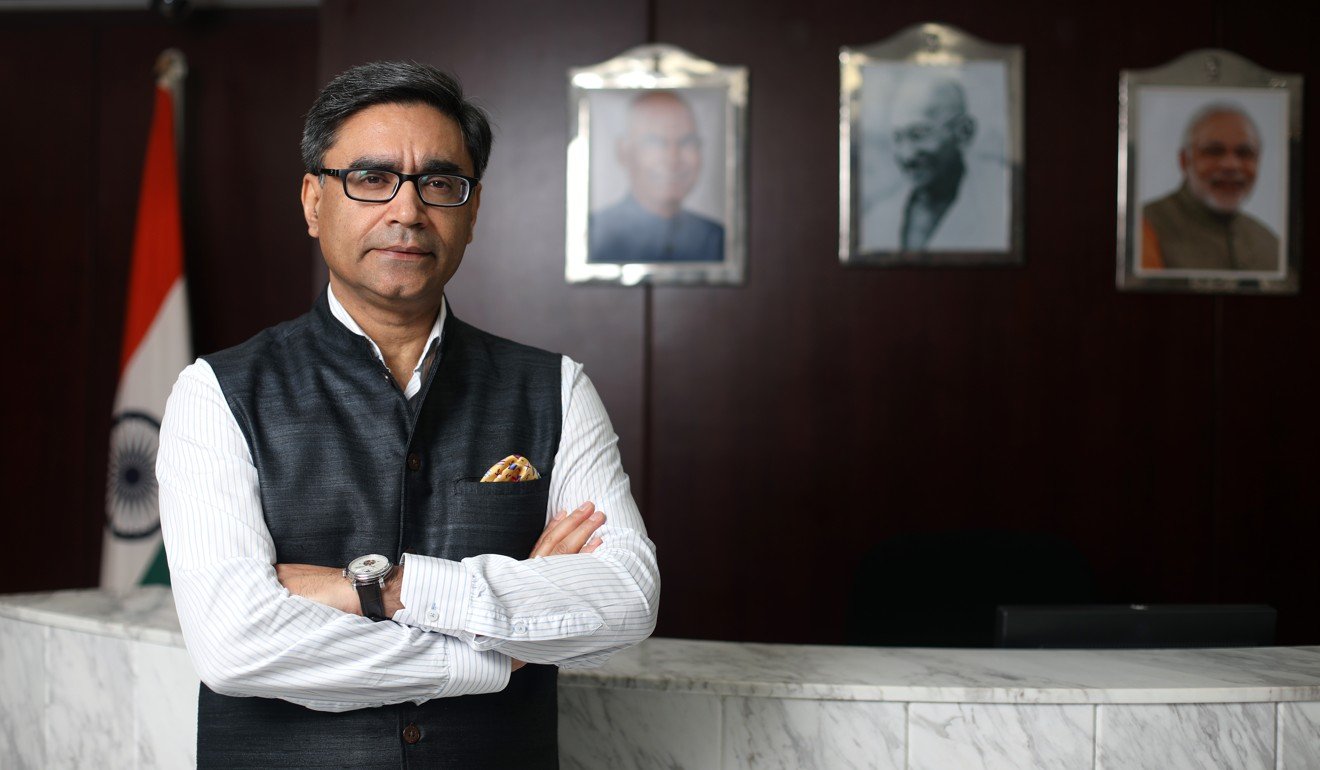
Ambassador to China Vikram Misri says they will be ‘meeting more and more in common waters’, and more exchanges are needed
He also says preparations are under way for President Xi Jinping to visit India
The INS Kolkata arrives in Qingdao for PLA Navy 70th anniversary celebrations in April.
The Indian ambassador called for more communication between the two navies. Photo: Reuters
The Chinese and Indian navies should establish communication because they are increasingly operating within close proximity, according to India’s ambassador to China.
While the two nations’ militaries communicated extensively, it was mainly between their land forces, and that should be extended to the navies and air forces, Vikram Misri said.
“We need to talk about the two air forces and the two navies – especially the two navies – because we are operating in the same waters and increasingly in the coming years, we will be meeting more and more in common waters,” Misri said.
“I think it is important for us to develop those levels of understanding and communication,” he said. “There are some [navy and air force] exchanges now, but not as well developed as in the case of the land force.”
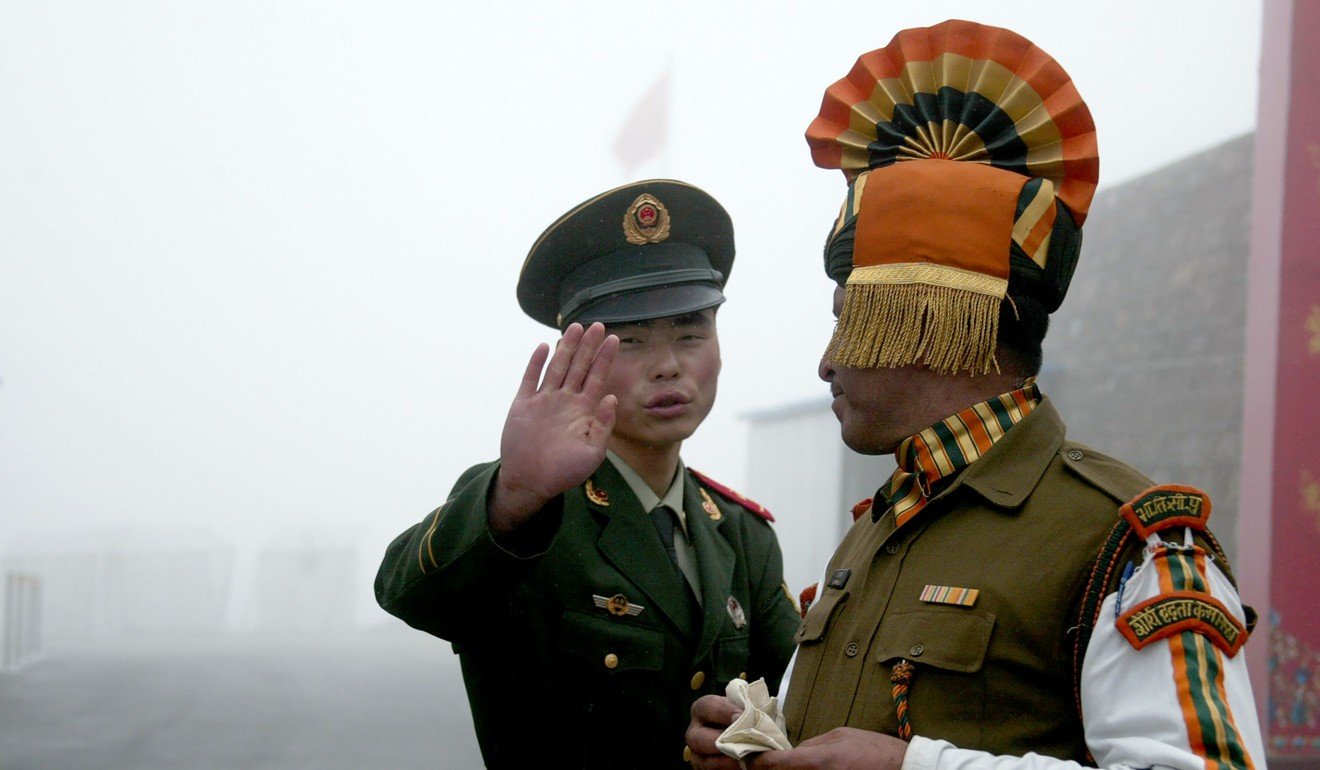
China and India have made efforts to repair their relations since a tense stand-off at the Doklam plateau two years ago, when communications between their forces along the border were seen as inadequate to contain the tension.
China and India have sought to repair relations after a tense stand-off at Doklam. Photo: AFP
Misri said the two nations had made incremental progress, and opened new points where “border personnel can meet and exchange information, or exchange views about any particular situation”.
The ambassador was visiting the Indian consulate in Hong Kong over the weekend, six months after taking up the post and six weeks after Prime Minister Narendra Modi was re-elected.
He said preparations were under way for Chinese President Xi Jinping to visit India, which was expected to happen in the fourth quarter, after they pledged earlier to strengthen cooperation.
have periodically flared along their 4,000km (2,485-mile) border, resulting in a brief war in 1962. Relations have also been strained by China’s ties with Pakistan, and India’s concern over China’s growing presence in the Indian Ocean.
India has also not signed on to China’s global trade and infrastructure strategy, the
, which has projects that run through the disputed Kashmir region.
“Our concerns with regards to this particular initiative are very clear, and we have continued to share them very, very frankly with our Chinese partners,” Misri said. “I think there is understanding on the part of our Chinese partners with regard to this.”
Indian ambassador to China Vikram Misri said New Delhi’s concerns on the Belt and Road Initiative were clear. Photo: Xiaomei Chen
But he said the two nations should not let their differences evolve into disputes, and they should focus on areas where they can cooperate.
One such area was maritime and investment cooperation in the Indo-Pacific region, including infrastructure and disaster response. The US in recent years has focused on the Indo-Pacific region, and has asked its allies to send naval vessels to the area as a counterbalance to Beijing.
“We have made the point that our vision of the Indo-Pacific is not a strategy, which sometimes is a concern on the part of some partners, aimed against any particular country,” Misri said. “It is definitely not a military alliance in any format.
“It is on the other hand a vision that aims at economic and development cooperation with our partners in the Indo-Pacific space,” he said, adding that India was discussing such cooperation with China.
He also said trilateral meetings between China, India and Russia would become more regular after their three leaders met on the sidelines of the
summit in Osaka, Japan last month, when they vowed to uphold multilateralism.
Those meetings would allow the nations to address challenges facing the international trading system and pushback against globalisation, but Misri said they should not be seen as a bid to counter the US, which is also involved in a trade battle with India.
India also had a trilateral meeting with Japan and the United States during the G20 summit.
“The fact that these countries seek us out also shows that they see value in engaging with India, and we have important issues to discuss in each of these settings,” he said. “None of our individual relationships is going to come at the cost of a relationship with any other partner.”
The ambassador said there could be a broader consensus on counterterrorism. Photo: AP
Misri also said there could be a broader consensus between China and India on counterterrorism. The two nations have clashed over Indian efforts to blacklist Masood Azhar, leader of the Pakistan-based terror group Jaish-e-Mohammed (JeM), at the United Nations, which China objected to for years – a move seen in India as being done at the behest of Islamabad.
Azhar was finally listed as a global terrorist by the UN in May, after JeM claimed responsibility for a deadly terror attack on Indian security forces in Pulwama in February, although the listing did not directly reference the attack.
“It could have happened earlier … but I’m glad that it did happen, and we hope to build on that – that should be taken as progress, and we hope to build on that in the coming years,” Misri said.
“Everybody is aware of the context in which the listing happened, and therefore, I don’t think it’s hidden from anybody as to what this was aimed at or who this was aimed at, or what the motivation for the action might have been.”
As for the tensions between India and Pakistan following the terror strike in Indian-controlled Kashmir, Misri said progress would be “largely dependent on Pakistan” and the actions it needed to take to address the “ecosystem of terror that prevails in different parts of that country”.
Vijay Keshav Gokhale is expected to meet Chinese deputy foreign minister Kong Xuanyou and Foreign Minister Wang Yi during two-day visit
Beijing’s refusal to sanction a Pakistani militant leader and its belt and road push in the disputed Kashmir region have strained ties
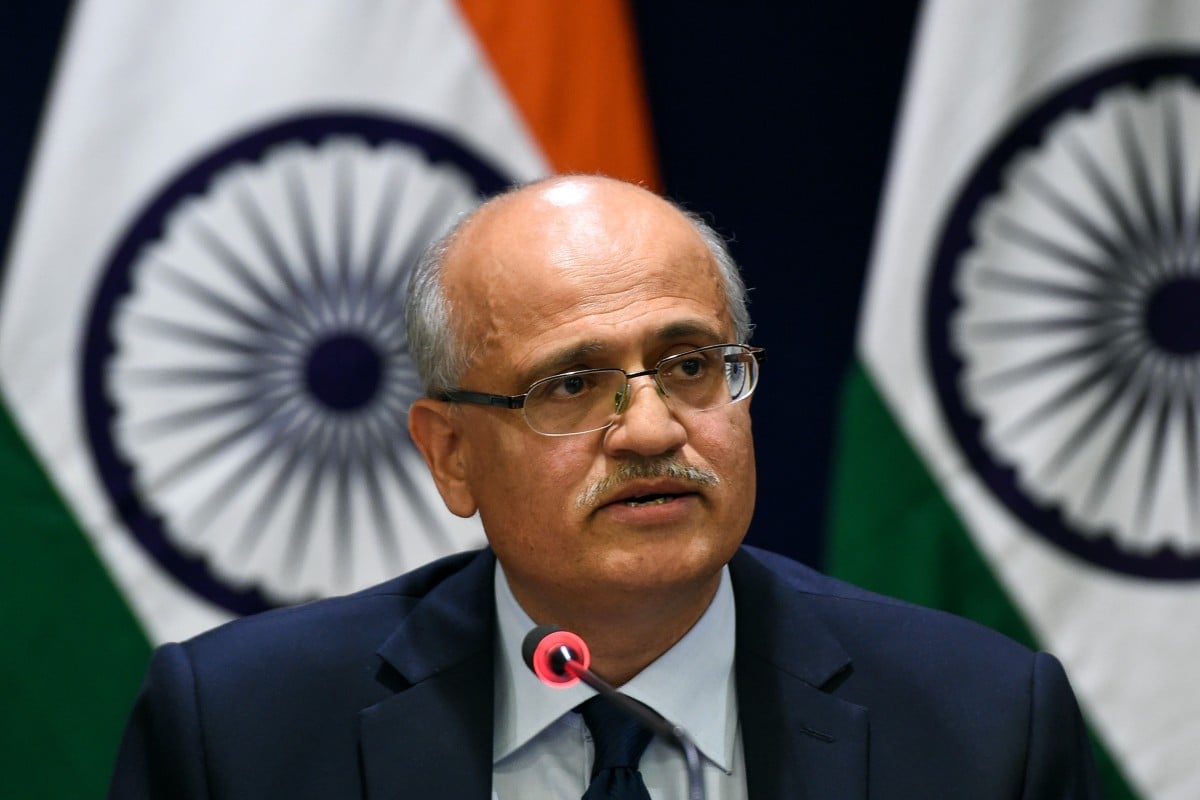
Indian Foreign Secretary Vijay Keshav Gokhale will visit China as part of “regular exchanges” between the two countries. Photo: AFP
Indian Foreign Secretary Vijay Keshav Gokhale will travel to Beijing on Sunday amid tensions between India and China over Beijing’s refusal to sanction a Pakistani militant leader and its infrastructure push in the disputed Kashmir region.
Gokhale’s two-day visit is part of “regular exchanges” between the two nations, the Indian embassy in Beijing said on Saturday.
During his stay, Gokhale is expected to meet Chinese deputy foreign minister Kong Xuanyou and Foreign Minister Wang Yi.
He will return to India on Monday, three days before the second Belt and Road Forum begins in the Chinese capital. Forty foreign leaders will attend the summit on Beijing’s global trade and infrastructure scheme, the “Belt and Road Initiative”, but India is not taking part.
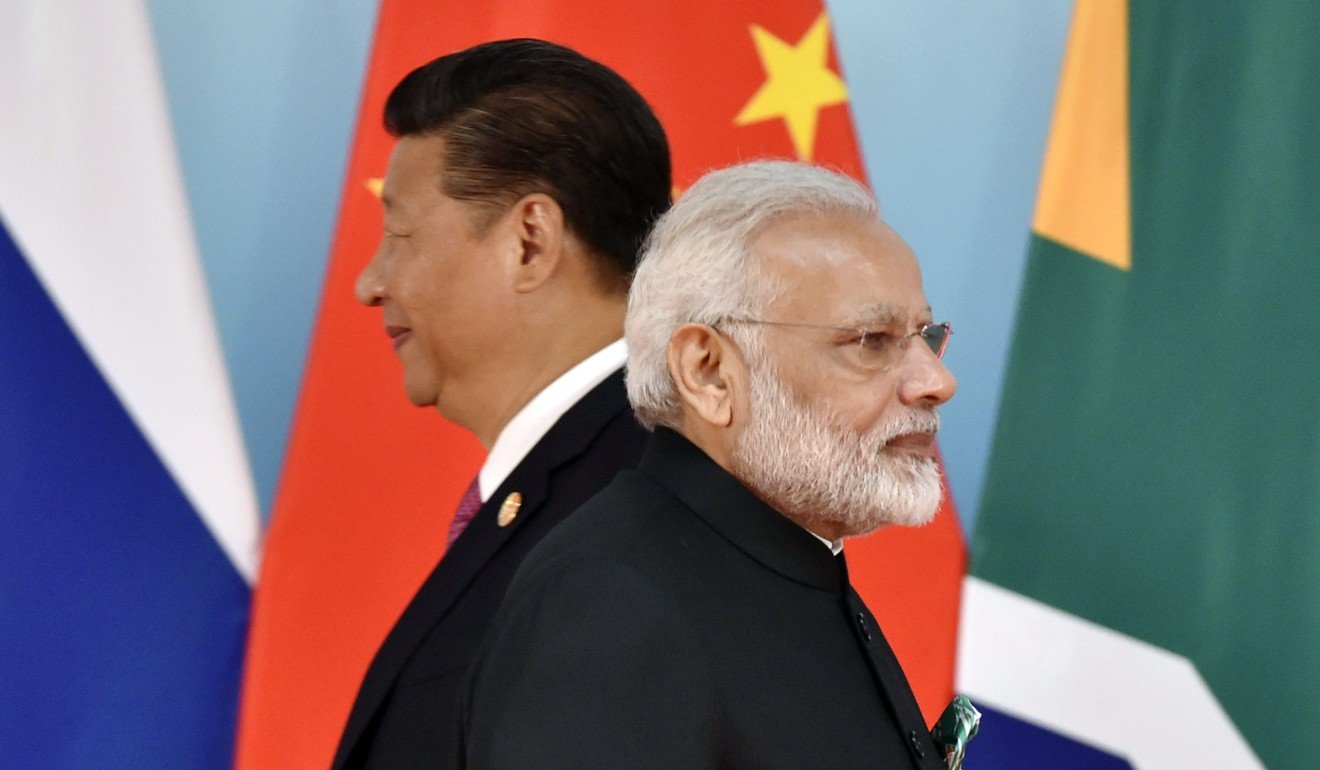
Wang on Friday called on India, and other countries sceptical of the initiative, to join up, dismissing claims that it is a geopolitical tool. He also said China was ready to hold a leaders’ summit with India like the informal meeting held between Chinese President Xi Jinping and Indian Prime Minister Narendra Modi in Wuhan, Hubei province last year.
A summit between Xi Jinping (left) and Narendra Modi in Wuhan last year was seen as a breakthrough in China-India relations after the Doklam border dispute. Photo: AFP
Gokhale visited Beijing in February last year, and the Wuhan summit happened two months later. That meeting was seen as a breakthrough in the
after a 73-day military stand-off over the Doklam plateau.
But the progress was overshadowed in February after a terror strike on Indian security forces in the Jammu and Kashmir province, which killed 40 Indian soldiers. The Pakistan-based Jaish-e-Mohammed group claimed responsibility for the attack. India has long wanted to designate its leader, Masood Azhar, as a terrorist under international law, but China has opposed the move.
During a visit to Pakistan in March, Kong said Beijing and Islamabad were all-weather strategic partners and would support each other on issues to do with their core interests.
What ‘Wuhan spirit’? Kashmir suicide attack reopens Modi’s China wound
Wang Dehua, head of the Institute for South and Central Asia Studies at the Shanghai Municipal Centre for International Studies, said China and India were looking to prevent their bilateral relations from deteriorating further.
“Both nations will elaborate on their stance on this matter, and China will probably deliver a message that the China-India relationship should not be affected by the dispute over Masood Azhar,” he said. “The positive sentiment out of Wuhan has been affected, and the two sides are seeking ways to continue the spirit of that informal summit.”
Du Youkang, director of Fudan University’s Pakistan Study Centre in Shanghai, said preparations for another informal summit of the nations’ leaders would only begin after India’s general election was over. Polling is being held in seven phases ending on May 19.
Gokhale’s trip would mainly be a chance to see how the two nations can push forward bilateral ties amid their disputes, Du said.
In addition to Azhar, India is also dismayed that some of China’s belt and road projects pass through the Pakistan-administered section of the disputed Kashmir region.
But Wang told reporters on Friday that the initiative did not target any third country, and that relations between China and India had improved after the Wuhan summit.
Beijing also rejected the report that the US, the UK and France asked China to lift the technical hold on Azhar by April 23, failing which they will move a formal resolution for discussion, vote and passage at the UN Security Council (UNSC).
WORLDUpdated: Apr 17, 2019 15:31 IST
Indo Asian News Service
Beijing
China on Wednesday said the issue of blacklisting Pakistan-based terrorist Masood Azhar at the UN panel was heading towards a settlement and asked the US not to force through its own resolution on the matter.(AP)
China on Wednesday said the issue of blacklisting Pakistan-based terrorist Masood Azhar at the UN panel was heading towards a settlement and asked the US not to force through its own resolution on the matter.
Beijing also rejected the report that the US, the UK and France asked China to lift the technical hold on Azhar by April 23, failing which they will move a formal resolution for discussion, vote and passage at the UN Security Council (UNSC).
“On the issue of the listing of Masood Azhar, China’s position remains unchanged. We are also having communication with relevant parties and the matter is moving towards the direction of settlement,” Chinese Foreign Ministry spokesperson Lu Kang said here.
Asked to elaborate further, Lu did not answer clearly.
“The matter is now moving in the direction of settlement. As to the specifics for the discussion in the 1267 committee, there are clear procedures and regulations regarding UNSC and its subsidiary bodies. We think members should follow and abide by such procedures.”
He was responding to a question whether anything was achieved after China claimed “positive progress” on the issue of declaring Azhar a terrorist.
China in the past has put four technical holds on the resolutions by India, the US, the UK and France to ban Azhar at the UN 1267 sanctions committee.
Beijing’s latest technical hold came last month after Azhar’s outfit claimed responsibility for the deadly attack in Jammu and Kashmir that killed 40 Indian military personnel in February.
This prompted the US to draft a new resolution and take it directly to the Security Council for an informal discussion. Beijing slammed the move, saying this will complicate matters when some progress has already been achieved.
Lu again reiterated it when asked if China will support such a resolution in the Security Council.
“Regarding what you said relevant parties are forcing a new resolution through the Security Council. We firmly oppose that. In relevant discussions, most members expressed that this issue should be discussed within the 1267 committee and they don’t hope to bypass the 1267 committee to handle the issue.
“We hope the relevant country can respect the opinions of most members of the Security Council to act in a cooperative manner and to help resolve this issue properly within the framework of the 1267 committee,” he added.
Asked if Beijing has been set a deadline of April 23 to lift the technical hold on resolution banning Azhar at the 1267 committee, Lu said: “I don’t know from where you get such information, but the Security Council and it’s subsidiary bodies like the 1267 committee, they have clear rules of procedures and you have to seek clarification from those sources.”
“China’s position is very clear. This issue should be resolved through cooperation and we don’t believe that any efforts without the consensus of most members will achieve satisfying results.”
India is optimistic that Azhar will be listed under the UN 1267 Sanctions Committee as New Delhi has the “strong support” of 14 members.
SNS Web | New Delhi | March 16, 2019 12:57 pm
Expressing disappointment with China blocking a bid to label Maulana Masood Azhar a global terrorist, India said on Saturday that it is continuing its work with the UN Security Council sanctions committee to get the Jaish-e-Mohammad (JeM) chief in the list.
“India continues to work with the UNSC’s sanction committee on listing of JeM chief Masood Azhar as a global terrorist,” PTI reported on Saturday quoting official sources.
India is optimistic that Azhar will be listed under the UN 1267 Sanctions Committee as New Delhi has the “strong support” of 14 members.
“Hold is not a block. We are optimistic (that Azhar will be listed). India will show patience as long as it takes. India has strong support of 14 members,” news agency ANI cited sources as saying.
The sources also said that China will have to resolve issues with Pakistan as Beijing is well aware that terrorism emanates and operates from Pakistan.
“China also knows terrorism is a challenge; they know it operates from Pakistan. Pakistan is spending diplomatic capital in defending indefensible,” the sources said.
China has adequate information that there are groups in Pakistan working against China, they said.
Calling Pakistan’s so-called actions against terrorism “cosmetic”, New Delhi said that US is supportive of India and has assured that Pakistan will take action.
The sources said that Washington has also taken note of New Delhi’s concerns over arms used.
“There are no takers in US to take Pak’s narrative that India is posing threat,” ANI reported quoting sources.
India also demanded that Pakistan can hand over Indians who are in India’s wanted list as well as international terror list such as Dawood Ibrahim and Sayeed Salahudeen.
China on Wednesday blocked the bid in the UN Security Council to designate Azhar a “global terrorist”. This was the fourth time Beijing placed a technical hold on the proposal.
The hold was placed for three months and China might put the issue on hold for another six months.
PARIS (Reuters) – France has decided to freeze the assets of Jaish-e-Mohammed (JeM) founder and leader Masood Azhar, the French government said on Friday.
A joint statement issued by the French interior ministry, finance ministry and foreign ministry added that France would discuss putting Masood Azhar on a European Union list of people suspected of being involved in terrorism.
Pakistan is under pressure from global powers to act against groups carrying out attacks in India, including Jaish-e-Mohammed, which claimed responsibility for a Feb. 14 attack in Kashmir that killed at least 40 Indian paramilitary police.
The bonhomie witnessed between India and China over the last one year after the informal summit between Prime Minister Narendra Modi and Chinese President Xi Jinping in Wuhan April last year has clearly evaporated following the Chinese action
Even as China asserted on Thursday that the ‘Wuhan Spirit’ was still on, there is a sense of betrayal in New Delhi over Beijing’s decision to stand by its ‘all-weather friend’ Pakistan by blocking the designation of JeM chief Masood Azhar as a global terrorist by the UN Security Council.
The bonhomie witnessed between India and China over the last one year after the informal summit between Prime Minister Narendra Modi and Chinese President Xi Jinping in Wuhan April last year has clearly evaporated following the Chinese action.
Amid the growing clamour in India for boycotting China after it used its veto power to block listing of Masood Azhar as a global terrorist, New Delhi has expressed disappointment over Beijing’s move while reaffirming its determination to pursue all avenues to bring the JeM chief to justice for terror attacks in different parts of India.
A number of reasons, including the significant role Pakistan plays in China’s ties with the Islamic world and Beijing’s anxiety over spill-over effect of a ban on Azhar in China’s own restive Muslim-dominated Xinjiang region, could have played a role in Beijing deciding to yet again stonewall any action by the UNSC against the JeM chief, observers say.
Despite its burgeoning trade relationship with India, China has never hidden the fact that it needed Pakistan more than any other country for achieving its geo-strategic goals in the region. Pakistan’s importance for China has increased manifold in recent years in view of the heavy economic and manpower investments it has made in the China-Pakistan Economic Corridor (CPEC) as part of President Xi’s signature Belt and Road Initiative (BRI).
Sources said it was quite clear to New Delhi over the past few days that China was adopting double standards in the global fight against terrorism only to shield Pakistan. China, they said, could no longer take shelter under ‘lame excuses’ like India had not provided any ‘updated material’ on Azhar’s terrorist activities in India which could compel Beijing to reconsider its position on the JeM chief.
Sources pointed out that India had submitted to China and other key nations ‘clinching and irrefutable’ evidence linking JeM to terror attacks in India, including the Pulwama attack. All other members of the UNSC, including those in the non-permanent category, solidly backed India’s effort to get the JeM chief banned but China put a spanner in their works yet again, they regretted.
The US, meanwhile, said responsible UNSC members might be forced to other actions at the Security Council if Beijing continued to block Masood’s designation.
China’s veto against banning Masood Azhar has once again highlighted the deep-rooted suspicion and mistrust between India and China on strategic issues, particularly the fight against terrorism. Despite pledging to work with India in combating terror, China has done precious little to assuage India’s concerns over terrorism emanating from Pakistan.
China has, in fact, praised Pakistan on many occasions for its role in the global war against terrorism. Beijing’s contention has been that Pakistan itself has been one of the main victims of terrorism and it must be supported in combating the menace.
There is also a feeling in Chinese circles that the situation in Jammu and Kashmir is the prime reason for terrorism in India. The argument being advanced by them is that while Kashmir is a disputed territory, Xinjiang is a province of China and, therefore, a comparison can not be drawn between the two regions.
Image copyrightGETTY IMAGESImage captionAn Indian man watches the news broadcasting images of the released Indian pilot
As tensions between India and Pakistan escalated following a deadly suicide attack last month, there was another battle being played out on the airwaves. Television stations in both countries were accused of sensationalism and partiality. But how far did they take it? The BBC’s Rajini Vaidyanathan in Delhi and Secunder Kermani in Islamabad take a look.
It was drama that was almost made for television.
The relationship between India and Pakistan – tense at the best of times – came to a head on 26 February when India announced it had launched airstrikes on militant camps in Pakistan’s Balakot region as “retaliation” for a suicide attack that had killed 40 troops in Indian-administered Kashmir almost two weeks earlier.
A day later, on 27 February, Pakistan shot down an Indian jet fighter and captured its pilot.
Abhinandan Varthaman was freed as a “peace gesture”, and Pakistan PM Imran Khan warned that neither country could afford a miscalculation, with a nuclear arsenal on each side.
Suddenly people were hooked, India’s TV journalists included.
Image copyrightAFPImage captionIndian PM Narendra Modi is accused of exploiting India-Pakistan hostilities for political gain
So were they more patriots than journalists?
Rajini Vaidyanathan: Indian television networks showed no restraint when it came to their breathless coverage of the story. Rolling news was at fever pitch.
The coverage often fell into jingoism and nationalism, with headlines such as “Pakistan teaches India a lesson”, “Dastardly Pakistan”, and “Stay Calm and Back India” prominently displayed on screens.
Some reporters and commentators called for India to use missiles and strike back. One reporter in south India hosted an entire segment dressed in combat fatigues, holding a toy gun.
And while I was reporting on the return of the Indian pilot at the international border between the two countries in the northern city of Amritsar, I saw a woman getting an Indian flag painted on her cheek. “I’m a journalist too,” she said, as she smiled at me in slight embarrassment.
Print journalist Salil Tripathi wrote a scathing critique of the way reporters in both India and Pakistan covered the events, arguing they had lost all sense of impartiality and perspective. “Not one of the fulminating television-news anchors exhibited the criticality demanded of their profession,” she said.
Media captionIndia and Pakistan’s ‘war-mongering’ media
Secunder Kermani: Shortly after shooting down at least one Indian plane last week, the Pakistani military held a press conference.
As it ended, the journalists there began chanting “Pakistan Zindabad” (Long Live Pakistan). It wasn’t the only example of “journalistic patriotism” during the recent crisis.
Two anchors from private channel 92 News donned military uniforms as they presented the news – though other Pakistani journalists criticised their decision.
But on the whole, while Indian TV presenters angrily demanded military action, journalists in Pakistan were more restrained, with many mocking what they called the “war mongering and hysteria” across the border.
In response to Indian media reports about farmers refusing to export tomatoes to Pakistan anymore for instance, one popular presenter tweeted about a “Tomatical strike” – a reference to Indian claims they carried out a “surgical strike” in 2016 during another period of conflict between the countries.
Media analyst Adnan Rehmat noted that while the Pakistani media did play a “peace monger as opposed to a warmonger” role, in doing so, it was following the lead of Pakistani officials who warned against the risks of escalation, which “served as a cue for the media.”
What were they reporting?
Rajini Vaidyanathan: As TV networks furiously broadcast bulletins from makeshift “war rooms” complete with virtual reality missiles, questions were raised not just about the reporters but what they were reporting.
Indian channels were quick to swallow the government version of events, rather than question or challenge it, said Shailaja Bajpai, media editor at The Print. “The media has stopped asking any kind of legitimate questions, by and large,” she said. “There’s no pretence of objectiveness.”
In recent years in fact, a handful of commentators have complained about the lack of critical questioning in the Indian media.
Image copyrightAFPImage captionIndians celebrated news of the strikes
“For some in the Indian press corps the very thought of challenging the ‘official version’ of events is the equivalent of being anti-national”, said Ms Bajpai. “We know there have been intelligence lapses but nobody is questioning that.”
Senior defence and science reporter Pallava Bagla agreed. “The first casualty in a war is always factual information. Sometimes nationalistic fervour can make facts fade away,” he said.
This critique isn’t unique to India, or even this period in time. During the 2003 Iraq war, western journalists embedded with their country’s militaries were also, on many occasions, simply reporting the official narrative.
Secunder Kermani: In Pakistan, both media and public reacted with scepticism to Indian claims about the damage caused by the airstrikes in Balakot, which India claimed killed a large number of Jaish-e-Mohammad (JeM) militants in a training camp.
Hamid Mir, one of the most influential TV anchors in the country travelled to the area and proclaimed, “We haven’t seen any such (militant) infrastructure… we haven’t seen any bodies, any funerals.”
“Actually,” he paused, “We have found one body… this crow.” The camera panned down to a dead crow, while Mr Mir asked viewers if the crow “looks like a terrorist or not?”
There seems to be no evidence to substantiate Indian claims that a militant training camp was hit, but other journalists working for international outlets, including the BBC, found evidence of a madrassa, linked to JeM, near the site.
Image copyrightPLANET LABS INC./HANDOUT VIA REUTERSImage captionThe satellite image shows a close-up of a madrassa near Balakot in Pakistan’s Khyber Paktunkhwa
A photo of a signpost giving directions to the madrassa even surfaced on social media. It described the madrassa as being “under the supervision of Masood Azhar”. Mr Azhar is the founder of JeM.
The signpost’s existence was confirmed by a BBC reporter and Al Jazeera, though by the time Reuters visited it had apparently been removed. Despite this, the madrassa and its links received little to no coverage in the Pakistani press.
Media analyst Adnan Rehmat told the BBC that “there was no emphasis on investigating independently or thoroughly enough” the status of the madrassa.
In Pakistan, reporting on alleged links between the intelligence services and militant groups is often seen as a “red line”. Journalists fear for their physical safety, whilst editors know their newspapers or TV channels could face severe pressure if they publish anything that could be construed as “anti-state”.
Who did it better: Khan or Modi?
Rajini Vaidyanathan: With a general election due in a few months, PM Narendra Modi continued with his campaign schedule, mentioning the crisis in some of his stump speeches. But he never directly addressed the ongoing tensions through an address to the nation or a press conference.
This was not a surprise. Mr Modi rarely holds news conference or gives interviews to the media. When news of the suicide attack broke, Mr Modi was criticised for continuing with a photo shoot.
Image copyrightAFPImage captionImran Khan was praised for his measured approach
The leader of the main opposition Congress party, Rahul Gandhi, dubbed him a “Prime Time Minister” claiming the PM had carried on filming for three hours. PM Modi has also been accused of managing his military response as a way to court votes.
At a campaign rally in his home state of Gujarat he seemed unflustered by his critics, quipping “they’re busy with strikes on Modi, and Modi is launching strikes on terror.”
Secunder Kermani: Imran Khan won praise even from many of his critics in Pakistan, for his measured approach to the conflict. In two appearances on state TV, and one in parliament, he appeared firm, but also called for dialogue with India.
His stance helped set the comparatively more measured tone for Pakistani media coverage.
Officials in Islamabad, buoyed by Mr Khan’s decision to release the captured Indian pilot, have portrayed themselves as the more responsible side, which made overtures for peace.
On Twitter, a hashtag calling for Mr Khan to be awarded a Nobel Peace Prize was trending for a while. But his lack of specific references to JeM, mean internationally there is likely to be scepticism, at least initially, about his claims that Pakistan will no longer tolerate militant groups targeting India.
The Prime Minister had earlier in the day chaired the Cabinet Committee on Security (CCS) after India carried out ‘non-military pre-emptive’ airstrikes targeting the JeM camp across the LoC.
Hours after India’s offensive on Pakistan-based terror camps across the LoC, Prime Minister Narendra Modi “assured that the country was in safe hands”.
“Today I assure the countrymen, the country is in safe hands,” PM Modi said while addressing a public rally in Rajasthan’s Churu.
“I pledge on this soil, I will not let the country die, I will not let the country stop, I will not let the country bend. It is my promise to Mother India, I will protect your honour,” he added.
Speaking on the One Rank One Pension (OROP), PM Modi said he was happy that the scheme had benefited over 20 lakh military families across the country including thousands of families of Churu and Rajasthan.
The Prime Minister had earlier in the day chaired the Cabinet Committee on Security (CCS) after India carried out “non-military pre-emptive” air strikes targeting the JeM camp across the LoC.
Foreign Secretary Vijay Gokhale addressing the media said India had received credible information on JeM attempting other attacks in the country and therefore a pre-emptive strike had become necessary.
He said the non-military pre-emptive action was targeted specifically at the JeM camp adding that the selection of the target was also conditioned to avoid civilian casualties.
In a 21-minute offensive, 12 Mirage 2000 jets carried out the strike at around 3.30 am and dropped 1000 Kg bombs on terror camps across LOC, completely destroying it.
The IAF jets struck terror camps and launch pads across the LoC in Balakot at around 3.45 am, Muzaffarabad at around 3.48 am and Chakoti at around 3.58 am.
The camp in Balakot was led by Maulana Yusuf Azhar alias Ustad Ghauri, brother-in-law of JeM Chief Masood Azhar. Yusuf Azhar was on the Interpol list and among the most wanted in India.
Following the airstrikes, many leaders including that of the opposition lauded the action of the IAF and praised the PM for giving a free hand to the security forces after the Pulwama terror attack.
Over 44 CRPF personnel were killed and many injured on February 14 in one of the deadliest terror strikes in Jammu-Kashmir when a Jaish-e-Mohammad (JeM) suicide bomber blew up an explosive-laden vehicle near their bus in Pulwama district.
At a public rally in Rajasthan, PM Modi said attacks on Kashmiri youths after Pulwama terror attack help the enemies of the country.
INDIAUpdated: Feb 23, 2019 19:11 IST
HT Correspondent
Hindustan Times, Tonk, Rajasthan
Prime Minister Narendra Modi addresses a public meeting, in Tonk in Rajasthan on Saturday. (PTI)
Prime Minister Narendra Modi on Saturday denounced reported attacks on Kashmiri youths in some parts of the country following Pulwama terror attack killing at least 40 soldiers on February 14. PM Modi said Kashmiri youths should not be targeted anywhere in the country.
Speaking at a public rally in Rajasthan’s Tonk, PM Modi said, “Our fight is against terror, the enemies of humanity… Our fight is for Kashmir not against Kashmir, not against Kashmiris.”
“What happened to Kashmiri youths in the last few days…It does not matter whether the incident was small or big, such things should not happen. Kashmiri youths are victims of terror. Every child of Kashmir is with India in our fight against terror,” said PM Modi.
Former Jammu and Kashmir Chief Minister and National Conference leader Omar Abdullah welcomed the statement of PM Modi. “Thank you @narendramodi Sahib. Aaj aap ne hamaray dil ki baat keh di (you said what I have in my heart),” wrote Abdullah on Twitter soon after the prime minister made the comment at his rally.
PM Modi referred to his congratulatory phone call to Pakistan Prime Minister Imran Khan, when he assumed office after the general elections in Pakistan last year. PM Modi said, “As per protocol, I telephoned Pakistan’s new prime minister. I told him we have fought for long. Let India and Pakistan together fight poverty and illiteracy.”
“Pakistan’s prime minister told me, ‘I am the son of a Pathan. I do what I say.’ It is time to test his words,” PM Modi said at his rally in Rajasthan.
The prime minister said incidents like these “give power to Bharat ke tukde honge gang” and their supporters. “It is the responsibility of every Indian to protect every laal (child) of Kashmir,” he said.
The prime minister served another warning to Kashmiri separatist leaders, many of whom were stripped of their security cover early this week. The Union home ministry had ordered to review the security provided by the government to the separatist leaders in the wake of Pulwama attack.
PM Modi said, “Action has been taken against separatists and more action will be taken against such people…We can’t keep silent, we know how to crush terror.”
‘Trust Modi Sarkar’
Asserting that the government has moved swiftly to “avenge” Pulwama terror attack, PM Modi said all the major institutions of the world have condemned “the terror attack that was engineered at Pulwama”.
“I am proud that our security forces sent the perpetrators (of Pulwama attack) within 100 hours to where they belong,” he said referring to encounter in Pulwama a day after the terror attack on Jammu-Srinagar highway, where a CRPF convoy carrying more than 2,500 jawans was targeted by a suicide bomber.
“Trust the brave soldiers of the country and trust the Modi government…This time, everyone will be taken to justice and complete justice will be served,” said PM Modi adding, “Your pradhan sevak is busy finishing terror…If I am destined to put locks to the factory of terror, so be it.”
He also talked about the steps, the government has taken to put pressure on Pakistan following Pulwama attack. He said, “Pakistan is being accounted for everything that they have done. There is anxiety in Pakistan due to the steps we have taken after the terror attack.”
A day after Pulwama terror attack, the government decided at a meeting of the Cabinet Committee on Security (CCS) to withdraw the most favoured nation (MFN) status granted to Pakistan in 1996. The government also hiked tariff on goods to be imported from Pakistan by 200 per cent.
The external affairs ministry reached out to more than a dozen countries to corner Pakistan, which denied its hand behind the terror attack in Jammu and Kashmir despite Jaish-e-Mohammed, a terror group based out of that country, claimed responsibility for the attack on CRPF jawans.
On Thursday, the United Nations Security Council (UNSC) passed a resolution condemning Pulwama terror attack. The UNSC named Jaish-e-Mohammed in its statement. The UNSC resolution was unanimously approved by all members including China, which has been shielding Jaish-e-Mohammed chief Masood Azhar from being declared as global terrorist by the top UN body.
In the latter half of his public speech, PM Modi sounded poll bugle throwing what appeared as an election slogan, “Modi hai to mumkin hai” (it is possible if Modi is there). He said, “People have faith in the current government because of the work done in last four years. Modi hai to mumkin hai.”
He listed out achievements of his government and talked about schemes such health insurance, One-Rank-One-Pension and electrification among others repeating the same slogan at the end. He also accused the Congress of misleading the people of Rajasthan in last year’s assembly election by making farm loan waiver promise.
Pakistan Prime Minister Imran Khan on Tuesday said if there is any evidence of involvement of any Pakistani national in Pulwama terror attack, his government will act against the culprits. (AP)
Pakistan Prime Minister Imran Khan has denied his country’s role behind the Pulwama terror attack, the worst in Jammu and Kashmir in decades. He claimed that India does not have any evidence to prove Pakistan’s role in terror attacks in Kashmir.
“You (India) have blamed the Pakistan government without any evidence…If you have any evidence, we will act,” Imran Khan said.
He said, “It is in our interest that nobody from our soil spreads violence. I want to tell Indian government that we will take action if evidence is found against anyone from Pakistan.”
“What has Pakistan to gain from this? Why will Pakistan do this at a stage when it is moving towards stability,” said Imran Khan adding that “this is a Naya Pakistan with a new mindset.”
Calling for a dialogue with India, he said, “If you thinks you will attack us and we will not think of retaliating…We will retaliate. We all know starting a war is in the hands of humans, where it will lead us only God knows. This issue should be solved through dialogue.”
Imran Khan’s reaction comes days after at least 40 CRPF jawans were killed in a terror attack in Jammu and Kashmir. Pakistan-backed terror outfit Jaish-e-Mohammad claimed responsibility for the attack.
Earlier, Pakistan sought an urgent intervention of UN Secretary-General in defusing tensions with India and help facilitate dialogue between the two countries.
Following the terror attack, India launched a diplomatic offensive against Pakistan with the ministry of external affairs reaching out to more than two dozen countries including P5 – the US, the UK, France, Russia and China, which has repeatedly blocked India’s bid to get Jaish-e-Mohammad chief Masood Azhar declared as global terrorist by the United Nations.
China has used veto to shield Masood Azhar. Pakistan has also denied its support to the terror group. On Monday, in a joint statement Imran Khan and Saudi Arabia’s prince Mohammed bin Sultan “underlined the need for avoiding politicisation of UN listing regime.” This is being viewed as a snub to India’s renewed efforts to isolate Pakistan over its continued support to terror outfits and corner Masood Azhar’s JeM.
India withdrew the most favoured nation (MFN) status accorded to Pakistan in 1996. The MFN status had not been revoked even during the 1999 Kargil War and in the aftermath of 2008 Mumbai terror attack that killed more than 160 people.





 CHINDIA ALERT: You'll be living in their world, very soon
India and Pakistan: How the war was fought in TV studios
As tensions between India and Pakistan escalated following a deadly suicide attack last month, there was another battle being played out on the airwaves. Television stations in both countries were accused of sensationalism and partiality. But how far did they take it? The BBC’s Rajini Vaidyanathan in Delhi and Secunder Kermani in Islamabad take a look.
It was drama that was almost made for television.
The relationship between India and Pakistan – tense at the best of times – came to a head on 26 February when India announced it had launched airstrikes on militant camps in Pakistan’s Balakot region as “retaliation” for a suicide attack that had killed 40 troops in Indian-administered Kashmir almost two weeks earlier.
A day later, on 27 February, Pakistan shot down an Indian jet fighter and captured its pilot.
Abhinandan Varthaman was freed as a “peace gesture”, and Pakistan PM Imran Khan warned that neither country could afford a miscalculation, with a nuclear arsenal on each side.
Suddenly people were hooked, India’s TV journalists included.
So were they more patriots than journalists?
Rajini Vaidyanathan: Indian television networks showed no restraint when it came to their breathless coverage of the story. Rolling news was at fever pitch.
The coverage often fell into jingoism and nationalism, with headlines such as “Pakistan teaches India a lesson”, “Dastardly Pakistan”, and “Stay Calm and Back India” prominently displayed on screens.
Some reporters and commentators called for India to use missiles and strike back. One reporter in south India hosted an entire segment dressed in combat fatigues, holding a toy gun.
And while I was reporting on the return of the Indian pilot at the international border between the two countries in the northern city of Amritsar, I saw a woman getting an Indian flag painted on her cheek. “I’m a journalist too,” she said, as she smiled at me in slight embarrassment.
Print journalist Salil Tripathi wrote a scathing critique of the way reporters in both India and Pakistan covered the events, arguing they had lost all sense of impartiality and perspective. “Not one of the fulminating television-news anchors exhibited the criticality demanded of their profession,” she said.
Secunder Kermani: Shortly after shooting down at least one Indian plane last week, the Pakistani military held a press conference.
As it ended, the journalists there began chanting “Pakistan Zindabad” (Long Live Pakistan). It wasn’t the only example of “journalistic patriotism” during the recent crisis.
Two anchors from private channel 92 News donned military uniforms as they presented the news – though other Pakistani journalists criticised their decision.
But on the whole, while Indian TV presenters angrily demanded military action, journalists in Pakistan were more restrained, with many mocking what they called the “war mongering and hysteria” across the border.
In response to Indian media reports about farmers refusing to export tomatoes to Pakistan anymore for instance, one popular presenter tweeted about a “Tomatical strike” – a reference to Indian claims they carried out a “surgical strike” in 2016 during another period of conflict between the countries.
Media analyst Adnan Rehmat noted that while the Pakistani media did play a “peace monger as opposed to a warmonger” role, in doing so, it was following the lead of Pakistani officials who warned against the risks of escalation, which “served as a cue for the media.”
What were they reporting?
Rajini Vaidyanathan: As TV networks furiously broadcast bulletins from makeshift “war rooms” complete with virtual reality missiles, questions were raised not just about the reporters but what they were reporting.
Indian channels were quick to swallow the government version of events, rather than question or challenge it, said Shailaja Bajpai, media editor at The Print. “The media has stopped asking any kind of legitimate questions, by and large,” she said. “There’s no pretence of objectiveness.”
In recent years in fact, a handful of commentators have complained about the lack of critical questioning in the Indian media.
“For some in the Indian press corps the very thought of challenging the ‘official version’ of events is the equivalent of being anti-national”, said Ms Bajpai. “We know there have been intelligence lapses but nobody is questioning that.”
Senior defence and science reporter Pallava Bagla agreed. “The first casualty in a war is always factual information. Sometimes nationalistic fervour can make facts fade away,” he said.
This critique isn’t unique to India, or even this period in time. During the 2003 Iraq war, western journalists embedded with their country’s militaries were also, on many occasions, simply reporting the official narrative.
Secunder Kermani: In Pakistan, both media and public reacted with scepticism to Indian claims about the damage caused by the airstrikes in Balakot, which India claimed killed a large number of Jaish-e-Mohammad (JeM) militants in a training camp.
Hamid Mir, one of the most influential TV anchors in the country travelled to the area and proclaimed, “We haven’t seen any such (militant) infrastructure… we haven’t seen any bodies, any funerals.”
“Actually,” he paused, “We have found one body… this crow.” The camera panned down to a dead crow, while Mr Mir asked viewers if the crow “looks like a terrorist or not?”
There seems to be no evidence to substantiate Indian claims that a militant training camp was hit, but other journalists working for international outlets, including the BBC, found evidence of a madrassa, linked to JeM, near the site.
A photo of a signpost giving directions to the madrassa even surfaced on social media. It described the madrassa as being “under the supervision of Masood Azhar”. Mr Azhar is the founder of JeM.
The signpost’s existence was confirmed by a BBC reporter and Al Jazeera, though by the time Reuters visited it had apparently been removed. Despite this, the madrassa and its links received little to no coverage in the Pakistani press.
Media analyst Adnan Rehmat told the BBC that “there was no emphasis on investigating independently or thoroughly enough” the status of the madrassa.
In Pakistan, reporting on alleged links between the intelligence services and militant groups is often seen as a “red line”. Journalists fear for their physical safety, whilst editors know their newspapers or TV channels could face severe pressure if they publish anything that could be construed as “anti-state”.
Who did it better: Khan or Modi?
Rajini Vaidyanathan: With a general election due in a few months, PM Narendra Modi continued with his campaign schedule, mentioning the crisis in some of his stump speeches. But he never directly addressed the ongoing tensions through an address to the nation or a press conference.
This was not a surprise. Mr Modi rarely holds news conference or gives interviews to the media. When news of the suicide attack broke, Mr Modi was criticised for continuing with a photo shoot.
The leader of the main opposition Congress party, Rahul Gandhi, dubbed him a “Prime Time Minister” claiming the PM had carried on filming for three hours. PM Modi has also been accused of managing his military response as a way to court votes.
At a campaign rally in his home state of Gujarat he seemed unflustered by his critics, quipping “they’re busy with strikes on Modi, and Modi is launching strikes on terror.”
Secunder Kermani: Imran Khan won praise even from many of his critics in Pakistan, for his measured approach to the conflict. In two appearances on state TV, and one in parliament, he appeared firm, but also called for dialogue with India.
His stance helped set the comparatively more measured tone for Pakistani media coverage.
Officials in Islamabad, buoyed by Mr Khan’s decision to release the captured Indian pilot, have portrayed themselves as the more responsible side, which made overtures for peace.
On Twitter, a hashtag calling for Mr Khan to be awarded a Nobel Peace Prize was trending for a while. But his lack of specific references to JeM, mean internationally there is likely to be scepticism, at least initially, about his claims that Pakistan will no longer tolerate militant groups targeting India.
Source: The BBC
Posted in Adnan Rehmat, airstrikes, airwaves, Al Jazeera, Balakot, BBC, BBC reporter, campaign schedule, casualty, combat fatigues, commentators, congress party, critical questioning, Dastardly Pakistan, Delhi, escalation, factual information, fought, general election, Hamid Mir, hashtag, Imran Khan, India alert, Indian jet fighter, international border, Islamabad, Islamist militant groups, Jaish-e-Mohammad (JeM), JeM, jingoism and nationalism, Journalist, Kashmir, madrassa, Masood Azhar, Media analyst, media editor, militant camps, militants, missiles, nationalistic fervour, Nobel Peace Prize, Pakistan, Pakistani, Pakistani military, Pallava Bagla, pilot, PM Narendra Modi, press, press conference, Prime Time Minister, rahul gandhi, Rajini Vaidyanathan, red line, retaliation, Reuters, Salil Tripathi, Secunder Kermani, Senior defence and science reporter, sensationalism and partiality, Shailaja Bajpai, signpost's, suicide attack, Surgical strike, The Print, Tomatical strike, toy gun, training camp, TV anchors, TV journalists, TV studios, Twitter, Uncategorized, war, war mongering and hysteria, warmonger, Wg Cdr Abhinandan Varthaman | Leave a Comment »