Chindia Alert: You’ll be Living in their World Very Soon
aims to alert you to the threats and opportunities that China and India present. China and India require serious attention; case of ‘hidden dragon and crouching tiger’.
Without this attention, governments, businesses and, indeed, individuals may find themselves at a great disadvantage sooner rather than later.
The POSTs (front webpages) are mainly 'cuttings' from reliable sources, updated continuously.
The PAGEs (see Tabs, above) attempt to make the information more meaningful by putting some structure to the information we have researched and assembled since 2006.
People work at a construction site of a utility tunnel in Wuhan, central China’s Hubei Province, April 30, 2020. (Xinhua/Xiao Yijiu)
BEIJING, May 1 (Xinhua) — China is getting the world’s largest workforce back to work as the nationwide battle against COVID-19 has secured major strategic achievements.
The unprecedented fight has nurtured new trends in the workplace. For example, more attention is being paid to public health and e-commerce to boost consumption and emerging sectors brought by new applications based on the country’s rapid new infrastructure development of 5G networks and data centers.
In this aerial photo taken on April 29, 2020, representatives of frontline health workers fighting COVID-19 attend a bell-ringing ceremony at the Yellow Crane Tower, or Huanghelou, a landmark in Wuhan, central China’s Hubei Province. (Xinhua/Xiao Yijiu)
ANGELS OF PUBLIC HEALTH
Ye Man, head nurse of gastrointestinal department of Hubei General Hospital East District, one of the five remaining COVID-19 designated hospitals in Wuhan, is taking her first weeklong vacation since January.
The 34-year-old mother of two started to take a week off on Monday, one day after her hospital cleared all remaining confirmed COVID-19 patients. The nine ICU wards in her hospital had been kept occupied over the past several months.
Friday marked International Workers’ Day, and the start of China’s five-day public holiday. Ye said she planned to visit urban parks with her family during the holiday.
At her busiest point, she and her colleagues took care of a ward filled with 40 COVID-19 patients.
“It was a really tough time,” she recalled. She had to wear a protective gown and a mask for nine hours a day and be separated from her family to avoid possible cross-infections.
Wuhan, capital of central China’s Hubei Province and once hard hit by COVID-19, cleared all confirmed cases in hospitals on April 26. Over 42,000 medical workers mobilized nationwide to aid Hubei have contributed to achieving a decisive outcome in the fight to defend Hubei and Wuhan.
In an inspection tour to Wuhan on March 10, President Xi Jinping, also general secretary of the Communist Party of China Central Committee and chairman of the Central Military Commission, lauded medical workers as “the most beautiful angels” and “messengers of light and hope.”
To reward brave and dedicated medics, major tourist sites in Hubei are offering free entry to medical staff over the following two years.
Chinese President Xi Jinping, also general secretary of the Communist Party of China Central Committee and chairman of the Central Military Commission, learns about development of the black fungus industry in Jinmi Village of Xiaoling Township in Zhashui County, Shangluo City, northwest China’s Shaanxi Province, April 20, 2020. (Xinhua/Xie Huanchi)
LIVESTREAMING ANCHORS
“We have a new batch of supplies today. Those who did not get the goods should hurry to buy now,” said Li Xuying, a livestreaming anchorwoman selling agaric mushrooms in Zhashui, a small county deep in the Qinling Mountains in northwest China’s Shaanxi Province.
Li has been prepared for a boom of online shopping in the holiday, because online buyers rushed to her livestreaming website to place orders, after Xi inspected the county and chatted with her in the village of Jinmi during a recent tour to Shaanxi.
“I used to sell goods worth about 50,000 yuan (7,070 U.S. dollars) on average after a six-hour livestreaming session. Now the sales are 10 times that,” she said.
Li was one of the 10 sales staff sent by the local agricultural e-commerce firm to Chinese e-commerce platform Taobao’s headquarters for livestreaming training. She said livestreaming is effective in bridging buyers and farmers, through which viewers can watch planting and harvesting online.
With the number of netizens in China reaching 904 million in March, e-commerce has been one of the popular means of promoting the sale of farm produce and helping farmers shake off poverty. Despite the impact of COVID-19, the country is determined to eradicate absolute poverty by the end of this year.
Workers work at the construction site of a 5G base station at Chongqing Hi-tech Zone in Chongqing, southwest China, April 15, 2020. (Xinhua/Wang Quanchao)
HI-TECH WORKERS IN “NEW INFRASTRUCTURE” BUILDING
As an elasticity calculation engineer of Alibaba Cloud, Zhao Kun and his colleagues always stay on alert for high data flow, for example, brought by the anticipated online shopping spike during the holiday.
“The profession, which may sound obscure, is actually closely connected to everyone’s life, as cloud computing is the infrastructure supporting high-tech applications of artificial intelligence and blockchain,” said Zhao.
The Chinese leadership has underscored expediting “new infrastructure” development to boost industrial and consumption upgrading and catalyze new growth drivers.
Seizing the opportunities of industrial digitization and digital industrialization, China needs to expedite the construction of “new infrastructure” projects such as 5G networks and data centers, and deploy strategic emerging sectors and industries of the future including the digital economy, life health services and new materials, President Xi has said.
During the epidemic, Zhao and his colleagues expanded more than 100,000 cloud servers to ensure the stable operation of “cloud classrooms” and “cloud offices” for millions of people working and studying from home.
In the “new infrastructure” building, people like Zhao contribute to constructing the virtual infrastructure of an ecosystem, which enables e-commerce, e-payment, online teaching and the digital transformation of manufacturing and supply chain management.
In early April, China released a plan on promoting the transformation of enterprises toward digitalization and intelligence by further expanding the application of cloud and data technologies, to nurture new business models of the digital economy.
SYDNEY (Reuters) – The Australian government said on Friday it would meet a week ahead of schedule to decide whether to ease social distancing restrictions, as the numbers of new coronavirus infections dwindle and pressure mounts for business and schools to reopen.
Australia has reported about 6,700 cases of the new coronavirus and 93 deaths, well below the levels reported in the United States and Europe. Growth in new infections has slowed to less 0.5% a day, compared to 25% a month ago.
Prime Minister Scott Morrison said it was imperative to lift social distancing restrictions as early as possible as 1.5 million people were now on unemployment benefits and the government forecast the unemployment rate to top 10% within months.
“We need to restart our economy, we need to restart our society. We can’t keep Australia under the doona,” Morrison said, using an Australian word for quilt.
Morrison’s government has pledged spending of more than 10% of GDP to boost the economy but the central bank still warns the country is heading for its worst contraction since the 1930s.
With less than 20 new coronavirus cases discovered each day, Morrison said state and territory lawmakers would meet on May 8 – a week earlier than expected – to determine whether to lift restrictions.
“Australians deserve an early mark for the work that they have done,” Morrison told reporters in Canberra.
Australia attributes its success in slowing the spread of COVID-19 to social distancing restrictions imposed in April, including the forced closures of pubs, restaurants and limiting the size of indoor and outdoor gatherings.
Morrison said 3.5 million people had downloaded an app on their smartphones designed to help medics trace people potentially exposed to the virus, though the government is hoping for about 40% of the country’s 25.7 million population to sign up to ensure it is effective.
Cabinet will also decide next week how to restart sport across the country, the prime minister said.
The government says any resumption of sport should not compromise the public health, and recommends a staggered start beginning with small groups that play non-contact contact sport outdoors.
The recommendations suggests Australia’s National Rugby League (NRL) competition may not get permission to restart its competition as soon as many in the sports-mad country would like.
Zeng Zhenguo (L), a member of the medical assistance team supporting the virus-hit Wuhan in Hubei Province, hugs his wife after 14-day quarantine at the Xianghu area of the First Affiliated Hospital of Nanchang University in Nanchang, east China’s Jiangxi Province, April 15, 2020. The 141 members of the medical assistance team reunited with their families on Wednesday after 14-day quarantine. (Xinhua/Wan Xiang)
Min Yuting (C), a member of the national emergency medical rescue team from Shaanxi Province, weeps at the Shaanxi Provincial People’s Hospital in Xi’an, northwest China’s Shaanxi Province, April 1, 2020. As one of the 43 members of the national emergency medical rescue team from Shaanxi Province, Min and her colleagues finished a 14-day quarantine on Wednesday after their return from virus-hit Hubei. The team, dispatched by Shaanxi Provincial People’s Hospital, has worked in two temporary hospitals together with colleagues from Wuhan City and Henan Province, managed 988 beds and treated 1,235 patients since their arrival in Wuhan on Feb. 4. (Xinhua/Li Yibo)
A man shows a welcome cardboard written to his girlfriend, one of the medics supporting virus-hit Hubei Province, in Lanzhou, northwest China’s Gansu Province, March 22, 2020. The third batch of medical assistance team supporting Hubei from Gansu, which consists of 147 members, returned home on Sunday as the epidemic situation in Hubei has been greatly eased. (Xinhua/Du Zheyu)
Media caption Americans are taken from the docked ship to Haneda airport in Tokyo
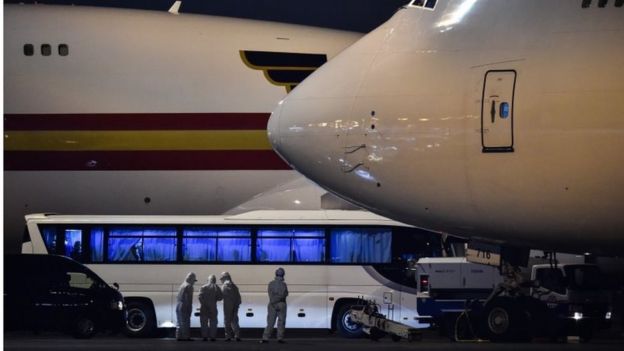
Two planes carrying hundreds of US citizens from a coronavirus-hit cruise ship have left Japan, officials say.
One plane has landed at a US Air Force air base in California, and its passengers will be isolated at military facilities for 14 days.
There were some 400 Americans on board the Diamond Princess. The ship with some 3,700 passengers and crew has been in quarantine since 3 February.
Meanwhile, China reported a total of 2,048 new cases on Monday.
Of those new cases, 1,933 were from Hubei province, the epicentre of the outbreak.
More than 70,500 people across China have been infected by the virus. In Hubei alone, the official number of cases stands at 58,182, with 1,692 deaths. Most new cases and deaths have been reported in Wuhan, Hubei’s largest city.
In other developments:
In Japan, a public gathering to celebrate the birthday of new Emperor Naruhito later this week has been cancelled, due to concerns over the spread of the virus while organisers of the Tokyo marathon due to take place on 1 March are considering whether to cancel the amateur part of the race, reports say
In China, the National People’s Congress standing committee said it would meet next week to discuss a delay of this year’s Congress – the Communist Party’s most important annual gathering – because of the outbreak
At the weekend, an American woman tested positive for the virus in Malaysia after leaving a cruise liner docked off the coast of Cambodia
A Russian court has ordered a woman who escaped from a quarantine facility to go back and stay there until she is confirmed to be disease-free, Fontanka news agency reports. Alla Ilyina has until Wednesday to return
What’s happening on the Diamond Princess?
The cruise ship was put in quarantine in Japan’s port of Yokohama after a man who disembarked in Hong Kong was found to have the virus.
On Monday, Japanese officials said there were 99 new cases of infections on board the ship, bringing the total to 454 confirmed cases. It is the largest cluster of cases outside China.
A Russian woman who was on board and tested positive is thought to be the first Russian national to contract the virus after the two previous cases found in Russia were Chinese nationals, Reuters news agency reports.
She will be taken to a hospital for treatment, the Russian embassy in Japan said.
At least 40 US citizens who were on board are infected and will be treated in Japan, Dr Anthony Fauci, Director of the National Institute of Allergy and Infectious Diseases told US broadcaster CBS.
Image copyright AFPImage caption Those bound for the US left from Tokyo’s Haneda Airport
The two aircraft chartered by the US government left Tokyo’s Haneda Airport in the early hours of Monday. The second flight was due to land at another base in Texas.
More than 300 passengers are being repatriated voluntarily, the US state department said. Fourteen of them were reported during transit to have tested positive for the virus and were being kept separate from the other passengers, it said.
we would like to just finish the quarantine on the ship as planned, decompress in a non-quarantine environment in Japan for a few days, then fly back to the U.S. pursuant to our own arrangements. What’s wrong with that?
The smartphones were distributed so people could use an app, created by Japan’s health ministry, which links users with doctors, pharmacists and mental health counsellors. Phones registered outside of Japan are unable to access the app.
Other evacuation flights have been arranged to repatriate residents of Israel, Hong Kong and Canada. On Monday, Australia announced that it would evacuate 200 of its citizens too.
What is happening in China?
According to official figures for 16 February, 100 people died from the virus in Hubei, down from 139 on Saturday.
The Chinese authorities are tightening curbs on movement to combat the outbreak. People in Hubei province, which has 60 million people, have been ordered to stay at home, though they will be allowed to leave in an emergency.
In addition, a single person from each household will be allowed to leave the building or compound they live in every three days to buy food and essential items.
On housing estates, one entrance will be kept open. It will be guarded to ensure that only residents can enter or leave.
All businesses will stay closed, except chemists, hotels, food shops and medical services.
“The effects of epidemic prevention and control in various parts of the country can already be seen.”
The proportion of infected patients considered to be in a “serious condition” has dropped nationwide from more than 15% to just over 7%, according to China’s State Council.
Taiwan has reported a death from the illness – a taxi driver, 61, who had not travelled abroad recently but had diabetes and hepatitis B, Health Minister Chen Shih-chung said.
The minister said many of his passengers had come from China.
Outside China, there have been more than 500 cases in nearly 30 countries. Four others have died outside mainland China – in France, Hong Kong, the Philippines and Japan.
Meanwhile, a plane carrying 175 evacuated Nepalis, mostly students, has arrived in Kathmandu from Wuhan.
The measures China has taken to stop the spread of the coronavirus are starting to have an impact, Mi Feng, a spokesman at the National Health Commission, said on Sunday.
In other developments:
The number of people who have tested positive on the Diamond Princess cruise ship, which is being held in quarantine in Japan, has risen to 355. The US and Canada are sending planes to evacuate their citizens
A Chinese tourist has died in France – the first fatality outside Asia
An 83-year-old American woman has tested positive after disembarking another cruise ship that was turned away by a number of countries before being allowed to dock in Cambodia
In the UK, all but one of nine people being treated have been discharged from hospital
On Saturday, World Health Organization (WHO) head Tedros Adhanom Ghebreyesus praised Beijing’s response to the outbreak.
“China has bought the world time. We don’t know how much time,” he said. “We’re encouraged that outside China, we have not yet seen widespread community transmission.”
How is China coping?
Tens of millions of Chinese still face heavy restrictions on their day-to-day life as part of the government’s efforts to halt the spread of the disease, which causes a disease named Covid-19.
Much of the response has focused on the hard-hit province of Hubei and its capital Wuhan, where the outbreak began. The city is all but sealed off from the rest of the country.
Foreign Minister Wang Yi said that along with a drop in infections within Hubei there had also been a rapid increase in the number of people who had recovered.
China’s central bank will also disinfect and store used banknotes before recirculating them in a bid to stop the virus spreading.
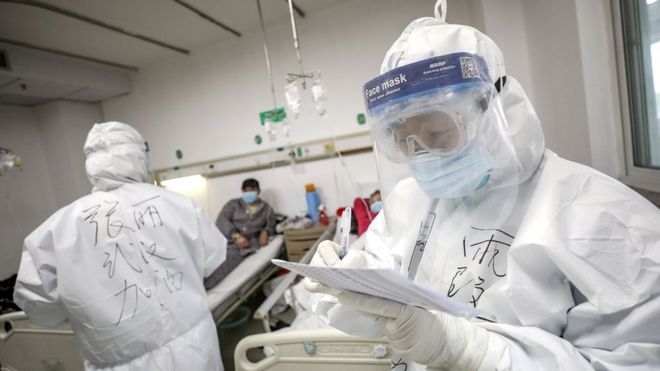
Media caption Medics in Wuhan resort to shaving their heads in a bid to prevent cross-infection of the coronavirus
In another development Chinese state media published a speech from earlier this month in which Chinese President Xi Jinping said he said he had given instructions on 7 January on containing the outbreak.
At the time, local officials in the city of Wuhan were downplaying the severity of the epidemic.
This would suggest senior leaders were aware of the potential dangers of the virus before the information was made public.
With the government facing criticism for its handling of the outbreak, analysts suggest the disclosure is an attempt to show the party leadership acted decisively from the start.
Military medics arrive at Tianhe International Airport in Wuhan, central China’s Hubei Province, Feb. 13, 2020. Ordered by the Central Military Commission, 11 transport aircraft of the People’s Liberation Army Air Force Thursday sent medics and supplies provided by the armed forces to virus-hit Wuhan, capital of Hubei Province. This was the first time for China’s domestically developed large transport aircraft Y-20 to take part in non-military action. It was also the first time for the Air Force to send large and medium transport aircraft on active service to carry out urgent air transport tasks on a large scale. (Xinhua/Li Yun)
WUHAN, Feb. 13 (Xinhua) — Ordered by the Central Military Commission, 11 transport aircraft of the People’s Liberation Army Air Force Thursday sent medics and supplies provided by the armed forces to virus-hit Wuhan, capital of Hubei Province.
This was the first time for China’s domestically developed large transport aircraft Y-20 to take part in non-military action. It was also the first time for the Air Force to send large and medium transport aircraft on active service to carry out urgent air transport tasks on a large scale.
The participation of the Y-20 in this task is an actual test to the strategic delivery capabilities of the Air Force, said Du Baolin, commander of a division in the Air Force that was equipped with the Y-20.
The Y-20 can carry out long-distance air transport tasks under complex meteorological conditions.
Since the outbreak of the COVID-19, the Air Force has sent several batches of medics and supplies to virus-hit areas. Its troops stationed in Hubei, the epicenter of the outbreak, have also taken part in transporting medical equipment and daily necessities.


 Min Yuting (C), a member of the national emergency medical rescue team from Shaanxi Province, weeps at the Shaanxi Provincial People’s Hospital in Xi’an, northwest China’s Shaanxi Province, April 1, 2020. As one of the 43 members of the national emergency medical rescue team from Shaanxi Province, Min and her colleagues finished a 14-day quarantine on Wednesday after their return from virus-hit Hubei. The team, dispatched by Shaanxi Provincial People’s Hospital, has worked in two temporary hospitals together with colleagues from Wuhan City and Henan Province, managed 988 beds and treated 1,235 patients since their arrival in Wuhan on Feb. 4. (Xinhua/Li Yibo)




 CHINDIA ALERT: You'll be living in their world, very soon