07/10/2019
NANCHANG, Oct. 6 (Xinhua) — Unlike most of his peers with an unquenchable thirst for urban life, Zhou Jing, a 23-year-old farmer painter, has a special affinity for the golden paddy fields of his hometown.
Zhou, who lives in a small town of Lichuan County, east China’s Jiangxi Province, would drive a tractor on the bumpy country road to the fields every morning, and pack up the paddies in gunny bags with his father.
With a paintbrush in hand and a paintbox on his desk, he was busy coloring a nearly finished oil painting of a bumper autumn harvest in the glow of several groggy light bulbs.
Painting in his small studio fills a pleasant hour after a day’s farm work for the young farmer who has studied painting for seven years. The scratch of paintbrushes is euphonic to his ear.
Although he chose farm work over further study or migrant work after graduating from middle school in 2012, Zhou later signed up to learn to paint at a local industrial park specialized in oil painting.
“I was hesitant, but I knew I should make a living by myself as soon as possible,” he said.
Yet his early paintings were no more than simple compositions of colored blocks, since the young man was not professionally trained. Zhou worked hard and continued to draw long after his classes had ended.
Years of practice did indeed make perfect. Zhou gradually developed his own painting style, as well as the unity of colors. He was finally recognized and started his new career as a registered painter at the industrial park in April.
Life in the countryside is improving as unremitting efforts have been made by the Chinese government to increase support for agriculture, rural areas and farmers. In Lichuan, with a population of less than 300,000, oil wall paintings by the farmers can be found everywhere.
Lichuan was selected as the “Hometown of Chinese Folk Culture and Art” for its oil painting industry in January, with the industrial park’s annual output reaching 300 million yuan (about 41.9 million U.S. dollars). More than 1,000 farmer artists have been trained, increasing their annual income by over 10,000 yuan.
“When I was little I used to envy those who ate chicken drumsticks, food that for me existed only on my drawing paper,” Zhou said. “I had long dreamed of being able to live such a life, and now those dreams have become a reality.”
Source: Xinhua
Posted in bumper autumn harvest, Bumper harvest, bumpy country road, canvas, ear, euphonic, further study, graduating, Hometown of Chinese Folk Culture and Art, Jiangxi Province, Lichuan County, local industrial park, middle school, migrant work, paintbox on his desk, paintbrush in hand, paintbrushes, scratch, specialized, tractor, Uncategorized, young farmer |
Leave a Comment »
18/09/2019
- Video of staff washing tableware with laundry detergent goes viral
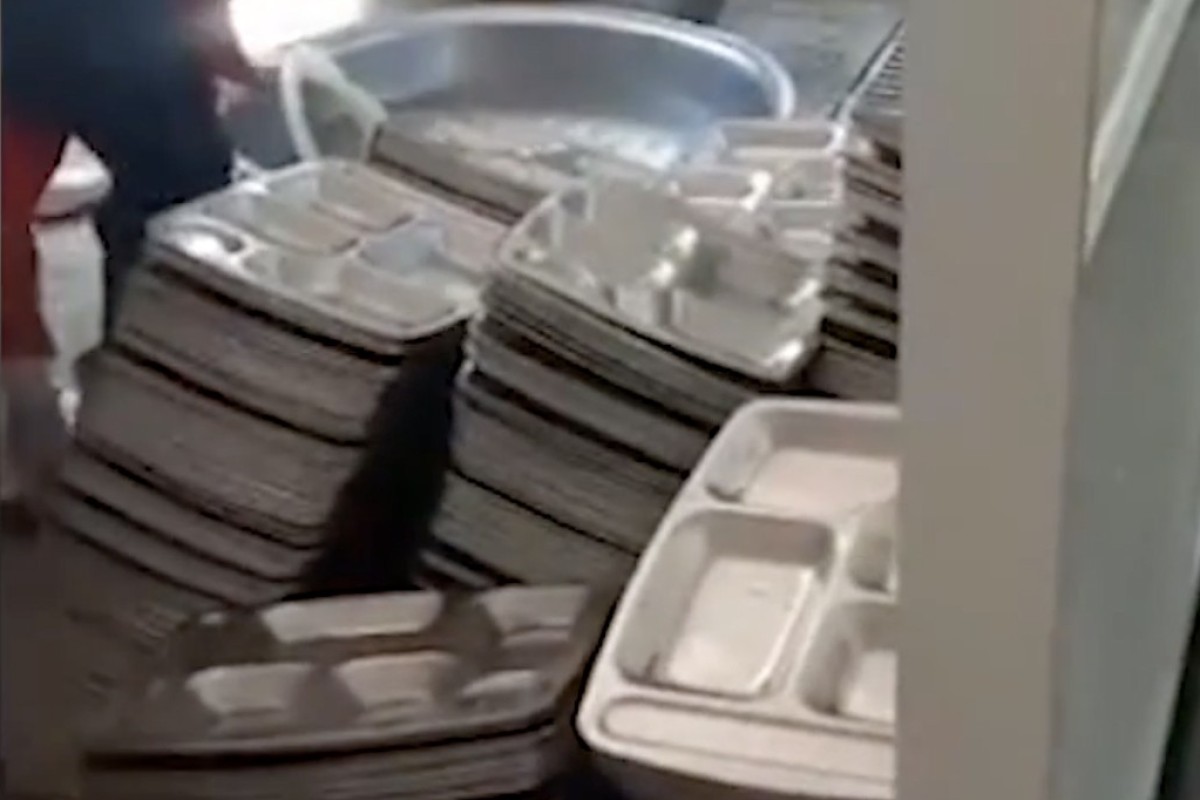
A primary school principal has been sacked after it emerged laundry detergent was used in the canteen to wash tableware. Photo: Thepaper.cn
The head of a primary school in northeastern China has been sacked and a government investigation is underway into the use of laundry washing powder to clean tableware in the school canteen.
The scandal came to light when a video of canteen staff washing up at Dongfeng Primary School in Zuanghe, Liaoning province, went viral on Chinese social media.
The video shows staff, wearing white uniforms and aprons, cleaning plates and bowls in basins containing water tainted with laundry detergent. It is unclear when the incident happened.
In a statement on Weibo, China’s version of Twitter, on Tuesday, the municipal government said the head of the school had been dismissed and representatives had been assigned by the authorities to take charge of the school’s daily operation. Due diligence investigations of the relevant department would begin “immediately”, the statement said.
Chinese school heads told to eat with pupils after string of scandals
The local administration for market regulation had also been ordered to speed up an examination of the food samples, tableware and washing products at the school, and the results would be made public in a timely manner, the authorities said.
Until the investigation is concluded, meals at the school, which has about 400 pupils, will be the responsibility of the municipal education department.
As an added precaution, food safety inspections would be carried out at all elementary and middle schools in the region.
The prompt action by the authorities reflects the wide public attention in China to any food safety scandal which involves children.
The principal of an international school in Shanghai was dismissed in October after parents of students found mouldy tomatoes and onions in a kitchen where food was prepared for pupils. In May, video footage showing mouldy food in the canteen of a middle school in Chengdu, Sichuan province, triggered angry parents to stage protests outside the school and the local government building.
Source: SCMP
Posted in angry parents, Building, canteen, Chengdu, Chinese, cleaning plates and bowls, Dongfeng Primary School, Food, head teacher, international school, kitchen, laundry detergent, Liaoning province, Local government, middle school, mouldy tomatoes and onions, municipal government, primary school principal, principal, pupils, sacked, scandal, Shanghai, sichuan province, staff, stage protests, Twitter, Uncategorized, video, viral, washing tableware, washing up, Weibo, white uniforms and aprons, Zuanghe |
Leave a Comment »
10/09/2019
- Expensive presents are officially discouraged but have become the norm at many schools on day of appreciation for educators
Students at Yangzhou Technical Vocational College form the Chinese characters for “Hello Teacher” to mark China’s Teachers’ Day. Photo: Handout
Despite a decade of official discouragement, parents in China have been struggling with one of the biggest dilemmas of the school year – how to mark the country’s annual Teacher’s Day.
Ellen Yuan agonised for a day and a night before sending her son off to kindergarten on Tuesday with a 1,000 yuan (US$140) gift card in his bag for the teacher.
It was the boy’s second week of attendance and Yuan had given no thought to any Teacher’s Day obligations –until she learned that several of her friends had been busy over the weekend preparing gifts for their children’s teachers.
“It makes me feel that I am being a drag on my son if I don’t do so,” said Yuan, who works for a foreign company in Shanghai.
Respecting teachers has traditionally been a fundamental social norm in China but gift giving on the special day for educators has gone beyond an expression of appreciation by their students, as parents have taken over with ever more expensive gifts – and sometimes cash – which they hope will mean their kids are well taken care of while at school.
What gift, how expensive it should be, and how to deliver it have become the biggest questions for many parents in the run-up to September 10 each year, even though the education ministry and its subordinate bodies have repeatedly issued directives over the past decade to ban teachers accepting gifts.
Yuan said one of her friends had bought a body care set worth more than 600 yuan for each of her child’s three teachers, another had bought an 800 yuan gift card, while a third had given the head teacher a 1,000 yuan bottle of perfume.
Some parents had delivered the presents directly to the school, while others had asked their children to take the gifts to their teachers. Yuan’s plan was to message the teacher and tell her to take the gift card from her son’s bag.
“I know it’s bad. I don’t want my kid to know that,” Yuan said.
Hundreds of teachers protest in China over poor pay
The question of whether parents should give gifts on Teacher’s Day was one of the hottest topics on Weibo, China’s Twitter-like social media platform, attracting more than 15 million views as of Tuesday afternoon.
“Of course we should not, but I don’t dare to ignore it,” one user said, winning more than 10,000 likes.
Chu Zhaohui, a researcher at the National Institute of Education Sciences, said the gift-giving trend had been partly driven by a “keeping up with the Joneses” mentality.
“Everybody has given a gift. Would my child be specially treated if I don’t? This is a common concern,” Chu said. As a result, the purpose of gift giving on Teacher’s Day had become about protecting the children’s interests instead of a sincere expression of gratitude, he said.
But not every teacher gets presents – with gifts usually reserved for those teaching the “main subjects” of mathematics, Chinese and English, which count the most in high school and college entrance examinations.
Emily Shen, an English teacher from a middle school in Hangzhou, in the eastern province of Zhejiang, said she also prepared gifts for the teachers of her two kids. “Some chocolate for them to take to school. And I myself would give a gift card to each of those who teach the main subjects,” she said.
Zhuang Ke, a music teacher at a primary school in Jiaxing, also in Zhejiang province, admitted she was embarrassed by the parents’ different treatment of teachers of “less important” subjects like her’s. “It’s always nice to receive presents. But teachers who teach music, art and PE are often forgotten,” she said.
Chinese kindergarten teacher fired for hot sun punishment
State broadcaster CCTV said in a commentary on its website on Sunday that “all forms of behavior that attempt to ruin normal teaching order and interfere in equality by sending gifts should be resolutely abandoned”. A similar message was run by a series of official media outlets at local level.
“The most fundamental way to stop parents from sending gifts is to treat the students equally and fairly every day, so that parents conclude it makes no difference whether they give a gift,” Rednet.cn, the official news portal of Hunan province, said on Monday.
Although some teachers have made it explicit to students that they will refuse presents on Teacher’s Day, Yuan said her son’s teacher accepted the gift, as did the teachers of her three friends’ children.
Source: SCMP
Posted in Art, bag, body care set, bottle of perfume, Chinese, chinese parents, Chocolate, college entrance examination, commentary, day of appreciation, discouraged, educators, English, Expensive presents, fired, foreign company, forgotten, fundamental way, gift card, gift etiquette, Hangzhou, High school, hot sun punishment, Hunan Province, Jiaxing, keeping up with the Joneses, kindergarten, mathematics, mentality, middle school, music, music teacher, National Institute of Education Sciences, norm, official news portal, officially, PE, poor pay, primary school, Protest, Rednet.cn, schools, Shanghai, sincere expression of gratitude, state broadcaster CCTV, struggle, teacher, Teacher’s Day, Uncategorized, website, Weibo, Yangzhou Technical Vocational College, zhejiang province |
Leave a Comment »
05/09/2019
- Doctor who helped 13-year-old girl recover says demands on her to do well at school induced condition
- Weibo poll reveals that 68 per cent of participants had hair loss in school
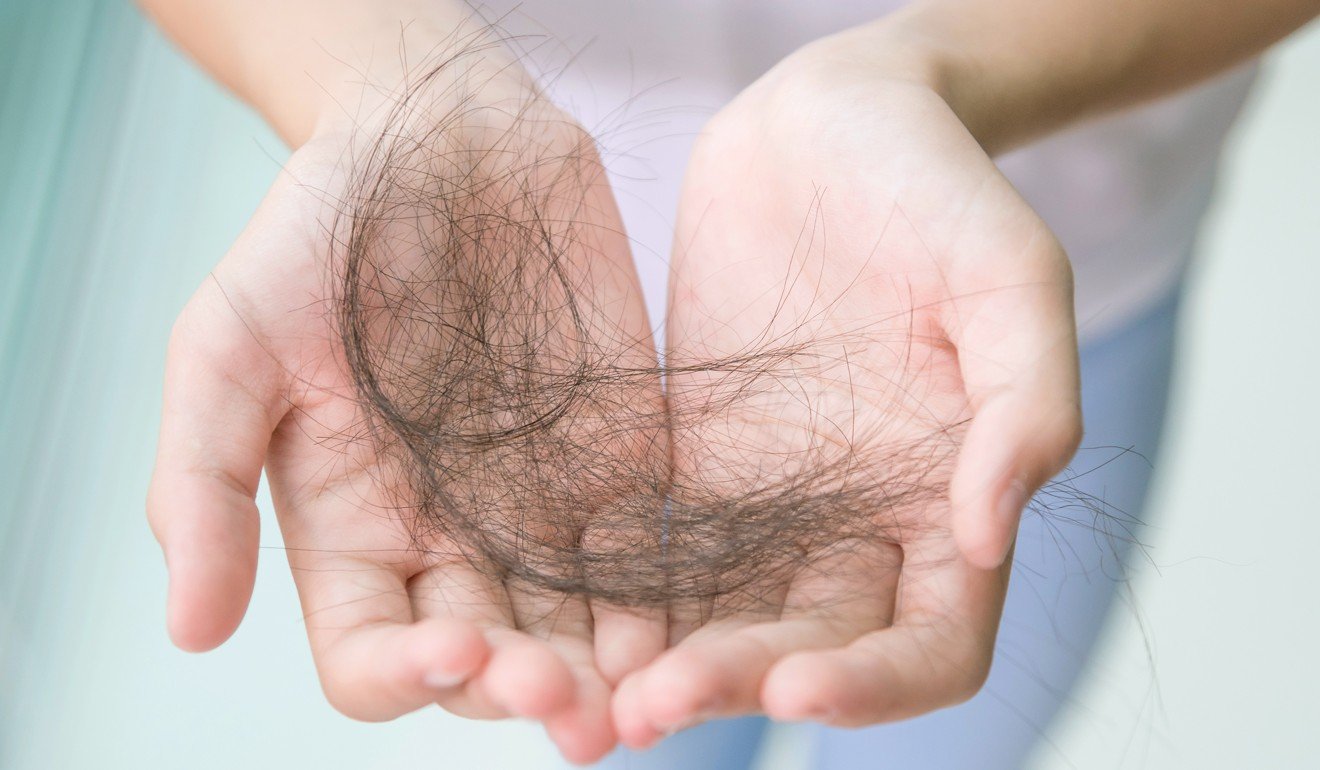
Studies and polls suggest stress leading to hair loss is a big health concern in China. Photo: Alamy
When the 13-year-old girl walked into the hospital in southern China around eight months ago, she was almost completely bald, and her eyebrows and eyelashes had gone.
“The patient came with a hat on and did not look very confident,” Shi Ge, a dermatologist at the Sixth Affiliated Hospital of Sun Yat-sen University in Guangzhou, told the Pear Video news portal.
The girl had done well in primary school but her grades dropped in middle school, Shi said.
Under parental pressure to do well, the girl pushed herself harder, but the stress resulted in severe hair loss.
With time and medical treatment, the teen’s hair grew back but her story left a lasting impression, raising awareness of the increasing number of young people in China seeking treatment for stress-induced hair loss, according to Chinese media reports.
Jia Lijun, a doctor at Shenzhen Traditional Chinese Medicine Hospital, told state-run Xinhua News Agency in May that aside from genetics, factors such as stress in work, study and life would result in endocrine imbalances which affected the cycle of hair growth.
And in January, a survey of 1,900 people by China Youth Daily found that 64.1 per cent of people aged between 18 and 35 said they had hair loss resulting from long and irregular working hours, insomnia, and mental stress.
Hits and myths: stress and hair loss
Shi said that an increasing number of young people had come to her for treatment of hair loss in recent years, and those working in information technology and white-collar jobs were the two biggest groups.
“They usually could not sleep well at night due to high pressure or had an irregular diet because of frequent business trips,” Shi said.
A Weibo poll on Wednesday revealed that 68 per cent out of 47,000 respondents said they had had serious hair loss when they were in school. About 22 per cent said they noticed after starting their careers, while only 5 per cent said it happened after they entered middle age.
More than half of the Chinese students who took part in a China Youth Daily survey said they had hair loss. Photo Shutterstock
Research published in 2017 by AliHealth, the health and medical unit of the Alibaba Group, found that 36.1 per cent of Chinese people born in the 1990s had hair loss, compared to the 38.5 per cent born in the 1980s. Alibaba is the parent company of the South China Morning Post.
The teenager’s experience sparked a heated discussion on Weibo, with users recounting similar cases and some voicing their panic.
“My niece’s hair was gone while she was in high school and has not recovered, even after she graduated from university. This makes her feel more and more inferior,” one user said.
Hong Kong’s schoolchildren are stressed out – and their parents are making matters worse
Another said: “I lost a small portion of my hair during the high school entrance exam, but that is already scary enough for a girl in her adolescence.”
“I had to quit my job and seek treatment,” said a third, who adding that he also suffered from very serious hair loss a few months ago because of high pressure.
Source: SCMP
Posted in adolescence, Alibaba Group, Alibaba Group Holding, AliHealth, at school, business trips, careers, chasing grades, China Youth Daily, Chinese people, Chinese teenager, condition, debate, demands, dermatologist, do well, doctor, entrance exam, frequent, Guangzhou, hair loss, health and medical unit, her hair, high pressure, High school, induced, inferior, Information technology, irregular diet, job, lost, middle age, middle school, myths, pressure, primary school, quit, recover, school, Shenzhen Traditional Chinese Medicine Hospital, Sixth Affiliated Hospital, south china morning post, sparks, stress, Sun Yat-Sen University, treatment, Uncategorized, university, Weibo, white-collar jobs, Xinhua News Agency, young people |
Leave a Comment »




 CHINDIA ALERT: You'll be living in their world, very soon
Chinese parents struggle with Teacher’s Day gift etiquette
Despite a decade of official discouragement, parents in China have been struggling with one of the biggest dilemmas of the school year – how to mark the country’s annual Teacher’s Day.
Ellen Yuan agonised for a day and a night before sending her son off to kindergarten on Tuesday with a 1,000 yuan (US$140) gift card in his bag for the teacher.
It was the boy’s second week of attendance and Yuan had given no thought to any Teacher’s Day obligations –until she learned that several of her friends had been busy over the weekend preparing gifts for their children’s teachers.
“It makes me feel that I am being a drag on my son if I don’t do so,” said Yuan, who works for a foreign company in Shanghai.
Respecting teachers has traditionally been a fundamental social norm in China but gift giving on the special day for educators has gone beyond an expression of appreciation by their students, as parents have taken over with ever more expensive gifts – and sometimes cash – which they hope will mean their kids are well taken care of while at school.
What gift, how expensive it should be, and how to deliver it have become the biggest questions for many parents in the run-up to September 10 each year, even though the education ministry and its subordinate bodies have repeatedly issued directives over the past decade to ban teachers accepting gifts.
Yuan said one of her friends had bought a body care set worth more than 600 yuan for each of her child’s three teachers, another had bought an 800 yuan gift card, while a third had given the head teacher a 1,000 yuan bottle of perfume.
Some parents had delivered the presents directly to the school, while others had asked their children to take the gifts to their teachers. Yuan’s plan was to message the teacher and tell her to take the gift card from her son’s bag.
“I know it’s bad. I don’t want my kid to know that,” Yuan said.
But not every teacher gets presents – with gifts usually reserved for those teaching the “main subjects” of mathematics, Chinese and English, which count the most in high school and college entrance examinations.
Emily Shen, an English teacher from a middle school in Hangzhou, in the eastern province of Zhejiang, said she also prepared gifts for the teachers of her two kids. “Some chocolate for them to take to school. And I myself would give a gift card to each of those who teach the main subjects,” she said.
Zhuang Ke, a music teacher at a primary school in Jiaxing, also in Zhejiang province, admitted she was embarrassed by the parents’ different treatment of teachers of “less important” subjects like her’s. “It’s always nice to receive presents. But teachers who teach music, art and PE are often forgotten,” she said.
Chinese kindergarten teacher fired for hot sun punishment
State broadcaster CCTV said in a commentary on its website on Sunday that “all forms of behavior that attempt to ruin normal teaching order and interfere in equality by sending gifts should be resolutely abandoned”. A similar message was run by a series of official media outlets at local level.
“The most fundamental way to stop parents from sending gifts is to treat the students equally and fairly every day, so that parents conclude it makes no difference whether they give a gift,” Rednet.cn, the official news portal of Hunan province, said on Monday.
Although some teachers have made it explicit to students that they will refuse presents on Teacher’s Day, Yuan said her son’s teacher accepted the gift, as did the teachers of her three friends’ children.
Source: SCMP
Posted in Art, bag, body care set, bottle of perfume, Chinese, chinese parents, Chocolate, college entrance examination, commentary, day of appreciation, discouraged, educators, English, Expensive presents, fired, foreign company, forgotten, fundamental way, gift card, gift etiquette, Hangzhou, High school, hot sun punishment, Hunan Province, Jiaxing, keeping up with the Joneses, kindergarten, mathematics, mentality, middle school, music, music teacher, National Institute of Education Sciences, norm, official news portal, officially, PE, poor pay, primary school, Protest, Rednet.cn, schools, Shanghai, sincere expression of gratitude, state broadcaster CCTV, struggle, teacher, Teacher’s Day, Uncategorized, website, Weibo, Yangzhou Technical Vocational College, zhejiang province | Leave a Comment »