01/04/2020
- Education ministry says they will be held a month later than planned – on July 7 and 8 – when there is ‘a lower risk’ for students and staff
- It will also give them more time to prepare after months of online learning due to school closures
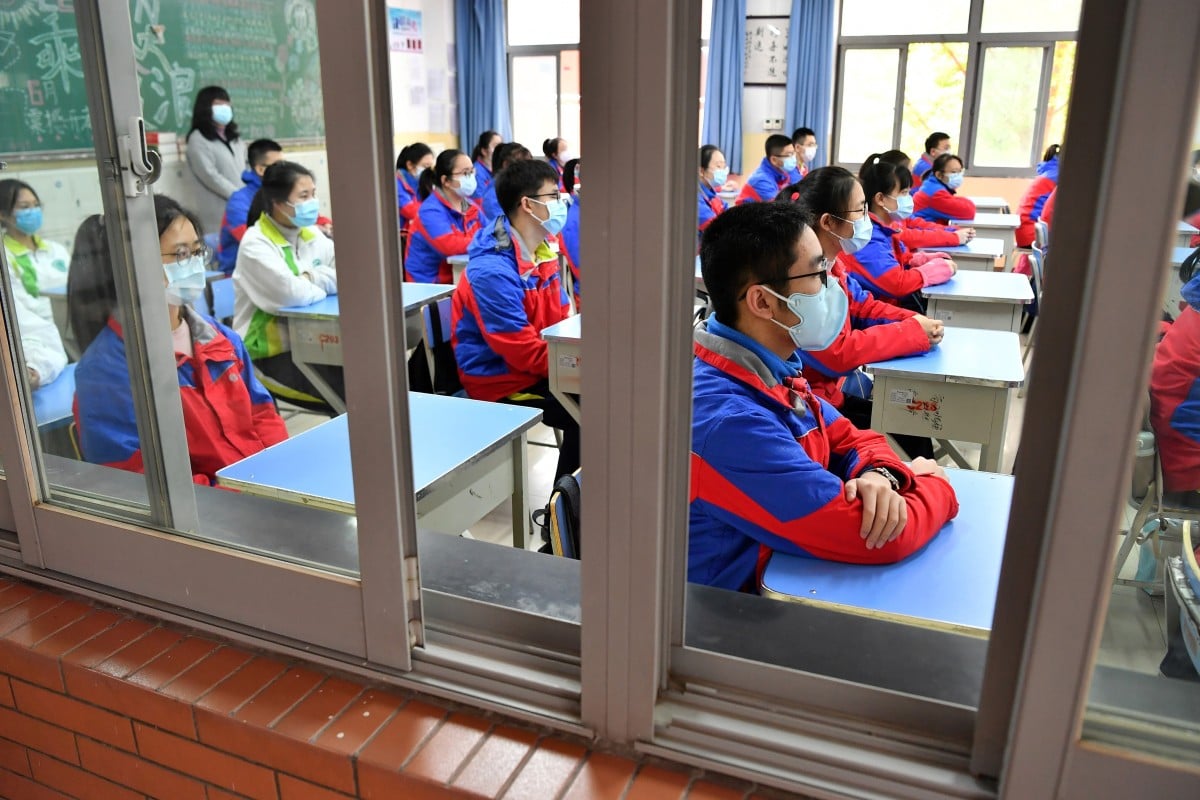
Students were back in class at the Xian Middle School in Shaanxi province on Monday after a nationwide closure because of the coronavirus outbreak. Photo: Xinhua
China’s all-important annual college entrance exams have been postponed by a month because of
the coronavirus crisis – the first time they have been disrupted since the Cultural Revolution.
Universities in mainland China base enrolments solely on the results of the gruelling examinations, known as the gaokao, and they are seen as tests that can make or break a student’s future.
This year, they will be held on July 7 and 8 for most of the country – a month later than planned, the Ministry of Education announced on Tuesday.
A date has not yet been set for the capital Beijing or for Hubei, the province worst-hit by the virus. The ministry said authorities in the two places would decide later when they would hold the gaokao, based on their public health situations.
Wang Hui, a ministry official who handles the university sector, said 10.71 million students were expected to sit the exams this summer.
He said the ministry decided to postpone this year’s gaokao to put students’ “health and fairness first”.
Coronavirus: Decoding Covid-19
Wang said although the spread of the coronavirus had slowed to almost a halt in the mainland, there was still a risk of isolated cases and localised outbreaks. China’s focus now is preventing imported cases among people who arrive in the country from overseas.
“[Disease control and] prevention experts suggest that if the gaokao is postponed for a month, there will be a lower risk from … the epidemic,” Wang said.
“We must adopt the most appropriate and the least risky plan in order to protect the safety and health of the students as well as the staff involved in the tests.”
The ministry official said the delay was also about fairness, by giving students more time to study at school and prepare for the exams.
“We hope to reduce the impact of the epidemic on students, especially those from rural and poverty-stricken regions, as much as possible,” Wang said.
“Third-year high school students have had to stay home [because of the coronavirus outbreak] so their preparation for the gaokao has been affected,” he said. “The internet [access] divide between urban and rural areas means some students in rural and poorer regions have been more affected by this epidemic.”
With schools remaining closed during coronavirus outbreak, China launches national remote learning platforms
Beijing imposed a nationwide school closure after the Lunar New Year holiday in late January as the pneumonia-like illness rapidly spread. Schools were told to postpone the new term that was due to start in mid- or late February, meaning millions of students – from primary school to university – had to turn to online learning. Several provinces began reopening schools this month and more are set to follow in early to mid-April, but authorities in Beijing and Guangdong have yet to set a date for classes to resume.
The last time the gaokao was disrupted was during the Cultural Revolution, a decade of political and social turmoil that ended in 1976. It was cancelled during this time and since it resumed in 1979 until 2002 it has been held nearly every year from July 7 to 9. From 2003, the ministry moved the gaokao forward to June 7 and 8 to avoid hot weather and potential natural disasters. The severe acute respiratory syndrome outbreak (Sars) in 2002-03 did not delay the exams.
China’s university entry exam, gaokao: elliptical, obscure and confusing
According to an online survey conducted by microblogging website Sina Weibo on Tuesday, some 537,000 users said they were “shocked” by the ministry’s decision and were “experiencing history”.
About 282,000 people said it was a good thing for students since it gave them more time to prepare for the exams. But it was bad news for another 153,000 users, who said they would have to endure an extra month of exhausting preparation.
Source: SCMP
Posted in all-important, Beijing, China, closure, confusing, coronavirus, coronavirus outbreak, Cultural Revolution, elliptical, entrance exams, epidemic, exams, exhausting preparation, hubei province, Lunar New Year holiday, Mainland China, microblogging website, Ministry of Education, nationwide, obscure, pneumonia-like illness, postpones, primary school, remote learning platforms, school closures, shaanxi province, Sina Weibo, students, Uncategorized, university, Virus, Xian Middle School |
Leave a Comment »
22/09/2019
TIANJIN, Sept. 21 (Xinhua) — Just scan a QR code on a vending machine, then you will be given a drink. The special vending machine placed at the ongoing cybersecurity expo held in Tianjin has attracted many people to try it out.
Once you scan the code, you will receive a message in a second, reminding you that “arbitrary code-sweeping will endanger personal property safety,” as your personal information might have been illegally collected.
This machine was installed by 360 Security Technology Inc.
The expo is a part of a cybersecurity publicity campaign held in north China’s Tianjin Municipality, aiming to promote public awareness of the issue
In fact, it is also a part of the 2019 China Cybersecurity Week, held from Sept. 16 to 22 nationwide.
The campaign was jointly launched by the Publicity Department of the Communist Party of China Central Committee, the Office of the Central Cyberspace Affairs Commission and the ministries of education, public security and industry and information technology.
Over 100 cybersecurity and Internet enterprises have attended various activities held during the week.
There will also be themed activities to promote cybersecurity issues related to students, the telecommunication sector and financial sector.
Personal information protection is a major theme of this year’s campaign.
In Tianjin, an interactive experience area has been set up at the expo, which allowed visitors to raise their cybersecurity awareness through taking part in different activities.
“I’ve learned a lot about cybersecurity through these activities. Do not click strange links or download mobile software from unofficial platforms,” said a 64-year-old visitor surnamed Zhang.
Statistics released showed that China has more than 200 app stores providing nearly 5 million apps. They bring convenience for many people, but some of them become “information funnels,” leaking people’s mobile phone numbers, call records, text messages, consumption records and other private information.
According to a report on netizen’s satisfaction on cybersecurity issued during the event, 51.25 percent of surveyed Chinese netizens believe the Internet is safe, up 12.91 percentage points from last year. About 37 percent of the respondents believe there are personal information leaks on the Internet, and 58 percent experienced personal information infringement.
More than 82 percent of the respondents also urge legislation on individual information protection.
Early in January, the Office of the Central Cyberspace Affairs Commission, the Ministry of Industry and Information Technology, the Ministry of Public Security and the State Administration for Market Regulation teamed up to launch a campaign to crackdown on illegal collection of personal information in mobile apps.
So far, more than 600 popular apps have been evaluated, with over 200 apps asked to make improvements in personal information protection.
Source: Xinhua
Posted in 360 Security Technology Inc, accelerates, China alert, China Cybersecurity Week, cybersecurity, cybersecurity expo, drink, efforts, finance sector, given, Ministry of Education, Ministry of Industry and Information Technology, Ministry of Industry and Information Technology (MIIT), ministry of information technology, ministry of public safety, Ministry of Public Security, Office of the Central Cyberspace Affairs Commission, promote, public awareness, Publicity Department, Publicity Department of the CPC Central Committee, QR code, scan, State Administration for Market Regulation, students, telecommunication sector, Tianjin, Uncategorized, Vending machine |
Leave a Comment »
15/09/2019
BEIJING, Sept. 14 (Xinhua) — The 22nd Mandarin popularization week will be held from Sept. 16 to 22 across China, highlighting a myriad of Mandarin-speaking and writing activities, according to the Ministry of Education.
Focusing on promoting Mandarin and carrying forward China’s fine traditional culture, this year’s event will start in Shanghai and conclude in the city of Kaili in southwest China’s Guizhou Province, the ministry said.
Initiated in 1998, the annual event falls on the third week of September and has become an important platform for Mandarin popularization and the promotion of fine traditional culture in society.
As of 2015, about 73 percent of Chinese people can speak Mandarin, up from 53 percent in 2000, while more than 95 percent of the literate population can use standardized Chinese characters.
Source: Xinhua
Posted in Beijing, China alert, Chinese characters, Guizhou Province, Kaili, Mandarin, Ministry of Education, promotion events, Shanghai, Uncategorized |
Leave a Comment »
10/09/2019
- More than 40 per cent of those surveyed in an online poll say they feel they have no other choice, while just a quarter think the extra tutoring is necessary
- It reflects widespread anxiety over getting places at the top schools, according to researcher
Sixty per cent of mainland Chinese children aged from three to 15 are receiving extra tutoring outside the classroom, according to a report. Photo: Handout
More than 40 per cent of Chinese parents feel they have no choice but to send their children to after-school classes because of the intense competition in the education system, according to an online poll.
But just a quarter of the respondents said they thought the extra tutoring was actually necessary for their children.
Nearly 200,000 parents had responded to the survey, conducted by social network Weibo, by Tuesday.
It comes after a report last week said 60 per cent of children aged between three and 15 in mainland China were receiving extra tutoring outside the classroom.
That report, released by the China National Children’s Centre and the Social Sciences Academic Press, also said parents of children in the age range were spending an average of 9,200 yuan (US$1,290) per year on after-school classes to cope with growing academic pressure.
It was based on a survey of nearly 15,000 children in 10 mainland cities and rural areas.
For the children, that meant they were spending an average of less than two hours playing outside on weekends, according to the report. They were also found to be devoting an average of 88 minutes a day to homework on school days.
Chinese parents send their children to a wide range of after-school classes. Photo: Xinhua
Wu Hong, a researcher from the Dandelion Education Think Tank in Chongqing, said the findings reflected the widespread anxiety of parents over their children getting places at the top schools.
“Many parents don’t have their own ideas about how their kids should be educated and they just follow others blindly. For example, a friend of mine said she plans to send her two five-year-olds to an international school in Thailand just because several of her friends did that,” Wu said.
“It’s not that kids should not attend any after-school classes, but we are apparently giving them too much when they’re so young, and this is only limiting their imagination.”
Last go at exam success for China’s ‘gaokao grandpa’
Studying a wider range of subjects in more depth than the public school syllabus requires and getting a head start by going over topics before they are covered in school have become common tactics used by parents trying to help their children compete in a challenging educational environment in China.
In the more affluent cities, some parents are spending a lot more than the average on their children’s extracurricular activities. Shanghai mother Emma Jin said she wanted to give her daughter, who is in Year Two, a good chance in the education system.
“Extra English classes cost 20,000 yuan for a year. She also takes dance classes, taekwondo and so on,” Jin said. “I don’t expect much from her, but I don’t want her to be the worst in the class either.”
Some parents said the pressure came from the schools.
“My child is studying at a public school. The teacher told us to have our child learn pinyin [the mainland’s system of romanisation of Mandarin script] in advance at after-school classes during the admission interview. Should I have just disregarded his advice?” one parent commented on Weibo.
‘Heavy burden’ of homework leaving Chinese children sleep-deprived, study finds
The heavy pressure on children from extra classes has meanwhile prompted the Ministry of Education to issue several directives to schools asking them to pay more attention to pupils’ well-being – including by encouraging them to get at least one hour of outdoor exercise and 10 hours’ sleep a day. Last year, it also banned cram schools from holding competitions or offering classes to children that were too advanced for their age.
Source: SCMP
Posted in academic pressure, after-school classes, China National Children’s Centre, chinese parents, Chongqing, Dandelion Education Think Tank, extra tutoring, forces, gaokao grandpa, homework, imagination, intense competition, international school, Mainland China, Mandarin, Ministry of Education, send children, Social Sciences Academic Press, Thailand, top schools, Uncategorized, weekends |
Leave a Comment »
02/09/2019
BEIJING, Sept. 1 (Xinhua) — As the autumn semester started Sunday, Chinese education departments, schools and military authorities have geared up for military training programs for students.
The Ministry of Education and three departments of the Central Military Commission jointly issued a directive earlier this week underlining adequate preparation of trainers, careful design of training programs and proper security management.
Freshman college students across the country and entrants to middle schools in many places are required to attend a short military training program mostly on campus but sometimes at training camps.
The military should select competent servicemen to be trainers and provide them with adequate training on teaching policies and skills, according to the directive.
Civilian and military authorities were also asked to introduce more interactive and creative training models and design courses that suit students’ physical and psychological conditions.
Source: Xinhua
Posted in campus, Central Military Commission, Central Military Commission (CMC), Chinese schools, college students, Country, entrants, Freshman, middle schools, Military, military training, military training program, Ministry of Education, servicemen, students, trainers, training camps, Uncategorized |
Leave a Comment »
01/07/2019
- Annual tests still an academic pressure cooker for students wanting to get into the nation’s top universities, despite efforts to change the system
- The gruelling exam is the sole criteria for admission to university in China
After months of study, China’s high school students are about to be put to the test in the annual “university entrance examinations which begin on Friday. Photo: EPA-EFE
For the past six months, the life of 18-year-old Shanghai student Xiao Qing has revolved around preparation for one of China’s annual rites of passage.
Every day at school, from 7.20am to 5.30pm, the final-year secondary school student in Changning district has studied previous test papers for the gaokao, officially known as the National Higher Education Entrance Examination.
“Sometimes I feel my bottom hurts from sitting for so many hours,” she said. “We feel like we are test machines.”
Xiao Qing will put all of that preparation to the real test from Friday, when over two to three days she will be among more than 10 million people trying to qualify for one of the spots at a Chinese university.
Most students get just one shot at the gaokao, the sole criteria for admission to university in China. It’s a gruelling process that has been criticised over the years as too focused on rote learning, putting too much pressure on students and privileging applicants living near the best universities.
Education authorities have gone some way to try to address these problems. In 2014, the Ministry of Education started letting students choose half of their subjects to introduce some flexibility into the system.
Apart from the compulsory subjects of Chinese, mathematics and English, students are now supposed to be able to choose any three of six other subjects: physics, chemistry, biology, politics, history and geography.
Previously, secondary school students had been split strictly into liberal arts or science majors in a system that was introduced in 1952 and revived in 1977 after being suspended during the Cultural Revolution.
Last go at exam success for China’s ‘gaokao grandpa’
Wen Dongmao, a professor from Peking University’s Graduate School of Education, said the changes expanded the opportunity for students to follow their interests.
“The new gaokao gives students plenty of choices of subjects to learn and to be evaluated on. I think people should choose which subject to learn based on what they are interested in,” Wen said.
“Gaokao reform is designed according to some methods by overseas universities, like American and Hong Kong schools. Its direction is right, but there will be inevitable problems brought by it.”
One of the problems is the uneven implementation of the changes throughout the country, with just 14 of China’s 31 provinces, municipalities and autonomous regions having introduced them.
In the eastern province of Anhui, for example, the reforms were supposed to go in effect from September last year but were postponed without reason, news portal Caixin.com reported.
The report quoted a teacher from Hefei No 1 Middle School in the provincial capital as saying the school was not ready for the changes.
Is the university entrance exam in China the worst anywhere?
“Shanghai and Zhejiang are economically advanced and we are not at that level,” he was quoted as saying. “It’s a big challenge for us to manage so many students’ choices of gaokao subjects.”
In neighbouring Jiangxi province, a high school history teacher said many places opposed the reform mainly “because of the shortage of resources”.
“It’s hard to roll out gaokao reform because we don’t have enough teachers or classrooms to handle the students’ various choices of subjects. Students can choose three out of six courses and that means there are 20 potential combinations,” the teacher was quoted as saying.
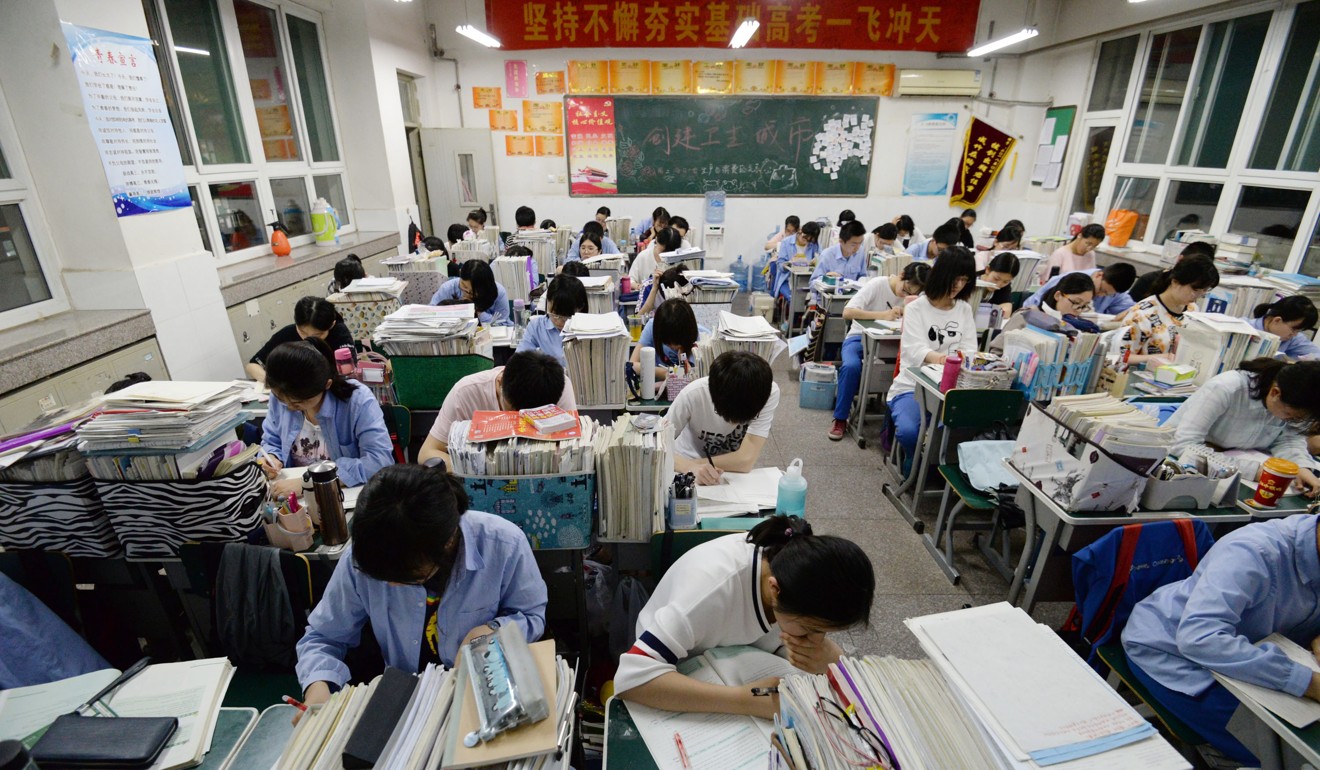
Chinese high school students study late into the night for the National Higher Education Entrance Examination. Photo: EPA-EFE
In addition, the system allows students to take the tests in more than one year and submit the highest scores when applying to universities.
“I heard from teachers in other provinces that students will take the tests of the selected subjects again and again for fear that other students will overtake them. That’s exhausting and will just put more burden on the students,” the Jiangxi teacher said.
He also said the gaokao process put extra pressure on teachers who feared the tests would push students to extremes. One of his students contemplated jumping from a bridge after she thought she had done poorly in the Chinese section of the exam.
“She called me, saying she felt it was the end of the world. I was shocked and hurried to the bridge,” he was quoted as saying. He spoke to her for more than an hour about before the girl came down, going on to get a decent score.
Critics also say the system is weighted in favour of students in bigger cities such as Beijing, Tianjin and Shanghai, home to the country’s top universities.
China private education industry is booming despite economic slowdown
Li Tao, an academic from the China Rural Development Institute at Northeast China Normal University in Changchun, Jilin province, said about 20-25 per cent of gaokao candidates from Beijing, Tianjin and Shanghai were admitted to China’s elite universities, compared with just 5 or 6 per cent in places like Sichuan, Henan and Guangdong.
Li said that was because the top universities were funded by local governments and gave preference to applicants from those areas.
“To make it fairer, the Ministry of Education has insisted over the years that elite universities cannot have more than 30 per cent of incoming students from the area in which it is located,” he said.
Despite these challenges, gaokao was still a “fair” way to get admitted to university in China, Li said.
“Gaokao is the fairest channel to screen applicants on such a large scale, to my knowledge,” he said. “It does not check your family background and every student does the same test paper [if they are from the same region]. Its score is the only factor in evaluating a university applicant.”
Fake nursing degree scandal prompts China-wide fraud check
In Shanghai, as the clock ticks closer to the gaokao test day, Xiao Qing said she was feeling the pressure.
She said she would keep up her test prep to ensure she got the score she needed to study art in Beijing.
“I am trying my utmost and don’t want to regret anything in the future,” she said.
At the same time, she is not pinning her entire life on it.
“Life is a long journey and it is not decided solely by gaokao,” she said.
“I don’t agree with my classmates that life will be easy after gaokao. I think we still need to study hard once we get to university.”
Source: SCMP
Posted in academic pressure cooker, Anhui province, Annual tests, Beijing, Biology, Caixin.com, Changchun, chemistry, China Rural Development Institute, China’s university hopefuls, Chinese, Crunch time, Cultural Revolution, English, gaokao, gaokao exam season, geography, Graduate School of Education, guangdong province, Hefei, Henan province, History, Jiangxi Province, Jilin, liberal arts, mathematics, Ministry of Education, National Higher Education Entrance Examination, nation’s top universities, Northeast China Normal University, Peking University, physics, Politics, Science, Shanghai, sichuan province, Tianjin, Uncategorized, zhejiang province |
Leave a Comment »
01/07/2019
- International schools and companies offering extracurricular services have sprung up to prepare children to study overseas
- Families disenchanted with exam-based classes and intense competition for tertiary places look offshore for alternatives
A group of young Chinese students tour the University of Cambridge in England. Photo: Alamy
On a sunny summer’s day, 24 schoolchildren head off on a four-day field trip to Guizhou province in southwestern China.
The children, aged eight to 16, have gone into the far reaches of the mountainous province not to see its picturesque Huangguoshu waterfall or to meet people from the ethnic Miao minorities. Instead, they are there to see the Five-hundred-metre Aperture Spherical Telescope, or Fast – the world’s biggest radio telescope, built in 2016.
The trip was organised by All in One Education, a Shenzhen-based company offering extracurricular classes and educational trips for Chinese students who aim to study abroad.
The agency has organised similar trips to Hebei and Yunnan provinces, catering to parents who want to expand their children’s horizons.
“This kind of experience is not usually available to students who follow the traditional Chinese education model, but it does appeal to those who go to international schools and schools that emphasise exploration,” Zhang Yong, the teacher leading the field trip, said.
Zhang said other agencies in China arranged educational trips abroad, including to universities such as Harvard and Oxford.
Many Chinese parents want their children to have a broader education than they get in the public schools system. Photo: Reuters
The companies are part of an industry targeting an ever-growing market of parents who have high expectations for their children and who are anxious to ensure their children go to the best schools they can afford.
The services are also aimed at parents who see studying abroad as a way to avoid the intense competition and discipline of the Chinese education system.
Crunch time as gaokao exam season starts for China’s university hopefuls
An overseas education has long been reserved for the privileged few in China but it is becoming more of an option as people become more affluent and more services open up to cater to the demand to give the best to the next generation.
According to the Ministry of Education, 662,100 people studied abroad last year, 53,700 more than in 2017.
For Shanghai parent Iris Wang the best means a Western university. She said that not only were Western universities better than their Chinese equivalents but she had also lost faith in China’s secondary education system.
With her daughter starting at an international middle school in September, Wang is now planning for the child to go overseas for experience and study.
She said that although the teachers working in public schools in China were responsible, the system itself was too rigid.
“In summer, the pupils have to take naps at noon, and teachers write down the names of those who don’t sleep and tell their parents,” she said. “And even if you don’t want to take nap, you are not allowed to take a walk or talk; you must rest your heads and arms on the table.”
Many middle-class Chinese parents are seeking alternatives to the public education system. Photo: AP
Such rules are common in Chinese public schools and meant to instil a sense of discipline among the pupils.
“But educating kids is not the same as making a product on an assembly line,” Wang said.
By withdrawing her daughter from the public system, Wang has forfeited her child’s chance to go to a Chinese high school or university.
It’s a route more Chinese parents are taking, according to a report released in April by the Social Sciences Academic Press and the 21st Century Education Research Institute, a Beijing-based think tank. In 2018, there were 821 international schools in China, up 12 per cent from a year earlier.
Wang has not just sent her daughter to an international school but has also begun researching the next steps, convinced that her daughter should leave China early to better adapt to university abroad.
“She will need to learn the language, develop a different learning mindset, as well as adapt to the lifestyle there,” Wang said.
China’s infamous gaokao university entrance exam
Shenzhen mother Yao Li has also decided that an early exit from the Chinese education system would be good for her daughter, who is still in primary school.
Yao plans to send her daughter to an international secondary school so she can receive a Western education and eventually apply to schools abroad.
Compared with the traditional Chinese education, which focused on exams as measures of excellence, an international education could give a child more possibilities, she said.
“The competition in China for a good education is so fierce that my child will not have sufficient room for development if she stays here,” she said. “We hope that she can become more international and have more diverse abilities as well.”
Why did one of China’s elite universities need to offer big money to get the best students?
Yao has already signed her daughter up for extracurricular classes such as English, art and public speaking, hoping that she can develop a diverse set of skills instead of focusing on academic results alone.
Zhang, the teacher at All In One Education, said there was a huge market in China catering to parents who are interested in such classes.
“The reason is simple, the university entrance examination in China is very difficult,” Zhang said. “So parents in areas like Shenzhen who are doing well will send their children abroad to study instead.”
But making the decision to send a child to an international school is just the start. For the middle-class parents who are preparing their children early, there are many more decisions to make, many more classes to attend and many more tests to take.
“We will have to think about which country to send her to in a year or so,” Wang from Shanghai said. “The options are different and so are the preparations – even the language tests required are different, one is TOEFL, one is IELTS.”
Source: SCMP
Posted in 21st Century Education Research Institute, All in One Education, Chinese education system, extracurricular services, fleeing, Guizhou Province, Hebei province, Huangguoshu waterfall, International schools, middle-class parents, Ministry of Education, Shanghai, Shenzhen-based company, Social Sciences Academic Press, study overseas, Uncategorized, University of Cambridge, West means best, Western university, Yunnan Province |
Leave a Comment »
28/05/2019
BEIJING, May 27 (Xinhua) — China’s Ministry of Education has asked universities to improve administration to boost scientific research.
In a circular, the ministry required simplifying procedures for reimbursement of expenses on research activities which include attending meetings, counseling, purchasing equipment and services, among others.
Internet-based reimbursement is encouraged and approval will also be streamlined, according to the circular.
It also demanded universities improve the system of appointing academic assistants and financial assistants for researchers, and allocate more funds to raise researchers’ bonuses.
The interference with scientific research must be reduced to a minimum, the circular said.
Source: Xinhua
Posted in appointing academic assistants, chinese universities, counseling, financial assistants, interference with scientific research, Internet-based reimbursement, Ministry of Education, purchasing equipment, reimbursement of expenses, research activities, researchers, researchers' bonuses, scientific research, scientific research administration, simplifying procedures, to improve, Uncategorized, universities |
Leave a Comment »
08/05/2019
- Investigation follows violent protest at Nanjing school
- Students discovered nursing qualification was actually a home economics degree
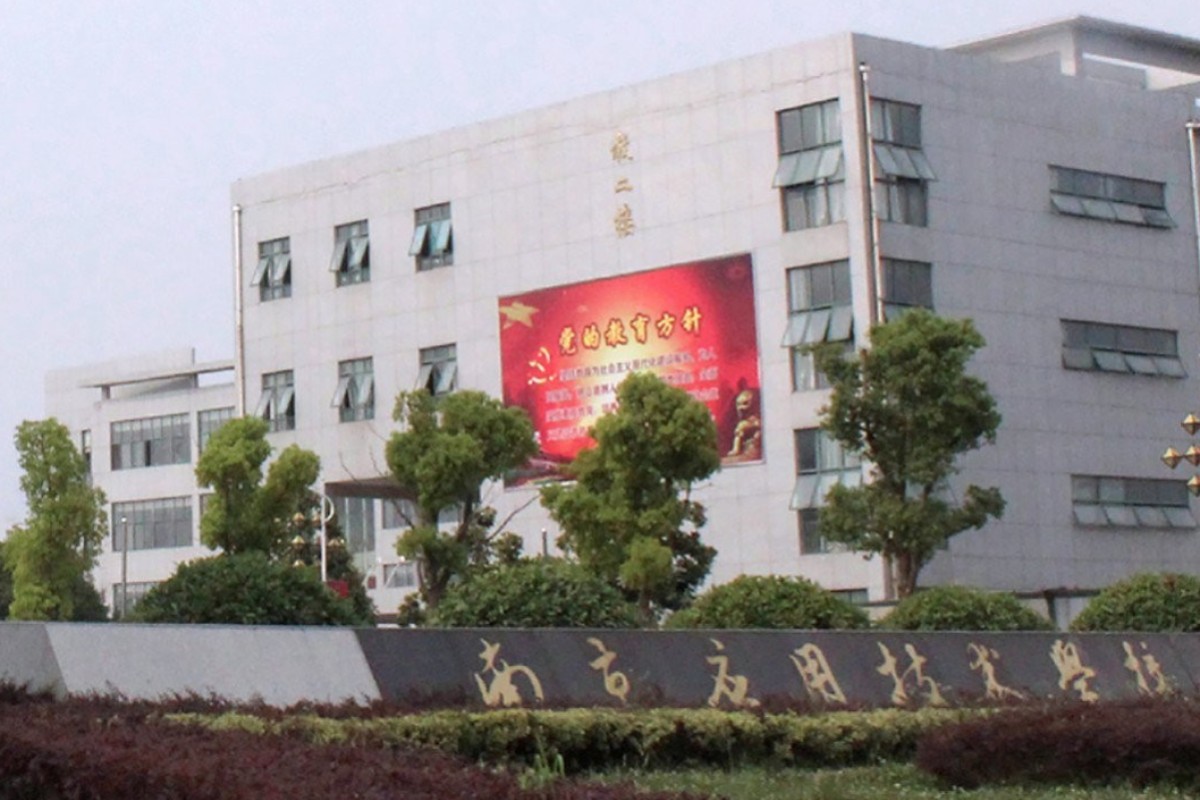
An investigation into enrolment practices at eastern China’s Nanjing Institute of Applied Technology has been widened into a country-wide check for similar frauds. Photo: Handout
A protest by technical school students over fake degrees that led to a
in eastern China last month has prompted the Ministry of Education to order local governments across the country to check for similar frauds in their regions.
Wang Jiping, director of the ministry’s vocational education department, said the authorities had been cracking down on fraudulent promotions in student enrolment – cause of the disturbance at Nanjing School of Applied Technology – for a long time.
“But some schools still irresponsibly cheated parents and students,” Wang said at a press conference on Wednesday.
“For this kind of phenomenon, our attitude is one of firmly stopping and seriously punishing.”
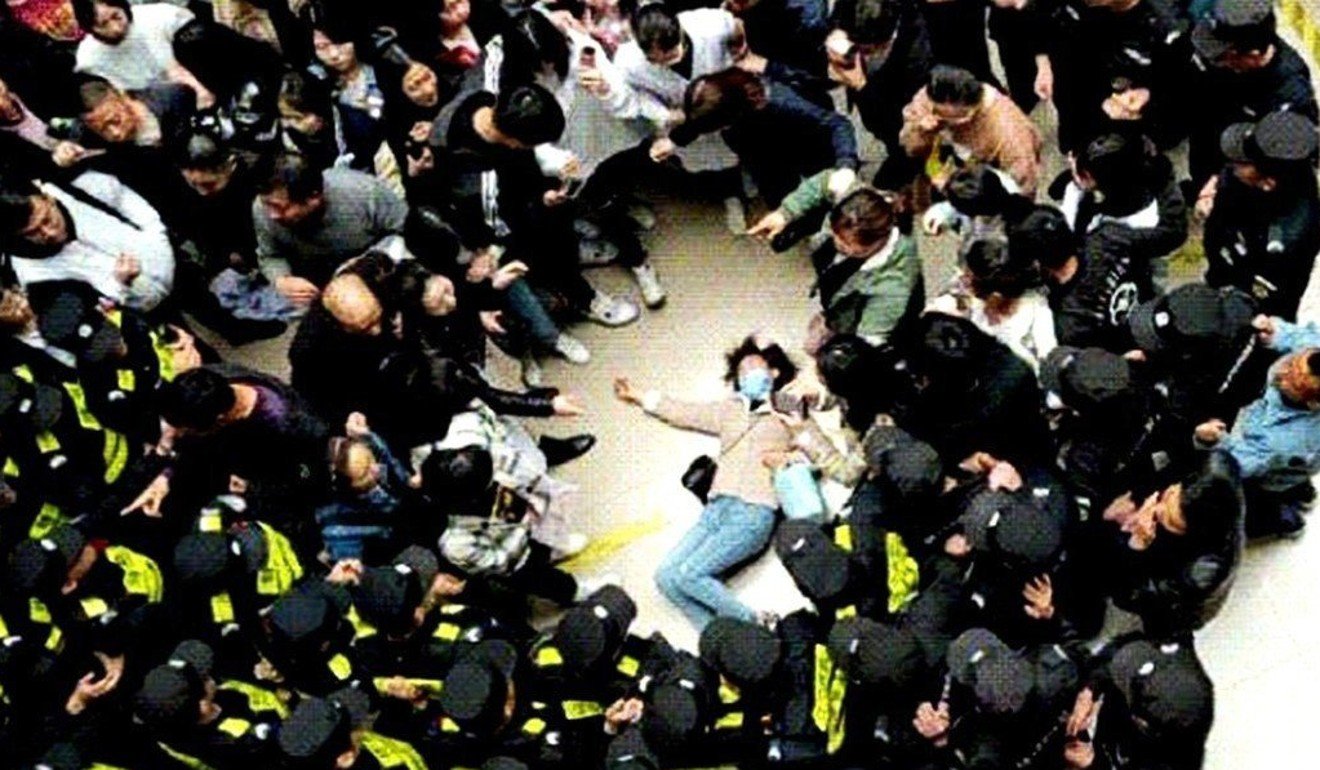
Dozens of students clashed with police and security staff at the Nanjing School of Applied Technology in eastern China last month after the discovery that their nursing course only provided a degree in home economics. Photo: Weibo
In a statement on Weibo, China’s Twitter-like microblogging service, the city government in Nanjing, capital of Jiangsu province, said on Tuesday the rally by students and parents at the school had attracted the attention of city and provincial authorities.
Investigations showed that when the school enrolled new students for its home economics major in 2016, it promised they would receive associate degrees and a nursing certificate upon graduation. The students were also guaranteed jobs.
Students about to graduate this summer were angry when they learned the school could not fulfil any of its promises.
At the end of last month, some parents started petitioning the local government. On the evening of April 26, dozens of students clashed with police and security staff, with two students sustaining leg injuries. Police took several people away for “stirring up trouble among students”, the police said on Weibo.
The city government said that, with the intervention of its education and human resources departments, 405 out of the 409 affected students had been transferred to higher level institutions, and the students and their parents had accepted that arrangement.
The investigation is continuing and school officials will be held accountable, it said.
The Nanjing government said some people had spread rumours online after the incident. The government statement said two people, both surnamed Wang, had falsely claimed a female student was beaten to death by school staff and her parents knocked unconscious by police in the incident.
The pair also claimed in their article, published on Monday, that the school’s security guards were armed during the confrontation with students.
The article went viral and the authors – one from Wuhan, Hubei province, and the other in Changsha, Hunan province, both in central China – were detained for causing trouble.
According to the government statement, they confessed to cooking up the rumour to attract online traffic and solicit rewards from readers.
They made 32,000 yuan (US$4,700) from the article.
Source: SCMP
Posted in China-wide fraud check, Fake degree scandal, home economics degree, jiangsu province, Ministry of Education, Nanjing, Nanjing Institute of Applied Technology, Nanjing school, nursing qualification, Uncategorized, vocational education department, Wang Jiping, Weibo |
Leave a Comment »
26/02/2019
BEIJING, Feb. 26 (Xinhua) — China had over 2.9 million teachers in rural areas by the end of 2018, the Ministry of Education said Tuesday.
Close to 2.5 million rural teachers work at primary and secondary schools, while 420,000 teachers work at kindergartens, according to the ministry.
The ministry is striving to build a high-quality team of rural teachers and dispatched a great number of college graduates to the rural areas, especially the poverty-stricken regions, said Liu Jiantong, an official with the ministry’s department of teachers.
The central budget financed 4.5 billion yuan (670 million U.S. dollars) last year as an allowance for 1.27 million teachers from over 80,000 rural schools in China’s central and western regions, said Liu.
In 2018, 1,800 retired teachers in good health registered to teach at rural schools. In addition, 19 provincial-level regions dispatched 4,000 teachers to support education in Tibet and Xinjiang, said the ministry.
Source: Xinhua
Posted in China alert, department of teachers, Liu Jiantong, Ministry of Education, rural areas, teachers, Tibet, Uncategorized, Xinjiang |
Leave a Comment »







 CHINDIA ALERT: You'll be living in their world, very soon