14/04/2020
- People’s Liberation Army resumes drills, including flotilla exercise in Miyako Strait
- Military observers say China is demonstrating its ability while virus hampers US aircraft carriers
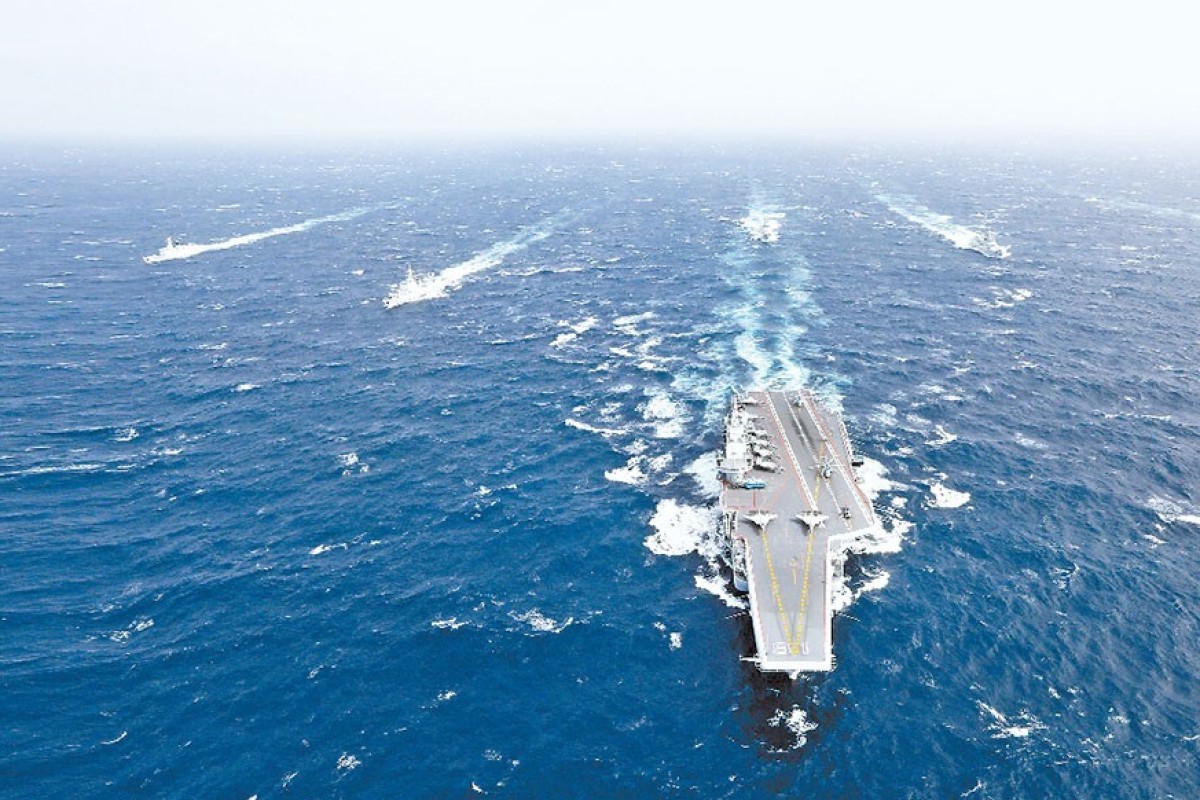
The Liaoning aircraft carrier strike group has resumed activities after being interrupted by the coronavirus pandemic. Photo: Handout
The People’s Liberation Army has resumed regular military drills at home and overseas, moves that military experts say are a show of strength and control over
.
The ground forces, navy and air force of the PLA’s five theatre commands started military drills this month, with some exercises involving joint operations, according to several reports published by the PLA Daily in recent days.
As the epidemic surged in China, the PLA was forced to suspend all large-scale joint drills because of disruptions to transport and allocations of military resources around the country.
China’s People Liberation Army conducts drills. Photo: Handout
On Saturday, one of the large-scale drills resumed. A six-ship flotilla, led by the
, sailed through the Miyako Strait – just 330km (205 miles) due east of the northernmost tip of Taiwan – on its way to the western Pacific.
“In the future, the Chinese navy will continue to organise similar training schedules to accelerate and improve the combat capability of its aircraft carrier strike groups,” navy spokesman Gao Xiucheng was quoted as saying in PLA Daily.
It is the first time the Liaoning has reappeared in waters near Taiwan since sailors on four United States aircraft carriers sent to the Indo-Pacific region were infected by the coronavirus, making the Chinese carrier the only vessel of its kind active in the western Pacific.
The reappearance of the Liaoning strike group prompted Taiwan to send warships, while the US sent a P-3C Orion anti-submarine aircraft to follow the Chinese flotilla. Taiwanese media reported that the aircraft was the seventh American warplane sent to the region in a week.
Hong Kong-based military analyst Song Zhongping said the Liaoning’s appearance near Taiwan was not only a demonstration of military deterrence to the independence-leaning ruling party in Taiwan, but also a gesture to show off the PLA’s greater ability to contain the coronavirus pandemic than its American counterpart.
“Compared with the PLA, the United States military is weaker and lacks experience in dealing with non-traditional military operations such as battles against epidemics, because those aspects are mostly carried by the US National Guard in various states,” Song said.
“Since the threat of Covid-19 is decreasing, the PLA needs to return to their regular training to prepare for a war to reunify Taiwan by force when necessary. The possible war is very complicated as it [would] involve dealing with foreign militaries, such as US and Japanese navies.”
Beijing-based military expert Zhou Chenming said that the PLA so far had been able to control the infection sources and channels among soldiers and officers, but that the threat of Covid-19 remained.
In pictures published by the PLA Daily, PLA officers do not wear masks while conducting drills.
Both Zhou and Song said that the Covid-19 pandemic had hit the US Navy and left a power vacuum in the region but that the PLA would not use the chance
to attack Taiwan.
“Using force to take Taiwan back is still the last step, not the first priority,” Zhou said. “How to manage and maintain Taiwan’s prosperity is the most important issue of the cross-strait relationship.”
Song said the PLA still believed the US Navy had maintained a degree of combat capability even though hundreds of US sailors were infected by the novel coronavirus.
Source: SCMP
Posted in aircraft carriers, anti-submarine aircraft, control, Coronavirus pandemic, COVID-19, flexes, flotilla exercise, Hong Kong, Liaoning, Military, Miyako Strait, near, P-3C Orion, People’s Liberation Army, PLA, PLA Daily, show, strike group, Taiwan, Uncategorized, US National Guard |
Leave a Comment »
25/03/2020
- Large-scale drills conducted across island in what defence ministry describes as test of combat-readiness
- Exercise follows US Navy live-fire exercise last month and a series of incursions by Chinese warplanes in recent weeks
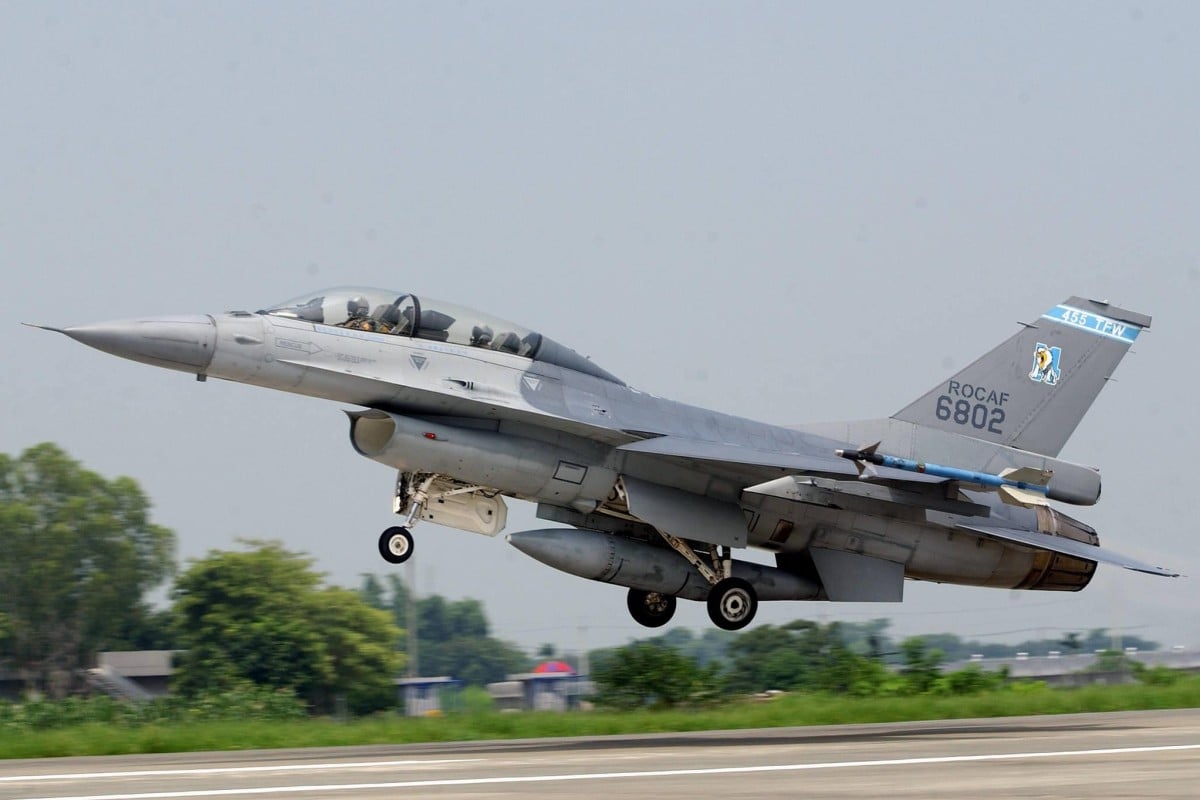
An F-16 fighter takes off from Hualien air base in eastern Taiwan. Photo: Military News Agency/ AFP
Taiwan has staged large-scale military drills throughout the island, including an exercise to repel an invading force, against a backdrop of rising tensions with Beijing.
The exercises, dubbed “Lien Hsiang,” involved the air force, army and the navy and were conducted on Tuesday from various military bases and strongholds in Taiwan, the island’s defence ministry said in a statement.
“The drills were designed to test the combat readiness of our forces and their responses to an all-out invasion by the enemy,” the ministry said, referring to the People’s Liberation Army, which has threatened to attack the self-ruled island.
The exercise follows a live-fire US drill in the region last week.
Taipei says Chinese military aircraft flew night exercise across Taiwan Strait
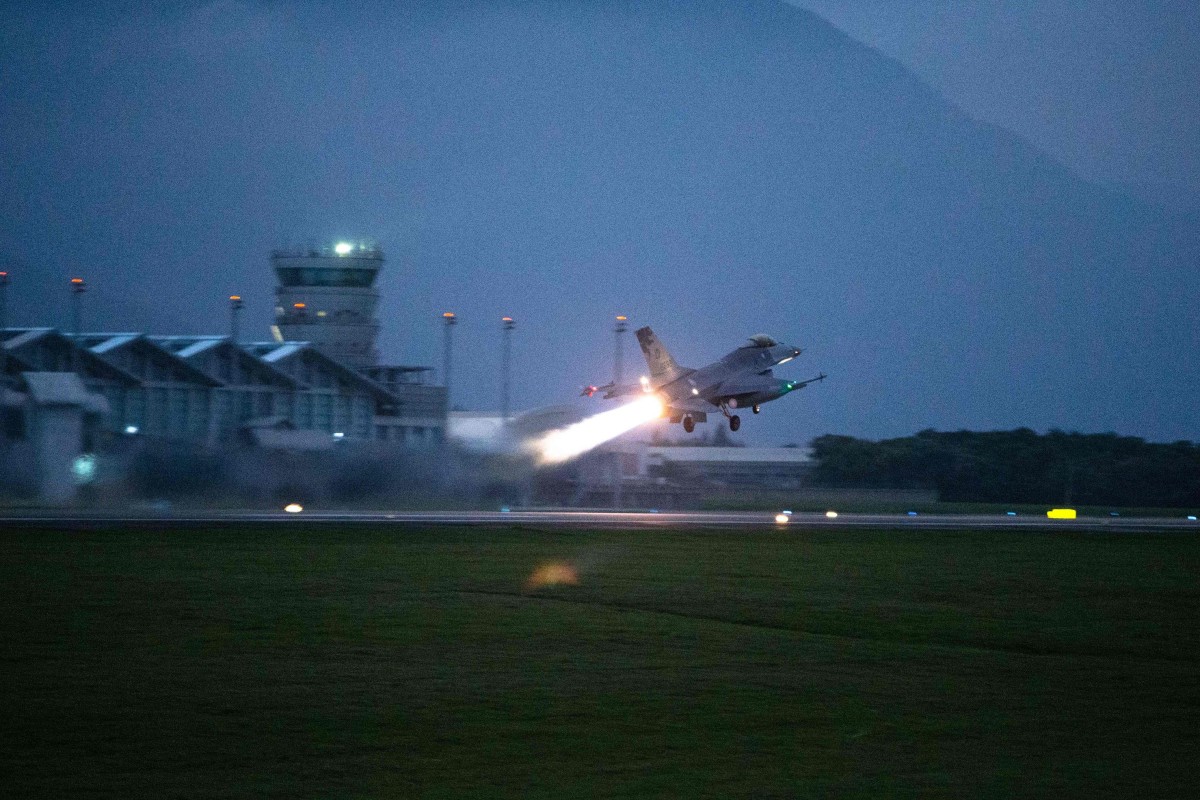
Eight F-16 fighter jets took off from the air force base in the eastern county of Hualien at dawn on Tuesday, simulating an emergency mission to scramble and intercept enemy warplanes entering the island’s airspace, the defence ministry said.
Elsewhere on the island, F-16 and other fighter jets were spotted taking off from other air force bases in the southwestern county of Chiayi, the northern county of Hsinchu, Ching Chuan Kang in central Taiwan and the southern city of Tainan, according to Taiwanese media.
The exercises also involved operations testing cyberwarfare capabilities, while the air force ground crew simulated an emergency repair of the aircraft runway, the ministry said.
Anti-air units of both the army and the navy also joined the air force in the drills, while various types of naval warships, including Kidd-class destroyers, plus Perry and Kang Ding-class frigates, were deployed near Taiwan’s coast for separated training drills, it added.
The ministry said the training mission, carried out without live ammunition, was also designed to test the military response and make improvements based on the results.
Hundreds of Taiwanese to return from coronavirus centre after Beijing and Taipei reach deal
Beijing considers Taiwan a wayward province that must be returned to the mainland fold, by force if necessary.
Beijing has staged a series of war games close to the island and poached seven of Taiwan’s diplomatic allies to heap pressure on President Tsai Ing-wen, from the independence-leaning Democratic Progressive Party, who was re-elected in January.
The exercises came after recent missions by PLA warplanes which briefly crossed the midpoint of the Taiwan Strait into the Taiwanese side in what analysts saw as testing the response from Taiwan and the US.
Three separate groups of warplanes approached Taiwan on their way to the western Pacific over the Bashi Channel for long-distance training exercises before returning home over the Miyako Strait to the northeast of Taiwan on February 9, 10 and 28.
Coronavirus threat shows ‘unacceptability’ of Beijing isolating Taiwan, US official says
On March 17, another flight of PLA warplanes approached Taiwan in a rare exercise which analysts said was aimed at showing off their night navigation and all-weather capabilities.
Taiwan’s air force scrambled fighter jets to shadow, intercept and disperse the PLA warplanes through radio warnings during each approach by the mainland’s planes, according to the ministry.
Those actions also prompted the US to send two B-52 bombers on southbound flights off Taiwan’s east coast, while a transport plane flew over the Taiwan Strait, the defence ministry said.
On Tuesday, the US Navy’s 7th Fleet also revealed that the US Navy had carried out live-fire missile tests in the Philippine Sea last week, in what analysts said was a message that it was up to the challenge of the Chinese military’s new systems.
DPP legislator Wang Ting-yu asked the Tsai government to take note of developments in the South China Sea, saying the US actions indicated that Washington must have learned “certain information suggesting that the Chinese government is planning certain military activities” or the 7th Fleet would not have made such a bold move.
Posted in 7th Fleet, air force, aircraft runway, army, ‘unacceptability’, B-52 bombers, Bashi Channel, Beijing, Chiayi, Chinese warplanes, Ching Chuan Kang, coronavirus, cyberwarfare capabilities, Democratic Progressive Party, emergency repair, exercise, F-16 fighter, fight off, Hsinchu, Hualien air base, incursions, isolating, Kidd-class destroyers, Kuomintang, Military, Miyako Strait, mock invasion, naval warships, navy, Pacific, Perry and Kang Ding-class frigates, PLA warplanes, President Tsai Ing-wen, stages, Taipei, Taiwan, Taiwan Strait, Taiwanese, threat, Uncategorized, US Navy live-fire exercise, Washington, wayward province |
Leave a Comment »
30/07/2019
- Armed F-16 fighter jets simulate attack followed by medium and long-range missile launches into eastern waters
- People’s Liberation Army launched two large-scale drills close to Taiwan Strait on Sunday
9
Taiwan has launched a military exercise including F-16 fighter jets in response to Beijing’s war games, which began on Sunday. Photo: AFP
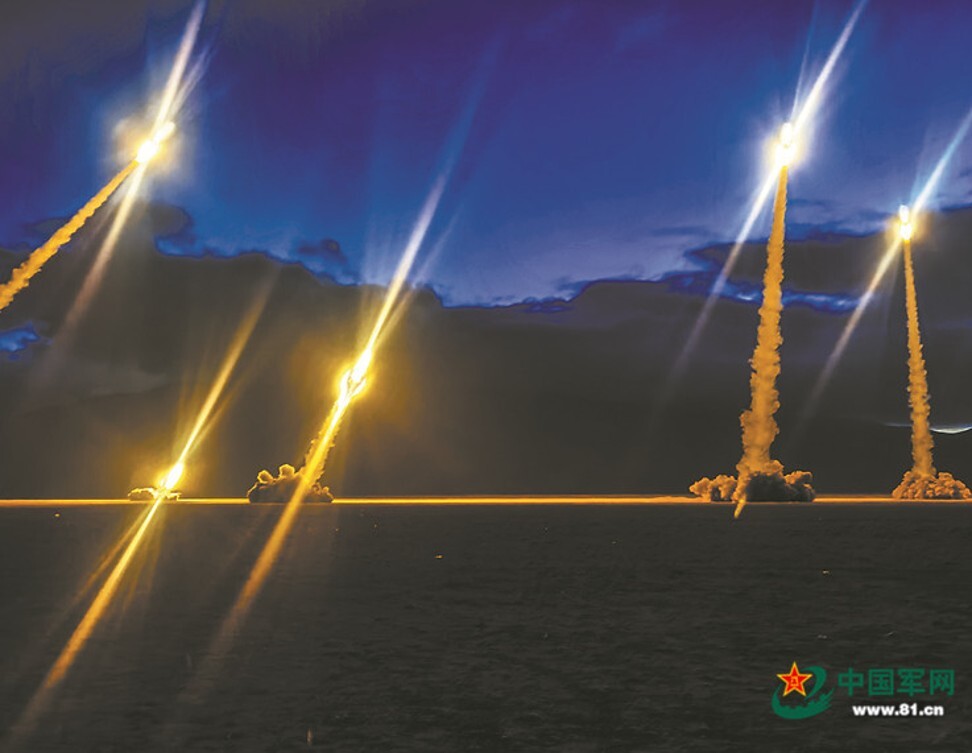
Taiwan responded to Beijing’s military drill targeting the self-ruled island by deploying its most advanced fighter jets and firing 117 medium and long-range missiles on Monday and Tuesday.
Defence ministry spokesman Lee Chao-ming said the missiles were fired from the Jiupeng military base to waters off eastern Taiwan, with a range of 250km (155 miles), in an exercise covering five types of training for the island’s forces.
On Monday, Taiwan’s air force also dispatched two F-16 fighter jets armed with AGM-84 Harpoon missiles in a simulation of an attack off the island’s southeast coast.
Song Zhongping, a military commentator based in Hong Kong, said the Taiwan drill was aimed at the mainland Chinese exercise which began on Sunday. The location of the Taiwan drill meant its missiles’ electronic data could avoid detection by the People’s Liberation Army’s radar, he said.
Chinese military starts Taiwan Strait drills amid rising tension
“Taiwan is focusing on boosting self-defence, and building up a comprehensive air and sea defence network to counter military threats from the mainland,” Song said.
“The test firing of missiles is to boost the island’s self-defence capability. The military drill of the PLA has triggered a lot of concerns in Taiwan, and Taiwan is responding to it also through a strong military means.”
The PLA launched two large-scale military drills close to the Taiwan Strait on Sunday, after a notice issued by the Zhejiang Maritime Safety Administration prohibited ships from entering the waters off the coast of the eastern province between 6pm on Saturday and 6pm on Thursday.
The Guangdong Maritime Safety Administration said another set of military exercises would be held in the waters off Fujian province between Monday morning and Friday evening.
Observers said they expected PLA forces from the Southern and Eastern commands – whose area of responsibility includes Zhejiang and Fujian, which lie across the strait from Taiwan – to take part in the exercises.
Japan’s Ministry of Defence said on Monday that six Chinese warships had passed through the Miyako Strait – a waterway lying between Okinawa Island and Miyako Island – presumably in preparation for the drills.
Japanese military vessels said a Chinese class-three missile destroyer – a type 054A missile frigate – was sailing 240km north of Miyako Island on Saturday.
On Thursday, Japanese ships reported China’s type 052D destroyer Xining, type 054A missile frigate Daging, the guided missile frigate Rizhao, and the ocean comprehensive supply ship Hulun Lake, all entered the Pacific Ocean through the Miyako Strait.
This is China’s first war game to involve simultaneous exercises at two locations in waters near Taiwan since the 1995–96 Taiwan Strait Crisis, during which the PLA conducted a series of large-scale live-fire exercises in response to then-Taiwanese leader Lee Teng-hui’s visit to the United States, and ahead of the Taiwanese presidential election.
Source: SCMP
Posted in 054A missile frigate, AGM-84 Harpoon missiles, Armed F-16 fighter jets, Beijing’s military exercises, Chinese warships, class-three missile destroyer, Daging, defence ministry spokesman, drill, Fujian Province, Guangdong Maritime Safety Administration, guided-missile frigate, Hulun Lake, Japan’s Ministry of Defence, Japanese military vessels, Jiupeng military base, large-scale drills, medium and long-range missile launches, missile frigate, Miyako Island, Miyako Strait, ocean comprehensive supply ship, Okinawa Island, own, Pacific Ocean, People’s Liberation Army (PLA), PLA, responds, Rizhao, Taiwan, Taiwan Strait, Taiwan Strait Crisis, Taiwan’s air force, type 052D destroyer, Uncategorized, United States, Xining, Zhejiang Maritime Safety Administration, zhejiang province |
Leave a Comment »





 CHINDIA ALERT: You'll be living in their world, very soon