Archive for ‘Mongolia’

29/04/2020

Tsai Ing-wen under pressure amid pro-independence push for constitutional change in Taiwan

  • Hardline politicians want president to fulfil promise to overhaul constitution to reflect the self-ruled island’s political reality
  • A petition calls for two referendums on the issue – proposing it either be replaced with a new one or revised
The push for constitutional change could lead to a cross-strait conflict. Photo: Handout

Taiwanese President Tsai Ing-wen is under growing pressure from the hardline camp to push for constitutional change to reflect the self-ruled island’s independent status – something observers say could provoke a cross-strait conflict.

With Tsai due to be sworn in for a second four-year term next month after a landslide victory in January’s election, hardline pro-independence politicians want her to fulfil a 2015 campaign promise: to overhaul the constitution so that it reflects Taiwan’s political reality. The process has been stalled since Tsai’s first term, which began in 2016.

Leading the charge is the Taiwan New Constitution Foundation, a group formed last year by a Tsai adviser and long-time independence advocate Koo Kwang-ming.

The foundation launched a petition at the end of March calling for two referendums on the constitution – proposing that it either be replaced with a new one or revised.

The existing constitution was adopted when Kuomintang leader Chiang Kai-shek and the KMT fled to Taiwan and set up an interim government in 1949 following their defeat by Mao Zedong’s communists in mainland China.

Drawn up in 1947, the constitution still puts the mainland and Mongolia under the Republic of China jurisdiction – Taiwan’s official name for itself. In reality, its jurisdiction extends only to Taiwan and its outlying islands of Penghu, Matsu and Quemoy, which is also known as Kinmen.

Taiwan’s constitution was adopted when KMT leader Chiang Kai-shek fled to the island in 1949. Photo: Handout
“We have garnered more than 3,000 signatures from the public for the first phase of initiating the proposals to hold two referendums asking the president to push for constitutional change,” Lin Yi-cheng, executive director of the Taiwan New Constitution Foundation, said on Wednesday.

He said they would propose that voters be asked two questions in the referendums: “Do you support the president in initiating a constitutional reform process for the country?”

And: “Do you support the president in pushing for the establishment of a new constitution reflecting the reality of Taiwan?”

“We’re ready to send the two referendum proposals to the Central Election Commission on Thursday,” he said.

Confusion prompts call for China Airlines name change in Taiwan, but at what cost?
14 Apr 2020

Under Taiwan’s Referendum Act, the process for holding a referendum involves three stages: a proposal, endorsement and voting.

Lin said there should be no problem for the commission to approve the proposal stage since they had gathered far more than the minimum 1,931 signatures needed under the act.

The endorsement stage requires a minimum of 290,000 signatures, and if the referendum is held, they will need at least 5 million votes.

Lin said if the process went smoothly, he expected a referendum could be held in August next year, allowing time for review and making the necessary arrangements.

He said if the referendum questions got enough public support, Tsai would need to deal with the issue.
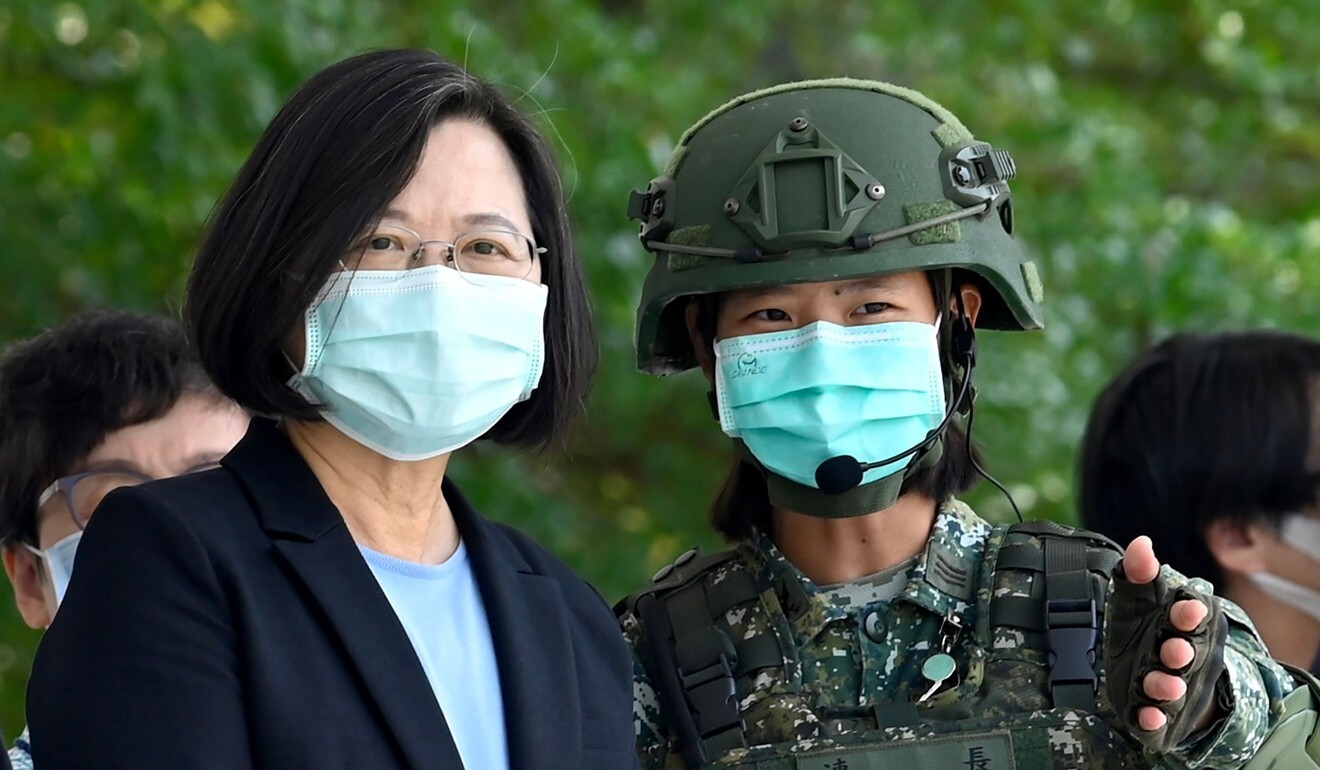
Tsai Ing-wen visits a military base in Tainan earlier this month. The pressure for constitutional change creates a dilemma for the president. Photo: AFP
Tsai’s Democratic Progressive Party government has been tight-lipped over the constitutional change issue, which Beijing sees as a move for the island to declare formal independence from the mainland.
Beijing considers Taiwan a wayward province that must be returned to the mainland fold, by force if necessary, and it has warned Tsai against declaring formal independence.
A DPP official said the foundation’s push would put Tsai in a difficult position.

“If she ignores the referendums, she will come under constant pressure from the hardline camp, and if she seriously considers taking action and instituting a new Taiwan constitution, she will risk a confrontation with Beijing, the consequence of which could be a cross-strait conflict,” said the official, who requested anonymity.

On Tuesday, Zhu Fenglian, a spokeswoman for the mainland’s Taiwan Affairs Office, warned the island against holding any referendum on constitutional revision, saying it would be doomed to end in an impasse and would ultimately fail.

“It will only push Taiwan towards an extremely dangerous abyss and bring disasters to Taiwanese compatriots,” she said.

Chinese air force’s drill ‘aimed at signalling deterrent around Taiwan’

2 Apr 2020

But according to Wang Kung-yi, a political science professor at Chinese Culture University in Taipei, Tsai should not be too worried about the hardline camp move.

“The hardline camp has been marginalised greatly in the past several years as reflected by the poor showing in the legislative elections in January,” Wang said, adding that he expected Tsai to continue her relatively moderate cross-strait policy of not sharply provoking the mainland.

Source: SCMP

10/03/2020

China issues contingency plan against locust threat

BEIJING, March 9 (Xinhua) — China on Monday unveiled its contingency plan to monitor and control the spread of locusts from home and abroad, in a bid to secure grain production and ecological safety.

Regional governance and scientific prevention and control should be given priority, said the plan jointly issued by the Ministry of Agriculture and Rural Affairs, the General Administration of Customs and the National Forestry and Grassland Administration.

The plan clarified the goal of locust control, which is to ensure that desert locusts from abroad will not cause harm and domestic locust outbreaks will not turn into a plague, with no more than 5 percent of crops affected.

Local authorities are urged to prevent the invasion of desert locusts from abroad. The plan requires that monitoring stations be set up in Tibet, Yunnan and Xinjiang on the potential migration routes of the destructive pests.

To control locusts in domestic agricultural areas, chemical control methods will be adopted for areas with a high density of the pests, while medium- or low-density areas will use biological and ecological control methods, the plan noted.

The plan also requires an investigation into the hidden dangers of grasshoppers in major grasslands in Inner Mongolia, Xinjiang and Sichuan, and the strengthening of prevention and control at key points on the border between China and Kazakhstan, and that between China and Mongolia.

The rare desert locust outbreak in East Africa and Southwest Asia has posed a severe threat to local grain and agricultural production, which led to the desert locust plague warning issued by the Food and Agriculture Organization of the United Nations.

Although experts believe it is highly unlikely that desert locusts will invade China, it is still necessary to take precautions, said the plan.

Source: Xinhua

20/09/2019

Interview: Mongolians reap tangible benefits from BRI humanitarian projects

ULAN BATOR, Sept. 19 (Xinhua) — Mongolians have been reaping tangible benefits from humanitarian activities under the China-proposed Belt and Road Initiative (BRI), the Mongolian Red Cross Society (MRCS) General Director Nordov Bolormaa said here on Thursday.

“Humanitarian activities play a crucial role in strengthening cooperation between countries and friendship between their peoples,” Bolormaa told Xinhua in an interview. “We are very happy that many Mongolian citizens have been benefiting from humanitarian projects under the BRI.”

A total of 98 Mongolian children with congenital heart disease have received free surgeries in China under a BRI humanitarian aid program launched in 2017, she said.

The heart surgeries were among multiple humanitarian aid programs conducted by the MRCS, the Red Cross Society of China (RCSC), and the latter’s Inner Mongolian branch, according to the RCSC of Inner Mongolia Autonomous Region.

In addition, over 300 Mongolian seniors have received free cataract surgeries under a project called “The Belt and Road-Brightness Trip” since June, Bolormaa said. The plan aims to provide at least 1,000 free cataract surgeries within five years.

Moreover, the RCSC Inner Mongolia branch helped build a first-aid training center equipped with advanced devices at the headquarters of the MRCS in June on the occasion of the 80th anniversary of the MRCS.

“We provide first aid trainings to students, teachers, employees of organizations and others 3-4 times a week at the center,” Bolormaa said, adding that this is another example of fruitful cooperation of the humanitarian organizations between Mongolia and China.

She said that the MRCS will further contribute the development of bilateral relations between Mongolia and China by more actively cooperating with the RCSC in disaster relief, first aid, prevention of traffic accidents and disaster risk reduction.

Source: Xinhua

03/08/2019

China’s Wang Yi meets foreign ministers from Malaysia, Mongolia, Timor-Leste, Canada, Australia

THAILAND-BANGKOK-WANG YI-MALAYSIAN FM-MEETING


Chinese State Councilor and Foreign Minister Wang Yi (R) meets with Malaysian Foreign Minister Saifuddin Abdullah in Bangkok, Thailand, Aug. 2, 2019. (Xinhua/Zhang Keren)

BANGKOK, Aug. 2 (Xinhua) — Chinese State Councilor and Foreign Minister Wang Yi met here Friday with foreign ministers from Malaysia, Mongolia, Timor-Leste, Canada and Australia.

Meeting with Malaysian Foreign Minister Saifuddin Abdullah, Wang hailed the sound momentum of China-Malaysia relations, saying that this year marks the 45th anniversary of the establishment of the diplomatic ties between the two countries.

China stands ready to work with Malaysia to implement the important consensus reached by the leaders of the two countries, consolidate strategic mutual trust and further promote mutually beneficial cooperation, he said.

Noting that the China-proposed Belt and Road Initiative upholds the principles of extensive consultation, joint contribution and shared benefits; adopts open, green and clean approaches and promotes high-standard, livelihood-improving and sustainable development, Wang said the initiative focuses on interconnectivity and is highly matched with the development strategies of Malaysia and the Association of Southeast Asian Nations.

The Chinese state councilor called on the two sides to step up the development of the joint industrial park in each other’s country and boost industrial and innovative cooperation, saying that China welcomes the relaunch of the East Coast Rail Link project.

China and Malaysia should enhance coordination and cooperation in multilateral affairs and resolutely supports multilateralism and free trade.

Saifuddin, for his part, said that Malaysian Prime Minister Mahathir Mohamad have made two visits to China in half a year since assuming office, which fully showed the importance the country attaches to the relations with China.

Malaysia-China relations enjoy a long history and transcends trade and business ties, he said, noting that Malaysia is willing to actively participate in the Belt and Road development.

When meeting with Mongolian Foreign Minister Damdin Tsogtbaatar, Wang said this year marks the 70th anniversary of the establishment of diplomatic ties between the two countries, calling on the two sides to take this opportunity to further synergize the Belt and Road Initiative and Mongolia’s Steppe Road program in a bid to achieve substantive results at an early date.

Hailing the initiative a symbol of multilateralism, Tsogtbaatar said Mongolia is ready to spare no effort to support and participate in the initiative which is conducive to promoting sustainable growth in the region.

The two sides vowed to consolidate mutual political trust and strengthen pragmatic cooperation so as to bring the bilateral relations to a new high.

In his meeting with Timor-Leste’s Foreign Minister Dionisio da Costa Babo Soares, Wang said China and Timor-Leste are good partners. In recent years the two countries have actively carried out cooperation on jointly building the Belt and Road, with a number of projects built by Chinese companies benefitting the people’s livelihood in Timor-Leste and welcomed by the locals.

Wang said China is ready to draw up cooperation plans with the Timor-Leste side on Belt and Road cooperation at an early date and expand cooperation in such areas as petrochemical industry, trade as well as framing and fishing sectors.

China supports Timor-Leste in playing a bigger role in regional and international affairs, Wang said.

Soares said bilateral relations between Timor-Leste and China have maintained healthy and stable development.

He said Timor-Leste sees China as a trustworthy friend, and is grateful to the assistance China has provided for the country’s economic development. Timor-Leste is willing to actively participate in Belt and Road cooperation, enhance inter-connectivity, and work with the Chinese side toward greater development of the bilateral comprehensive cooperative partnership.

In his meeting with Canadian Foreign Minister Chrystia Freeland, Wang said it is regrettable that Canada arbitrarily detained a Chinese citizen in December last year, which aroused strong indignation of the Chinese people and brought serious difficulties to the China-canada relations.

The Chinese government firmly upholds the legitimate rights and interests of Chinese citizens and enterprises. “We hope that this issue will be properly resolved as soon as possible so as to bring the China-Canadian relations back to the right and healthy track at an early date,” he said.

For her part, Freeland said there was no historical grudge between both countries. It is indeed heartbreaking that China-Canada relations are what they are today.

Next year marks the 50th anniversary of the establishment of diplomatic ties between the two countries. Canada values the relations with China and is willing to work with China for healthy and stable development of bilateral relations, she said.

While meeting with Australian Foreign Minister Marise Payne, Wang hoped that Australia will meet China halfway, uphold the principles of mutual respect and treating each other equally, properly handle differences, promote consensus and trust so as to push the China-Australia relations back to the right track.

Welcoming Australia to share the opportunities brought by China’s reform and opening up, the Chinese state councilor also hoped that Australia sticks to openness and inclusiveness to create a fair, transparent and indiscriminative business environment for Chinese enterprises.

Payne said the Australian side values and recognizes China’s growth and its development potential and speaks highly of China’s significant achievements in poverty reduction and development.

Although there are some differences in the bilateral ties, Australia is ready to join hands with China to promote dialogue and communication, seek more consensus, expand cooperation on trade and investment and push forward healthy development of bilateral ties on the basis of mutual respect, the Australian foreign minister said.

On the issue of 5G, Australia will make its decision independently and adopt no policies discriminating specific countries or enterprises, Payne said.

Source: Xinhua

24/05/2019

Chinese police arrest 20 over pornographic live-streaming app that attracted 1 million users

  • Streaming platform Huahua earned US$2.3 million in profit in five months, according to media report
  • Final two suspects arrested in Philippines, police say
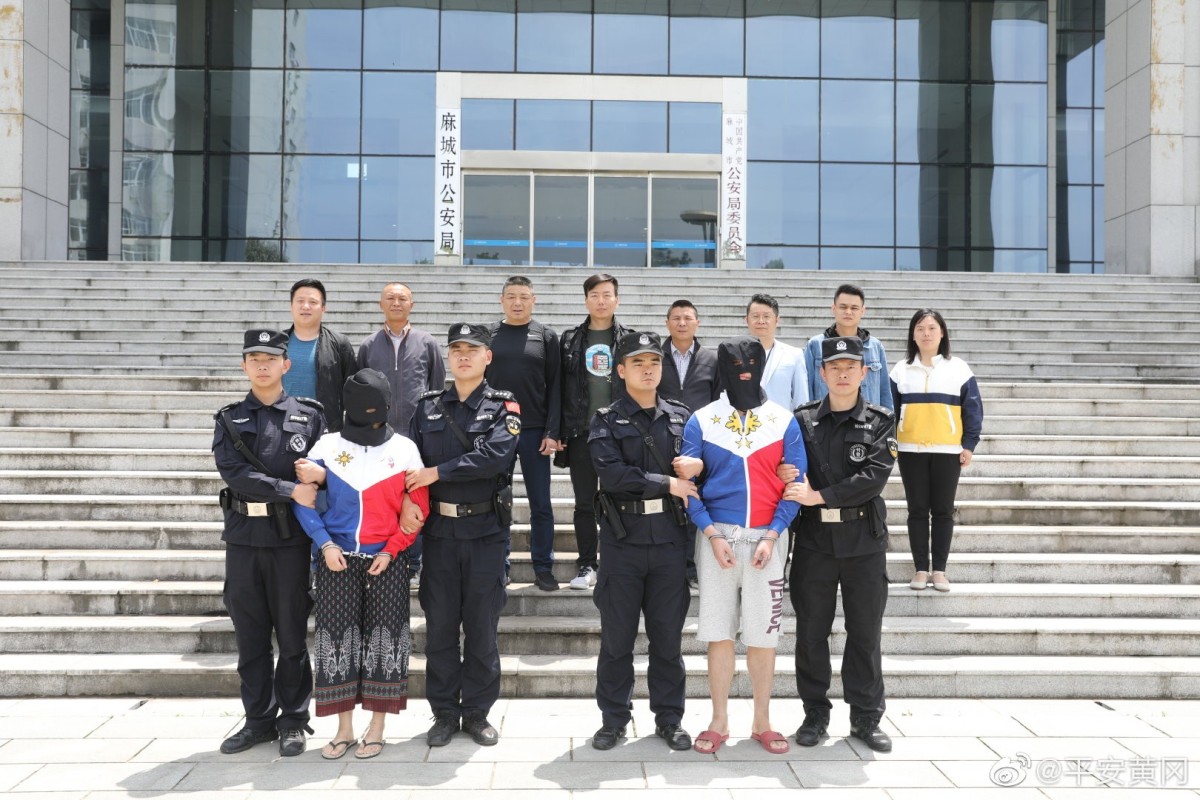
Chinese police with the last two principal suspects in the Philippines on April 26. Photo: Weibo
Chinese police have arrested 20 people from a cross-border group accused of operating illegal live streaming platforms to broadcast pornographic content, according to mainland online news outlet The Paper.
After an investigation lasting over a year, police in Macheng in central China’s Hubei province said they arrested the last two main suspects, a man surnamed Hong and a woman surnamed Li, in the Philippines on April 26.
Their 
live-streaming

platform, which was initially called Huahua, had more than 900,000 registered users, earning the group 16 million yuan (US$2.3 million) in profit in five months from November 2017, according to the report.

The Chinese government announced in February 2018 it was 
launching a campaign

against pornographic and illegal publications to foster a healthy online environment.The next month, Macheng police received a tip-off that people were distributing QR codes to download Huahua in chat groups on the popular Chinese messaging app QQ.

On the Huahua platform, live streamers gave erotic performances, with the most popular streamers drawing more than 2,000 viewers at a time and users able to make requests by paying up to almost 2,000 yuan (US$290).

The group had a structure and rules designed to avoid the police’s attention, the report said. Members did not know each other’s identities and each had only one point of contact.

Some recruited streamers, others promoted the app on social platforms to attract traffic, and members in Mongolia laundered money with foreign bank accounts, while the app’s appearance and servers were changed several times, the report said.

After 18 people were arrested by April 2018 across the country, including in Shanghai and Guangdong, the No 1 suspect, the Mongolia-based Hong, fled to South Korea then to the Philippines, where he met Li and they built a similar app, according to the report.

The report said Hong had owned a company in Shanghai focusing on developing video games before turning to pornographic live streaming to make money quickly when the gaming business struggled.

Source: SCMP

20/04/2019

Chile, Mongolia, Nepal, Portugal, Switzerland presidents, Austria Chancellor to visit China

BEIJING, April 19 (Xinhua) — The presidents of Chile, Mongolia, Nepal, Portugal, and Switzerland will pay state visits to China and attend the second Belt and Road Forum for International Cooperation (BRF) next week, at the invitation of Chinese President Xi Jinping, Foreign Ministry spokesperson Lu Kang announced Friday.

Chilean President Sebastian Pinera and Mongolian President Khaltmaa Battulga will visit China from April 24 to 28; Nepali President Bidhya Devi Bhandari will visit from April 24 to May 2; Portuguese President Marcelo Rebelo de Sousa will visit from April 28 to May 2, and Ueli Maurer, president of the Swiss Confederation, will visit from April 23 to 30, Lu said.

Bhandari will also attend the opening ceremony of the 2019 Beijing International Horticultural Exhibition, according to Lu.

Chancellor of Austria Sebastian Kurz will pay an official visit to China from April 25 to 29 and attend the second BRF, at the invitation of Chinese Premier Li Keqiang, Lu announced.

Source: Xinhua

20/04/2019

Xi to address Belt and Road forum next week: FM

CHINA-BEIJING-BRF-PRESS BRIEFING (CN)

Chinese State Councilor and Foreign Minister Wang Yi (C) speaks during a press briefing for the second Belt and Road Forum for International Cooperation (BRF) in Beijing, capital of China, April 19, 2019. The second Belt and Road Forum for International Cooperation will be held from April 25 to 27 in Beijing, Wang Yi announced Friday. (Xinhua/Zhai Jianlan)

BEIJING, April 19 (Xinhua) — Chinese President Xi Jinping will deliver a keynote speech at the second Belt and Road Forum for International Cooperation (BRF) to be held from April 25 to 27 in Beijing, State Councilor and Foreign Minister Wang Yi announced Friday.

Leaders including heads of state and government from 37 countries will attend the forum’s roundtable summit, Wang told a press briefing.

Wang said 12 thematic forums and a CEO conference would be held on April 25, the opening ceremony and a high-level meeting on April 26, and the leaders’ roundtable on April 27.

Xi will attend the opening ceremony and deliver a keynote speech. He will also chair the leaders’ roundtable and brief media from home and abroad about the outcomes after the roundtable, Wang said, adding that Xi and his wife Peng Liyuan will also hold a welcoming banquet for the leaders and representatives.

According to Wang, the 37 countries are Austria, Azerbaijan, Belarus, Brunei, Cambodia, Chile, Cyprus, Czech Republic, Djibouti, Egypt, Ethiopia, Greece, Hungary, Indonesia, Italy, Kazakhstan, Kenya, Kyrgyzstan, Laos, Malaysia, Mongolia, Mozambique, Myanmar, Nepal, Pakistan, Papua New Guinea, the Philippines, Portugal, Russia, Serbia, Singapore, Switzerland, Tajikistan, Thailand, the United Arab Emirates, Uzbekistan and Vietnam.

The secretary-general of the United Nations and the managing director of the International Monetary Fund will attend the forum, Wang said, adding that senior representatives of France, Germany, Britain, Spain, Japan, the Republic of Korea and the European Union will also participate.

Noting that the BRF is the top-level platform for international cooperation under the framework of the Belt and Road Initiative, Wang said the conference next week would be of landmark significance.

The theme of the second BRF is “Belt and Road Cooperation, Shaping a Brighter Shared Future.” Wang said the main purpose is to promote the high-quality development of Belt and Road cooperation, which is the common aspiration of countries participating in the initiative.

Speaking highly of the fruitful results yielded since the initiative was launched in 2013, Wang said the second BRF was greatly welcomed worldwide with some 5,000 participants from more than 150 countries and 90 international organizations having confirmed their attendance, covering areas from five continents and different walks of life such as government, civil society, business and academia.

According to Wang, this year’s forum will have 12 thematic forums, twice of that during the first forum in 2017, and the CEO conference will be held for the first time. A joint communique will be released after the leaders’ roundtable and other consensus reached during the forum will be issued in a report.

The Belt and Road Initiative, proposed by Xi in 2013, aims at enhancing all-around connectivity through infrastructure construction, exploring new driving force for the world economic growth, and building a new platform for world economic cooperation, according to Wang.

Stressing that Xi and leaders from other countries blueprinted the initiative in 2017, Wang said the progress in the past two years shows that the initiative conforms to the trend of the times featuring peace, development, cooperation and win-win and accords with the common aspiration of openness and joint development of all countries.

“As the host country, we will maintain close communication and coordination with all parties to prepare for the forum with openness, inclusiveness and transparency, upholding the principle of consultation and cooperation for shared benefits,” Wang said.

He said the forum would voice the firm support for multilateralism and an open world economy, enrich the principles of cooperation of the Belt and Road Initiative, build a network of partnership, and establish more mechanisms for high-quality development.

Bilateral, trilateral and multilateral cooperation has been reinforcing each other under the initiative, laying a solid foundation for a closer and more wide-ranging partnership, he said.

Wang said China will showcase the outcomes and introduce the measures of its reform and opening-up to the world, adding that this will allow China to share the dividends of its economic growth, promote the Belt and Road Initiative, and bring more opportunities to the development of all countries as well as the building of the Belt and Road.

“I believe that the forum will inject stronger impetus into the world economy, open even broader horizon for the development of the countries, and contribute to the building of a community with a shared future for humanity, ” said Wang.

Source: Xinhua

Law of Unintended Consequences

continuously updated blog about China & India

ChiaHou's Book Reviews

continuously updated blog about China & India

What's wrong with the world; and its economy

continuously updated blog about China & India