Chindia Alert: You’ll be Living in their World Very Soon
aims to alert you to the threats and opportunities that China and India present. China and India require serious attention; case of ‘hidden dragon and crouching tiger’.
Without this attention, governments, businesses and, indeed, individuals may find themselves at a great disadvantage sooner rather than later.
The POSTs (front webpages) are mainly 'cuttings' from reliable sources, updated continuously.
The PAGEs (see Tabs, above) attempt to make the information more meaningful by putting some structure to the information we have researched and assembled since 2006.
NEW DELHI/MUMBAI (Reuters) – India’s ruling Bharatiya Janata Party (BJP) is set to sweep two state polls next week, the first since Prime Minister Narendra Modi’s landslide win in a parliamentary election in May, a leading pollster said.
The BJP is set to comfortably win elections in the western state of Maharashtra and the northern state of Haryana, leaving the main opposition Congress party trailing, according to a survey by polling agency CVoter released on Friday.
CVoter estimates that a BJP-led alliance in Maharashtra will pick up 194 of the 288 seats on offer. In Haryana, the party is predicted to win 83 of the state’s 90 seats, leaving just three for Congress.
Voting in the elections will be held on Monday with the results expected to be announced on Thursday.
Several Congress party officials conceded they had all but given up hope of posing a serious challenge to Modi and the BJP.
In particular, the resignation of Congress chief Rahul Gandhi in July, after weeks of drama following the loss to the BJP in the general election, has sown internal confusion, triggering infighting and exits, two party officials in New Delhi said.
“It’s going to be a rout, and it will deflate morale even further,” one of the officials said, referring to the state elections. “It’s like a slow-moving disaster.”
They requested anonymity because they are not authorised to speak to the media.
Pranav Jha, the secretary in charge of Congress’s communication department, said the party was undergoing a period of “cleansing and churning” and remained committed to taking on the BJP.
“The people of India…can see through the diversionary drama of the ruling party, and realise that jobs, economy and issues of farmers can only be put on track by the Congress party,” Jha told Reuters.
Modi, analysts say, has moved decisively, including withdrawing special rights for Muslim-majority Jammu and Kashmir state, and consolidating the BJP’s hold over India’s Hindu-majority electorate.
INFIGHTING, INDIFFERENCE
In Maharashtra, one of India’s most industrialised states which includes Mumbai, two Congress officials said the top leadership’s relative indifference and infighting had hurt their already weak campaign.
Congress’s state wing had asked for Gandhi, his mother and current party chief Sonia Gandhi, and his charismatic sister Priyanka Gandhi Vadra to join the campaign, one of the two officials said.
But only Rahul Gandhi came and spoke at a handful of rallies.
“Senior leaders from BJP have covered every district. They have been visiting Maharashtra for the last two months to build momentum,” said one Congress official, who is contesting the upcoming poll.
“There wasn’t any concrete effort from Congress leaders in New Delhi to give energy to our cadre,” he said.
The list of recent resignations from the party include Ashok Tanwar, Congress’s former chief in Haryana who quit earlier this month and is now campaigning against his old party.
“The state of affairs in the Congress party is so dire that the decision makers can’t win an election themselves, while the soldiers on ground who stay in touch with the masses are neglected,” Tanwar wrote in his resignation letter.
The situation has even riled Congress allies. Two leaders from the Nationalist Congress Party, which is in alliance with the Congress in Maharashtra, said their partner was slack.
“It looks like Congress is not very serious about the state elections,” one of the leaders said. “Congress is not in the picture. Congress leaders are not attacking the ruling party the way we expected.”
In New Delhi, Congress officials said there was a sense of inertia at the party headquarters, without any understanding of who will become president after Sonia Gandhi, who is only holding charge temporarily.
“Without a clear leadership, nothing is going to change,” one of the officials said, “If it continues like this, the party will fade away.”
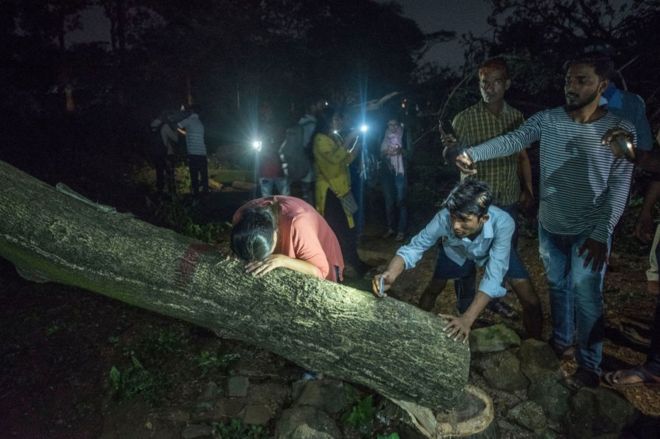
Image copyright GETTY IMAGESImage caption Protesters cry over felled trees in Aarey colony
India’s top court has asked officials to stop cutting trees in a forested area in Mumbai city after protesters clashed with police over the weekend.
The trees, part of a green strip known as Aarey colony, were being cut to make way for a new metro rail project.
Locals have long opposed the move, and filed petitions seeking Aarey to be declared a protected area.
But a high court dismissed the petitions on Friday, sparking protests as officials began felling the trees.
They planned to cut 2,185 trees, and admitted in the Supreme Court that more than 1,500 had already been cut. But petitioners claim that officials have cut around 2,500 trees.
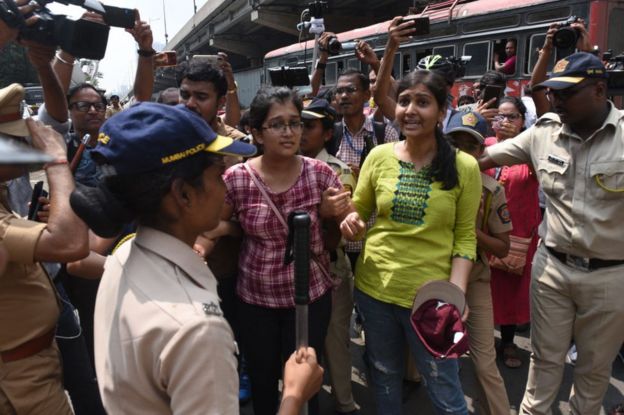
Local residents, students and environmental activists clashed with police on Friday as they took to the streets to stop authorities, and even broke through barricades to enter Aarey colony. More than 50 people were arrested and police imposed restrictions on public gatherings.
The protests grabbed the national spotlight over the weekend, and the Supreme Court took suo moto (without a formal complaint from any party) notice.
What did the Supreme Court say?
A special two-judge bench heard the matter on Monday after students wrote to the chief justice, asking the court to intervene and save the trees.
The court asked the state government of Maharashtra, where Mumbai is located, to not cut any more trees.
Image copyright GETTY IMAGESImage caption Police arrested more than 50 protesters
The court also asked the government to maintain “status quo” – which means that no construction can take place – until 21 October when it will hear the matter again.
The court also ordered the release of all activists who were arrested or detained on bail.
What is Aarey colony?
Spread over 1,300 hectares (3,212 acres), Aarey is a densely forested area dotted with lakes and has the Mithi river flowing through it. It lies at the heart of Mumbai and is often referred to as its last green lung.
It’s locally known as the Aarey “milk colony” because most of the land was given to the department of dairy development in 1951. But they are allowed to grow cattle fodder only on a fraction of the land.
Image copyright GETTY IMAGESImage caption Protesters broke through barricades and clashed with police on Friday
Earlier this year, officials cleared some 40 hectares of the forested area to build a zoo, complete with a night safari. And now, locals complain, another slice of it is in danger from the metro construction.
They also fear that the government will eventually clear the way for private builders to encroach on the Sanjay Gandhi National Park, which lies to the north of Aarey colony.
Officials, however, dismiss these fears as unfounded and point out that the construction for the metro only requires 30 hectares.
How crucial is the metro rail for Mumbai?
The city badly needs a “mass rapid transport system,” Ashwini Bhide, managing director of the Mumbai metro rail corporation, had told the BBC earlier.
The land in Aarey colony, she said, was “the most suitable land due to its size, shape and location”.
She has also been defending the decision to cut the trees on Twitter.
India’s financial hub is congested and infamous for its crawling traffic jams.
Its colonial-era local train system ferries some 7.5 million people between the city’s suburbs and its centre on a daily basis.
Officials say that the metro will eventually carry around 1.7 million passengers every day and bring down the number of vehicles on the road by up to 650,000.
MUMBAI (Reuters) – At least 11 people have been killed and six are missing after the Western Indian city of Pune and its neighbouring areas were hit by heavy rain and flash floods, a government official said on Wednesday.
More than 28,000 people have been evacuated from low-lying areas and the local administration is on alert for more rain, Deepak Mhaisekar told Reuters.
Pune, which is around 200 kilometres (124 miles) east of India’s financial hub of Mumbai, has received 113% more rainfall than average since the start of the monsoon season in early June, a weather department official said.
Of the 11 deaths, five occurred in Pune when a wall collapsed, said Mhaisekar.
South Asia gets monsoon rain annually during the June-September months which cause fatalities and mass displacement.
India’s monsoons, which deliver more than 70% of the country’s annual rainfall, are crucial for farm output and economic growth, but rainfall often weakens the foundations of poorly built walls and buildings resulting in deaths.
Leo Tolstoy’s War and Peace is in the news in India after a judge asked an activist to explain why he had a book “about war in another country”.
Vernon Gonsalves had appeared in the high court in Mumbai city on Wednesday for a hearing on his bail plea.
The judge’s question sparked a flurry of tweets, with users both outraged and bemused by it.
Five activists, including Mr Gonsalves, were arrested in August 2018 in connection with caste-based violence.
Police raided and searched their homes at the time and submitted a list of books, documents and other belongings to the court. The public prosecutor told the court that police had found “incriminating evidence” in Mr Gonsalves’ home, including “books and CDs with objectionable titles”.
“Why were you having these books and CDs at your home? You will have to explain this to the court,” the judge told Mr Gonsalves.
Police said that all five activists incited Dalits (formerly untouchables) at a large public rally on 31 December 2017, leading to violent clashes that left one person dead. They accused them of “radicalising youth” and taking part in “unlawful activities” which led to violence and showed “intolerance to the present political system”.
The arrests had been criticised by many at the time who saw them as an attack on free speech, and even a “witch hunt” against those who challenged the governing Bharatiya Janata Party (BJP).
So the judge’s question quickly made news and War and Peace was soon trending on Twitter.
The tweets ranged from jokes to shock over the state of India’s judiciary.
Others wondered how they would fare in a courtroom given what’s on their bookshelf, and some have issued a call out asking people to share books from their own “subversive” collection.
Image copyright AFPImage caption India is affected by seasonal monsoon rains between June and September
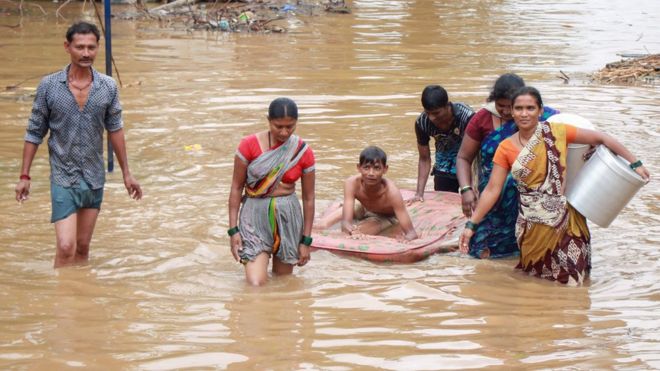
At least 95 people have been killed by monsoon flooding in southern and western India, while hundreds of thousands have been evacuated from their homes, according to reports.
More than 40 of those killed were in the south-western state of Kerala.
The flooding and landslides caused by the heavy seasonal rainfall have left some areas cut off.
Officials have called on those affected to try to seek shelter on higher ground.
India is affected by monsoon rains between June and September. While crucial to replenishing water supplies, the heavy rainfall also results in death and destruction each year.
Disaster management officials said more than 100,000 people in Kerala had been evacuated into emergency relief camps, while more than 40 had been killed.
“There are around 80 places where flood and rains have triggered mudslides, which we cannot reach,” state police spokesman Pramod Kumar told AFP news agency.
With the rains predicted to continue there in the coming days, the military is attempting to airlift food to stranded villages.
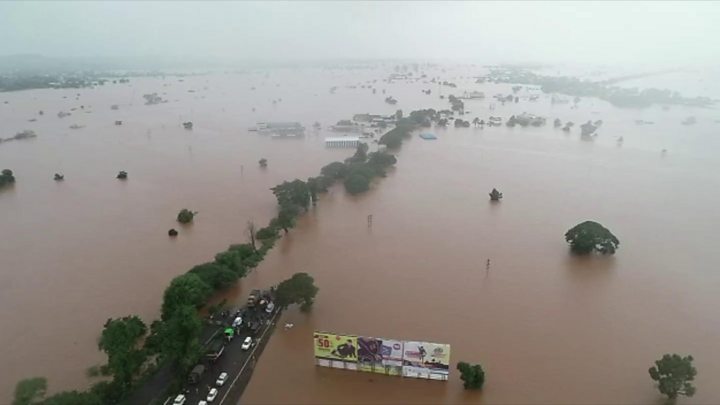
Media caption Aerial shots of flood-hit Indian states
The south-western state of Karnataka and western state of Maharashtra – which is home to India’s financial capital Mumbai – are also experiencing heavy rains, with dozens of fatalities reported and hundreds of thousands of people evacuated.
India’s National Disaster Management Authority issued warnings on Saturday for “heavy” to “extremely heavy” rainfall in several parts of the country, as well as strong winds.
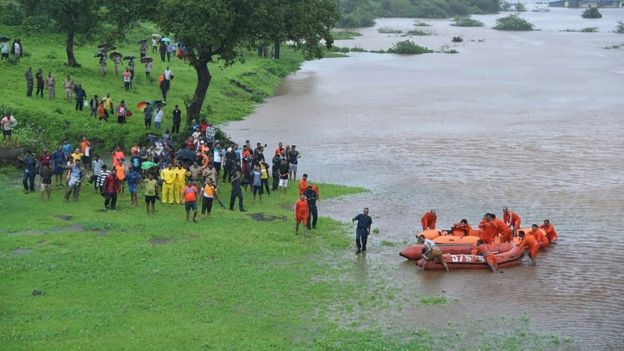
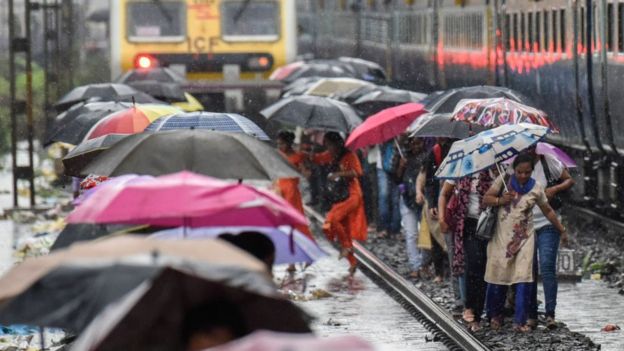
Indian authorities have rescued 1,050 people from a train after it became trapped by flooding near Mumbai.
Helicopters, boats and diving teams were deployed by the Indian authorities after the Mahalaxmi Express was stranded on Friday night close to the town of Vangani.
Passengers told news agency IANS they were ordered to stay onboard but had had no food or water for 15 hours.
Weeks of monsoon flooding in south Asia has killed over 600 people.
Images released by the NDRF show passengers being rescued in rubber boats.
Image copyright AFPImage caption Nine pregnant women are reportedly among those who have been rescued
Train operator Central Railway said all passengers – including nine pregnant women – had been recovered and taken to safety.
A temporary camp has been set up nearby with food and medical supplies.
A spokesperson for the train operator also said alternative travel arrangements had been arranged for passengers affected.
Most areas in the nearby towns of Badlapur, Ulhasnagar, Vangani have been submerged as heavy rains battered the region this week, swelling local rivers.
Other transport has also been hit by flooding in Mumbai, with 11 flights cancelled and several others diverted by from the city’s airport.
With unusually severe rainfall in India’s financial capital Mumbai over the past few weeks, and severe drought conditions elsewhere in the country, questions are being raised about whether these extreme events are becoming more common.
Reality Check has had a look at the available data for floods and drought over time to see if any patterns are emerging.
First, the rainfall
India relies on the heavy rains of the annual monsoon season for most of its water needs.
The rains arrive in different parts of the country at different times and, if they are early or late, with devastating consequences for farmers. If they are unusually heavy, built-up areas can face severe disruption.
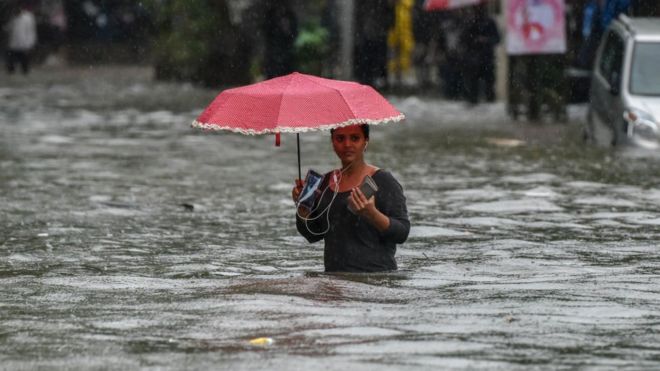
In recent days, Mumbai has been particularly badly affected, with at least 30 flood-related deaths, and the city’s top civic official says its infrastructure has not been able to cope with the erratic rainfall patterns.
Media caption Deadly floods has brought India’s financial capital to a standstill
But is there a longer-term pattern?
Looking at the annual data from the 36 weather stations that monitor monsoon rainfall across the country, no clear pattern emerges.
Yes, the rainfall levels are unpredictable and erratic, but figures since 2002 show no indication of an increase in the extremes of monsoon rainfall.
Mumbai is a good example of the problems faced by urban planners in dealing with the annual monsoon rains.
When, in 2005, at least 900 died in floods in Mumbai, a decision was made to build eight stations to pump out water. Two of them are yet to be built.
Large parts of the city are built on land reclaimed from the sea and many blame poor planning and rapid construction for the annual rain chaos.
Mumbai’s centuries-old storm drains discharge rainwater through outfalls into the sea and the city’s Mithi river, but these outfalls get blocked when high tides coincide with heavy rain.
Their capacity is also affected by silting and dumping of solid waste.
A plan to revamp the city’s drains began back in 1993, but critics say not enough has been done.
MUMBAI (Reuters) – Monsoon rains caused wall collapses that killed 27 people in India on Tuesday, as a second day of bad weather disrupted rail and air traffic in the financial capital Mumbai, prompting officials to shut schools and offices, though markets were open.
During every monsoon season, which runs from June to September, India experiences fatal incidents of building and wall collapses as rainfall weakens the foundations of poorly-built structures.
Heavy rain brought a wall crashing down on shanties built on a hill slope in Malad, a western suburb of Mumbai, a fire brigade official said, killing 18 people.
“Rescue work is still going on,” the official added. “So far we have rescued more than two dozen people.”
Three people died when a school wall collapsed in the city of Kalyan, 42 km (26 miles) north of Mumbai.
In the nearby western city of Pune, six people were killed in a wall collapse on Tuesday, a fire brigade official said, after a similar incident on Saturday killed 15.
Mumbai is looking to turn itself into a global financial hub but large parts of the city struggle to cope with annual monsoon rains, as widespread construction and garbage-clogged drains and waterways make it increasingly vulnerable to chaos.
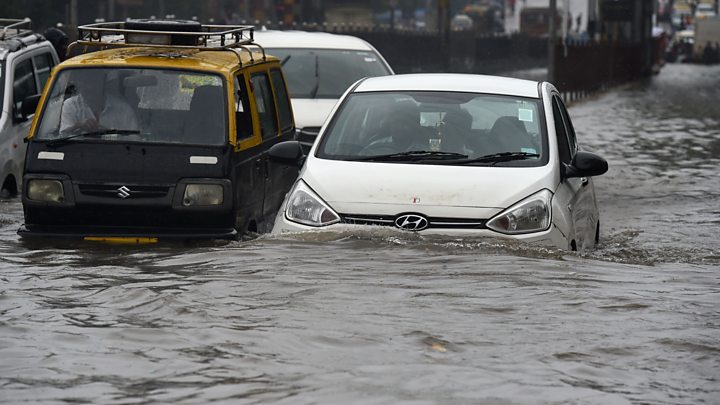
More than 300 mm (11.8 inches) of rain fell over 24 hours in some areas of Mumbai, flooding streets and railway tracks, forcing the suspension of some suburban train services, which millions of commuters ride to work each day.
About 1,000 people stranded in low-lying areas of the city were rescued after a swollen river began to overflow, municipal authorities said.
As weather officials forecast intermittent heavy showers and isolated extremely heavy rainfall, authorities called a holiday for government offices and educational institutions.
“Rain is expected to remain intense even today,” city authorities said on Twitter. “We request you to stay indoors unless there’s an emergency.”
Financial markets were open on Tuesday, though trading volumes were expected to be lower than normal. Many firms asked employees to work from home.
The main runway at Mumbai airport, India’s second biggest, was closed from midnight after a SpiceJet flight overshot the runway while landing, an airport spokeswoman said.
The secondary runway is operational, but 55 flights were diverted and another 52 were cancelled due to bad weather, she said.
In 2005, floods killed more than 500 people in Mumbai, the majority in shantytown slums home to more than half the city’s population.
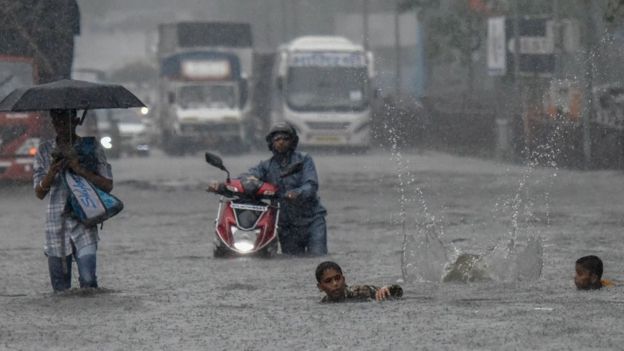
MUMBAI (Reuters) – Heavy rains battered India’s financial capital Mumbai on Monday causing disruption to the commuter train network, snarling traffic on water-logged streets and delaying flights from the country’s second-busiest airport.
The city, home to India’s two biggest stock exchanges and the headquarters of several major companies, has been hit by heavy rain since Sunday night and could get more over the next 24 hours, the weather department said.
Suburban trains were delayed by as much as two hours because the tracks were submerged under water while some long distance trains were cancelled.
Several flights were delayed by around half an hour, said a spokeswoman for Mumbai International Airport.
Thousands of commuters were stranded in trains and vehicles during peak morning hours as they tried to reach offices.
“Fifty minutes train journey took two and half hours today as railway tracks were flooded,” said Ketan Bondre, who works for a private sector company.
Although Mumbai is trying to build itself into a global financial hub, large parts of the city struggle to cope with annual monsoon rains.
Unabated construction on floodplains and coastal areas, as well as storm-water drains and waterways clogged by plastic garbage, have made the city increasingly vulnerable to chaos.
Floods in 2005 killed more than 500 people in Mumbai. The majority of deaths occurred in shanty town slums, which are home to more than half of Mumbai’s population.
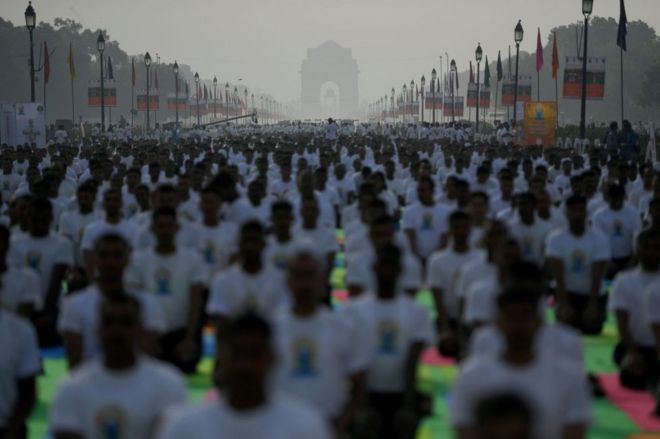
Indians across the country celebrated the fifth international yoga day on Friday.
Temperatures are soaring in many cities, including the capital Delhi, but that didn’t stop people from gathering outdoors and stretching and bending their way through at least an hour of yoga.
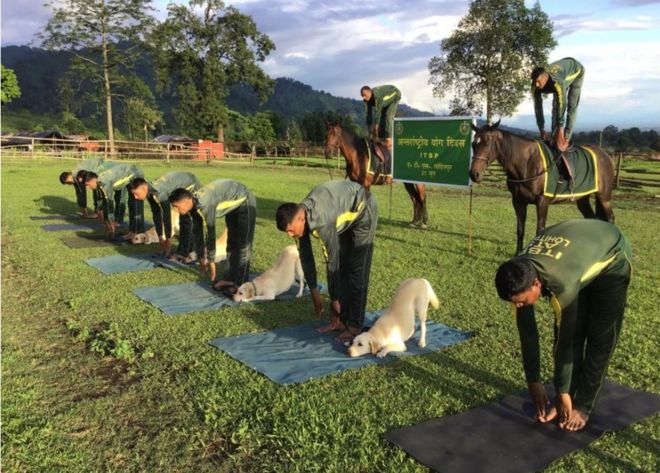
And everyone joined in – even the dog unit of the Indian army!
Image copyright @SPOKESPERSONMOD/TWITTER
The Indo-Tibetan border police – and their dogs and horses – were not about to be outdone. They practised what they called yoga, doga and hoga.
And they were luckier than many of their counterparts – they got to practise their yoga in cooler climes, along India’s scenic Himalayan border.
Image copyrightI TBPOFFICIAL
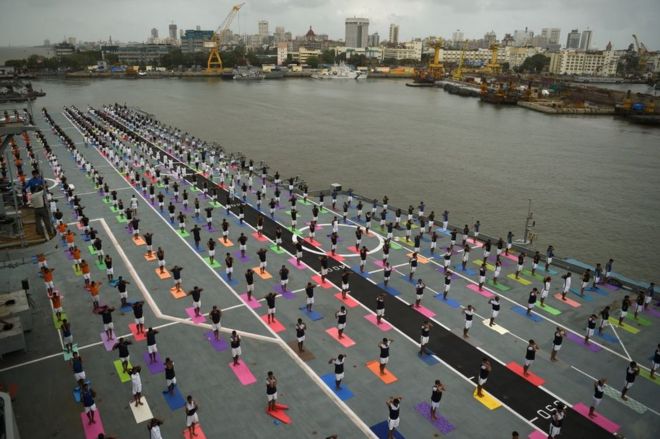
Among those who did yoga in more hostile climates were the armed forces on board the naval aircraft carrier INS Viraat which is docked off the coastline of sweltering Mumbai city.
Image copyright GETTY IMAGES
In Gujarat, the soldiers got a little more creative with their yoga.








 CHINDIA ALERT: You'll be living in their world, very soon