Archive for ‘Muslims’

16/03/2020

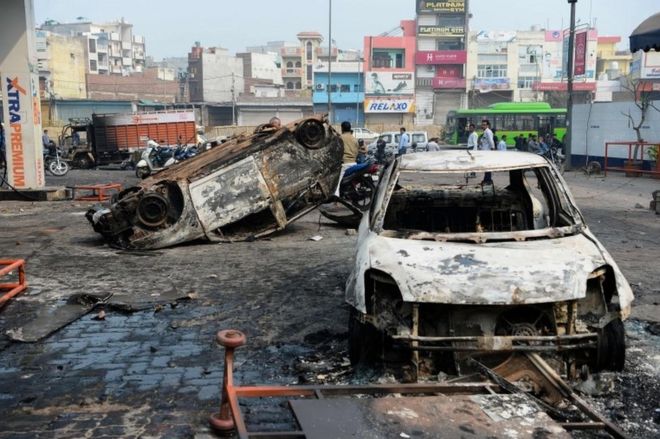
In Indian capital, riots deepen a Hindu-Muslim divide

NEW DELHI (Reuters) – For years, Hindus and Muslims lived and worked peacefully together in Yamuna Vihar, a densely populated Delhi district.

But the riots that raged through the district last month appear to have cleaved lasting divisions in the community, reflecting a nationwide trend as tensions over the Hindu nationalist agenda of Prime Minister Narendra Modi boil over.

Many Hindus in Yamuna Vihar, a sprawl of residential blocks and shops dotted with mosques and Hindu temples, and in other riot-hit districts of northeast Delhi, say they are boycotting merchants and refusing to hire workers from the Muslim community. Muslims say they are scrambling to find jobs at a time when the coronavirus pandemic has heightened pressure on India’s economy.

“I have decided to never work with Muslims,” said Yash Dhingra, who has a shop selling paint and bathroom fittings in Yamuna Vihar. “I have identified new workers, they are Hindus,” he said, standing in a narrow lane that was the scene of violent clashes in the riots that erupted on Feb. 23.

The trigger for the riots, the worst sectarian violence in the Indian capital in decades, was a citizenship law introduced last year that critics say marginalises India’s Muslim minority. Police records show at least 53 people, mostly Muslims, were killed and more than 200 were injured.

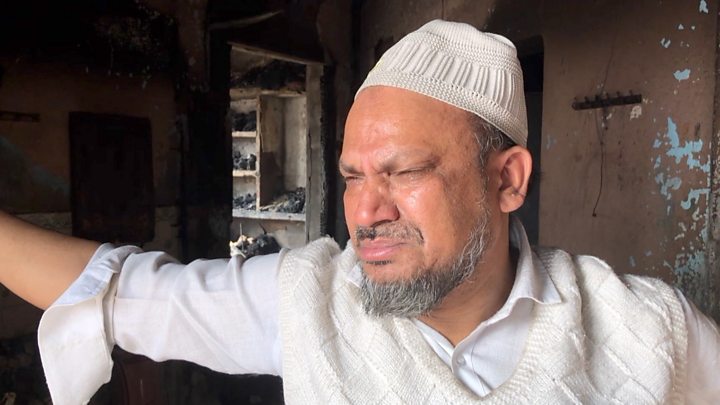
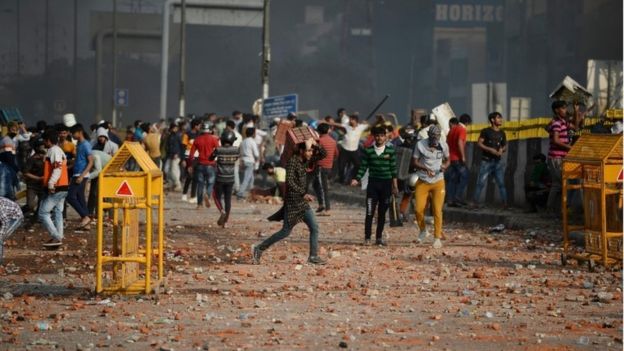
Dhingra said the unrest had forever changed Yamuna Vihar. Gutted homes with broken doors can be seen across the neighbourhood; electricity cables melted in the fires dangle dangerously above alleys strewn with stones and bricks used as makeshift weapons in the riots.

Most Hindu residents in the district are now boycotting Muslim workers, affecting everyone from cooks and cleaners to mechanics and fruit sellers, he said.

“We have proof to show that Muslims started the violence, and now they are blaming it on us,” Dhingra said. “This is their pattern as they are criminal-minded people.”

Those views were widely echoed in interviews with 25 Hindus in eight localities in northeast Delhi, many of whom suffered large-scale financial damages or were injured in the riots. Reuters also spoke with about 30 Muslims, most of whom said that Hindus had decided to stop working with them.

Suman Goel, a 45-year-old housewife who has lived among Muslim neighbours for 23 years, said the violence had left her in a state of shock.

“It’s strange to lose a sense of belonging, to step out of your home and avoid smiling at Muslim women,” she said. “They must be feeling the same too but it’s best to maintain a distance.”

Mohammed Taslim, a Muslim who operated a business selling shoes from a shop owned by a Hindu in Bhajanpura, one of the neighbourhoods affected by the riots, said his inventory was destroyed by a Hindu mob.

He was then evicted and his space was leased out to a Hindu businessman, he said.

“This is being done just because I am a Muslim,” said Taslim.

Many Muslims said the attack had been instigated by hardline Hindus to counter protests involving tens of thousands of people across India against the new citizenship law.

“This is the new normal for us,” said Adil, a Muslim research assistant with an economic think tank in central Delhi. “Careers, jobs and business are no more a priority for us. Our priority now is to be safe and to protect our lives.”

He declined to disclose his full name for fear of reprisals.

Emboldened by Modi’s landslide electoral victory in 2014, hardline groups began pursuing a Hindu-first agenda that has come at the expense of the country’s Muslim minority.

Vigilantes have attacked and killed a number of Muslims involved in transporting cows, which are seen as holy animals by Hindus, to slaughterhouses in recent years. The government has also adopted a tough stance with regard to Pakistan, and in August withdrew semi-autonomous privileges for Jammu and Kashmir, India’s only Muslim-majority state.

In November, the Supreme Court ruled that a Hindu temple could be built at Ayodhya, where a right-wing mob tore down a 16th-century mosque in 1992, a decision that was welcomed by the Modi government.

The citizenship law, which eases the path for non-Muslims from neighbouring Muslim-majority nations to gain citizenship in India, was the final straw for many Muslims, as well as secular Indians, sparking nationwide protests.

Modi’s office did not respond to questions from Reuters about the latest violence.

NIGHT VIGILANTES

During the day, Hindus and Muslims shun each other in the alleys of the Delhi districts that were hardest hit by the unrest in February. At night, when the threat of violence is greater, they are physically divided by barricades that are removed in the morning.

And in some areas, permanent barriers are being erected.

On a recent evening, Tarannum Sheikh, a schoolteacher, sat watching two welders install a high gate at the entrance of a narrow lane to the Muslim enclave of Khajuri Khas, where she lives. The aim was to keep Hindus out, she said.

“We keep wooden batons with us to protect the entrance as at any time, someone can enter this alley to create trouble,” she said. “We do not trust the police anymore.”

In the adjacent Hindu neighbourhood of Bhajanpura, residents expressed a similar mistrust and sense of insecurity.

“In a way these riots were needed to unite Hindus, we did not realise that we were surrounded by such evil minds for decades,” said Santosh Rani, a 52-year-old grandmother.

She said she had been forced to lower her two grandchildren from the first floor of her house to the street below after the building was torched in the violence, allegedly by a Muslim.

“This time the Muslims have tested our patience and now we will never give them jobs,” said Rani who owns several factories and retail shops. “I will never forgive them.”

Hasan Sheikh, a tailor who has stitched clothing for Hindu and Muslim women for over 40 years, said Hindu customers came to collect their unstitched clothes after the riots.

“It was strange to see how our relationship ended,” said Sheikh, who is Muslim. “I was not at fault, nor were my women clients, but the social climate of this area is very tense. Hatred on both sides is justified.”

Source: Reuters
03/03/2020

Indian police detain hundreds after Hindu-Muslim clashes in New Delhi

NEW DELHI (Reuters) – Indian police said on Friday they had detained hundreds of people and were keeping a heavy presence in northeast New Delhi, days after the worst bout of sectarian violence in the capital in decades.

At least 38 people were killed in Hindu-Muslim violence this week, police said, amid mounting international criticism that authorities failed to protect minority Muslims.

Media said the toll was likely to rise.

Delhi police spokesman M.S. Randhawa said police were collecting evidence, reviewing video footage of the violence and had already detained more than 600 people.

“The detentions were important to bring the situation under control,” Randhawa told reporters, adding that there had been no new reports of violence.

The clashes began over a citizenship law that Prime Minister Narendra Modi’s Hindu nationalist government introduced in December providing a path to Indian citizenship for six religious groups from neighbouring countries – but not Muslims.

Critics say the law is discriminatory and comes on top of other measures such as withdrawal of autonomy for Muslim-majority Jammu and Kashmir that has deepened disquiet about the future of India’s 200 million Muslims.

Critics of the government however blamed this week’s violence on members of Modi’s Bharatiya Janata Party (BJP), which was trounced in local Delhi elections at the beginning of the month. The BJP has denied the allegations.

The violence morphed into street battles between Hindu and Muslim groups with the police largely ineffective in ending the violence.

The Organisation of Islamic Countries (OIC) has condemned the violence against Muslims and vandalism of mosques and Muslim-owned properties.

U.S. Democratic presidential hopeful Bernie Sanders accused President Donald Trump of failing on the issue of human rights after he refused to be drawn into criticising New Delhi for its handling of the violence.

Trump was on a state visit to India when the violence broke out.

Source: Reuters

26/02/2020

Why Delhi violence has echoes of the Gujarat riots

Local residents look at burnt-out vehicles following clashes between people supporting and opposing a contentious amendment to India"s citizenship law, in New Delhi on February 26, 2020Image copyright AFP
Image caption Delhi remains on edge after three days of rioting

The religious violence which has roiled Delhi since the weekend is the deadliest in decades.

What began as small clashes between supporters and opponents of a controversial citizenship law quickly escalated into full-blown religious riots between Hindus and Muslims, in congested working class neighbourhoods on the fringes of the sprawling capital.

Armed Hindu mobs rioted with impunity as the police appeared to look the other way. Mosques and homes and shops of Muslims were attacked, sometimes allegedly with the police in tow. Journalists covering the violence were stopped by the Hindu rioters and asked about their religion. Videos and pictures emerged of the mob forcing wounded Muslim men to recite the national anthem, and mercilessly beating up a young Muslim man. Panicky Muslims began leaving mixed neighbourhoods.

On the other side, Muslim rioters have also been violent – some of them also armed – and a number of Hindus, including security personnel, are among the dead and injured.

Media caption Delhi religious riots: ‘Mobs set fire to my house and shop’

Three days and 20 deaths later, Prime Minister Narendra Modi tweeted his first appeal for peace. There were no commiserations for the victims. Delhi’s governing Aam Aadmi Party was criticised for not doing much either. Many pointed to the egregious failure of Delhi’s police – the most well-resourced in India – and the inability of opposition parties to rally together, hit the streets and calm tensions. In the end, the rioters operated with impunity, and the victims were left to their fate.

Demonstrators gather along a road scattered with stones following clashes between supporters and opponents of a new citizenship law, at Bhajanpura area of New Delhi on February 24, 2020Image copyright AFP
Image caption More than 20 people have been killed in the rioting

Not surprisingly, the ethnic violence in Delhi has drawn comparisons with two of India’s worst sectarian riots in living memory. Nearly 3,000 people were killed in anti-Sikh riots in the capital in 1984 after the then prime minister Indira Gandhi was assassinated by her Sikh bodyguards. And in 2002, more than 1,000 people, mostly Muslims, died after a train fire killed 60 Hindu pilgrims in Gujarat – Mr Modi was then the chief minister of the state. The police were accused of complicity in both riots. The Delhi High Court, which is hearing petitions about the current violence, has said it cannot let “another 1984” happen on its “watch”.

Ashutosh Varshney, a professor of political science at Brown University who has extensively researched religious violence in India, believes that the Delhi riots are beginning to “look like a pogrom” – much like the ones in 1984 and 2002.

Pogroms happen, according to Prof Varshney, when the police do not act neutrally to stop riots, look on when mobs go on the rampage and sometimes “explicitly” help the perpetrators. Evidence of police apathy in Delhi has surfaced over the past three days. “Of course, the violence thus far has not reached the scale of Gujarat or Delhi. Our energies should now focus on preventing further escalation,” he says.

Political scientist Bhanu Joshi and a team of researchers visited constituencies in Delhi ahead of February’s state elections. They found the BJP’s “perfectly oiled party machinery constantly giving out the message about suspicion, stereotypes and paranoia”. In one neighbourhood, they found a party councillor telling people: “You and your kids have stable jobs, money. So stop thinking of free, free. [She was alluding to free water and electricity being given to people by the incumbent government.] If this nation doesn’t remain, all the free will also vanish.” Such paranoia about the security of the nation at a time when India has been at its most secure has “widened” existing ethnic divisions and “made people suspicious”, Mr Joshi said.

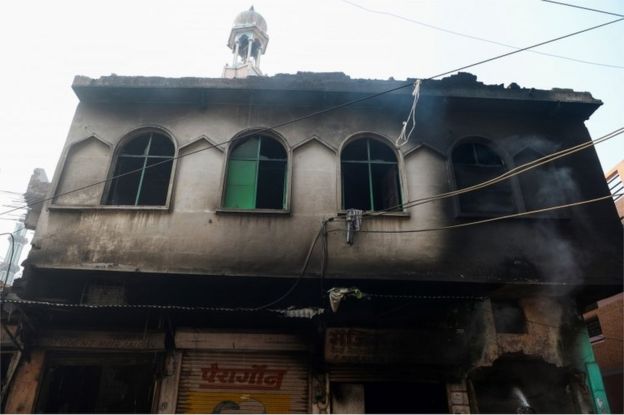
burnt-out mosque and shops are seen following clashes between people supporting and opposing a contentious amendment to India"s citizenship law, in New Delhi on February 26, 2020.Image copyright AFP
Image caption Mosques have been vandalised in the clashes

In the run-up to the Delhi elections Mr Modi’s party embarked on a polarising campaign around a controversial new citizenship law, the stripping of Kashmir’s autonomy and building a grand new Hindu temple on a disputed holy site. Party leaders freely indulged in hate speech, and were censured by poll authorities. A widely reported protest against the citizenship law by women in Shaheen Bagh, a Muslim-dominated neighbourhood in Delhi, was especially targeted by the BJP’s campaign, which sought to show the protesters as “traitors”.

“The repercussion of this campaign machine is the normalisation of suspicion and hate reflected in WhatsApp groups, Facebook pages, and conversations families have among themselves,” says Mr Joshi.

It was only a matter of time before Delhi’s fragile stability would be shaken. On Sunday a BJP leader issued a threat, telling the Delhi police they had three days to clear the sites where people had been protesting against the citizenship law and warned of consequences if they failed to do so. The first reports of clashes emerged later that day. The ethnic violence that followed was a tragedy foretold.

Source: The BBC

18/02/2020

China Uighurs: Detained for beards, veils and internet browsing

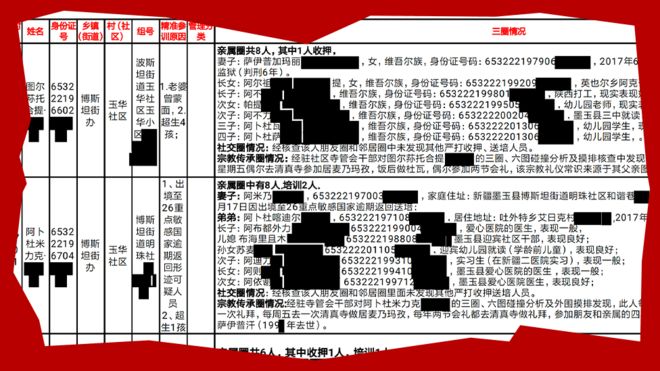
Redacted copy of The Karakax List in ChineseImage copyright UHRP

A document that appears to give the most powerful insight yet into how China determined the fate of hundreds of thousands of Muslims held in a network of internment camps has been seen by the BBC.

Listing the personal details of more than 3,000 individuals from the far western region of Xinjiang, it sets out in intricate detail the most intimate aspects of their daily lives.

The painstaking records – made up of 137 pages of columns and rows – include how often people pray, how they dress, whom they contact and how their family members behave.

China denies any wrongdoing, saying it is combating terrorism and religious extremism.

The document is said to have come, at considerable personal risk, from the same source inside Xinjiang that leaked a batch of highly sensitive material published last year.

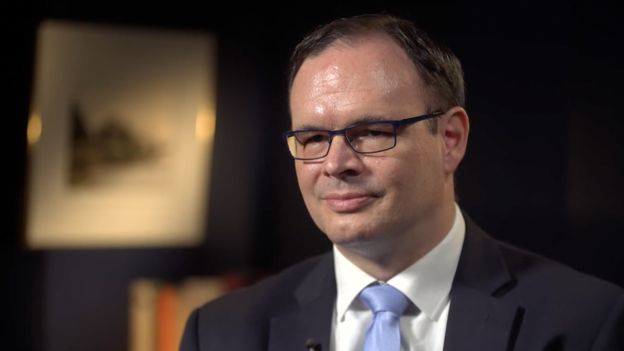
One of the world’s leading experts on China’s policies in Xinjiang, Dr Adrian Zenz, a senior fellow at the Victims of Communism Memorial Foundation in Washington, believes the latest leak is genuine.

“This remarkable document presents the strongest evidence I’ve seen to date that Beijing is actively persecuting and punishing normal practices of traditional religious beliefs,” he says.

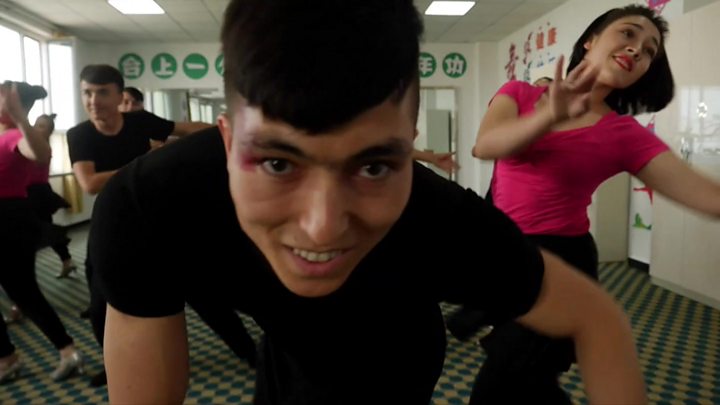
One of the camps mentioned in it, the “Number Four Training Centre” has been identified by Dr Zenz as among those visited by the BBC as part of a tour organised by the Chinese authorities in May last year.

Media caption The BBC previously visited one of the camps identified by scholars using the Karakax List

Much of the evidence uncovered by the BBC team appears to be corroborated by the new document, redacted for publication to protect the privacy of those included in it.

It contains details of the investigations into 311 main individuals, listing their backgrounds, religious habits, and relationships with many hundreds of relatives, neighbours and friends.

Verdicts written in a final column decide whether those already in internment should remain or be released, and whether some of those previously released need to return.

It is evidence that appears to directly contradict China’s claim that the camps are merely schools.

In an article analysing and verifying the document, Dr Zenz argues that it also offers a far deeper understanding of the real purpose of the system.

It allows a glimpse inside the minds of those making the decisions, he says, laying bare the “ideological and administrative micromechanics” of the camps.

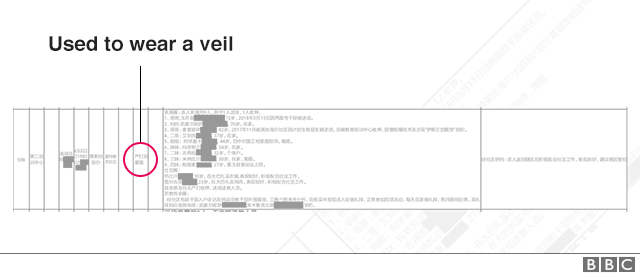
An image showing the lits

Row 598 contains the case of a 38-year-old woman with the first name Helchem, sent to a re-education camp for one main reason: she was known to have worn a veil some years ago.

It is just one of a number of cases of arbitrary, retrospective punishment.

Others were interned simply for applying for a passport – proof that even the intention to travel abroad is now seen as a sign of radicalisation in Xinjiang.

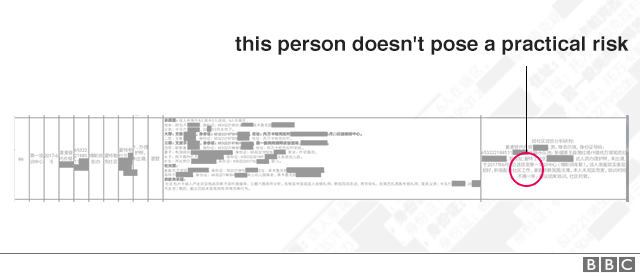
An image showing the list of names and observations

In row 66, a 34-year-old man with the first name Memettohti was interned for precisely this reason, despite being described as posing “no practical risk”.

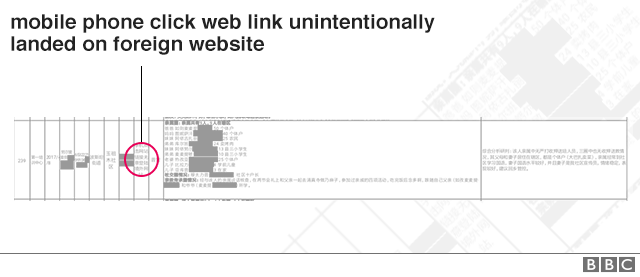
And then there’s the 28-year-old man Nurmemet in row 239, put into re-education for “clicking on a web-link and unintentionally landing on a foreign website”.

A picture showing the list

Again, his case notes describe no other issues with his behaviour.

The 311 main individuals listed are all from Karakax County, close to the city of Hotan in southern Xinjiang, an area where more than 90% of the population is Uighur.

Predominantly Muslim, the Uighurs are closer in appearance, language and culture to the peoples of Central Asia than to China’s majority ethnicity, the Han Chinese.

In recent decades the influx of millions of Han settlers into Xinjiang has led to rising ethnic tensions and a growing sense of economic exclusion among Uighurs.

Those grievances have sometimes found expression in sporadic outbreaks of violence, fuelling a cycle of increasingly harsh security responses from Beijing.

It is for this reason that the Uighurs have become the target – along with Xinjiang’s other Muslim minorities, like the Kazakhs and Kyrgyz – of the campaign of internment

The “Karakax List”, as Dr Zenz calls the document, encapsulates the way the Chinese state now views almost any expression of religious belief as a signal of disloyalty.

To root out that perceived disloyalty, he says, the state has had to find ways to penetrate deep into Uighur homes and hearts.

In early 2017, when the internment campaign began in earnest, groups of loyal Communist Party workers, known as “village-based work teams”, began to rake through Uighur society with a massive dragnet.

With each member assigned a number of households, they visited, befriended and took detailed notes about the “religious atmosphere” in the homes; for example, how many Korans they had or whether religious rites were observed.

The Karakax List appears to be the most substantial evidence of the way this detailed information gathering has been used to sweep people into the camps.

It reveals, for example, how China has used the concept of “guilt by association” to incriminate and detain whole extended family networks in Xinjiang.

For every main individual, the 11th column of the spreadsheet is used to record their family relationships and their social circle.

Presentational grey line

China’s hidden camps

BBC
Presentational grey line

Alongside each relative or friend listed is a note of their own background; how often they pray, whether they’ve been interned, whether they’ve been abroad.

In fact, the title of the document makes clear that the main individuals listed all have a relative currently living overseas – a category long seen as a key indicator of potential disloyalty, leading to almost certain internment.

Rows 179, 315 and 345 contain a series of assessments for a 65-year-old man, Yusup.

His record shows two daughters who “wore veils and burkas in 2014 and 2015”, a son with Islamic political leanings and a family that displays “obvious anti-Han sentiment”.

His verdict is “continued training” – one of a number of examples of someone interned not just for their own actions and beliefs, but for those of their family.

The information collected by the village teams is also fed into Xinjiang’s big data system, called the Integrated Joint Operations Platform (IJOP).

The IJOP contains the region’s surveillance and policing records, culled from a vast network of cameras and the intrusive mobile spyware every citizen is forced to download.

The IJOP, Dr Zenz suggests, can in turn use its AI brain to cross-reference these layers of data and send “push notifications” to the village teams to investigate a particular individual.

Adrian Zenz, the academic who has analysed and assessed the Karakax List
Image caption Adrian Zenz has analysed the leaked document

The man found “unintentionally landing on a foreign website” may well have been interned thanks to the IJOP.

In many cases though, there is little need for advanced technology, with the vast and vague catch-all term “untrustworthy” appearing multiple times in the document.

It is listed as the sole reason for the internment of a total of 88 individuals.

The concept, Dr Zenz argues, is proof that the system is designed not for those who have committed a crime, but for an entire demographic viewed as potentially suspicious.

China says Xinjiang has policies that “respect and ensure people’s freedom of religious belief”. It also insists that what it calls a “vocational training programme in Xinjiang” is “for the purposes of combating terrorism and religious extremism”, adding only people who have been convicted of crimes involving terrorism or religious extremism are being “educated” in these centres.

However, many of the cases in the Karakax List give multiple reasons for internment; various combinations of religion, passport, family, contacts overseas or simply being untrustworthy.

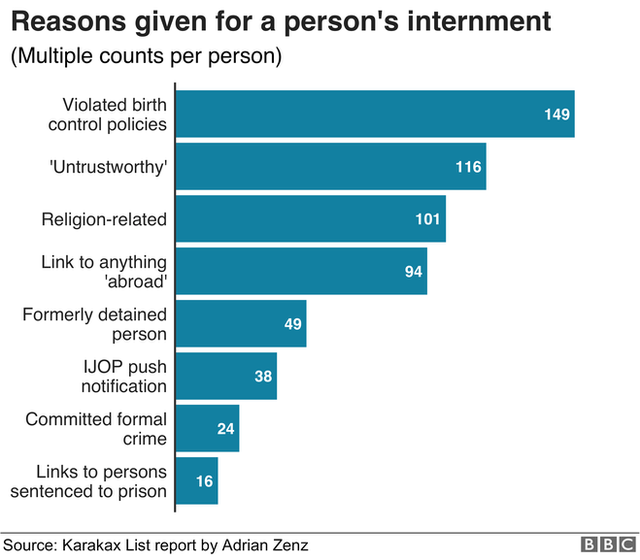
The most frequently listed is for violating China’s strict family planning laws.

In the eyes of the Chinese authorities it seems, having too many children is the clearest sign that Uighurs put their loyalty to culture and tradition above obedience to the secular state.

Chart showing reasons given for a person's internment
China has long defended its actions in Xinjiang as part of an urgent response to the threat of extremism and terrorism.

The Karakax List does contain some references to those kinds of crimes, with at least six entries for preparing, practicing or instigating terrorism and two cases of watching illegal videos.

But the broader focus of those compiling the document appears to be faith itself, with more than 100 entries describing the “religious atmosphere” at home.

The Karakax List has no stamps or other authenticating marks so, at face value, it is difficult to verify.

It is thought to have been passed out of Xinjiang sometime before late June last year, along with a number of other sensitive papers.

They ended up in the hands of an anonymous Uighur exile who passed all of them on, except for this one document.

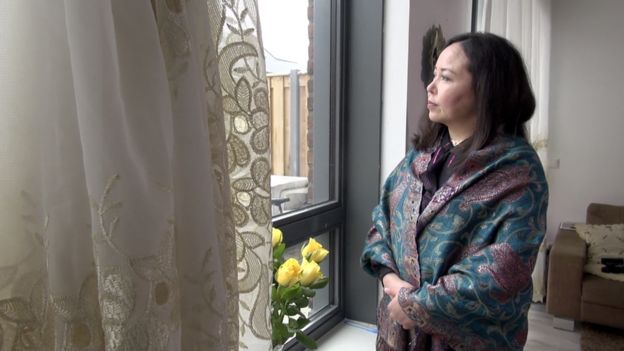
Only after the first batch was published last year was the Karakax List then forwarded to his conduit, another Uighur living in Amsterdam, Asiye Abdulaheb.

She told the BBC that she is certain it is genuine.

Asiye Abdulaheb, the Uighur woman who helped leak the Karakax List
Image caption Asiye Abdulaheb decided to speak out, despite the danger

“Regardless of whether there are official stamps on the document or not, this is information about real, live people,” she says. “It is private information about people that wouldn’t be made public. So there is no way for the Chinese government to claim it is fake.”

Like all Uighurs living overseas, Ms Abdulaheb lost contact with her family in Xinjiang when the internment campaign began, and she’s been unable to contact them since.

But she says she had no choice but to release the document, passing it to a group of international media organisations, including the BBC.

“Of course I am worried about the safety of my relatives and friends,” she says. “But if everyone keeps silent because they want to protect themselves and their families, then we will never prevent these crimes being committed.”

At the end of last year China announced that everyone in its “vocational training centres” had now “graduated”. However, it also suggested some may stay open for new students on the basis of their “free will”.

Almost 90% of the 311 main individuals in the Karakax List are shown as having already been released or as being due for release on completion of a full year in the camps.

But Dr Zenz points out that the re-education camps are just one part of a bigger system of internment, much of which remains hidden from the outside world.

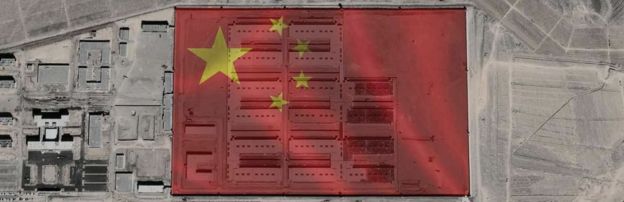
A camp holding Muslims in Xinjiang. (nb: NOT a camp identified in the Karakax List)
Image caption The outside of one of the camps in Xinjiang

More than two dozen individuals are listed as “recommended” for release into “industrial park employment” – career “advice” that they may have little choice but to obey. There are well documented concerns that China is now building a system of coerced labour as the next phase of its plan to align Uighur life with its own vision of a modern society.

In two cases, the re-education ends in the detainees being sent to “strike hard detention”, a reminder that the formal prison system has been cranked into overdrive in recent years.

Many of the family relationships listed in the document show long prison terms for parents or siblings, sometimes for entirely normal religious observances and practices.

One man’s father is shown to have been sentenced to five years for “having a double-coloured thick beard and organising a religious studies group”.

A neighbour is reported to have been given 15 years for “online contact with people overseas”, and another man’s younger brother given 10 years for “storing treasonable pictures on his phone”.

Whether or not China has closed its re-education camps in Xinjiang, Dr Zenz says the Karakax List tells us something important about the psychology of a system that prevails.

“It reveals the witch-hunt-like mindset that has been and continues to dominate social life in the region,” he said.

Source: The BBC

11/02/2020

India’s ruling party routed in key state election

NEW DELHI (Reuters) – India’s ruling party was projected to lose a key state election on Tuesday, the vote count showed, in its first electoral test since deadly anti-government protests erupted nearly two months ago.

The Hindu-nationalist Bharatiya Janata Party (BJP) led by Prime Minister Narendra Modi won a bigger majority in a general election in May, but it has lost a string of state elections since then.

The protests, in which at least 25 people have been killed, erupted across the country in mid-December, after the BJP passed a new citizenship law critics say violates India’s secular constitution and discriminates against minority Muslims.

In counting for state polls held in India’s capital New Delhi, data from India’s Election Commission showed the liberal Aam Aadmi Party, led by the city’s chief minister, Arvind Kejriwal, leading 57 out of 70 seats.

The BJP ran a campaign accusing protesters of supporting India’s arch-rival Pakistan and was projected to win 13 seats, up from three in 2015 but far below its own expectations. The party’s local chief Manoj Tiwari had predicted it would win a majority.

AAP activists in distinctive white boat-shaped caps danced outside party headquarters in New Delhi as the result became clear, TV channels showed.

Neelanjan Sircar, an assistant professor at Ashoka University near New Delhi, said that local issues, including delivery of basic services like education and health, appeared to sway voters towards the AAP, even as the BJP ran a polarising campaign on the back of Modi’s image.

“Modi is a larger than life character at the national level, which obviously gives the BJP a huge advantage in national politics,” Sircar said.

“But it doesn’t translate to state level politics, where the BJP often doesn’t have a charismatic face.”

Bespectacled former bureaucrat Kejriwal, 51, formed AAP in 2012 amid an anti-corruption movement that swept India.

The party won a stunning victory in 2015 state elections in the capital, wiping out the BJP and Congress, the party that has ruled India for half its post-independence history.

The Congress – the main opposition at national level – was projected to win no seats in Delhi on Tuesday, data showed, reflecting the deep decline in its fortunes.

Source: Reuters

08/02/2020

Chinese UN envoy refutes U.S. accusations over counter-terrorism in Xinjiang

UNITED NATIONS, Feb. 7 (Xinhua) — A Chinese UN envoy on Friday refuted accusations by the United States over China’s counter-terrorism efforts in its northwestern region of Xinjiang.

At a Security Council meeting on the threat posed by the Islamic State, Wu Haitao, China’s deputy permanent representative to the United Nations, said the remarks by the U.S. representative regarding Xinjiang are “unwarranted.”

Senior Policy Advisor for U.S. UN Mission Michael Barkin, who addressed the council earlier than Wu, claimed that “Uighurs” (Uygurs) and other Muslims have been “detained in internment camps under the guise of counter-terrorism” in Xinjiang.

He labeled China’s counter-terrorism measure as “confinement that is based and imposed on the basis of ethnicity and religion.”

Wu said that Barkin’s “attacks” are “completely baseless, and represent a wanton interference in China’s internal affairs and a brazen attempt to provoke confrontation.”

In nature, he said, the issues Xinjiang faces are not about ethnic group or religion or human rights, but rather they are about counter-terrorism.

Recalling the past, Wu said that for some time, Xinjiang suffered frequent terrorist attacks, which seriously jeopardized the lives and property of all ethnic communities and gravely violated human dignity.

“In response, China has taken resolute, law-based measures to combat terrorism and extremism, eliminating to the extent possible the breeding ground and conditions for terrorism and extremism, effectively curbing the trend of rampant terrorist activities and safeguarding citizens’ basic rights, including the right to life and development,” Wu expounded.

“Those measures have produced good results,” he said. “At present, the situation in Xinjiang is largely stable, and local economy continues to grow. People of all ethnic groups live in harmony. The region has been free of terrorist attacks for over three years.”

He noted relevant policies and measures against terrorism and extremism in Xinjiang constitute a crucial part of the global counter-terrorism efforts.

The Chinese envoy also rejected the remarks of Britain’s representative, who echoed the U.S. stance.

“Regrettably, Britain once again blindly followed the footsteps of the United States and put up unfounded charges against China,” Wu said.

He expressed the hope that Britain has “recorded our positions on this matter,” urging Britain not to use the Security Council “to make trouble, to spread rumor and to interfere with the internal affairs of China.”

Source: Xinhua

24/01/2020

George Soros takes aim at ‘authoritarian’ Presidents Xi and Trump

Media caption The billionaire financier and philanthropist has become a divisive figure in global politics in recent years

Billionaire philanthropist George Soros has launched a stinging attack on the “authoritarian rulers” of both the US and China.

He said President Donald Trump was a “conman and the ultimate narcissist” who had breached the limits of the US constitution.

And he said China’s President Xi Jinping was using technology to exert total control over Chinese life.

“The world would be a better place if they weren’t in power,” Mr Soros said.

Using his annual speech at the World Economic Forum, in Davos, the financier warned of a growing threat from populism and climate change, while pledging $1bn towards a new global university network to tackle intolerance.

But the businessman – who is a major donor to the US Democratic party – said Beijing and Washington posed the biggest threat to “open societies”.

“Both [leaders] try to extend the powers of their office to its limit and beyond.

“Trump is willing to sacrifice the national interests for his personal interests and he will do practically anything to win re-election.

“By contrast, Xi Jinping is eager to exploit Trump’s weaknesses and use artificial intelligence to achieve total control over his people.”

The White House was approached for comment.

Media caption Modi to Trump: “My honour to introduce you to my family”

Mr Soros also targeted Indian Prime Minister Narendra Modi, saying the Indian state was “imposing punitive measures on Kashmir, a semi-autonomous Muslim region, and threatening to deprive millions of Muslims of their citizenship”.

He was referring to two controversial decisions made by Mr Modi’s Hindu nationalist government.

The first was to strip the disputed Kashmir region of its semi-autonomous status and place it under virtual lockdown.

The second is the introduction and passage of a controversial citizenship law that critics say is discriminatory towards Muslims.

It seeks to fast-track Indian citizenship to non-Muslim minorities from three nearby Muslim-majority countries.

Media caption The Conspiracy Files: Why did Hungary’s PM turn on George Soros?

The US and China recently struck a deal to de-escalate a major trade war which has seen both sides impose tariffs on billions of dollars worth of exports.

But Mr Soros said President Xi’s had stifled China’s economy, while Mr Trump had “overheated” his.

“US stock markets are high but can’t be kept at boiling point for too long.”

Mr Soros, a Jew who survived Nazi occupation by forging identity documents, became infamous for his involvement in the devaluation of the British pound, known as Black Wednesday.

But it is his philanthropic and political activities that have made him a divisive figure in the US, Europe and beyond.

He has spent billions of his own money funding human rights projects and liberal democratic ventures around the world, and has become a frequent target for criticism by right-wing groups due to his support for liberal causes.

Much of the criticism aimed at him has been criticised as having anti-Semitic undertones.

The financier, who is a regular at the elite World Economic Forum, said his new university network would help promote “critical thinking” in an age of intolerance.

The move will be seen as a riposte to Hungarian President Victor Orban, who has repeatedly tried to shut down the Central European University, a private institution set up by Mr Soros in the country in 1971.

Mr Orban’s populist nationalist government claims Mr Soros has a secret plot to flood Hungary with migrants and destroy the nation, an accusation Mr Soros denies.

Mr Soros said the network would be “the most important and enduring project of my life and I should like to see it implemented while I am still around”.

Source: The BBC

14/12/2019

Clashes erupt in Delhi over citizenship law; Japan PM cancels visit

NEW DELHI (Reuters) – Violent clashes erupted in Delhi between police and hundreds of university students on Friday over the enactment of a new citizenship law that critics say undermines India’s secular foundations.

The unrest has already led Japanese Prime Minister Shinzo Abe to cancel a planned visit to India from Sunday.

The new law offers a way to Indian citizenship for six minority religious groups from neighbouring Bangladesh, Pakistan and Afghanistan including Hindus and Christians, but not Muslims.

Police fired tear gas and used baton charges to disperse scores of students demonstrating at Jamia Millia Islamia university in the heart of Delhi over the law.

Protesters attacked cars in the capital, and several people were injured and taken to hospital.

Zakir Riyaz, a PhD student in social work, said the new law made a mockery of India’s religious openness.

“It goes against the whole idea of a secular India,” he said, speaking by phone from the Holy Family Hospital in New Delhi where 15 of his fellow students were admitted after being injured in a police baton charge.

Police barricades were knocked down and streets were strewn with shoes and broken bricks. An official at the university dispensary said that more than 100 students had been brought in with injuries but all had been discharged.

Parvez Hashmi, a local politician who went to the protest site to speak to police, said about 50 students had been detained.

Students said it was meant to be a peaceful protest, with them trying to go from Jamia University to Parliament Street to show their opposition to the legislation. But police pushed them back, leading to clashes.

Critics of Prime Minister Narendra Modi’s government say it is promoting a Hindu-first agenda for India and that the citizenship law excluding Muslims showed a deep-seated bias against India’s 170 million Muslims.

Imran Chowdhury, a researcher, said “either give citizenship to refugees of all religions or none at all. The constitution is being tampered with in the name of religion.”

Modi’s ruling Bharatiya Janata Party denies any religious bias but says it is opposed to the appeasement of one community. It says the new law is meant to help minority groups facing persecution in the three nearby Muslim countries.

ABE CANCELS

The United Nations human rights office voiced concern that the new law is “fundamentally discriminatory in nature”, and called for it to be reviewed.

Two people were killed in India’s Assam state on Thursday when police opened fire on mobs torching buildings and attacking railway stations in protest at the new citizenship rules signed into law on Thursday.

Japan’s Prime Minister Shinzo Abe cancelled a trip to Assam for a summit with his Indian counterpart Narendra Modi that had been due to begin on Sunday.

Japan has stepped up infrastructure development work in Assam in recent years, which the two sides were expected to highlight during the summit. Abe had also planned to visit a memorial in the nearby state of Manipur where Japanese soldiers were killed in World War Two.

“With reference to the proposed visit of Japanese PM Abe Shinzo to India, both sides have decided to defer the visit to a mutually convenient date in the near future,” Indian foreign ministry spokesman Raveesh Kumar said in a tweet.

Japan’s Chief Cabinet Secretary Yoshihide Suga said both countries would decide on the appropriate timing for the visit although nothing has been decided yet.

A movement against immigrants from Bangladesh has raged in Assam for decades. Protesters there say granting Indian nationality to more people will further strain the state’s resources and lead to the marginalisation of indigenous communities.

Source: Reuters

12/12/2019

Citizenship Amendment Bill: India calls in army to Assam and Tripura states

The army has been called into north-eastern India, after thousands of people defied curfews to protest against a new citizenship bill.

The Citizenship Amendment Bill (CAB) offers amnesty to non-Muslim illegal immigrants from three countries.

Critics say the bill discriminates against Muslims – but in the north-east, protesters claim they will be “overrun” by Hindus from Bangladesh.

Indian Prime Minister Narendra Modi has appealed for calm.

Officials said 20-30 people were injured in the demonstrations, and air and railway services have been severely impacted.

The bill – which applies to people from Afghanistan, Bangladesh and Pakistan – was passed in the upper house of parliament on Wednesday night.

It is yet to be ratified by the president, but that is merely a formality.

The ruling Hindu nationalist Bharatiya Janata Party says the CAB will give sanctuary to people fleeing religious persecution.

Illegal migration from Bangladesh has long been a concern in the north-east.

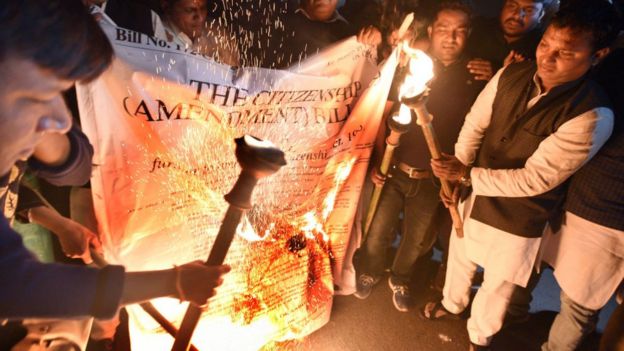
NYC National President Srinivas B.V with party supporters during a torch procession against the Citizenship Amendment Bill at Rajpath near India Gate, on December 11, 2019 in New Delhi, India. Normal life came to a halt on Tuesday in several states amid protests over the Citizenship (Amendment) Bill.Image copyright GETTY IMAGES

How bad are the protests?

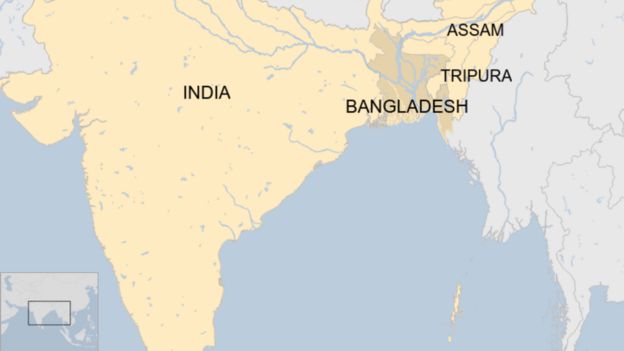
Violent protests intensified on Thursday, and have been particularly bad in the states of Assam and Tripura, which border Bangladesh.

The army has deployed thousands of personnel, as protesters defy curfew orders and spill into the streets.

The protesters blocked roads and set vehicles on fire. There are reports that at least two railway stations have been burned down.

Railway services are suspended and some airlines have started offering rescheduling or cancellation fee waivers.

The AFP news agency reported that police fired blanks into the air in a bid to disperse crowds. They have also used tear gas shells.

Prime Minister Narendra Modi sought to reassure people in Assam, telling them they had “nothing to worry” about.


Read more about the Citizenship Amendment Bill:


“The central government and I are totally committed to constitutionally safeguard the political, linguistic, cultural and land rights of the Assamese people,” he tweeted.

However, with internet and mobile services shut down, it is unlikely residents would have been able to read the message.

The chief minister of Assam was stranded at the airport for several hours on Wednesday because roads were blocked by protests.

What do protesters want?

They want the bill to be repealed, as they say their ethnic and cultural identity is under threat from illegal migration.

Essentially, they do not want any migrants – regardless of religion – to be allowed into the state.

What is further fuelling passions in Assam, is the fact that two million residents – deemed to be illegal immigrants- were left off a citizens’ register last August.

map

The National Register of Citizens (NRC) is a list of people who can prove they came to the state by 24 March 1971, a day before neighbouring Bangladesh became an independent country.

In the run-up to its publication, the BJP had supported the NRC, but changed tack days before the final list was published, saying it was error-ridden.

The reason for that was a lot of Bengali Hindus – a strong voter base for the BJP – were left off the list, and would possibly become illegal immigrants.

The CAB is seen as being linked to the register, although it is not the same thing.

It will help protect non-Muslims who are excluded from the register and face the threat of deportation or internment.

Has the bill been challenged?

The Indian Union Muslim League, a political party, has petitioned the country’s top court to declare the bill illegal.

In their petition to the Supreme Court, the Indian Union Muslim League argued that the bill violated articles of equality, fundamental rights and the right to life.

Source: The BBC

05/12/2019

Religious, social freedom in Xinjiang impress Afghan journalists

KABUL, Dec. 5 (Xinhua) — Two Afghan journalists who visited China recently affirmed that Muslims in the country’s northwestern Xinjiang Uygur Autonomous Region enjoy religious and social freedom.

“I visited Xinjiang earlier this year. Our visiting team has learned that Muslims in Xinjiang benefit from all religious beliefs with no restrictions. They have mosques and perform their religious obligations freely, including offering prayers,” Mansoor Ahmad Faizy, editor-in-chief of the Afghanistan Times, told Xinhua on Wednesday.

Faizy described the tour as a great opportunity to obtain a deep and comprehensive understanding about the life of locals in Xinjiang.

“The people are satisfied with China’s policy, particularly with regard to Xinjiang’s ethnic Muslims,” he said.

Regarding the region’s re-education centers, Faizy said, “We have visited a center that provides education for people who were reportedly influenced by extremists.”

Different from reports found in Western media, Faizy said the students he encountered were provided with professional vocational training, as well as classes in legal knowledge and Mandarin.

“What we (witnessed) in the re-education center was very different from what we heard. The students had a friendly atmosphere, the students were learning … and they could contact their families freely,” he said.

Extremism and terrorism have become a problem in Afghanistan, as well as other countries in the region, in recent years, he said.

Every country has the right to take measures to fight terrorism and extremism, Faizy noted.

Hujjatullah Zia, a local researcher and columnist for Daily Outlook Afghanistan, echoed Faizy’s view.

“After our tour of Xinjiang and after talking with Muslims living in the region, my group and I learned that the Muslims living in Xinjiang were satisfied with the policies of the central government, as they were enjoying all religious freedom and social activities,” he told Xinhua.

Talking about his visit to re-education centers for local youth, Zia said that he “did not witness any violence or mistreatment … local officials and teachers were friendly with the students in the re-education centers.”

“They will become professional workers in (the) future, as they are learning a lot of professions. I think they will make a good life (for themselves) after rejoining the society,” he said.

What’s more, he believes that more should be done in Afghanistan to raise public awareness of the true situation for Muslims in China.

“I think the Afghan media should help the Afghan people know and respect the policies of China with regard to ethnic minority groups and their religions,” he added.

Source: Xinhua

Law of Unintended Consequences

continuously updated blog about China & India

ChiaHou's Book Reviews

continuously updated blog about China & India

What's wrong with the world; and its economy

continuously updated blog about China & India