24/05/2020

Chinese President Xi Jinping, also general secretary of the Communist Party of China Central Committee and chairman of the Central Military Commission, takes part in a deliberation with his fellow deputies from the delegation of Inner Mongolia Autonomous Region at the third session of the 13th National People’s Congress (NPC) in Beijing, capital of China, May 22, 2020. (Xinhua/Ju Peng)
BEIJING, May 23 (Xinhua) — “What is people first?” Chinese President Xi Jinping asked, before offering his own answer when he was talking with lawmakers at the ongoing national legislative session.
“So many people worked together to save a single patient. This, in essence, embodies doing whatever it takes (to save lives),” he said.
Xi, also general secretary of the Communist Party of China Central Committee and chairman of the Central Military Commission, is a deputy to the 13th National People’s Congress.
During his deliberations with fellow deputies from Inner Mongolia Autonomous Region on Friday, “people” was a keyword.
Xi referred to a story told by another deputy that morning. Luo Jie, from the COVID-19 hard-hit province of Hubei, told reporters at the session how medical workers in his hospital spent 47 days saving an 87-year-old COVID-19 patient.
“About 10 medical workers meticulously took care of the patient for dozens of days, and finally saved the patient’s life,” Xi said. “I am really impressed.”
In the COVID-19 pandemic, health workers around the world got to know the elderly are the most difficult to treat and require the most sophisticated medical resources. China has given every patient equal treatment irrespective of their age or wealth.

Chinese President Xi Jinping, also general secretary of the Communist Party of China Central Committee and chairman of the Central Military Commission, takes part in a deliberation with his fellow deputies from the delegation of Inner Mongolia Autonomous Region at the third session of the 13th National People’s Congress (NPC) in Beijing, capital of China, May 22, 2020. (Xinhua/Huang Jingwen)
In Hubei alone, more than 3,600 COVID-19 patients over the age of 80 have been cured. In the provincial capital Wuhan, seven centenarian patients have been cured.
“We mobilized from around the nation the best doctors, the most advanced equipment and the most needed resources to Hubei and Wuhan, going all out to save lives,” Xi said during the deliberations, adding that the eldest patient cured is 108 years old.
“We are willing to save lives at all costs. No matter how old the patients are and how serious their conditions have become, we never give up,” Xi said.
Xi joined political advisors and lawmakers on Thursday and Friday in paying silent tribute to the lives lost to COVID-19 as the top political advisory body and the national legislature opened their annual sessions.
This year’s government work report said China’s economy posted negative growth in the first quarter of this year, but it was “a price worth paying” to contain COVID-19 as life is invaluable.
“As a developing country with 1.4 billion people, it is only by overcoming enormous difficulties that China has been able to contain COVID-19 in such a short time while also ensuring our people’s basic needs,” the report said.
Epidemic response is a reflection of China’s governing philosophy.
The fundamental goal for the Party to unite and lead the people in revolution, development and reform is “to ensure a better life for them,” Xi said.
The nation’s average life expectancy reached 77 years in 2018, more than double that in 1949, when the people’s republic was founded.
Chinese people are not just living longer but better lives, with more material wealth and broader choices to pursue individual dreams. All rural poor will bid farewell to poverty this year as part of the goal of building a moderately prosperous society in all respects.
The Party’s long-term governance, Xi said, rests on “always maintaining close bond with the people.”
“We must always remain true to the people’s aspiration and work in concert with them through thick and thin,” Xi said.
Source: Xinhua
Posted in "a price worth paying", "What is people first?", 13th National People's Congress (NPC), 1949, 2018, advanced, age, around the world, at all costs, Beijing, better lives, broader choices, Building, capital of China, centenarian, Chairman of the Central Military Commission, China, China's, Chinese President Xi Jinping, close bond, COVID-19, Covid-19 pandemic, development, doctors, double, dreams, elderly, epidemic response, founded, fundamental goal, general secretary of the Communist Party of China Central Committee, goal, governing, health workers, Hubei, individual, inner mongolia autonomous region, irrespective, lead, Life expectancy, lives, living longer, long-term governance, maintaining, material wealth, medical workers, mobilized, moderately prosperous, nation, national legislature, negative growth, Party, Patient, People’s Republic, philosophy, political advisory body, poverty, provincial capital, pursue, reached, reflection, reform, reporters, revolution, rural poor, saves, society, sophisticated, thick and thin, this year, to unite, treatment, Uncategorized, wealth, Wuhan |
Leave a Comment »
17/04/2020
- Fu Chengyu, the former chairman of China National Offshore Oil Corporation (CNOOC), says hostility towards Beijing will increase after the coronavirus
- US will try to ‘thwart China’s rise’ and economic fallout from Covid-19 will be worse than the global financial crisis, says Fu
Former Sinopec chairman Fu Chengyu says China will face a more hostile world post coronavirus. Photo: EPA
The world is set to become more hostile for China after the coronavirus as the risk of “black swan” events gathers for Beijing, a heavyweight in China’s state oil industry has warned, reflecting growing wariness about the geopolitical environment among political and business elites.
Fu Chengyu, the former chairman of both China National Offshore Oil Corporation (CNOOC) and Sinopec Group, painted an ominous picture of increasing antagonism from the United States and damaging unforeseen events, known as black swans, like Covid-19
at an online symposium organised by business magazine Caijing.
The US would “mercilessly” suppress China in the fields of economics, trade, finance and technology, and Washington was set on taking advantage of the coronavirus pandemic to “forge a less favourable international environment for” the nation, Fu said this week.
“We’ve smelled the odours and new plots against China are in formation,” he said.
After the epidemic, the external environment for our survival will be more severe – Fu Chengyu
“After the epidemic, the external environment for our survival will be more severe … we must prepare for the worst and do our best to achieve the best possible results.”
While Fu has retired from his posts at state companies, he is an influential voice in
with decades of experience and contacts in the US petroleum sector.
Fu was a counterpart of Rex Tillerson, who was chairman of ExxonMobil from 2006 to 2017, and served as US State Secretary under President Donald Trump until March 2018.
While at the helm of CNOOC in the early 2000s, he felt political heat from Washington over a US$18.5 billion takeover bid for the American oil company Unocal in 2005, which the company was subsequently forced to withdraw.
China says no evidence to suggest coronavirus virus came from Wuhan’s lab
“The crisis stemming from the coronavirus pandemic won’t be over in just one or two years … the impact will last longer than the 2008 global financial crisis,” he said.
He added that China would face numerous “black swan” risks in the future.
President Xi Jinping warned in 2019 that China must be on guard for black swan risks as well as “grey rhino” events, referring to an obvious threat that is often neglected.
Geopolitics is getting worse and worse, and we need to be very careful. The US will try various ways to thwart China’s rise, and energy is an important area
To respond to the economic fallout from the coronavirus, China must do more to create a self-sustaining domestic economy, Fu said, and in particular reduce input prices for gas and electricity and boost public services such as health care and education.
“Geopolitics is getting worse and worse, and we need to be very careful,” Fu said. “The US will try various ways to thwart China’s rise, and energy is an important area.”
The US could potentially form a new oil export alliance with Saudi Arabia and Russia to make it possible to cut oil supplies to China, he said.
“China must be prepared for such a scenario, and even when supplies are cut off, we can have some basic self-protection.”
Source: SCMP
Posted in "severe", 2005, 2006, 2008, 2017, 2018, 2019, advantage, against, American oil company, ‘thwart China’s rise’, “grey rhino”, “mercilessly”, Beijing, black swans, business magazine, Chairman, China, China National Offshore Oil Corporation (CNOOC), CNOOC, contacts, coronavirus, Coronavirus pandemic, COVID-19, crisis, cut, damaging, economic fallout, Economics, education, Electricity, energy, epidemic, experience, external environment, ExxonMobil, favourable, fields, Finance, forge, formation, gas, gathering, geopolitical environment, GeoPolitics, global financial crisis, global value chains, growing wariness, Health care, heightened tensions, hostility, increase, increasing antagonism, input prices, international environment, March, nation, neglected, new plots, obvious threat, odours, oil export alliance, oil industry, oil supplies, oil titan, ominous picture, on guard, online symposium, painted, pandemic, petroleum sector, political heat, prepared, President Donald Trump, President Xi Jinping, Public services, Rex Tillerson, Risks, Russia, Saudi Arabia, scenario, self-protection, self-sustaining domestic economy, Sinopec Group, smelled, suppress, survival, Technology, Trade, Uncategorized, unforeseen events, United States, Unocal, US, US State Secretary, warns, Washington, week, world trade landscape |
Leave a Comment »
31/03/2020
- The team is expected to provide technical advice on epidemic prevention and control as well as treatment protocols
- The Southeast Asian nation on Tuesday recorded its largest daily increase in coronavirus deaths and infections
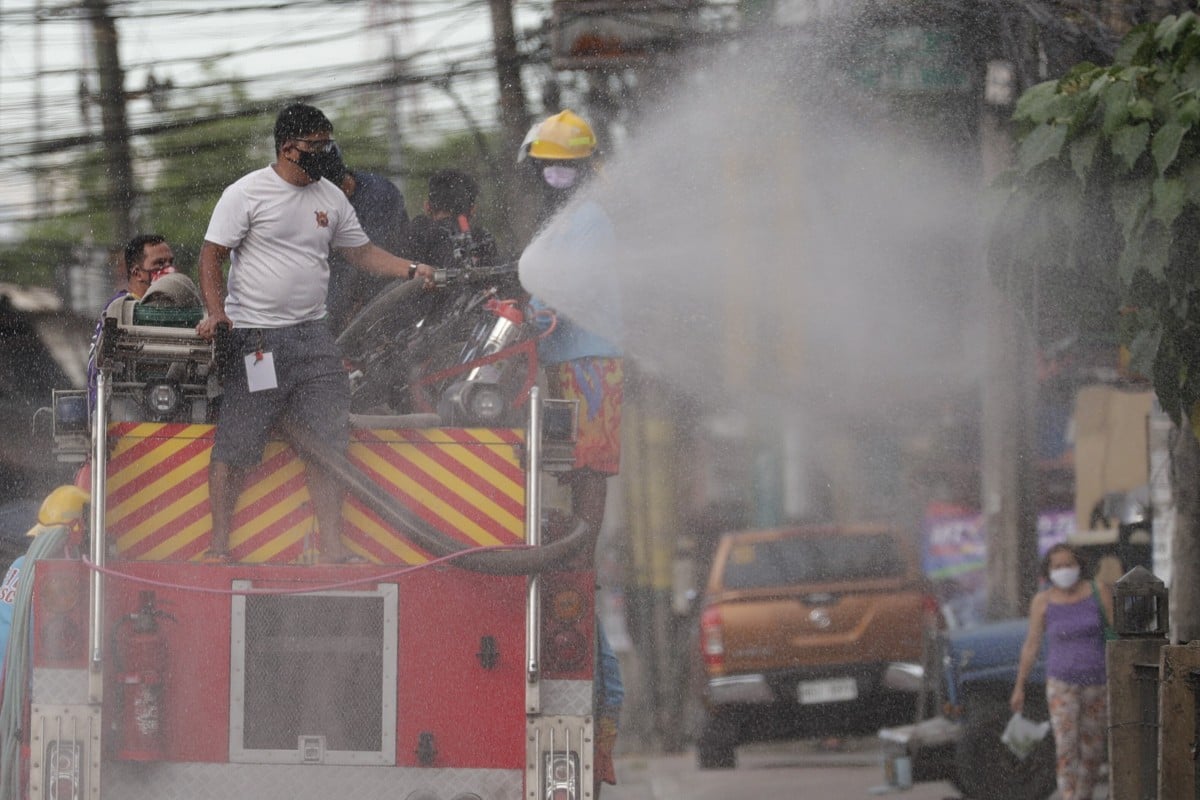
A fireman sprays disinfectant from the back of a fire truck to help curb the spread of the coronavirus during a localised quarantine in Manila. Photo: AP
on Tuesday recorded its largest daily increase in coronavirus deaths and infections, as it awaited the arrival of a Chinese medical team to support its embattled frontline health care workers.
Ten more people died from the Covid-19 disease, bringing the total to 88, while 538 new infections were reported for a total of 2,084.
Among those included in the latest count of positives is former senator Ferdinand “Bongbong” Marcos, whose condition, according to his spokesman Victor Rodriguez, is now “stable” and “improving”.
Health undersecretary Maria Rosario Vergeire said the ministry had opened new labs and run more than 15,000 tests, a five-fold jump from about 3,000 last week. She added that more hospitals were seeking government approval to function as testing centres.
Medical evacuation plane crashes at Manila airport in Philippines, killing eight on board
“We have six more laboratories to conduct tests,” Vergeire said. “We are also conducting contact tracing to find possibly infected persons.”
Philippine hospitals are struggling with a shortage of protective gear, manpower and testing capacity, as are medical facilities around the world. At least 13 doctors have died as of Tuesday and the Philippine Medical Association estimates that over 5 per cent of health workers are currently under quarantine due to Covid-19.
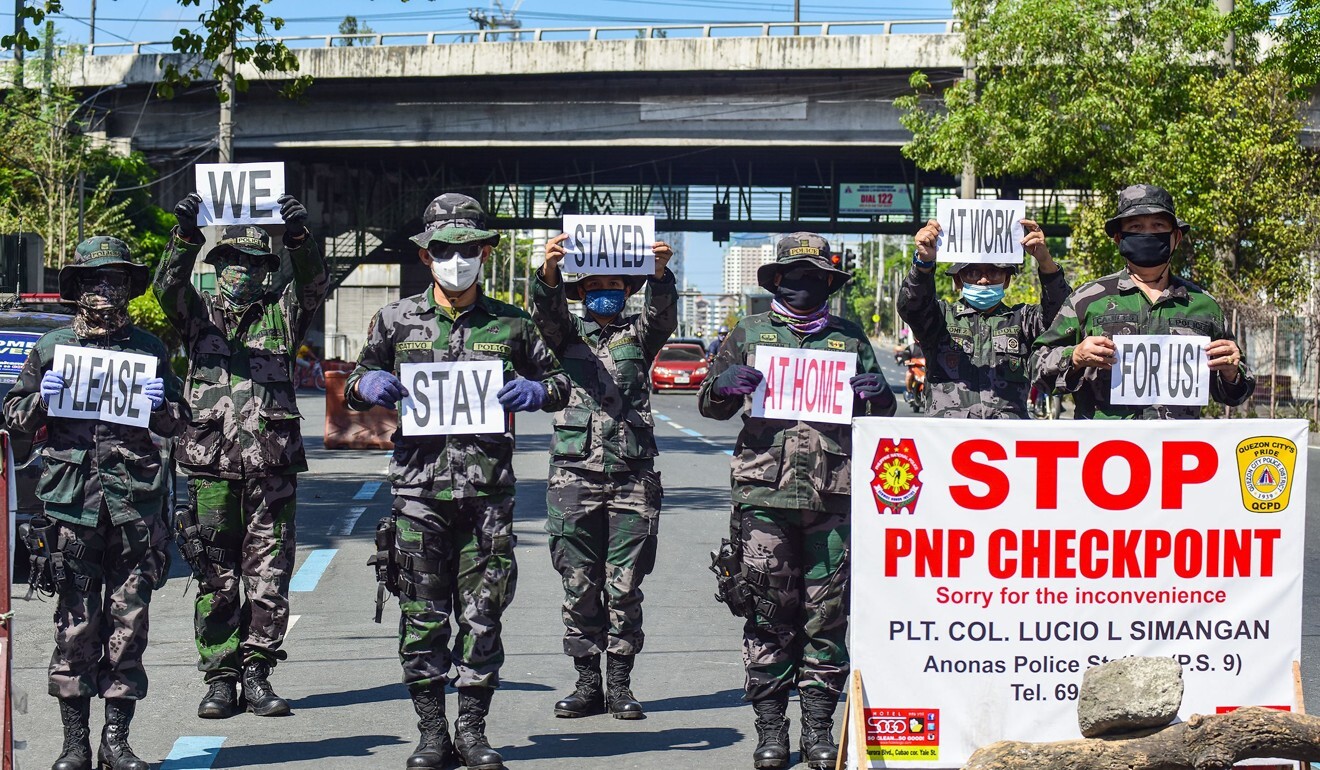
Police personnel in Manila hold up placards reminding people to stay at home. Photo: AFP
The country’s ambassador to China, Chito Sta Romana, confirmed a statement by the Chinese embassy in Manila that Beijing would send an expert team to the Philippines to provide technical advice on epidemic prevention and control as well as treatment protocols.
Sta Romana said the team was made of up of “experienced doctors and public health officials who specialise in infectious diseases”, but could not say when they would arrive.
An infectious disease doctor who spoke on condition of anonymity said the Chinese medical team would only give advice.
Coronavirus: in Philippines, leak shows politicians and relatives received ‘VIP’ testing
“There was an offer to see patients but it was rebuffed because of local laws on practice,” he said, referring to a law that bans foreign doctors from practising medicine in the Southeast Asian nation.
Philippine foreign secretary Teodoro Locsin Jnr on Saturday tweeted that the Department of Health was “blocking their arrival”. His tweet, now deleted, had said “Don’t piss me off. Let them in.”
Health secretary Francisco Duque told local media that Locsin took down his tweet after hearing that the department was preparing hotel accommodation and translators for the expert team.
According to an ethnic Chinese businessman who is a member of a foundation involved in the visit, the team was supposed to have arrived on March 27. It will comprise doctors, nurses and researchers from hospitals and disease prevention agencies in Fujian province who specialise in areas such as infectious diseases, emergency medicine and integrated traditional Chinese and Western medicine.
An estimated 1.2 million ethnic Chinese call the Philippines – which has a population of 107 million people – home, with many tracing their ancestry to Fujian province.
The businessman, who declined to be named, showed This Week in Asia a screenshot of the team’s name list, which included an official from Fujian province’s United Work Front Department, the controversial Communist Party department responsible for promoting its influence around the world.
Beijing has dispatched teams of medical experts to countries struggling with a surge in Covid-19 cases, including Iran and Italy, and has also donated testing kits and other medical supplies.
The Philippine health department apologised over the weekend for comments made by undersecretary Vergeire that some of the kits donated by China had yielded only “40 per cent accuracy” and could not be used.
The Chinese embassy in Manila had rejected the suggestions, and shared a mobile text message supposedly from Duque to Ambassador Huang Xilian that thanked the Chinese government for the test kits.
Philippine President Rodrigo Duterte addresses the nation during a live broadcast on March 30. Photo: AP
Vergeire also issued a correction to her earlier statement, and said she was referring to “another brand” of test kits from China that a private foundation was going to donate.
Political risk analyst Ramon Casiple, who chairs the Institute for Political and Electoral Reforms, said at this point in the Philippines’ coronavirus fight “any help is welcome”.
He said he did not expect any negative political backlash towards the Chinese experts, even though on social media Filipinos have continued to blame China for failing to contain the outbreak in Hubei province, where cases first emerged.
Coronavirus: Philippines’ Luzon lockdown hits domestic helper agencies in Singapore
The Philippines has locked down its main island of Luzon – where about a third of the population lives, and where 70 per cent of economic activity takes place – for the past two weeks, resulting in supply chain disruptions and millions of poor families losing any source of income.
’s critics have questioned what he has done with emergency powers granted to him that came bundled with a 275 billion peso (US$5.4 billion) emergency fund. A report showed that Duterte, through the Department of Social Welfare and Development, had managed to deliver emergency food aid to only 4,753 of the 18 million targeted families.
On Tuesday, finance secretary Carlos Dominguez said the government was planning a stimulus package to help companies and the poorest households.
“This planned stimulus package is already being crafted and will be responsive to the uncertainties of the situation,” Dominguez said in a statement, without elaborating. “At this point, nobody knows how bad this pandemic will get or how long it will last.”
Senate defence committee chair Panfilo Lacson warned that some people “are eating corn fungus to stave off hunger” and “if the executive does not act with dispatch, we may have a serious social problem to face”.
Communist Party of the Philippines founding chairman Jose Maria Sison agreed with Lacson but added, “it is therefore just for the broad masses of the people to be outraged and demand collective action against Duterte, his servant generals and the Department of Health because of their incompetence, corruption and stupidity.”
However, Senate President Vicente Sotto urged the public to “cut [Duterte] some slack”.
Source: SCMP
Posted in Airport, ambassador to China, awaits, Chinese, Communist Party, Communist Party of the Philippines, coronavirus, Covid-19 disease, crashes, Department of Health, Department of Social Welfare and Development, disinfectant, emergency medicine, expert team, Ferdinand “Bongbong” Marcos, Finance Secretary, fireman, Fujian, Health Secretary, Health undersecretary, hotel accommodation, infectious diseases, integrated traditional Chinese and Western medicine, Luzon, Manila, Medical evacuation plane, nation, Philippine Medical Association, Philippines, quarantine, Southeast Asian, This Week in Asia, translators, Uncategorized |
Leave a Comment »
25/10/2019
BEIJING, Oct. 25 (Xinhua) — Chinese President Xi Jinping has underlined the important role of traditional Chinese medicine (TCM) in building “Healthy China.”
The country should carry on fine elements in TCM and innovate them, Xi said in a recent instruction, stressing that traditional medicine is a treasure of Chinese civilization embodying the wisdom of the nation and its people.
Xi’s instruction was delivered at a national conference of TCM held Friday in Beijing.
Xi said that equal importance should be placed on traditional Chinese and Western medicines and efforts be made to enable them to supplement each other and prosper together.
He also underlined the efforts to promote TCM internationally and fully develop its unique strength in preventing and treating diseases.
In an instruction also delivered at the conference, Premier Li Keqiang called TCM a great creation of the Chinese nation.
Li stressed promoting talent training, scientific and technological innovation, and research and development of medicines.
He required efforts to promote preservation, innovation and high-quality development of TCM so that it will contribute to the improvement of people’s health and wellbeing.
Addressing the event, Vice Premier Sun Chunlan pledged to thoroughly implement the leaders’ instructions.
People who made outstanding contribution to TCM development were awarded at the conference.
Source: Xinhua
Posted in "Healthy China", Building, Chinese civilization, Chinese President Xi Jinping, embodying, health, important role, medicines, nation, People, Premier Li Keqiang, promoting, research and development (R&D), scientific and technological innovation, talent training, TCM, traditional Chinese medicine (TCM), Uncategorized, underlined, vice premier, Vice Premier Sun Chunlan, wellbeing, Western medicines, wisdom |
Leave a Comment »
13/10/2019
- The likes of Saudi Arabia also saw an upswing in travellers from the mainland after the release of its new visa programme
- But fewer Chinese tourists went abroad this year, with a 15 per cent drop from 2018 attributed to more opting to visit local historical sites
Chinese tourists take photos in front of the Imperial Palace in Tokyo, Japan. Photo: Reuters
Fewer Chinese travellers went overseas during
“golden week” this year – but for those who did, Japan, Thailand and Singapore were the top-ranked destinations as tourists from the mainland gave Hong Kong a miss, according to China’s largest travel company Ctrip.
Chinese government data showed only 6.07 million people travelled during the national holiday between October 1-6, a 15.1 per cent drop from the corresponding period last year. Analysts attributed this to Chinese tourists opting for a “staycation”, as 782 million people – a 7 per cent increase from last year – chose to celebrate the 70th anniversary of the People’s Republic of China by visiting local historical sites.
How a new wave of Indian travellers are transforming tourism in Southeast Asia
For those who did venture abroad, Japan, Thailand and Singapore ranked as the top three most-booked countries in Asia during the week, according to Chinese travel firm Ctrip, as tourists from the mainland skipped protest-hit Hong Kong for other destinations.
The city, now in its 19th week of anti-government protests, over the week saw a 50 per cent overall drop in tourism from last year, as well as a 47.8 per cent reduction in border crossings at the Luohu border checkpoint, according to government figures.
Japan remained the most popular destination for Chinese tourists. In the first half of 2019, the nation saw 4.5 million visitors from China, up 11.7 per cent from the same period in 2018. In order of popularity, the top-visited cities were Osaka, Tokyo, Kyoto, Sapporo and Nagoya, according to Japanese media.
Over the same week, Japan increased its sales tax from 8 to 10 per cent, but Chinese shoppers – who accounted for 37 per cent, or US$15.4 billion, of the spending by international visitors to the nation last year – were undeterred.
Japan saw the highest volume of overseas transactions over the week, according Alipay Mobile, the world’s largest mobile payment platform. The firm declined to share the exact amount Chinese tourists had spent in Japan, but reported average spending per international traveller during golden week had increased by 15 per cent to 2,500 yuan (US$350).
From Nissan sales to Tsushima tourism, trade spat with Korea hits Japan in the pocket
Alipay is operated by Ant Financial, an affiliate of Alibaba Group Holding, which owns the Post.
Japanese department stores such as Sogo and Seibu celebrated the Chinese national holiday by holding golden week events and sales at 15 different branches across the nation, with food and arts promotions targeting Chinese shoppers.
Chinese travellers to Japan want cultural experiences involving local customs such as temple tours, heritage sites and cultural events, according to Emily Guo, a researcher at Hong Kong-based marketing research firm Cherry Blossoms.
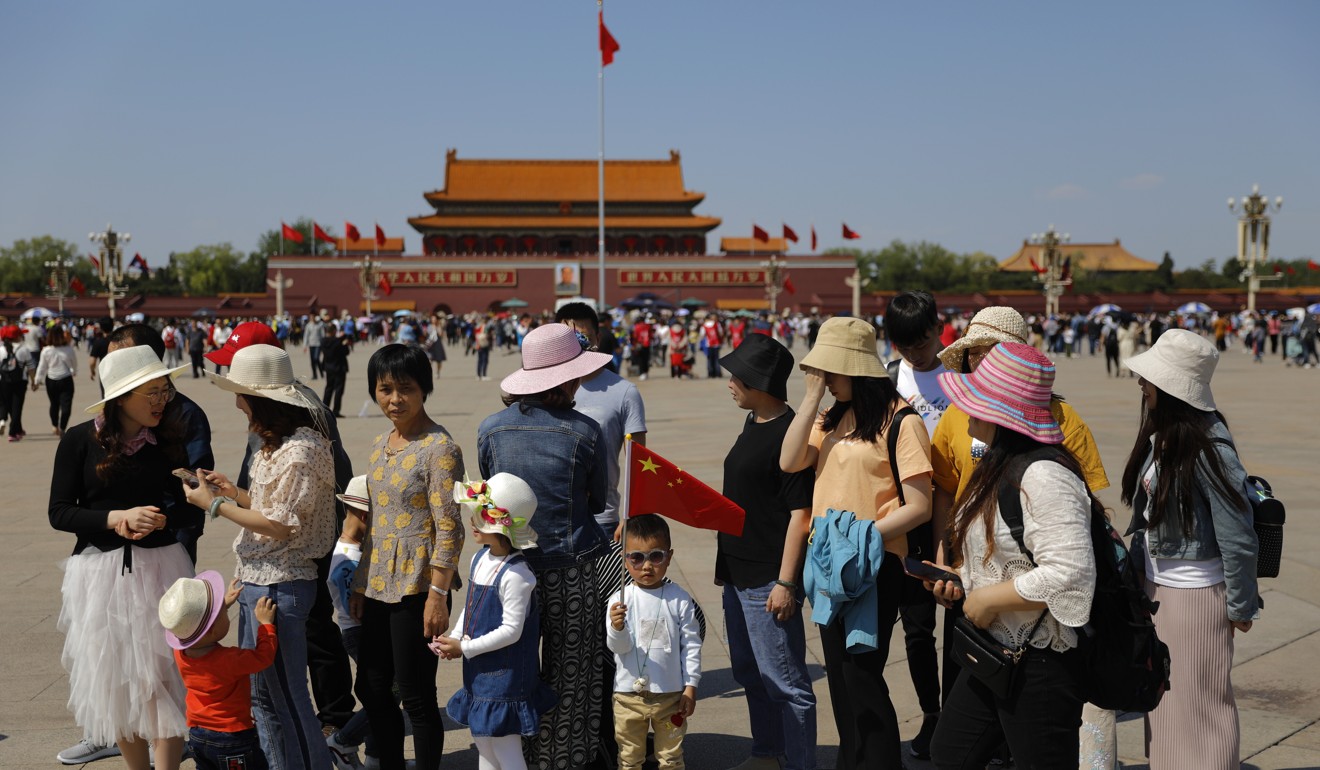
Chinese tourists visit Tiananmen Square in Beijing. Analysts say 782 million people opted for “staycations” at local historical sites over golden week this year. Photo: EPA
Experts say Thailand – the second-most booked country during golden week, according to Ctrip – saw many repeat travellers return to the country. The nation saw 1.03 million arrivals from China in August, up 19 per cent from 2018.
Guo said these travellers were more budget-conscious than those who travelled to Japan, and enjoyed the good value and picturesque scenery for sharing on social media.
“They have already travelled to Southeast Asia before, and are therefore looking for personalised and local experiences like interacting with Thai residents, jungle treks and food tours,” she said, adding that many are willing to spend extra on immersive experiences such as a hotel in the countryside, or on a room with a forest view.
Thailand’s tourism industry gets jitters after currency surges, visitor numbers from China fall
According to Alipay Mobile, the sale of “durian experience” packages for Chinese tourists looking to taste the spiky, pungent fruit at local farms increased by 60 per cent in Thailand and Malaysia from last year.
Shopping remained on the agenda, too. Thailand ranked second for the highest volume of overseas transactions during the week, according to data from Alipay Mobile. Most Chinese shoppers frequented duty-free shops, convenience stores and local malls, according to local press.
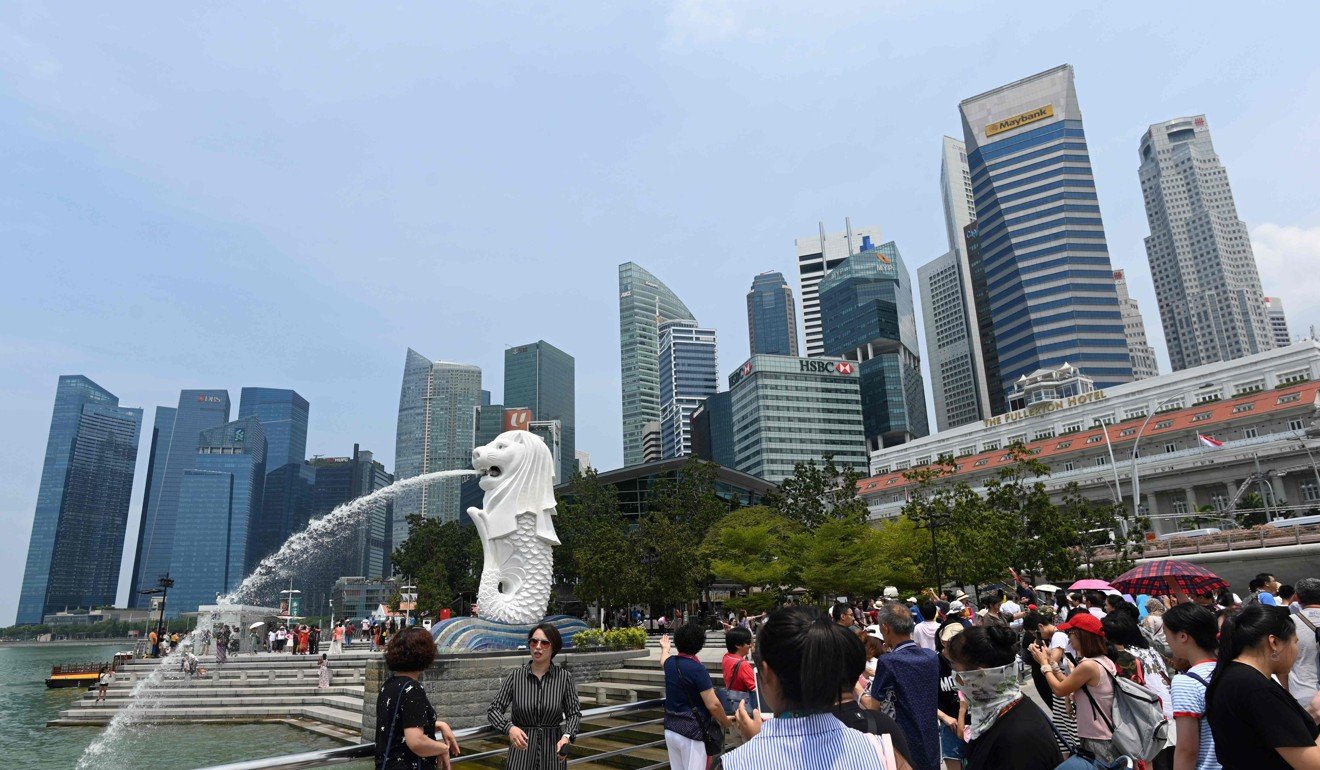
Singapore remained a destination of choice for tourists from the mainland. The city was among the most popular “traditional destinations” for them, according to China’s culture and tourism ministry, with others including Malaysia, Thailand, Japan, Australia, France, Italy, and Russia.
Chinese tourists visiting Singapore over golden week also seized the opportunity to check out property in the Lion City. Photo: AFP
July saw the Lion City break its record for the number of Chinese arrivals, at close to 390,000, an unprecedented 46 per cent jump from the previous month.
Analysts have attributed this to a diversion of tourists from Hong Kong, but property agents such as Clarence Foo, associate deputy group director at OrangeTee & Tie, said some of these Chinese tourists were using the golden week as a chance to eye Singaporean real estate.
“Compared to a normal week, there were probably 15 to 20 per cent more Chinese visitors who viewed property,” said Foo, who counts Singaporean and international buyers among his clients.” They are certainly more keen on Singapore [property] now as there isn’t another comparable investment destination in Asia.”
Meanwhile, the Middle East is emerging as a popular shopping destination for Chinese tourists. According to Ctrip, Dubai saw 501,000 travellers from the mainland in the first half of 2019, an 11 per cent increase from last year.
Saudi Arabia has also experienced a surge in Chinese tourists, with 7,931 heading to the country since it launched its new instant tourist visa programme on September 27. With the new visa, which can be obtained online or upon arrival, tourists can stay in the country for up to 90 days, and unwed foreign men and women can for the first time share hotel rooms.
“Saudi Arabia has the potential to become very popular with Chinese tourists,” said Guo from Cherry Blossoms, adding that travellers from the mainland are increasingly looking for exciting new adventures. “It’s a status symbol for them to visit a country others haven’t visited before.”
Source: SCMP
Posted in 70th anniversary, Alibaba Group Holding, Alipay Mobile, Australia, ‘golden week’, “staycation”, “staycations”, Beijing, benefit, celebrated, Chinese national holiday, chinese tourists, Ctrip, cultural events, cultural experiences, Dubai, durian experience, France, golden week, heritage sites, Hong Kong, Imperial Palace, Italy, Japan, Korea, Kyoto, Lion City, Luohu border checkpoint, mainland, Malaysia, Middle East, Nagoya, nation, Nissan, People’s Republic of China, Post, Russia, Sapporo, Saudi Arabia, Seibu, Singapore, Singaporean real estate, skip, Sogo, Southeast Asia, spiky, pungent fruit, temple tours, Thailand, Tiananmen Square, Tokyo, traditional destinations, travellers, Tsushima tourism, Uncategorized |
Leave a Comment »
03/10/2019
NEW DELHI (Reuters) – Indian Prime Minister Narendra Modi called on the nation to work toward ending the consumption of single-use plastics by 2022, in a speech on Wednesday.
“Hygiene, protection of environment and protection of life were of keen interest to Gandhi,” said Modi, speaking on the anniversary of the freedom movement leader’s birth. “Plastic is dangerous to all these three goals. So we need to reach the goal of ending single-use plastic by 2022.”
Meanwhile, India held off a plan to impose a blanket ban on single-use plastics as it was seen as a measure too disruptive for industry at a time when India is dealing with an economic slowdown and job losses, officials told Reuters on Tuesday.
In a tweet on Wednesday, India’s environment ministry however, denied that it had planned to issue a ban.
“India, today is on the verge of starting a historic movement against #SingleUsePlastic, setting an example for the world. At such a time, discovering a shelved ban, when none was planned is indeed misleading & doesn’t do justice to its fight against single use plastic,” the ministry said in a tweet.
Reuters had in August reported that India was set to impose a nationwide ban on plastic bags, cups and straws on Oct. 2, in a sweeping measure to stamp out single-use plastics from cities and villages that rank among the world’s most polluted.
Concerns are growing worldwide about plastic pollution, especially in oceans, where nearly 50% of single-use plastic products end up, killing marine life and entering the human food chain, studies have shown.
Source: Reuters
Posted in #SingleUsePlastic, 2022, anniversary, birth, blanket ban, cities, consumption, dangerous, disruptive, economic slowdown, end usage, entering, exhorts, freedom movement leader, Gandhi, goals, held off, historic movement, human food chain, hygiene, impose, India’s Environment Ministry, Indian Prime Minister Narendra Modi, industry, job losses, killing, marine life, measure, most polluted, nation, nationwide ban, oceans, plan, plastic, plastic bags, plastic cups, plastic straws, protection of environment, protection of life, Reuters, single-use plastics, stamp out, sweeping measure, tweet, Uncategorized, villages |
Leave a Comment »
27/08/2019
Huang Kunming, a member of the Political Bureau of the Communist Party of China (CPC) Central Committee and head of the Publicity Department of the CPC Central Committee, addresses a seminar on expositions on historical sciences made by Xi Jinping, general secretary of the CPC Central Committee, in Beijing, capital of China, Aug. 26, 2019. (Xinhua/Yao Dawei)
BEIJING, Aug. 26 (Xinhua) — A seminar on expositions on historical sciences made by Xi Jinping, general secretary of the Communist Party of China (CPC) Central Committee, was held Monday in Beijing.
Xi’s expositions on historical sciences, which embody a deep understanding of history and historical sciences by contemporary Chinese Communists, are an important guideline to be followed by China’s historical research in the new era, said Huang Kunming, a member of the Political Bureau of the CPC Central Committee and head of the Publicity Department of the CPC Central Committee, when addressing the seminar.
He said Marxism should be firmly upheld to offer guidance and called for efforts to facilitate the building of discipline, and academic and discourse systems of history research with Chinese characteristics.
Huang stressed the importance of combining research and education, taking a clear-cut stand to oppose historical nihilism, and guiding people to establish a correct view of the history, nation, country, and culture.
The seminar, hosted by the Chinese history research institute under the Chinese Academy of Social Sciences, was attended by over 150 historians from across the country.
Source: Xinhua
Posted in Beijing, Chinese Academy of Social Sciences, Chinese Characteristics, Chinese history research institute, Country, Culture, general secretary of the Communist Party of China (CPC) Central Committee, historians, historical sciences, History, history research, Marxism, nation, Political Bureau of the CPC Central Committee, Publicity Department of the CPC Central Committee, Seminar, Uncategorized, Xi JinPing, Xi's expositions |
Leave a Comment »
11/02/2019
Urging Congress workers to “transform UP”, Rahul Gandhi said that PM Modi’s “hollow promises of have come to light”.
SNS Web | New Delhi | February 11, 2019 7:04 pm
With an appeal to the people of Uttar Pradesh to bring the Congress to power at the Centre in the upcoming Lok Sabha elections, party president Rahul Gandhi presented his party as the one that can bring a progressive government for farmers, Dalits, youth and the poor.
Addressing Congress supporters in Lucknow on Monday at the conclusion of a massive roadshow with Priyanka Gandhi and Jyotiraditya Scindia, the 48-year-old Gandhi said that there is need to empower grassroot leaders to help bring the party to power and fulfil the aspirations of the people.
Slamming the BJP-RSS, Gandhi said, “This is an ideological battle. On one hand there is the Congress ideology of love, harmony and brotherhood. On the other, there is BJP-RSS ideology of dividing and weakening the nation.”
Urging Congress workers to “transform UP”, Gandhi said that PM Modi’s “hollow promises of have come to light”.
“Congress workers must fight this battle with issues that concern the youth, farmers. There is no dearth of issues. Congress party will fight to transform UP and the nation,” he added, while assuring the supporters that the party will “play on the front foot”.
Criticising Narendra Modi over the promises he made, Gandhi said that the youth of the country believe that the Prime Minister has failed to fulfil them.
“Uttar Pradesh has witnessed what Narendra Modi did for the last 5 years in the country. Youth are saying that Modi failed his promise to provide employment and benefited only people like Anil Ambani,” he said.
Attacking the NDA government and PM Modi over the Rafale deal, in which the Congress smells a scam, Gandhi cited a series of media reports stating that the Defence Ministry expressed its strong reservations to the “parallel negotiations” conducted by the Prime Minister’s Office (PMO) with France on the multi-billion dollar fighter jet deal and that the government removed the anti-corruption clause from the Rafale fighter jet defence deal.
“Modi had said that he has a 56-inch chest. He wants to be a ‘Chowkidar’. The truth has now surfaced that he conducted parallel negotiations in the Rafale deal. The clause that enabled investigation in case of corruption, was waived off by Mr. Modi,” he said.
Also Read | Defence Ministry objected to PMO role in Rafale deal, says report; Rahul Gandhi slams PM Modi
Earlier today, Gandhi had accused PM Modi of “facilitating loot” in the Rafale fighter jet deal with France.
“Every defence deal has an anti-corruption clause. The Hindu has reported that the PM removed the anti-corruption clause. It is clear that the PM facilitated loot,” Gandhi told reporters outside the Andhra Bhawan in New Delhi where he came to support Andhra Pradesh Chief Minister N Chandrababu Naidu’s protest against the Centre.
Read More: PM Modi facilitated loot in Rafale deal: Rahul Gandhi
“NoMo anti corruption clause. The Chowkidar himself opened the door to allow Anil Ambani to steal 30,000 crore from the IAF,” Gandhi tweeted from his official handle using his “chowkidaar chor hai” jibe at the PM while attaching a report.
The report, published by The Hindu, stated that just days before it signed the Inter-governmental Agreement (IGA) for 36 Rafale fighter jets, the Centre had waived off critical provisions for anti-corruption penalties as well as overruled financial advisers’ recommendations for making payments through an escrow account.
Mega roadshow
Monday’s roadshow, which was witnessed by thousands in the city, marked the official entry of Priyanka Gandhi Vadra into active politics.
Appointed Congress general secretary of Uttar Pradesh East last month by her brother, Priyanka Gandhi Vadra is being seen by Congress loyalists as a fortune changer for the grand old party in electorally powerful Uttar Pradesh.
From onboard an open top bus, Priyanka Gandhi, her brother Rahul, Scindia and Uttar Pradesh Congress Committee chief Raj Babbar were seen waving to a sea of supporters who had gathered to catch a glimpse of the leaders.
Read More: Priyanka Gandhi Vadra kicks off mega Lucknow roadshow with Rahul
The approximately 20-km long roadshow started from Amausi airport to the Nehru Bhawan office of the Uttar Pradesh Congress Committee located a Mall Avenue near Hazratganj.
Ahead of her visit to the state, a group of party workers geared up to work as her “army”, complete with a pink uniform that has her photo and a message. They call themselves the ‘Priyanka Sena’.
Earlier on Sunday, in a message to party supporters and voters, Priyanka Gandhi said she hopes to start a “new kind of politics” in which “everyone will be a stakeholder”.
“… I have hope in my heart that together we will start a new kind of politics, a politics in which all of you will be stakeholders — my young friends, my sisters and even the weakest person, all their voices will be heard,” said Gandhi through the Congress’s Shakti App.
While Priyanka will concentrate on 42 seats of eastern UP, Scindia will focus on 38 seats of western UP.
Priyanka’s first meeting is scheduled with the workers of the Mohanlalganj (reserved) constituency while the last interaction slated for Thursday will be with the workers of the Misrikh (reserved) Lok Sabha seat.
UP East also has Varanasi, the parliamentary constituency of Prime Minister Modi, and Gorakhpur, a stronghold of UP Chief Minister Yogi Adityanath.
Source: The Statesman
Posted in Congress, India alert, nation, rahul gandhi, Uncategorized, Uttar Pradesh |
Leave a Comment »







 CHINDIA ALERT: You'll be living in their world, very soon