Chindia Alert: You’ll be Living in their World Very Soon
aims to alert you to the threats and opportunities that China and India present. China and India require serious attention; case of ‘hidden dragon and crouching tiger’.
Without this attention, governments, businesses and, indeed, individuals may find themselves at a great disadvantage sooner rather than later.
The POSTs (front webpages) are mainly 'cuttings' from reliable sources, updated continuously.
The PAGEs (see Tabs, above) attempt to make the information more meaningful by putting some structure to the information we have researched and assembled since 2006.
Members of a road construction team depart from the advance camp at an altitude of 6,500 meters of Mount Qomolangma in southwest China’s Tibet Autonomous Region, May 10, 2020. A road construction team will work on a route to the peak of Mount Qomolangma on May 12 if weather conditions permit. China initiated a new round of measurement on the height of Mount Qomolangma, the world’s highest peak, on April 30. The measurement team consists of members from the Ministry of Natural Resources and the national mountaineering team. (Xinhua/Sun Fei)
MOUNT QOMOLANGMA BASE CAMP, May 10 (Xinhua) — A road construction team will work on a route to the peak of Mount Qomolangma on May 12 if weather conditions permit.
In order to complete missions of building a route to the peak and transporting materials to camps below 8,300 meters above sea level, members of road construction and transportation teams departed for a camp at an altitude of 7,028 meters from the advance camp at an altitude of 6,500 meters at 7:00 a.m. Sunday.
The members eliminated potential safety hazards along the route and arrived at the camp at 2:00 p.m.
On May 12, a total of 12 guides will depart from the camp at an altitude of 7,028 meters to transport materials to another camp.
China initiated a new round of measurement on the height of Mount Qomolangma, the world’s highest peak, on April 30. The measurement team consists of members from the Ministry of Natural Resources and the national mountaineering team.
Since the founding of the People’s Republic of China in 1949, Chinese surveyors have conducted six rounds of scaled measurement and scientific research on Mount Qomolangma and released the height of the peak twice in 1975 and 2005, which was 8,848.13 meters and 8,844.43 meters respectively.
URUMQI, April 18 (Xinhua) — A medical team of eight experts who aided Pakistan’s fight against COVID-19 returned Friday night to Urumqi, capital of northwest China’s Xinjiang Uygur Autonomous Region.
The team, consisting of experts in various fields including respiratory, critical care and traditional Chinese medicine (TCM), arrived in Pakistan on March 28 and visited cities of Islamabad, Lahore and Karachi.
The Chinese experts communicated with the Pakistani federal government, national and local health authorities, hospitals and medical schools, as well as the Red Crescent.
The team members shared their experience through several video conferences and offered practical, specific suggestions to their Pakistani peers concerning the diagnosis, clinical treatment and epidemiologic study of COVID-19, and the application of TCM, hospital infection control and the construction of temporary hospitals.
The team also assisted with improving Pakistan’s guidelines on diagnosis and treatment of COVID-19 to help build an efficient epidemic prevention and control system in Pakistan and enhance its screening and testing capabilities.
Meanwhile, the experts carried out epidemic prevention guidance and popular science education for the Chinese embassy in Pakistan, Chinese enterprises, overseas Chinese and Chinese students in the country.
Image copyright GETTY IMAGESImage caption The Chinese city of Wuhan recently lifted its strict quarantine measures
The Chinese city of Wuhan, where the coronavirus originated last year, has raised its official Covid-19 death toll by 50%, adding 1,290 fatalities.
Wuhan officials attributed the new figure to updated reporting and deaths outside hospitals. China has insisted there was no cover-up.
It has been accused of downplaying the severity of its virus outbreak.
Wuhan’s 11 million residents spent months in strict lockdown conditions, which have only recently been eased.
The latest official figures bring the death toll in the city in China’s central Hubei province to 3,869, increasing the national total to more than 4,600.
China has confirmed nearly 84,000 coronavirus infections, the seventh-highest globally, according to Johns Hopkins University data.
What’s China’s explanation for the rise in deaths?
In a statement released on Friday, officials in Wuhan said the revised figures were the result of new data received from multiple sources, including records kept by funeral homes and prisons.
Deaths linked to the virus outside hospitals, such as people who died at home, had not previously been recorded.
Media caption Learn how Wuhan dealt with the lockdown
The “statistical verification” followed efforts by authorities to “ensure that information on the city’s Covid-19 epidemic is open, transparent and the data [is] accurate”, the statement said.
It added that health systems were initially overwhelmed and cases were “mistakenly reported” – in some instances counted more than once and in others missed entirely.
A shortage of testing capacity in the early stages meant that many infected patients were not accounted for, it said.
A spokesman for China’s National Health Commission, Mi Feng, said the new death count came from a “comprehensive review” of epidemic data.
In its daily news conference, the foreign ministry said accusations of a cover-up, which have been made most stridently on the world stage by US President Donald Trump, were unsubstantiated. “We’ll never allow any concealment,” a spokesman said.
Why are there concerns over China’s figures?
Friday’s revised figures come amid growing international concern that deaths in China have been under-reported. Questions have also been raised about Beijing’s handling of the epidemic, particularly in its early stages.
In December 2019, Chinese authorities launched an investigation into a mysterious viral pneumonia after cases began circulating in Wuhan.
China reported the cases to the World Health Organization (WHO), the UN’s global health agency, on 31 December.
But WHO experts were only allowed to visit China and investigate the outbreak on 10 February, by which time the country had more than 40,000 cases.
The mayor of Wuhan has previously admitted there was a lack of action between the start of January – when about 100 cases had been confirmed – and 23 January, when city-wide restrictions were enacted.
Around that time, a doctor who tried to warn his colleagues about an outbreak of a Sars-like virus was silenced by the authorities. Dr Li Wenliang later died from Covid-19.
Wuhan’s death toll increase of almost exactly 50% has left some analysts wondering if this is all a bit too neat.
For months questions have been asked about the veracity of China’s official coronavirus statistics.
The inference has been that some Chinese officials may have deliberately under-reported deaths and infections to give the impression that cities and towns were successfully managing the emergency.
If that was the case, Chinese officials were not to know just how bad this crisis would get in other countries, making its own figures now seem implausibly small.
The authorities in Wuhan, where the first cluster of this disease was reported, said there had been no deliberate misrepresentation of data, rather that a stabilisation in the emergency had allowed them time to revisit the reported cases and to add any previously missed.
That the new death toll was released at the same time as a press conference announcing a total collapse in China’s economic growth figures has led some to wonder whether this was a deliberate attempt to bury one or other of these stories.
Then again, it could also be a complete coincidence.
China has been pushing back against US suggestions that the coronavirus came from a laboratory studying infectious diseases in Wuhan, the BBC’s Barbara Plett Usher in Washington DC reports.
US President Donald Trump and some of his officials have been flirting with the outlier theory in the midst of a propaganda war with China over the origin and handling of the pandemic, our correspondent says.
Mr Trump this week halted funding for the World Health Organization (WHO), accusing it of making deadly mistakes and overly trusting China.
“Do you really believe those numbers in this vast country called China, and that they have a certain number of cases and a certain number of deaths; does anybody really believe that?” Mr Trump said at the White House on Wednesday.
On Thursday, UK Foreign Secretary Dominic Raab said: “We’ll have to ask the hard questions about how [coronavirus] came about and how it couldn’t have been stopped earlier.”
But China has also been praised for its handling of the crisis and the unprecedented restrictions that it instituted to slow the spread of the virus.
SHANGHAI (Reuters) – China ordered on Saturday that anyone in Wuhan working in certain service-related jobs must take a coronavirus test if they want to leave the city.
The order comes after the central city, where the coronavirus emerged late last year, lifted a 70-day lockdown that all but ended the epidemic there.
People in Wuhan work in nursing, education, security and other sectors with high exposure to the public must take a nucleic acid test before leaving, the National Health Commission said in an order.
The government of Hubei province, of which Wuhan is capital, will pay for the tests, the commission said.
Since the city relaxed its lockdown restrictions people who arrived in there before Chinese New Year, when the virus was peaking in China, are allowed to go back to their homes.
People working in other sectors aiming to leave Wuhan are encouraged to take voluntary tests before going.
Within seven days of arrival at their destinations, people who can present test results showing they do not carry the virus, as well as a clean bill of health on a health app, can go back to work.
Everyone else will have to spend 14 days in quarantine before returning to work.
Authorities have worked with the China’s tech giants to devise a colour-based health code system, retrieved via mobile app, that uses geolocation data and self-reported information to indicate one’s health status.
Wuhan will speed up its efforts to investigate asymptomatic coronavirus cases and confirm the presence of antibodies in people, which might suggest immunity, the commission said.
Wuhan, which accounts for 60% of infections in China and 84% of the death toll as of Saturday, has been testing inhabitants aggressively throughout the virus’ breakout and many companies had already been asking workers from the city to undergo tests before resuming work.
Wuhan revised up its death toll from the coronavirus by 1,290 on Friday, taking the city’s toll to 3,869, because of incorrect reporting, delays and omissions, especially in the chaotic early stages of the outbreak, authorities said.
China national death toll is 4,632 from 82,719 cases.
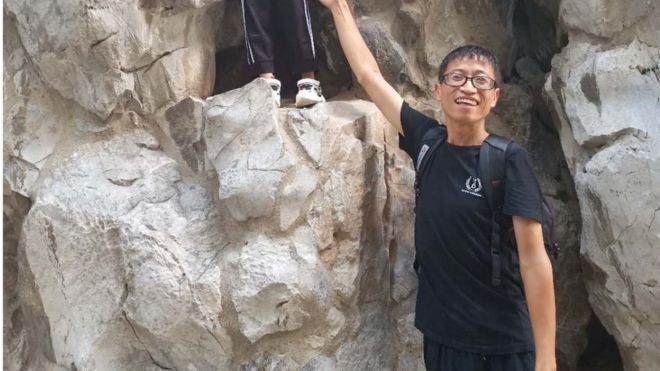
“Doctors and nurses are people who saved me from cancer and gave me strength in the darkest time. I need to return the favour,” says Li Yan, a food delivery rider based in Beijing.
Mr Li was diagnosed with lymph cancer in 2003, when he was just 17 years old. He recovered from the disease and has been full of gratitude ever since for the medical workers who nursed him back to health. With China in a national lockdown, food delivery firms found themselves in hot demand providing meals for residents stuck at home to prevent the spread of the coronavirus.
As a delivery rider for Meituan, one of China’s biggest food delivery firms, Mr Li saw an opportunity to repay the medical professionals he admires by providing them with food and drinks as they worked tirelessly on patients across the city. “Given my past experience, I felt I needed to do something for them in return during the virus outbreak,” he adds.
Beijing is a city of 21 million residents, and Mr Li covers its Tongzhou district, where there are a handful of hospitals with fever clinics, one of which is a designated hospital for Covid-19 treatment. “Many might have concerns delivering for the hospital, but I’ve chosen to deliver for them more often. I just think of the local residents and medical workers who need us. I can’t leave them being hungry. It’s not for money.”
Before the outbreak in China, he delivered more than 50 orders on an average day. But during the first ten days after the coronavirus outbreak in late January, the number of orders dropped to less than 20, as some restaurants were closed. The outbreak also coincided with the Chinese New Year period which is normally a low season.
“By mid-February when the situation was brought more under control, and people’s concerns and fears gradually began to ease, orders started to be restored. I can deliver over 40 orders a day now.”
Image copyright LI YAN
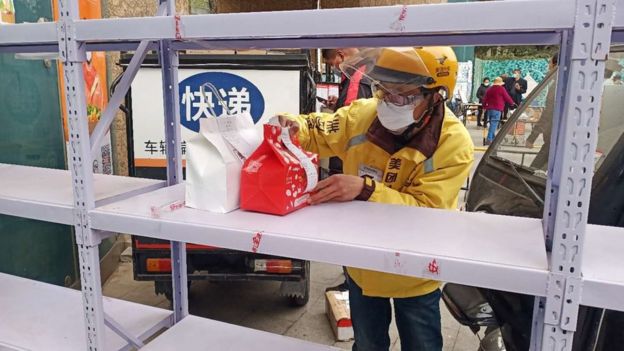
During this time, Meituan brought in a contactless delivery option which allowed food to be dropped off at designated points to avoid contact between customers and riders. “When I called customers to explain, some initially didn’t understand and wanted to cancel the order. But gradually people grew more understanding and began to welcome the contactless approach.”
Empty streets
China was in lockdown for more than two months, although restrictions are now beginning to be lifted. It will still take time before a sense of normalcy returns.
“I remember when the coronavirus first broke out, it was hazy for a few days in Beijing. Streets were empty and stores were closed. An ambulance or a delivery rider occasionally drove by. It felt like I was living in a different world.”
Mr Li says restaurants have started to re-open and people have begun coming back to work in the office since mid-February. Orders are still lower than normal but are improving.
“I miss the hustling Beijing which used to filled with traffic, the days when I could smell car exhaust when I stop at crossroads, the times when I had to walk all the way up to the 6th floor to deliver food, and even times when I was late for a delivery.”
Image copyright LI YAN
When the virus first broke out, face masks and alcohol disinfectant were the most ordered items along with supermarket groceries. “Grains, rice, cooking oil, vegetables, fruits, and solid, packaged food that lasts long. Orders often came in big sizes and transaction prices at around 200 yuan [£23; $28] to 300 yuan on one order.”
Being a food delivery rider, Mr Li feels he can not only give back to the medical community but to the city’s vulnerable too.
“I once received an order that came with a note saying the customer is a 82-year-old who lives alone and couldn’t get downstairs to pick up the food so the rider needs to enter the residential community and deliver food to the door. I had to spend some time communicating with security and finally was allowed in. The door was open when I arrived, and I put the bowl of wontons [a type of dumpling] on the table.”
Tips have increased from happy customers during the pandemic as a result. “Many more send me thank-you notes in the Meituan app and tell me to take care.”
Image copyright LI YAN
Keeping clean
Mr Li has a new routine now which involves lots of disinfecting and temperature checks. “I get my temperature checked dozens of times everyday now, before entering shopping malls, at restaurants, and returning home to the residential compound I live in. I also bring with me disinfectant sprays, a towel in my scooter and use disposable gloves when delivering to areas with reported confirmed cases.”
While he’s providing a vital service, is Mr Li worried about the risk of infection? “I did have worries when the virus spread and was at its worst time here but I feel like I’ve already been there, given what I went through in the fight against cancer.
“I’ve learnt to take things easy, look at the bright side of things and always seek strength in a dark time. As long as I take sufficient precautions, masks, gloves, disinfectants and everything, and follow advice from disease control experts, I think the possibility of getting the virus is pretty low.”
And with a seven-month pregnant wife at home, Mr Li is looking forward to happier times.
BEIJING, March 25 (Xinhua) — Chinese Vice Premier Hu Chunhua called for all-out efforts to make full use of online platforms to boost employment as the novel coronavirus outbreak has dampened the country’s job market.
Hu, also a member of the Political Bureau of the Communist Party of China Central Committee, made the remarks Wednesday during an investigation of a national online recruitment program.
The special hiring project, launched on March 20, offered over 10 million positions for job seekers.
After hearing reports of the program, Hu held video conferences to learn about work resumption of enterprises and online recruitment and paid special attention to key groups like college graduates and migrant workers.
Noting that this year’s employment situation could be tough due to the epidemic, Hu urged localities and relevant government agencies to guide all kinds of employers to provide more types of jobs and help those with employment difficulties.
The vice premier also underlined the use of online platforms in special recruitment plans, career guidance and vocational training as normal hiring activities were disrupted by the outbreak.
Meanwhile, public employment service agencies and relevant market institutions should be encouraged to share information on job vacancies and strengthen the coordination of online and offline recruitment activities to ensure a stable job market, Hu said.
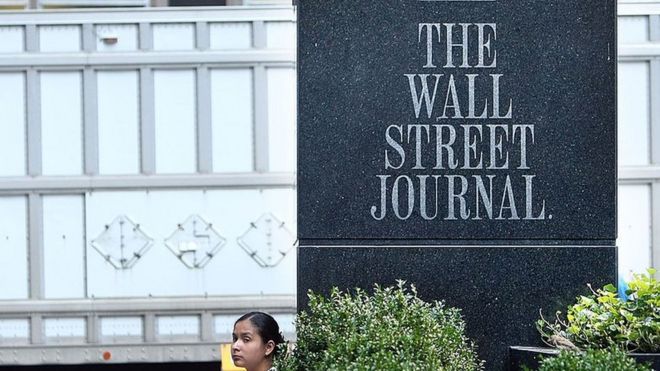
“The Chinese people do not welcome media that publish racist statements and maliciously attacks China,” Mr Geng said, without naming the journalists being expelled.
The Wall Street Journal identified the reporters as two US citizens – Josh Chin, who is the deputy bureau chief, and Chao Deng – as well as Australian citizen Philip Wen. The newspaper has not yet commented.
It is the first time in more than two decades that journalists holding valid credentials have been ordered to leave China, the BBC’s John Sudworth in Beijing reports.
The Foreign Correspondents Club of China called the decision “an extreme and obvious attempt by the Chinese authorities to intimidate foreign news organizations”.
The measure comes a day after the US said it would begin treating five Chinese state-run media outlets that operate in the country in the same way as foreign embassies, requiring them to register their employees and properties with the US government.
The decision affects the Xinhua News Agency, China Global Television Network and China Daily Distribution Corp.
Press freedom in China
China is consistently rated poorly for press freedom and can be a difficult place for foreign journalists to work
Nine journalists have been either expelled or effectively expelled through non-renewal of visas since 2013, according to the Foreign Correspondents Club of China
Last year, the government declined to renew the credentials – necessary for the work of foreign journalists in the country – of another Wall Street Journal reporter.
The journalist, a Singaporean national, had co-written a story that authorities in Australia were looking into activities of one of China’s President Xi Jinping’s cousins suspected of involvement in organised crime and money laundering.
And in 2018, the Beijing bureau chief for BuzzFeed News Megha Rajagopalan was unable to renew her visa after reporting on the detention of Muslim minority Uighurs and others in China’s Xinjiang region.
Meanwhile, two Chinese citizen journalists who disappeared last week after covering the coronavirus in Wuhan, the epicentre of the outbreak in Hubei province, remain missing.
Fang Bin and Chen Qiushi had been sharing videos and pictures online from inside the quarantined city.
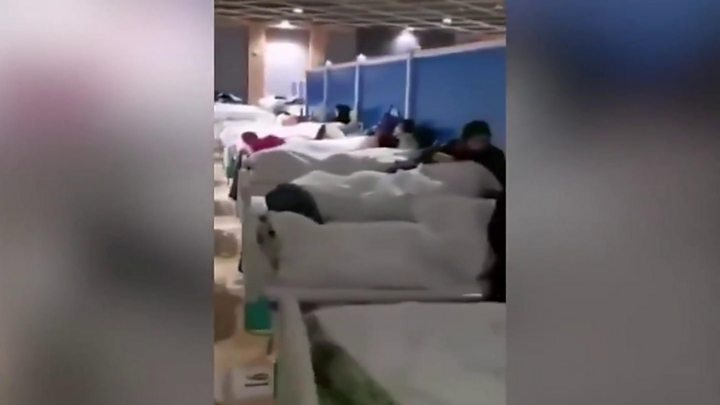
Media caption Footage appearing to show people held in quarantine in a makeshift facility in Wuhan, has been shared across social media
BEIJING, June 5 (Xinhua) — A national WeChat mini-program was launched Wednesday to enable users to enjoy over 200 e-government services via the cross-region and cross-department digital platform.
The mini-program, a small application embedded within China’s popular social media platform WeChat, connects users with services offered by six government agencies including the National Development and Reform Commission and the Ministry of Commerce, according to a statement from WeChat’s developer Tencent.
Individual users can search information about their education and traffic violation record, among others, while enterprises can apply for certain licenses and certificates online via the mini-program.
The mini-program is also connected with local government online service platforms in several provinces including Guangdong and Zhejiang, while more local e-government services will be connected in the future, the statement said.
E-government services via apps and mini-programs are increasingly popular in China amid national and local efforts to cut administrative red tape to benefit residents and businesses alike.
A total of 30 provincial-level regions have established integrated e-government platforms that incorporate the services of provincial, city and county governments, according to a report released in May.
In 2018, the number of real-name users on provincial e-government platforms reached 145 million, an increase of 38 million over the previous year, the report showed.
Guo Shengkun (R), a member of the Political Bureau of the Communist Party of China (CPC) Central Committee and head of the Commission for Political and Legal Affairs of the CPC Central Committee, meets with Afghan president’s national security adviser Hamdullah Mohib in Beijing, capital of China, Jan. 11, 2019. (Xinhua/Shen Hong)
BEIJING, Jan. 12 (Xinhua) — Guo Shengkun, a member of the Political Bureau of the Communist Party of China (CPC) Central Committee, met with Afghan president’s national security adviser Hamdullah Mohib Friday in Beijing.
Guo, also head of the Commission for Political and Legal Affairs of the CPC Central Committee, called on China and Afghan to implement the consensus reached by the two heads of state and continue to advance the strategic cooperative partnership between the two countries.
China’s law enforcement and security departments stand ready to enhance cooperation with Afghan in counter-terrorism, border security, institution and personnel security, so as to safeguard security and development interests of the two countries, and promote regional peace and stability.
Mohib said Afghan will resolutely fight against terrorism, and stands ready to deepen law enforcement and security cooperation between the two countries.
BEIJING, Dec. 12 (Xinhua) — China has decided the winners for the 2018 national science and technology awards at an executive meeting of the State Council presided by Premier Li Keqiang on Wednesday.
The list of winners and awards are yet to be released.
According to the meeting, the purpose of the awards is to inspire more domestic technicians, especially younger ones, to engage in the study of cutting-edge technologies, make breakthroughs in essential technologies, expand international cooperation and to have science and technology better serve and support economic development and the improvement of people’s livelihood.
A grand ceremony was held in Beijing in January, where 271 projects and nine scientists won the national prizes last year. There were also seven foreign scientists who won international science and technology cooperation awards.


 Members of a road construction team depart from the advance camp at an altitude of 6,500 meters of Mount Qomolangma in southwest China’s Tibet Autonomous Region, May 10, 2020. A road construction team will work on a route to the peak of Mount Qomolangma on May 12 if weather conditions permit. China initiated a new round of measurement on the height of Mount Qomolangma, the world’s highest peak, on April 30. The measurement team consists of members from the Ministry of Natural Resources and the national mountaineering team. (Xinhua/Sun Fei)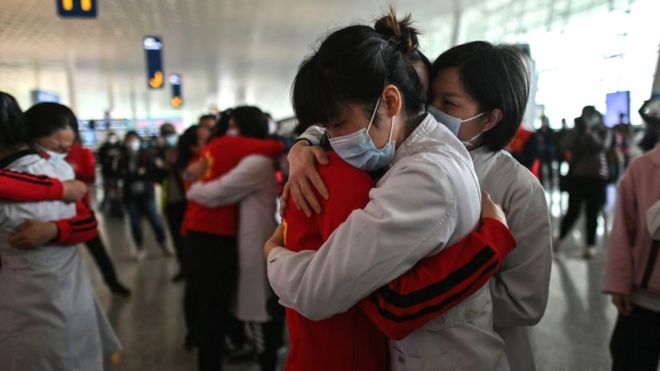








 CHINDIA ALERT: You'll be living in their world, very soon