Chindia Alert: You’ll be Living in their World Very Soon
aims to alert you to the threats and opportunities that China and India present. China and India require serious attention; case of ‘hidden dragon and crouching tiger’.
Without this attention, governments, businesses and, indeed, individuals may find themselves at a great disadvantage sooner rather than later.
The POSTs (front webpages) are mainly 'cuttings' from reliable sources, updated continuously.
The PAGEs (see Tabs, above) attempt to make the information more meaningful by putting some structure to the information we have researched and assembled since 2006.
NEW DELHI (Reuters) – Indian police said on Friday they had detained hundreds of people and were keeping a heavy presence in northeast New Delhi, days after the worst bout of sectarian violence in the capital in decades.
At least 38 people were killed in Hindu-Muslim violence this week, police said, amid mounting international criticism that authorities failed to protect minority Muslims.
Media said the toll was likely to rise.
Delhi police spokesman M.S. Randhawa said police were collecting evidence, reviewing video footage of the violence and had already detained more than 600 people.
“The detentions were important to bring the situation under control,” Randhawa told reporters, adding that there had been no new reports of violence.
The clashes began over a citizenship law that Prime Minister Narendra Modi’s Hindu nationalist government introduced in December providing a path to Indian citizenship for six religious groups from neighbouring countries – but not Muslims.
Critics say the law is discriminatory and comes on top of other measures such as withdrawal of autonomy for Muslim-majority Jammu and Kashmir that has deepened disquiet about the future of India’s 200 million Muslims.
Critics of the government however blamed this week’s violence on members of Modi’s Bharatiya Janata Party (BJP), which was trounced in local Delhi elections at the beginning of the month. The BJP has denied the allegations.
The violence morphed into street battles between Hindu and Muslim groups with the police largely ineffective in ending the violence.
The Organisation of Islamic Countries (OIC) has condemned the violence against Muslims and vandalism of mosques and Muslim-owned properties.
U.S. Democratic presidential hopeful Bernie Sanders accused President Donald Trump of failing on the issue of human rights after he refused to be drawn into criticising New Delhi for its handling of the violence.
Trump was on a state visit to India when the violence broke out.
NEW DELHI (Reuters) – As deadly clashes between Hindu and Muslim groups rocked parts of the Indian capital Delhi this week, the family of a young Hindu woman living in a Muslim-majority area was forced to cancel her wedding.
Dressed in her wedding finery, her hands laced maroon with henna and her skin cleansed with turmeric, 23-year-old Savitri Prasad said she was weeping in her home as violent mobs battled outside on Tuesday, which was to have been her wedding day.
But Savitri’s father then organised the wedding for the following day, saying his Muslim neighbours were family and he was comforted by their presence.
“My Muslim brothers are protecting me today,” Savitri told a Reuters team that visited the house on the day of the ceremony, breaking down again as her family and neighbours comforted her.
The rituals took place at Savitri’s home, a small brick building in a narrow alley in the Chand Bagh district. Steps away, the main street looked like a war zone, with cars and shops vandalised, a Muslim shrine torched and the area littered with rocks used in pitched battles between mobs on both sides.
At least 32 people have been killed in the fighting in Chand Bagh and nearby areas of the capital this week, and hundreds of Hindus and Muslims have been injured in the worst sectarian riots in the Indian capital in decades.
“We went to the terrace and just saw smoke and more smoke,” Bhoday Prasad, Savitri’s father, said of the scene on Monday and Tuesday. “It is terrifying. We just want peace.”
Bhoday Prasad said he has lived in the area for years alongside Muslims without any trouble.
“We don’t know who the people behind the violence are, but they are not my neighbours. There is no enmity between Hindus and Muslims here.”
On Monday evening, the day Savitri was to have henna applied on her hands in a pre-wedding ritual, violence had already spiralled out of control.
“We could hear a lot of commotion outside, but I had the henna applied, hoping things would be better next day,” she said. Instead, they got worse.
Her father told the groom and his family it was too dangerous to come to the house.
“Our heart pains for her, who would want their daughter to be sitting home crying when she is supposed to be happy?” said Sameena Begum, one of the Muslim neighbours.
Violence ebbed on Wednesday, but markets remained shut and residents stayed indoors, fearful of further clashes. Savitri’s father said he decided to organise a scaled-down ceremony.
“Hindu or Muslim, we are all humans and we are all terrified of the violence,” said Savitri’s cousin Pooja, as she helped the bride dress for the ceremony. “This fight was not about religion, but it has been made so.”
Muslim neighbours gathered to offer blessings as the groom arrived and the wedding rituals took place, with a Hindu priest reciting holy verses and the groom and bride taking the rounds of a small pyre set up inside the house.
“We live peacefully with our Hindu brothers,” said Aamir Malik, who was standing guard with several other men outside the home. “We are everything for them. It’s been like that. We are here for them.”
Following an exchange of garlands, Savitri, her husband and his family were escorted out of the alleys by her family and neighbours.
“Today, none of our relatives could attend my daughter’s wedding,” said Bhoday Prasad. “But our Muslim neighbours are here. They are our family.”
NEW DELHI (Reuters) – U.S. President Donald Trump said on Tuesday that India will buy $3 billion worth of military equipment, including attack helicopters, as the two countries deepen defence and commercial ties in an attempt to balance the weight of China in the region.
India and the United States were also making progress on a big trade deal, Trump said. Negotiators from the two sides have wrangled for months to narrow differences on farm goods, medical devices, digital trade and new tariffs.
Trump was accorded a massive reception in Indian Prime Minister Narendra Modi’s home state on Monday, with more than 100,000 people filling into a cricket stadium for a “Namaste Trump” rally.
On Tuesday, Trump sat down for one-on-one talks with Modi followed by delegation-level meetings to try and move forward on issues that have divided them, mainly the festering trade dispute.
RELATED COVERAGE
U.S. first lady Melania Trump visits ‘happiness’ class at Delhi school
After those meetings, Trump said his visit had been productive with the conclusion of deals to buy helicopters for the Indian military. India is buying 24 SeaHawk helicopters from Lockheed Martin equipped with Hellfire missiles worth $2.6 billion and also plans a follow-on order for six Apache helicopters.
India is modernising its military to narrow the gap with China and has increasingly turned to the United States over traditional supplier, Russia.
Trump said the two countries were also making progress on a trade deal, which had been an area of growing friction between them.
“Our teams have made tremendous progress on a comprehensive trade agreement and I’m optimistic we can reach a deal that will be of great importance to both countries,” said Trump in remarks made alongside Modi.
The two countries had initially planned to produce a “mini deal”, but that proved elusive.
Instead both sides are now aiming for a bigger package, including possibly a free trade agreement.
Trump said he also discussed with Modi, whom he called his “dear friend”, the importance of a secure 5G telecoms network in India, ahead of a planned airwaves auction by the country.
The United States has banned Huawei, arguing the use of its kit creates the potential for espionage by China – a claim denied by Huawei and Beijing – but India, where telecoms companies have long used network gear from the Chinese firm, is yet to make a call.
Trump described Monday’s rally in Ahmedabad and again praised Modi and spoke of the size of the crowd, claiming there were “thousands of people outside trying to get in..
“I would even imagine they were there more for you than for me, I would hope so,” he told Modi. “The people love you…every time I mentioned your name, they would cheer.”
In New Delhi, Trump was given a formal state welcome on Tuesday at the red sandstone presidential palace with a 21-cannon gun salute and a red coated honour guard on horseback on a smoggy day.
HUG GETS TIGHTER
India is one of the few big countries in the world where Trump’s personal approval rating is above 50% and Trump’s trip has got wall-to-wall coverage with commentators saying he had hit all the right notes on his first official visit to the world’s biggest democracy.
They were also effusive in their praise for Modi for pulling off a spectacular reception for Trump.
“Modi-Trump hug gets tighter,” ran a headline in the Times of India.
But in a sign of the underlying political tensions in India, violent protests broke out in Delhi on Monday over a new citizenship law that critics say discriminates against Muslims and is a further attempt to undermine the secular foundations of India’s democracy. They say the law is part of a pattern of divisiveness being followed by Modi’s Hindu nationalist Bharatiya Janata Party.
At least 7 people were killed and about 150 injured in the clashes that took place in another part of the capital, away from the centre of the city where Modi is hosting Trump.
In his speech on Monday, Trump extolled India’s rise as a stable and prosperous democracy as one of the achievements of the century. “You have done it as a tolerant country. And you have done it as a great, free country,” he said.
Delhi has also been struggling with high air pollution and on Tuesday the air quality was moderately poor at 193 on a government index that measures pollution up to a scale of 500. The WHO considers anything above 60 as unhealthy.
LUCKNOW (Reuters) – U.S. President Donald Trump vowed to “drain the swamp” of lobbyists and elites in Washington D.C. Now, one Indian city is racing to clean up a stagnant river as he prepares to visit.
Trump arrives in India on Feb. 24 on a maiden two-day trip that aims to repair bilateral relations hurt by a trade spat.
He plans to visit the western city of Ahmedabad and India’s capital New Delhi, as well as Agra, where he will view the famed monument to love, the Taj Mahal, at sunset.
In the city, authorities are on a clean-up drive, including the polluted waters of the Yamuna river, that backs on to the monument complex.
Jal Singh Meena, an officer with the Agra Ganga Nahar, the government body that manages the canal network that feeds into the Yamuna in Agra, said on Thursday an additional 17 million litres of water are being released from three locks in the week preceding Trump’s visit on Monday- more than double the usual amount.
The extra flow had been ordered “to keep it clean and remove the foul smell,” he told Reuters.
On Thursday, workers scrubbed walls and fountains at the monument, commissioned in 1632 by Mughal emperor Shah Jahan in memory of his late wife Mumtaz, TV channels showed.
India’s best-known attraction, the Taj Mahal is visited by nearly seven million tourists a year, according to official data, but has been blighted by overcrowding and pollution.
Along with polluted water, authorities are battling some of the world’s filthiest air that stains the white marble of the monument, and increasingly aggressive troops of monkeys that have been known to attack visitors.
District authorities have denied local media reports they have relocated some of the more troublesome primates for the visit, and that a bridge on a proposed route taken by Trump will be unable to bear the weight of his armour-plated limousine known as “The Beast”.
NEW DELHI (Reuters) – U.S. President Donald Trump will meet executives of large Indian companies with interests in the United States as he looks to drum up investments during his visit to New Delhi this month.
Executives of some of the companies expected to attend the meeting include Indian oil & gas company Reliance Industries (RELI.NS), diversified group Tata Sons and auto sector companies such as Bharat Forge (BFRG.NS), Mahindra and Mahindra (MAHM.NS) and Motherson, industry and business sources told Reuters.
Trump is scheduled to make his first visit as president to India on Feb. 24-25 during which he will travel to Prime Minister Narendra Modi’s home state of Gujarat followed by talks in New Delhi. The two countries are trying to sign a trade deal during his visit.
On Feb. 25, a meeting is being planned between Trump and Indian executives, especially those focussing on job creation and manufacturing in the United States, the sources said.
The meeting, which will be held in New Delhi, was unlikely to include executives of U.S. companies, they said.
Creating new jobs and boosting manufacturing is critical for Trump in his re-election bid later this year. U.S. factory activity rebounded in January but only after it contracted for five straight months.
“President (Trump) is keen on acknowledging Indian companies which are focussing on manufacturing in the United States,” said a Washington-based source aware of the plans.
United States is a key market for several Indian firms.
Mahindra last year said it will invest another $1 billion (£767.64 million) in the United States and was committed to creating American jobs, while Bharat Forge has announced plans to invest $56 million to set up a new plant in North Carolina.
The $100-billion Tata Group says it is one of the largest Indian-headquartered multinationals in North America, with 13 companies and more than 35,000 employees.
The Confederation of Indian Industries and U.S.-India trade groups have suggested several Indian executives for the Trump meeting and the U.S. Embassy in New Delhi was reviewing that, one source said, adding the final list was yet to be finalised.
The U.S. Embassy in New Delhi declined to comment.
Other than his meeting with Indian business leaders and Modi, Trump is expected to attend an event at a stadium in Gujarat along the lines of the “Howdy Modi” extravaganza held in Houston last September during which the two leaders made a joint appearance.
NEW DELHI/MUMBAI (Reuters) – The Indian government ordered mobile carriers on Friday to immediately pay billions of dollars in dues after the Supreme Court threatened the companies and officials with contempt proceedings for failing to implement an earlier ruling.
The court, which had ordered companies including Vodafone Idea (VODA.NS) and Bharti Airtel (BRTI.NS) to pay 920 billion Indian rupees ($13 billion) in overdue levies and interest by Jan. 23, last month rejected petitions seeking a review of the order it issued back in October.
“This is pure contempt, 100% contempt,” Justice Arun Mishra told lawyers for the companies and the government on Friday.
Later in the day, the Department of Telecommunications called for “immediate payments” from the telcos. A second order instructed relevant offices to stay open on Saturday to “facilitate the Telecom Licensees to make payments or contact them with respect to any matter related to that.”
The companies had contested the government’s definition of revenues subject to tax and Vodafone Idea and Bharti Airtel both flagged risks to their ability to continue as ongoing concerns following the October order. They did not immediately respond to calls seeking comment on the new ruling.
The companies, along with Reliance Jio, which is backed by Asia’s richest man, Mukesh Ambani, control more than 90% of India’s mobile market.
Jio, a relatively new entrant which has disrupted the market with its cut-price offerings, has paid its dues.
Shares in Vodafone Idea, in which Britain’s Vodafone Group (VOD.L) owns a sizable stake, closed down 24.4% after the order. The company’s future is in doubt, with Vodafone Group having said it has no plans to commit any more equity into India.
Shares in Bharti Airtel rose 4.64%, as many investors expect it will be able to survive the payment, leaving it and Jio with a potential opportunity to win market share and enjoy an effective duopoly in the sector. In a letter to the government, Bharti Airtel said it would deposit 100 billion rupees by Thursday and pay the balance “well before” the next hearing on March 17.
Justice Mishra rebuked the government for having failed to implement the court order on collecting the dues. “A desk officer in the government stays a Supreme Court order … Is there any law left in the country?,” he said.
“We will draw up contempt against everyone,” he added, implying that both company and government officials could be fined or jailed if the dues are not paid by March 17.
Analysts said the court’s move could harm the government more broadly, as well as the companies.
“It can’t be in anybody’s interest if a company as high profile as Vodafone Idea shuts shop. Also, the government’s own dues from the sector are at risk,” said Mahesh Uppal, director at ComFirst, a telecom consultancy firm.
BANKS BURDENED
Indian banks are burdened with nearly $140 billion of bad loans and face another huge hit if Vodafone Idea is forced into bankruptcy.
Banks in India are owed roughly 300 billion rupees by Vodafone Idea, according to a Macquarie report from last year.
“Banks were yet to make additional provisioning for these loans as they were expecting some sort of a relief from the court,” said Siddharth Purohit, an analyst at SMC Institutional Equities.
Banks that have the highest exposure to Vodafone Idea include State Bank of India (SBI.NS), Punjab National Bank (PNBK.NS), Canara Bank (CNBK.NS) and Bank of India (BOI.NS), among others, the Macquarie report said.
Vodafone Idea, which owes the government about $4 billion in dues related to the ruling, has seen its shares slide more than 40% since the court ruling in October.
The broader Indian stock market also reversed early gains to trade lower after the ruling as investors worried about the fallout.
Still, some analysts remained hopeful the government could appeal to the court to review its decision.
“Let’s see how the government reacts and what they do. If the government appeals to the court they could still settle it out, and we may see some positives emerge for everyone,” said a senior industry analyst, who asked not to be named.
SRINAGAR/NEW DELHI, India (Reuters) – More than two dozen diplomats are visiting Indian-administered Kashmir, New Delhi said on Wednesday, as the country tries to reassure foreign allies following several months of unrest in the contested territory.
The group includes European diplomats, some of whom declined a previous invitation from New Delhi to visit the region. A proposed vote in the European Union parliament next month could chastise India for its actions in Kashmir.
The Muslim-majority Himalayan region is claimed by India and arch-rival Pakistan and has been in turmoil since New Delhi stripped it of special status and clamped down on communication and freedom of movement in August.
India has since eased those restrictions, and restored limited internet connectivity last month, ending one of the world’s longest such shutdowns in a democracy.
But many political leaders, including three former chief ministers of Jammu & Kashmir state, are still in detention without charge six months after the crackdown, and foreign journalists have so far been denied permission to visit the region.
Representatives from countries including Germany, Canada, France, New Zealand, Mexico, Italy, Afghanistan and Austria are on a two-day visit to “witness for themselves the progressive normalisation of the situation,” India’s foreign ministry said in a statement on Wednesday.
Representatives from several countries, including Germany’s ambassador Walter Lindner, were pictured on a traditional wooden shikara boat on Dal Lake, in Kashmir’s main city of Srinagar.
“We are interacting with the traders, businesswomen and entrepreneurs in Srinagar about the status of business and tourism,” Afghanistan’s envoy Tahir Qadiry said in a tweet on Wednesday.
Sources familiar with the itinerary said the trip will also include meetings with the Indian army and government officials, as well as journalists and civil society groups selected by the security services.
Last month fifteen foreign envoys visited Kashmir – a trip participants characterised as tightly-choreographed with no room for independent meetings.
“Things looked calm, but we only had a very short time out the window of the car to assess the situation,” said a diplomat who attended the previous trip.
“They told the truth, but not necessarily the whole truth,” he added of his meetings with delegates.
NEW DELHI (Reuters) – India’s ruling party was projected to lose a key state election on Tuesday, the vote count showed, in its first electoral test since deadly anti-government protests erupted nearly two months ago.
The Hindu-nationalist Bharatiya Janata Party (BJP) led by Prime Minister Narendra Modi won a bigger majority in a general election in May, but it has lost a string of state elections since then.
The protests, in which at least 25 people have been killed, erupted across the country in mid-December, after the BJP passed a new citizenship law critics say violates India’s secular constitution and discriminates against minority Muslims.
In counting for state polls held in India’s capital New Delhi, data from India’s Election Commission showed the liberal Aam Aadmi Party, led by the city’s chief minister, Arvind Kejriwal, leading 57 out of 70 seats.
The BJP ran a campaign accusing protesters of supporting India’s arch-rival Pakistan and was projected to win 13 seats, up from three in 2015 but far below its own expectations. The party’s local chief Manoj Tiwari had predicted it would win a majority.
AAP activists in distinctive white boat-shaped caps danced outside party headquarters in New Delhi as the result became clear, TV channels showed.
Neelanjan Sircar, an assistant professor at Ashoka University near New Delhi, said that local issues, including delivery of basic services like education and health, appeared to sway voters towards the AAP, even as the BJP ran a polarising campaign on the back of Modi’s image.
“Modi is a larger than life character at the national level, which obviously gives the BJP a huge advantage in national politics,” Sircar said.
“But it doesn’t translate to state level politics, where the BJP often doesn’t have a charismatic face.”
Bespectacled former bureaucrat Kejriwal, 51, formed AAP in 2012 amid an anti-corruption movement that swept India.
The party won a stunning victory in 2015 state elections in the capital, wiping out the BJP and Congress, the party that has ruled India for half its post-independence history.
The Congress – the main opposition at national level – was projected to win no seats in Delhi on Tuesday, data showed, reflecting the deep decline in its fortunes.
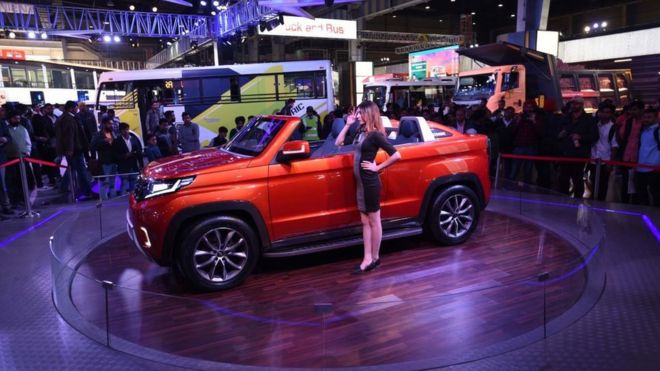
Image copyright GETTY IMAGESImage caption A model displays a car at the annual Indian Auto Expo
Chinese attendees are not welcome at India’s Auto Expo next week due to concerns about the coronavirus.
Chinese guests are prevented from attending the show because of “government policy” an Indian Society of Automobile Manufacturers (SIAM) spokeswoman said.
Yet Chinese cars will be on display.
Other events across Asia will be missing the large delegations that usually come from Chinese firms because of travel restrictions.
Changing car markets
India and China have much at stake in spurring domestic car sales as well as exports, making such industry events vital to drum up business.
New Indian car sales fell 16% last year and China, the world’s largest car market, saw an 8% dip as both markets saw increased turnover in used cars. However there is interest in newer models in the electric vehicle segment, according to Chinese market consultancy LMC Automotive and SIAM figures.
India’s Tata Motors, owner of the Land Rover and Jaguar brands, has developed electric car models for sale at home and abroad, while China’s SAIC Motor and Great Wall Motor also offer electric vehicles for the domestic and export markets. That makes auto shows like the one in India next week important venues to showcase the newest models.
Ripple effect
With hotels and conference fees paid in advance and lunch and dinner meetings arranged months earlier, missing a big industry show has a major ripple effect on economic activity. Events like the Auto Expo in suburban New Delhi, or the Singapore air show due to take place next week draw thousands of out-of-town guests.
In China, the conference circuit has come to a standstill with over 20,000 infections and more than 420 people dead as the virus spreads from the epicentre of the city of Wuhan.
In the case of the Singapore Airshow organisers have faced cancellations by vendors from China, including aircraft maker Comac, and reduced attendance by companies from elsewhere in the world concerned about the spread of the virus outside of China. Singapore has reported 24 cases. India to date has seen three coronavirus cases.
To mitigate the impact, both events have highlighted plans to screen throngs of guests for fever and ensure thorough sanitation measures as well as access to medical care to ensure they can carry on even at reduced attendance.
NEW DELHI (Reuters) – India sought to boost growth in a federal budget on Saturday that raised spending on farms and expressways and offered cuts inpersonal taxes, but the measures fell short of market expectations and battered stocks.
Prime Minister Narendra Modi’s government is grappling with the country’s worst slowdown in a decade, with falling employment, consumption and investment ratcheting up the pressure to revive growth.
The government estimates growth this year to March 31 will slip to 5%, the weakest pace since the global financial crisis of 2008-09. It also warned an expected rebound the following year might entail a blow-out in fiscal deficit targets.
Finance Minister Nirmala Sitharaman, presenting the budget for the financial year beginning April 1, said 2.83 trillion rupees ($39.8 billion) will be allocated toward agriculture and allied activities, up 5.6 percent on the previous year.
RELATED COVERAGE
India raises import taxes in move set to spook some foreign firms
The funds will be deployed to help farmers set up solar power generation units as well as establish a national cold storage system to transport perishables.
Sitharaman also vowed to spend $50.7 billion in coming years on a federal water scheme to address challenges facing one of the world’s most water-stressed nations.
Agriculture accounts for near 15% of India’s $2.8 trillion economy and is a source of livelihood for more than half of the country’s 1.3 billion population.
Sitharaman announced a new personal tax system including cuts for those ready to give up a myriad of tax breaks. She also abolished payment of dividend distribution tax by companies to spur investment.
“People have reposed faith in our economic policy,” Sitharaman said to the thumping of desks in parliament. “This is a budget to boost their income and enhance their purchasing power.”
Opposition parties slammed the budget, saying it had failed to address the slowdown in consumer demand and investment. “The government is in complete denial that the economy faces a grave macro economic challenge,” said former finance minister P. Chidambaram.
But higher government spending has put pressure on public finances, prompting caution from rating agencies. Sitharaman said the fiscal deficit for the current year would widen to 3.8% of GDP, up from 3.3% targeted for the current year.
Gene Fang, associate managing director, sovereign risk at Moody’s, said: “India’s 2020/21 budget highlights the challenges to fiscal consolidation from slower real and nominal growth, which may continue for longer than the government forecasts.”
GOVERNMENT SPENDING
For fiscal 2020/21 Sitharaman set the fiscal deficit at 3.5 percent. Moody’s said India’s government debt is already significantly higher than the average for Baa-rated sovereigns, a product of persistent fiscal deficits.
To help finance government spending, Sitharaman set a target for selling stakes in state firms at 2.1 trillion rupees for 2020/21, more than three times the amount expected this year.
She said the government will sell a part of its holding in state-run Life Insurance Corp, the country’s biggest insurance company.
But many experts said the measures did not go far enough to address the slowdown and structural flaws.
“In a normal scenario this budget would have been considered as good providing tax benefit to the common man, corporate and focus on farmers’ incomes, but the situation required more,” said Vinod Nair, head of research at Geojit Financial Services in Kochi.
Indian shares slid to a more than three-month low after a special trading session on Saturday, dented by what analysts said was a lack of sufficient stimulus measures. The NSE Nifty 50 index .NSEI closed 2.5% lower while the benchmark S&P BSE Sensex .BSESN fell 2.4%
“Markets had very high expectations from the budget … these expectations have not been met,” said Deepak Jasani of HDFC Securities.
The government also announced higher duties on a host of imports from walnuts to phone parts. Taxes on imports of pre-assembled printed circuit boards were raised to 20% from 10% and there were new taxes on mobile phones ringers and display panels in a bid to boost local manufacturing.
In its annual economic report released on Friday the government predicted growth would rebound to 6.0% to 6.5% in the fiscal year beginning April 1.
Some economists say global trade tensions and the outbreak of coronavirus in China pose a new risk to economic recovery by hitting cross-border commerce and supply chains.



 CHINDIA ALERT: You'll be living in their world, very soon