Chindia Alert: You’ll be Living in their World Very Soon
aims to alert you to the threats and opportunities that China and India present. China and India require serious attention; case of ‘hidden dragon and crouching tiger’.
Without this attention, governments, businesses and, indeed, individuals may find themselves at a great disadvantage sooner rather than later.
The POSTs (front webpages) are mainly 'cuttings' from reliable sources, updated continuously.
The PAGEs (see Tabs, above) attempt to make the information more meaningful by putting some structure to the information we have researched and assembled since 2006.
URUMQI, April 18 (Xinhua) — A medical team of eight experts who aided Pakistan’s fight against COVID-19 returned Friday night to Urumqi, capital of northwest China’s Xinjiang Uygur Autonomous Region.
The team, consisting of experts in various fields including respiratory, critical care and traditional Chinese medicine (TCM), arrived in Pakistan on March 28 and visited cities of Islamabad, Lahore and Karachi.
The Chinese experts communicated with the Pakistani federal government, national and local health authorities, hospitals and medical schools, as well as the Red Crescent.
The team members shared their experience through several video conferences and offered practical, specific suggestions to their Pakistani peers concerning the diagnosis, clinical treatment and epidemiologic study of COVID-19, and the application of TCM, hospital infection control and the construction of temporary hospitals.
The team also assisted with improving Pakistan’s guidelines on diagnosis and treatment of COVID-19 to help build an efficient epidemic prevention and control system in Pakistan and enhance its screening and testing capabilities.
Meanwhile, the experts carried out epidemic prevention guidance and popular science education for the Chinese embassy in Pakistan, Chinese enterprises, overseas Chinese and Chinese students in the country.
JOHANNESBURG (Reuters) – African ambassadors in China have written to the country’s foreign minister over what they call discrimination against Africans as the country seeks to prevent a resurgence of the coronavirus.
Several African countries have separately also demanded that China address their concerns that Africans, in particular in the southern city of Guangzhou, are being mistreated and harassed.
Having brought under control the original outbreak centred on the city of Wuhan, China is now concerned about imported cases and is stepping up scrutiny of foreigners coming into the country and tightening border controls. It has denied any discrimination.
In recent days Africans in Guangzhou have reported being ejected from their apartments by their landlords, being tested for coronavirus several times without being given results and being shunned and discriminated against in public. Such complaints have been made in local media, and on social media.
The ambassadors’ note said such “stigmatisation and discrimination” created the false impression that the virus was being spread by Africans.
“The Group of African Ambassadors in Beijing immediately demands the cessation of forceful testing, quarantine and other inhuman treatments meted out to Africans,” it said.
The note was sent to China’s top diplomat, Wang Yi, copying the chair of the African Union, South African President Cyril Ramaphosa and all African foreign ministers.
The Chinese foreign ministry’s International Press Centre did not immediately respond to a request for comment on the note, sent outside of business hours.
The Chinese embassy in South Africa also did not respond.
Foreign affairs official Liu Baochun told a news conference on Sunday that Guangzhou is enforcing anti-virus measures on anyone who enters the city from across the national border, regardless of nationality, race or gender.
The Chinese embassy in Zimbabwe on Saturday dismissed the accusation that Africans were being deliberately targeted.
“It is harmful to sensationalize isolated incidents,” it said in a tweeted statement. “China treats all individuals in the country, Chinese and foreign alike, as equals.”
DISAPPOINTMENT
The ambassadors’ note highlighted a number of reported incidents, including that Africans were being ejected from hotels in the middle of the night, the seizure of passports, and threats of visa revocation, arrest or deportation.
On Saturday, Ghana’s foreign minister of affairs Shirley Ayorkor Botchwey said she had summoned the Chinese ambassador to express her disappointment and demand action.
Kenya’s foreign ministry has also “officially expressed concern”, adding the government is working with Chinese authorities to address the matter.
On Friday, Nigerian legislator Akinola Alabi tweeted a video of a meeting between the leader of Nigeria’s lower house of parliament, Femi Gbajabiamila, and Chinese Ambassador Zhou Pingjian. In it, Gbajabiamila demanded an explanation from the diplomat after showing Zhou a video of a Nigerian complaining about mistreatment in China.
The ambassador said in response to the questions from the house leader that he took the complaints “very seriously” and promised to convey them to the authorities back home.
Arranged marriages can often throw up surprises. Uma Preman’s unhappy marriage transformed not only her life, but also the lives of thousands of others – because it left her with the skills and motivation to help disadvantaged Indians gain access to medical treatment.
The moment
Uma always dreamed of a perfect wedding in a traditional south Indian temple. She imagined it decorated throughout with colourful flowers – and a big party by the beach.
But it never happened.
Uma still remembers the grey February morning 30 years ago when her mother introduced her to Preman Thaikad. Uma was only 19, and Preman was 26 years older.
They had never met before, but she was told he was her husband. There were no festivities and no music – in fact there wasn’t even a wedding.
“My mother told me that I was now Preman’s property. He told me that I was his wife but I had no rights over his property,” says Uma.
Preman took her to his house and left her there for the night. She still remembers that she couldn’t sleep and just stared at the pale yellow ceiling and the rickety fan.
The next morning, Preman returned at 6am and asked her to accompany him to a bar. He kept drinking for several hours while she sat in silence, trying to figure out the strange direction her life had taken.
He told her that she was his second wife, but she quickly learned that she was actually his fourth. He also revealed that he had a severe form of tuberculosis – and that her main job was to be his carer.
Before
Uma grew up in Coimbatore, a busy town in the southern Indian state of Tamil Nadu. As a child, she wanted to become a doctor like her father, TK Balakrishnan.
Balakrishnan had studied medicine for a year before his uncle asked him to drop out and work on his farm. He had learned the basics and would use his knowledge to dress wounds, change dressings and treat fevers with basic medicines. Uma heard that the families of the patients would often give him treats – so she began to accompany him on his rounds.
“I just loved food and eating and that’s why I went with him,” she says.
But one day she saw something that made her realise how serious her father’s work was. Her father was treating a patient with gangrene. The stench, Uma says, was unbearable.
“He was using gardening gloves because he didn’t have surgical ones, but he was so calm.”
See below for more stories in the Interrupted Lives series, produced by the BBC’s Geeta Pandey in Delhi
But Uma’s mother hated the fact that her husband was spending most of his time helping others, Uma says.
When she was eight, her mother gave her some money to buy firecrackers for the Hindu festival of Diwali – and when she came back, her mother was gone.
“I found out later that she loved another man and she left with him,” Uma says.
Suddenly it was up to Uma to take care of her three-year-old brother. She says she didn’t know how to cook, but she decided to learn because she couldn’t bear the food her father made for them.
“I went to nearby homes and requested the ladies to teach me. They said I wouldn’t be able to cook because I was small,” Uma says. But within days they had taught her to make a variety of dishes, and cooking became part of her daily routine.
“I would wake up at 5am to make breakfast and lunch. Then I would go to school at 9am. I would come back in the evening and take care of my brother and cook dinner,” Uma says.
“My friends played every evening – they were enjoying their life. But I was happy taking care of my family.”
She kept thinking about her mother though, and worrying that she might never see her again.
Years later, when Uma was 17, she went with some neighbours to visit a famous temple in Guruvayur – 87 miles from Coimbatore – and there she met a man who told her he’d seen a woman who looked exactly like her.
Uma left her address with him and a few days later a letter arrived in the post.
It was from her mother.
Uma rushed back to Guruvayur to be reunited with her, but it quickly became clear there was a problem. Her second husband had borrowed large sums of money, then abandoned her – and the lenders were demanding payment.
“I would see people coming to her house every day to harass her for money,” Uma says. “It was painful to see.”
Her mother’s solution was for her to marry Preman, who was wealthy enough to clear her debts. Uma was reluctant. She tried to get work instead, but failed. Then she returned to her father – but he felt betrayed by her decision to resume contact with her mother, and turned his back on her.
Eventually, Uma gave in.
“I felt worthless. I just accepted my fate and went with Preman.”
After
“Every day before he left for work, Preman would lock me inside the house,” Uma remembers.
“I wasn’t allowed to meet anybody or to go out – not even for a minute. For six months, I was alone. I started talking to walls. I lost my confidence and self-respect.”
As the years passed, Preman’s tuberculosis worsened. The couple started spending most of their time in hospitals, and in 1997, seven years after Uma had moved in with him, Preman died. Although he had once said she would have no right over his property, he left her comfortably off.
Uma says she felt free for the first time in her life.
“I didn’t want him to die, but I couldn’t help but feel that life had given me a second chance.”
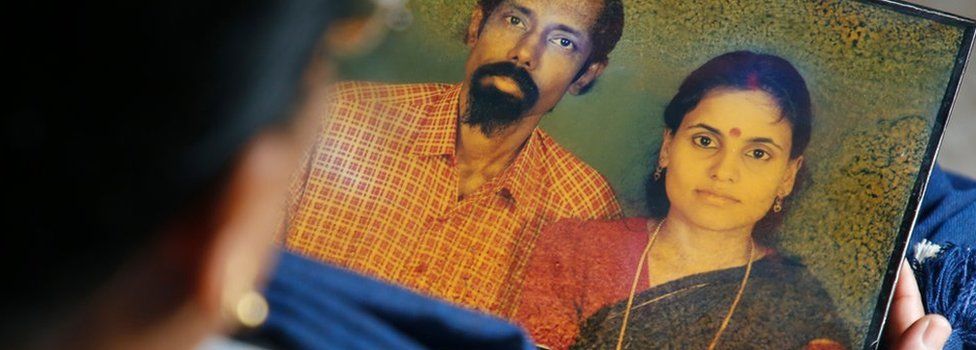
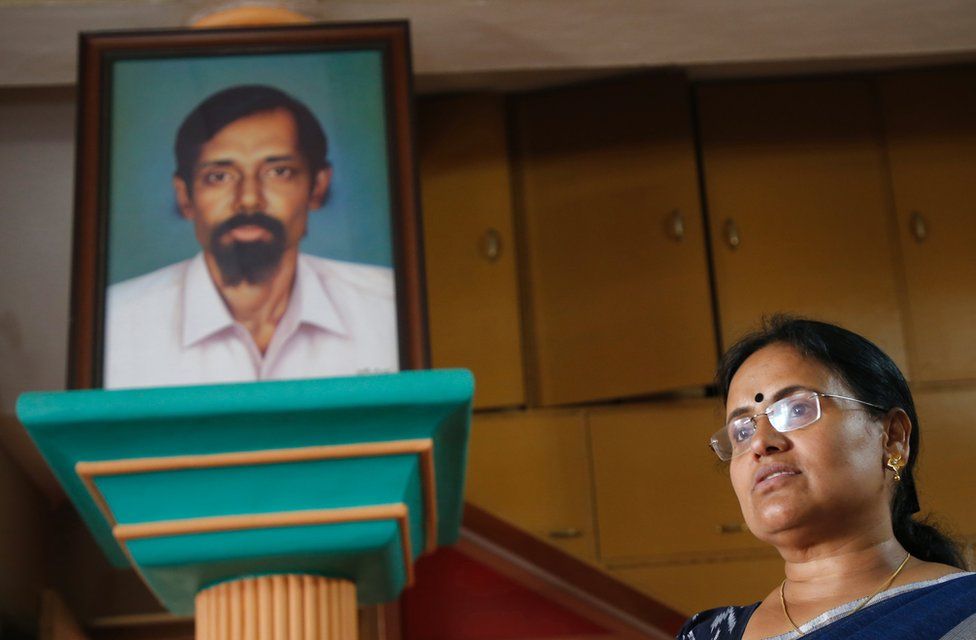
Image caption Uma with Preman’s portrait in the background
It took a while for it to become clear what she would do with this new freedom.
During her years with Preman, Uma had observed that poor people were often unable to get proper medical treatment, not only because they couldn’t afford it but also because they didn’t have the right information – they didn’t know what treatments and facilities were available.
So Uma had started helping them, filling in forms for them, guiding them to the right doctors and sometimes just listening to their problems.
When she left the hospital in Trivandrum where Preman had spent the last six months of his life, she was missed. But she wasn’t completely beyond reach. There was a booth where she had often called Preman’s family, she says, and the person who owned it gave her number to people in need of help.
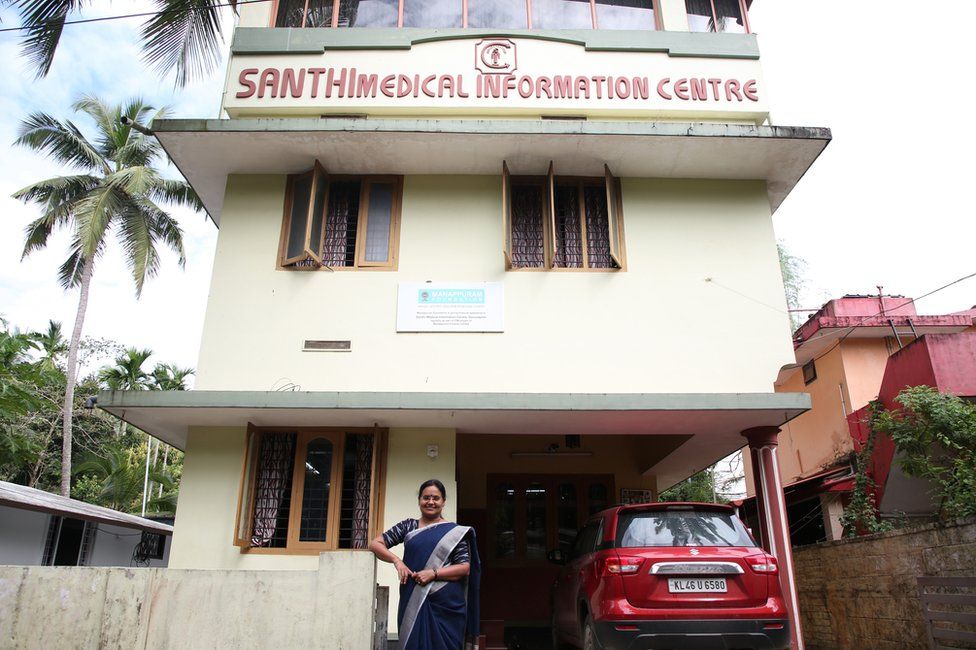
Soon hundreds of people started calling for advice and that’s how the Santhi Medical Information Centre was born. Uma had found her life’s calling – she wasn’t treating people, as her father had done, but she was helping them get treatment.
However, to help other people Uma had to acquire knowledge herself, and in the late 1990s the internet wasn’t yet widely available in India. She had to travel across the country to collect data about treatments, hospitals and the places where people could get free or subsidised treatment.
“I had to travel because no hospital replied to my letters,” she says.
Even when she met people face to face, they often didn’t take her seriously. In other Indian states there was also a language barrier, as Uma spoke only Tamil.
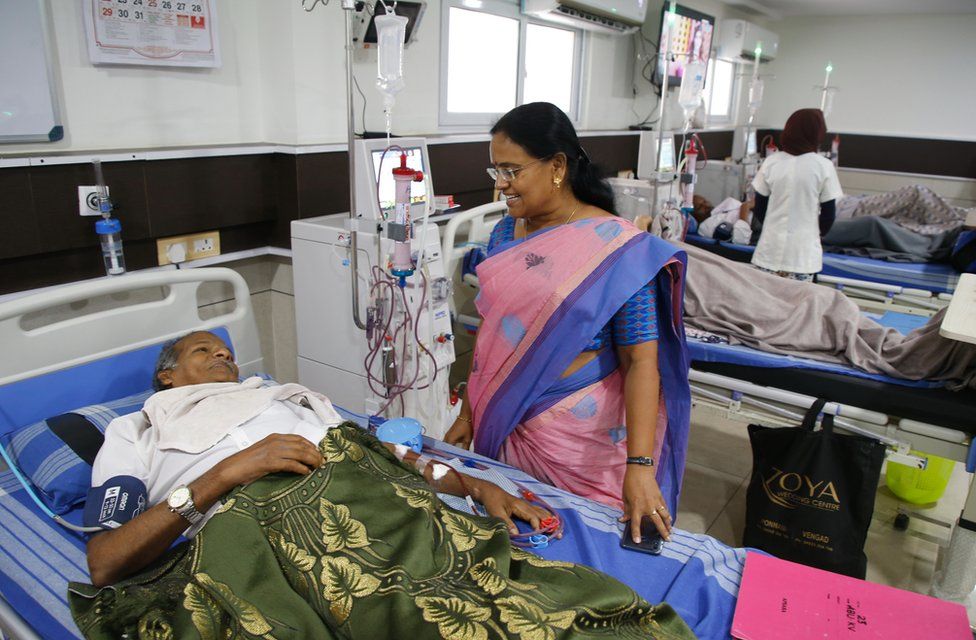
In the past decade, the Santhi Centre’s top priority has been helping people with kidney disease.
There are not enough dialysis centres in the country and the rate of kidney donation is poor. Uma has been working to change this, raising funds for new facilities open to all.
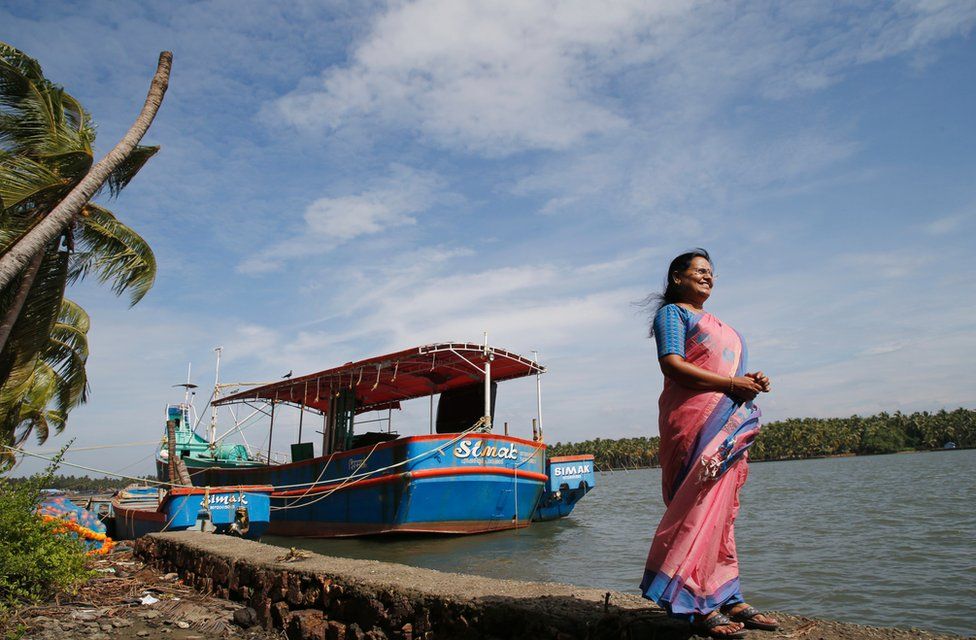
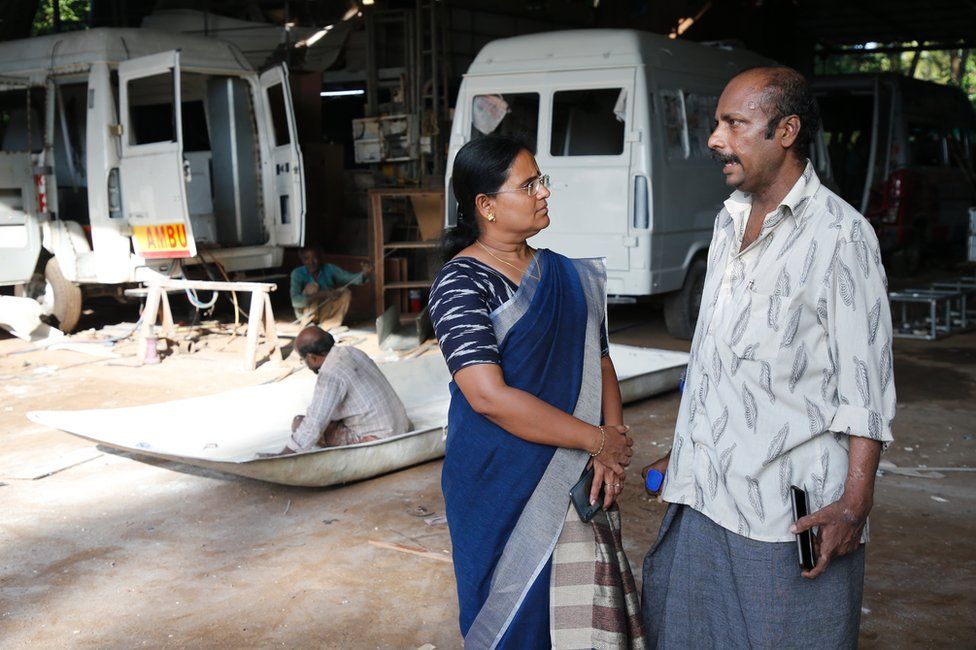
“Our first dialysis centre started in Thrissur district in Kerala. Now we have 20 centres across India. Many rich people donated for the cause,” she says.
Uma says persuading people to donate a kidney is not easy because they often worry about the impact on their own health.
So she decided to set an example, and donated one of her own kidneys. She gave it to an orphan whose kidneys had failed.
Image caption One of Uma’s kidneys enables Salil to live a normal life
Salil says he owes his life to her.
“I was 26 when I was undergoing dialysis. When she met me, she told me that she would donate her kidney on the condition that I continued to work after the transplant.”
He did continue to work – in fact, after a while he went to work for Uma.
Salil says Uma is a woman who truly believes in Mahatma Gandhi’s words that “you have to be the change you want to see”.
“Everyone wants to change the world but no-one is ready to change themselves,” Uma says. “I changed my attitude and I donated one kidney, but I also got a brother in return.”
NANNING, Sept. 19 (Xinhua) — Pham Thi Nguyet Hoa, a vendor living in Vietnam’s Mong Cai, comes to Dongxing, a southern Chinese port city, to sell Vietnam fruits every day. When night falls, she often ends up with thousands of yuan in her pocket, much more than what she can earn at home.
“Most of my customers are Chinese, and it is very convenient to exchange Chinese yuan to Vietnamese Dong as many banks in Dongxing have this currency exchange service,” said Pham.
Tourism has been a pillar industry in the border city of southern China’s Guangxi Zhuang Autonomous Region. Dongxing port saw 12 million people, of which half were tourists, pass through last year, ranking first among all land ports in China.
In the first six months this year, tourism consumption at the port exceeded 6.2 billion yuan (874 million U.S. dollars), up 40.4 percent from the year before.
The flourishing border tourism has brought a huge demand for currency exchange, with a slew of financial reforms rolled out in recent years.
In 2014, the ABC China (Dongxing Experimental Zone) ASEAN Currency business center was established in Dongxing, allowing direct convertibility of Chinese yuan and Vietnamese Dong.
In February 2018, a total of 8 million yuan was transferred in cash from Vietnam to China, marking the first cross-border cash transfer in Guangxi between China and Vietnam.
Fan Zuojun, vice president of Guangxi University, said the cross-border cash transfer will further promote the financial cooperation between China and Members of the Association of Southeast Asian Nations (ASEAN) as well as deepen reform and push forward the internationalization of the Chinese currency in the region.
China and ASEAN countries have always maintained close relations in trade.
In January 2010, the China-ASEAN Free Trade Area was set up, which has significantly boosted bilateral trade. China has maintained its position as the largest trading partner of ASEAN for 10 consecutive years, and trade between China and ASEAN has skyrocketed tenfold from 16 years ago to 587.8 billion U.S. dollars in 2018.
In the first half of 2019, ASEAN became China’s second-largest trading partner, with bilateral trade volume reaching 291.85 billion U.S. dollars, up 4.2 percent year on year.
Guangxi’s geographical advantages have also given it huge development dividends over the past decades. ASEAN has been Guangxi’s largest trade partner for 19 consecutive years, and trade volume between Guangxi and ASEAN in the first seven months of this year topped 128 billion yuan, accounting for 48.7 percent of Guangxi’s total foreign trade.
Now with the launch of the Guangxi Pilot Free Trade Zone (FTZ) in August, bilateral trade exchanges are expected to embrace another golden opportunity.
The pilot FTZ, with a total area of nearly 120 square km, will focus on modern financial services, smart logistics, digital economy, port shipping logistics, international trade and cross-border tourism, among others.
Guangxi vows to make greater efforts to consolidate its financial strength and build itself into an ASEAN-oriented financial portal, with over 90 financial reform measures being rolled out to further facilitate trade and investment and promote innovation in financial services with ASEAN countries.
Material that generates heat from sunlight could provide self-maintaining water supply on remote islands
An international research team used solar power to generate a supply of drinking water. Photo: Chinese Academy of Sciences
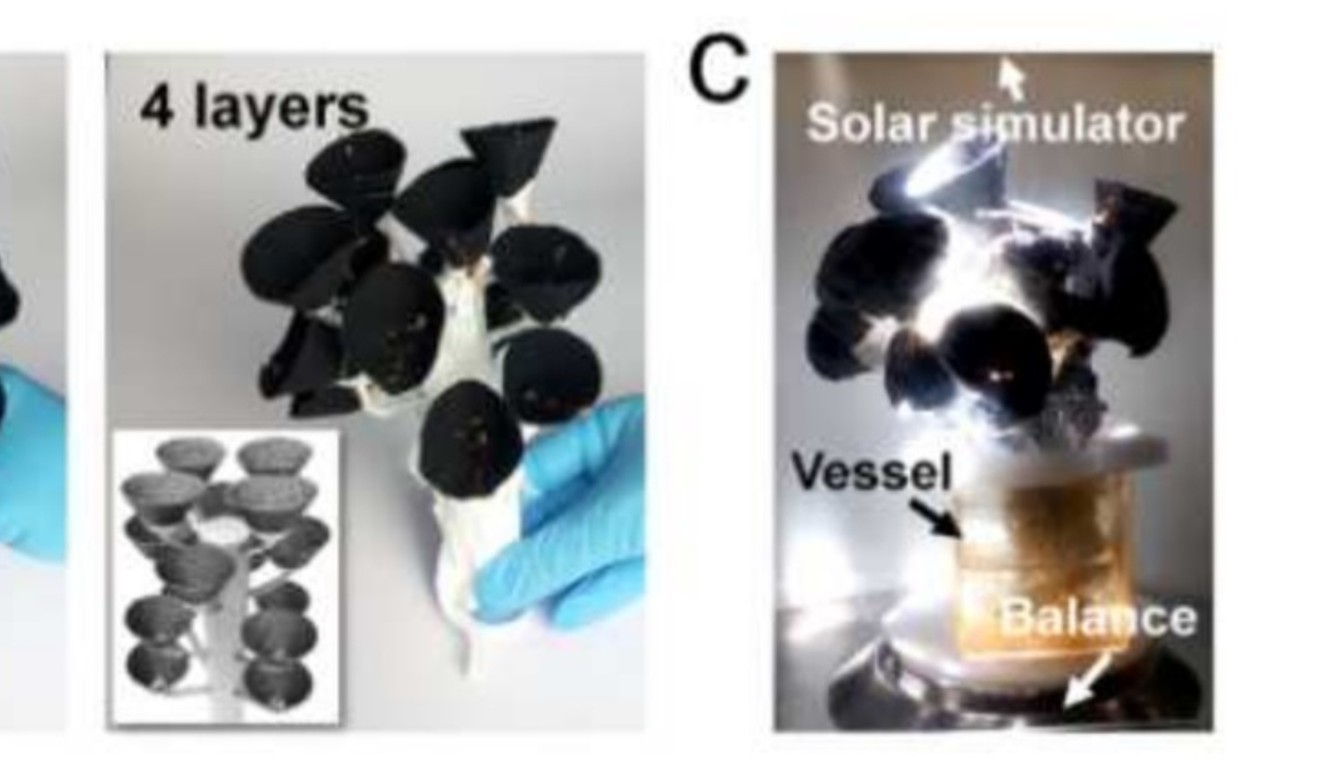
A Chinese-led international research team has created a “tree” that can generate clean drinking water.
Drawing its energy entirely from the sun just like a real tree, the “water tree” has a root made of cotton fabric that can absorb water from its surroundings, such as from sand on a beach.
After water moves up the stem, it is vaporised by “leaves” made of black-carbon paper cones that convert light energy to heat, reaching nearly 50 degrees Celsius (122 Fahrenheit). The tree sits in a glass chamber with a relatively cool surface that collects the vapour.
Using standard cotton fabric and a new nanomaterial that can be cheaply mass-produced from charcoal, a paper cone with a surface area as large as 1 square metre would cost only US$2, according to the researchers.
The cones, which function like leaves, could be mass-produced cheaply, researchers say. Photo: Chinese Academy of Sciences
A cone that size can generate up to 3.4kg (7.5lbs) of condensed water per hour, faster than any other solar-powered desalination methods previously reported.
Even on a cloudy day, the total output in seven hours of sunlight can reach 5.4kg, or three times the amount the typical adult needs to stay hydrated.
One tree can have multiple layers of branches, each with several cones to increase the vapour-producing surface area.
The study, published this month in the journal Nano Energy, was led by Professor Chen Tao at the Chinese Academy of Sciences’ Ningbo Institute of Material Technology and Engineering in Zhejiang province, and also involved researchers from Singapore and Taiwan.
World’s thirst for fresh water is causing a big toxic problem
One of the paper’s co-authors, Dr Ouyang Jianyong, associate professor at the National University of Singapore’s department of materials science and engineering, told the South China Morning Post that the technology could be applied in remote places such as on islands in the South China Sea.
“It is particularly useful for isles far away without a stable drinking water supply,” Ouyang said. “These ‘trees’ may not be able to quench the thirst of a large city, but they can meet the critical demand of a small community, especially in emergencies.
“We are already in contact with some companies [to commercialise the technology],” he added.
The material used to make the cone has several advantages, according to Ouyang. The cones can absorb a wide spectrum of sunlight, maximising the amount of energy they can collect, and their porous structure allows them to release vapour quickly.
Lawmakers endorse plan for HK$7.7 billion desalination plant
When used to desalinate a supply of seawater, the trees would be self-cleaning at night, by water washing away salt residue without being vaporised as it would during sunlight hours.
The vapour-producing fabric is as thin and lightweight as a few sheets of paper. It can be folded and sewn into almost any shape, or cleaned in a washing machine, and can operate effectively for several years in a harsh environment, the researchers say.
The condensed water meets stringent safety standards for direct drinking set by the World Health Organisation, according to the researchers.





 CHINDIA ALERT: You'll be living in their world, very soon