Archive for ‘nuclear powers’

14/05/2020

US Navy warship transits Taiwan Strait as PLA starts live-fire drills

  • American destroyer’s mission comes a week before Taiwanese president officially starts second term in office
  • Increased military activity in the region could have unintended consequences but unlikely to lead to direct conflict, observer says
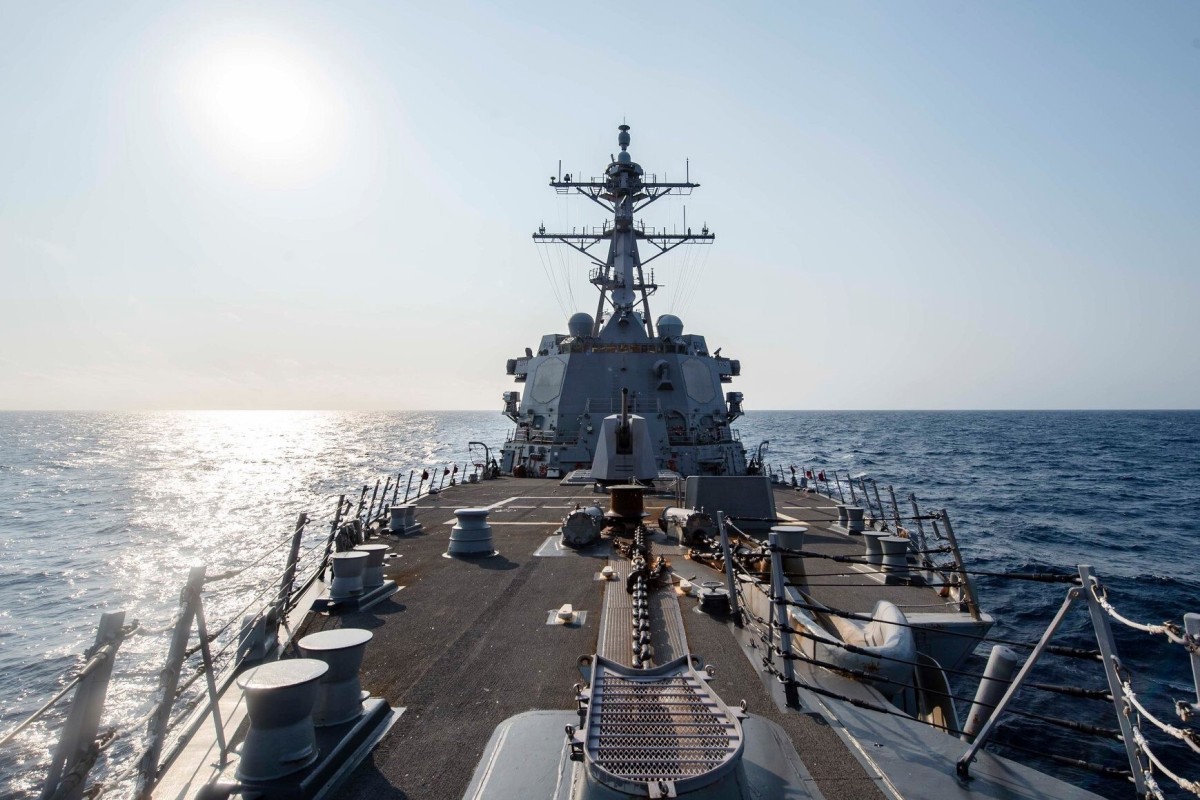
The guided-missile destroyer USS McCampbell made a transit through the Taiwan Strait on Thursday. Photo: US Navy

The United States sent a warship through the Taiwan Strait on Thursday as the Chinese military embarked on more than two months of live-fire naval drills off the mainland’s northern coast.

The passage by the USS McCampbell was the sixth through the strait by a US Navy vessel this year and comes a week before Taiwanese President Tsai Ing-wen, of the independence-leaning Democratic Progressive Party, is expected to be sworn in for a second term in office.

According to Taiwan’s defence ministry, the Arleigh Burke-class guided-missile destroyer transited the narrow body of water separating Taiwan from mainland China from north to south “in a routine mission”.

“It is continuing its southward voyage and the military is monitoring its movement through the intelligence it has gathered,” the ministry said.

In a statement on its Facebook page, the US Pacific Fleet said the McCampbell transited the Taiwan Strait as part of ongoing operations in the Indo-Pacific.

Analysts said the passage was a response to the People’s Liberation Army’s increasing military activity near Taiwan and in the wider region.

“This will become a new routine as a kind of US security commitment to maintain stability in the Indo-Pacific region,” said Soong Hseik-wen, professor of strategic studies and international relations at National Chung Cheng University in Taiwan.

Beijing urges France to cancel contract to sell arms to Taiwan

13 May 2020

The PLA has staged a series of war games, including fly-bys and warship transits through the strait, in recent months in response to what Beijing sees as growing pro-independence moves by the Tsai government and her party. China has also warned the US against supplying weapons to the island, which Beijing considers to be a wayward province that must return to the mainland fold, by force if necessary.

Mainland China has suspended official exchanges with Taiwan since Tsai was first elected president in 2016 and refused to accept the one-China policy, which Beijing says must be the foundation for any talks.

The PLA has embarked on 11 weeks of naval exercises off the coast of Tangshan in northern China, barring all other vessels from a 25km (15 mile) radius of the drill area, according to the China Maritime Safety Administration.

Taiwanese support closer ties with US over China, few identify as solely Chinese, Pew Research survey finds
13 May 2020

Both Beijing and Washington have ramped up military activities near Taiwan in recent months during the coronavirus pandemic, moves that some observers say run the risk of miscommunication.

Alexander Huang Chieh-cheng, professor of strategic studies and international relations at Tamkang University in Taipei, said no one could exclude the possibility of unintended incidents when both the US and the mainland were stepping up their presence in the region.

“Rational analysts would however argue that the two nuclear powers are not likely to engage in or escalate to direct military conflict,” he said.

Huang said he believed cross-strait relations would worsen during Tsai’s second term in office, which begins on May 20.

“The already damaged relationship between Taiwan and mainland China has worsened since the pandemic mainly due to travel bans and Taiwan’s increased international visibility,” he said.

On Tuesday, Japan’s Kyodo News reported that the PLA was planning a large-scale beach landing exercise near Hainan province in August, simulating a takeover of the Pratas Islands, which are controlled by Taiwan and also known as the Dongsha Islands.

In Taipei, Major General Lin Wen-huang said Taiwan was monitoring the PLA movements and “has contingency plans in place for the South China Sea to strengthen combat readiness and defence preparedness on both the Spratly and Pratas islands”.

Taiwan’s coastguard also announced on Wednesday that its Pratas Islands Garrison was scheduled to conduct an annual live-fire exercise in June to ensure the “effectiveness of various mortar and machine-gun positions”.

Taiwan shows off its military power after presidential election
Shanghai-based military commentator Ni Lexiong said that both the US Navy and PLA were increasing activities during the pandemic because neither side could afford to show weaknesses that the other might take advantage of.
The destroyer’s passage and the PLA’s drills were all part of such efforts, Li said.

But he agreed that both countries were unwilling, unable, and unlikely to have a real conflict.

“They are both bluffing. It’s a fake crisis,” he said. “A pandemic always ends or prevents a war if you look at history.

“I also don’t believe the PLA would want to take over the Dongsha or Taiping islands [in the South China Sea], because these islets alone are not worth a military campaign and all the consequences of that. The only target valuable enough for the PLA is Taiwan.”

Source: SCMP
05/08/2019

Article 370: India strips disputed Kashmir of special status

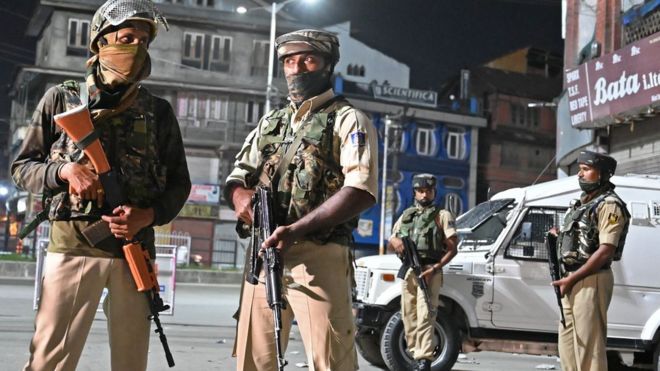
Indian paramilitary troopers stand guard at a roadblock at Maisuma locality in Srinagar on August 4, 2019.Image copyright AFP
Image caption India has deployed tens of thousands of troops to Indian-administered Kashmir in recent days

India’s government has revoked part of the constitution that gives Indian-administered Kashmir special status, in an unprecedented move likely to spark unrest.

Article 370 is sensitive because it is what guarantees significant autonomy for the Muslim-majority state.

There has been a long-running insurgency on the Indian side.

Nuclear powers India and Pakistan have fought two wars and a limited conflict over Kashmir since 1947.

The BBC’s Geeta Pandey in Delhi says that for many Kashmiris, Article 370 was the main justification for being a part of India and by revoking it, the BJP has irrevocably changed Delhi’s relationship with the region.

Pakistan condemned India’s decision to revoke the special status of its part of Kashmir as illegal, saying it would “exercise all possible options” to counter it.

“India is playing a dangerous game which will have serious consequences for regional peace and stability,” said Foreign Minister Shah Mehmood Qureshi.

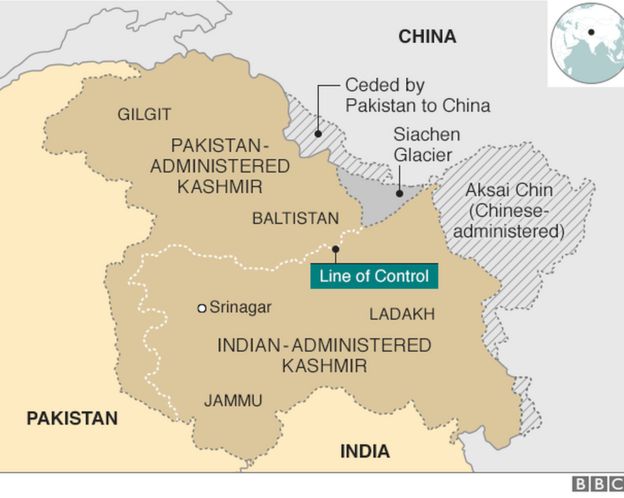
But an Indian government source said there was no external implication as the Line of Control, the de facto border, and boundaries of Kashmir had not been altered.

Why are there tensions over Kashmir?

During the partition of the Indian subcontinent in 1947, some expected Jammu and Kashmir, like other Muslim-majority regions, to go to Pakistan.

But the ruler of the princely state, who had initially wanted Jammu and Kashmir to become independent, joined India in return for help against an invasion of tribesmen from Pakistan.

War broke out between India and Pakistan, and Kashmir effectively became partitioned.

The region, which remains one of the most militarised zones in the world, has been a flashpoint between India and Pakistan for more than six decades.


Atmosphere of fear

By Aamir Peerzada, BBC News, Srinagar

By the time we woke up this morning, the internet was gone and we now have no mobile connectivity.

If people step out of their homes, they see paramilitary forces on every street. Almost every major road is shut – we are hearing that more troops are being deployed.

No-one knows what is happening in other parts of the state – we can’t talk to anyone else.

People are concerned – they don’t know what is happening, they don’t know what is going to happen.

It’s an atmosphere of fear. People are scared to come out, they have stockpiled food for months.

Kashmiris have always been willing to defend the state’s special status. It looks like a long road ahead, and no-one knows what’s next.


What is Article 370?

In 1949, a special provision was added to India’s constitution providing autonomy to Jammu and Kashmir.

Article 370 allows the state to have its own constitution, a separate flag and independence over all matters except foreign affairs, defence and communications.

kashmir mapAnother provision later added under Article 370 – 35A – gives special privileges to permanent residents, including state government jobs and the exclusive right to own property in the state.

It is seen as protecting the state’s distinct demographic character as the only Muslim-majority state in India.

So why is India’s move controversial?

The move by the Hindu nationalist BJP government prompted outrage in parliament, and some legal experts have called it an attack on the constitution.

Critics fear the move is designed to change the demographic make-up of India-administered Kashmir – by giving people from the rest of the country to right to acquire property and settle there permanently.

The state’s former chief minister, Mehbooba Mufti, told the BBC she felt there was a “sinister design” to the decision.

“They just want to occupy our land and want to make this Muslim-majority state like any other state and reduce us to a minority and disempower us totally.”

She added Article 370 was not given to the people of the state as a “gift”, but “a matter of constitutional guarantees given by the very same Indian parliament to the people of Jammu and Kashmir”.

Why is the government doing this?

The ruling BJP made revoking Article 370 part of the party’s 2019 election manifesto – and it won a landslide victory earlier this year.

It has argued that Article 370 has prevented the region’s development and its integration with India.

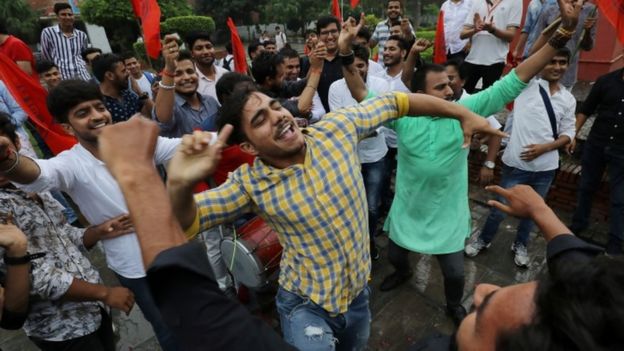
Supporters of the ruling BJP's student wing celebrate in DelhiImage copyright REUTERS
Image caption Supporters of India’s ruling BJP have been celebrating the move

An Indian government source said on Monday that the region’s special status had discouraged outside investment and affected its economy, while terrorism and smuggling were rife.

“A set of anachronistic provisions were not allowing the progress of Kashmir,” the source said. “The huge sum of money and resources which were going into the state were not being optimised.”

How did the government make the change?

India’s government announced a presidential order revoking all of Article 370 apart from one clause which says that the state is an integral part of India.

The order was met by massive protests from the opposition – but has now been signed into law by President Ram Nath Kovind.

The government also proposed dividing the state into two regions ruled by the central government, and a bill to that effect passed the upper house on Monday and will now go to the lower house where the BJP has a majority.

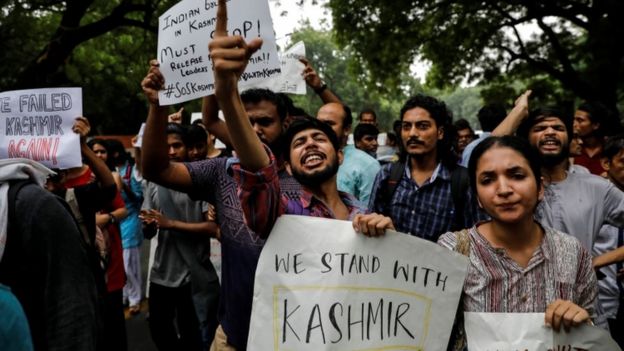
Opponents of the move protest in DelhiImage copyright REUTERS
Image caption Opponents of the move have also been out in the streets of Delhi

Changing Article 370 also requires the assent of the state government, but Jammu and Kashmir has been under the rule of a governor since June 2018 when the BJP pulled out of a state government coalition with the regional People’s Democratic Party (PDP).

This effectively means the state has been ruled directly by Delhi through a governor, who has agreed to the bills.

What has been happening in Kashmir?

Indian-administered Kashmir is in a state of lockdown.

Curfew-like conditions have been imposed, and orders preventing the assembly of more than four people have been introduced.

Tens of thousands of Indian troops were deployed to the region ahead of Monday’s announcement and tourists were told to leave under warnings of a terror threat.

Media caption In December Yogita Limaye examined why there had been a rise in violence in Kashmir

In the hours before Monday’s announcement, two of the state’s former chief ministers – Omar Abdullah and Mehbooba Mufti – were placed under house arrest.

Source: The BBC

11/05/2019

Islamic State claims ‘province’ in India for first time after clash in Kashmir

NEW DELHI/SRINAGAR, India (Reuters) – Islamic State (IS) claimed for the first time that it has established a “province” in India, after a clash between militants and security forces in the contested Kashmir region killed a militant with alleged ties to the group.

IS’s Amaq News Agency late on Friday announced the new province, that it called “Wilayah of Hind”, in a statement that also claimed IS inflicted casualties on Indian army soldiers in the town of Amshipora in the Shopian district of Kashmir.

The IS statement corresponds with an Indian police statement on Friday that a militant called Ishfaq Ahmad Sofi was killed in an encounter in Shopian.

IS’s statement establishing the new province appears to be designed to bolster its standing after the group was driven from its self-styled “caliphate” in Iraq and Syria in April, where at one point it controlled thousands of miles of territory.

IS has stepped up hit-and-run raids and suicide attacks, including taking responsibility for the Easter Sunday bombing in Sri Lanka that killed at least 253 people.

“The establishment of a ‘province’ in a region where it has nothing resembling actual governance is absurd, but it should not be written off,” said Rita Katz, director of the SITE Intel Group that tracks Islamic extremists.

“The world may roll its eyes at these developments, but to jihadists in these vulnerable regions, these are significant gestures to help lay the groundwork in rebuilding the map of the IS ‘caliphate’.”

Sofi had been involved in several militant groups in Kashmir for more than a decade before pledging allegiance to Islamic State, according to a military official on Saturday and an interview given by Sofi to a Srinagar-based magazine sympathetic to IS.

He was suspected of several grenade attacks on security forces in the region, police and military sources said.

“It was a clean operation and no collateral damage took place during the exchange of fire,” a police spokesman said in the statement on Friday’s encounter.

The military official said it was possible that Sofi had been the only militant left in Kashmir associated with IS.

Separatists have for decades fought an armed conflict against Indian rule in Muslim-majority Kashmir. The majority of these groups want independence for Kashmir or to join India’s arch-rival Pakistan. They have not, like Islamic State, sought to establish an empire across the Muslim world.

Nuclear powers India and Pakistan have fought two wars over Kashmir, and came to the brink of a third earlier this year after a suicide attack by a Pakistan-based militant group killed at least 40 paramilitary police in the Indian-controlled portion of the region.

A spokesman for India’s home ministry, which is responsible for security in Kashmir, did not respond to a request for comment.

Source: Reuters

22/02/2019

Pulwama attack: India government must protect Kashmiris – top court

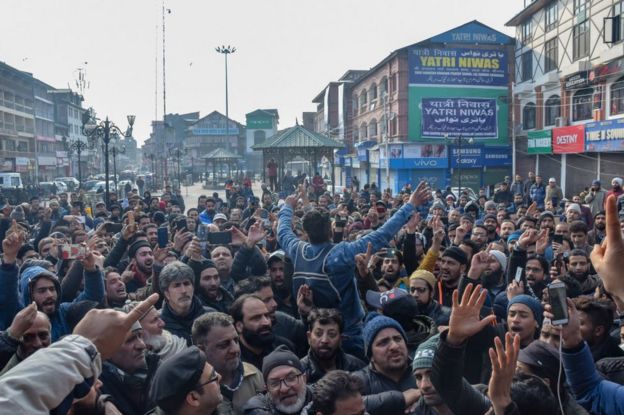
Protests against attacks on Kashmiris in Srinagar on 20 FebruaryImage copyrightGETTY IMAGES
Image captionProtests have been held in Indian-administered Kashmir over attacks on Kashmiris in other parts of India

India’s top court has ordered the government to protect Kashmiri people from attacks in apparent retaliation for last week’s deadly bombing in Indian-administered Kashmir.

There have been several reports of Kashmiri students and businessmen being harassed or beaten up in recent days.

The Supreme Court has also sought a response from the states where these alleged incidents happened.

The attack has sparked anger and anti-Pakistan protests across India.

The suicide bombing of an Indian security convoy in Pulwama on 14 February was claimed by a Pakistan-based militant group and has led to a war of words between nuclear-armed India and Pakistan.

But in some cases the anger has been directed against Kashmiri people living in other parts of India. The attack, which killed more than 40 Indian paramilitary police, was the deadliest against Indian forces in Kashmir in decades.

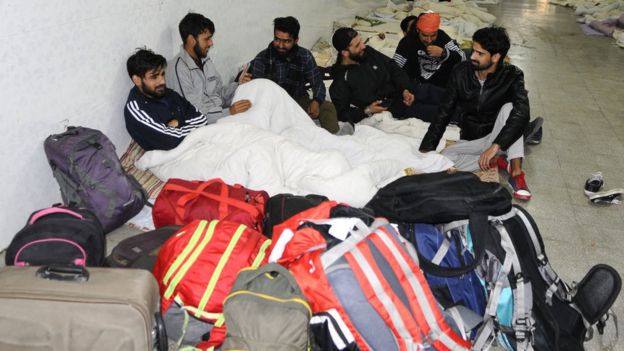
Hundreds of Kashmiri students, traders and businessmen have returned to Kashmir from various Indian cities out of fear that they could face harassment or attack.

Many Indians have expressed sympathy towards the Kashmiri students on social media, with some offering shelter in their own homes.

India has long had a volatile relationship with Muslim-majority Kashmir, where there has been an armed insurgency against Indian rule since the late 1980s.

The region has been a flashpoint between India and Pakistan since independence. Both countries claim all of Kashmir but control only parts of it. They have fought two wars and a limited conflict over the territory.

Kashmiri students from Dehradun, Ambala, Banur and Mohali leaving for Kashmir in Mohali, India.Image copyrightGETTY IMAGES
Image captionKashmiri students living in Dehradun and other cities have returned home since the attack

What did the court say?

The court’s decision singled out the federal government as well as governments in 10 states which are home to a sizeable Kashmiri population.

It asked authorities to widely publicise the details of officials who Kashmiris can contact if they face threats or violence.

The order was in response to a petition seeking protection for Kashmiris living across India. Tehseen Poonawala, one of the petitioners, told the BBC that he was moved to act because he was “disturbed” after reading reports of Kashmiris being attacked.

“It’s not about Kashmiris. It’s about human beings. We cannot be a country that responds with mob violence,” he said.

What happened to Kashmiri students?

In the days following the attack, isolated incidents of students from Kashmir being beaten up or evicted from their accommodation in northern Indian states were reported in local media. Kashmiri Muslims were warned to stay vigilant and India’s Central Reserve Police Force (CRPF) offered help to those in need, but also warned of false reports.

Twenty Kashmiri girls in the northern city of Dehradun were forced to lock themselves in their hostel after protesters gathered outside to demand their eviction, according to the Times of India.

Two other colleges in the city issued public statements saying they would not admit Kashmiri students in the next academic year.

“We did so to provide protection to the [Kashmiri] students,” the college principal, Aslam Siddidqu, told the BBC, adding that he had faced pressure from right-wing groups.

Federal education minister Prakash Javadekar has denied that “incidents” have taken place involving Kashmiri students.

But a police official in Dehradun told the BBC that 22 students had been arrested for protesting and demanding that Kashmiri students be expelled from colleges in the city.

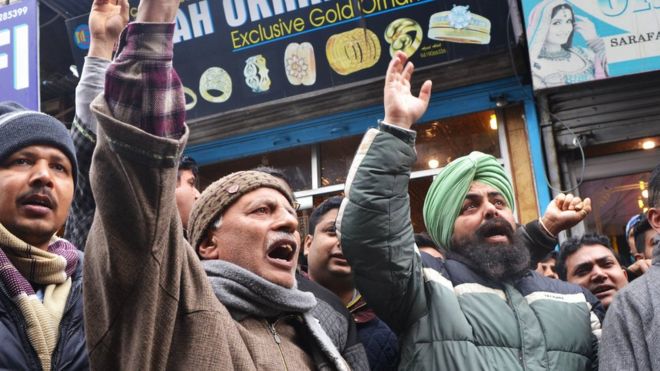
Kashmiri traders are seen shouting slogans during the protest. Traders in Lal Chowk and adjoining markets closed their shops as a mark of protest against attacks on Kashmiris elsewhere in India.Image copyrightGETTY IMAGES
Image captionMarkets and businesses were closed to protest against violence

What’s the bigger picture?

The attack has raised tensions between India and Pakistan, which have fought two wars and a limited conflict in the region and are both nuclear powers.

India has accused Pakistani intelligence services of having a hand in the attack, which was claimed by militant group Jaish-e-Mohammad.

Pakistan denies this and has warned that it will retaliate if India takes military action. In his first comments addressing the attack, Prime Minister Imran Khan said India should “stop blaming Pakistan without any proof or evidence” and urged Indian authorities to share any “actionable intelligence”.

India has moved to impose trade restrictions on Pakistan. It has also said it will build dams to reduce the flow of water to Pakistan from three rivers in India. Similar plans were announced in 2016, after a deadly militant attack on an Indian base in Kashmir.

The tensions between the neighbours may also have an impact on cricket, a national obsession in both India and Pakistan. Amid outrage over the attack, there have been calls for India to boycott its much anticipated match against Pakistan at the World Cup in June.

Indian cricket administrators say no decision has yet been made.

Source: The BBC

Law of Unintended Consequences

continuously updated blog about China & India

ChiaHou's Book Reviews

continuously updated blog about China & India

What's wrong with the world; and its economy

continuously updated blog about China & India