Chindia Alert: You’ll be Living in their World Very Soon
aims to alert you to the threats and opportunities that China and India present. China and India require serious attention; case of ‘hidden dragon and crouching tiger’.
Without this attention, governments, businesses and, indeed, individuals may find themselves at a great disadvantage sooner rather than later.
The POSTs (front webpages) are mainly 'cuttings' from reliable sources, updated continuously.
The PAGEs (see Tabs, above) attempt to make the information more meaningful by putting some structure to the information we have researched and assembled since 2006.
— Chinese archaeologists announced significant achievements at the Shuanghuaishu site in central China’s Henan Province, providing key proof of the origin of the over 5,000-year-long Chinese civilization.
— With an area of 1.17 million square meters, the Shuanghuaishu site, dating back to around 5,300 years, is located on the south bank of the Yellow River in the township of Heluo, Gongyi City, and was proposed to be named “Heluo kingdom.”
— A large number of relics of the Yangshao Culture dating back 5,000 to 7,000 years have been discovered at the site.
by Xinhua writers Xu Ruiqing, Wang Ding, Gui Juan, Shuang Rui
ZHENGZHOU, May 7 (Xinhua) — Chinese archaeologists announced Thursday significant achievements at the Shuanghuaishu site in central China’s Henan Province, providing key proof of the origin of the over 5,000-year-long Chinese civilization.
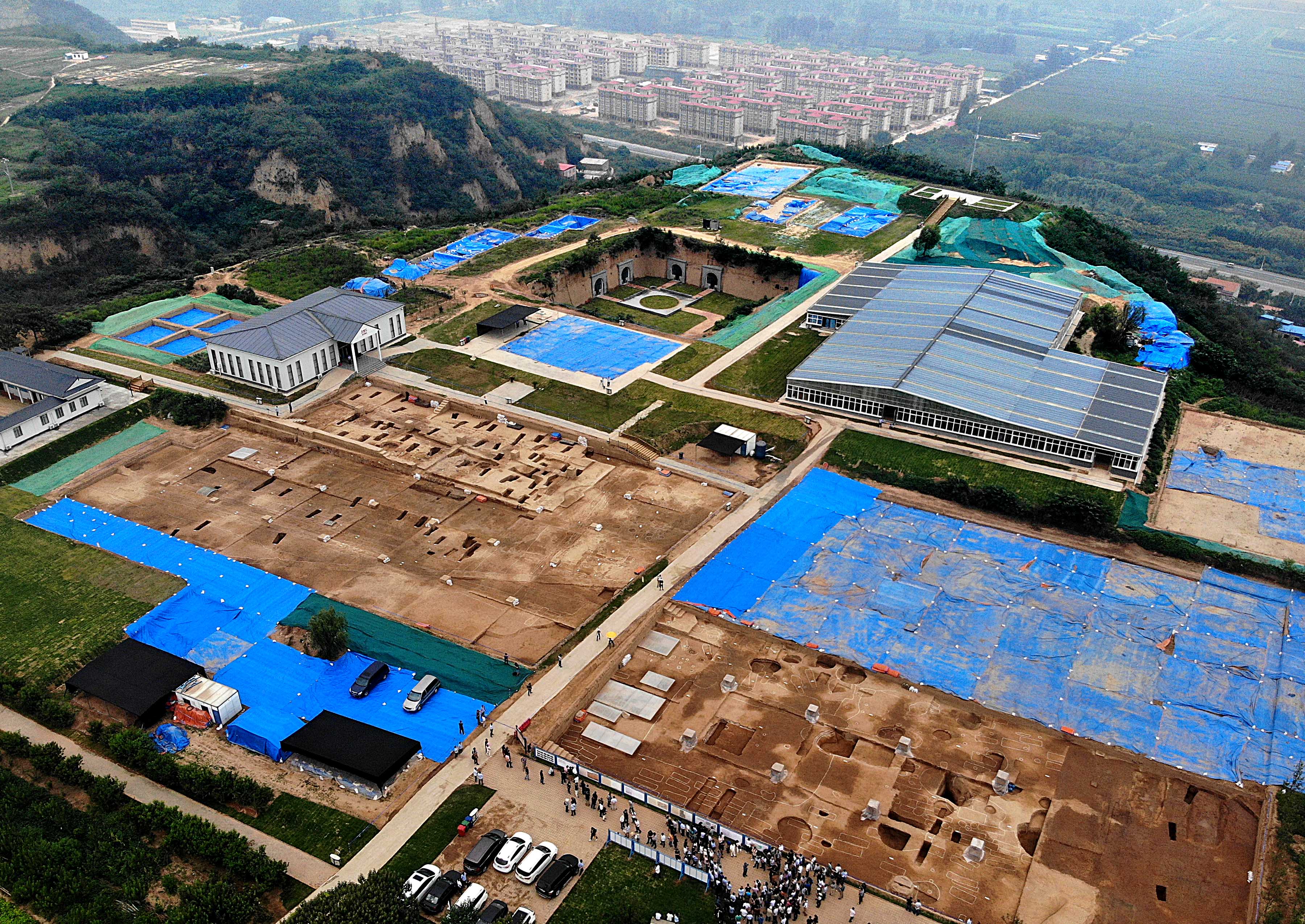
With an area of 1.17 million square meters, the Shuanghuaishu site is located on the south bank of the Yellow River in the township of Heluo, Gongyi City.
The ancient city relic dating back to around 5,300 years ago was proposed by Chinese archaeologists to be named “Heluo kingdom” after its location in the center of the Heluo area, where the Yellow River (known as He in ancient China) and the Luohe River meet.
“The Shuanghuaishu site is the highest-standard cluster with the nature of a capital city discovered so far in the Yellow River basin in the middle and late stage of Yangshao Culture, the early stage of the formation of Chinese civilization,” said Li Boqian, a professor at Peking University, at a press conference on major archaeological discoveries at Shuanghuaishu site held Thursday in Zhengzhou, the provincial capital.
Aerial photo taken on Aug. 27, 2019 shows the Shuanghuaishu site in central China’s Henan Province. (Xinhua/Li An)
A large number of relics of the Yangshao Culture dating back 5,000 to 7,000 years have been discovered at the site, said Gu Wanfa, director of the Zhengzhou Municipal Research Institute of Cultural Relics and Archaeology, at the press conference.
“The important archaeological findings provide key proof of the origin of Chinese civilization, and also prove the representativeness and influence of the Heluo area in the golden stage of the origin of Chinese civilization around 5,300 years ago,” said Wang Wei, a member of the Chinese Academy of Social Sciences.
Since 2013, the Zhengzhou Municipal Research Institute of Cultural Relics and Archaeology and the Institute of Archaeology of the Chinese Academy of Social Sciences have conducted continuous archaeological excavations on the site.
According to archaeologists, the Shuanghuaishu site was about 1,500 meters long from east to west and 780 meters wide from north to south. It was surrounded by three ring trenches with each found to have external access, forming a strict defense system.
Aerial photo taken on Aug. 27, 2019 shows the Shuanghuaishu site in central China’s Henan Province. (Xinhua/Li An)
The central residential area with four rows of houses was found in the northern part of the inner ring moat. Meanwhile, three public cemeteries with more than 1,700 tombs, three sacrificial remains, an astronomical relic, a pottery workshop area, a water storage area, a road system, and other facilities were also discovered at the city ruins.
“The Shuanghuaishu site was a well-selected and scientifically planned settlement site,” said Wang.
“Based on the geographical location and scale, it’s also the only large-scale city settlement discovered so far in the Yellow River basin from the middle and late stage of Yangshao Culture,” Wang added.
Archaeologists believe that the Heluo kingdom was the source of many typical characteristics of Chinese civilization.
Silk originated in China and later became one of the country’s major trade items. “The mulberry-growing and silkworm-raising culture was an important component of Chinese civilization,” said Li.
Among the unearthed relics at Shuanghuaishu, a boar tusk carving of a silkworm, 6.4 cm long, nearly 1 cm wide and 0.1 cm thick, was believed to be China’s earliest carving depicting silkworms.
Undated photo shows a boar tusk carving of a silkworm unearthed at the Shuanghuaishu site in central China’s Henan Province. (Xinhua)
Experts say that the carving depicts a spinning silkworm which is quite similar to modern silkworms in appearance. “The spinning shape of the carving suggests that ancient Chinese people were familiar with the habits of silkworms,” said Gu.
Along with silk fabrics unearthed at the surrounding Wanggou site and Qingtai site, archaeologists said they are solid evidence to prove that the ancient Chinese in the Yellow River basin began raising silkworms and silk production around 5,300 years ago.
“Except Shuanghuaishu and its surrounding settlement sites, there were no definite discoveries from around 5,300 years ago related to the silk textile industry in other parts of the country,” said Li. “In that sense, they are the earliest representatives in the development history of Chinese mulberry cultivation and silkworm-rearing culture.”
Meanwhile, at the astronomical relic at Shuanghuaishu, nine pottery pots were arranged in the pattern of the nine stars of the Big Dipper, which shows that the ancestors of Heluo had relatively mature astronomical knowledge.
Photo taken on April 28, 2020 shows one of nine pottery pots arranged in the pattern of the nine stars of the Big Dipper, at an astronomical relic at the Shuanghuaishu site in central China’s Henan Province. (Xinhua/Li An)
“The relic also indicates the worship of the celestial body may have formed a grand sacrificial ceremony for observing the solar terms and praying for a good harvest,” said Gu.
Experts also believe the astronomical relic and the surrounding sacrificial remains constitute a whole, which is consistent with the records of winter solstice sacrifices in ancient Chinese documents. “It is of great significance to the study of early Chinese astronomy and the origin of Chinese civilization,” added Gu.
WASHINGTON (Reuters) – President Donald Trump said on Wednesday he believes China’s handling of the coronavirus is proof that Beijing “will do anything they can” to make him lose his re-election bid in November.
In an interview with Reuters in the Oval Office, Trump talked tough on China and said he was looking at different options in terms of consequences for Beijing over the virus. “I can do a lot,” he said.
Trump has been heaping blame on China for a global pandemic that has killed at least 60,000 people in the United States according to a Reuters tally, and thrown the U.S. economy into a deep recession, putting in jeopardy his hopes for another four-year term.
The Republican president, often accused of not acting early enough to prepare the United States for the spread of the virus, said he believed China should have been more active in letting the world know about the coronavirus much sooner.
Asked whether he was considering the use of tariffs or even debt write-offs for China, Trump would not offer specifics. “There are many things I can do,” he said. “We’re looking for what happened.”
RELATED COVERAGE
China says it has no interest in meddling in U.S. election
“China will do anything they can to have me lose this race,” said Trump. He said he believes Beijing wants his Democratic opponent, Joe Biden, to win the race to ease the pressure Trump has placed on China over trade and other issues.
“They’re constantly using public relations to try to make it like they’re innocent parties,” he said of Chinese officials.
He said the trade deal that he concluded with Chinese President Xi Jinping aimed at reducing chronic U.S. trade deficits with China had been “upset very badly” by the economic fallout from the virus.
A senior Trump administration official, speaking on condition of anonymity, said on Wednesday that an informal “truce” in the war of words that Trump and Xi essentially agreed to in a phone call in late March now appeared to be over.
The two leaders had promised that their governments would do everything possible to cooperate to contain the coronavirus. In recent days, Washington and Beijing have traded increasingly bitter recriminations over the origin of the virus and the response to it.
However, Trump and his top aides, while stepping up their anti-China rhetoric, have stopped short of directly criticizing Xi, who the U.S. president has repeatedly called his “friend.”
Trump also said South Korea has agreed to pay the United States more money for a defense cooperation agreement but would not be drawn out on how much.
“We can make a deal. They want to make a deal,” Trump said. “They’ve agreed to pay a lot of money. They’re paying a lot more money than they did when I got here” in January 2017.
The United States stations roughly 28,500 troops in South Korea, a legacy of the 1950-53 Korean War that ended in an armistice, rather than a peace treaty.
Trump is leading a triage effort to try to keep the U.S. economy afloat through stimulus payments to individuals and companies while nudging state governors to carefully reopen their states as new infections decline.
Trump sounded wistful about the strong economy that he had enjoyed compared with now, when millions of people have lost their jobs and GDP is faltering.
“We were rocking before this happened. We had the greatest economy in history,” he said.
He said he is happy with the way many governors are operating under the strain of the virus but said some need to improve. He would not name names.
Trump’s handling of the virus has come under scrutiny. Forty-three percent of Americans approved of Trump’s handling of the coronavirus, according to the Reuters/Ipsos poll from April 27-28.
But there was some good coronavirus news, as Gilead Sciences Inc said its experimental antiviral drug remdesivir was showing progress in treating virus victims.
Trump has also seeking an accelerated timetable on development of a vaccine.
“I think things are moving along very nicely,” he said.
At the end of the half-hour interview, Trump offered lighthearted remarks about a newly released Navy video purportedly showing an unidentified flying object.
“I just wonder if it’s real,” he said. “That’s a hell of a video.”
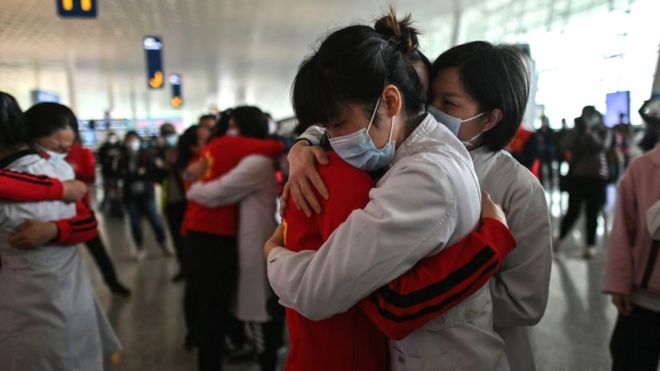
Image copyright GETTY IMAGESImage caption The Chinese city of Wuhan recently lifted its strict quarantine measures
The Chinese city of Wuhan, where the coronavirus originated last year, has raised its official Covid-19 death toll by 50%, adding 1,290 fatalities.
Wuhan officials attributed the new figure to updated reporting and deaths outside hospitals. China has insisted there was no cover-up.
It has been accused of downplaying the severity of its virus outbreak.
Wuhan’s 11 million residents spent months in strict lockdown conditions, which have only recently been eased.
The latest official figures bring the death toll in the city in China’s central Hubei province to 3,869, increasing the national total to more than 4,600.
China has confirmed nearly 84,000 coronavirus infections, the seventh-highest globally, according to Johns Hopkins University data.
What’s China’s explanation for the rise in deaths?
In a statement released on Friday, officials in Wuhan said the revised figures were the result of new data received from multiple sources, including records kept by funeral homes and prisons.
Deaths linked to the virus outside hospitals, such as people who died at home, had not previously been recorded.
Media caption Learn how Wuhan dealt with the lockdown
The “statistical verification” followed efforts by authorities to “ensure that information on the city’s Covid-19 epidemic is open, transparent and the data [is] accurate”, the statement said.
It added that health systems were initially overwhelmed and cases were “mistakenly reported” – in some instances counted more than once and in others missed entirely.
A shortage of testing capacity in the early stages meant that many infected patients were not accounted for, it said.
A spokesman for China’s National Health Commission, Mi Feng, said the new death count came from a “comprehensive review” of epidemic data.
In its daily news conference, the foreign ministry said accusations of a cover-up, which have been made most stridently on the world stage by US President Donald Trump, were unsubstantiated. “We’ll never allow any concealment,” a spokesman said.
Why are there concerns over China’s figures?
Friday’s revised figures come amid growing international concern that deaths in China have been under-reported. Questions have also been raised about Beijing’s handling of the epidemic, particularly in its early stages.
In December 2019, Chinese authorities launched an investigation into a mysterious viral pneumonia after cases began circulating in Wuhan.
China reported the cases to the World Health Organization (WHO), the UN’s global health agency, on 31 December.
But WHO experts were only allowed to visit China and investigate the outbreak on 10 February, by which time the country had more than 40,000 cases.
The mayor of Wuhan has previously admitted there was a lack of action between the start of January – when about 100 cases had been confirmed – and 23 January, when city-wide restrictions were enacted.
Around that time, a doctor who tried to warn his colleagues about an outbreak of a Sars-like virus was silenced by the authorities. Dr Li Wenliang later died from Covid-19.
Wuhan’s death toll increase of almost exactly 50% has left some analysts wondering if this is all a bit too neat.
For months questions have been asked about the veracity of China’s official coronavirus statistics.
The inference has been that some Chinese officials may have deliberately under-reported deaths and infections to give the impression that cities and towns were successfully managing the emergency.
If that was the case, Chinese officials were not to know just how bad this crisis would get in other countries, making its own figures now seem implausibly small.
The authorities in Wuhan, where the first cluster of this disease was reported, said there had been no deliberate misrepresentation of data, rather that a stabilisation in the emergency had allowed them time to revisit the reported cases and to add any previously missed.
That the new death toll was released at the same time as a press conference announcing a total collapse in China’s economic growth figures has led some to wonder whether this was a deliberate attempt to bury one or other of these stories.
Then again, it could also be a complete coincidence.
China has been pushing back against US suggestions that the coronavirus came from a laboratory studying infectious diseases in Wuhan, the BBC’s Barbara Plett Usher in Washington DC reports.
US President Donald Trump and some of his officials have been flirting with the outlier theory in the midst of a propaganda war with China over the origin and handling of the pandemic, our correspondent says.
Mr Trump this week halted funding for the World Health Organization (WHO), accusing it of making deadly mistakes and overly trusting China.
“Do you really believe those numbers in this vast country called China, and that they have a certain number of cases and a certain number of deaths; does anybody really believe that?” Mr Trump said at the White House on Wednesday.
On Thursday, UK Foreign Secretary Dominic Raab said: “We’ll have to ask the hard questions about how [coronavirus] came about and how it couldn’t have been stopped earlier.”
But China has also been praised for its handling of the crisis and the unprecedented restrictions that it instituted to slow the spread of the virus.
BEIJING (Reuters) – China reported on Saturday a rise in new coronavirus cases, as authorities try to head off a second wave of infections, particularly from imported and asymptomatic cases, as curbs on cities and travel are lifted.
The National Health Commission said 46 new cases were reported on Friday, including 42 involving travellers from abroad, up from 42 cases a day earlier.
In its statement the commission added that 34 new asymptomatic cases were reported, down from 47 the previous day.
Mainland China’s tally of infections now stands at 81,953. The death toll rose by three to 3,339.
Tough curbs imposed since January helped rein in infections sharply from the height of the pandemic in February. But policymakers fear a second wave triggered by arrivals from overseas or asymptomatic patients.
Northeastern Heilongjiang recently reported a spike in new cases because of Chinese nationals entering the province from Russia, which has seen a surge of cases.
Provincial health officials said it had 22 new imported cases on Friday, all Chinese nationals coming from Russia, and one new local case, in its capital of Harbin.
Inner Mongolia had a daily tally of 27 new imported cases by Saturday morning, all from Russia, the region’s health authority said.
The central province of Hubei, where the virus emerged late last year, reported no new cases for a seventh successive day.
A rise in virus infections has prompted authorities in Guangzhou to step up scrutiny of foreigners, ordering bars and restaurants not to serve clients who appear to be of African origin, the U.S. consulate in the southern city said.
Anyone with “African contacts” faces mandatory virus tests followed by quarantine, regardless of recent travel history or previous isolation, it said in a statement.
It advised African-Americans or those who feel they might be suspected of contact with nationals of African origin to avoid the city.
Since the epidemic broke out in the provincial capital of Wuhan, it has spread around the world, infecting 1.6 million people and killing more than 100,000.
A visitor views an exhibit at the Erlitou Relic Museum in Luoyang, central China’s Henan Province, Oct. 19, 2019. The Erlitou Relic Museum, which exhibits the history of ancient China’s first recorded dynasty of Xia (2070-1600 B.C.), opened Saturday in Luoyang. It exhibits over 2,000 items, including bronze wares, pottery wares and jade wares. Covering an area of 32,000 square meters, the museum exhibits the history of the Xia Dynasty, the first dynasty recorded in ancient China. Construction of the museum cost 630 million yuan (about 89 million U.S. dollars). The Erlitou Relics date back to 3,500 to 3,800 years ago in ancient China’s late Xia or early Shang (1600-1046 B.C.) dynasties. (Xinhua/Li An)
ZHENGZHOU, Oct. 19 (Xinhua) — The Erlitou Relic Museum opened Saturday in Luoyang city in central China’s Henan Province, unveiling the history and culture of ancient China’s first recorded dynasty of Xia (2070-1600 B.C.).
Covering an area of 32,000 square meters, the museum exhibits over 2,000 items, including bronze wares, pottery wares and jade wares.
Construction of the museum cost 630 million yuan (about 89 million U.S. dollars).
The Erlitou Relics date back to 3,500 to 3,800 years ago in ancient China’s late Xia or early Shang (1600-1046 B.C.) dynasties.
Discovered in 1959 in Luoyang by historian Xu Xusheng, Erlitou was identified by Chinese archaeologists as the relics of the capital city of the middle and late Xia Dynasty.
Over the past 60 years, archaeologists have excavated over 10,000 items out of a total area of 40,000 square meters from the site.
Zhao Haitao from the Chinese Academy of Social Sciences (CASS) Erlitou archaeological team, said that China’s earliest palace complex, bronze ware workshop and urban road network were all found at the site.
The museum has three display areas where visitors can experience and better understand the archaeological achievements of the Xia Dynasty, and probe into the history and culture of the Xia Dynasty via various kinds of projects, such as virtual reality, embossment and sand tables.
Li Boqian, a professor with the School of Archaeology and Museology of Peking University, said the Erlitou Relic Museum presents daily utensils, manufacturing tools and decorations for visitors to understand the social development, history and culture of the Xia Dynasty.
The museum will help people around the world learn about ancient Chinese history and culture, said Liu Yuzhu, director of China’s National Cultural Heritage Administration, at the opening ceremony.
In addition, the museum will become a demonstration site for the protection, preservation and exhibition of China’s major cultural heritage sites and a research center for the origin of Chinese civilization.










 CHINDIA ALERT: You'll be living in their world, very soon