Archive for ‘outbound flights’

30/04/2020

Travel bookings surge up to 1,500 per cent on some sites after Beijing downgrades emergency alert level

  • Outbound flights from Beijing were 15 times higher on one travel site within half an hour of Beijing relaxing quarantine requirements on the city
  • The rebound in bookings spells some hope for online travel providers in China as the country emerges from a pandemic which saw widespread travel restrictions
Passengers arrive from a domestic flight at Beijing Capital Airport on March 27, 2020. Photo: AFP
Within an hour of Beijing downgrading its emergency response level, relaxing quarantine requirements for some arrivals to the Chinese capital city, travel bookings on some sites surged up to 15 times.
Thirty minutes after the announcement on Wednesday, bookings for outbound flights from Beijing were 15 times higher than before the announcement on Qunar, one of the biggest online travel service providers in China. Searches for travel packages and hotel bookings on the platform also increased three-fold, according to a Qunar report.
On Alibaba Group Holding‘s Fliggy travel platform, bookings for flight and trains heading in and out of Beijing increased 500 per cent and 300 per cent respectively one hour after the announcement, compared to the same time a day ago, according to a Fliggy report. Alibaba owns the South China Morning Post.
Bookings for flight and train tickets in Beijing for the upcoming Labour Day long weekend also increased more than 300 per cent and 160 per cent respectively on Chinese group buying site Meituan Dianping on Wednesday after the announcement compared to the day before, while searches for the attractions in the Beijing area on the platform increased almost three times from a week ago, according to Meituan.
“The surge in searches for travel in Beijing was because the lockdown measures in the city were the strictest in the country after work resumed,” said Jiang Xinwei, senior analyst with Analysys. “Consumption among residents was suppressed [during the lockdowns], so there is now a rebound in bookings.”
China’s online travel sites prepare for surge in domestic tourism
21 Mar 2020

The rebound in bookings spells some hope for online travel providers in China as the country gradually emerges from a pandemic which the Chinese government responded to by implementing strict quarantine measures, shutting down tourist attractions and suspending group tours.

Beijing-based consultancy Analysys estimates that China’s national tourism economy lost at least 10 billion yuan (US$1.4 billion) a day on average during the outbreak, with travel service providers like Qunar and Ctrip overloaded with millions of booking changes as well as cancellation and refund requests.
The relaxation of travel restrictions in and out of Beijing also comes ahead of a

five-day break dubbed the “mini golden week”

, which starts on Friday and is the first extended public holiday after Lunar New Year in late January.

In November, the Chinese government lengthened the holiday from the original three days to five to stimulate consumption and encourage travelling amid a slowing economy weighed down by the US-China trade war.

Some cities, such as Huzhou in eastern China’s Zhejiang province and Kunming in southwestern province Yunnan, have issued travel vouchers to stimulate consumption for the tourist industry, according to the Ministry of Culture and Tourism.

Ctrip estimated that there would be more than 86 million domestic tourists during the long weekend – more than double the number of travellers seen during the Ching Ming Festival in April, which recorded 43 million tourists, according to the China Tourism Academy.

However, Jiang said the rebound this week does not mean the Chinese travel industry is out of the red. “The travel industry will recover partially during the public holiday, but this will not be more than 60 per cent [of levels before the pandemic],” he said. “The government needs to do more to signal that travelling is safe and encourage residents to do so.”

Source: SCMP
09/04/2020

Coronavirus in Suifenhe: Remote border town locks down as China opens up

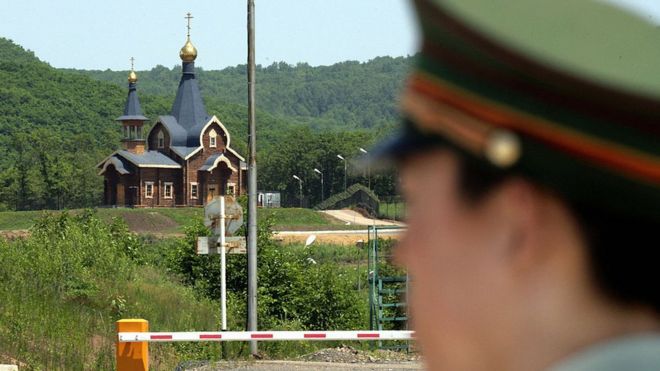
Guard at the Russian borderImage copyright AFP / GETTY
Image caption Suifenhe, where around 100,000 people live, has a road and rail crossing with Russia

A Chinese city on the Russian border is entering a “lockdown” due to an increase in coronavirus cases – even as the rest of China cautiously opens up.

In Suifenhe, 1,000 miles from Beijing, people have been ordered to stay indoors, with some exceptions.

The border is closed to people, although not goods, and a 600-bed isolation hospital is being built.

One business owner told the BBC she was “very scared” – but another local said he had confidence in the government.

What is the virus situation in Suifenhe?

On Wednesday, China reported 59 imported cases of Covid-19 across the whole country.

According to state media, 25 of them entered the country via Suifenhe – making the remote north-east crossing something of a hotspot.

The patients were all returning Chinese citizens who had flown from Moscow to Vladivostok, a Russian city around 100 miles south.

All the new patients were taken to hospital, with two in a serious condition.

In addition, another 86 people in Suifenhe – who came via the same route – were classed as “asymptomatic” but positive for the virus, which China counts separately.

What has Suifenhe done?

The border was closed to people on Tuesday, the local government said, although cargo can continue. Russia closed its border with China in February.

People in the city have been told to stay at home, although the lockdown isn’t as severe as Hubei province experienced. One person per house can shop for essentials every three days.

At the same time, the new hospital – in an existing building – is due to open this weekend, intended for patients with mild symptoms.

“Of course I’m very scared,” one woman who runs a bakery shop told the BBC.

“We don’t leave the house now. Many people already left the city. But we can’t do that, because we have a shop need to take care of.”

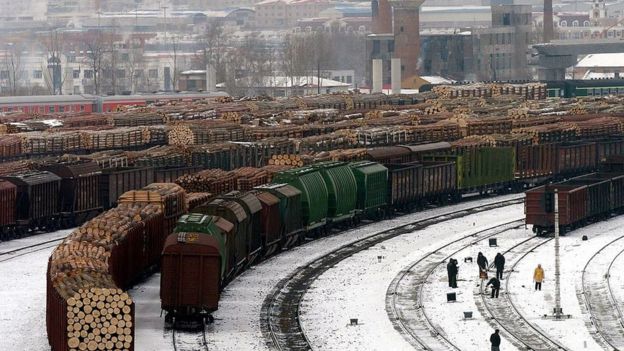
This picture from 2005 showed the extent of Russian timber exports passing through Suifenhe railway stationImage copyright SOVFOTO
Image caption This picture from 2005 showed the extent of Russian timber exports passing through Suifenhe railway station

Meanwhile, a member of staff at a restaurant in the city said it was normally their high season, with around 1,000 customers a day.

Instead, they were told to close earlier this week, with “no idea” when they can open again.

But the staff member was not critical of the government. He said the lockdown made him feel “secure” – and that he was “very confident” the government would look after the situation.

What is the situation in the rest of China?

China’s recorded rate of Covid-19 infections has slowed dramatically in recent weeks.

On Tuesday, it reported no new deaths for the first time since publishing daily figures in January.

On Thursday, it reported 63 cases – 61 imported from overseas – and just two new deaths.

The “flattening of the curve” has allowed restrictions to be lifted, and some normality to return.

On Wednesday, people were allowed to leave Wuhan – where the outbreak emerged – for the first time in 11 weeks if they were deemed virus-free.

There were 221 inbound and outbound flights, with more than 7,000 people leaving and 4,500 arriving. More than half a million used public transport, state media reported.

But although people from Wuhan can leave, they still face restrictions in other cities. In Beijing, for example, they will be tested upon arrival, according to local media.

Even if they pass, they will then be quarantined for 14 days – and tested again – before being released.

Source: The BBC

Law of Unintended Consequences

continuously updated blog about China & India

ChiaHou's Book Reviews

continuously updated blog about China & India

What's wrong with the world; and its economy

continuously updated blog about China & India