Chindia Alert: You’ll be Living in their World Very Soon
aims to alert you to the threats and opportunities that China and India present. China and India require serious attention; case of ‘hidden dragon and crouching tiger’.
Without this attention, governments, businesses and, indeed, individuals may find themselves at a great disadvantage sooner rather than later.
The POSTs (front webpages) are mainly 'cuttings' from reliable sources, updated continuously.
The PAGEs (see Tabs, above) attempt to make the information more meaningful by putting some structure to the information we have researched and assembled since 2006.
US President Donald Trump has described the coronavirus pandemic as the “worst attack” ever on the United States, pointing the finger at China.
Mr Trump said the outbreak had hit the US harder than the Japanese bombing of Pearl Harbor in World War Two, or the 9/11 attacks two decades ago.
His administration is weighing punitive actions against China over its early handling of the global emergency.
Beijing says the US wants to distract from its own response to the pandemic.
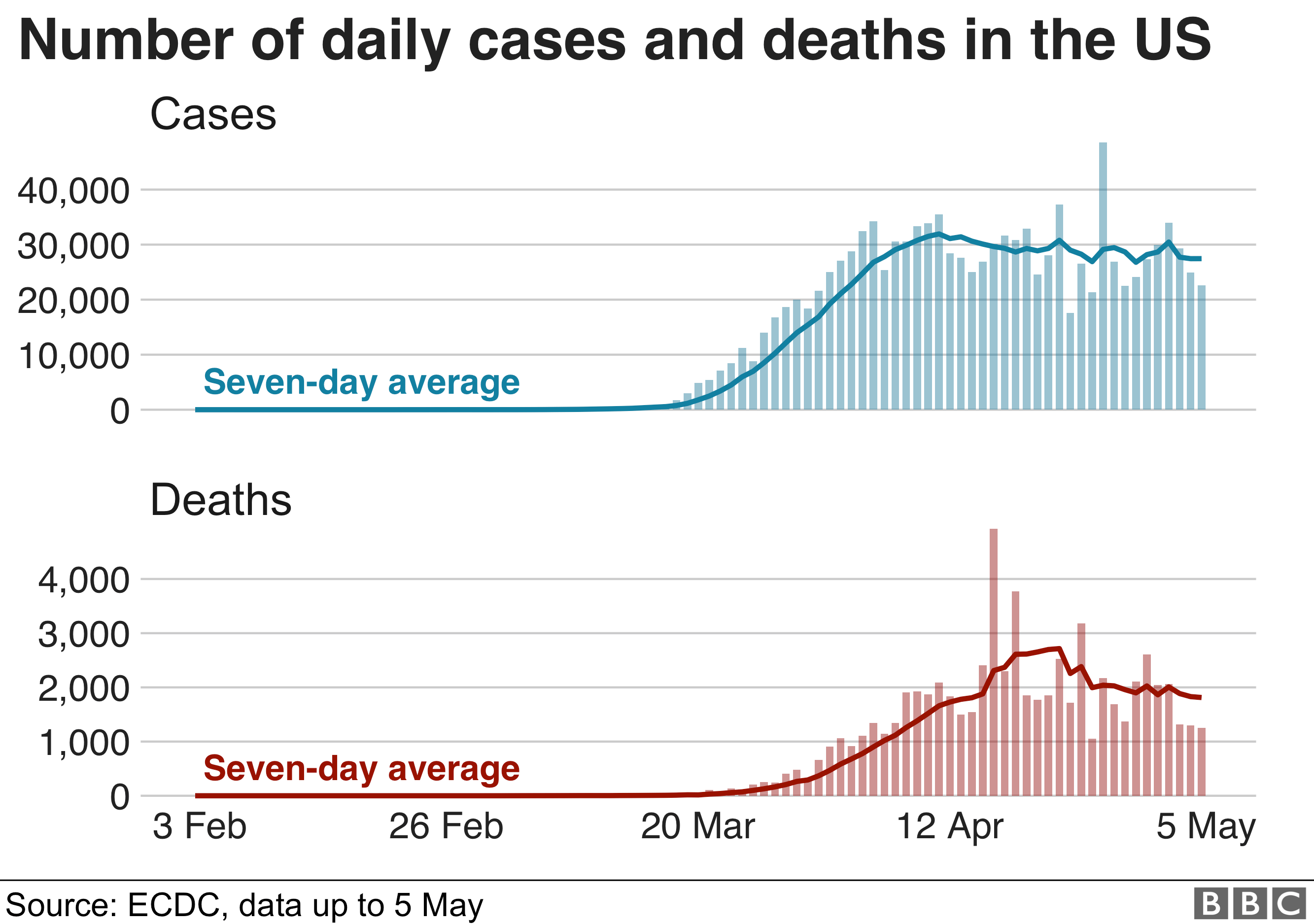
Since emerging in the Chinese city of Wuhan in December, the coronavirus is confirmed to have infected 1.2 million Americans, killing more than 73,000.
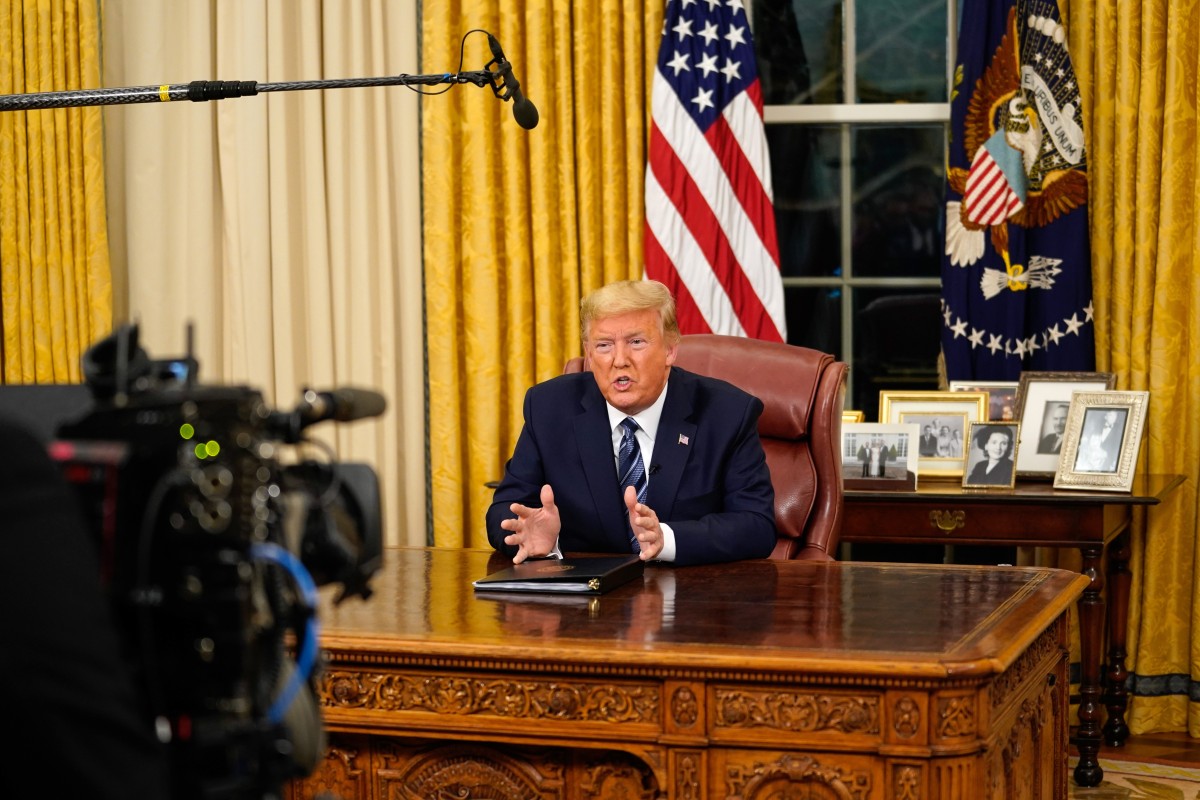
Speaking to reporters in the Oval Office of the White House on Wednesday, Mr Trump said: “We went through the worst attack we’ve ever had on our country, this is worst attack we’ve ever had.
“This is worse than Pearl Harbor, this is worse than the World Trade Center. There’s never been an attack like this.
“And it should have never happened. Could’ve been stopped at the source. Could’ve been stopped in China. It should’ve been stopped right at the source. And it wasn’t.”
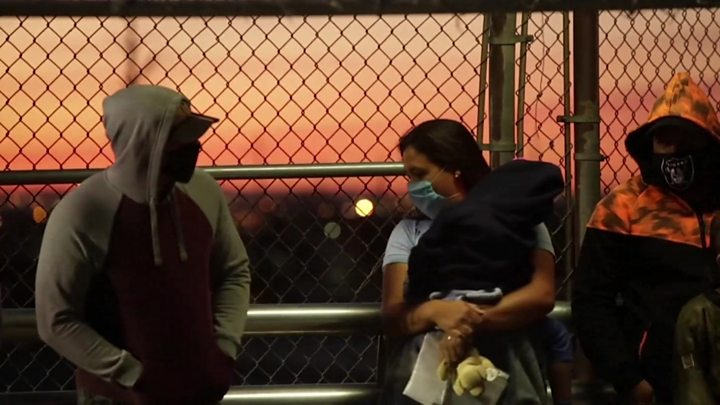
Media caption Life for asylum seekers in lockdown on the US-Mexico border
Asked later by a reporter if he saw the pandemic as an actual act of war, Mr Trump indicated the outbreak was America’s foe, rather than China.
“I view the invisible enemy [coronavirus] as a war,” he said. “I don’t like how it got here, because it could have been stopped, but no, I view the invisible enemy like a war.”
Media caption US shopping centres re-open: ‘This is the best day ever’
Who else in Trump’s team is criticising China?
The deepening rift between Washington and Beijing was further underscored on Wednesday as Secretary of State Mike Pompeo renewed his rhetoric against China, accusing it of covering up the outbreak.
He stuck by his so far unsubstantiated charge that there is “enormous evidence” the coronavirus hatched in a Chinese laboratory, even while acknowledging there is still uncertainty about its origins.
“Those statements are both true,” America’s top diplomat told the BBC. “We don’t have certainty and there is significant evidence that it came from a lab.”
One of the most trusted US public health experts has said the best evidence indicates the virus was not made in a lab.
Dr Anthony Fauci, a member of Mr Trump’s coronavirus task force, said on Monday the illness appeared to have “evolved in nature and then jumped species”.
Why is the US blaming China?
President Trump faces a tough re-election campaign in November, but the once humming US economy – which had been his main selling point – is currently in a coronavirus-induced coma.
As Mr Trump found his management of the crisis under scrutiny, he began labelling the outbreak “the China virus”, but dropped that term last month days before speaking by phone with Chinese President Xi Jinping.
Both Mr Trump and his likely Democratic challenger, Joe Biden, appear to be fastening on to China’s unpopularity as an election issue, with each accusing the other of being a patsy for America’s primary economic competitor.
As the coronavirus began spreading in the US back in January, Mr Trump signed phase one of a trade deal with China that called a truce in their tariff war. The US president’s hopes of sealing a more comprehensive phase two deal are now in limbo because of the pandemic.
WASHINGTON (Reuters) – President Donald Trump said on Wednesday he believes China’s handling of the coronavirus is proof that Beijing “will do anything they can” to make him lose his re-election bid in November.
In an interview with Reuters in the Oval Office, Trump talked tough on China and said he was looking at different options in terms of consequences for Beijing over the virus. “I can do a lot,” he said.
Trump has been heaping blame on China for a global pandemic that has killed at least 60,000 people in the United States according to a Reuters tally, and thrown the U.S. economy into a deep recession, putting in jeopardy his hopes for another four-year term.
The Republican president, often accused of not acting early enough to prepare the United States for the spread of the virus, said he believed China should have been more active in letting the world know about the coronavirus much sooner.
Asked whether he was considering the use of tariffs or even debt write-offs for China, Trump would not offer specifics. “There are many things I can do,” he said. “We’re looking for what happened.”
RELATED COVERAGE
China says it has no interest in meddling in U.S. election
“China will do anything they can to have me lose this race,” said Trump. He said he believes Beijing wants his Democratic opponent, Joe Biden, to win the race to ease the pressure Trump has placed on China over trade and other issues.
“They’re constantly using public relations to try to make it like they’re innocent parties,” he said of Chinese officials.
He said the trade deal that he concluded with Chinese President Xi Jinping aimed at reducing chronic U.S. trade deficits with China had been “upset very badly” by the economic fallout from the virus.
A senior Trump administration official, speaking on condition of anonymity, said on Wednesday that an informal “truce” in the war of words that Trump and Xi essentially agreed to in a phone call in late March now appeared to be over.
The two leaders had promised that their governments would do everything possible to cooperate to contain the coronavirus. In recent days, Washington and Beijing have traded increasingly bitter recriminations over the origin of the virus and the response to it.
However, Trump and his top aides, while stepping up their anti-China rhetoric, have stopped short of directly criticizing Xi, who the U.S. president has repeatedly called his “friend.”
Trump also said South Korea has agreed to pay the United States more money for a defense cooperation agreement but would not be drawn out on how much.
“We can make a deal. They want to make a deal,” Trump said. “They’ve agreed to pay a lot of money. They’re paying a lot more money than they did when I got here” in January 2017.
The United States stations roughly 28,500 troops in South Korea, a legacy of the 1950-53 Korean War that ended in an armistice, rather than a peace treaty.
Trump is leading a triage effort to try to keep the U.S. economy afloat through stimulus payments to individuals and companies while nudging state governors to carefully reopen their states as new infections decline.
Trump sounded wistful about the strong economy that he had enjoyed compared with now, when millions of people have lost their jobs and GDP is faltering.
“We were rocking before this happened. We had the greatest economy in history,” he said.
He said he is happy with the way many governors are operating under the strain of the virus but said some need to improve. He would not name names.
Trump’s handling of the virus has come under scrutiny. Forty-three percent of Americans approved of Trump’s handling of the coronavirus, according to the Reuters/Ipsos poll from April 27-28.
But there was some good coronavirus news, as Gilead Sciences Inc said its experimental antiviral drug remdesivir was showing progress in treating virus victims.
Trump has also seeking an accelerated timetable on development of a vaccine.
“I think things are moving along very nicely,” he said.
At the end of the half-hour interview, Trump offered lighthearted remarks about a newly released Navy video purportedly showing an unidentified flying object.
“I just wonder if it’s real,” he said. “That’s a hell of a video.”
‘He is a reality-show expert. This is a real crisis. The happy ending is not guaranteed,’ communications strategist says
Televised Oval Office address offered an ineffective remedy in the European travel ban and fell short on other policy recommendations, according to analysts
US President Donald Trump addresses the nation from the Oval Office of the White House on Wednesday night. Photo: Bloomberg
US President Donald Trump’s coronavirus address from the Oval Office on Wednesday night was meant to project confidence, show leadership in a time of crisis and otherwise reassure an anxious nation and world.
It didn’t work out that way, say health, government policy and crisis management experts, pointing in part to the 1,000-point drop in stock futures even before his 10-minute nationally televised speech was finished.
“You had an uncomfortable president who looked like he didn’t want to be there. He doesn’t want to be the leader that the country, if not free world, wants him to be in a crisis,” said Richard Levick, chief executive of Levick Strategic Communications.
“He is a reality-show expert,” Levick added. “This is a real crisis. The happy ending is not guaranteed. The applause line is not guaranteed. You have to actually lead. He doesn’t like that.”
Trump bans travel from Europe to the US as coronavirus pandemic hits actor Tom Hanks and the NBA
Public health experts say Trump’s announcement that the US was blocking all incoming visitors from Europe for 30 days will prove largely ineffective given that the virus is already firmly rooted in the US and spreading rapidly. And his efforts to reassure the public that testing is widely available, medical experts are fully deployed and face masks widely available was not convincing and a case of too little, too late, they added.
His speech, only his second Oval Office address, followed weeks of denying the gravity of the coronavirus, spreading misinformation, deflecting blame onto Democrats and the media and contradicting highly regarded experts, including Dr. Anthony Fauci, head of infectious diseases at the National Institutes of Health, observers said.
“He has such a bad track record, no one will believe him,” said JB Silvers, professor of health finance at Case Western University in Ohio. “He can’t help but make this a political thing. A Chinese virus? Viruses don’t have nationalities.”
“He could’ve ramped up testing much earlier,” Silvers added. “Instead he told people, ‘Don’t worry, go back to work.’ All the wrong things.”
New York bans gatherings of more than 500 on coronavirus fears
13 Mar 2020
Governments around the world have struggled to cope with the spread of the virus, prepare adequately and take lessons from China and South Korea, which were hit early.
But Trump’s speech also fell short from a policy standpoint, some said. Washington and the markets have been looking for direction, given the logjam and partisanship in Congress. That includes whether the president would support, albeit grudgingly, a Democratic package of economic stimulus measures, oppose specific parts or reject it outright in favour of a still unformed Republican plan.
“No one has a clear sign what he wants, what he will sign,” said Jeffrey Wright, North America analyst with EurAsia Group. “It was a massive failure, one of the least effective presidential prime-time addresses in my memory.”
Companies and markets hate uncertainty and want reassurance, which they’re not getting said Zhaohui Chen, associate professor of commerce at the University of Virginia. “Investors are worried about the policy, that it may cause more harm to the economy,” he said.
Communication and policy experts said there tend to be few obvious answers initially during a crisis, which puts a premium on relatively transparent leaders who can acknowledges what is known and unknown, build trust and work through complexities toward a solution.
“It’s not so much what he did last night, it’s what he did before. Never before has Trump’s habit of making events about himself hurt him until now,” said Eric Dezenhall, chief executive of public relations firm Dezenhall Resources.
“Standing with science officials and talk about how no one has seen such a scientific genius before him, that he should’ve become a doctor, we’re not selling time-shares in the Caymans,” he added.
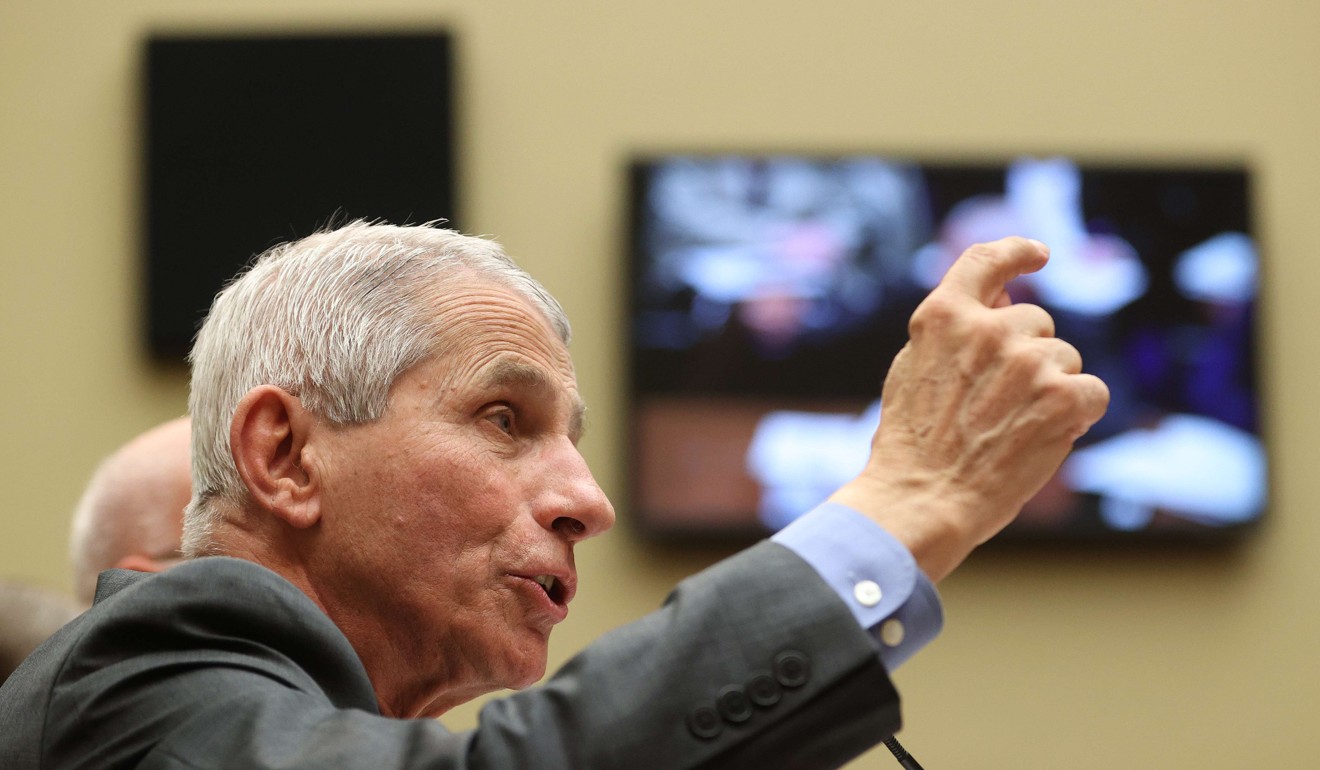
Anthony Fauci, director of the National Institute of Allergy and Infectious Diseases, testifies to lawmakers about coronavirus preparedness on Thursday. Photo: Getty Images/AFP
Leslie Rosenthal, a writer from New Jersey, said the speech failed to reassure her as an ordinary citizen, and seemed to focus on the wrong issues.
“What I wanted to hear from the president was a solution to what’s happening in this country right now,” she said. “While stopping people from coming into the country might do something, it’s about what’s going on here. Where are the test kits? Where are the viral hotspots? I’m placing my trust in Dr. Fauci.”
Trump is a skilled off-the-cuff orator at rallies, where he can energise and be energised by the crowd, communication experts said, and less adept at delivering prepared speeches, as seen on Wednesday night.
“He used a teleprompter, but still made misstatements in ways that rocked the market,” said Levick. Most notable was his statement that his administration was blocking not just people but all cargo from Europe, a statement his office quickly walked back shortly after the speech, he said.
White House orders secrecy for coronavirus meetings
12 Mar 2020
Also questionable was the decision to block travellers from the European continent but not from Britain, even though the UK is a global travel and financial hub.
“You can’t ban people from some countries and not others,” said Ron Waldman, a doctor, professor of global health and infectious disease specialist at George Washington University. “It makes no sense.”
Trump hoped the speech would build confidence in the US economy, its health care system and his leadership. “The virus will not have a chance against us,” he said. “No nation is more prepared.”
But many experts had a different view.
“We’re clearly unprepared,” said Ali Khan, epidemiology professor at the University of Nebraska Medical Center and a former director at the Centres for Disease Control and Prevention.
“We don’t even need to talk about a pandemic,” he said, adding that even a bad flu outbreak would swamp American hospitals.
Trump vows to ‘take care’ of citizens and economy as coronavirus cases rise in the US
After playing down the economic and health risks from the coronavirus for weeks, the Trump administration kicked into gear on Monday, floating a blizzard of proposals to stimulate the economy. These include expanding loans to small businesses, increasing paid sick leave and extending tax relief for the hospitality industry. The White House and congressional leaders are now trying to hammer out an economic relief bill.
Trump’s turnaround reflects, in part, a growing realisation that the disease is real, can’t be tweeted away, can’t be blamed on political opponents and seriously threatens his re-election prospects.
“He’s definitely worried,” said Silvers. “All those ‘Democratic viruses’ are going to cause him trouble.”
US President Donald Trump and Indian Prime Minister Narendra Modi exchanged warm words of friendship in Texas at a rare mass rally for a foreign leader.
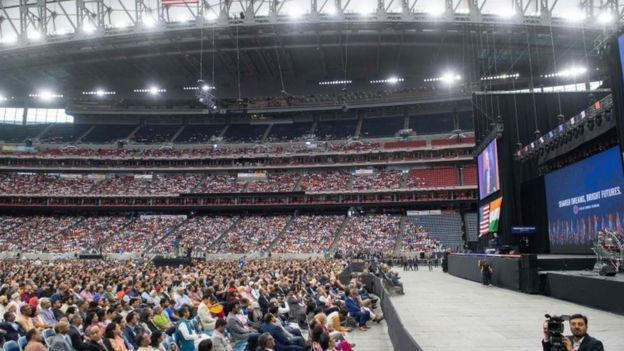
Around 50,000 people gathered for what Mr Trump called a “profoundly historic event” on Sunday in Houston.
The “Howdy, Modi!” event was billed as one of the largest ever receptions of a foreign leader in the US.
Mr Modi, however, may face a frostier reception at the UN General Assembly.
He is likely to face criticism over tensions in Indian-administered Kashmir, which he stripped of its special status last month, promising to restore the region to its “past glory”.
The region has been in lockdown for more than a month with thousands of activists, politicians and business leaders detained.
Trade talks and the UN General Assembly are on the Indian prime minister’s agenda during his week-long visit to the United States.
Pakistani Prime Minister Imran Khan, who has been the most vocal international leader to oppose India’s Kashmir move, is also in the US for the UN conference. Like Mr Modi, he will have a one-on-one meeting with Mr Trump on the sidelines of the summit.
A 90-minute show, featuring 400 performers, warmed up the crowd before Mr Modi and Mr Trump shared the stage.
“I’m so thrilled to be here in Texas with one of America’s greatest, most devoted and most loyal friends, Prime Minister Modi of India,” Mr Trump told the crowd.
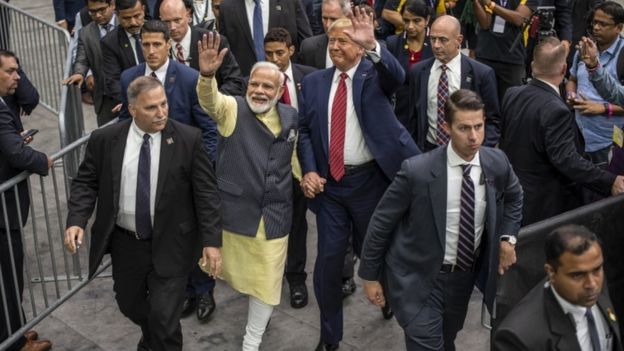
Image copyright GETTY IMAGESImage caption Narendra Modi and Donald Trump leave the stage holding hands at Houston’s NRG Stadium
In his speech, Mr Modi said India has a “true friend” in the White House, describing Mr Trump as “warm, friendly, accessible, energetic and full of wit”.
“From CEO to commander-in-chief, from boardrooms to the Oval Office, from studios to the global stage… he has left a lasting impact everywhere,” Mr Modi said.
Personal-touch diplomacy played to perfection
Brajesh Upadhyay, BBC News, Houston
This was exactly the kind of crowd size and energy President Trump loves at his rallies.
Only here the chants were for Indian Prime Minister Narendra Modi and Mr Trump was the superstar invited to the party. But the crowd did not disappoint him either and greeted him with chants of “USA!”, most heard at Trump rallies.
The personal-touch diplomacy with Mr Modi’s trademark bear hugs was played to perfection.
This rally has been called a win-win for both the leaders. For President Trump, it was a chance to court Indian-Americans for the 2020 presidential election race where Texas could emerge as a battleground state. For Mr Modi, a PR triumph and picture with the president of the United States may help him shrug off the criticism over his recent strong-arm policies at home.
Houston’s NRG Stadium, where the event was hosted, was the first stop for Mr Modi, whose Hindu nationalist Bharatiya Janata Party (BJP) won a landslide victory in this year’s Indian elections.
Greeted by a standing ovation, Mr Trump used his speech to heap praise on Mr Modi, who he said was doing a “truly exceptional job for India” and its people.
Mr Trump also paid tribute to the Indian-American community, telling them “we are truly proud to have you as Americans”.
The US has a population of about 4 million Indians who are seen as an increasingly important vote bank in the country.
Apart from Mr Trump, organisers also invited Democrats to the event – House Majority Leader Steny Hoyer was among those who spoke.
The 2010 US census shows that Texas is home to the fourth-largest Indian-American population in the country after California, New York and New Jersey.
Analysis of voting patterns shows the community tends overwhelmingly to support the Democrat party.
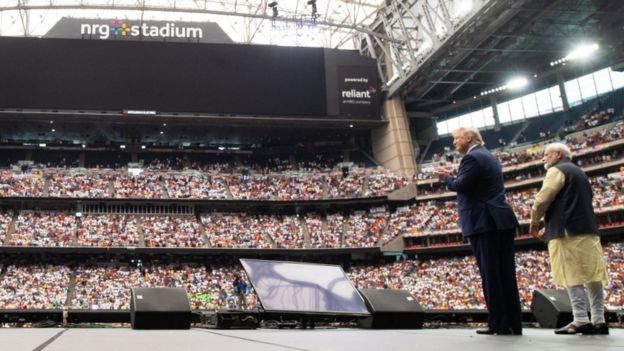
Image copyright GETTY IMAGESImage caption The event, dubbed “Howdy, Modi!”, was attended by an estimated 50,000 people
No stranger to nationalist rhetoric himself, Mr Trump compared security at the US-Mexico border to the tensions between India and Pakistan in the tinderbox Kashmir region.
“Both India and US also understand that to keep our communities safe, we must protect our borders,” Trump said.
Image copyright GETTY IMAGESImage caption Donald Trump described Narendra Modi as one of America’s most “loyal friends”
In India, the rally was closely watched, with most mainstream media outlets running live news updates of what was transpiring on stage.
The event had been making headlines for days before as well.
On Twitter, many people shared instant analysis and opinions of what was taking place on the stage with the sentiment being overwhelmingly positive. Many praised Mr Modi for what they saw as his statesmanship and diplomatic acumen with a lot of praise coming in for the US president as well.





 CHINDIA ALERT: You'll be living in their world, very soon