Chindia Alert: You’ll be Living in their World Very Soon
aims to alert you to the threats and opportunities that China and India present. China and India require serious attention; case of ‘hidden dragon and crouching tiger’.
Without this attention, governments, businesses and, indeed, individuals may find themselves at a great disadvantage sooner rather than later.
The POSTs (front webpages) are mainly 'cuttings' from reliable sources, updated continuously.
The PAGEs (see Tabs, above) attempt to make the information more meaningful by putting some structure to the information we have researched and assembled since 2006.
Chinese Vice President Wang Qishan meets with German President Frank-Walter Steinmeier in Berlin, Germany, May, 31, 2019. Wang Qishan paid a visit to Germany from Thursday to Sunday at the invitation of the German Federal Government. (Xinhua/Rao Aimin)
BERLIN, June 2 (Xinhua) — Chinese Vice President Wang Qishan paid a visit to Germany from Thursday to Sunday at the invitation of the German Federal Government.
During his visit in Berlin, Wang met with German President Frank-Walter Steinmeier, Chancellor Angela Merkel and Foreign Minister Heiko Maas separately.
When meeting with Steinmeier, Wang said that China and Germany were both major world economies and major countries with great influence. The relations between the two countries have gone beyond bilateral scope and bear global significance.
Wang said in recent years the high-level contacts were frequent, and the cooperation in all fields has been constantly deepened, adding he is willing to push for new development of the all-around strategic partnership through his visit.
Noting the ties between China and Germany is currently facing a new situation, Wang called on the two countries to set a model of win-win cooperation for the world through deepening collaboration, to bring stability to the world through guiding the China-EU cooperation, and to strength the power to safeguard multilateralism through boosting global governance.
For his part, German President Steinmeier said that the current international landscape is complicated and turbulent, and multilateralism is under threat.
He noted that Germany highly values the ties with China, adding Germany is willing to strengthen communication and coordination with China at all levels, and to continue the pragmatic cooperations in Industry 4.0 and in other fields.
Germany and China, and Europe and China, should join hands to maintain the world peace and stability, free trade, and existing international orders, Steinmeier added.
When meeting with Merkel, Wang said China sticks to peaceful development, and will through steadily deepening reform and opening up, solve the existing problem of imbalance and insufficient development to meet people’s desire for a better life and to fulfill the promises of the party and the government to the people.
Wang said China cannot develop itself in isolation from the world, nor can the world develop without the 1.4 billion Chinese people, and China advocates countries to together build a community of shared future for humankind.
Facing the profound and complex changes in the international situation, China always insists on doing its own share firstly, staying calm and clear-headed, showing composure, shouldering responsibility and reacting rationally, he noted.
Wang called on China and Germany, as all-around strategic partners, to strengthen cooperation in building a more fair and reasonable global governance system, and to jointly face the uncertainties.
The Chinese vice president also said that China has always viewed Europe from a strategic height and with a long-term vision, and firmly supported the European integration. Wang added that China is a trustworthy partner for Europe to have dialogue on an equal footing.
Chancellor Merkel said Germany appreciates China’s great achievements in economic development and believes that China can definitely achieve the ambitious goals of eradicating poverty and finishing building a moderately prosperous society on schedule.
Facing the current complex and volatile international environment in which various new problems emerge, Merkel said, Germany is always committed to safeguarding the principle of multilateralism and the existing international order.
She noted that Germany advocates to strengthen international coordination and collaboration through dialogue, disagrees with the action of exerting threat and pressure to solve problems.
She believed that Germany and China, as well as Europe and China, share broad consensus on a wide range of issues, expressing Germany’s willingness to strengthen communication, exchanges and cooperation with China, and to improve global governance system jointly with China.
When meeting with Heiko Maas, Wang said China and Germany share common interests in many fields such as deepening pragmatic cooperation, safeguarding multilateralism and free trade, improving global governance and promoting world peace.
Looking to the next stage of the bilateral relations, Wang advocates that both sides should set the right direction for the Sino-German, Sino-European win-win cooperation, encourage the enhanced exchanges in ideology, talents as well as science and technology, cement the friendship between the two peoples, and to inject more positive energy into the world.
Echoing Wang’s comments, Maas said Germany is willing to strengthen strategic communication and cooperation on multilateral issues with China, as well as to jointly tackle global challenges, safeguard multilateralism and international order, promote the liberalization of international trade.
During his visit to Germany, Wang also met with mayor of Hamburg Peter Tschentscher and Bavarian governor Markus Soeder and visited the port of Hamburg.
Before his tour to Germany, the Chinese Vice president also visited Pakistan and the Netherlands.
NEW DELHI (Reuters) – India warned of severe heat in northern and central areas on Monday, following similar extreme weather on Sunday.
Of the 15 hottest places in the world in the past 24 hours, eight were in India with the others in neighbouring Pakistan, according to weather monitoring website El Dorado.
Churu, a city in the west of the northern state of Rajasthan, recorded the country’s highest temperature of 48.9 Celsius (120 Fahrenheit) on Monday, according to the Meteorological Department.
Churu has issued a heat wave advisory and government hospitals have prepared emergency wards with extra air conditioners, coolers and medicines, said Ramratan Sonkariya, additional district magistrate for Churu.
Water is also being poured on the roads of Churu, known as the gateway to the Thar desert, to keep the temperature down and prevent them from melting, Sonkariya added.
A farmer from Sikar district in Rajasthan died on Sunday due to heatstroke, state government officials said.
Media reported on Friday that 17 had died over the past three weeks due to a heatwave in the southern state of Telangana. A state official said it would confirm the number of deaths only after the causes had been ascertained.
The temperature in New Delhi touched 44.6C (112.3F) on Sunday. One food delivery app, Zomato, asked its customers to greet delivery staff with a glass of cold water.
Heat wave warnings were issued on Monday for some places in western Rajasthan and Madhya Pradesh state.
The monsoon, which brings down the heat, is likely to begin on the southern coast on June 6, the weather office said last month.
The three-month, pre-monsoon season, which ended on May 31, was the second driest in the last 65 years, India’s only private forecaster, Skymet, said, with a national average of 99 mm of rain against the normal average of 131.5 mm for the season.
President Xi Jinping will meet Russian counterpart Vladimir Putin next month and address economic summit in St Petersburg
Diplomatic flurry will also include regional security forums in Kyrgyzstan and Tajikistan
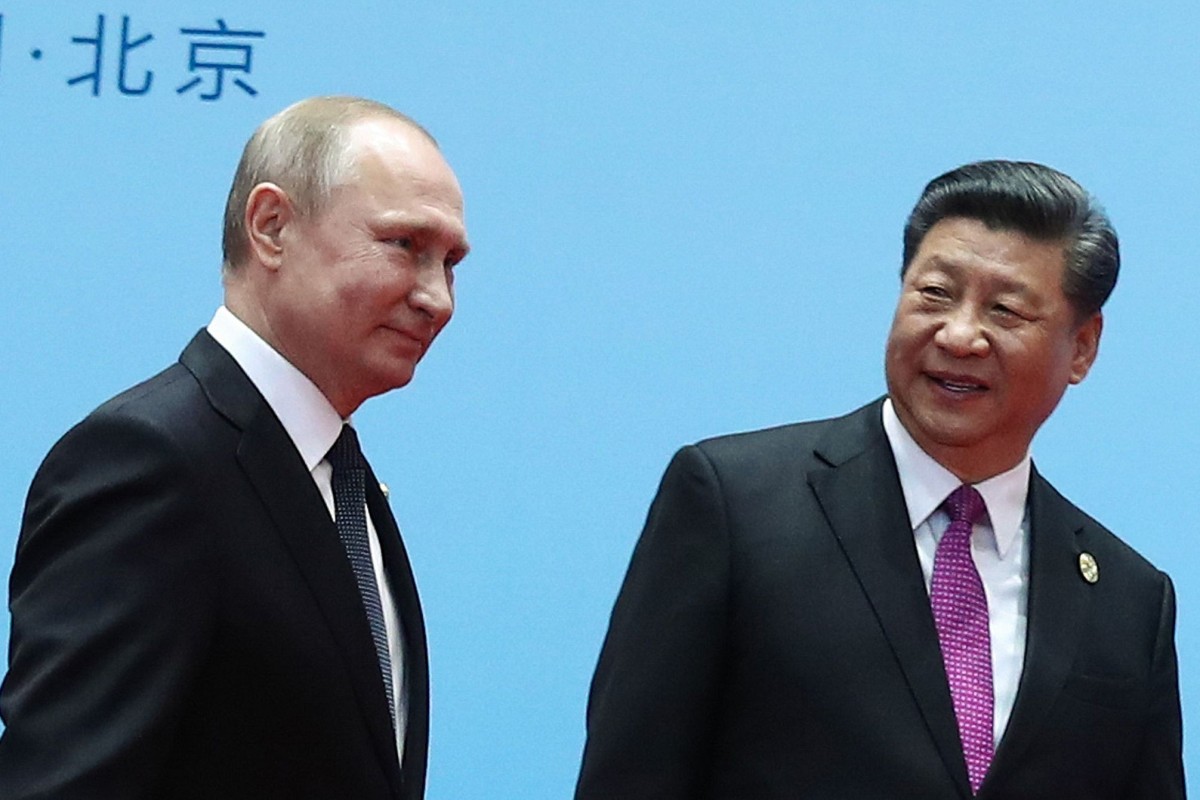
Xi Jinping has met Vladimir Putin more times than any other foreign leader since he took power in 2013. Photo: AFP
Beijing is stepping up efforts to seek support from regional and global players such as Russia and Central Asian nations as its geostrategic rivalry with Washington heats up.
President Xi Jinping is expected to meet his Russian counterpart Vladimir Putin next month, when he will also address the St Petersburg International Economic Summit,
The Chinese president will also visit the Kyrgyzstan capital Bishkek for the Shanghai Cooperation Organisation (SCO) summit in June, as well as another regional security forum in Dushanbe, Tajikistan.
Meanwhile, Vice-PresidentWang Qishan is visiting Pakistan before he heads to the Netherlands and Germany, according to the Chinese foreign ministry.
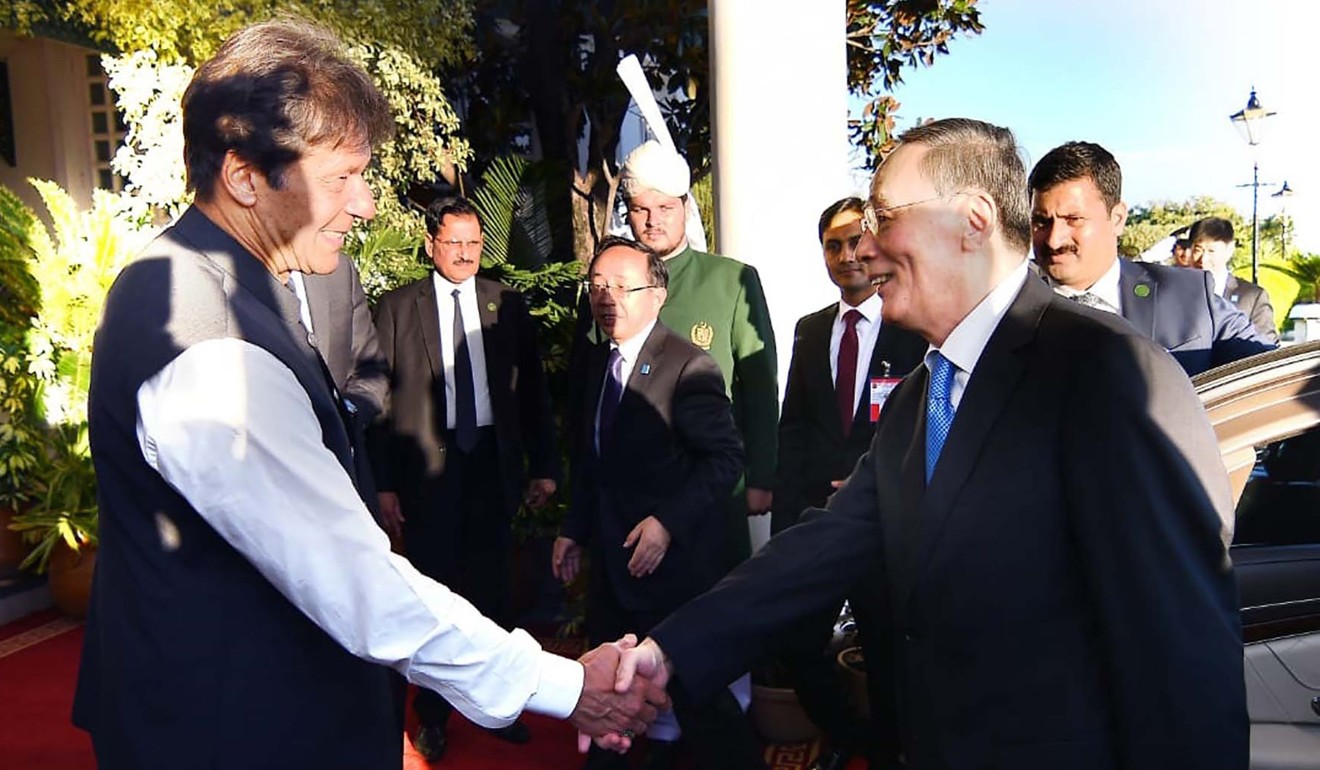
Pakistani Prime Minister Imran Khan meets Chinese Vice-President Wang Qishan in Islamabad on Sunday. Photo: AFP
The latest flurry of diplomatic activity comes as competition between China and the US intensifies on several fronts including trade and technology, the South China Sea and the Arctic, where Beijing’s partnership with Moscow –
It will be Xi’s second time at the St Petersburg forum, and observers expect the Chinese leader will reaffirm Beijing’s commitment to multilateralism and promote the nation as a champion of openness and cooperation.
China-Russia ties unrivalled, Beijing warns before Pompeo meets Putin
It will also be his second meeting with Putin in two months, after talks on the sidelines of the Belt and Road Forum in Beijing in late April, when the Russian president
for the controversial China-led infrastructure and investment initiative.
With China and Russia edging closer, the latest meeting is likely to see efforts to coordinate their strategies on a range of issues – including Venezuela, North Korea, nuclear weapons and arms control, according to observers. Xi has met Putin more times than any other foreign leader since he took power in 2013.
“This time it is very likely that the latest anti-China moves by the US, such as new tariffs and the Huawei ban, will feature prominently in their conversations,” said Artyom Lukin, an associate professor at Far Eastern Federal University in Vladivostok.
Lukin said Russia’s stagnating economy and sanctions imposed by the West limited its role as a substitute for the foreign markets and technologies China could lose access to because of the US crusade. But he said Putin would “provide political and moral support to Xi”.
“That is also significant as Russia has been withstanding intense US-led sanctions pressure for more than five years already,” Lukin said, referring to sanctions imposed after Russia’s annexation of Crimea in 2014.
Xi and Putin are also expected to talk about Venezuela, where US-backed opposition leader Juan Guaido is attempting to oust socialist President Nicolas Maduro, who has the support of China and Russia.
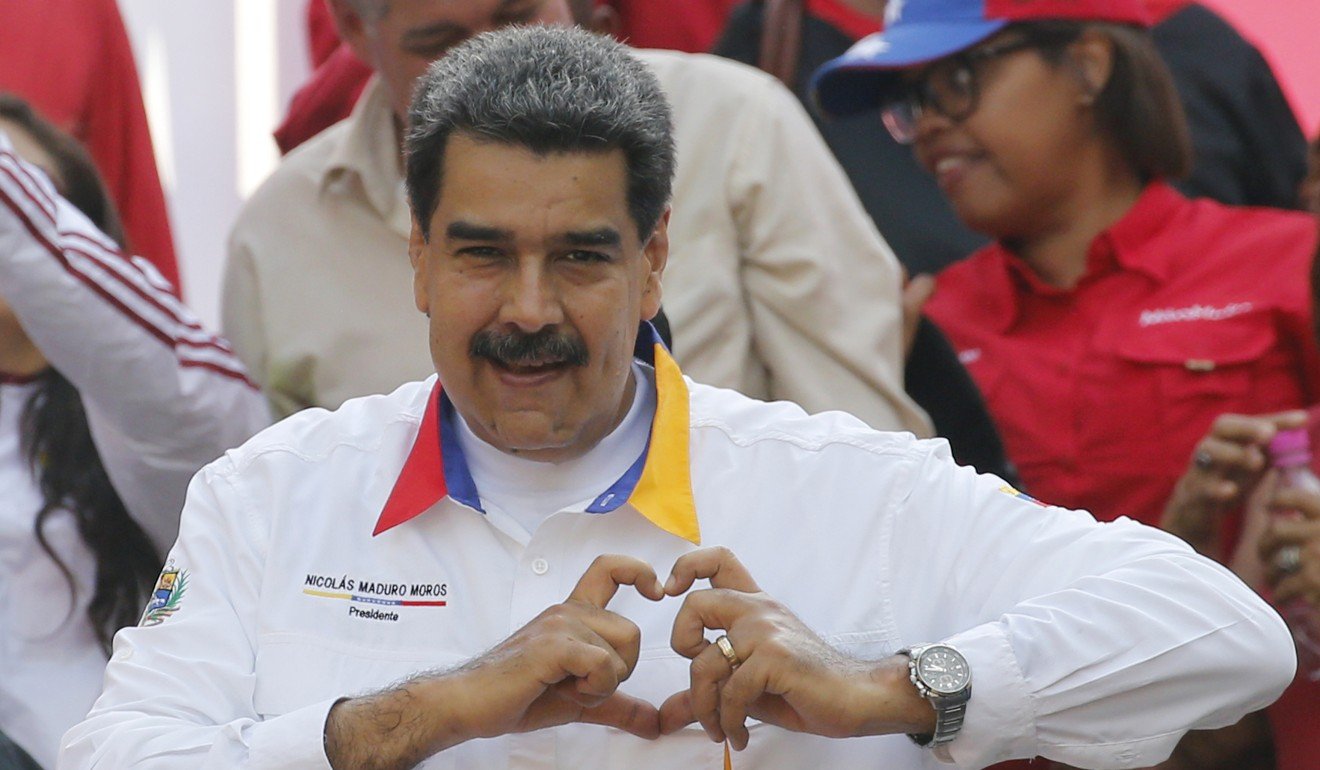
Venezuelan President Nicolas Maduro has the backing of China and Russia. Photo: AP
“Moscow and Beijing are not able to seriously hurt Washington by raising tariffs or denying access to high technology. However, there are plenty of areas where coordinated Sino-Russian policies can damage US interests in the short term or in the long run,” Lukin said. “For example, Moscow and Beijing could intensify their joint support for the Venezuelan government of Nicolas Maduro, frustrating Washington’s efforts to dislodge him.”
China and Russia would also be seeking to boost economic ties. Bilateral trade, dominated by Chinese imports of gas and oil, reached US$108 billion last year – falling far short of the target set in 2011 by Xi’s predecessor, Hu Jintao, of US$200 billion by 2020.
China and Russia to forge stronger Eurasian economic ties
Li Lifan, an associate research professor at the Shanghai Academy of Social Sciences, said bilateral trade was a sticking point. “This is one of the potential hindrances in China-Russia relations and Beijing is hoping to [address this] … in the face of a possible global economic slowdown,” Li said.
Given the escalating trade war with Washington, he said China would seek to diversify its investments and markets to other parts of the world, particularly Russia and Europe.
“China will step up its investment cooperation with Europe and Russia and focus more on multilateral investment,” Li said.
But Beijing was not expected to do anything to worsen tensions with Washington.
“China is currently taking a very cautious approach towards the US, trying to avoid heating up the confrontation and further aggravation of the situation,” said Danil Bochkov, a contributing author with the Russian International Affairs Council. “For China it is important to demonstrate that it has a reliable friend – Russia – but that should not be done in an openly provocative manner.”
Stephen Blank, a senior fellow at the American Foreign Policy Council in Washington, said Beijing and Moscow would also seek to contain US influence “as far as possible” from Central Asia, where China has increased its engagement through infrastructure building under the “Belt and Road Initiative”.
Leaders from the region will gather in Bishkek next month for the SCO summit, a security bloc set up in 2001 that now comprises China, Russia, Kazakhstan, Kyrgyzstan, Tajikistan, Uzbekistan, India and Pakistan. Those members account for about 23 per cent of the world’s land mass, 45 per cent of its population, and 25 per cent of global GDP.
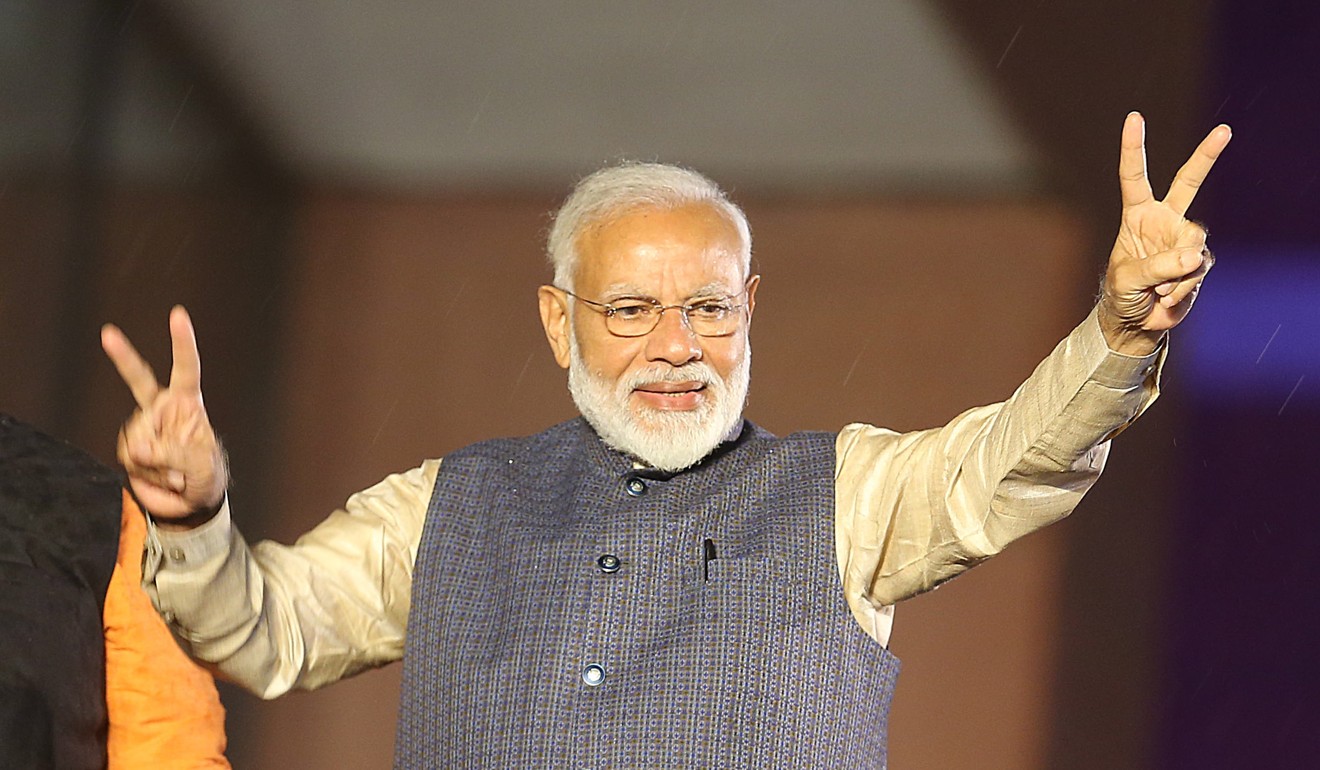
Newly re-elected Indian Prime Minister Narendra Modi could meet the Chinese president for talks in Bishkek next month. Photo: EPA-EFE
There is growing speculation that Xi will meet newly re-elected Indian Prime Minister Narendra Modi on the sidelines of that summit.
Independent analyst and author Namrata Goswami said India would be seeking a commitment to a WTO-led and rules-based multilateral trading system during the SCO talks.
“This is interesting and significant given the current US tendencies under President Donald Trump focused on ‘America first’ and the US-China trade war,” Goswami said.
Counterterrorism will again be a top priority at the SCO summit, amid concerns among member states about the rising number of Islamic State fighters returning from Syria and Iraq. Chinese scholars estimated last year that around 30,000 jihadists who had fought in Syria had gone back to their home countries, including China.
Alexander Bortnikov, chief of the main Russian intelligence agency FSB, said earlier that 5,000 fighters from a group affiliated with Isis had gathered in areas bordering former Soviet states in Central Asia, saying most of them had fought alongside Isis in Syria.
War-torn Afghanistan, which shares a border with four SCO member states – China, Pakistan, Tajikistan and Uzbekistan – is also likely to be high on the agenda at the Bishkek summit.
“With the Trump administration drafting plans to withdraw troops from Afghanistan, the SCO will assess the security situation there and decide whether to provide training for Afghan troops,” Li said.
Eva Seiwert, a doctoral candidate at the Free University of Berlin, expected the security bloc would also discuss Iran after the US withdrew from the 2015 nuclear deal and ordered new sanctions against the country.
Iran, which has observer status with the SCO, was blocked from becoming a full member in 2008 because it was subject to UN sanctions at the time. But its membership application could again be up for discussion.
Iran presses China and Russia to save nuclear deal
“The Trump administration’s unilateral withdrawal from the Iran nuclear deal in 2018 made it easy for China and Russia to present themselves as the proponents of peaceful settlement of conflicts,” Seiwert said. “Discussing the possibility of admitting Iran as a full member state would help the SCO members demonstrate their support of multilateral and peaceful cooperation.
“This would be a strong signal to the US and enhance the SCO’s standing in the international community,” she said.
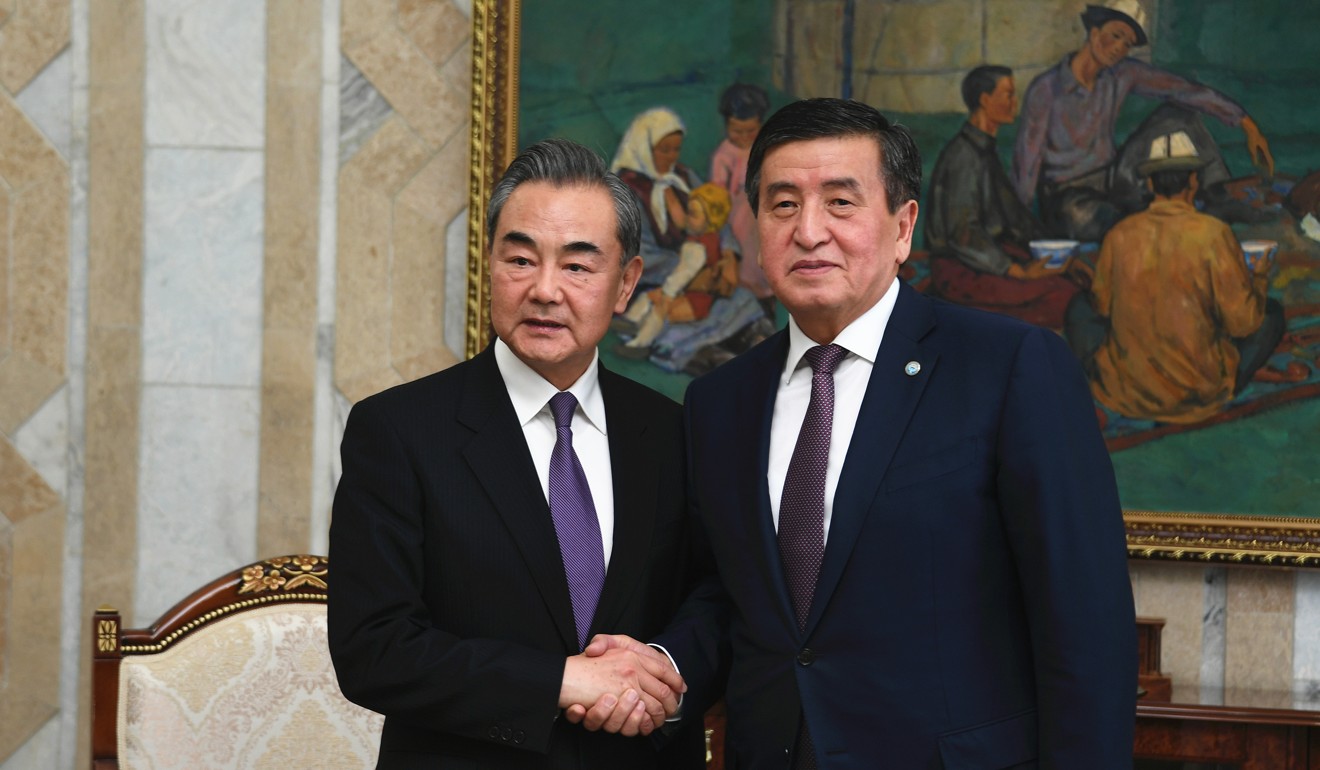
Kyrgyz President Sooronbay Jeenbekov (right) meets Chinese Foreign Minister Wang Yi in Bishkek on Tuesday last week. Photo: Xinhua
As well as security, Xi’s visit to Central Asia is also likely to focus on economic ties. Meeting Kyrgyz President Sooronbay Jeenbekov in Bishkek last week, Chinese Foreign Minister Wang Yi said Beijing would continue to “provide support and help national development and construction in Kyrgyzstan”.
Li said China may increase investment in the Central Asian region, especially in greenfield projects.
“China will continue to buy agriculture products from Central Asia, such as cherries from Uzbekistan, and build hydropower projects to meet local energy demand,” Li said. “Investment in solar and wind energy projects is also expected to increase too.”
Chinese Vice President Wang Qishan meets with Pakistani President Arif Alvi in Islamabad, Pakistan, May 26, 2019. Wang Qishan visited Pakistan from Sunday to Tuesday and held meetings with Pakistani President Arif Alvi and Prime Minister Imran Khan respectively on further strengthening bilateral relations. (Xinhua/Yan Yan)
ISLAMABAD, May 28 (Xinhua) — Chinese Vice President Wang Qishan visited Pakistan from Sunday to Tuesday and held meetings with Pakistani President Arif Alvi and Prime Minister Imran Khan respectively on further strengthening bilateral relations.
When meeting with the Pakistani president, Wang said China and Pakistan are “iron friends.” Throughout the past 68 years since the establishment of diplomatic ties, the two countries have always respected and supported each other on issues concerning each others’ core interests, forging the sincerest friendship.
In recent years, the development of China-Pakistan relations has kept a good momentum, with mutual political trust further enhanced, pragmatic cooperation continuously deepened and people-to-people exchanges growing more vigorous, Wang said.
He said the development of the China-Pakistan Economic Corridor (CPEC) has made concrete achievements and has become an important hallmark for China-Pakistan friendly cooperation in the new era, adding that his visit was meant for sending out a signal once more to peoples of the two countries and the world that China and Pakistan are all-weather strategic cooperative partners.
Wang said China is willing to strengthen the all-around cooperation with Pakistan in various sectors and at various levels, so as to make the friendship better benefit the two sides and forge a closer China-Pakistan community of shared future in the new era.
For his part, President Arif Alvi extended congratulations to the upcoming 70th anniversary of the founding of the People’s Republic of China. He said Pakistan-China cooperation has become more important in current times. Pakistan is firmly committed to the one-China policy, firmly supports China in safeguarding the country’s core and major interests, he said.
Pakistan wishes to deepen cooperation with China in such areas including agriculture, tourism and trade, with a bid to promote the all-weather strategic cooperative partnership further ahead, said the president, who also expressed appreciation for China’s support to Pakistan and wished China to play a bigger role in international and regional affairs.
After their meeting, the Pakistani president conferred on Wang the Nishan-e-Pakistan, the country’s highest award for foreign leaders.
While meeting with Pakistani Prime Minister Imran Khan, Wang said the prime minister has visited China twice since taking office and reached important consensus with Chinese leaders on further pushing forward the development of bilateral relations.
China is ready to join hands with Pakistan to deepen high-level exchanges, boost strategic communication and pragmatic cooperation as well as closely coordinate in international and regional affairs between the two sides, Wang said.
Wang called on the two sides to work for high-quality CPEC development in the next phase, and make concrete progress in industrial park building and agricultural cooperation.
China will speed up the implementation of social and people’s livelihood projects of early harvest, and discuss the third-party cooperation in the CPEC development, he added.
The Chinese vice president called for strengthened people-to-people and cultural exchanges and collaboration so as to expand the public foundation for the China-Pakistan friendship.
Wang hoped that Pakistan will take effective measures to provide security guarantees for the cooperation and exchanges between the two countries.
Imran Khan, for his part, said that Pakistan adheres to the friendly policy towards China, admires the achievements of China’s reform and opening-up and stands ready to consolidate the traditional friendship with China.
Pakistan also hopes to learn from China in terms of state governance, and enhance exchanges and cooperation in the sectors of agricultural technology, special economic zone development, talent training and anti-corruption.
Noting that fruitful results have been reaped in the CPEC development, the Pakistani prime minister said that the CPEC has played an important role in promoting Pakistan’s economic development and improving people’s livelihood.
He said Pakistan has established a special committee to take charge of inter-department and inter-sector coordination and ensure personnel safety of Chinese institutions in Pakistan.
Pakistan will continue to enhance coordination with China in international and regional affairs so as to enrich bilateral all-weather strategic cooperative partnership.
After the meeting, Wang Qishan and Imran Khan jointly witnessed the signing of bilateral cooperation agreements concerning agriculture, customs and disaster relief.
During his stay in Pakistan, the Chinese vice president also met with local leaders of the Punjab province, addressed the Friends of Silk Road Forum and visited Haier-Ruba Economic Zone.
ISLAMABAD (Reuters) – Pakistani Prime Minister Imran Khan on Sunday spoke to Narendra Modi and congratulated the Indian leader on the runaway election victory of his Hindu-nationalist Bharatiya Janata Party (BJP), both countries said on Sunday.
“Prime Minister Imran Khan spoke to Prime Minister Narendra Modi today and congratulated him on his party’s electoral victory in the Lok Sabha elections in India,” Pakistan’s foreign ministry said in a statement.
“The Prime Minister expressed his desire for both countries to work together for the betterment of their peoples.”
Tensions between India and Pakistan, both nuclear-armed countries, flared in February with cross-border air strikes and a brief battle between fighter jets above Kashmir.
India’s Ministry of External Affairs confirmed Khan had called Modi on Sunday, adding the two leaders had discussed fighting poverty together.
He (Modi) stressed that creating trust and an environment free of violence and terrorism were essential for fostering cooperation for peace, progress and prosperity in our region,” the ministry added in a statement.
SRINAGAR (Reuters) – Indian forces have killed the leader of an al Qaeda affiliated militant group in Kashmir, police said on Friday, triggering protests in parts of the disputed region.
Zakir Rashid Bhat, 25, was trapped by security forces in a three-storey house in southern Kashmir late on Thursday, said a senior police officer, adding that the house was set ablaze during the operation.
“As we were clearing debris from the house, he tried to get up. Our troops fired at him and he was killed,” said the officer, who declined to be named because he was not authorised to speak to media.
For decades, separatists have fought an armed conflict against Indian rule in Kashmir, with the majority of them wanting independence for the Himalayan region, or to join New Delhi’s arch rival Pakistan.
India has stepped up an offensive against militants in the Muslim-majority region since a suicide attack in February killed 40 Indian troopers in Kashmir and brought India and Pakistan to the brink of war.
Pakistan denies giving material support to militants in Kashmir but says it provides moral and diplomatic backing for the self-determination of Kashmiri people.
Protests by supporters of Bhat broke out in parts of Kashmir on Thursday and there were reports of demonstrations early on Friday, the police officer said.
Fearing more unrest, authorities said schools were closed and railway services suspended in the affected areas.
Any large scale unrest in the region would be a challenge for Indian Prime Minister Narendra Modi as he prepares for a second term after winning a general election on Thursday.
Bhat, a former commander of the Hizbul Mujahideen, the largest of the militant groups fighting against Indian rule in Kashmir, founded his own group and declared its association with al Qaeda in 2017.
Also known as Zakir Musa, he was seen as a successor to Burhan Wani, a popular Hizbul Mujahideen commander whose death in 2016 sparked clashes that left 90 civilians dead.
NEW DELHI (Reuters) – Voters in north India lined up early on Sunday to cast their ballots in the second-to-last round of a seven-phase general election, with Prime Minister Narendra Modi facing a diverse group of opposition parties seeking to deny him a second term.
More than 100 million people across seven states are eligible to vote in the sixth phase of the 39-day-long poll, which Modi began on April 11 as front-runner after an escalation of tension with neighbouring Pakistan.
But opposition parties have recently taken heart at what they see as signs Modi’s Hindu nationalist Bharatiya Janata Party (BJP) may be losing ground and have begun negotiations over a post-election alliance even before polling ends on May 19. Votes will be counted on May 23.
The president of the main opposition Congress party, Rahul Gandhi, said the main issues in the election were unemployment, distress in the countryside, the demonetisation of bank notes and a new sales tax.
“It was a good fight,” Gandhi said after he cast his vote.
“Narendra Modi used hatred, we used love. And I think love is going to win.”
A lack of new jobs – despite annual economic growth of about 7% – and the plight of farmers struggling with falling crop prices have been major worries for voters.
A new good and services tax (GST), as well as Modi’s shock ban on all high-value currency notes in 2016, hurt small and medium businesses.
Some voters in the capital, New Delhi, said they were backing Modi because they were won over by his tough stand on security.
Indian warplanes attacked what the government said was a terrorist training camp in Pakistan in February, soon after a suicide car bomb attack in the disputed Kashmir region killed 40 police officers.
BIG CHANCE FOR SMALL PARTIES?
The aggressive response stirred nationalist passions that pollsters said could favour Modi in the election.
“I have voted for Modi’s sound foreign policy and national security,” said a 36-year-old first-time voter who declined to be identified.
“The demonetisation has affected jobs growth but over time, the positive effects of GST and demonetisation would take care of jobs,” he said.
But concern about unemployment and crop prices have put the BJP on the back foot, and the opposition has in recent days felt more upbeat about its chances.
Political analysts say state-based and caste-driven parties could be decisive in determining the make-up of the next government.
“Regional parties will play a bigger role compared to the previous 5 years or even 15 years,” said K.C. Suri, a political science professor at the University of Hyderabad. “They will regain their importance in national politics.”
Recent weeks have also been marked by personal attacks between leaders, including comments from Modi about the family of Congress President Rahul Gandhi, the scion of the Nehru-Gandhi political dynasty.
At a recent rally Modi called Gandhi’s late father, former Prime Minister Rajiv Gandhi, “corrupt no. 1”. The BJP says Modi was reacting to Rahul Gandhi calling him a thief.
“The political vitriolic has become intense, and negatively intense,” said Ashok Acharya, a political science professor at the University of Delhi.
“It seems as if this particular election is all about a few political personalities. It is not about issues, any kind of an agenda.”
Are increasing diplomatic tensions behind tighter inspections and cancelled orders?
Farmers switch to other crops in bid to beat barriers
Canadian exporters of pork, soybeans and peas say they are facing delays and increased inspections at Chinese ports. Photo: Reuters
A growing list of Canadian farm exports is facing obstacles at Chinese ports, raising concerns that a bitter diplomatic dispute between the two countries may be to blame.
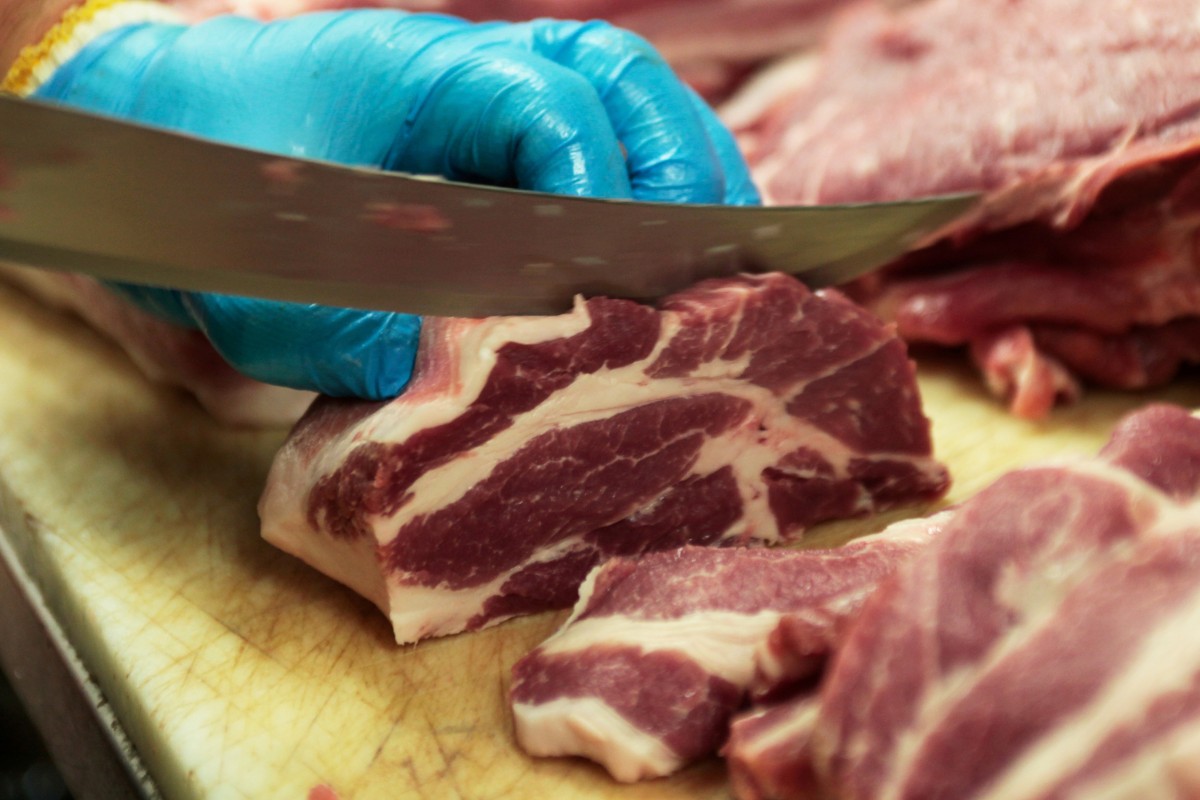
Sellers of Canadian soybeans and peas say they are experiencing unusual obstacles and Ottawa also warned last week that China was holding up pork shipments over paperwork issues.
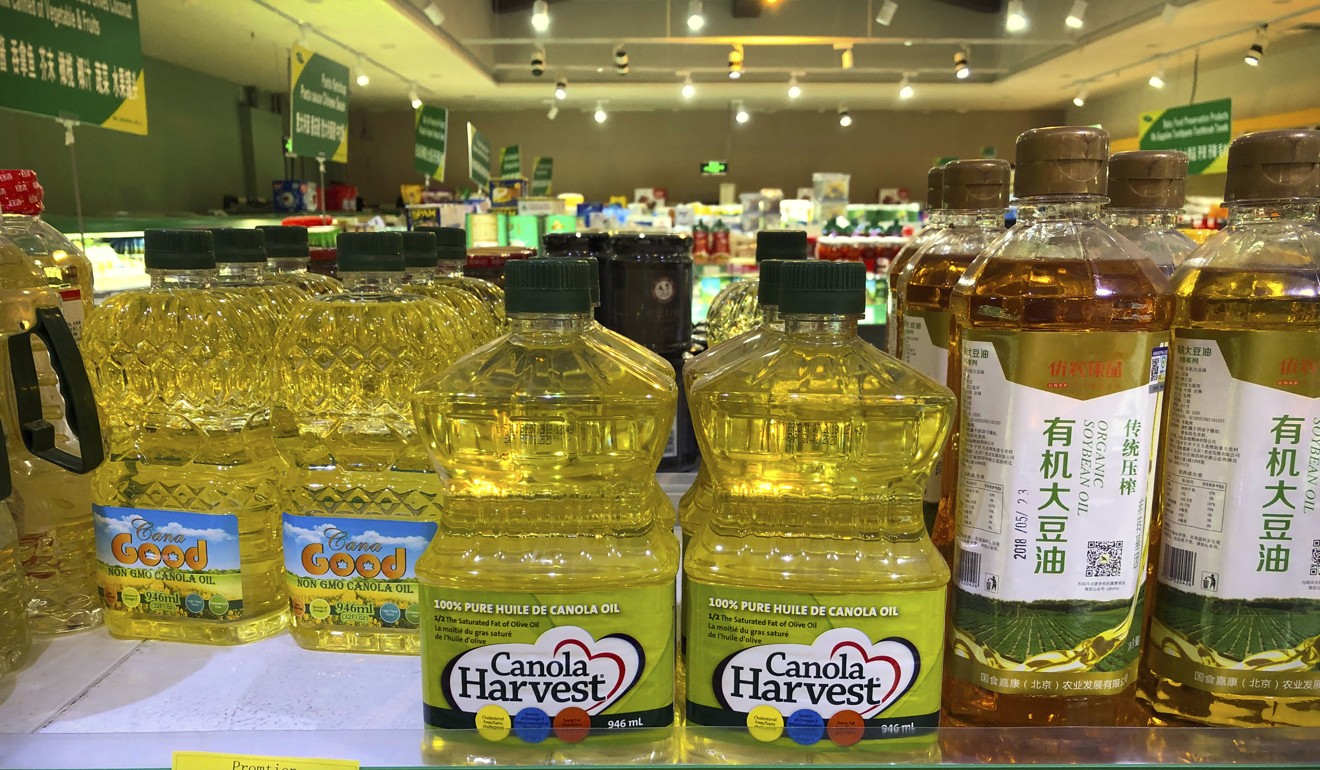
China has already blocked Canadian canola from Richardson International and Viterra, two of Canada’s biggest farm exporters, saying that shipments had pests. Other China-bound canola cargoes have been cancelled, forcing exporters to re-sell elsewhere at discount.
Canadian politicians have said the concerns are baseless, and noted that China detained two Canadians after Canada arrested an executive of Chinese telecom company Huawei Technologies Co Ltd in December at the United States’ request. China has used non-tariff barriers before during diplomatic tensions, most recently against Australian coal.
China has already blocked canola from two of Canada’s biggest farm exporters, while other China-bound canola cargoes have been cancelled. Photo: AP
Increasing tensions with China, a top buyer for most Canadian farm commodities, have forced farmers to plant other crops, such as wheat, that they hope will not face barriers.
China bought US$2.01 billion worth of Canada’s canola and $381 million worth of its pork last year.
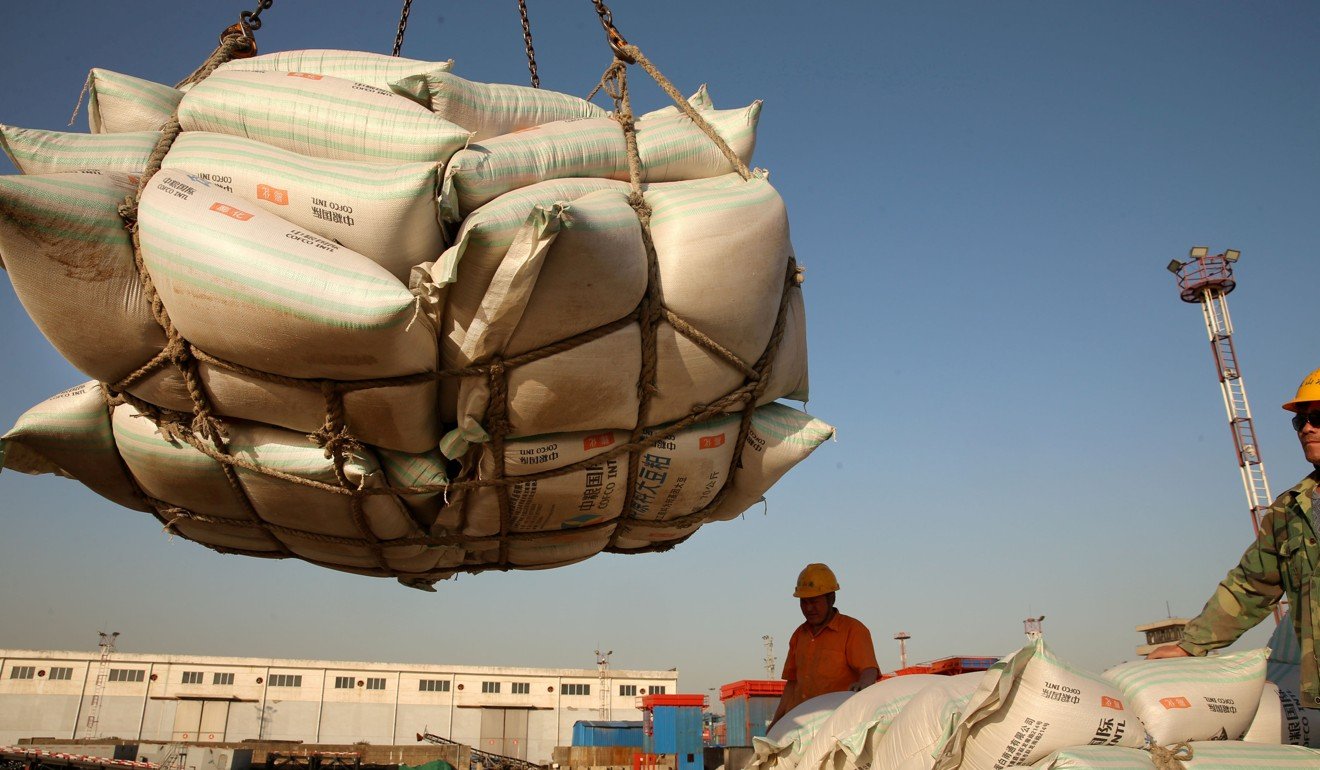
The spread of African swine fever through China’s pig herd has reduced China’s need for canola and soybeans to process into feed ingredients but, since January, port soybean inspections that routinely take a few days now require three weeks, causing Chinese buyers to avoid Canadian products, according to Dwight Gerling, president of Canadian exporter DG Global.
“They’re basically sending out the signal, ‘You buy from Canada, we’re going to make your life difficult,’” Gerling said.
Earlier this year, a Chinese buyer told Gerling that a government inspector had found ants in 34 containers (roughly 680 tonnes) of the Canadian soybeans he shipped there.
Such a finding would be rare, since the soybeans were stored in concrete silos in Canada and shipped in sealed containers in late autumn, said Gerling, who concluded the buyer was trying to avoid the new hassles of buying from Canada.
“It’s just them playing games. (Beijing) is just going to keep putting the screws to us,” he said.
China’s General Administration of Customs did not reply to a request for comment. Government officials have said their canola ban is a regular inspection and quarantine measure to protect China’s farm production and ecological safety.
In a statement, the Canadian agriculture department said it could not confirm that China had imposed stricter measures against farm goods other than canola. Ottawa said this month it hoped to send a delegation to China to discuss the issue.
Gerling’s company has halted soybean sales to China and found other buyers in Southeast Asia.
An official at a state-owned crusher in southern China confirmed that port inspections had tightened on Canadian soybean cargoes.
“We don’t have Canadian cargoes coming in as we can’t blatantly commit such wrongdoing when the atmosphere is so intense,” the official said on condition of anonymity.
Soybeans from Canada are facing delays when they reach Chinese ports, according to traders. Photo: Reuters
Another official in northern China said his crushing plant scrapped plans to buy Canadian soybeans when the trade dispute flared.
Canada shipped $1.2 billion worth of soybeans to China in 2018, up sharply year over year, according to the Soy Canada industry group, as China and the United States fought a trade war. But sales have now slowed to a trickle.
Canola has taken the brunt of China’s measures.
Chinese buyers have cancelled at least 10 cargoes of Canadian canola in the past few weeks, according to a Singapore-based trader at a company that runs crushing facilities in China. Some cargoes, around 60,000 tonnes each, have been resold to buyers in Pakistan and Bangladesh at deep discounts, the trader said.
“It is devastating for exporters,” the trader said.
Canada gets tough with China on canola ban, demands contamination proof
Intercontinental Exchange (ICE) canola futures fell to a more than four-year low on Tuesday as supplies piled up. Growers intend to sow the smallest crop in three years.
On Monday last week, Ottawa said some Canadian pork exporters used an outdated form to certify shipments to China, causing delays. Such issues arise regularly in commodity trading, but rarely with damaging consequences, said Canadian Pork Council spokesman Gary Stordy.
Canadian pea exporters fear they could be next. China imported C$533 million worth of Canadian peas in 2018, according to industry group Pulse Canada, but the pace has slowed.
Chinese authorities have begun scrutinising import documents and product samples more closely, according to Taimy Cruz, director of logistics at Toronto-based BroadGrain Commodities.
China Inspection and Quarantine Authorities now tests samples of each pea shipment before authorising it for import. They also restrict in some cases the number of soybean shipments allowed under one licence, slowing the flow, she said.
Similarly, import authorities now require soybean shipments that change vessels in Singapore and Shanghai – a routine practice called trans-shipping – to reach their destination on a single ship, she said.
While BroadGrain has not seen its cargoes turned back, it has reduced sales to China to avoid risk, concentrating on the Indian subcontinent and South America, she said.
“We have to be extra careful,” Cruz said. “They are very strict now.”
MUMBAI/NEW DELHI (Reuters) – Police broke up clashes between rival groups of voters in West Bengal on Monday as some of India’s richest families and Bollywood stars also cast their ballots in Mumbai during the fourth phase of a massive, staggered general election.
In West Bengal, a populous eastern state crucial for Prime Minister Narendra Modi’s re-election bid, supporters of his Hindu nationalist Bharatiya Janata Party (BJP) clashed with others from the regional Trinamool Congress, police said.
TV footage showed armed security forces chasing away people wielding sticks, although it was initially difficult to determine the scale of the clashes.
There were no immediate reports of any poll-related injuries in West Bengal, where at least one person was killed and three injured during the third phase of voting last week.
The BJP is in a direct, and sometimes bloody, fight in West Bengal with Trinamool, whose chief Mamata Banerjee is one of Modi’s biggest critics and a potential prime ministerial candidate.
More than 127 million people are eligible to vote in this round of the seven-phase election held across 71 seats in nine states. Modi’s coalition won more than 75 percent of the seats in the previous election in 2014.
Many of the constituencies are in Uttar Pradesh in the north and western India’s Maharashtra, where the financial capital Mumbai is located. Uttar Pradesh elects the most lawmakers, with Maharashtra next. Both states are ruled by the BJP and its allies.
However, political analysts say the BJP may struggle to repeat its strong showing this time due mainly to a jobs shortage and weak farm prices, issues upon which the main opposition Congress party has seized.
‘SOME PROGRESS’
First-time voter Ankita Bhavke, a college student in Mumbai, said she voted for economic development.
“I want the country to be at par with the best in the world,” she said. “There’s been some progress in the last five years.”
India’s financial markets were closed on Monday for the election.
Mumbai is home to the massive Hindi film industry, as well as Asia’s wealthiest man, Mukesh Ambani, and India’s richest banker, Uday Kotak.
Ambani, who heads Reliance Industries, and Kotak, managing director of Kotak Mahindra Bank, created a stir this month by publicly endorsing an opposition Congress party candidate from their upscale South Mumbai constituency.
Mumbai, which has six seats, is India’s wealthiest city but ageing and insufficient infrastructure is a major concern. Six people were killed last month when part of a pedestrian bridge collapsed, recalling memories of a 2017 rush-hour stampede that killed at least 22 people on a narrow pedestrian bridge.
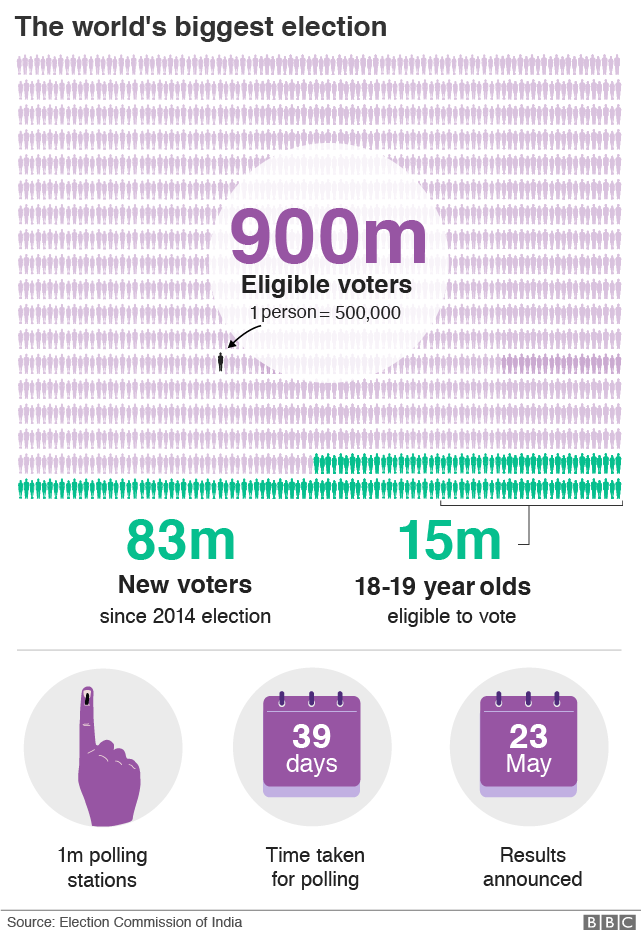
The election, the world’s biggest democratic exercise with about 900 million voters, started on April 11 with Modi in the lead amid heightened tension with long-time enemy Pakistan.
The last phase of voting is on May 19, with results released four days later.
There are a total of 545 seats in the Lok Sabha.
Modi sent warplanes into Pakistan in late February in response to a suicide attack by an Islamist militant group based there that killed 40 Indian police in the disputed Kashmir region.
Modi has sought votes on his tough response towards militancy and in recent days has evoked the deadly Easter Sunday bombings in nearby Sri Lanka.
Maidul Islam, a professor of political science at Kolkata’s Centre for Studies in Social Sciences, said long queues outside polling stations would indicate whether Modi’s national security pitch was working.
“Whenever there is a BJP kind of a wave, you see a higher voter turnout,” he said.
It is an election like no other. Those eligible to vote in India’s upcoming polls represent more than 10% of the world’s population and they will take part in the largest democratic exercise in history.
Voters will choose representatives for the Indian parliament, and in turn decide if Hindu nationalist Prime Minister Narendra Modi will run the country for another five years.
What is at stake?
Whoever wins these elections and forms a government will control the destiny of the world’s largest democracy.
While they are in charge, India’s economy is likely to overtake the UK’s and become the world’s fifth-largest.
Its population meanwhile – at more than 1.34bn people – is predicted to soon surpass China’s 1.39bn.
Hundreds of millions of Indians have escaped poverty since the turn of the millennium but huge challenges remain.
Unemployment is a major concern and is especially high among young people.
Millions of farmers are angry about low crop prices.
How the nuclear-armed country engages with the outside world – and manages a tricky relationship with its neighbour Pakistan – is also of immense importance to international security.
Who is being elected?
Indians are voting for members of parliament and the job of prime minister tends to go to the leader of the party or coalition with most seats. The current PM is Narendra Modi.
His main rival is opposition leader Rahul Gandhi.
Parliament has two houses: the Lok Sabha and the Rajya Sabha.
The lower house – Lok Sabha – is the one to watch.
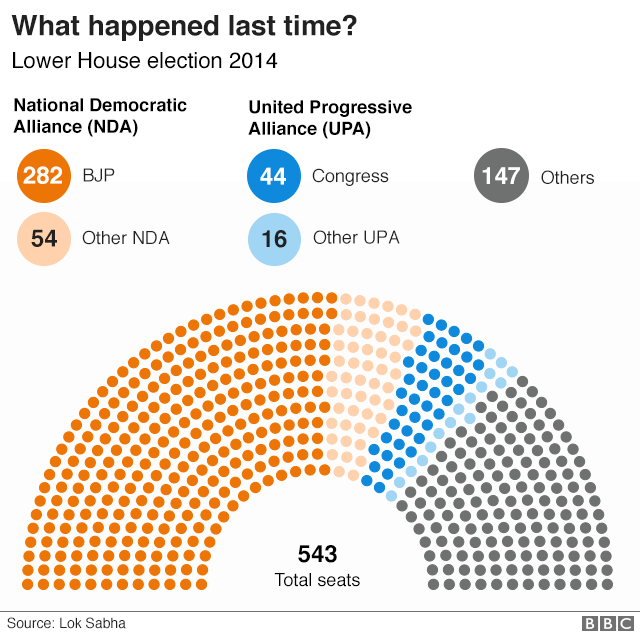
It has 543 elected seats and any party or coalition needs a minimum of 272 MPs to form a government.
At the last election in 2014, Mr Modi’s BJP won 282 seats.
Mr Gandhi’s Congress Party only took 44 seats in 2014 – down from 206 in 2009.
Why does voting take so long?
Because of the enormous number of election officials and security personnel involved, voting will take place in seven stages between 11 April and 19 May.
Different states will vote at different times.
Votes will be counted on 23 May and results are expected on the same day.
Who will win?
This election is being seen as a referendum on Mr Modi, a polarising figure adored by many but also accused of stoking divisions between India’s Hindu majority and the country’s 200 million Muslims.
Until a few months ago, Mr Modi and his BJP party were seen as the overwhelming favourites. But the loss of key states in December’s regional elections injected a sense of serious competition into the national vote.
Analysts are divided on whether Mr Modi will be able to win a simple majority again.
A recent escalation of tensions with Pakistan has given the BJP a new and popular issue to campaign on.
It will be hoping that a focus on patriotism will help the party to get past the serious challenge mounted by powerful regional parties and Congress.




 CHINDIA ALERT: You'll be living in their world, very soon