Chindia Alert: You’ll be Living in their World Very Soon
aims to alert you to the threats and opportunities that China and India present. China and India require serious attention; case of ‘hidden dragon and crouching tiger’.
Without this attention, governments, businesses and, indeed, individuals may find themselves at a great disadvantage sooner rather than later.
The POSTs (front webpages) are mainly 'cuttings' from reliable sources, updated continuously.
The PAGEs (see Tabs, above) attempt to make the information more meaningful by putting some structure to the information we have researched and assembled since 2006.
CHANGSHA, April 24 (Xinhua) — China will promote international space cooperation to contribute to sustainable development goals set by the United Nations, a senior official with the China National Space Administration (CNSA) said here Wednesday.
“China is to build a new type of cooperative and win-win relationship with other space agencies and international organizations around the world, to jointly enhance the role of space industries in facilitating sustainable development,” said CNSA deputy director Wu Yanhua at the United Nations/China Forum on Space Solutions: Realizing the Sustainable Development Goals.
Over the years, the use of space has been recognized as one of the key components to successfully achieve the 17 Sustainable Development Goals (SDGs) of the 2030 Agenda for Sustainable Development adopted by the UN, according to Simonetta Di Pippo, director of United Nations Office for Outer Space Affairs.
In order to quantify the impact, a dedicated study was published in early 2018 and shows that around 40 percent of the 169 targets underpinning the 17 SDGs benefit from the use of geo-location and earth observation satellites, said Simonetta at the forum.
Committed to better service for countries along the Belt and Road Initiative, especially developing countries, China is constructing a space information corridor and sharing satellite resources, according to Wu.
“China’s earth observation satellites have actively supported the construction of the Belt and Road spatial information corridor, vigorously developed space international cooperation,” said Wang Cheng, a researcher from the CNSA.
FY-2H, the meteorological satellite located over the Indian Ocean, can fill the observation gap and provide weather monitoring service to countries along the Belt and Road, said Tang Shihao from China Meteorological Administration.
The unique strength of satellites in supporting telemedicine, epidemic prevention and control, and distance education, social security services can be improved, Wu said.
Independently constructed and operated by China, the BeiDou Navigation Satellite System has been widely used in many countries and regions. “The system started to provide RNSS (Radio Navigation Satellite System) services worldwide last December,” said Gao Weiguang from China Satellite Navigation Project Center.
Wu Yanhua said that China was developing a space economy and supporting commercial space development by pushing forward the commercialization of space technologies.
As the provider of Long March launch services, the China Great Wall Industry corporation (CGWIC) has performed 48 dedicated launch services and 17 piggyback launch services for international clients with high successful rate and competitive pricing, according to Zhou Yuanying from CGWIC.
Wu said that China would undertake monitoring and research of global climate change by taking advantage of satellites, to achieve the goals outlined in the Paris Agreement.
By pushing forward international space cooperation, China is also committed to joint efforts to tackle contemporary issues with global impact including poverty, hunger, natural disasters and environmental pollution, Wu added.
Many countries, in particular developing countries, need to make the best possible use of space assets to support the SDGs. At the same time, a lot of space agencies and companies are struggling to find partners/users to which they can offer their particular space solutions, Simonetta said.
“This Forum will build on previous UN workshops and symposiums to provide a unique platform for users and space solution providers to forge partnerships and thus contribute concretely to the achievement of the SDGs.” Simonetta said.
Also on Wednesday, the CNSA inked agreements on space cooperation separately with the UN Office for Outer Space Affairs, Turkey, Ethiopia and Pakistan.
Since 2016, China has set April 24 as the country’s Space Day. Activities on Space Day have become a window for the Chinese public and the world to gain a better understanding of China’s aerospace progress.
The theme this year is to “pursue space dreams for win-win cooperation.”
At the first day of the forum in Beijing, Chinese Finance Minister Liu Kun said China aims to make the Belt and Road initiative sustainable and to prevent debt risks.
Last year, Foreign Minister Wang Yi said in a speech Belt and Road was not a “geostrategic concept” but was part of efforts to build “a community with a shared future for mankind together with countries around the globe.”
Leaders from 37 countries and dozens of officials are due to attend the three-day summit, including Russian President Vladimir Putin and Italian Prime Minister Giuseppe Conte.
Western governments, and particularly the US, are increasingly wary of China’s growing influence.
The US, which has fought a trade war with China over the past year, has been particularly critical of the project.
Vice President Mike Pence said in a speech last year China was using “debt diplomacy” to expand its influence around the world.
Debt trap?
Other countries that are set to benefit from the project also seem to be growing more cautious.
Sri Lanka, Malaysia and Pakistan have all expressed concerns about the programme. Recipient countries worry about debt accumulation and increased Chinese influence.
Tom Rafferty, China economist at The Economist Intelligence Unit, said China is using this week’s summit to “reposition and, it hopes, revive the initiative after it lost its way in 2018 amid project delays and a slowdown in associated lending.”
Mr Rafferty said the Chinese government “wants to convince the international community that the Belt and Road Initiative is inclusive and policy concessions in areas such as debt sustainability” are likely.
QINGDAO, China (Reuters) – Warships from India, Australia and several other nations arrived in the eastern Chinese port city of Qingdao on Sunday to attend a naval parade, part of a goodwill visit as China extends the hand of friendship despite regional tensions and suspicions.
China on Tuesday will mark 70 years since the founding of the People’s Liberation Army Navy, where it will show off new warships including nuclear submarines and destroyers at a major review in the waters off Qingdao.
China says warships from about a dozen nations are also taking part – one diplomatic source with direct knowledge said it was 13 countries in total – and the PLA is putting its best foot forward to welcome them.
India, which has been at odds with China over their disputed land border and Beijing’s support for India’s regional rival Pakistan, has sent stealth guided-missile destroyer the “INS Kolkata” to take part, along with a supply ship.
“We bring to you one of the best ships that we have made. It is the pride of the nation and the navy, and we are very happy to be here,” Captain Aditya Hara told reporters on the dockside after disembarking from the ship in Qingdao.
A source familiar with the situation told Reuters the “Kolkata” had sailed through the Taiwan Strait to get to Qingdao, a sensitive waterway that separates China from self-ruled Taiwan, claimed by Beijing as sacred Chinese territory.
“We headed on a direct route and we are very happy that we were facilitated by the PLA Navy and they ensured that we had a safe passage to Qingdao,” Hara said, when asked if they had sailed via the Taiwan Strait.
Australia, a close U.S. ally, has sent the “HMAS Melbourne” guided-missile frigate to Qingdao, though officials declined to make the captain available for interview.
China and Australia have sparred over Australian suspicions of Chinese interference in the country’s politics and Australia’s banning of China’s Huawei Technologies Co Ltd from supplying equipment for its planned 5G broadband network.
Japan has also sent a destroyer to Qingdao, in the first visit of a Japanese navy ship to China since 2011, according to Japanese media.
Ties between China and Japan, the world’s second and third-largest economies, have been plagued by a long-running territorial dispute over a cluster of East China Sea islets and suspicion in China about Japanese Prime Minister Shinzo Abe’s efforts to amend Japan’s pacifist constitution.
But they have sought to improve relations more recently, with Abe visiting Beijing in October, when both countries pledged to forge closer ties and signed a broad range of agreements including a $30 billion currency swap pact.
The other countries taking part include China’s close friend Russia, and three countries which have sparred with China over competing claims in the disputed South China Sea: Vietnam, Malaysia and the Philippines.
Pakistan, a very close Chinese ally, is not on the list of countries officials have provided which are sending ships to the parade.
Chinese State Councilor and Foreign Minister Wang Yi (C) speaks during a press briefing for the second Belt and Road Forum for International Cooperation (BRF) in Beijing, capital of China, April 19, 2019. The second Belt and Road Forum for International Cooperation will be held from April 25 to 27 in Beijing, Wang Yi announced Friday. (Xinhua/Zhai Jianlan)
BEIJING, April 19 (Xinhua) — Chinese President Xi Jinping will deliver a keynote speech at the second Belt and Road Forum for International Cooperation (BRF) to be held from April 25 to 27 in Beijing, State Councilor and Foreign Minister Wang Yi announced Friday.
Leaders including heads of state and government from 37 countries will attend the forum’s roundtable summit, Wang told a press briefing.
Wang said 12 thematic forums and a CEO conference would be held on April 25, the opening ceremony and a high-level meeting on April 26, and the leaders’ roundtable on April 27.
Xi will attend the opening ceremony and deliver a keynote speech. He will also chair the leaders’ roundtable and brief media from home and abroad about the outcomes after the roundtable, Wang said, adding that Xi and his wife Peng Liyuan will also hold a welcoming banquet for the leaders and representatives.
According to Wang, the 37 countries are Austria, Azerbaijan, Belarus, Brunei, Cambodia, Chile, Cyprus, Czech Republic, Djibouti, Egypt, Ethiopia, Greece, Hungary, Indonesia, Italy, Kazakhstan, Kenya, Kyrgyzstan, Laos, Malaysia, Mongolia, Mozambique, Myanmar, Nepal, Pakistan, Papua New Guinea, the Philippines, Portugal, Russia, Serbia, Singapore, Switzerland, Tajikistan, Thailand, the United Arab Emirates, Uzbekistan and Vietnam.
The secretary-general of the United Nations and the managing director of the International Monetary Fund will attend the forum, Wang said, adding that senior representatives of France, Germany, Britain, Spain, Japan, the Republic of Korea and the European Union will also participate.
Noting that the BRF is the top-level platform for international cooperation under the framework of the Belt and Road Initiative, Wang said the conference next week would be of landmark significance.
The theme of the second BRF is “Belt and Road Cooperation, Shaping a Brighter Shared Future.” Wang said the main purpose is to promote the high-quality development of Belt and Road cooperation, which is the common aspiration of countries participating in the initiative.
Speaking highly of the fruitful results yielded since the initiative was launched in 2013, Wang said the second BRF was greatly welcomed worldwide with some 5,000 participants from more than 150 countries and 90 international organizations having confirmed their attendance, covering areas from five continents and different walks of life such as government, civil society, business and academia.
According to Wang, this year’s forum will have 12 thematic forums, twice of that during the first forum in 2017, and the CEO conference will be held for the first time. A joint communique will be released after the leaders’ roundtable and other consensus reached during the forum will be issued in a report.
The Belt and Road Initiative, proposed by Xi in 2013, aims at enhancing all-around connectivity through infrastructure construction, exploring new driving force for the world economic growth, and building a new platform for world economic cooperation, according to Wang.
Stressing that Xi and leaders from other countries blueprinted the initiative in 2017, Wang said the progress in the past two years shows that the initiative conforms to the trend of the times featuring peace, development, cooperation and win-win and accords with the common aspiration of openness and joint development of all countries.
“As the host country, we will maintain close communication and coordination with all parties to prepare for the forum with openness, inclusiveness and transparency, upholding the principle of consultation and cooperation for shared benefits,” Wang said.
He said the forum would voice the firm support for multilateralism and an open world economy, enrich the principles of cooperation of the Belt and Road Initiative, build a network of partnership, and establish more mechanisms for high-quality development.
Bilateral, trilateral and multilateral cooperation has been reinforcing each other under the initiative, laying a solid foundation for a closer and more wide-ranging partnership, he said.
Wang said China will showcase the outcomes and introduce the measures of its reform and opening-up to the world, adding that this will allow China to share the dividends of its economic growth, promote the Belt and Road Initiative, and bring more opportunities to the development of all countries as well as the building of the Belt and Road.
“I believe that the forum will inject stronger impetus into the world economy, open even broader horizon for the development of the countries, and contribute to the building of a community with a shared future for humanity, ” said Wang.
Women make up nearly half of India’s 900 million voters, but they are still poorly represented in the country’s law-making bodies. One political party is trying to correct the balance by nominating 41% female candidates. The BBC’s Geeta Pandey travelled to the state of West Bengal to see how they are faring.
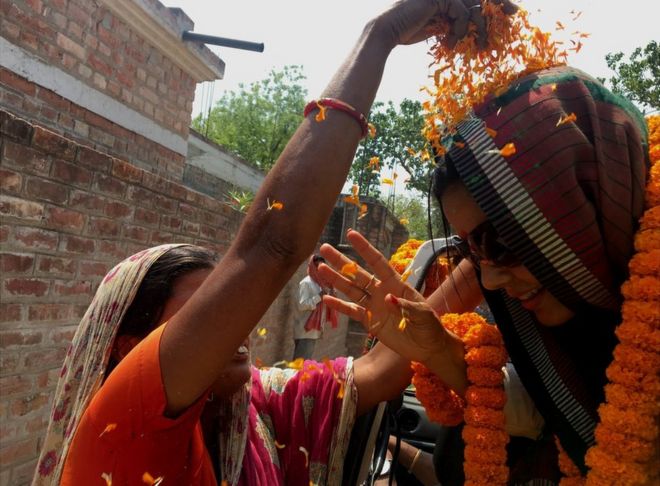
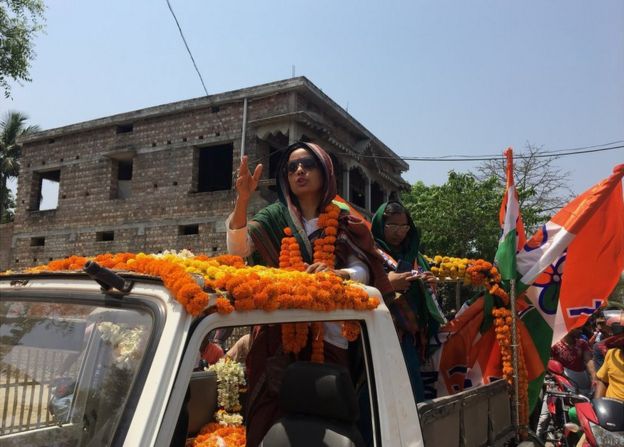
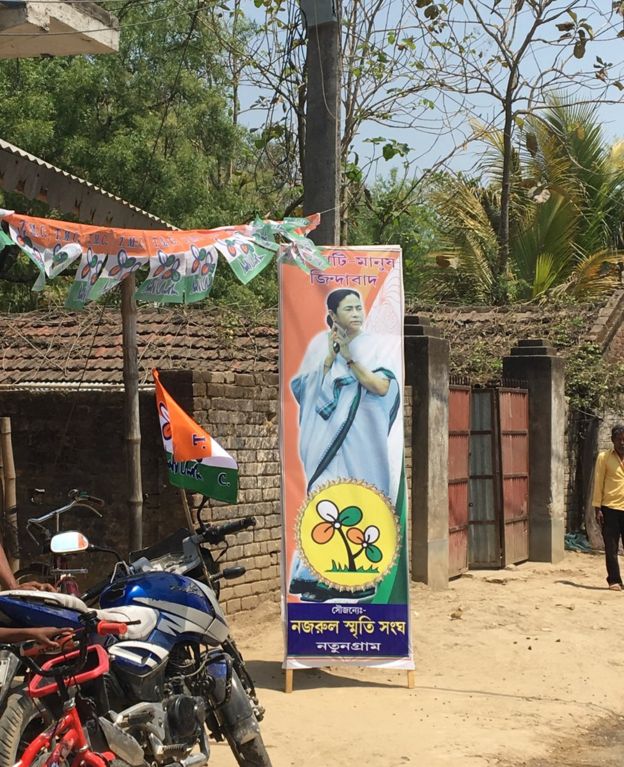
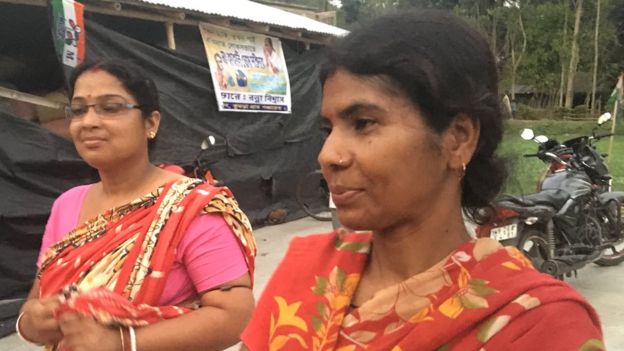
On a bright sunny morning, as an open jeep decorated with bright yellow and orange flowers hurtles along the dirt track from one village to the next, women in colourful saris and men rush to greet Mahua Moitra.
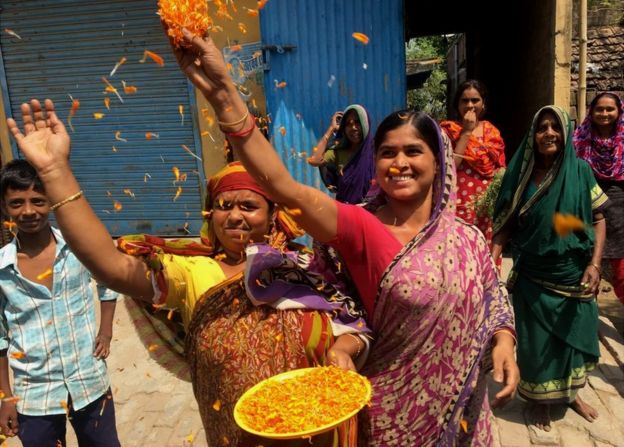
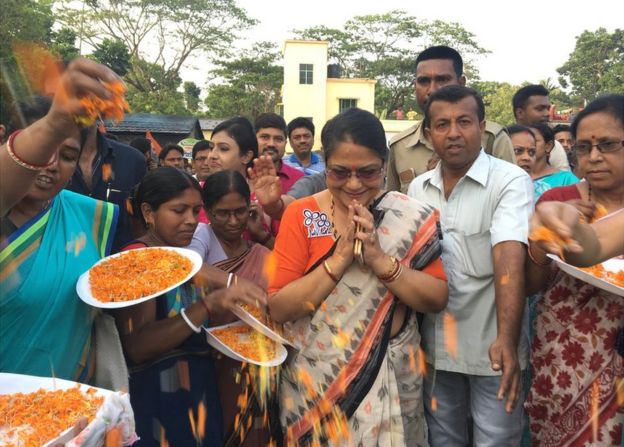
They shower bright orange marigold petals on her, place garlands around her neck and many reach out to shake and kiss her hands. She waves at them, greeting them with her palms joined: “Give me your blessings.”
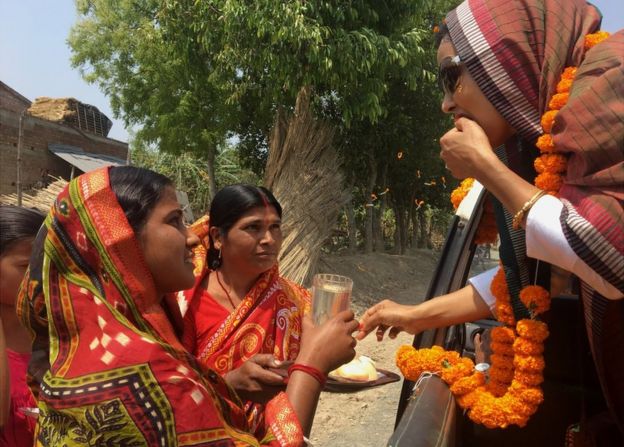
Young men and women whip out their smartphones to take photos and selfies. On the way, she’s offered coconut water and sweets.
Ms Moitra, who is contesting the general election as a candidate of the state’s governing Trinamool Congress Party (TMC), is campaigning in her constituency Krishnanagar.
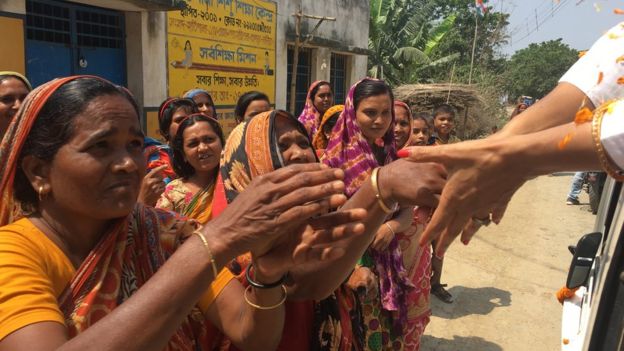
Image caption On the campaign trail, women offer coconut water and sweetsImage caption Supporters throw marigold petals at Mahua Moitra
In one village, party workers tell her about an old man who’s too ill to come to meet her, so she walks to his home to greet him.
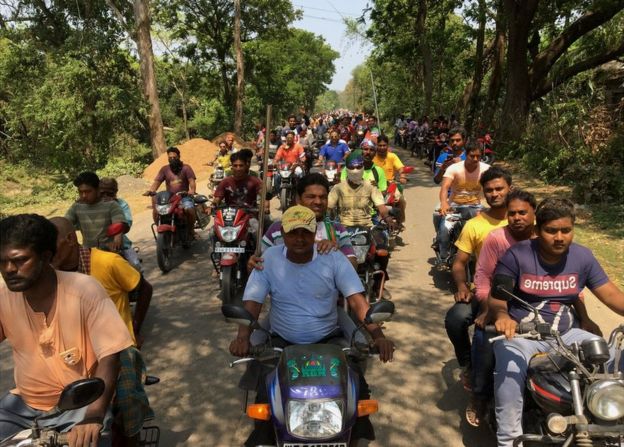
Her jeep is followed by dozens of bikes and their riders, all young men, chanting slogans like “Long live Trinamool Congress, Long live Mamata Banerjee.”
The loud, colourful procession is led by a small truck, fitted with loudspeakers, from which announcements asking people to vote for Ms Moitra are played on a loop.
With the election season well under way in India and political leaders criss-crossing the length and breadth of the country, addressing rallies, I’m travelling across the country to see if the high-decibel campaigns are addressing the real issues that actually affect millions of people. One of them is getting more women into parliament.
A bill to reserve 33% of seats for women in parliament and regional assemblies has been pending since 1996, so the decision by the TMC – led by West Bengal Chief Minister Mamata Banerjee – to give 41% of her party nominations to women has created a huge buzz.
Image caption Ms Moitra quit her banker’s job in London to return to India and enter politics
Ms Banerjee, who set up the TMC in 1998 after falling out with the Congress party, is a feisty politician who was named one of Time magazine’s 100 most influential people in the world in 2012.
Her female candidates, says my BBC Bengali colleague Subhajyoti Ghosh, are an “interesting mix” of career politicians and first-timers. They include actors, doctors, a tribal activist and the 25-year-old widow of a recently-murdered politician.
Ms Moitra, the TMC’s national spokesperson and a member of the state assembly since 2016, is among 17 women who have made it to the party’s list of 42 general election nominees.
A former investment banker with JP Morgan, she gave up a well-paying job in London in 2009 to return to the heat and dust of Indian politics.
Her decision left her family aghast. Her parents, she told me, thought she was “insane”. Some party workers too had their doubts – “she’s a memsahib”, they said at the time, “she won’t survive”.
Image caption Mamata Banerjee was named one of Time magazine’s 100 most influential people in the world in 2012But she has survived – and thrived. In 2016, she won the Karimpur assembly seat that no non-Left party had won since 1972 and has now set her eyes on the national parliament.
She’s agreed to let me follow her on the campaign trail, so for two days I’ve been a “fly on the wall” – standing behind her in her jeep, travelling in her car, watching her strategise with party workers, aides and confidants.
The previous evening, I had watched her be the chief guest at a college cricket match and address a gathering at the local market in Plassey.
A four-hour drive from Kolkata, Plassey is the site of the famous 1757 battle between the British East India Company and the local ruler supported by the French.
Image caption Her jeep is followed by dozens of supporters on bikesImage caption Many women reach out to shake hands with Ms Moitra
“What’s the point of saying you killed all those terrorists in Pakistan? It’s not important who you killed in Pakistan or how many. What’s important is you failed to protect our soldiers.”
She talks about how the government has failed to create jobs and accuses the BJP of trying to divide Hindus and Muslims.
“You have taken away our livelihoods and you’re trying to teach us about [the Hindu god] Ram and [Muslim saint] Rahim? I don’t have to write my religion on my forehead,” she declares to loud claps from her supporters.
Elections in the past were to change the government, she says, but this election is to save the constitution of India. “It is no ordinary vote.”
Her main rival is the BJP’s Kalyan Chaubey, a former footballer who played in goal for India. So drawing a football analogy, she declares: “I’m an A-league centre-forward player, stop my goal if you can. I am here to win.”
Kakoli Ghosh Dastidar, a founder member of the TMC and two-term MP, says to nominate so many women is part of a “continuous process” followed by Mamata Banerjee because “you can’t develop a society without uplifting the status of its women”.
In the last general election in 2014, she points out that the party nominated 33% women and 12 of their 34 MPs in the outgoing lower house were women.
Ms Banerjee, she says, believes that gender sensitive laws will come only if more women are in power.
At a campaign rally that Dr Ghosh Dastidar addresses in Kumhra Kashipur village in her constituency Barasat, women are seated in the front rows.
Their opinion though is divided over whether having more women in parliament will actually benefit other women.
Image caption Dr Kakoli Ghosh Dastidar is among the founder members of the TMC and a two-term MP
Supriya Biswas says it’s easier if their MP is a woman because then it’s easier to approach her. “For, who can understand a woman better than a woman?”
Archana Mallick and Meena Mouli, who live just across from the rally ground, point to the broken roads near their homes and complain about poor medical facilities in their village. They say that the candidate’s gender is “inconsequential” and what’s important is “who works for our benefit”.
Saswati Ghosh, professor of economics at Kolkata’s City College, says that politics in India is “still very patriarchal” and it’s “absolutely necessary” to elect more women MPs.
“It is important to have more women in lawmaking bodies because I think after a certain number, you’ll reach the threshold level and that will lead to change. I don’t know if 33% is the magic number that will change the quality of discourse, maybe 25% can do the trick?”
Image caption Archana Mallick and Meena Mouli say a candidate’s gender is “inconsequential”
Critics, however, question whether celebrities are the right candidates to bring about that change.
Prof Ghosh says actors and celebrities make for “winnable candidates” and that’s why all parties choose them even though sometimes they may not be the right candidates to reach that threshold.
But, she says that Ms Banerjee is a strong leader who’s regarded by many women as “a role model who inspires more women to come into politics”.
And that’s something that many Indians think the country sorely needs.
In their manifestos, the main opposition Congress party has promised to pass the women’s reservation bill, if elected to power. So has the ruling Bharatiya Janata Party, although it had made similar promises in its last manifesto and did nothing about it.
By allotting 41% seats to women, Ms Banerjee has shown that one doesn’t need to set artificial quotas to elect more women.
India has suspended trade across the Line of Control in Jammu and Kashmir with effect from Friday. The Ministry of Home Affairs issued the order to this effect on Thursday.
INDIAUpdated: Apr 18, 2019 20:20 IST
HT Correspondent
Hindustan Times, New Delhi
The Home Ministry said reopening of Line of Control trade will be revisited after placing a stricter regulatory and enforcement mechanism in place.(HT file photo)
India suspended trade across the Line of Control in Jammu and Kashmir over concern that the route was being misused by Pakistan-based elements to smuggle weapons, narcotics and fake currency, the Ministry of Home Affairs said on Thursday. New Delhi said the Centre will revisit the decision to suspend LoC trade at Jammu and Kashmir’s Salamabad and Chakkan-da-Bagh after putting in place a stricter regulatory and enforcement mechanism.
Cross-LoC trade is meant to facilitate exchange of goods of common use between local populations across the LoC in Jammu & Kashmir. The trade is allowed through two Trade Facilitation Centres located at Salamabad, Uri, District Baramulla and Chakkan-da-Bagh, District Poonch. The trade takes place four days a week. The Trade is based on Barter system and zero duty basis.
The home ministry decision comes after the federal anti-terror probe agency National Investigation Agency told the government that a “significant number of trading concerns engaged in LoC trade” were linked with banned terror organisations involved in fuelling terrorism”.
“Investigations have further revealed that some individuals, who have crossed over to Pakistan, and joined militant organizations have opened trading firms in Pakistan. These trading firms are under the control of militant organizations and are engaged in LoC trade,” a home ministry statement said.
The home ministry said there were also inputs to indicate the LoC route is likely to be misused to a “much larger extent” to evade higher duties after India withdrew the most favoured nation to Pakistan.
Relations between India and Pakistan have been under strain since Pulwama terror attack in February when 40 jawans of the Central Reserve Police Force were killed on Jammu-Srinagar highway.
The cross-LoC trade between Jammu and Kashmir and Pakistan-occupied Kashmir had resumed on Tuesday after nearly two weeks. The trade and travel across the LoC had been suspended on April 1 in the wake of heavy shelling from the Pakistani side. Three people including a Border Security Force officer, a woman and a five-year-old girl died in Poonch.
The relation between India and Pakistan has been under strain since Pulwama terror attack in February when 40 jawans of the Central Reserve Police Force were killed on Jammu-Srinagar highway.
Trade and travel across the LoC had been suspended on April 1 in the wake of heavy shelling from the Pakistani side. Three people including a Border Security Force officer, a woman and a five-year-old girl died in Poonch.
The cross-LoC trade between Jammu and Kashmir and Pakistan-occupied Kashmir had just resumed on Tuesday after nearly two weeks.
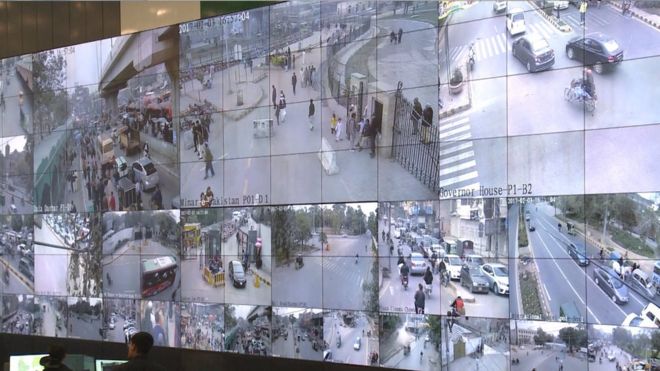
Image captionThe surveillance system was built to monitor Lahore’s streets following a series of terrorist attacks
Huawei removed wi-fi transmitting cards from a Pakistan-based surveillance system’s CCTV cabinets after they were discovered by the project’s staff.
Punjab Safe City Authority (PSCA) told BBC Panorama it had told the firm to remove the modules in 2017 “due to [a] potential of misuse”.
The authority said that the Chinese firm had previously made mention of the cards in its bidding documents.
But a source involved in the project suggested the reference was obscure.
A spokesman for Huawei said there had been a “misunderstanding”. He added that the cards had been installed to provide diagnostic information, but said he was unable to discuss the matter further.
The PSCA confirmed that the explanation it had been given was that wi-fi connectivity could have made it easier for engineers to troubleshoot problems when they stood close to the cabinets, without having to open them up.
Two people involved in Lahore’s project helped bring the matter to the BBC’s attention and have asked to remain anonymous. One said that Huawei had never provided an app to make use of the wi-fi link, and added that the cabinets could already be managed remotely via the surveillance system’s main network.
Image captionIt was suggested that a wi-fi link could have helped engineers troubleshoot problems without having to climb up and open the cabinets
A UK-based cyber-security expert said that it was not uncommon for equipment sellers to install extra gear to let them offer additional services at a later date.
But he added that the affair highlighted the benefit of oversight because if the authority had remained unaware of the cards’ existence, it could not have taken steps to manage any potential risk they posed.
“As soon as you give someone another method of remote connectivity you give them a method to attack it,” commented Alan Woodward.
“If you put a wi-fi card in then you’re potentially giving someone some other form of remote access to it. You might say it’s done for one purpose, but as soon as you do that it’s got the potential to be misused.”
There is no evidence that the cards created a vulnerability, and one of the sources involved confirmed that there had not been an opportunity to test if they could be exploited before the kit was removed.
‘Prompt response’
Lahore’s Safe City scheme was first announced in 2016 following a series of terrorist bombings.
It provides a vast surveillance network of cameras and other sensors, and a brand new communications system for the city’s emergency services
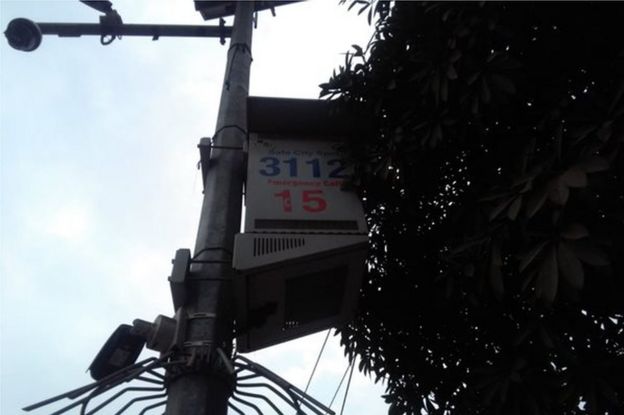
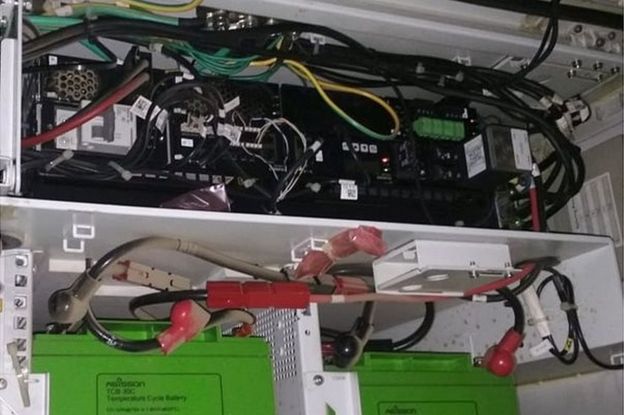
As part of the system, Huawei installed 1,800 CCTV cabinets, within which it placed the wi-fi modules behind other equipment.
Image captionThe cards were placed among other equipment in the cabinets
The PSCA’s chief operating officer told the BBC that Huawei had been “prompt” in its response to a request to remove them and had fully “complied with our directions”.
“It is always [the] choice of the parties in a contract to finalise the technical details and modules as per their requirements and local conditions,” added Akbar Nasir Khan.
“PSCA denies that there are any threats to the security of the project [and the] system was continuously checked by our consultants, including reputed firms from [the] UK.”
But there is no suggestion that this was related to Huawei’s involvement, and in any case the wi-fi modules would have been removed by this point. The PSCA has also denied anyone from its office had been involved.
AMMAN, April 7 (Xinhua) — Li Chengwen, ambassador for China-Arab States Cooperation Forum Affairs of China’s Foreign Ministry, refuted on Sunday the criticism that China’s Belt and Road Initiative (BRI) will create so-called “debt trap” for some participating countries.
“China is trying to find mechanisms to avoid the ‘debt trap,'” Li said during a session on the second day of the World Economic Forum on the Middle East and North Africa 2019 held in the Dead Sea area of Jordan.
The Chinese envoy was responding to the criticism directed at the BRI by some people in the United States and Europe ahead of the second Belt and Road Forum for International Cooperation, due to be hosted by China later this month in Beijing.
The initiative, proposed by China in 2013, aims at building a trade and infrastructure network connecting Asia with Europe and Africa along the ancient trade routes of the Silk Road to seek common development and prosperity.
As of July 2018, more than 100 countries and international organizations had signed Belt and Road cooperation documents with China, extending the initiative’s scope from the Eurasian continent to Africa, Latin America and the Caribbean, and the South Pacific region.
Li pointed out that no participating country has complained of falling into the so-called “trap” of Chinese loans.
“The Belt and Road Initiative aims to increase the economic prosperity of a country. It does not aim at expanding the political and geographical authority of China in the world,” he said.
Many participants at the forum in Jordan agreed with Li’s comments.
“If you keep your interest first, you will not find China an unfair partner,” said Shandana Gulzar Khan, Pakistan’s parliamentary secretary for commerce. “But it depends on how well you do your homework.”
In Pakistan, a major BRI participating country, the China-Pakistan Economic Corridor has created tens of thousands of jobs and revived the economy of an entire region, Khan noted.
Speaking at the session, He Wenping, a research fellow of the Institute of West-Asian and African Studies, Chinese Academy of Social Sciences, echoed Li’s remarks.
“The biggest worry on the ‘debt-trap diplomacy’ should come from China’s side, not from outside. It is tax payers’ money,” the Chinese professor said.
“China is not waving the ‘China First’ flag,” she said.
The upcoming Belt and Road forum to be held in Beijing later this month could be an opportunity to kickstart a “second phase” of the initiative, she added.
KARACHI (Reuters) – Pakistan has “reliable intelligence” that India will attack again this month, Foreign Minister Shah Mahmood Qureshi said on Sunday, as tension over a February standoff between the two nuclear-armed neighbours had appeared to ease.
The attack could take place between April 16 and 20, he said, adding that Pakistan had told the five permanent members of the U.N. Security Council of its concerns.
A suicide car bombing by Pakistan-based militants in Indian-controlled Kashmir killed at least 40 Indian paramilitary police on Feb. 14 and the risk of conflict rose dramatically on Feb. 27, when India launched an air strike on what it said was a militant training base.
The following day Pakistan shot down an Indian fighter jet and captured its pilot who was later released.
“We have reliable intelligence that India is planning a new attack on Pakistan. As per our information this could take place between April 16 and 20,” Qureshi told reporters in his hometown of Multan.
He did not elaborate on what evidence Pakistan had or how he could be so specific with the timing, but he said Prime Minister Imran Khan had agreed to share the information with the country.
India’s foreign office didn’t immediately respond to an email seeking comment.
Khan blamed India’s ruling Bharatiya Janata Party (BJP) for “whipping up war hysteria” over claims that India shot down a Pakistani F-16 during the February standoff.
India said it, too, had shot down a Pakistani aircraft and the air force displayed pieces of a missile that it said had been fired by a Pakistani F-16 before it went down.
The success of Indian air strikes on a camp of the Jaish-e-Mohammed militant group in northwestern Pakistan has also been thrown into doubt after satellite images showed little sign of damage.
Pakistan closed its airspace amid the standoff but most commercial air traffic has since resumed and major airports have opened.
KARACHI, Pakistan/MUMBAI (Reuters) – Pakistani Prime Minister Imran Khan blamed India’s ruling Bharatiya Janata Party (BJP) for “whipping up war hysteria” over claims that India shot down a Pakistani F-16 during a standoff in February, saying the truth is always the best policy.
U.S.-based Foreign Policy magazine, citing U.S. officials, said all of Pakistan’s F-16 combat jets had been accounted for, contradicting an Indian air force assessment that it had shot down one of the jets.
“The truth always prevails and is always the best policy,” Khan said in a Tweet. “BJP’s attempt to win elections through whipping up war hysteria and false claims of downing a Pak F 16 has backfired with US Defence officials also confirming that no F16 was missing from Pakistan’s fleet.”
Nuclear-armed neighbours India and Pakistan engaged in an aerial battle over the disputed region of Kashmir a day after Indian jets crossed over into Pakistan to attack a suspected camp of anti-India militants.
An Indian jet was brought down during the fight and its pilot captured when he ejected on the Pakistani side of the border. He was later released.
India said it too had shot down a Pakistani aircraft and the air force displayed pieces of a missile that it said had been fired by a Pakistani F-16 before it went down.
Foreign Policy said in a report published on Thursday two U.S. defence officials with direct knowledge of the matter said U.S. personnel had done a count of Pakistan’s F-16s and found none missing.
Details of the India-Pakistan air engagement have not been fully provided by either side. If the U.S. report turns out to be true, it would be a further blow to Prime Minister Narendra Modi, who had said that India had taught Pakistan a lesson, ahead of elections next week.
The BJP is campaigning on a platform of tough national security, especially with regard to arch foe Pakistan. New Delhi blames Pakistan for stoking a 30-year revolt in Muslim-majority Kashmir but Islamabad denies any involvement.
“Firstly, their (Pakistan’s) habit of lying is no secret to the world. Secondly, this is absolutely clear that the roots of terrorism lie in Pakistan and terrorism is cultivated in Pakistan,” he told Reuters.
The success of Indian air strikes on a camp of the Jaish-e-Mohammed militant group in northwestern Pakistan has also been thrown into doubt after satellite images showed little sign of damage.
High-resolution satellite images reviewed by Reuters last month showed that a religious school run by Jaish appeared to be still standing days after India said its warplanes had hit the Islamist group’s training camp on the site and killed a large number of militants.
Pakistan closed its airspace amid the standoff but most commercial air traffic has since resumed and major airports have opened.
Pakistan offered to open one air route on Friday, an Indian government official said, without specifying details and declining to be named as the matter was not public.
An Air India official said on condition of anonymity that Pakistan has opened one of its 11 air routes, from the southern side, adding that the carrier began operations via this route on Friday.
“Pakistan has opened one air route over India on April 4th, it is a north-west bound route,” Mujtaba Baig, spokesman for Pakistan’s Civil Aviation Authority, told Reuters on Saturday.
An email sent to the Indian Directorate General of Civil Aviation was not immediately answered. Air India did not immediately respond to an email seeking comment.










 CHINDIA ALERT: You'll be living in their world, very soon