Archive for ‘Pakistani Prime Minister’

09/10/2019

Xi meets Pakistani PM, calls for forging closer community of shared future

CHINA-BEIJING-XI JINPING-PAKISTANI PM-MEETING (CN)

Chinese President Xi Jinping meets with Pakistani Prime Minister Imran Khan at the Diaoyutai State Guesthouse in Beijing, capital of China, Oct. 9, 2019. (Xinhua/Liu Weibing)

BEIJING, Oct. 9 (Xinhua) — Chinese President Xi Jinping on Wednesday met with Pakistani Prime Minister Imran Khan, vowing to work jointly to strengthen strategic coordination and pragmatic cooperation so as to forge a closer China-Pakistan community of shared future in the new era.

Noting the two countries as all-weather strategic cooperative partners, Xi said no matter how the international and regional situation changes, the friendship between China and Pakistan has always been unbreakable and rock-solid, and China-Pakistan cooperation has always maintained strong vitality with continuous expansion.

China has always viewed relations with Pakistan as a diplomatic priority and will continue to firmly support Pakistan on issues concerning its core interests and of major concern to it, Xi said.

This year marks the 70th anniversary of the founding of the People’s Republic of China.

“We have held a series of celebration activities, which is an opportunity for intensive patriotic education. Chinese people, nearly 1.4 billion in number, have forged a cohesive force with unprecedented patriotism, consolidating our confidence and determination to continue down the path of socialism with Chinese characteristics against all odds, run our own affairs, and stand firm in the community of nations,” Xi said.

In the past, Pakistan selflessly provided help to China in difficult times, and now that China has developed, it sincerely hopes to help Pakistan for better development, Xi said.

He called on the two sides to maintain close high-level exchanges, step up strategic communication and coordinate positions on major issues in a timely fashion.

On the China-Pakistan Economic Corridor (CPEC), Xi said the two sides should adopt a high standard, build and effectively run the existing energy projects, transport infrastructure, industrial parks and projects concerning people’s livelihoods, and make the CPEC a model for jointly building the Belt and Road Initiative.

China highly appreciates and firmly supports Pakistan’s efforts in fighting terrorism, Xi said, calling on the two sides to beef up communication and cooperation within the United Nations, the Shanghai Cooperation Organization and other multilateral mechanisms so as to jointly safeguard regional peace and stability.

Imran Khan offered his congratulations for the 70th anniversary of the founding of the People’s Republic of China.

Pakistan is delighted to see China’s remarkable development achievements and is grateful to China for always adhering to principles and upholding justice and for its firm support and selfless help to Pakistan, Khan said.

“Facts have shown that China is Pakistan’s all-weather strategic cooperative partner and the two countries’ friendship enjoys popular support,” he said, hoping to continue strengthening exchanges, coordination and cooperation with China, and advancing the construction of the CPEC so as to make it a paradigm of the Belt and Road Initiative.

He also pledged to continue to firmly advance counter-terrorism efforts so as to safeguard security and stability.

Khan briefed Xi on Pakistan’s views on the Kashmir situation, hoping to avoid deterioration of the situation, saying that Pakistan values and appreciates China’s objective and unbiased position.

Xi told Khan that China is paying close attention to the Kashmir situation and the facts are clear.

“China supports Pakistan to safeguard its own legitimate rights and hopes that the relevant parties can solve their disputes through peaceful dialogue,” Xi said.

Source: Xinhua

24/09/2019

China-Pakistan friendship unbreakable: state councilor

UN-CHINA-WANG YI-PAKISTAN-PM-MEETING

Chinese State Councilor and Foreign Minister Wang Yi (R) meets with Pakistani Prime Minister Imran Khan on the sidelines of the United Nations General Assembly high-level week, at the UN headquarters in New York, on Sept. 23, 2019. (Xinhua/Han Fang)

UNITED NATIONS, Sept. 23 (Xinhua) — Chinese State Councilor and Foreign Minister Wang Yi on Monday said China and Pakistan hold all-weather strategic cooperative partnership and the friendship between the two countries is unbreakable.

Meeting with Pakistani Prime Minister Imran Khan on the sidelines of the UN General Assembly high-level week, Wang said the two countries have always enjoyed mutual trust, mutual understanding and mutual support.

He said China will continue to support Pakistan’s efforts to uphold its territorial sovereignty and national dignity. China-Pakistan cooperation has contributed significantly to Pakistan’s national development and improvement of its people’s livelihood.

Wang added that the two sides should work together to build the China-Pakistan Economic Corridor (CPEC) into a model for high-quality development projects under the Belt and Road Initiative.

Khan, for his part, said Pakistan will firmly push forward the transformation and upgrading of the CPEC and continue to make every effort to ensure the safety of Chinese projects, enterprises and personnel in Pakistan.

He said that Pakistan and China are close friends, and Pakistan thanks the Chinese government and people for standing firmly with the Pakistani people in the most difficult time.

He added that China’s support and assistance are of great significance to Pakistan’s national security and development.

Pakistan will spare no effort in maintaining bilateral friendship and will not allow any external forces to interfere in or sabotage the development of bilateral relations.

Khan introduced Pakistan’s views on the current situation in Kashmir. Wang reiterated China’s principled position on the issue.

The two sides also exchanged views on Afghanistan, Iran and other issues.

Source: Xinhua

23/09/2019

‘Howdy, Modi!’: Trump hails Indian PM at ‘historic’ Texas rally

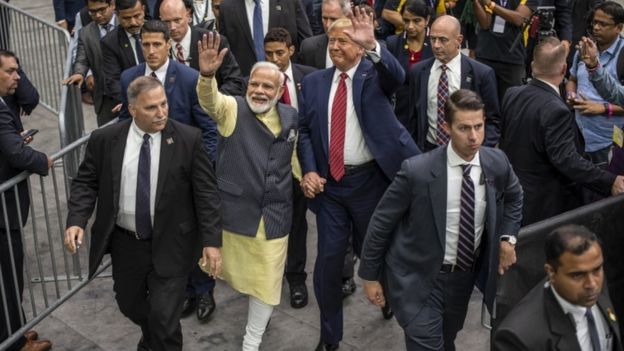
US President Donald Trump and Indian Prime Minister Narendra Modi exchanged warm words of friendship in Texas at a rare mass rally for a foreign leader.

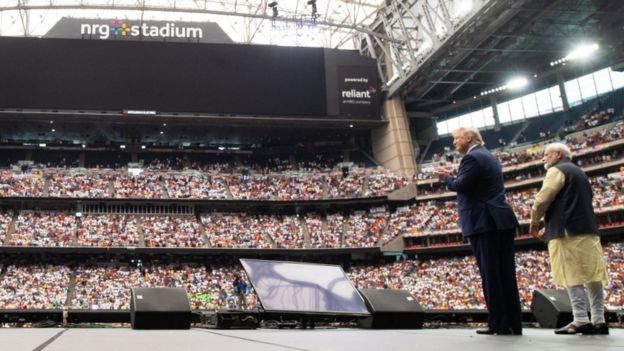
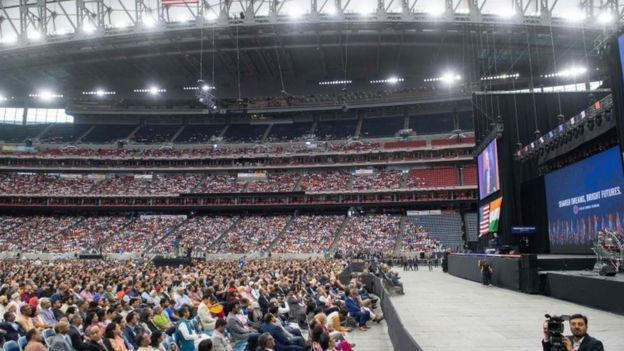
Around 50,000 people gathered for what Mr Trump called a “profoundly historic event” on Sunday in Houston.

The “Howdy, Modi!” event was billed as one of the largest ever receptions of a foreign leader in the US.

Mr Modi, however, may face a frostier reception at the UN General Assembly.

He is likely to face criticism over tensions in Indian-administered Kashmir, which he stripped of its special status last month, promising to restore the region to its “past glory”.

The region has been in lockdown for more than a month with thousands of activists, politicians and business leaders detained.

Trade talks and the UN General Assembly are on the Indian prime minister’s agenda during his week-long visit to the United States.

Pakistani Prime Minister Imran Khan, who has been the most vocal international leader to oppose India’s Kashmir move, is also in the US for the UN conference. Like Mr Modi, he will have a one-on-one meeting with Mr Trump on the sidelines of the summit.

A 90-minute show, featuring 400 performers, warmed up the crowd before Mr Modi and Mr Trump shared the stage.

“I’m so thrilled to be here in Texas with one of America’s greatest, most devoted and most loyal friends, Prime Minister Modi of India,” Mr Trump told the crowd.

Narendra Modi and Donald Trump leave the stage holding hands at NRG Stadium, HoustonImage copyright GETTY IMAGES
Image caption Narendra Modi and Donald Trump leave the stage holding hands at Houston’s NRG Stadium

In his speech, Mr Modi said India has a “true friend” in the White House, describing Mr Trump as “warm, friendly, accessible, energetic and full of wit”.

“From CEO to commander-in-chief, from boardrooms to the Oval Office, from studios to the global stage… he has left a lasting impact everywhere,” Mr Modi said.

Presentational grey line

Personal-touch diplomacy played to perfection

Brajesh Upadhyay, BBC News, Houston

This was exactly the kind of crowd size and energy President Trump loves at his rallies.

Only here the chants were for Indian Prime Minister Narendra Modi and Mr Trump was the superstar invited to the party. But the crowd did not disappoint him either and greeted him with chants of “USA!”, most heard at Trump rallies.

The personal-touch diplomacy with Mr Modi’s trademark bear hugs was played to perfection.

This rally has been called a win-win for both the leaders. For President Trump, it was a chance to court Indian-Americans for the 2020 presidential election race where Texas could emerge as a battleground state. For Mr Modi, a PR triumph and picture with the president of the United States may help him shrug off the criticism over his recent strong-arm policies at home.

Presentational grey line

Houston’s NRG Stadium, where the event was hosted, was the first stop for Mr Modi, whose Hindu nationalist Bharatiya Janata Party (BJP) won a landslide victory in this year’s Indian elections.

Greeted by a standing ovation, Mr Trump used his speech to heap praise on Mr Modi, who he said was doing a “truly exceptional job for India” and its people.

Mr Trump also paid tribute to the Indian-American community, telling them “we are truly proud to have you as Americans”.

The US has a population of about 4 million Indians who are seen as an increasingly important vote bank in the country.

Apart from Mr Trump, organisers also invited Democrats to the event – House Majority Leader Steny Hoyer was among those who spoke.

The 2010 US census shows that Texas is home to the fourth-largest Indian-American population in the country after California, New York and New Jersey.

Analysis of voting patterns shows the community tends overwhelmingly to support the Democrat party.

Narendra Modi said Donald Trump attend a mass rally in TexasImage copyright GETTY IMAGES
Image caption The event, dubbed “Howdy, Modi!”, was attended by an estimated 50,000 people

No stranger to nationalist rhetoric himself, Mr Trump compared security at the US-Mexico border to the tensions between India and Pakistan in the tinderbox Kashmir region.

“Both India and US also understand that to keep our communities safe, we must protect our borders,” Trump said.

Donald Trump described Narendra Modi as one of America's most "loyal friends"Image copyright GETTY IMAGES
Image caption Donald Trump described Narendra Modi as one of America’s most “loyal friends”

In India, the rally was closely watched, with most mainstream media outlets running live news updates of what was transpiring on stage.

The event had been making headlines for days before as well.

On Twitter, many people shared instant analysis and opinions of what was taking place on the stage with the sentiment being overwhelmingly positive. Many praised Mr Modi for what they saw as his statesmanship and diplomatic acumen with a lot of praise coming in for the US president as well.

Source: The BBC

07/09/2019

Chinese Foreign Minister Wang Yi visits Pakistan amid tensions over Kashmir

  • He is expected to join a trilateral dialogue with his counterparts from Pakistan and Afghanistan, and observers say he may try to mediate in Kashmir dispute
  • Trip also includes a stop in Nepal that could pave way for a visit by Xi Jinping
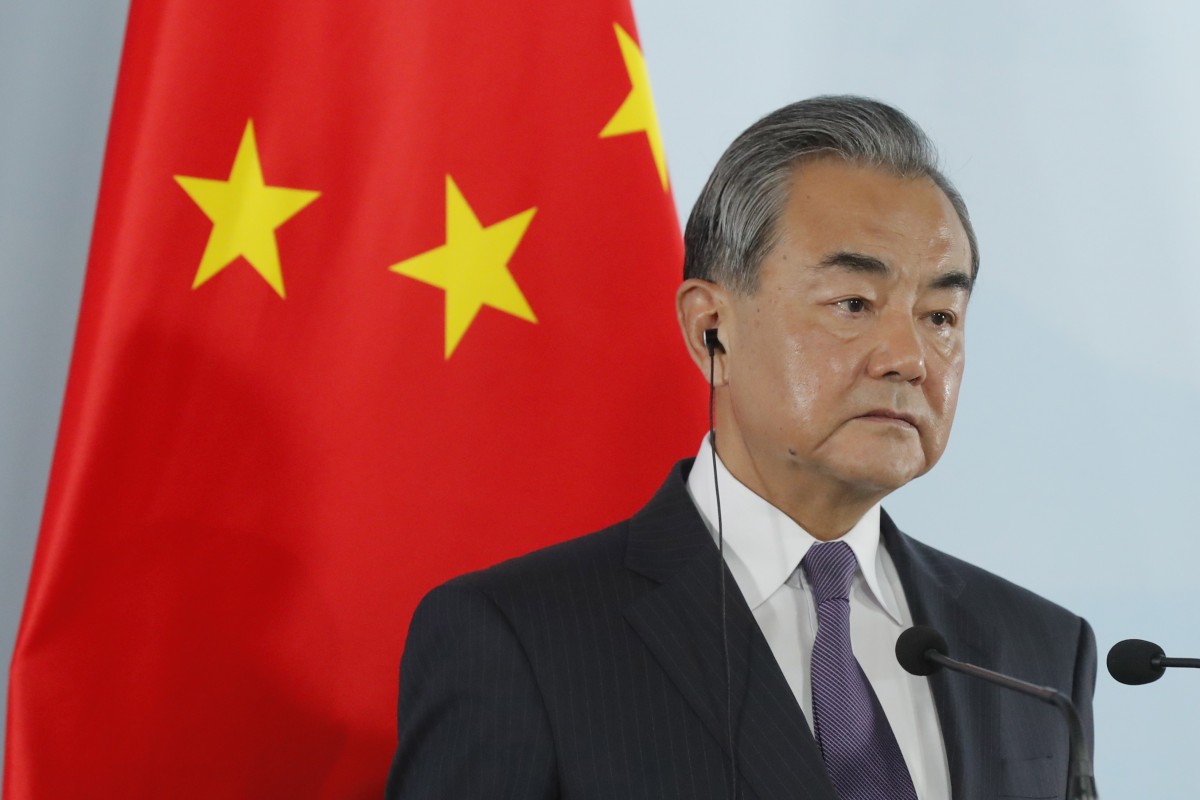
Chinese Foreign Minister Wang Yi may try to act as a negotiator in the Kashmir dispute. Photo: EPA-EFE
Chinese Foreign Minister Wang Yi began a four-day trip to Pakistan and Nepal on Saturday, amid escalating tensions between Islamabad and New Delhi over

Kashmir

.

Wang was expected to join a trilateral dialogue with the foreign ministers of Pakistan and Afghanistan in Islamabad, foreign ministry spokesman Geng Shuang said on Friday. He will also travel to Nepal.

Beijing has criticised India’s decision last month to strip the Jammu and Kashmir autonomous state of its special status and break it into two federally controlled territories, calling it “unacceptable”.

China also formally backed Pakistan’s request for the United Nations Security Council to hold “closed consultations” on the revocation of the state’s autonomy.

Meanwhile, observers say the Chinese foreign minister could attempt to act as a negotiator in the complex border dispute.
“Wang might try to play a role to mediate between the two sides to resolve the crisis,” said Wang Dehua, head of the Institute for South and Central Asia Studies at the Shanghai Municipal Centre for International Studies. “This has been China’s long-held position on the issue.”

Pang Zhongying, an international relations researcher at Ocean University of China in Qingdao, agreed.

“[Indian Prime Minister] Narendra Modi has visited China a couple of times and it is likely [Chinese President] Xi Jinping will visit India soon,” he said. “If Xi is to visit India later this year, China may try to contain its differing views with India on Kashmir.”

Modi has proposed an informal summit with Xi later this year that may be held in the religious hub of Varanasi, Modi’s parliamentary constituency. New Delhi said in May that Indian officials were working with the Chinese side to finalise the details, but Beijing has yet to confirm Xi’s visit.

India dismisses Beijing’s concerns over Kashmir because ‘it won’t have any impact on China’
Wang Yi was also due to visit India later this month for border talks, but the trip had to be postponed at the request of New Delhi because of scheduling problems, Hindustan Times reported, citing China’s foreign ministry.

The row over Kashmir has escalated in the past month. Pakistani Prime Minister Imran Khan said on Friday that Islamabad would make the fullest possible response to New Delhi’s actions in disputed Kashmir and that the global community would be responsible for any “catastrophic” aftermath.

Since Modi withdrew special rights for Indian-administered Kashmir on August 5, India has flooded the Kashmir valley with troops, restricted the movements of residents and cut off communication.

Both India and Pakistan claim the whole of Kashmir, which was partitioned between the two following the end of British rule in 1948, and they have subsequently fought wars over the territory.

China has its own territorial dispute with India over the part of Kashmir it controls. In early August, Chinese foreign ministry spokeswoman Hua Chunying 

called Modi’s move “unacceptable”

and said it was not binding. Beijing later appeared to soften its rhetoric, with Hua calling for a solution through dialogue and negotiation, without criticising either side.

The Chinese foreign minister will also visit Nepal, where he is expected to meet his counterpart, the president and prime minister. The trip could pave the way for an expected visit by Xi to Nepal.
Source: SCMP
06/04/2019

Pakistan PM accuses India of war hysteria over downed F-16 claim

KARACHI, Pakistan/MUMBAI (Reuters) – Pakistani Prime Minister Imran Khan blamed India’s ruling Bharatiya Janata Party (BJP) for “whipping up war hysteria” over claims that India shot down a Pakistani F-16 during a standoff in February, saying the truth is always the best policy.

U.S.-based Foreign Policy magazine, citing U.S. officials, said all of Pakistan’s F-16 combat jets had been accounted for, contradicting an Indian air force assessment that it had shot down one of the jets.

“The truth always prevails and is always the best policy,” Khan said in a Tweet. “BJP’s attempt to win elections through whipping up war hysteria and false claims of downing a Pak F 16 has backfired with US Defence officials also confirming that no F16 was missing from Pakistan’s fleet.”

Nuclear-armed neighbours India and Pakistan engaged in an aerial battle over the disputed region of Kashmir a day after Indian jets crossed over into Pakistan to attack a suspected camp of anti-India militants.

An Indian jet was brought down during the fight and its pilot captured when he ejected on the Pakistani side of the border. He was later released.

India said it too had shot down a Pakistani aircraft and the air force displayed pieces of a missile that it said had been fired by a Pakistani F-16 before it went down.

Foreign Policy said in a report published on Thursday two U.S. defence officials with direct knowledge of the matter said U.S. personnel had done a count of Pakistan’s F-16s and found none missing.

Details of the India-Pakistan air engagement have not been fully provided by either side. If the U.S. report turns out to be true, it would be a further blow to Prime Minister Narendra Modi, who had said that India had taught Pakistan a lesson, ahead of elections next week.

The BJP is campaigning on a platform of tough national security, especially with regard to arch foe Pakistan. New Delhi blames Pakistan for stoking a 30-year revolt in Muslim-majority Kashmir but Islamabad denies any involvement.

BJP spokesman Bizay Sonkar Shastri dismissed Khan’s accusations.

“Firstly, their (Pakistan’s) habit of lying is no secret to the world. Secondly, this is absolutely clear that the roots of terrorism lie in Pakistan and terrorism is cultivated in Pakistan,” he told Reuters.

The success of Indian air strikes on a camp of the Jaish-e-Mohammed militant group in northwestern Pakistan has also been thrown into doubt after satellite images showed little sign of damage.

High-resolution satellite images reviewed by Reuters last month showed that a religious school run by Jaish appeared to be still standing days after India said its warplanes had hit the Islamist group’s training camp on the site and killed a large number of militants.

Pakistan closed its airspace amid the standoff but most commercial air traffic has since resumed and major airports have opened.

Pakistan offered to open one air route on Friday, an Indian government official said, without specifying details and declining to be named as the matter was not public.

An Air India official said on condition of anonymity that Pakistan has opened one of its 11 air routes, from the southern side, adding that the carrier began operations via this route on Friday.

“Pakistan has opened one air route over India on April 4th, it is a north-west bound route,” Mujtaba Baig, spokesman for Pakistan’s Civil Aviation Authority, told Reuters on Saturday.

An email sent to the Indian Directorate General of Civil Aviation was not immediately answered. Air India did not immediately respond to an email seeking comment.

Source: Reuters

Law of Unintended Consequences

continuously updated blog about China & India

ChiaHou's Book Reviews

continuously updated blog about China & India

What's wrong with the world; and its economy

continuously updated blog about China & India