Chindia Alert: You’ll be Living in their World Very Soon
aims to alert you to the threats and opportunities that China and India present. China and India require serious attention; case of ‘hidden dragon and crouching tiger’.
Without this attention, governments, businesses and, indeed, individuals may find themselves at a great disadvantage sooner rather than later.
The POSTs (front webpages) are mainly 'cuttings' from reliable sources, updated continuously.
The PAGEs (see Tabs, above) attempt to make the information more meaningful by putting some structure to the information we have researched and assembled since 2006.
BEIJING, Oct. 28 (Xinhua) — Premier Li Keqiang’s upcoming trip to Uzbekistan and Thailand is of great importance to cementing cooperation among both SCO members and East Asian states, as well as solidifying Chinese relations with Uzbekistan and Thailand, senior officials said at a press briefing Monday.
Premier Li is scheduled to attend the 18th meeting of the Council of Heads of Government (Prime Ministers) of the Shanghai Cooperation Organization (SCO) in the Uzbek capital Tashkent, pay an official visit to Uzbekistan, and attend the 22nd China-ASEAN (10+1) leaders’ meeting, the 22nd ASEAN-China, Japan and Republic of Korea (10+3) leaders’ meeting and the 14th East Asia Summit (EAS) in the Thai capital Bangkok before paying an official visit to Thailand, from Nov. 1 to 5.
During the SCO heads of government meeting, Li will explain Xi Jinping Thought on Socialism with Chinese Characteristics for a New Era and share the successful construction experience of the People’s Republic of China in the past 70 years, according to Assistant Foreign Minister Chen Xiaodong.
“Li will exchange in-depth views with the leaders of the participating countries on enhancing solidarity and mutual trust among member states, building the Belt and Road Initiative and cooperation in such fields as economy and trade, industrial capacity, connectivity, finance, investment and people-to-people exchanges,” Chen said.
Noting it will be Li’s first official visit to Uzbekistan, Chen said the premier will exchange views with the Uzbek side on implementing the important consensus of the two heads of state, promoting the development of bilateral relations and international and regional issues of common concern. The two sides will sign a series of cooperation agreements covering economy and trade, investment, science and technology, customs and other fields.
Regarding the East Asian leaders’ meeting on cooperation, Chen said the premier will expound on China’s policy proposals for East Asian cooperation and propose more than 20 new initiatives for deepening cooperation under various mechanisms.
The East Asian leaders’ meeting this year will strengthen consensus, deepen cooperation, improve regional economic integration, promote regional common prosperity and development, and send out a positive signal of adhering to multilateralism and free trade, building an open world economy, according to Assistant Minister of Commerce Li Chenggang.
Calling Thailand a traditional friendly neighbor and important partner for the Belt and Road cooperation, Chen said Premier Li’s official visit to Thailand is the second visit by the premier in six years.
During the visit, the premier will exchange in-depth views with the leaders of the Thai side on bilateral relations and cooperation. The two sides will issue a joint press statement between the two governments and sign cooperation documents in such fields as technology and e-commerce.
BEIJING, Oct. 4 (Xinhua) — Chinese President Xi Jinping’s speech during Tuesday’s National Day celebrations was warmly embraced across the globe, with politicians and experts in different parts of the world expressing support for China’s social and economic development.
“China’s yesterday has been inscribed in human history while China’s today is being created in the hands of hundreds of millions of Chinese people,” Xi said. “China will surely have an even brighter future.”
Marcelo Abi-Ramia Caetano, secretary general of the International Social Security Association, said Xi’s speech briefly summarized the “remarkable socio-economic progress” achieved by the People’s Republic of China (PRC) over the past 70 years.
“In terms of social protection, China serves as an excellent example in extending social security coverage and improving social security administration, and has much to share with the rest of the world,” he added.
The “overarching theme” of China’s National Day celebrations is “a comprehensive and integrated vision of why China’s system works so well for China, and how, at the same time, it benefits the world,” said Robert Kuhn, a leading U.S. expert on China.
China’s goal is “to improve the standards of living of all its citizens, and then to share the fruits of such development with the world in various forms,” added Kuhn, also chairman of the Kuhn Foundation.
“China’s role in the world has increased and (the) PRC has been making an important contribution to global governance and its needed reforms,” said Fabio Massimo Parenti, an Italian scholar of international studies at the International Institute Lorenzo de’ Medici.
The China-proposed Belt and Road Initiative is “for the entire world” and has received support from countries across the globe, he added.
Mahmoud Raya, director of the Lebanese website “China in Arab Eyes,” said Xi’s speech reflected strength and hope.
The strength comes from the glorious history of the Chinese nation and the confidence of the younger generation in their future, he added.
Xi’s speech showed “solid confidence that China has,” and revealed “future directions that China will follow,” said Do Tien Sam, former director of the Institute of Chinese Studies under the Vietnam Academy of Social Sciences.
GUANGZHOU, Oct. 2 (Xinhua) — With the help of audio description given by volunteers, visually impaired people in south China’s Guangzhou “watched” live broadcasting of China’s National Day celebrations on Tuesday.
“The aircrafts are flying through the sky in a shape of triangle, with seven lines of colored clouds behind,” the volunteers described the formation in detail.
On Tuesday, a grand military parade and a 100,000-people mass pageantry were held in Beijing to celebrate the 70th founding anniversary of the People’s Republic of China.
A total of 100 visually-impaired people “watched” the broadcast in Guangzhou Library. Wearing earphones, they got a full account of the celebrations from two volunteers.
For Lu Haixia, one of the volunteers, narrating a live broadcasting put her under great pressure.
“It takes me 100 hours to prepare the oral scripts for a movie, and much more hours for preparing for such a long live broadcasting in order to provide informative accounts of the event to the audience,” she said.
“With the detailed narration, I feel like seeing formations parading on the Chang’an Avenue, and that I can get more involved in the cheering,” said Wang Zeyu, one of the “viewers.”
This was the first time for Guangzhou to introduce a live broadcast of major celebrations with audio description to the visually impaired. Organizers of the event hope to carry the effort forward to give the visually impaired more confidence to get integrated into the society.
BEIJING, Oct. 2 (Xinhua) — While turning 70 often signals the beginning of a person’s twilight years, for the People’s Republic of China (PRC) it marks a golden age full of hope and vigor.
The PRC celebrated its 70th birthday on Oct. 1. China’s transformation from an agricultural society isolated from the West into the world’s second-largest economy open wide is nothing short of a miracle.
More importantly, it has charted a new path for developing countries to modernize.
Seven decades ago, the war-ravaged country started from scratch. Observers are astonished at China’s large-scale modernization, its reduction of the number of people living in poverty and the sheer volume of its consumer market. Their heads have been turned not only because of the speed of the transition but also by the unique path taken to realize this great transformation.
Reflecting on its past and present, and through experimentation, China has identified and will continue down the right path — socialism with Chinese characteristics.
Reform is the engine of China’s miracle. There is no ready-made solution for the development issues facing China. From creating special economic zones to building free trade pilot zones, from carrying out family-based production contracts to revitalizing state-owned enterprises, China has been one of the most successful countries in piloting reforms over the past decades. Now the reform is more in-depth and more comprehensive in economic, political, cultural, social and ecological sectors.
The Chinese government stresses being effective and responsive to the public interest. Development outlines are far-sighted. For example, the five-year plans are made to deal with comprehensive aspects that concern human development: food, transportation, communication, environment, health and education. These plans are a priority for the government.
Of course these achievements could never have been realized without the leadership of the CPC.
From the people and for the people, the CPC has always upheld its principle of striving for the happiness of the people and the rejuvenation of the nation.
At a life-or-death moment, the CPC shouldered the mission of saving the nation from existential peril. After 28 years of bloody struggle, it led the Chinese people to overthrow the “three mountains” placed on their heads and put an end to the semi-colonial and semi-feudal society of old China. Gone are the days where any attempt to bully China with “fists” or “intimidation” would succeed.
Despite overseas doubts, misunderstandings and predictions that its survival would be short-lived, the CPC has stunned the world with its leadership, innovative theories and ability to unite and organize the people.
It abolished the agricultural tax that had been in place for more than 2,600 years; it established a political system in which people are masters of their own affairs; it did its utmost to help people shake off poverty and keep nearly 1.4 billion people well-off.
No ruling party in the world can match the CPC’s record of adhering to the truth, versing itself in self-reform and self-purification, and turning impossibility into certainty in the face of difficulties and challenges, again and again.
The 70-year journey was never smooth. Trials and hardships abounded. The Chinese people dealt with floods and massive earthquakes and guarded against SARS and financial tsunamis. Yet these twists and turns never blocked China’s way forward but made it more sober, determined and mature.
Today, more than at any other time in history, China is closer to, more confident and more capable of achieving the great rejuvenation of the Chinese nation. However, lofty goals are never easily reached.
The world has been undergoing tremendous changes unseen in a century. Resistant external forces and headwinds still remain. “Zero-sum game” and “superior civilization” mentalities, among others, are prevailing.
The CPC will continue to lead the Chinese people to fight trade bullying, blackmailing and hegemonism. Only the CPC can lead China to emerge as a stronger country.
It all started long ago, and the journey is far from over.
Image copyright GETTY IMAGESImage caption China’s version of its past is a story of prosperity, progress and sacrifice for the common good
China’s extraordinary rise was a defining story of the 20th Century, but as it prepares to mark its 70th anniversary, the BBC’s John Sudworth in Beijing asks who has really won under the Communist Party’s rule.
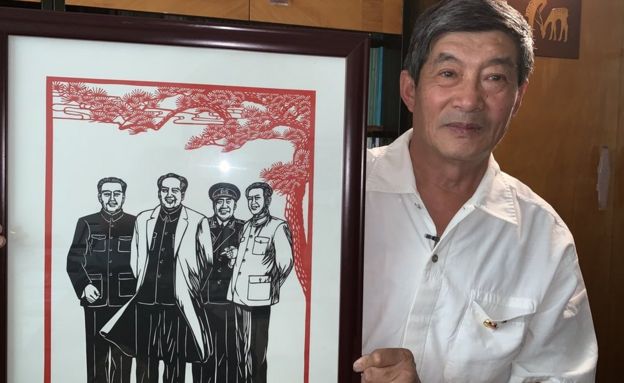
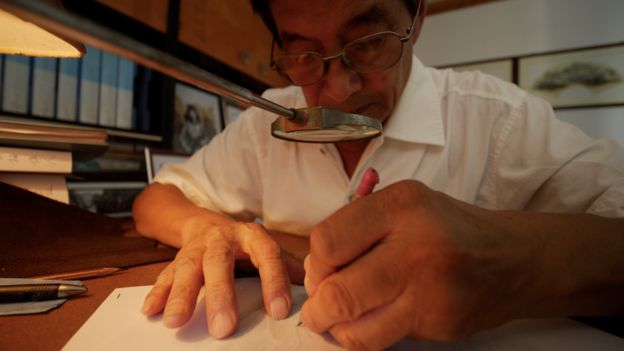
Sitting at his desk in the Chinese city of Tianjin, Zhao Jingjia’s knife is tracing the contours of a face.
Cut by delicate cut, the form emerges – the unmistakable image of Mao Zedong, founder of modern China.
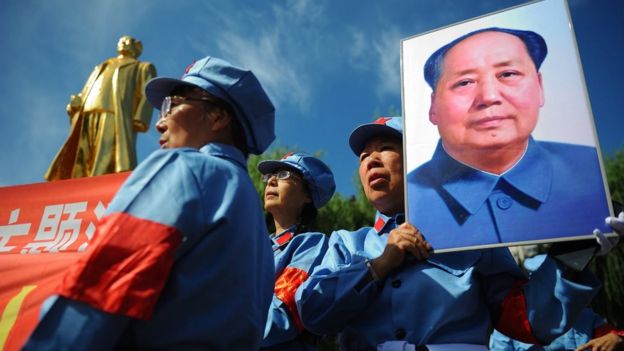
The retired oil engineer discovered his skill with a blade only in later life and now spends his days using the ancient art of paper cutting to glorify leaders and events from China’s communist history.
“I’m the same age as the People’s Republic of China (PRC),” he says. “I have deep feelings for my motherland, my people and my party.”
Image caption For people like Zhao Jingjia, China’s success outweighs the “mistakes” of its leaders
Born a few days before 1 October 1949 – the day the PRC was declared by Mao – Mr Zhao’s life has followed the dramatic contours of China’s development, through poverty, repression and the rise to prosperity.
Now, in his modest but comfortable apartment, his art is helping him make sense of one of the most tumultuous periods of human history.
“Wasn’t Mao a monster,” I ask, “responsible for the deaths of tens of millions of his countrymen?”
“I lived through it,” he replies. “I can tell you that Chairman Mao did make some mistakes but they weren’t his alone.”
“I respect him from my heart. He achieved our nation’s liberation. Ordinary people cannot do such things.”
On Tuesday, China will present a similar, glorious rendering of its record to the world.
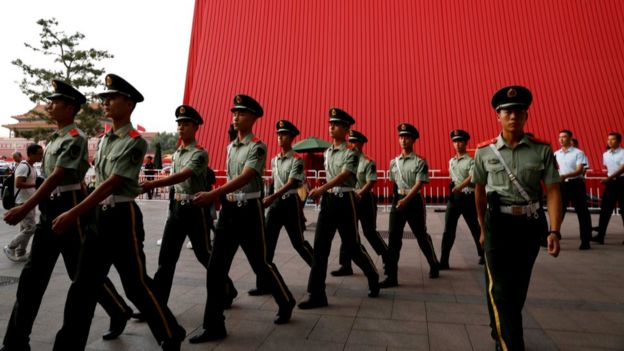
Beijing will tremble to the thunder of tanks, missile launchers and 15,000 marching soldiers, a projection of national power, wealth and status watched over by the current Communist Party leader, President Xi Jinping, in Tiananmen Square.
An incomplete narrative of progress
Like Mr Zhao’s paper-cut portraits, we’re not meant to focus on the many individual scars made in the course of China’s modern history.
It is the end result that matters.
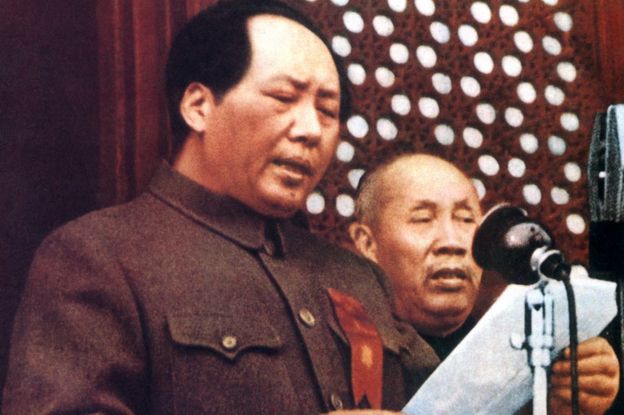
Image copyright XINHUA/AFPImage caption Mao Zedong pronounces the dawn of the People’s Republic of China on 1 October 1949
And, on face value, the transformation has been extraordinary.
On 1 October 1949, Chairman Mao stood in Tiananmen Square urging a war-ravaged, semi-feudal state into a new era with a founding speech and a somewhat plodding parade that could muster only 17 planes for the flyby.
This week’s parade, in contrast, will reportedly feature the world’s longest range intercontinental nuclear missile and a supersonic spy-drone – the trophies of a prosperous, rising authoritarian superpower with a 400 million strong middle class.
It is a narrative of political and economic success that – while in large part true – is incomplete.
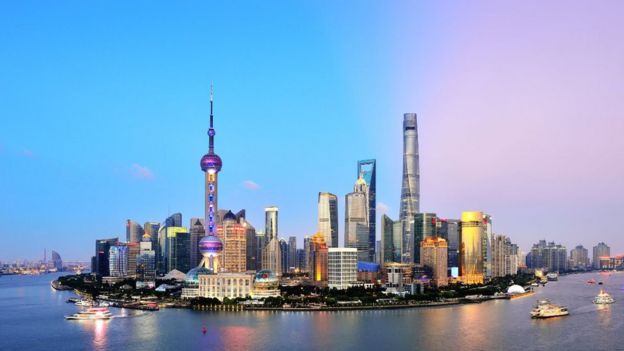
New visitors to China are often, rightly, awe-struck by the skyscraper-festooned, hi-tech megacities connected by brand new highways and the world’s largest high-speed rail network.
Image copyright GETTY IMAGESImage caption Those in China’s glittering cities may accept the trade-off of political freedom for economic growth
They see a rampant consumer society with the inhabitants enjoying the freedom and free time to shop for designer goods, to dine out and to surf the internet.
“How bad can it really be?” the onlookers ask, reflecting on the negative headlines they’ve read about China back home.
The answer, as in all societies, is that it depends very much on who you are.
Many of those in China’s major cities, for example, who have benefited from this explosion of material wealth and opportunity, are genuinely grateful and loyal.
In exchange for stability and growth, they may well accept – or at least tolerate – the lack of political freedom and the censorship that feature so often in the foreign media.
For them the parade could be viewed as a fitting tribute to a national success story that mirrors their own.
But in the carving out of a new China, the knife has cut long and deep.
The dead, the jailed and the marginalised
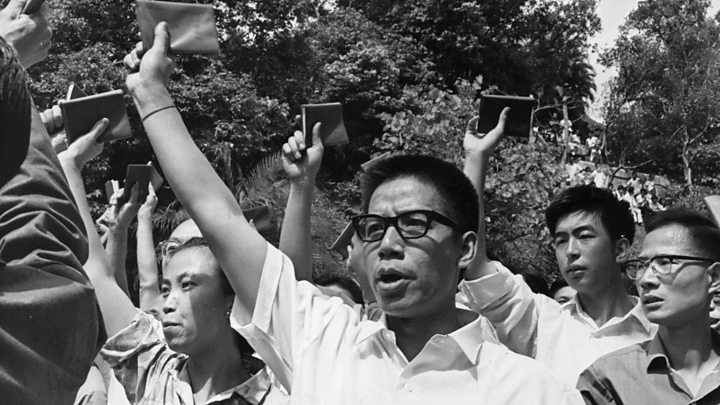
Mao’s man-made famine – a result of radical changes to agricultural systems – claimed tens of millions of lives and his Cultural Revolution killed hundreds of thousands more in a decade-long frenzy of violence and persecution, truths that are notably absent from Chinese textbooks.
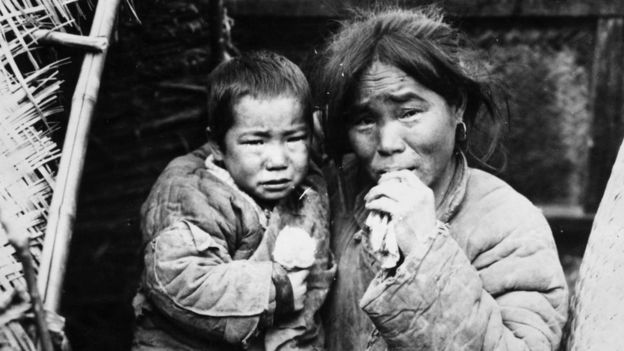
Image copyright GETTY/TOPICALImage caption Tens of millions starved to death under Mao, as China radically restructured agriculture and society
After his death, the demographically calamitous One Child Policy brutalised millions over a 40-year period.
Still today, with its new Two Child Policy, the Party insists on violating that most intimate of rights – an individual’s choice over her fertility.
The list is long, with each category adding many thousands, at least, to the toll of those damaged or destroyed by one-party rule.
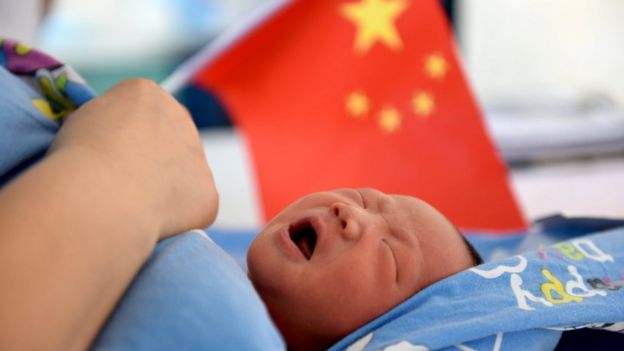
Image copyright GETTY IMAGESImage caption Beijing still regulates how many children families can have
There are the victims of religious repression, of local government land-grabs and of corruption.
There are the tens of millions of migrant workers, the backbone of China’s industrial success, who have long been shut out of the benefits of citizenship.
A strict residential permit system continues to deny them and their families the right to education or healthcare where they work.
And in recent years, there are the estimated one and a half million Muslims in China’s western region of Xinjiang – Uighurs, Kazakhs and others – who have been placed in mass incarceration camps on the basis of their faith and ethnicity.
China continues to insist they are vocational schools, and that it is pioneering a new way of preventing domestic terrorism.
The stories of the dead, the jailed and the marginalised are always much more hidden than the stories of the assimilated and the successful.
Viewed from their perspective, the censorship of large parts of China’s recent history is not simply part of a grand bargain to be exchanged for stability and prosperity.
Getty
Timeline of modern China
1949 Mao declares the founding of the People’s Republic of China
1966-76 Cultural Revolution brings social and political upheaval
1977 Deng Xiaoping initiates major reforms of China’s economy
1989 Army crushes Tiananmen Square pro-democracy protests
2010 China becomes the world’s second-largest economy
2018 Xi Jinping is cleared to be president for life
It is something that makes the silence of their suffering all the more difficult to penetrate.
It is the job of foreign journalists, of course, to try.
‘Falsified, faked and glorified’
But while censorship can shut people up, it cannot stop them remembering.
Prof Guo Yuhua, a sociologist at Beijing’s Tsinghua University, is one of the few scholars left trying to record, via oral histories, some of the huge changes that have affected Chinese society over the past seven decades.
Her books are banned, her communications monitored and her social media accounts are regularly deleted.
“For several generations people have received a history that has been falsified, faked, glorified and whitewashed,” she tells me, despite having been warned not to talk to the foreign media ahead of the parade.
“I think it requires the entire nation to re-study and to reflect on history. Only if we do that can we ensure that these tragedies won’t be repeated.”
Image copyright GETTY IMAGESImage caption Can progress really be attributed to the leadership?
A parade, she believes, that puts the Communist Party at the front and centre of the story, misses the real lesson, that China’s progress only began after Mao, when the party loosened its grip a bit.
“People are born to strive for a better, happier and more respectful life, aren’t they?” she asks me.
“If they are provided with a tiny little space, they’ll try to make a fortune and solve their survival problems. This shouldn’t be attributed to the leadership.”
‘Our happiness comes from hard work’
As if to prove the point about how the unsettled, censored pasts of authoritarian states continue to impact the present, the parade is for invited guests only.
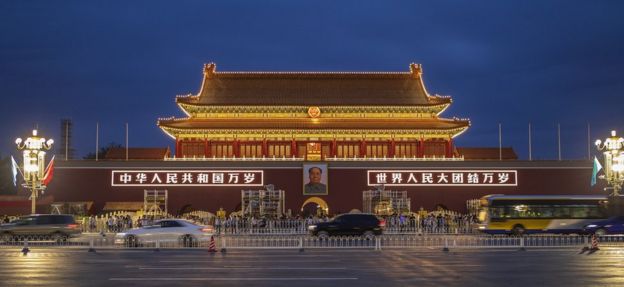
Image copyright GETTY IMAGESImage caption Mao’s portrait will, as it always is, be watching over the events in Tiananmen Square
Another anniversary, of which Tiananmen Square is the centrepiece, is also being measured in multiples of 10 – it is 30 years since the bloody suppression of the pro-democracy protests that shook the foundations of Communist Party rule.
The troops will be marching – as they always do on these occasions – down the same avenue on which the students were gunned down.
The risk of even a lone protester using the parade to mark a piece of history that has largely been wiped from the record is just too great.
With central Beijing sealed off, ordinary people in whose honour it is supposedly being held, can only watch it on TV.
Back in his Tianjin apartment, Zhao Jingjia shows me the intricate detail of a series of scenes, each cut from a single piece of paper, depicting the “Long March”, a time of hardship and setback for the Communist Party long before it eventually swept to power.
“Our happiness nowadays comes from hard work,” he tells me.
It is a view that echoes that of the Chinese government which, like him, has at least acknowledged that Mao made mistakes while insisting they shouldn’t be dwelt on.
“As for the 70 years of China, it’s extraordinary,” he says. “It can be seen by all. Yesterday we sent two navigation satellites into space – all citizens can enjoy the convenience that these things bring us.”
Media caption What was China’s Cultural Revolution?
Image copyright EPAImage caption China is getting dressed up for its big birthday party
One week from now, the People’s Republic of China will mark its 70th anniversary with celebrations on a scale not seen in China in decades.
Beijing is pulling out all stops and 1 October will be flush with fireworks, fanfare and a huge military parade.
To ensure it goes smoothly, authorities have been ramping up security in the capital – and online – for weeks.
But with yet more protests expected in Hong Kong, the territory might just rain on China’s parade.
What is it all about?
The birth of modern China was declared on 1 October 1949, after the communists under Mao Zedong won the civil war that followed World War Two.
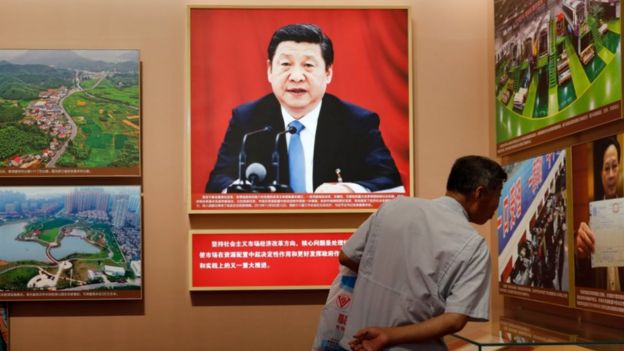
Image copyright EPAImage caption Exhibitions are highlighting the achievements of the Communist Party
The date is marked every year, but celebrations for this 70th anniversary are expected to eclipse previous events.
It’s the first big anniversary since China has emerged as a global power. While 10 years ago China was a superpower in the making, it is now the world’s second largest economy, almost eye-to-eye with the United States.
What to expect?
The main celebrations will take place in the capital, Beijing, where there will be a grand military parade with “advanced weapons” on display, followed by a “mass pageant”.
President Xi Jinping – considered the most powerful Chinese leader since Mao – will address the Chinese people. His speech is expected to celebrate China’s rapid growth and which will be closely watched for any indication of the country’s direction in the coming years.
The president will also hand out honours for contributions to the country and in the evening there will be a grand gala and fireworks show.
All official Chinese celebrations are carefully choreographed and the success of this one is particularly important to the government.
The Dos and Don’ts
The parade – open to invited guests only – will take place around Tiananmen Square in central Beijing. The surrounding area will be practically under lockdown, and in fact has been so several times already.
During rehearsals leading up to the big day, hotels near Tiananmen Square told guests that for several hours each day, no-one would be able to leave the hotel or return to it should they be out, leading to much travel chaos and rebookings.
Many shops and restaurants in the centre are also closed or have shortened hours and some subway stations are temporarily shut.
Image copyright EPAImage caption Security is tight ensure the party goes to plan
Trains to Beijing are running numerous safety checks on their passengers and vehicles going into the city are also being tightly watched.
On the big day itself, areas around Tiananmen Square will be blocked and guarded. Local residents will need to identify themselves if they want to pass.
To ensure the sun will shine brightly on the celebration in notoriously polluted Beijing, several coal plants and construction sites in and around the city have been ordered to stop work for the duration.
There’s also a ban on any low-flying aerial vehicles in place. That means anything from light aircraft to drones, balloons and even racing pigeons.
Censorship galore
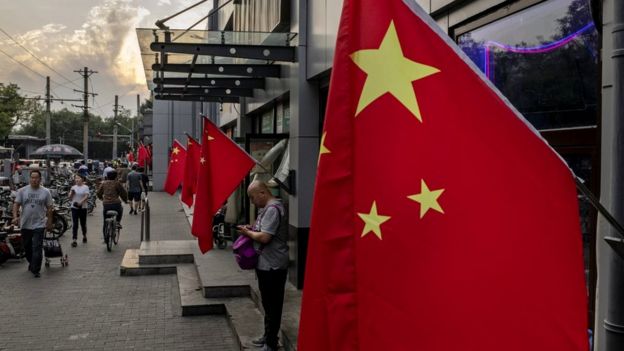
Across much of the city centre, there are national flags set up at every door. Voluntary inspectors are monitoring the streets and locals have told the BBC they’re being questioned after having even brief conversations with foreigners
One person said she was asked by an inspector: “Who were those foreigners? Why were they here?”
The tight control naturally extends online as well. Popular social media platform Weibo said it was deleting content that “distorts” or “insults” the country’s history ahead of the anniversary.
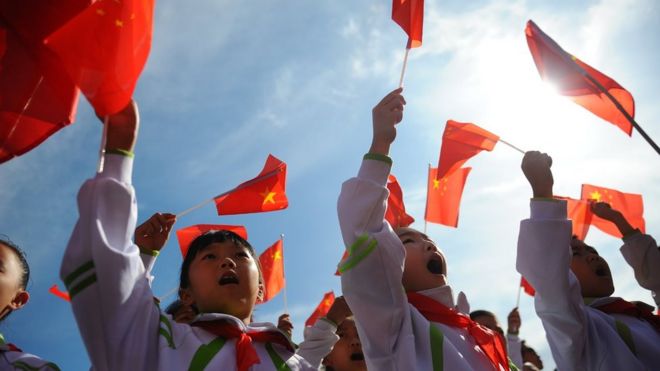
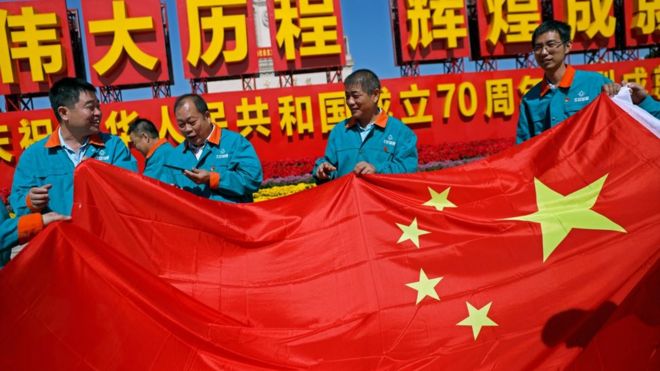
Image copyright GETTY IMAGESImage caption Every house and every shop is sporting a national flag
Chinese journalists are always expected to toe the party line anyway, but starting in October they will have to pass an extra test to prove they are versed particularly in Xi Jinping’s teachings, officially called Xi Jinping Thought on Socialism with Chinese Characteristics, which has been written into the constitution.
Whether or not they pass the exam will then determine whether they’ll be accredited as journalists.
“The fundamental point with this ‘training’ and indoctrination process isn’t so much about the content,” David Bandurski of China Media Watch told the BBC.
“It is about reinforcing the message and understanding among journalists that they work, first and foremost, for the Chinese Communist Party, and serve its agenda.”
So not only will the events be choreographed – the domestic coverage of them will also be tightly guarded.
What about Hong Kong?
Despite Beijing’s determination to let its achievements shine on 1 October, there’s a good chance Hong Kong will pull focus.
Anti-Beijing protests always take place in Hong Kong on China’s National Day, but this time, the activists know that the world is watching.
Anti-government protests have rocked the city for months and the situation shows no sign of dying down.
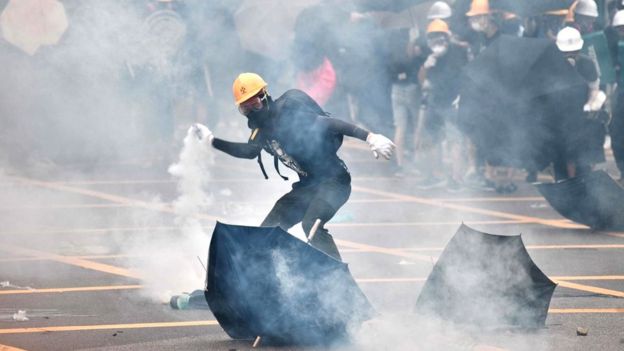
Clashes between police and activists have been becoming increasingly violent, with police using tear gas and activists storming parliament.
Image copyright AFPImage caption The protests have often escalated into violent clashes
That means two things for 1 October: official celebrations in the territory are being toned down to avoid clashes – the annual fireworks display has been cancelled – while at the same time, activists are planning to step up their protests.
On Sunday 29 September, a “Global Anti Totalitarianism March” is scheduled to take place at various locations around the world in support of Hong Kong.
On 1 October itself, a march in central Hong Kong is planned with everyone asked to wear black.
If the past weeks’ demonstrations are anything to go by, the smiles and celebrations in Beijing will be competing for media space with pictures of tear gas and angry young protesters in Hong Kong.
Chinese State Councilor and Foreign Minister Wang Yi and Solomon Islands’ Minister of Foreign Affairs and External Trade Jeremiah Manele sign a joint communique on the establishment of diplomatic relations after their talks in Beijing, capital of China, Sept. 21, 2019. (Xinhua/Xie Huanchi)
BEIJING, Sept. 21 (Xinhua) — China and the Solomon Islands signed a joint communique in Beijing Saturday on the establishment of diplomatic relations.
The communique was signed by Chinese State Councilor and Foreign Minister Wang Yi and Solomon Islands’ Minister of Foreign Affairs and External Trade Jeremiah Manele after they held talks.
The communique stated that the two countries have decided to recognize each other and establish diplomatic relations at the ambassadorial level effective from the date of signature of this communique, in keeping with the interests and desire of the two peoples.
China and the Solomon Islands agree to develop friendly relations on the basis of the principles of mutual respect for sovereignty and territorial integrity, mutual non-aggression, non-interference in each other’s internal affairs, equality, mutual benefit and peaceful coexistence.
The government of Solomon Islands recognizes that there is but one China in the world, that the Government of the People’s Republic of China is the sole legal government representing the whole of China, and that Taiwan is an inalienable part of China’s territory, according to the communique.
“The Government of the Solomon Islands shall sever ‘diplomatic relations’ with Taiwan as of this day and undertakes that it shall no longer develop any official relations or official exchanges with Taiwan. The Government of the People’s Republic of China appreciates this position of the Government of the Solomon Islands,” the communique said.
Prior to the signing of the communique, the Solomon Islands announced in a statement that it recognized the one-China principle and severed the so-called “diplomatic ties” with Taiwan.
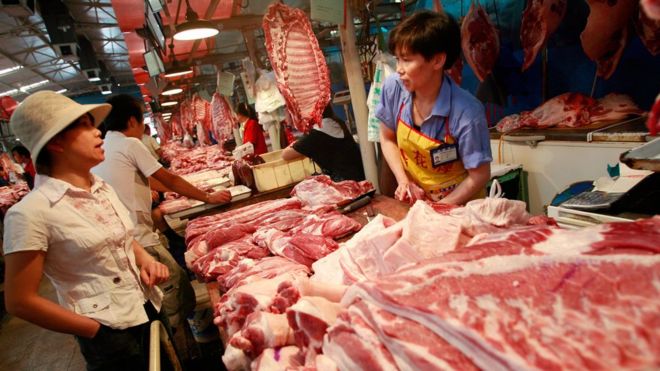
China is set to release pork supplies from its central reserves as it moves to tackle soaring prices and shortages caused by an outbreak of swine fever.
A state-backed body will auction 10,000 tonnes of frozen pork from its strategic reserves on Thursday.
China, the world’s biggest producer and consumer of pork, has struggled to control the spread of the disease.
In a bid to stabilise prices, a state-backed group that manages the pork reserves will auction imported frozen pork from countries including Denmark, France, the US and UK.
Only 300 tonnes will be sold to each bidder at the auction.
Pork is used widely in Chinese festivals, and the auction comes as the country prepares to celebrate a week-long national holiday for the 70th anniversary of the People’s Republic of China.
Julian Evans-Pritchard, senior China economist at Capital Economics, said the auction would provide slight relief to the industry but would not do much to contain prices.
“In itself, I don’t think it will be able to prevent pork prices from rising further unless they manage to get the disease under control,” he said.
Beijing created its strategic pork reserve in 2007 but the size of the stockpile is not known.
Capital Economics estimates that at most, the stockpile would hold four days’ worth of pork supplies to feed China.
About 1.2 million pigs have been culled in China in an effort to halt the spread of swine fever since August 2018, according to data from the Food and Agriculture Organization, a UN agency.
In April, Rabobank estimated Chinese pork production would fall by up to 35% this year due to swine fever.
The supply shortage has sent pork prices soaring and has eaten into household incomes.
That poses a fresh challenge for the Chinese economy, which is already facing a slowdown and a trade war between Beijing and Washington.
BEIJING, Sept. 11 (Xinhua) — Premier Li Keqiang on Wednesday expressed his expectation for the Japanese economic community to seize the opportunities of China’s opening up, increase investment in China and expand bilateral cooperation areas to promote more achievements in trade and the economy.
Li made the remarks in a meeting with a delegation from Japan’s business community, led by president of the Japan-China Association on Economy and Trade Shoji Muneoka, chair of the Japan Chamber of Commerce and Industry Akio Mimura, and Nobuyuki Koga, chairman of the Board of Councilors of the Japan Business Federation.
China-Japan relations have returned to the right track since last year thanks to the joint efforts of the two sides, and the trade and economic cooperation between the two countries has been steadily advanced and the prospects for bilateral cooperation are broad, said Li.
When China-Japan relations encountered difficulties, the Japanese economic community made important efforts and contributions to maintain their healthy and steady development as well as accelerate pragmatic cooperation between the two countries, the Chinese premier said.
According to Li, China and Japan are two of the world’s major economies, and should give full play to their complementary advantages and work together to deepen cooperation, which will not only benefit the two countries, but also conducive to regional and global economy, as well as the prosperity and stability of the world.
Noting that economic globalization is irreversible, and economic and trade exchanges should not be blocked by national borders, Li pointed out that promoting the healthy development of globalization is the way of progress.
“China has always firmly upheld the multilateral trading system with the World Trade Organization at its core and promotes the liberalization and facilitation of trade and investment,” Li said, stressing China will unswervingly promote all-round opening up, and strive to optimize the business environment.
China welcomes the Japanese economic community to seize the opportunity brought forth by China’s opening up and increase investments in China, expand cooperation areas, and promote more cooperation achievements in trade and economic areas between the two countries, he said.
While expressing congratulations on the 70th anniversary of the founding of the People’s Republic of China, the Japanese economic delegation said that Japan and China have witnessed progress in bilateral ties since last year, and close high-level exchanges have facilitated the two countries’ economic and trade cooperation.
The Japanese economic community firmly supports free trade and hopes China and the United States will resolutely resolve their trade disputes through negotiation, they said.
Speaking highly of China’s efforts in promoting trade and investment liberalization, expanding market access and improving the business environment, they said that the Japanese economic community is willing to boost cooperation with the Chinese side in science and technology innovation, climate change, health care and third-party markets.
They also expressed their expectation of concluding the negotiations for the Regional Comprehensive Economic Partnership (RCEP), a proposed free trade agreement between the 10 ASEAN (the Association of Southeast Asian Nations) members and Australia, China, India, Japan, South Korea and New Zealand, by the end of the year.
Chinese Premier Li Keqiang meets with an American delegation visiting China for a dialogue with Chinese entrepreneurs and exchanges views with them on China-U.S. trade relations in Beijing, capital of China, Sept. 10, 2019. The delegation consists of U.S. business entrepreneurs and some former high-level officials. (Xinhua/Yao Dawei)
BEIJING, Sept. 10 (Xinhua) — Premier Li Keqiang on Tuesday met with American delegation visiting China for a dialogue with Chinese entrepreneurs and exchanged views with them on China-U.S. trade relations.
The delegation consists of U.S. business entrepreneurs and some former high-level officials.
This year marks 40th anniversary of the establishment of diplomatic relations between the People’s Republic of China and the United States. Over the past 40 years, the two countries have witnessed forward-moving economic and trade ties with win-win results, Li said.
While stressing the importance of extensive common interests between China and the U.S., Premier Li suggested that both sides, in accordance with the consensus reached by the two heads of state, should follow principles of equality and mutual respect, seek common ground and continue to explore approaches accepted by both sides to resolve differences.
China will open only wider to the outside world, and is committed to creating a market-oriented, law-based international business environment where domestic and foreign enterprises are treated equally and protection of intellectual property is given priority to.
China has fully liberalized its manufacturing sector and accelerated the opening up of its service sector, the premier said.
“China has a vast market. We welcome enterprises from all countries, including those from the United States, to expand economic, trade and investment cooperation with China and achieve mutually beneficial results,” Li added.
The American entrepreneurs said that U.S. companies, which were inspired by China’s new measures to open up, are looking at the current U.S.-China trade frictions from a long-term perspective, opposing actions to weaken economic relations with China and economic decoupling between the two countries.
They also voiced their hope that bilateral economic and trade consultations will gain ground with an agreement being reached at an early date.





 CHINDIA ALERT: You'll be living in their world, very soon