Chindia Alert: You’ll be Living in their World Very Soon
aims to alert you to the threats and opportunities that China and India present. China and India require serious attention; case of ‘hidden dragon and crouching tiger’.
Without this attention, governments, businesses and, indeed, individuals may find themselves at a great disadvantage sooner rather than later.
The POSTs (front webpages) are mainly 'cuttings' from reliable sources, updated continuously.
The PAGEs (see Tabs, above) attempt to make the information more meaningful by putting some structure to the information we have researched and assembled since 2006.
BEIJING (Reuters) – With millions of Asians travelling on Tuesday for the Lunar New Year holiday, authorities in China confirmed that a new virus could be spread through human contact, reporting 15 medical staff had been infected and a fourth person had died.
The chilling update on the coronavirus outbreak that began in the central city of Wuhan sent shivers through financial markets, as the World Health Organisation called a meeting for Wednesday to consider declaring an international health emergency.
By the end of Monday the number of confirmed cases in China had climbed to 291, the National Health Commission said. Some 270 were in Hubei province. Wuhan, a city of 11 million people is the provincial capital.
The outbreak was also spreading to other cities, with 15 cases in southern province of Guangdong, five in the capital Beijing and two in Shanghai.
RELATED COVERAGE
WHO says expects further spread of new coronavirus in China
Death toll from coronavirus outbreak in China’s Wuhan rises to six – state TV
“Information about newly reported infections suggest there may now be sustained human to human transmission,” WHO Regional Director for the Western Pacific Takeshi Kasai said in an email statement.
The scare brought back bad memories of Severe Acute Respiratory Syndrome (SARS), another coronavirus that broke out in China in 2002/2003, resulting in the death of nearly 800 people in global pandemic.
Health authorities around the world have begun to step up screening of travellers arriving from China. Two cases have already been identified in Thailand, one in Japan and one in South Korea, while the Philippines reported on Tuesday its first suspected case.
Wuhan Municipal Health Commission confirmed a fourth fatality on Tuesday, disclosing that an 89-year-old man who had underlying health issues, including heart disease, died on Jan. 19.
Chinese authorities also confirmed for the first time that the virus could spread through human contact and said 15 medical staff had been infected.
The mounting anxiety was transmitted to regional markets. China’s onshore yuan CNY= fell 0.6%, its biggest daily drop since Aug. 26, 2019, while airline and travel stocks fell across the region.
European shares also slipped on mounting concerns about the impact of the outbreak, with luxury goods firms particularly hard-hit on worries about weaker demand from Chinese consumers.
The virus can cause pneumonia, with symptoms including fever and difficulty in breathing. As those symptoms are similar to many other respiratory diseases, extra screening is needed.
AIRPORT SCREENING
The origin of the virus has yet to be identified, but the primary source is most likely animal, according to WHO. Chinese officials have linked the outbreak to a seafood market in Wuhan.
“The outbreak of a SARS-like coronavirus in Wuhan is developing into a major potential economic risk to the Asia-Pacific region now that there is medical evidence of human-to-human transmission,” said Rajiv Biswas, Asia Pacific Chief Economist for IHS Markit, in an email statement.
So far, the WHO has not recommended trade or travel restrictions but such measures could be discussed at Wednesday’s emergency meeting.
China’s National Health Commission will also give an update on the outbreak at a press briefing at 10 a.m. (0200 GMT) on Wednesday.
Foreign ministry spokesman Geng Shuang said China will attend the WHO meeting and share relevant information.
“China is willing to deepen its global cooperation and work with the international community to work together to deal with the epidemic,” Geng told reporters at a regular daily briefing.
Airport authorities in the United States as well as most Asian nations also are screening passengers from Wuhan.
Australia on Tuesday said it would screen passengers on flights from Wuhan, while Singapore announced it would quarantine individuals with pneumonia and a history of travel to Wuhan within 14 days prior to the onset of symptoms.
QUEUES FOR MASKS
Wuhan officials have been using infrared thermometers to screen passengers at airports, railway stations and other passenger terminals since Jan. 14.
Zhong Nanshan, head of the National Health Commission’s team of experts investigating the outbreak, said in footage shown by state television on Monday there was no danger of a repeat of the SARS epidemic so long as precautions were taken.
Images of long lines of people queuing to buy face masks were circulating widely on Chinese social media, where the outbreak was one of the top trending topics.
Some online vendors were limiting sales of masks and hand sanitizers as demand surged.
And Shanghai’s market regulator warned on Tuesday that it will punish speculators who hoard masks and other products used for preventing diseases, according to the Shanghai Observer – a web publication backed by a Communist Party newspaper.
Trip.com, China’s top online travel booking platform, said it would refund customers who cancel bookings in Wuhan this month, or whose travel plans are disrupted by quarantines or other regulatory efforts to prevent the spread of the virus.
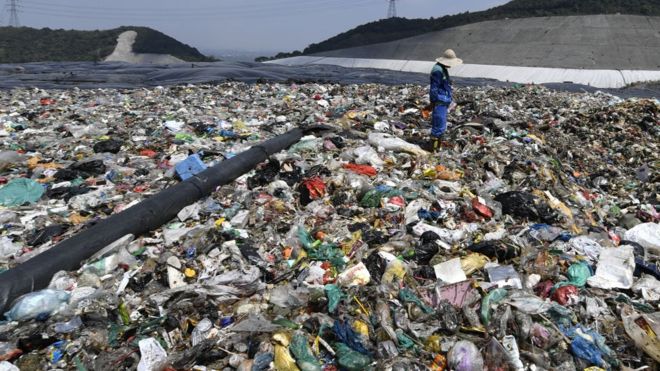
Image copyright GETTY IMAGESImage caption A worker applying a capping layer to a landfill site in Hangzhou
China’s largest dump is already full – 25 years ahead of schedule.
The Jiangcungou landfill in Shaanxi Province, which is the size of around 100 football fields, was designed to take 2,500 tonnes of rubbish per day.
But instead it received 10,000 tonnes of waste per day – the most of any landfill site in China.
China is one of the world’s biggest polluters, and has been struggling for years with the rubbish its 1.4 billion citizens generate.
How big is the landfill site?
The Jiangcungou landfill in Xi’an city was built in 1994 and was designed to last until 2044.
The landfill serves over 8 million citizens. It spans an area of almost 700,000 square metres, with a depth of 150 metres and a storage capacity of more than 34 million cubic metres.
Until recently, Xi’an was one of the few cities in China that solely relied on landfill to dispose of household waste – leading to capacity being reached early.
Earlier this month, a new incineration plant was opened, and at least four more are expected to open by 2020. Together, they are expected to be able to process 12,750 tonnes of rubbish per day.
The move is part of a national plan to reduce the number of landfills, and instead use other waste disposal methods like incineration.
The landfill site in Xi’an will eventually become an “ecological park”.
The country had 654 landfill sites and 286 incineration plants.
It is not clear what China’s recycling rate is, as no figures have been released. China plans to recycle 35% of waste in major cities by the end of 2020, according to one government report.
This July, sorting and recycling rubbish was made mandatory in Shanghai – leading to “a sense of panic” among some residents.
Chan is accused of supporting Beijing’s so-called nine-dash line, which is its historical justification for its territorial claims in the resource-rich sea
Vietnam, Malaysia, the Philippines, Taiwan and Brunei all have competing claims in the waterway that overlap with China’s
Film star Jackie Chan. Photo: Reuters
Martial arts film star Jackie Chan’s planned visit to Vietnam for a charity has been cancelled following an online backlash related to Beijing’s expansive claims in the disputed South China Sea.
The Hong Kong-born actor was set to visit Hanoi on November 10 to support Operation Smile, a charity that gives free surgery to children with facial disfigurements.
Jackie Chan says he wants to make films in Saudi Arabia
But the plans were scrapped after thousands of angry Facebook users flooded the charity’s official page when his visit was announced last week.
Some of their comments claimed Chan had spoken in support of China’s so-called nine-dash line – its historical justification for its territorial claims in the resource-rich sea.
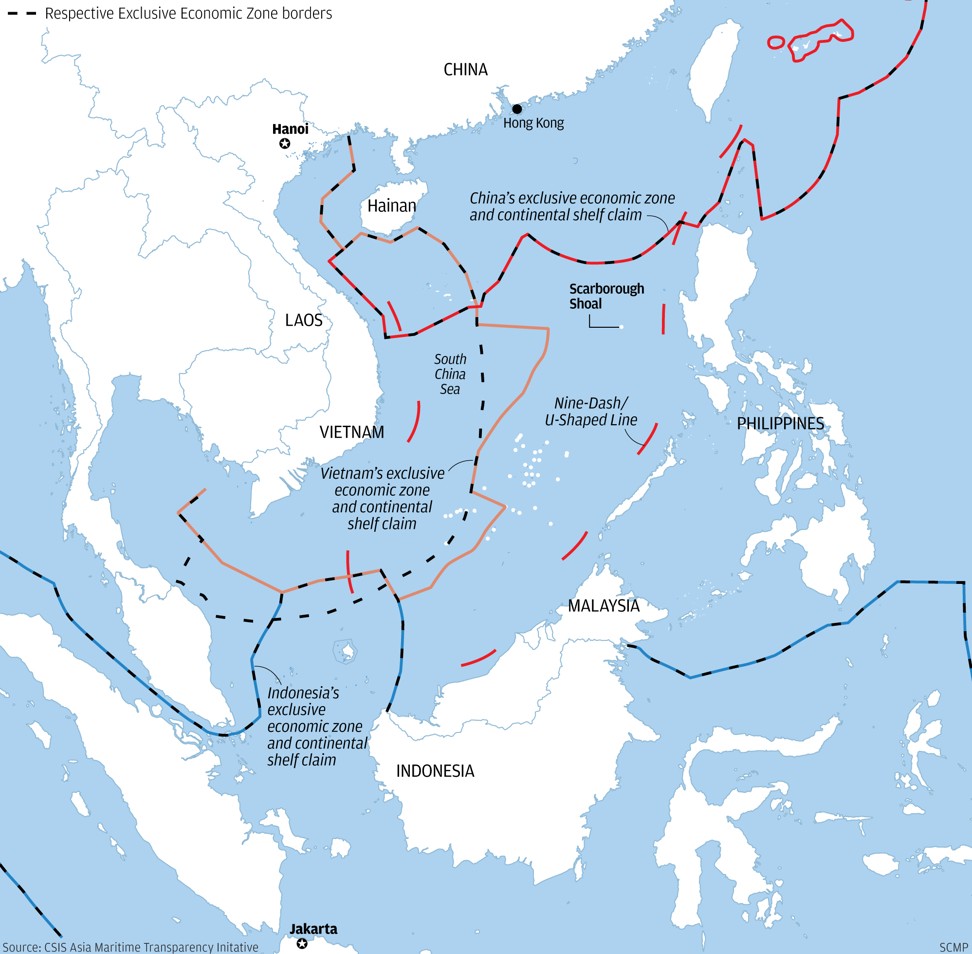
A map showing claimant countries’ exclusive economic zones in the South China Sea.
However, Chan has not explicitly expressed public support for the controversial maritime assertion.
Vietnam, Malaysia, the Philippines, Taiwan and Brunei all have competing claims in the waterway that overlap with China’s – long a source of tension in the region.
Issuing a mea culpa on Friday for failing “to predict the reaction” of the Vietnamese public, the charity asserted that their work is “non-political”.
“We are very sorry … Operation Smile will not organise any activities with [Chan’s] involvement” in Vietnam, they said.
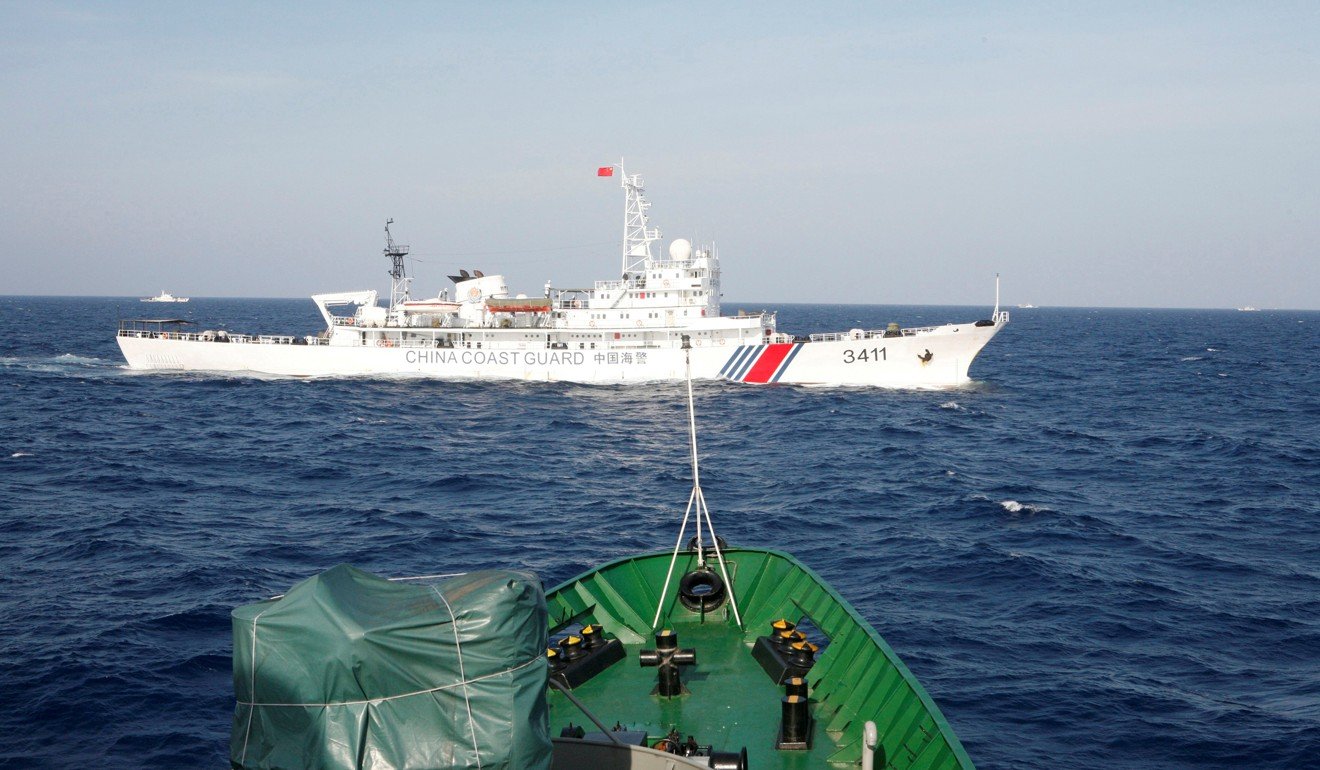
A Chinese coastguard ship sails by a Vietnamese vessel off the coast of Vietnam in 2014. Photo: Reuters
Vietnam is one of Beijing’s most vocal critics over the flashpoint South China Sea issue.
The foreign ministry on Thursday repeated its usual proclamation on the sea, citing the country’s “full legal basis and true evidence to affirm Vietnam’s sovereignty”, deputy spokesperson Ngo Toan Thang said.
Chan has in the past been accused of siding with China over Hong Kong’s democracy protests after calling the unrest in his hometown “sad and depressing”.
The comment sparked ire in Hong Kong but was warmly received by many in China where he has a massive fan base.
Abominable has been criticised for a scene showing the nine-dash line. Photo: DreamWorks
Beijing claims most the South China Sea through the vague delineation, which is based on maps from the 1940s as the then-Republic of China snapped up islands from Japanese control.
MANILA, Nov. 3 (Xinhua) — Chinese State Councilor and Foreign Minister Wang Yi has offered condolences for the people killed in the series of strong earthquakes that devastated central and eastern Mindanao in the southern Philippines last month, saying China is ready to help the Philippine government in its efforts to rehabilitate the region.
In a message of sympathy sent to Philippine Foreign Secretary Teodoro Locsin on Saturday, Wang said he was shocked to learn that strong earthquakes had hit Mindanao, resulting in casualties and property damage.
“He (Wang) would like to extend sincere sympathy to the victims and the bereaved families,” the Chinese Embassy in the Philippines said in a statement.
“China is willing to offer assistance to the Philippines within our capacity, and believes that under the strong leadership of the Philippine government, the Philippine people will overcome the disaster and return to normal life at an early date,” it quoted Wang as saying.
On Friday, China announced a donation of 3 million yuan (about 434,896 U.S. dollars) to help the quake victims, mostly poor farmers.
The Philippine National Disaster Risk Reduction and Management Council (NDRRMC) said in an updated report on Sunday that the Oct. 29 6.6-magnitude and the Oct. 31 6.5-magnitude earthquakes that hit several central and eastern Mindanao provinces had killed 21 people and injured more than 400 others.
Rescuers were still looking for two missing villagers, the country’s disaster agency said.
The agency said the two tremors also affected more than 178,000 people in 200 villages in the region. Nearly 22,000 displaced people were staying in makeshift tents, it added.
The agency said the quakes also damaged nearly 29,000 infrastructures in the region, mostly houses, school buildings, hospitals, roads and bridges.
The president is set to become the first Russian leader to make a state visit to the Philippines for more than 40 years, according to a former envoy
Moscow is aware of China’s entry into the Philippines, and could have its eye on some projects there, while the US is also watching developments
Russian President Vladimir Putin and Philippine President Rodrigo Duterte shake hands during a 2016 meeting in Peru. Photo: EPA
The timing of Moscow’s announcement over the weekend that President Vladimir Putin
has accepted an invitation to visit Manila has raised eyebrows, as it comes on the eve of crucial bilateral talks between the Philippines and China on joint oil exploration in the
In a statement immediately welcomed by the Philippine presidential palace, Igor Khovaev, Russia’s ambassador to the Philippines, on Saturday told reporters Putin had accepted Duterte’s invitation “with gratitude”.
No date has been set for the visit, with Khovaev only saying Moscow would “do our best to arrange this meeting as soon as possible”.
A steering committee with representatives from both Manila and Beijing is set to meet this week to discuss the joint oil exploration deal. China has proposed a 60 per cent-40 per cent split in favour of the Philippines, according to Hermogenes Esperon,
Courting Russia with South China Sea oil is a ‘dangerous gamble’ for Duterte
Neither side has clarified if the split refers to ownership or revenue, and no other details were disclosed.
After an August meeting with Duterte, Chinese President Xi Jinping said the countries could take a “bigger step” in jointly developing oil and gas resources if they could properly handle their sovereignty dispute in the South China Sea.
But defence and security analysts say the Philippine president took a “dangerous gamble” on a visit to Russia last month, when he invited the Russian state oil company Rosneft to explore for oil in Philippine waters – which include parts of the South China Sea claimed by China.
The timing of Moscow’s announcement has not gone unnoticed.
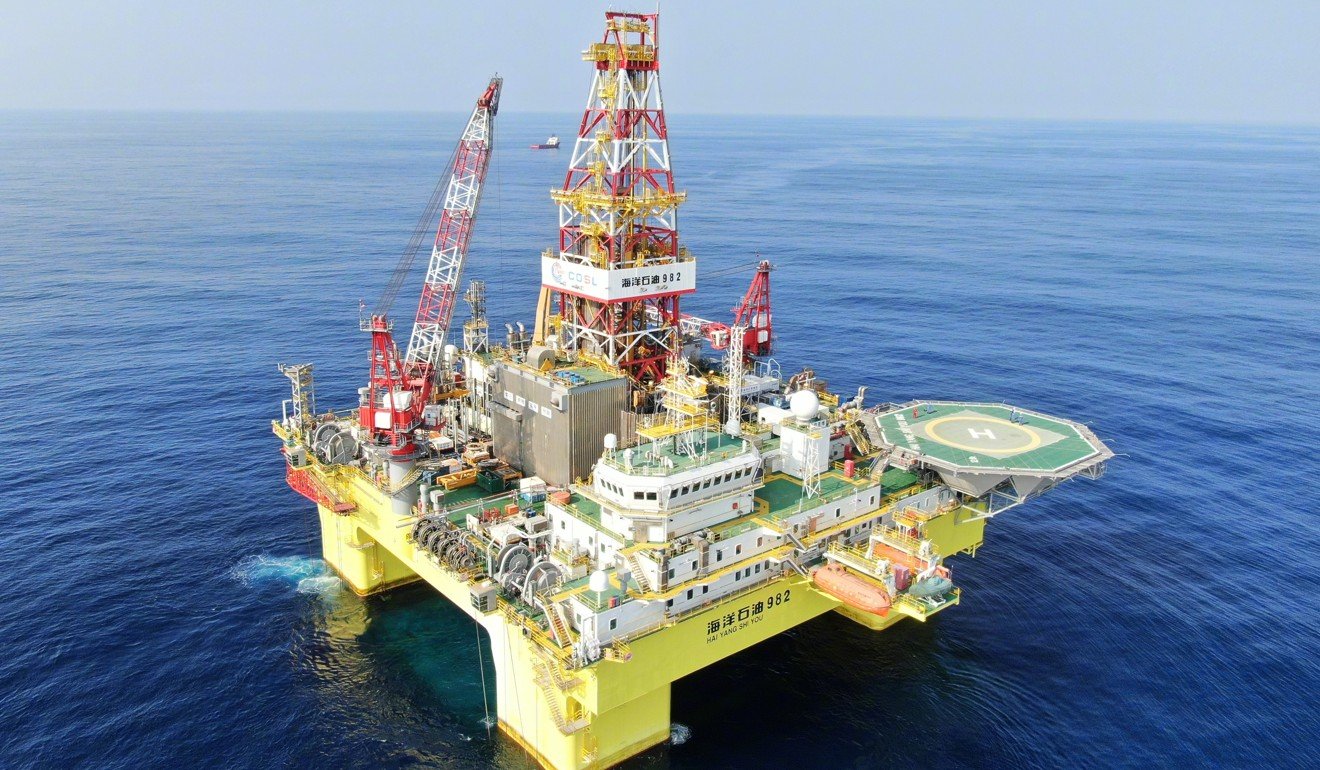
A Chinese deepwater oil rig in the South China Sea. Photo: Weibo
“It’s a welcome and historic development. Some wise guy in the Duterte government thought about timing [the invitation to Putin around the oil talks with Beijing],” said retired Philippine ambassador Lauro Baja, who once served as president of the United Nations Security Council.
Baja told the Post that no Russian president had visited the Philippines during his more than 40 years with the Department of Foreign Affairs.
“The Philippines then was almost a nonentity as far as Russia was concerned, [but] maybe now Russia recognises the strategic importance of the Philippines [in terms of] regional politics,” he said.
Baja said Moscow was aware of China’s entry into the Philippines, and could have its eye on some projects there.
“For all their so-called alliance, China and Russia are fierce competitors for influence and other benefits. And I think Russia has some objectives in mind like selling armaments and [forging] technological agreements,” he said, while cautioning that the situation remained “nebulous”.
New Philippines military chief sees no ‘shooting war’ in South China Sea despite disputes
“It’s a fascinating development but things are still early … For now, this is [just] an invitation extended by Duterte and accepted in principle by Putin.”
The United States will also be monitoring developments in the Philippines, according to Greg Poling, director of the Washington-based Centre for Strategic and International Studies’ Asia Maritime Transparency Initiative.
“Russia is eager to boost its influence in the region, and doubtless doing so with a long-standing US ally is seen as a bonus by Moscow,” he said. “There is nothing that prevents the Philippines from engaging in security cooperation with Russia, but the devil will be in the details.”
Poling added that the US would be concerned if Russia-Philippine cooperation involved acquiring military platforms that were incompatible with the shared platforms and doctrines used by Washington and Manila, as well as the latter’s other major security partners, namely Australia, Japan and South Korea.
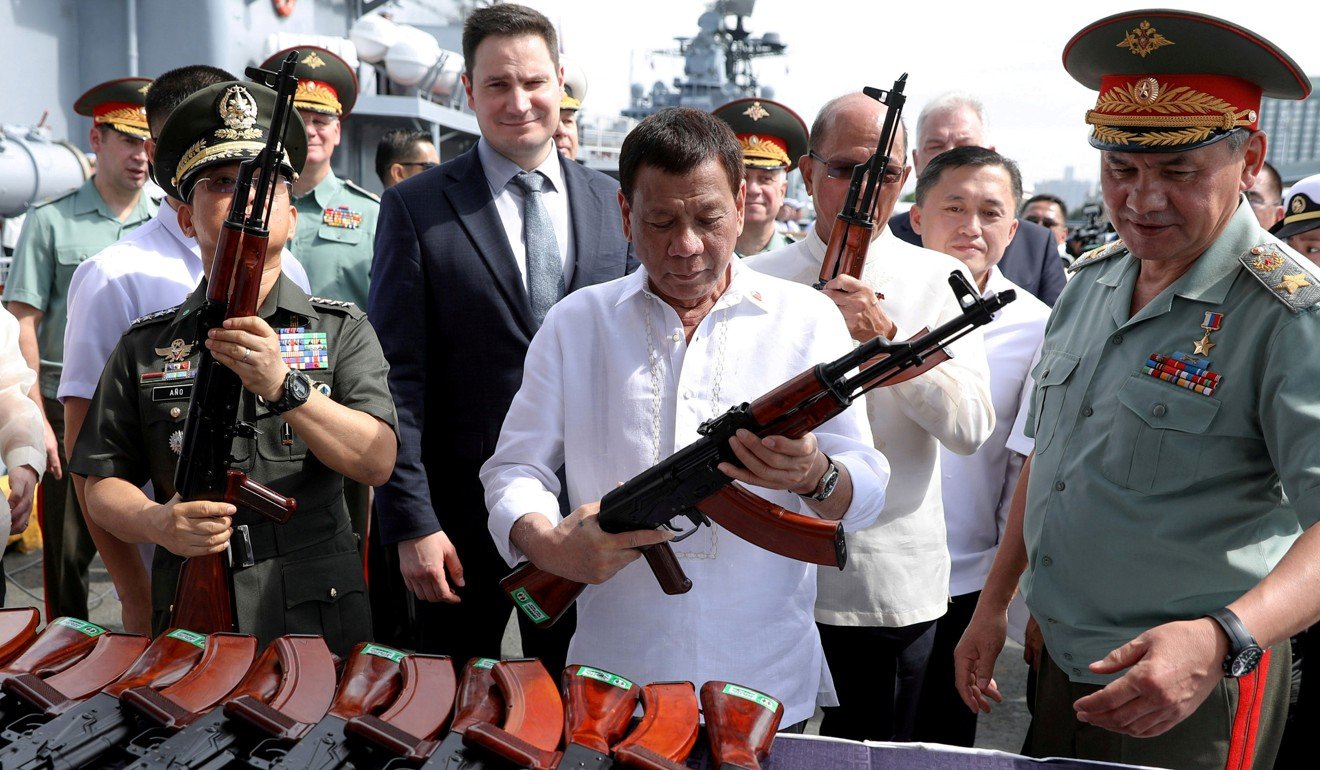
Philippine President Rodrigo Duterte inspects firearms donated by Russia in 2017. Photo: Reuters
“The US will also be concerned if any acquisitions or cooperation with Russia might threaten information security or intelligence cooperation between the US and the Philippines,” he said.
“And finally, any major platforms acquired from Russia would likely require the US to impose sanctions on the Philippines unless a waiver is granted, and the US government has been very stingy about awarding those waivers because they undermine the effectiveness of the sanctions regime.”
“Imagine a US stronghold and long-time ally and former colony becoming a manufacturing hub for Russian arms. And it makes it worse if [the Philippine armed forces] buys them too,” he said.
“Weakening the US alliances in Asia will benefit Russia [as it is] one of the US’ competitors in arms sales and geopolitics.”
Russia offers arms technology to the Philippines with ‘no conditions’ as US ties falter
The Philippines, Montero said, would benefit from such an arrangement since it is “a laggard in defence technology”. However, he pointed out that the country’s armed forces continue to buy weapons from the US and receive American arms as grants, potentially limiting the domestic market for Russian arms.
Navy cooperation has also been on the agenda, as Moscow and Manila discussed signing a new naval pact in March, while warships from each country have visited the other this year. Philippine naval vessels made their first-ever visit to Russia in October, while three Russian ships docked in the Philippines for a goodwill visit in January.
Russia is the top supplier of arms to Southeast Asia, and the No 2 global arms supplier, behind the US. Southeast Asia bought US$6.6 billion of Russian arms between 2010 and 2017, or more than 12 per cent of Russia’s sales, according to the Stockholm International Peace Research Institute, a Swedish think tank that publishes global arms tracking data.
was back in waters close to home on Friday afternoon, according to an online platform that provides information about maritime activity.
As of 4pm, the Haiyang Dizhi 8 (Marine Geology 8), which had been operating close to Vanguard Bank – a disputed reef in the Spratly Island chain claimed by both Beijing and Hanoi – was located just off Macau, the MarineTraffic service said.
China’s foreign ministry said on Thursday that the vessel had finished the work it had started “in Chinese-controlled waters in early July”.
“According to our understanding the work is now complete,” spokeswoman Hua Chunying told a regular press briefing, without elaborating.
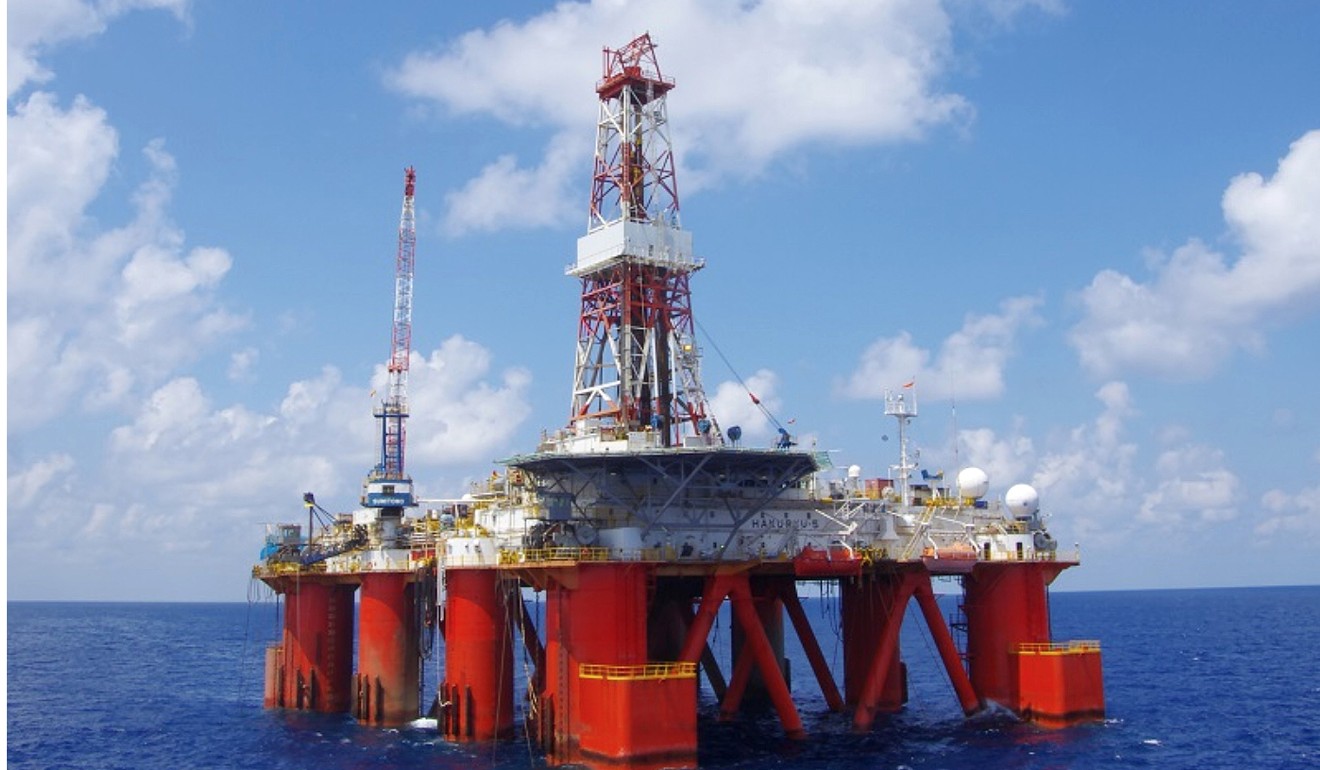
The Japanese oil rig, Hakuryu 5, is reported to have completed its drilling mission near Vanguard Bank earlier this week. Photo: Japan Drilling Co
While in the Vanguard Reef area, the Haiyang Dizhi 8, escorted by heavily armed coastguard vessels, made multiple passes by an oil block operated by Russian energy company Rosneft.
Observers say the presence of the Chinese vessels in the region is part of Beijing’s efforts to prevent Hanoi from partnering with international energy firms to explore energy reserves in the disputed waterway. The latest activity triggered a months-long stand-off between the two countries.
The departure of the Haiyang Dizhi 8 came amid reports that the Japanese oil rig, Hakuryu 5, owned by Tokyo-based Japan Drilling Company and employed by Rosneft, had earlier this week completed a drilling mission it started in May near Vanguard Bank.
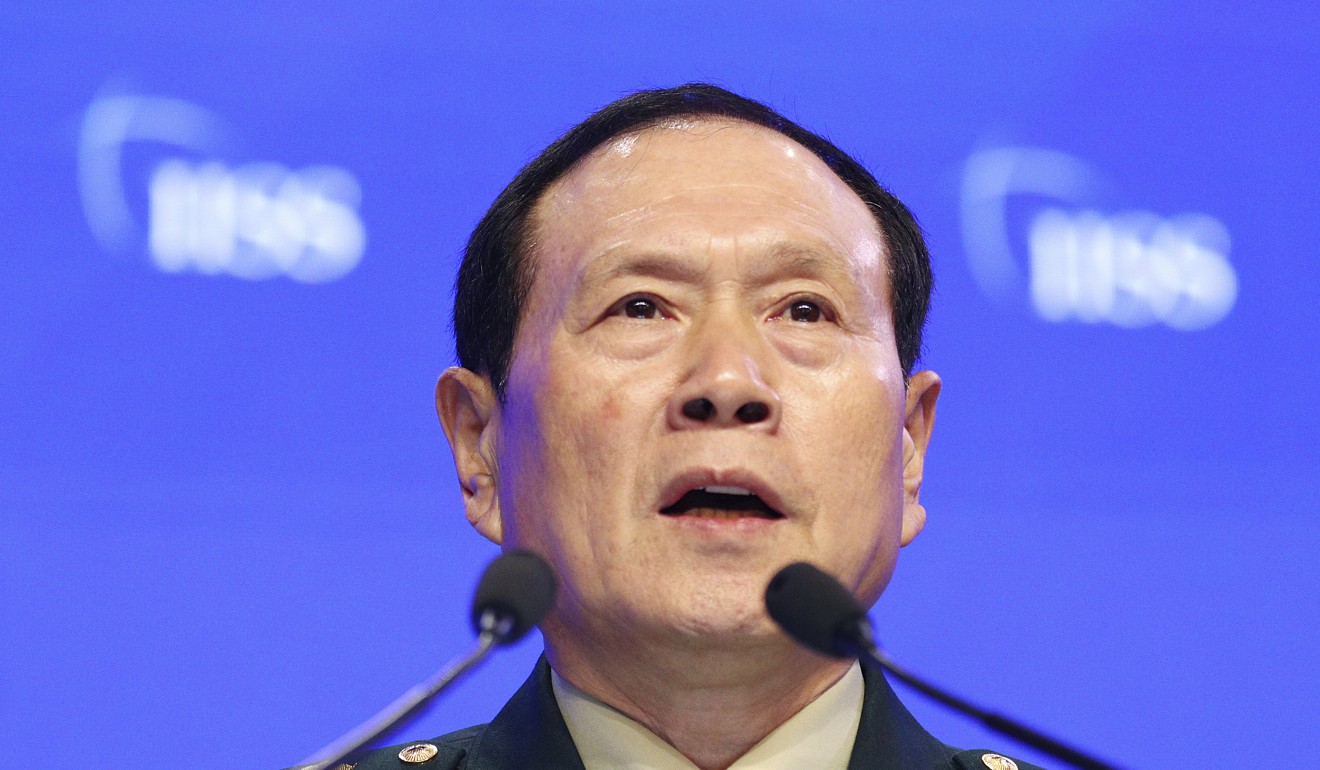
China’s Defence Minister Wei Fenghe told a regional security conference that the South China Sea was an inalienable part of China’s territory. Photo: AP
Although China and Vietnam have said they are looking for a diplomatic solution to prevent confrontations, neither has shown any signs of backing down and tensions have continued to rise.
On Monday, China’s Defence Minister Wei Fenghe told military and defence officials attending a regional security conference in Beijing that the South China Sea was an inalienable part of China’s territory.
“We will not allow even an inch of territory that our ancestors have left to us to be taken away,” he said in his opening speech at the Xiangshan Forum.
Also on Monday, Vietnamese Prime Minister Nguyen Xuan Phuc told lawmakers at the National Assembly that Hanoi would never give any territorial concessions.
“The situation in the South China Sea has become increasingly complicated,” he said. “Our party and state have consistently stated that what belongs to our independence, sovereignty and territorial integrity, we will never give up.”
Last week, Hanoi pulled DreamWorks’ animated film Abominable from theatres over a scene featuring a map that shows Beijing’s self-declared “nine-dash line” in the South China Sea. China uses the U-shaped line to claim sovereignty over more than 80 per cent of the resource-rich waterway, parts of which are also claimed by Vietnam, Malaysia, the Philippines and Brunei.
Ian Storey, a senior fellow at the ISEAS-Yusof Ishak Institute in Singapore, said that the withdrawal of the Haiyang Dizhi might only be “temporary”.
“China has made its point about drilling activities within the nine-dash line and expects Vietnam to suspend further exploration and production activities,” he said. “[But] of course Vietnam won’t.”
China, Malaysia seek to resolve South China Sea disputes with dialogue mechanism
Zhang Mingliang, a specialist in Southeast Asian affairs at Jinan University in the south China city of Guangzhou, said that the Chinese ship’s withdrawal was unlikely to have had anything to do with the comments made by Vietnam.
“I think the main reason is that it had finished its work,” he said. “But the withdrawal could also be seen as an attempt to ease the [China’s] tensions with the US.”
The significance for relations between Beijing and Hanoi was minimal, he said, as the two nations were engaged in one of the world’s most complicated territorial disputes.
“The impact on Sino-Vietnam relations will be limited because there have been too many disputes like this one,” he said.
HANOI (Reuters) – Vietnamese President and Communist Party chief Nguyen Phu Trong has called for restraint in the disputed South China Sea amid a tense months-long standoff between Chinese and Vietnamese ships, state media reported on Tuesday.
China claims almost all the energy-rich waters but neighbours Brunei, Malaysia, the Philippines, Taiwan and Vietnam also have claims.
Tension escalated when Beijing dispatched a research ship to conduct an energy survey in waters controlled by Vietnam in July.
“On the subject of foreign policy, including the East Sea issue, the General Secretary stressed the importance of maintaining a peaceful and stable environment, and resolutely fighting to protect Vietnam’s independence, sovereignty and territorial integrity,” the state-run Voice of Vietnam (VOV) said on its website.
The South China Sea is known as the East Sea in Vietnam.
Vietnam has good relations with China but should “never compromise” on its sovereignty and territorial integrity, VOV quoted Trong as saying.
The Chinese vessel, the Haiyang Dizhi 8, was continuing its survey in Vietnam’s exclusive economic zone late on Tuesday, under escort from at least three Chinese ships, according to data from Marine Traffic, a website that tracks vessel movements.
Vietnam’s foreign ministry has repeatedly accused the vessel and its escorts of violating its sovereignty and has demanded that China remove its ships from the area.
On Sunday, Vietnam pulled DreamWorks’ animated film “Abominable” from cinemas over a scene featuring a map which shows China’s unilaterally declared “nine-dash line” in the South China Sea.
The U-shaped line is used on Chinese maps to illustrate its claims, including large swathes of Vietnam’s continental shelf, where it has awarded oil concessions.
In August, police broke up a brief protest outside the Chinese embassy in Hanoi over the survey vessel.
Trong has made more public appearances in recent weeks after suffering from an unspecified illness..
The 75-year-old has presided over a widespread crackdown on corruption in the Southeast Asian country that has seen several high-ranking ministers and politicians, including one Politburo member, sent to prison on charges ranging from embezzlement to economic mismanagement.
Operations aimed to caution Beijing that US forces can carry out amphibious campaigns far from home
Washington has power to intervene directly in territorial disputes between its allies and China
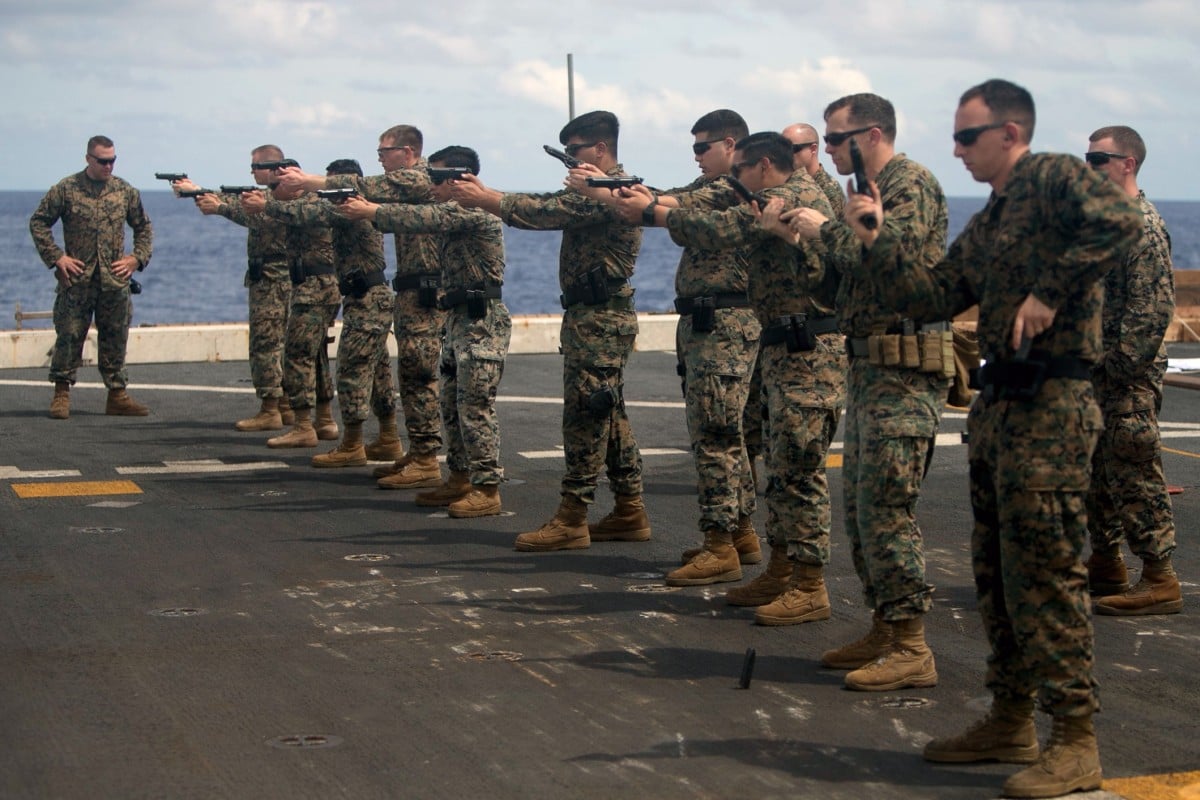
US Marines practise speed reloads on August 9 aboard the USS Green Bay, part of the Wasp Amphibious Ready Group, in the Indo-Pacific region. Photo: Handout
US Marines have conducted airfield- and island-seizure drills in the East and South China seas in what observers say is meant to remind Beijing of US military supremacy in the Asia-Pacific.
The 11-day naval drills were conducted near the Philippines and around the Japanese island of Okinawa by Okinawa-based US marine expeditionary units, the 31st Marine Expeditionary Unit said.
Observers said the operations were meant as a warning to Beijing that the US military could carry out amphibious campaigns far from home if Washington needed to intervene in territorial disputes between China and America’s allies in the region.
The 31st Marine Expeditionary Unit and Amphibious Squadron 11 conducted joint weapons drills from their Wasp Amphibious Ready Group ships from August 9-19, the Okinawa-based marine unit said in a statement.
The activity took place in the Philippine and East China seas and around an American naval base in Japan, it said.
The unit’s Amphibious Reconnaissance Platoon also performed a reconnaissance and surveillance mission through a high-altitude, low-opening parachute jump onto Okinawa.
A tilt-rotor aircraft, which hovers like a helicopter but flies like an aeroplane, afterward sent a landing team from a Wasp ship more than 400km (250 miles) away to establish the arming and refuelling point. The team achieved its objective in just over one hour, the statement said.
“The speed with which the Marines were able to establish the forward arming and refuelling point demonstrates a capability that is critical to conducting expeditionary operations in a contested environment,” the statement quoted Lieutenant Guirong Cai, a FARP officer-in-charge from the Marine Air Traffic Control Mobile Team, as saying.
“Their proficiency in swiftly setting up a refuelling point with 5,500 pounds (2.5 tonnes) of fuel demonstrates the 31st MEU’s ability to rapidly refuel and redeploy our air assets as the mission requires.”
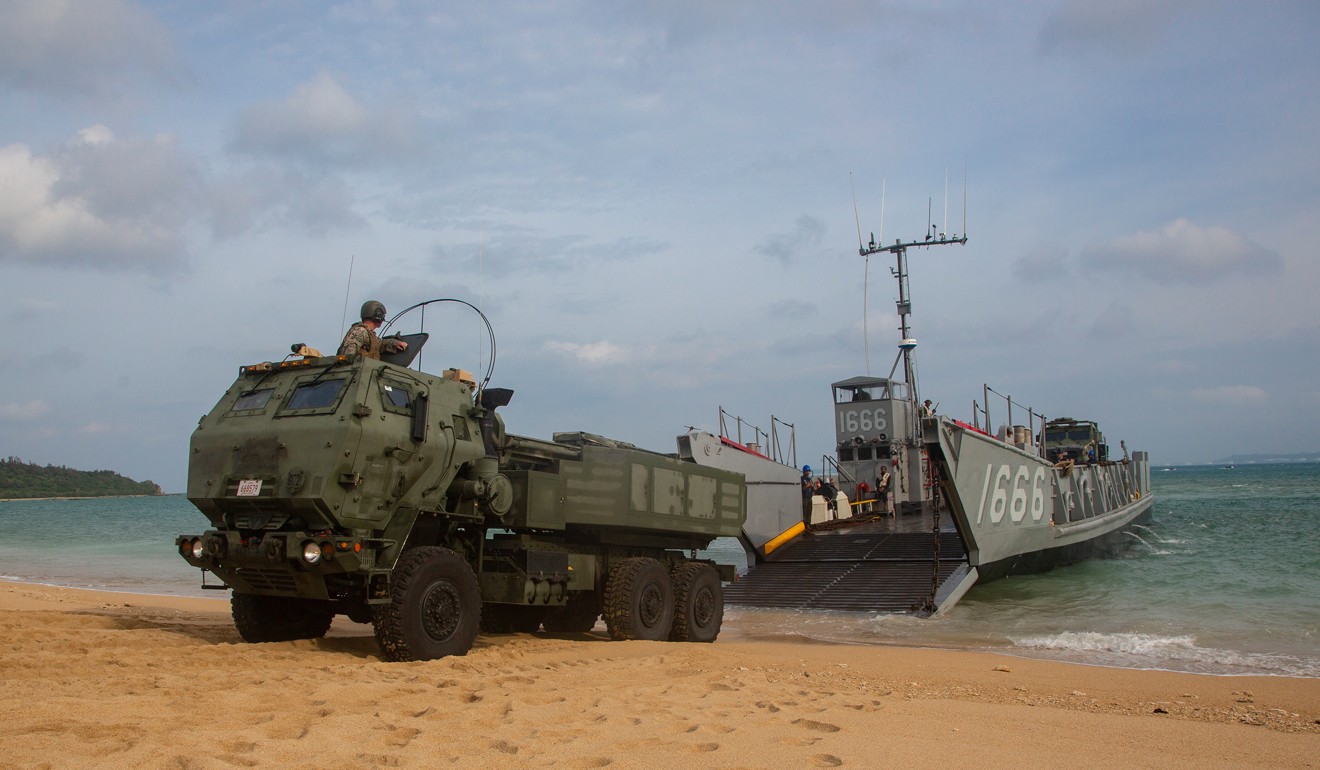
A US landing craft lowers its ramp to unload a high mobility artillery rocket system as part of a simulated amphibious raid at Kin Blue on Okinawa on August 14. Photo: Handout
China has a territory dispute with Japan over Diaoyu Islands, known as the Senkakus in Japan, in the East China Sea, while both Beijing and Manila have put in claims on the Scarborough Shoal – also known in China as Huangyan Dao – in the South China Sea.
Adam Ni, a China specialist at Sydney’s Macquarie University, said the drills near the Philippines and Okinawa showed that such a campaign would encompass a wide area, including the South and East China seas, where the US has joined other countries in the region to conduct freedom of navigation operations since 2015.
Maritime drills between US, Asean coincide with rising tensions
“It is a clear reminder to China of US military supremacy despite the narrowing of gaps in military capability in recent years,” Ni said. “The message is that the US military can still take China-controlled South China Sea features in high-intensity conflict.”
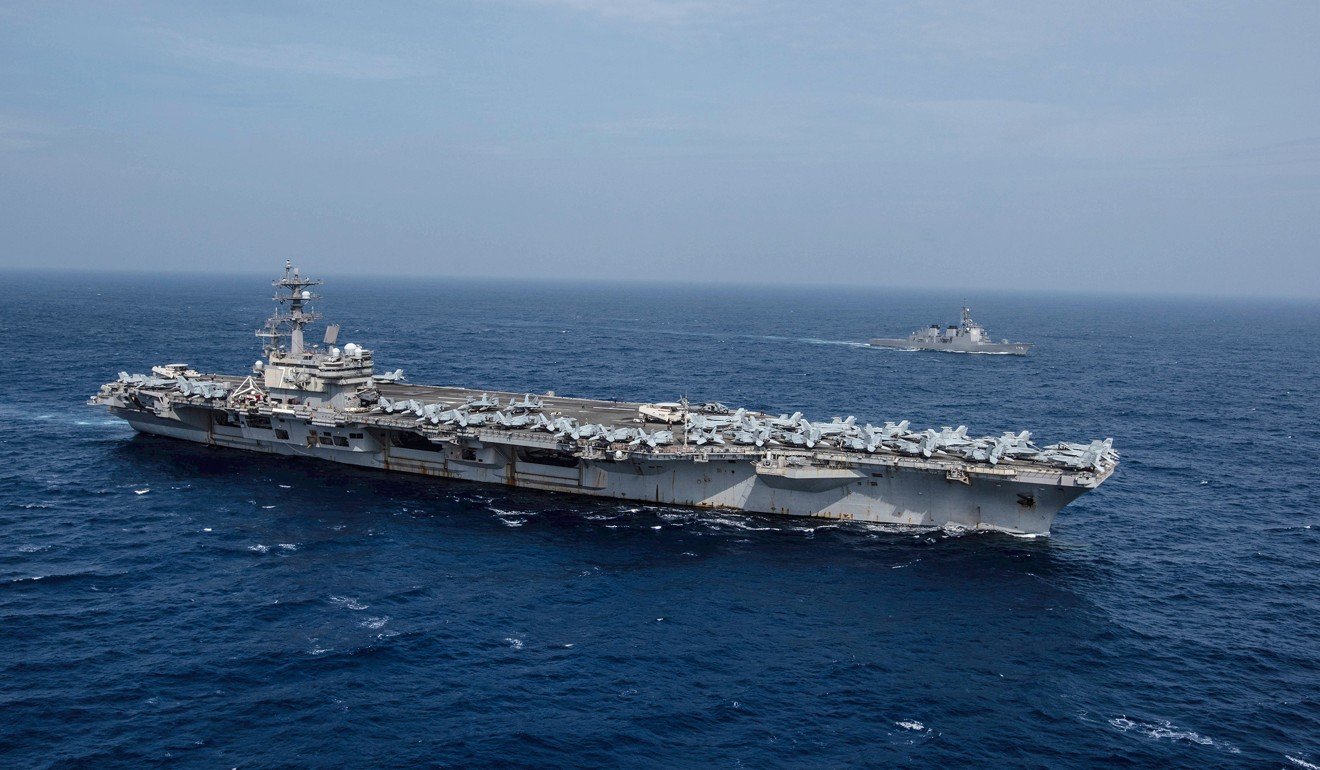
The USS Ronald Reagan aircraft carrier sails alongside a Japan Maritime Self-Defence Force guided-missile destroyer during drills. Photo: Handout
The statement did not say whether the Philippine navy and Japanese maritime self-defence force took part in the drills. But Hong Kong-based military commentator Song Zhongping said the US government would call on its two allies to observe the exercises.
“Whether Washington will intervene in territorial disputes between China and the Philippines as well as China and Japan, the American [military] has used [these drills] to strengthen its island-capture and airfield seizure capabilities in unfamiliar waters and areas,” Song said.
“To show its close relationship with and commitments to Manila and Tokyo, the Americans would invite the two allies to watch the drills. That could also be a good time to sell their amphibious warships and new model aircraft to Japan.”
During the drills, 10 simulated casualties were treated by three medical technicians from the US Air Force’s special operations group and given blood transfusions before being loaded onto a KC-130 transport aircraft for in-flight medical treatment en route to Marine Corps Air Station Futenma on Okinawa, the US Marines said.
BEIJING (Reuters) – China and Malaysia have agreed to set up a joint dialogue mechanism for the disputed South China Sea, the Chinese government’s top diplomat said on Thursday after meeting Malaysia’s foreign minister.
Recent Chinese naval deployments in the strategic waterway, through which more than $3.4 trillion worth of goods are transported annually, have reignited tension with Vietnam and the Philippines. Malaysia, Brunei and Taiwan also have competing claims in the South China Sea.
Malaysia had been critical of China’s South China Sea position, but has not been excessively outspoken recently, especially after China pumped in billions of dollars into infrastructure projects under its Belt and Road Initiative.
Malaysia regularly tracked Chinese naval and coastguard vessels entering Malaysia’s territorial waters, but China respects Malaysia and had “not done anything that caused us trouble, so far”, Defence Minister Mohamad Sabu told Reuters last month.
Chinese State Councillor Wang Yi told a news conference with Malaysian Foreign Minister Saifuddin Abdullah that this year, tensions in the South China Sea had dropped.
Littoral states and China were committed to continue appropriately handling the South China Sea issue and jointly safeguard peace and stability there, said Wang, who is the Chinese government’s top diplomat.
“To this end, our two sides have agreed to set up a bilateral consultation mechanism for maritime issues, a new platform for dialogue and cooperation for both sides,” he said.
Abdullah, who referred to Wang as “my brother”, said the mechanism would be led by the two countries’ foreign ministries.
“Our officers will be discussing the details, but I think this is one important outcome of the meeting today and also the 45 years of our diplomatic relations,” he said.
China is debt-heavy Malaysia’s biggest trade partner and the countries have close cultural ties too.
In July, China and Malaysia resumed construction on a train project in northern Malaysia, which is part of China’s Belt and Road plan, after a year-long suspension and following a rare agreement to cut its cost by nearly a third, to about $11 billion.
Deity has all the necessary travel documents for seven-day journey bringing blessings to coastal communities
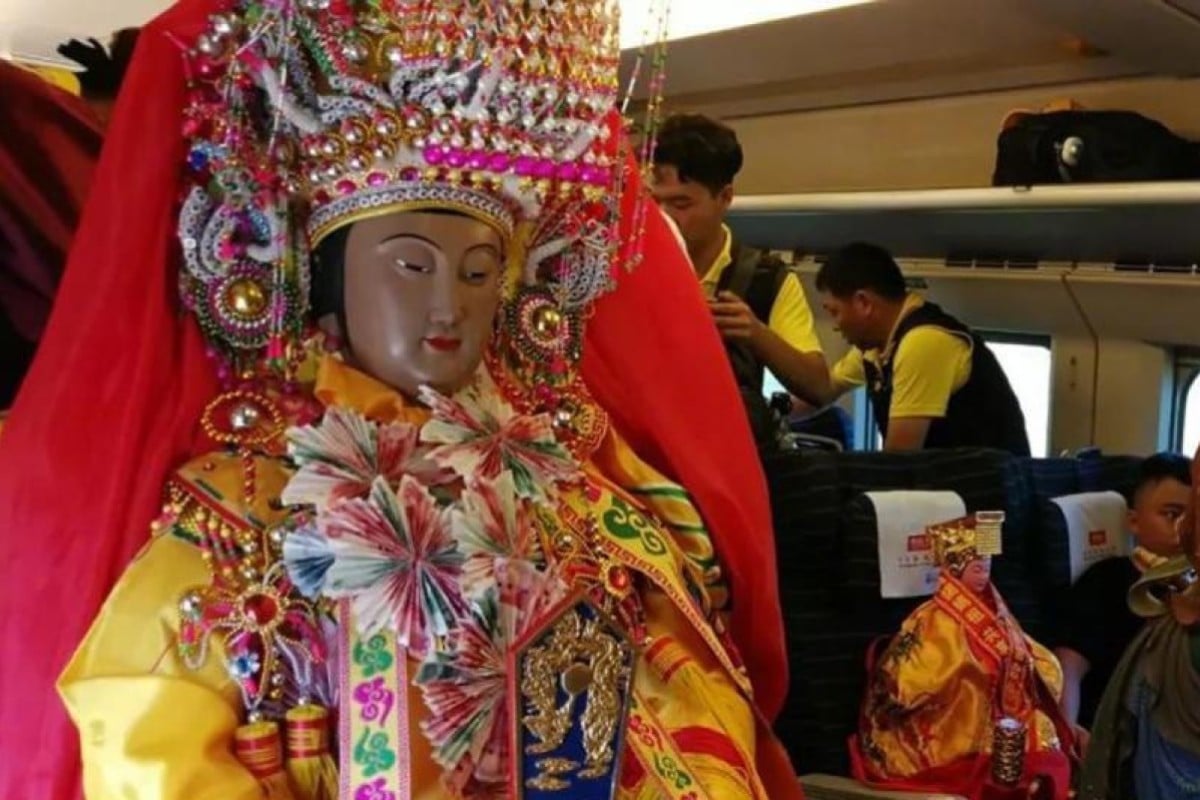
The statue of Chinese sea goddess Mazu on board the train for her seven-day tour of eastern China. Photo: Weibo
High-speed rail travellers in eastern China may find themselves in exalted company this week as one of China’s most beloved deities is on a seven-day tour.
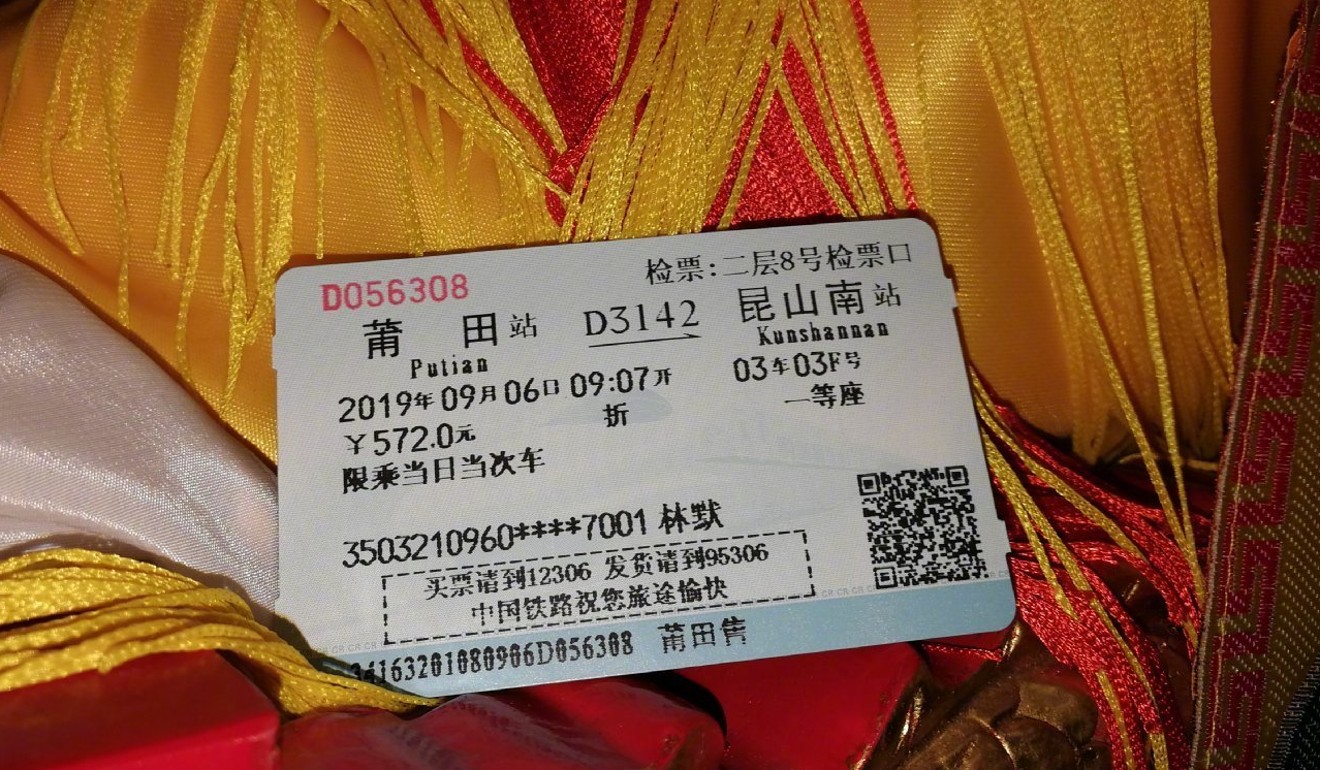
Mazu, protector of seafarers, boarded the train at Putian in Fujian province on Friday with an entourage of 230 worshippers for one of her regular “inspection tours”. And, like any modern traveller, the sea goddess had the necessary identity card and ticket for the journey.
Mazu, known as Tin Hau in Hong Kong, began life more than 1,000 years ago as a mortal named Lin Mo, according to Chinese folk belief. As a girl she is said to have saved some of her family members when they were caught in a typhoon while out fishing. In another version of the myth, Lin Mo died while trying to rescue shipwreck victims.
She fell out of favour in mainland China during the Cultural Revolution, when her ancestral temple on Meizhou Island in the southeastern province of Fujian was destroyed to make way for a People’s Liberation Army garrison. In the late 1970s the temple was rebuilt and in 2009 the beliefs and customs surrounding Mazu were recognised as an Intangible Cultural Heritage of Humanity by Unesco.
Inspectors on China’s high speed rail will find everything in order if they ask to see the goddess Mazu’s ticket during her seven-day tour. Photo: Weibo
Staff at the Meizhou Mazu Temple applied for an ID card for the goddess, in her earthly name of Lin Mo. Tickets were also organised for two other fairy figures who traditionally protect her, according to Chinese folklore.
“Not only Mazu but Thousand-Mile Eye and Wind-Accompanying Ear were all bought tickets,” a temple representative told the Southern Metropolis News.
This is not the first time the trio have been bought travel tickets. Two years ago their airfares were paid for when they visited Malaysia and Singapore and, a year later, they took a cruise ship to the Philippines.
This year’s tour includes a visit to Kunshan in Jiangsu and Shanghai, before Mazu returns to her home temple on the island of Meizhou. At each stop, devotees believe Mazu blesses the location with her presence and protects its residents from harm.
Taiwanese tycoon Gou thanks sea goddess for presidential inspiration
The tour has been organised jointly by the Meizhou Temple as well as the Huiju Mazu Temple in Kunshan and the Lugang Mazu Temple in Taiwan.
News of the celestial train journey quickly went viral on Chinese social media, with posts on Mazu receiving 460 million views on Weibo, the Twitter-like microblogging platform, since Monday. “First, respect. Second, she takes up a seat so it’s not crazy to buy her a ticket,” one comment read.







 CHINDIA ALERT: You'll be living in their world, very soon