Archive for ‘photo’

02/05/2020

China plans to send Uygur Muslims from Xinjiang re-education camps to work in other parts of country

  • Inmates who have undergone compulsory re-education programme to be moved to other parts of China under job placement scheme delayed by Covid-19 outbreak
  • Critics have said the camps are a move to eradicate cultural and religious identity but Beijing has defended them as way of boosting job opportunities and combating Islamic radicalisation
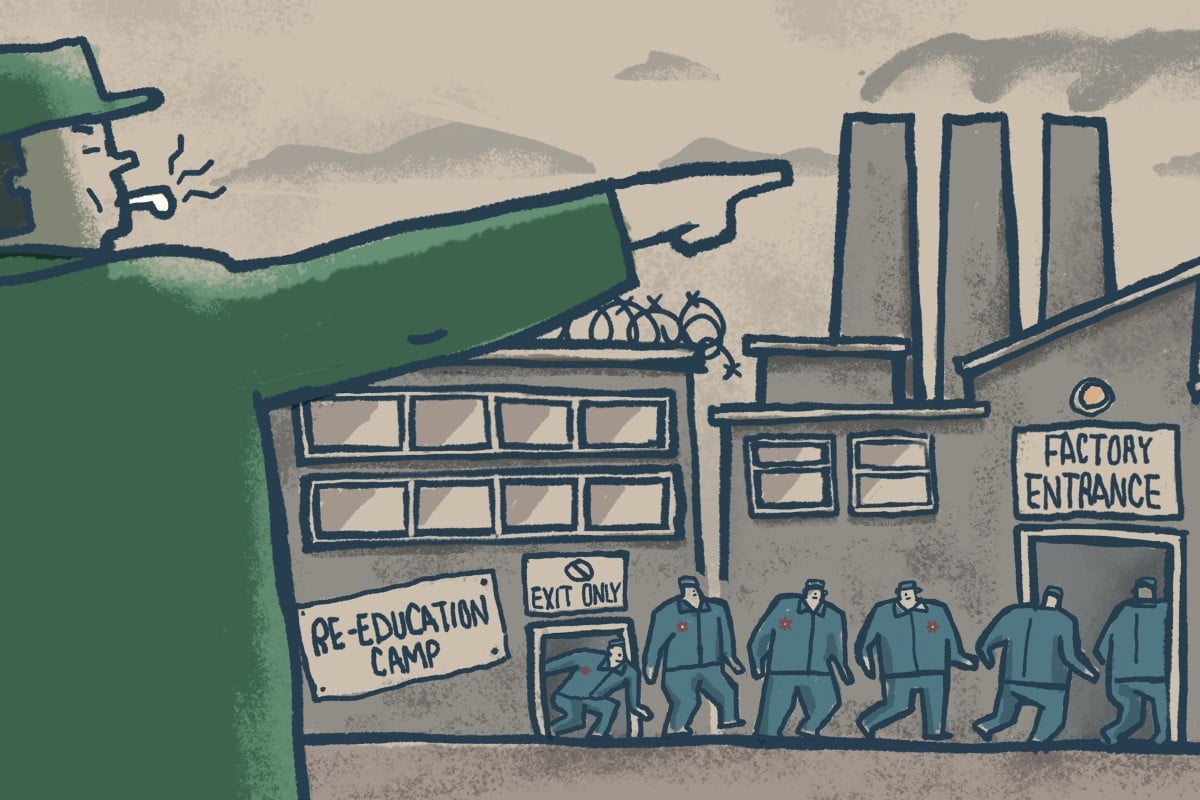
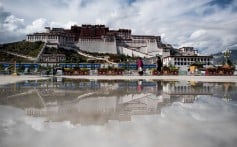
Illustration by Perry Tse

The Chinese government has resumed a job placement scheme for tens of thousands of Uygur Muslims who have completed compulsory programmes at the “re-education” camps in the far-western region of Xinjiang, sources said.

The plan, which includes a quota for the numbers provinces must take, was finalised last year but disrupted by the outbreak of Covid-19.

The delay threatens to undermine the Chinese government’s efforts to justify its use of internment camps in Xinjiang.

Critics have said these camps were part of the measures designed to eradicate the ethnic and cultural identity of Uygurs and other Muslim minorities and that participants had no choice but to undertake the re-education programme.
Beijing has repeatedly dismissed these criticisms and said the camps are to give Uygurs the training they need to find better jobs and stay away from the influence of radical fundamentalism.
First Xinjiang, now Tibet passes rules to promote ‘ethnic unity’
17 Feb 2020

Now with the disease under control, the Chinese government has resumed the job placement deal for other provinces to absorb Xinjiang labourers, sources said.

Despite the devastating impact of the disease on its economy and job markets, the Chinese authorities are determined to go ahead with the plan, which they believe would

“demonstrate the success of Xinjiang’s re-education centres policy”

, a source said.

“Excellent graduates were to be taken on as labourers by various inland governments, in particular, 19 provinces and municipalities,” said the source. It is unclear what constitutes “excellent graduates”.

Some sources earlier said that the programme may be scaled back in light of the new economic reality and uncertainties.

But a Beijing-based source said the overall targets would remain unchanged.

“The unemployment problem in Xinjiang must be resolved at all costs, despite the outbreak,” the source said.

The South China Morning Post has learned that at least 19 provinces and cities have been given quotas to hire Muslim minorities, mostly Uygurs, who have “graduated” from re-education camps.

As early as February, when the daily number of infections started to come down outside Hubei province, China already begun to send Uygur workers to their new jobs.

A photo taken in February showed thousands of young Uygurs, all wearing face masks and with huge red silk flowers pinned to their chests, being dispatched to work in factories outside their hometowns.

By the end of February, Xinjiang alone has created jobs for more than 60,000 Uygur graduates from the camps. A few thousand were also sent to work in other provinces.

Many have been employed in factories making toys and clothes.

Xinjiang’s new rules against domestic violence expand China’s ‘extremism’ front to the home

7 Apr 2020

Sources told the Post that the southern city of Shenzhen – China’s hi-tech manufacturing centre – was given a target last year to eventually resettle 50,000 Uygurs. The city is allowed to do this in several batches, with 15,000 to 20,000 planned for the first stage.

Shaoguan, a less developed Guangdong city where a deadly toy factory brawl between Uygurs and Han Chinese broke out in 2009, was also asked to take on another 30,000 to 50,000 Uygur workers.
In Fujian province, a government source also said they had been told to hire “tens of thousands of Xinjiang workers”.
“I heard the first batch of several thousands would arrive soon. We have already received official directives asking us to handle their settlement with care,” said the source.

He said the preparation work includes providing halal food to the workers as well as putting in place stronger security measures to “minimise the risks of mass incidents”. It is not known whether they will be given access to prayer rooms.

There are no official statistics of how many Uygurs will be resettled to other provinces and the matter is rarely reported by the mainland media.

But in March, Anhui Daily, the province’s official newspaper, reported that it had received 1,560 “organised labourers from Xinjiang”.

The Uygur workers on average could earn between 1,200 yuan (US$170) to 4,000 yuan (US$565) a month, with accommodation and meals provided by the local authorities, according to Chinese media reports.

However, they are not allowed to leave their dormitories without permission.
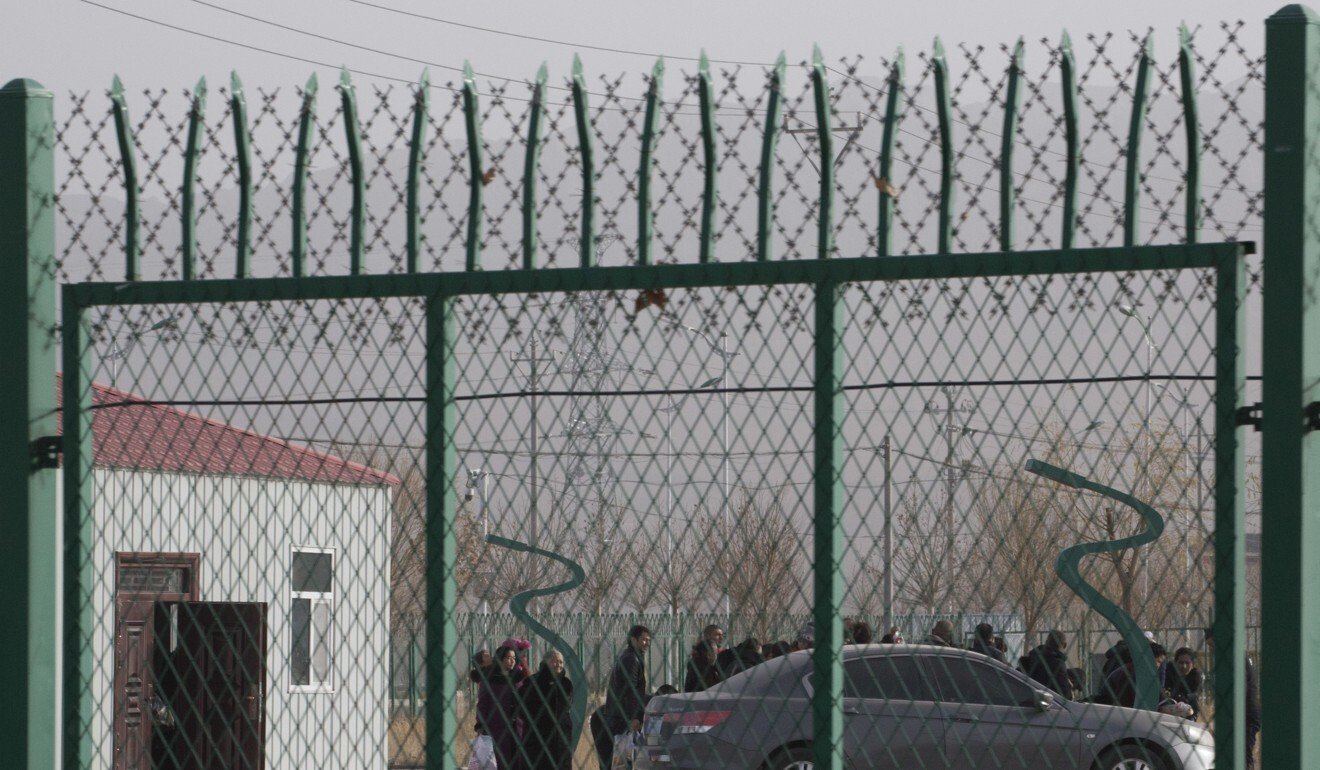
The UN has estimated that up to a million Muslims were being held in the camps. Photo: AP
Xinjiang’s per capita disposable income in 2018 was 1,791 yuan a month, according to state news agency Xinhua. But the salary level outside the region’s biggest cities such as Urumqi may be much lower.
The official unemployment rate for the region is between 3 and 4 per cent, but the statistics do not include those living in remote rural areas.
Mindful of the potential risks of the resettlement, Beijing has taken painstaking efforts to carefully manage everything – from recruitment to setting contract terms to managing the workers’ day-to-day lives.
Local officials will go to each Uygur workers’ home to personally take them to prearranged flights and trains. On arrival, they will be immediately picked up and sent to their assigned factories.
US bill would bar goods from Xinjiang, classifying them the product of forced labour by Uygurs
12 Mar 2020

Such arrangements are not unique to Uygurs and local governments have made similar arrangements for ethnic Han workers in other parts of China.

After screening them for Covid-19, local governments have arranged for workers to be sent to their workplaces in batches. They are checked again on arrival, before being sent to work.

China is accelerating such placement deals on a massive scale to offset the impact of the economic slowdown after the outbreak.

Sources told the South China Morning Post that the job placement deal was first finalised by governments in Xinjiang and other provinces last year.

The aim is to guarantee jobs for Uygur Muslim who have “completed vocational training” at the re-education camps and meet poverty alleviation deals in the region, one of the poorest parts of China.

The training they receive in the camps includes vocational training for various job types such as factory work, mechanical maintenance and hotel room servicing. They also have to study Mandarin, Chinese law, core party values and patriotic education.

Xinjiang’s massive internment camps have drawn widespread international condemnation.

The United Nations has estimated that up to 1 million Uygur and other Muslim minority citizens are being arbitrarily detained in the camps, which Beijing insists are necessary to combat terrorism and Islamic radicalisation.

Late last year, Xinjiang’s officials announced that all the inmates of these so-called vocational training centres had “graduated” and taken up employment.

Before this labour placement scheme was introduced, it was extremely difficult for Uygurs to find jobs or live and work in inland regions.

The 2009 brawl at the factory in Shaoguan was one of the factors that triggered a deadly riot in Xinjiang’s capital Urumqi, that left 192 people dead and more than 1,000 wounded.

Muslim ethnic minorities, Uygurs in particular, have been subjected to blatant discrimination in China and the situation worsened after the 2009 clashes.

Earlier this month, the Australian Strategic Policy Institute released a report saying more than 80,000 Uygurs had been moved from Xinjiang to work in factories in nine Chinese regions and provinces.

It identified a total of 27 factories that supplied 83 brands, including household names such as Google, Apple, Microsoft, Mitsubishi, Siemens, Sony, Huawei, Samsung, Nike, Abercrombie and Fitch, Uniqlo, Adidas and Lacoste.

‘Psychological torture’: Uygurs abroad face mental health crisis over plight of relatives who remain in Xinjiang

11 Mar 2020

The security think tank concluded that the Chinese government had transferred Uygur workers “under conditions that strongly suggest forced labour” between 2017 and 2019, sometimes drawing labourers directly from re-education camps.

The report also said the work programme represents a “new phase in China’s social re-engineering campaign targeting minority citizens”.

Workers were typically sent to live in segregated dormitories, underwent organised Mandarin lessons and ideological training outside working hours and were subject to constant surveillance, the researcher found.

They were also forbidden from taking part in religious observances, according to the report that is based on open-source documents, satellite pictures, academic research and on-the-ground reporting.

Chinese foreign ministry spokesman Zhao Lijian criticised the report saying it had “no factual basis”.

Source: SCMP
17/11/2019

The truth behind India’s viral photo that got a girl into school

The viral photo in the newspaperImage copyright EENADU NEWSPAPER/A SRINIVAS
Image caption The photo that sparked an outcry

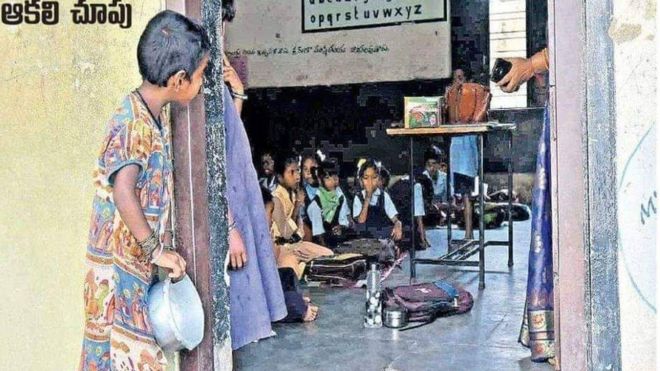
A five-year-old in the southern city of Hyderabad was enrolled in school after a photo of her peeking into a classroom sparked an outcry. BBC Telugu’s Deepthi Bathini reports on why the photo doesn’t tell the full story.

Divya is something of a local celebrity in the slum where she lives. The shy five-year-old was the subject of a recent photo which went viral – it showed her clutching a bowl and peeking into a classroom at the local government school.

The touching image was published in a Telugu newspaper on 7 November with a caption that translates from the Telugu as “hungry gaze”.

It quickly grabbed people’s attention: a children’s rights activist shared it on Facebook, lamenting that yet another child was being denied the right to food and education.

It had such an impact, the school enrolled Divya the following day.

But her father, M Lakshman, says the photo and the outcry it provoked was in fact unfair to him and his wife, Yashoda, who works as a sweeper.

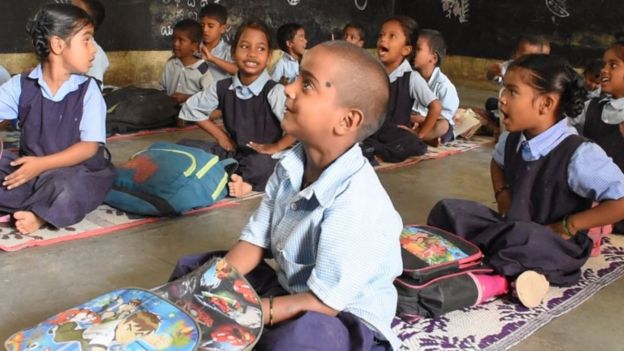
Divya in school
Image caption Five-year-old Divya enrolled in school after a photo of her in a newspaper went viral

“I felt sad when I saw the photo,” he told the BBC. “Divya has parents and we are working so hard to give her a good future – but she was portrayed as a hungry orphan.”

Mr Lakshman says he was waiting for Divya to turn six so he could enrol her in a government hostel where his other two daughters are studying. The couple also have a son, who has finished school and is now applying to college while helping Mr Lakshman, who works as a rag picker.

Breaking the cycle

Divya and her parents live in a one-room hut in a shanty town in the heart of Hyderabad. The slum is about 100 metres from the government school, where Divya was photographed. Most of the 300 families living here are daily wage labourers and their children attend the school nearby.

The home is sparse and plastic and glass are piled outside, ready to be sold for recycling. He says between him and his wife, they earn about 10,000 rupees ($139; £108) a month, which pays for their food and clothes. Education, however, is free for the children, since they are all enrolled in government-run schools.

Mr Lakshman knows what it is to struggle: he himself grew up without parents and always battled to earn a decent living. “I never wanted my children to have the life I had. So I made sure they all go to school.”

The photo, he adds, was especially hurtful because he has also been taking care of his brother’s five children.

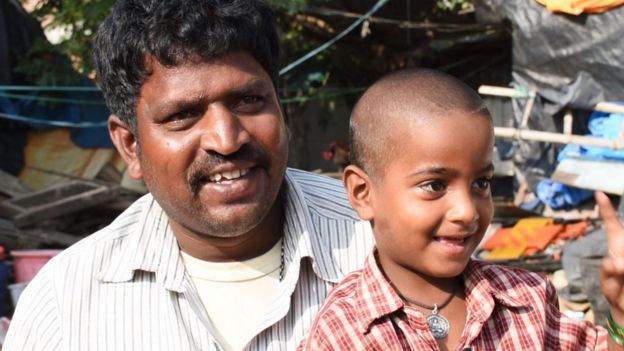
Divya with her father
Image caption Divya’s father said the outcry over the photo was “unfair” to his family

“My brother and sister-in-law passed away sometime ago. I didn’t want their five children to grow up as orphans. So, I enrolled all of them in a hostel and I take care of them.”

When asked why Divya had gone to the government school with a bowl in hand, Mr Lakshman explains that a lot of the younger children from the slum go there around lunch time to take advantage of the free midday meal – a government programme which provides cooked meals to children in more than a million schools – which they know about because their older brothers and sisters are already enrolled.

“Divya doesn’t go every day but she happened to go on that day and someone photographed her,” he explained.

This was confirmed by teachers at the school who told the BBC that some children brought lunch from home, so leftovers over from the free meal scheme would be given to the younger children who had not yet joined.

“Children are children. And there is no day-care centre, so a lot of these children hang around the school anyway,” says one teacher, who spoke on the condition of anonymity.

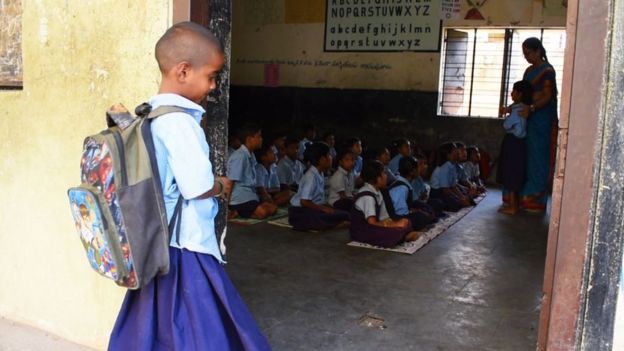
Divya in her new school
Image caption Divya says she’s excited to go to school

Mr Lakshman and his neighbours acknowledged the lack of an anganwadi, or government-sponsored day-care centre, in the neighbourhood was a major problem as parents had no place to leave their children so they could go to work.

The local school inspector, SU Shivram Prasad, says he hopes the attention generated by the Divya’s photo will hasten the process of setting up one up.

“It will help the parents and the children can eat a nutritious meal,” he adds.

Teachers at the school also hope that the media spotlight will improve facilities. They say there is an acute shortage of staff and teaching materials, and the school did not even have a compound wall, which meant they have to constantly watch the children during their breaks.

Divya, however, is excited to be going to school. She insists on taking her school bag with her everywhere, even to the playground. Other than saying her name, she does not answer any questions.

“She is a very calm child,” says Mr Lakshman, as his daughter holds his hand and kisses it.

And he admits that despite everything, the photo did do some good.

“Now other children who are Divya’s age are also enrolling in school. So that makes me happy.”

Source: The BBC

05/11/2019

Chinese pilot banned from flying after passenger cockpit photo

Photo taken from microblogging site WeiboImage copyright WEIBO/SCREENSHOT
Image caption The female passenger is seen here with her fingers in a V pose, also known as the peace sign

A Chinese pilot has been banned from flying after a photo went viral showing a female passenger in the cockpit.

The photo was taken in January on an Air Guilin flight from Guilin city to Yangzhou city, state media said, but was widely shared this week – causing the airline to take action.

It shows a woman posing in the cockpit with refreshments laid out next to her.

Air Guilin said in a statement the pilot had violated air safety regulations.

‘Thanks to the captain’

The incident took place on 4 January on flight GT1011 from Guilin city to Yangzhou city, according to state media outlet The Global Times.

But it was brought to the airline’s attention on Sunday after screenshots of the alleged passenger’s post started being shared widely on micro-blogging site Weibo.

The post showed the woman making a V sign with her fingers – a popular pose in China – with the photo captioned: “Thanks to the captain. So happy.”

The woman is rumoured to be a flight attendant in training at a Guilin university, according to news site Chinese News Service.

Air Guilin did not specify if the photo was taken mid-flight, but Chinese pilots and analysts said the photo appears to have been taken during the flight.

The pilot, who was not named, has been banned from flying for life, though it is unclear if he was fired from all roles by the airline.

Air Guilin said in a statement that he had “violated [regulations] by allowing irrelevant personnel into the cockpit”.

According to the Civil Aviation Administration of China, passengers are not allowed to enter the cockpit without special approval or under “necessary” circumstances.

Other staff members involved in the incident have also been “suspended indefinitely” while further investigations are held.

“Passengers’ safety is always Air Guilin’s priority. We take a zero-tolerance approach against any inappropriate and unprofessional behaviour that might risk the aviation safety,” the Chinese carrier said.

Last year, Chinese carrier Donghai Airlines suspended a pilot for six months and revoked his qualifications as a flight instructor after he allowed his wife to go inside the cockpit.

Source: The BBC

04/10/2019

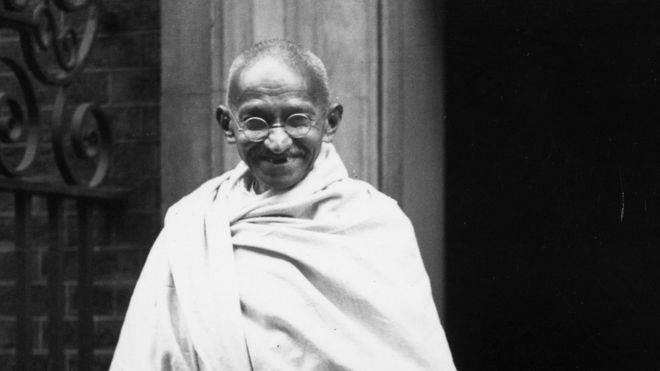
Gandhi’s ashes stolen and photo defaced on 150th birthday


Indian leader Mahatma Gandhi outside Ten Downing Street, London, in 1931Image copyright GETTY IMAGES
Image caption Mahatma Gandhi led the fight for India’s independence from British colonial rule

Thieves stole some of Mahatma Gandhi’s remains on what would have been his 150th birthday, police say.

The ashes were taken from a memorial in central India, where they had been kept since 1948 – the year of Gandhi’s assassination by a Hindu extremist.

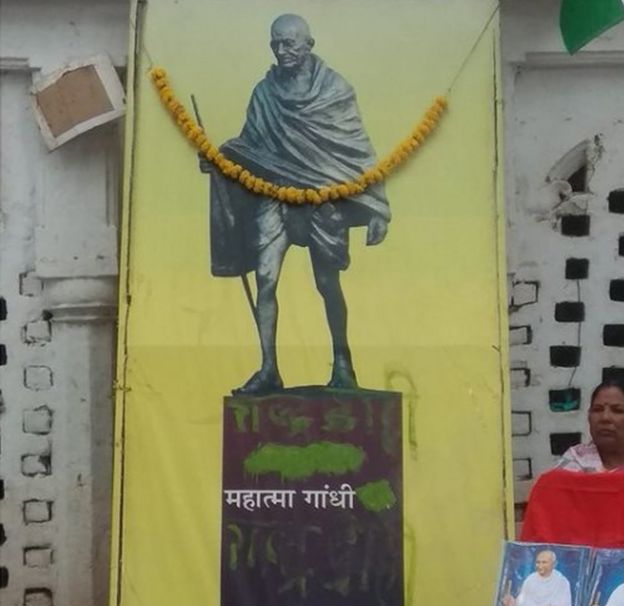
The thieves also scrawled “traitor” in green paint across photographs of the independence leader.

Some Hindu hardliners view Gandhi as a traitor for his advocacy of Hindu-Muslim unity.

This is despite Gandhi being a devout Hindu himself.

Police in Rewa, in Madhya Pradesh state, confirmed to BBC Hindi’s Shuriah Niazi that they were investigating the theft on the grounds of actions “prejudicial to national integration” and potential breach of the peace.

Mangaldeep Tiwari, caretaker of the Bapu Bhawan memorial, where the ashes were being held, said the theft was “shameful”.

“I opened the gate of the Bhawan early in the morning because it was Gandhi’s birthday,” he told Indian website The Wire. “When I returned at around 23:00 [17:30 GMT], I found the mortal remains of Gandhi missing and his poster was defaced.”

Police took action after Gurmeet Singh – leader of the local Congress political party – filed a complaint.

“This madness must stop,” Mr Singh told The Wire. “I urge Rewa police to check CCTV cameras installed inside Bapu Bhawan.”

The poster with green paint on it at the memorial
Image caption The thieves are believed to have also scrawled “traitor” across Gandhi’s photograph
Gandhi led a non-violent resistance movement against British colonial rule in India, inspiring people across the world.

Most Indians still revere him as the “father of the nation”.

But Hindu hardliners in India accuse Gandhi of having betrayed Hindus by being too pro-Muslim, and even for the division of India and the bloodshed that marked Partition, which saw India and Pakistan created after independence from Britain in 1947.

He was assassinated by a Hindu extremist in January 1948.

After his death, he was cremated, but his ashes were not scattered in a river, in accordance with Hindu belief.

Because of his fame, some were held back and sent around the country to various memorials – including the one in the Bapu Bhawan.

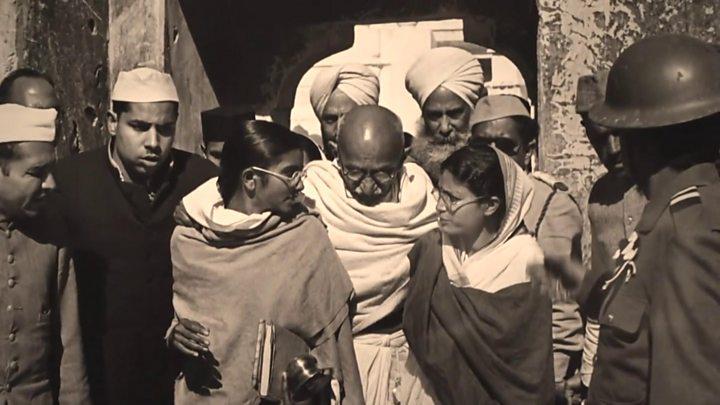
Media caption How Gandhi’s last day was photographed

Source: The BBC

Law of Unintended Consequences

continuously updated blog about China & India

ChiaHou's Book Reviews

continuously updated blog about China & India

What's wrong with the world; and its economy

continuously updated blog about China & India