09/07/2019
- Ambassador to China Vikram Misri says they will be ‘meeting more and more in common waters’, and more exchanges are needed
- He also says preparations are under way for President Xi Jinping to visit India
The INS Kolkata arrives in Qingdao for PLA Navy 70th anniversary celebrations in April.
The Indian ambassador called for more communication between the two navies. Photo: Reuters
The Chinese and Indian navies should establish communication because they are increasingly operating within close proximity, according to India’s ambassador to China.
While the two nations’ militaries communicated extensively, it was mainly between their land forces, and that should be extended to the navies and air forces, Vikram Misri said.
“We need to talk about the two air forces and the two navies – especially the two navies – because we are operating in the same waters and increasingly in the coming years, we will be meeting more and more in common waters,” Misri said.
“I think it is important for us to develop those levels of understanding and communication,” he said. “There are some [navy and air force] exchanges now, but not as well developed as in the case of the land force.”
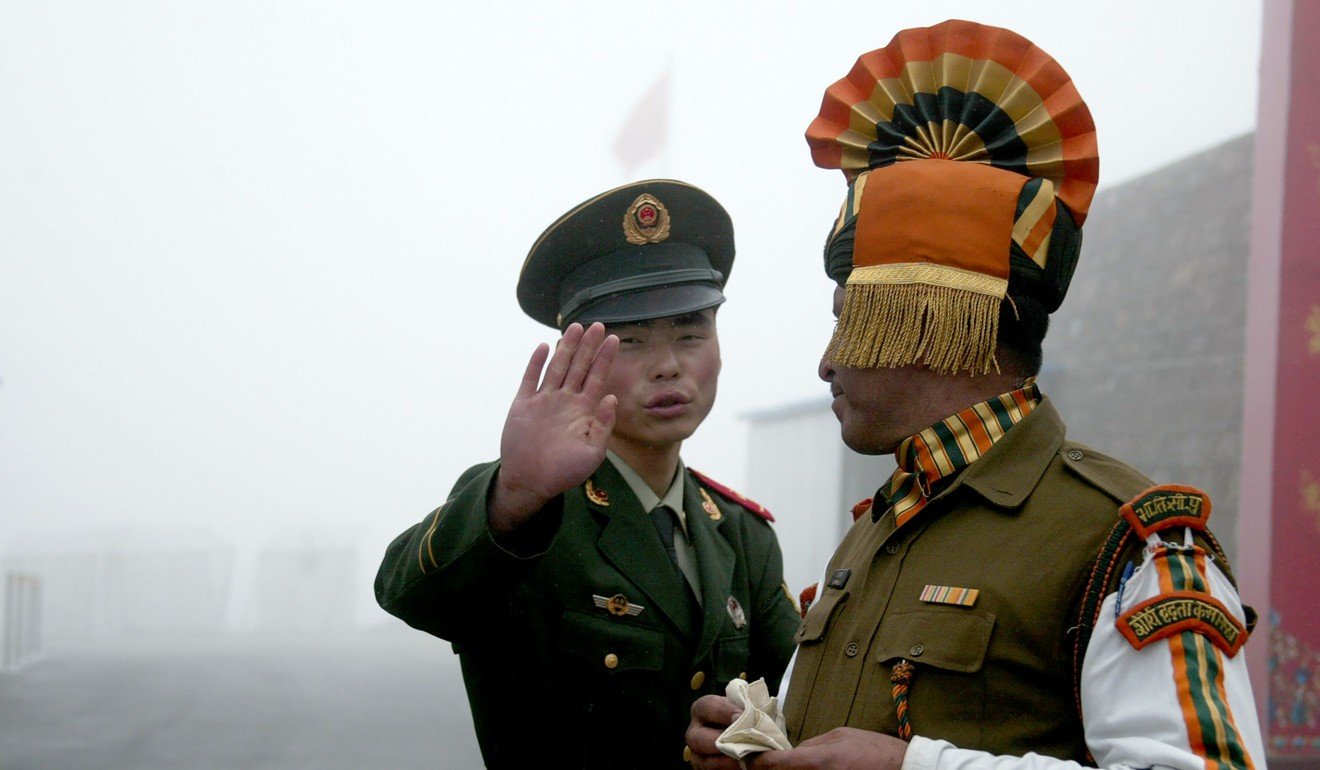
China and India have made efforts to repair their relations since a tense stand-off at the Doklam plateau two years ago, when communications between their forces along the border were seen as inadequate to contain the tension.
China and India have sought to repair relations after a tense stand-off at Doklam. Photo: AFP
Misri said the two nations had made incremental progress, and opened new points where “border personnel can meet and exchange information, or exchange views about any particular situation”.
The ambassador was visiting the Indian consulate in Hong Kong over the weekend, six months after taking up the post and six weeks after Prime Minister Narendra Modi was re-elected.
He said preparations were under way for Chinese President Xi Jinping to visit India, which was expected to happen in the fourth quarter, after they pledged earlier to strengthen cooperation.
Tensions between
have periodically flared along their 4,000km (2,485-mile) border, resulting in a brief war in 1962. Relations have also been strained by China’s ties with Pakistan, and India’s concern over China’s growing presence in the Indian Ocean.
India has also not signed on to China’s global trade and infrastructure strategy, the
, which has projects that run through the disputed Kashmir region.
“Our concerns with regards to this particular initiative are very clear, and we have continued to share them very, very frankly with our Chinese partners,” Misri said. “I think there is understanding on the part of our Chinese partners with regard to this.”
Indian ambassador to China Vikram Misri said New Delhi’s concerns on the Belt and Road Initiative were clear. Photo: Xiaomei Chen
But he said the two nations should not let their differences evolve into disputes, and they should focus on areas where they can cooperate.
One such area was maritime and investment cooperation in the Indo-Pacific region, including infrastructure and disaster response. The US in recent years has focused on the Indo-Pacific region, and has asked its allies to send naval vessels to the area as a counterbalance to Beijing.
“We have made the point that our vision of the Indo-Pacific is not a strategy, which sometimes is a concern on the part of some partners, aimed against any particular country,” Misri said. “It is definitely not a military alliance in any format.
“It is on the other hand a vision that aims at economic and development cooperation with our partners in the Indo-Pacific space,” he said, adding that India was discussing such cooperation with China.
He also said trilateral meetings between China, India and Russia would become more regular after their three leaders met on the sidelines of the
summit in Osaka, Japan last month, when they vowed to uphold multilateralism.
Those meetings would allow the nations to address challenges facing the international trading system and pushback against globalisation, but Misri said they should not be seen as a bid to counter the US, which is also involved in a trade battle with India.
India also had a trilateral meeting with Japan and the United States during the G20 summit.
“The fact that these countries seek us out also shows that they see value in engaging with India, and we have important issues to discuss in each of these settings,” he said. “None of our individual relationships is going to come at the cost of a relationship with any other partner.”
The ambassador said there could be a broader consensus on counterterrorism. Photo: AP
Misri also said there could be a broader consensus between China and India on counterterrorism. The two nations have clashed over Indian efforts to blacklist Masood Azhar, leader of the Pakistan-based terror group Jaish-e-Mohammed (JeM), at the United Nations, which China objected to for years – a move seen in India as being done at the behest of Islamabad.
Azhar was finally listed as a global terrorist by the UN in May, after JeM claimed responsibility for a deadly terror attack on Indian security forces in Pulwama in February, although the listing did not directly reference the attack.
“It could have happened earlier … but I’m glad that it did happen, and we hope to build on that – that should be taken as progress, and we hope to build on that in the coming years,” Misri said.
“Everybody is aware of the context in which the listing happened, and therefore, I don’t think it’s hidden from anybody as to what this was aimed at or who this was aimed at, or what the motivation for the action might have been.”
As for the tensions between India and Pakistan following the terror strike in Indian-controlled Kashmir, Misri said progress would be “largely dependent on Pakistan” and the actions it needed to take to address the “ecosystem of terror that prevails in different parts of that country”.
Source: SCMP
Posted in 70th anniversary, Ambassador Vikram Misri, Belt and Road Initiative (BRI), celebrations, Chinese navy, Chinese President Xi Jinping, communicate, counterterrorism, Doklam plateau, ecosystem of terror, Group of 20 (G20), Hong Kong, Indian ambassador to China, Indian consulate, indian navy, Indian-controlled Kashmir, INS Kolkata, Jaish-e-Mohammed (JeM), Japan, Masood Azhar, Osaka, pla navy, President Xi Jinping, Prime Minister Narendra Modi, Qingdao, Russia, Uncategorized, US, We need to talk |
Leave a Comment »
12/06/2019
- Ship was en route to Pacific for routine exercise when spotted in East China Sea on Tuesday, state media says
- PLA Navy has plenty of other military options to contest maritime conflicts over sovereignty
China’s state media says it is unlikely aircraft carriers will ever be used to resolve maritime disputes. Photo: AFP
The appearance of a Chinese aircraft carrier in the East China Sea on Tuesday had nothing to do with the country’s territorial disputes in the region but was rather part of a routine training exercise, Beijing said.
The
, the country’s only fully operational carrier, and several other naval vessels were spotted passing through the Miyako Strait that separates the Japanese islands of Miyako and Okinawa en route to the Pacific Ocean, according to Japanese broadcaster NHK.
Beijing said it was a routine mission that had been conducted in accordance with international law, and called on other nations to respect its right of passage.
Xiakedao, a social media account run by the overseas edition of Communist Party mouthpiece People’s Daily, said in a commentary that the Liaoning had no role to play in sovereignty disputes.
Instead its operations covered the four areas of maritime traffic protection, naval diplomacy, regional deterrence, and humanitarian aid and rescue missions.
“It is very unlikely that Chinese carriers will ever be involved in resolving maritime disputes with neighbouring countries,” the article said, adding that the People’s
Liberation Army, China’s military, had plenty of other options, like long-range aircraft, missiles and destroyers, for such missions. “Why bother using aircraft carriers?” it said.
China forced to rethink navy spending as trade war bites
The Liaoning’s Pacific mission involved at least five other vessels – two guided missile destroyers, two frigates and a supply ship – according to photographs released by Japan’s defence ministry.
The presence of the 45,000-tonne Type 901 Hulun Lake fast combat support ship – the first time such a vessel has taken part in one of the carrier’s missions – suggested the Liaoning was headed for the high seas.
“This is probably going to be a long journey,” naval expert Li Jie said. “We will see how far they go [but] … the whole purpose of an aircraft carrier is that it can operate far out in the ocean.”
Having a supply ship as part of the strike group, which would allow the Liaoning to travel an extra 10,000 nautical miles or conduct thousands of hours of operations, was essential on such missions, he said.
The exercise is the carrier’s first Pacific deployment since undergoing a major maintenance programme earlier in the year.
The 300km (186 mile) wide Miyako Strait is the most convenient route for China’s navy and air force to access the Western Pacific through the so-called first island chain, which sits between the Chinese coast and the vast ocean.
“The Miyako Strait is wide enough and the sea conditions are usually stable,” Li said. “Pacific training missions will become routine and other Chinese carriers will probably also take this route.”
Details of new carrier revealed in sea trial footage
The Liaoning, accompanied by a fleet of eight vessels, first passed through the strait in December 2016 as part of its first Pacific mission. In April last year, the carrier and its escorts conducted an exercise in the ocean after reaching it via the Bashi Strait, which runs between the Philippines and Taiwan.
As well as the Liaoning, China’s first home-grown aircraft carrier – the
– is conducting sea trials and expected to go into full service later this year, while at least one more is under construction.
Chinese defence ministry spokesman Wu Qian said in 2017 that the navy would increase its activities in the Miyako Strait until the Japanese side “gets used to it”.
Source: SCMP
Posted in Chinese aircraft carrier, East China Sea, Liaoning, pla navy, territorial disputes, Uncategorized |
Leave a Comment »
21/04/2019
QINGDAO, China (Reuters) – Warships from India, Australia and several other nations arrived in the eastern Chinese port city of Qingdao on Sunday to attend a naval parade, part of a goodwill visit as China extends the hand of friendship despite regional tensions and suspicions.
China on Tuesday will mark 70 years since the founding of the People’s Liberation Army Navy, where it will show off new warships including nuclear submarines and destroyers at a major review in the waters off Qingdao.
China says warships from about a dozen nations are also taking part – one diplomatic source with direct knowledge said it was 13 countries in total – and the PLA is putting its best foot forward to welcome them.
India, which has been at odds with China over their disputed land border and Beijing’s support for India’s regional rival Pakistan, has sent stealth guided-missile destroyer the “INS Kolkata” to take part, along with a supply ship.
“We bring to you one of the best ships that we have made. It is the pride of the nation and the navy, and we are very happy to be here,” Captain Aditya Hara told reporters on the dockside after disembarking from the ship in Qingdao.
A source familiar with the situation told Reuters the “Kolkata” had sailed through the Taiwan Strait to get to Qingdao, a sensitive waterway that separates China from self-ruled Taiwan, claimed by Beijing as sacred Chinese territory.
“We headed on a direct route and we are very happy that we were facilitated by the PLA Navy and they ensured that we had a safe passage to Qingdao,” Hara said, when asked if they had sailed via the Taiwan Strait.
Australia, a close U.S. ally, has sent the “HMAS Melbourne” guided-missile frigate to Qingdao, though officials declined to make the captain available for interview.
China and Australia have sparred over Australian suspicions of Chinese interference in the country’s politics and Australia’s banning of China’s Huawei Technologies Co Ltd from supplying equipment for its planned 5G broadband network.
Japan has also sent a destroyer to Qingdao, in the first visit of a Japanese navy ship to China since 2011, according to Japanese media.
Ties between China and Japan, the world’s second and third-largest economies, have been plagued by a long-running territorial dispute over a cluster of East China Sea islets and suspicion in China about Japanese Prime Minister Shinzo Abe’s efforts to amend Japan’s pacifist constitution.
But they have sought to improve relations more recently, with Abe visiting Beijing in October, when both countries pledged to forge closer ties and signed a broad range of agreements including a $30 billion currency swap pact.
The other countries taking part include China’s close friend Russia, and three countries which have sparred with China over competing claims in the disputed South China Sea: Vietnam, Malaysia and the Philippines.
Pakistan, a very close Chinese ally, is not on the list of countries officials have provided which are sending ships to the parade.
Source: Reuters
Posted in Australia, Beijing, Captain Aditya Hara, destroyers, East China Sea islets, guided-missile frigate, HMAS Melbourne, Huawei Technologies Co Ltd, India alert, INS Kolkata, Japan’s pacifist constitution, Japanese navy ship, Japanese Prime Minister Shinzo Abe, Malaysia, naval parade, nuclear submarines, Pakistan, People's Liberation Army Navy, pla navy, Qingdao, Russia, South China Sea, stealth guided-missile destroyer, Taiwan Strait, the Philippines, Uncategorized, Vietnam, warships |
Leave a Comment »
26/02/2019
- Liaoning has just undergone a nine-month revamp
- Flight system of new warship the Type 001A expected to be put to test
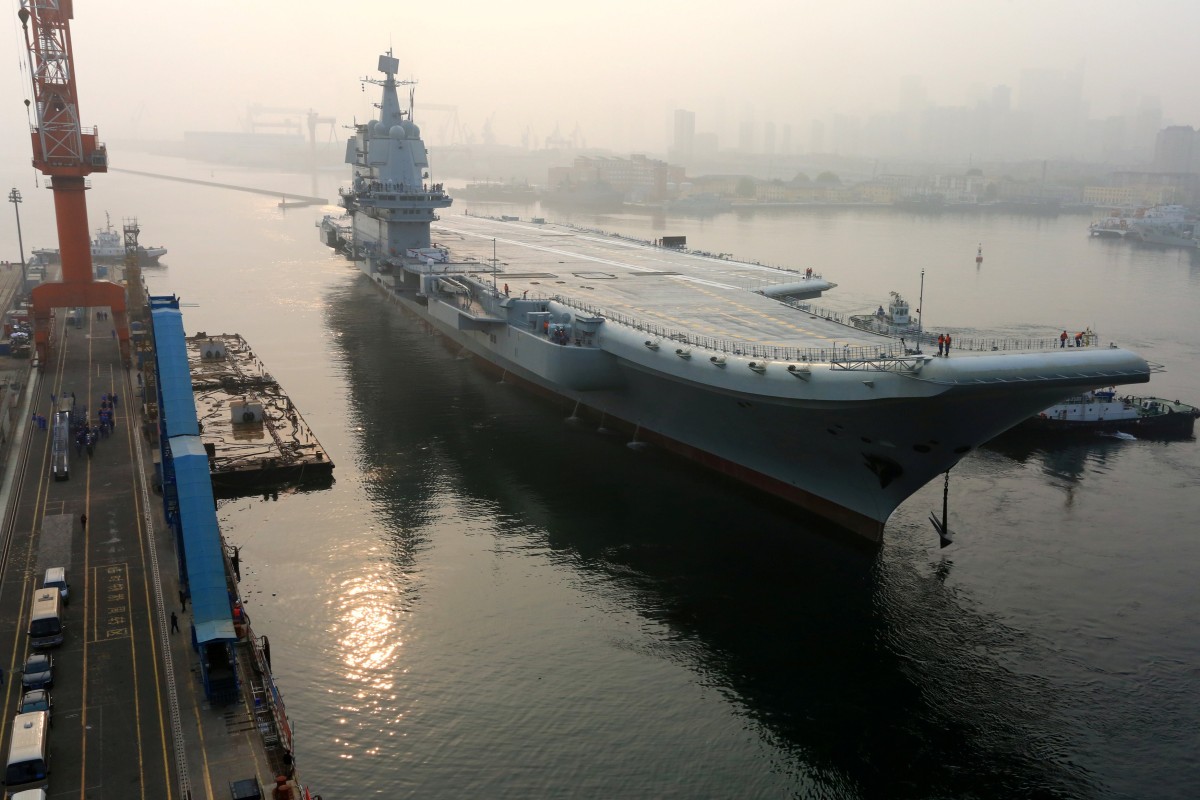
China’s first domestically built aircraft carrier, the Type 001A, will undergo major tests as it enters the final phase of preparations before it is commissioned. Photo: Reuters
China has announced a “no-go zone” in the Yellow Sea while sea trials are carried out for two of its aircraft carriers – the Liaoning, which has just been upgraded, and its first domestically built carrier.
The Liaoning Maritime Administration said there would be no entry to the area off China’s northeast coast from Sunday to March 6, and it would be used for “military purposes”.
State media reported that the Liaoning, which was commissioned in 2012, left the Dalian shipyard on Sunday after nine months of maintenance and modifications. Photos showed a banner where the warship was docked reading “Congratulations to the Liaoning on its new mission”.
China’s first aircraft carrier may become test bed for top flight electromagnetic warplane launcher.
Meanwhile, the Type 001A aircraft carrier, which was built at the same shipyard, is expected to undergo major tests at sea as it enters the final phase of preparations before it is commissioned.
Naval expert Li Jie said the Liaoning would probably also undergo testing, but he expected the no-go zone would mainly be for the Type 001A, especially to put its flight system to the test.
“This vessel will soon enter service and in preparation for that it has to go through a number of manoeuvres, take-offs and landings with the ship-based aircraft,” Li said.
China will build 4 nuclear aircraft carriers in drive to catch US Navy, experts say
The warship appears to be ready for operations involving those aircraft, according to a report on news website Guancha.cn. Photos showed three blast deflectors – which protect the deck and crew from jet engines – on the Type 001A flight deck, along with trucks to tow planes and fire engines, the report said.
The vessel has undergone four sea trials since it was launched in April 2017.
China’s first and only active aircraft carrier, the Liaoning, was likely to carry out exercises involving J-15 fighter jets to get it combat-ready after its revamp, according to Li.
He expected both aircraft carriers to take part in the PLA Navy’s fleet review to be held off Qingdao, in Shandong province, on April 23 to mark the anniversary of the navy – part of a series of activities to commemorate the 70th year since the founding of the People’s Republic of China.
“They will both be at the event if the tests of the Type 001A go well. If not, the Liaoning will be there at least,” Li said.
After a fourth sea trial, China’s Type 001A aircraft carrier may go into service within month.
The Liaoning went back to the Dalian shipyard in May and has had its bridge and air traffic control centre rebuilt and radar system upgraded. The flight deck was also modified.
China bought the vessel from Ukraine in 1998 as an unfinished Soviet Kuznetsov-class carrier, the Varyag. It was retrofitted between 2006 and 2011. China’s first domestically built aircraft carrier, the Type 001A, was based on the 50,000-tonne vessel.
Source: SCMP
Posted in air traffic control centre, Aircraft carrier, Dalian, electromagnetic warplane launcher, Guancha.cn, jet engines, Li Jie, Liaoning, Naval expert, No-go zone, nuclear aircraft carriers, People’s Republic of China, pla navy, sea trials, Soviet Kuznetsov-class carrier, three blast deflectors, Ukraine, Uncategorized, Varyag, warship, Yellow Sea |
Leave a Comment »






 CHINDIA ALERT: You'll be living in their world, very soon