Chindia Alert: You’ll be Living in their World Very Soon
aims to alert you to the threats and opportunities that China and India present. China and India require serious attention; case of ‘hidden dragon and crouching tiger’.
Without this attention, governments, businesses and, indeed, individuals may find themselves at a great disadvantage sooner rather than later.
The POSTs (front webpages) are mainly 'cuttings' from reliable sources, updated continuously.
The PAGEs (see Tabs, above) attempt to make the information more meaningful by putting some structure to the information we have researched and assembled since 2006.
SRINAGAR (Reuters) – Police arrested the publisher of one of the most widely read newspapers in Indian-controlled Kashmir in a midnight raid over a decades-old case, the police and his brother said on Tuesday, highlighting the difficulties facing media in the region.
Tension has run high in the Himalayan region since more than 40 Indian police were killed in a February suicide car bomb attack by a militant group based in Pakistan.
Muslim-majority Kashmir is at the heart of more than seven decades of hostility between nuclear archrivals India and Pakistan. Each claims it in full but rules only a part.
Ghulam Jeelani Qadri, 62, a journalist and the publisher of the Urdu-language newspaper Daily Afaaq, was arrested at his home in the region’s main city of Srinagar, half an hour before midnight on Monday.
“It is harassment,” his brother, Mohammad Morifat Qadri, told Reuters. “Why is a 1993 arrest warrant executed today? And why against him only?”
Qadri was released on bail after a court appearance on Tuesday.
The case dates from 1990, when Qadri was one of nine journalists to publish a statement by a militant group fighting against Indian rule in Kashmir. An arrest warrant for Qadri was issued in 1993, but it was never served.
Qadri had visited the police station involved in the arrest multiple times since the warrant was issued, most recently in 2017 to apply for a passport, his brother added.
Asked why Qadri was arrested at night, Srinagar police chief Haseeb Mughal told Reuters, “Police were busy during the day.”
The Kashmir Union of Working Journalists condemned the arrest, saying it seemed to be aimed at muzzling the press.
“Qadri was attending the office on a daily basis and there was absolutely no need for carrying out a midnight raid at his residence,” it said in a statement.
Journalists in Kashmir find themselves caught in the crossfire between the Indian government and militant groups battling for independence.
Both sides are stepping up efforts to control the flow of information, with the situation at its worst in decades, dozens of journalists have told Reuters.
India is one of the world’s worst places to be a journalist, ranked 138th among 180 countries on the press freedom index of international monitor Reporters Without Borders, with conditions in Kashmir cited as a key reason.
SRINAGAR (Reuters) – Indian forces have killed the leader of an al Qaeda affiliated militant group in Kashmir, police said on Friday, triggering protests in parts of the disputed region.
Zakir Rashid Bhat, 25, was trapped by security forces in a three-storey house in southern Kashmir late on Thursday, said a senior police officer, adding that the house was set ablaze during the operation.
“As we were clearing debris from the house, he tried to get up. Our troops fired at him and he was killed,” said the officer, who declined to be named because he was not authorised to speak to media.
For decades, separatists have fought an armed conflict against Indian rule in Kashmir, with the majority of them wanting independence for the Himalayan region, or to join New Delhi’s arch rival Pakistan.
India has stepped up an offensive against militants in the Muslim-majority region since a suicide attack in February killed 40 Indian troopers in Kashmir and brought India and Pakistan to the brink of war.
Pakistan denies giving material support to militants in Kashmir but says it provides moral and diplomatic backing for the self-determination of Kashmiri people.
Protests by supporters of Bhat broke out in parts of Kashmir on Thursday and there were reports of demonstrations early on Friday, the police officer said.
Fearing more unrest, authorities said schools were closed and railway services suspended in the affected areas.
Any large scale unrest in the region would be a challenge for Indian Prime Minister Narendra Modi as he prepares for a second term after winning a general election on Thursday.
Bhat, a former commander of the Hizbul Mujahideen, the largest of the militant groups fighting against Indian rule in Kashmir, founded his own group and declared its association with al Qaeda in 2017.
Also known as Zakir Musa, he was seen as a successor to Burhan Wani, a popular Hizbul Mujahideen commander whose death in 2016 sparked clashes that left 90 civilians dead.
Police in Shenzhen look for clues to accident in driver’s medical records
Motorist complains of ‘sudden attack’ at time of accident
Police in Shenzhen, Guangdong province, are investigating a driver’s medical history after a fatal accident on Thursday. Photo: Weibo
Police in southern China have detained a motorist after three people were killed and seven injured in a car accident on Thursday night.
Officers said a car went out of control and struck pedestrians on a road in Nanshan district in Shenzhen, Guangdong province, at about 7.20pm. The 23-year-old driver, surnamed Liu, was taken into custody.
In a statement online, the Shenzhen public security bureau said blood and urine tests showed the driver was sober and drug-free. They said medicine for epilepsy was found in the vehicle.
Two dead, six injured in Japan after bus drives through pedestrians in Kobe
During questioning, Liu told officers he lost control of car because he had had “a sudden attack”, but did not elaborate.
Police said they were examining Liu’s medical records.
In China, people with epilepsy are not allowed to apply for a driving licence, according to regulations from the Ministry of Public Security.
MUMBAI/NEW DELHI (Reuters) – Police broke up clashes between rival groups of voters in West Bengal on Monday as some of India’s richest families and Bollywood stars also cast their ballots in Mumbai during the fourth phase of a massive, staggered general election.
In West Bengal, a populous eastern state crucial for Prime Minister Narendra Modi’s re-election bid, supporters of his Hindu nationalist Bharatiya Janata Party (BJP) clashed with others from the regional Trinamool Congress, police said.
TV footage showed armed security forces chasing away people wielding sticks, although it was initially difficult to determine the scale of the clashes.
There were no immediate reports of any poll-related injuries in West Bengal, where at least one person was killed and three injured during the third phase of voting last week.
The BJP is in a direct, and sometimes bloody, fight in West Bengal with Trinamool, whose chief Mamata Banerjee is one of Modi’s biggest critics and a potential prime ministerial candidate.
More than 127 million people are eligible to vote in this round of the seven-phase election held across 71 seats in nine states. Modi’s coalition won more than 75 percent of the seats in the previous election in 2014.
Many of the constituencies are in Uttar Pradesh in the north and western India’s Maharashtra, where the financial capital Mumbai is located. Uttar Pradesh elects the most lawmakers, with Maharashtra next. Both states are ruled by the BJP and its allies.
However, political analysts say the BJP may struggle to repeat its strong showing this time due mainly to a jobs shortage and weak farm prices, issues upon which the main opposition Congress party has seized.
‘SOME PROGRESS’
First-time voter Ankita Bhavke, a college student in Mumbai, said she voted for economic development.
“I want the country to be at par with the best in the world,” she said. “There’s been some progress in the last five years.”
India’s financial markets were closed on Monday for the election.
Mumbai is home to the massive Hindi film industry, as well as Asia’s wealthiest man, Mukesh Ambani, and India’s richest banker, Uday Kotak.
Ambani, who heads Reliance Industries, and Kotak, managing director of Kotak Mahindra Bank, created a stir this month by publicly endorsing an opposition Congress party candidate from their upscale South Mumbai constituency.
Mumbai, which has six seats, is India’s wealthiest city but ageing and insufficient infrastructure is a major concern. Six people were killed last month when part of a pedestrian bridge collapsed, recalling memories of a 2017 rush-hour stampede that killed at least 22 people on a narrow pedestrian bridge.
The election, the world’s biggest democratic exercise with about 900 million voters, started on April 11 with Modi in the lead amid heightened tension with long-time enemy Pakistan.
The last phase of voting is on May 19, with results released four days later.
There are a total of 545 seats in the Lok Sabha.
Modi sent warplanes into Pakistan in late February in response to a suicide attack by an Islamist militant group based there that killed 40 Indian police in the disputed Kashmir region.
Modi has sought votes on his tough response towards militancy and in recent days has evoked the deadly Easter Sunday bombings in nearby Sri Lanka.
Maidul Islam, a professor of political science at Kolkata’s Centre for Studies in Social Sciences, said long queues outside polling stations would indicate whether Modi’s national security pitch was working.
“Whenever there is a BJP kind of a wave, you see a higher voter turnout,” he said.
Media caption The “Umbrella Movement” activists said they would continue to strive for democracy
Nine pro-democracy activists in Hong Kong have been found guilty of public nuisance charges for their role in a civil disobedience movement that called for free elections in the city.
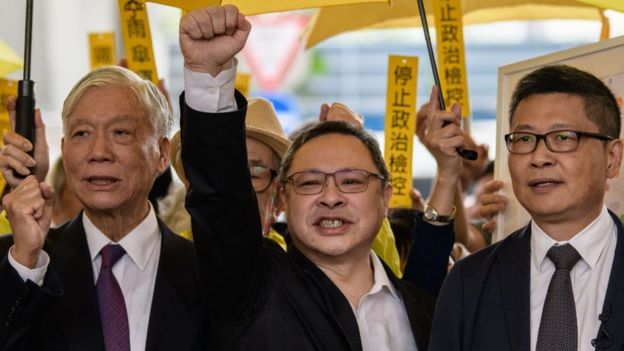
Among them are three prominent activists, seen as figureheads of Hong Kong’s pro-democracy movement.
They could be jailed for up to seven years for their part in the “Umbrella Movement” protests of 2014.
Thousands marched demanding the right for Hong Kong to choose its own leader.
Those convicted include the so-called “Occupy trio” – sociology professor Chan Kin-man, 60, law professor Benny Tai, 54, and Baptist minister Chu Yiu-ming, 75.
They are seen as the founders of the movement that galvanised protesters in their campaign of civil disobedience.
“No matter what happens today… we will persist on and do not give up,” Mr Tai told reporters ahead of the verdict.
A large crowd gathered outside the court on Thursday to support them. It is not yet clear when they will be sentenced.
Image copyrightAFPChu Yiu-ming, Benny Tai and Chan Kin-man (left to right) were charged under colonial-era laws that carry possible jail terms of up to seven years
Like just another day
By Martin Yip, BBC News Chinese, Hong Kong
The nine defendants walked into the court building looking refreshed and in high spirits. All but one said a few words in what might have been their last hours of freedom before their predicted jail term.
Delivering his verdict, Justice Johnny Chan said the defendants had caused a nuisance – by occupying major roads – leading to injuries among civilians. The nine looked calm and not particularly emotional. They were later released on bail. Benny Tai, Chan Kin-man and Chu Yiu-ming smiled as they passed me, as if it was just another day.
They are yet to say if they will appeal. The court was adjourned for the day as the lawyers are yet to finish their mitigation submissions. The sentences have yet to be announced.
The broader pro-democracy camp already has bad relations with Beijing. Activists and politicians did express their anger but political analysts also warn that people might simply leave the movement out of frustration.
“Some people might feel dispirited and helpless. I hope they can see that other people haven’t given up,” Benny Tai told BBC News Chinese ahead of today’s verdict.
Seventy nine days of sit-in protests have already changed Hong Kong a lot. But today’s verdict might serve more as a reminder that this city remains divided.
What has the reaction been?
At the trial Judge Johnny Chan rejected the idea that this would have a substantial impact on society.
“It cannot be reasonably argued that a charge of conspiracy to cause public nuisance would generate a chilling effect in society,” he wrote in his ruling.
But rights groups criticised the ruling, with Humans Rights Watch saying the court was “sending a terrible message”.
“[This] will likely embolden the government to prosecute more peaceful activists, further chilling free expression in Hong Kong,” said researcher Maya Wang in a statement to the BBC.
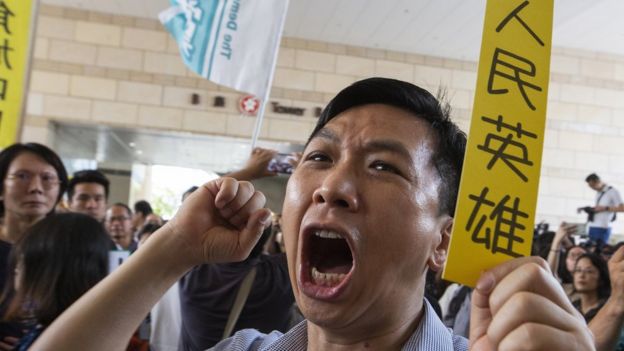
Image copyrightEPAOne pro-democracy supporter outside the court held up a sign saying “People’s Hero”
Lord Chris Patten, the last British governor of Hong Kong, released a statement saying that it was “appallingly divisive to use anachronistic common law charges in a vengeful pursuit of political events which took place in 2014”.
This verdict comes after a string of frustrations for pro-democracy activists. In the last few years the courts have removed six lawmakers for changing their swearing in oaths to include protest phrases. Others have also been disqualified from running for office.
What were the protests about?
The protests started in reaction to a decision made by China that it would allow direct elections in 2017, but only from a list of candidates pre-approved by Beijing.
Beijing is highly sensitive about Hong Kong’s status and any calls for more autonomy from China.
The former British colony was handed back in 1997 on condition it would retain “a high degree of autonomy, except in foreign and defence affairs” for 50 years.
Many people in Hong Kong believe they should have the right to elect their own leader.
In 2014, the three activists’ calls for non-violent civil disobedience joined with student-led protests and snowballed into the massive demonstrations.
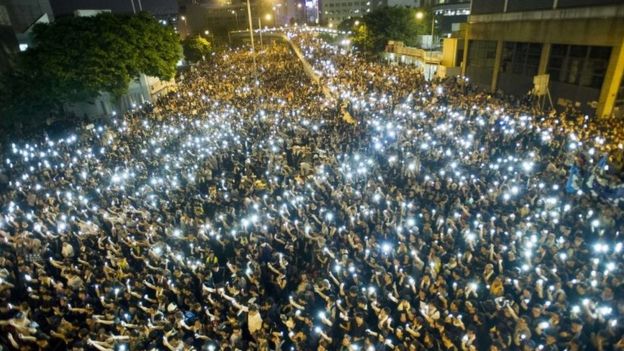
Tens of thousands of people camped in the streets and demanded the right to fully free leadership elections.
Image copyrightAFP The pro-democracy protests bought an area of central Hong Kong to a standstill for weeks in 2014
The protests became known as the “Umbrella Movement” after people used umbrellas to shield themselves from pepper spray fired by police to disperse the crowd.
Protesters accused the Chinese government of breaking its promise to allow full democracy in Hong Kong, and of encroaching more and more on the region.
But the number of protesters dwindled to just a few hundred as the weeks dragged on and they ultimately failed to achieve their goal.
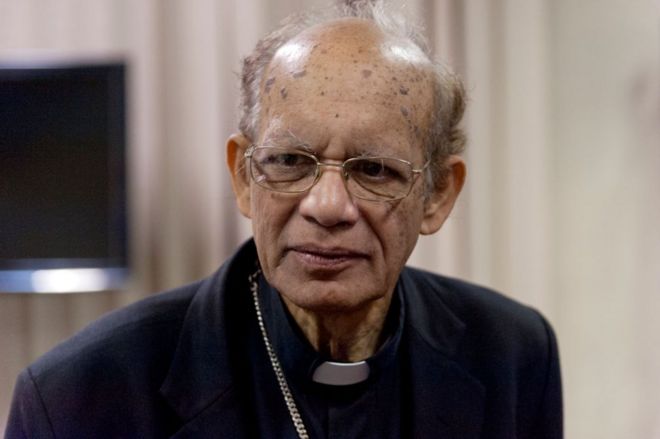
Image copyrightGETTY IMAGESImage captionCardinal Oswald Gracias told the BBC it pained him to hear accusations that he had neglected victims of alleged abuse
One of the Catholic Church’s most senior cardinals has admitted that he could have better handled sexual abuse allegations that were brought to him.
Oswald Gracias, the Archbishop of Mumbai is one of four men organising a major Vatican conference on child abuse this week.
We found two separate cases where the cardinal, who is tipped by some to possibly become the next Pope, is claimed to have failed to respond quickly or offer support to the victims.
Victims and those who supported them allege that Cardinal Gracias did not take allegations of abuse seriously when they were reported to him.
India’s Catholics say there is a culture of fear and silence in the Catholic Church about sexual abuse by priests. Those who have dared to speak out say it has been an ordeal.
A woman’s life changed when her son returned from Mass at the church and told her that the parish priest had raped him.
“I could not understand what should I do?” she said. She did not know this yet, but this event would put her on a collision course with the Catholic Church in India.
Media captionWhy is India’s Catholic church silent about sexual abuse?
The man she reached out to for help was and remains one of the most senior representatives of the Church.
It was nearly 72 hours after the alleged rape that the family briefly met Cardinal Gracias, then president of the Catholic Bishop’s Conference of India and Federation of Asian Bishops’ Conferences.
The issue of sexual abuse within the Church is being called the Vatican’s biggest crisis in modern times, and the integrity of the Catholic Church is said to ride on the outcome of this conference.
Image copyrightGETTY IMAGESImage captionPope Francis with Cardinal Oswald Gracias (fourth from left)
Over the past year, the Catholic Church has been reeling under multiple allegations of sexual abuse around the world.
But while abuse claims have made headlines in North and South America, Europe and Australia, very little is known about the problems in Asian countries. In countries such as India there is a social stigma about reporting abuse.
Among Christians, who are a minority of nearly 28 million people, a culture of fear and silence makes it impossible to gauge the true scale of the problem.
Cardinal Blase Cupich of Chicago – a colleague of Cardinal Gracias on the four-member organising committee – has promised that decisive action in Rome and in dioceses worldwide will follow after the meeting so as to safeguard children and bring justice to the victims.
Cardinal Gracias will open the second day of the summit with a conversation about accountability in the Church.
Media captionBrigitte, a survivor of child sex abuse by a chaplain, explains why she is ready to speak now
This vital role given to him during this crucial conference has made some in India unhappy.
They say his track record in protecting children and women from abusers is questionable. Those we have spoken to who have taken cases to him say they received little support from him.
The mother of the abused boy said: “I told the cardinal about what the priest had done to my child, that my child was in a lot of pain. So he prayed for us and told us he had to go to Rome…my heart was hurt in that moment.
“As a mother, I had gone to him with great expectations that he would think about my son, give me justice, but he said he had no time, he only cared about going to Rome.”
The family say they requested medical help but were offered none.
The cardinal told us it pained him to hear this, and that he was not aware that the boy needed medical help – and if he had been asked, he would have immediately offered it.
The cardinal admits he left for Rome that night without alerting the authorities.
By failing to call the police, Cardinal Gracias may have violated India’s Protection of Children from Sexual Offences Act, 2012 (POCSO).
The provisions of this law state that if the head of any company or institution fails to report the commission of an offence in respect of a subordinate under his control, they shall be punished with imprisonment for a term which may extend to one year, and with a fine.
The cardinal told us he had telephoned his bishop the next day, who told him the family had subsequently informed the police themselves.
Asked if he regretted not calling the police personally at the time, he said: “You know I’m being honest, I’m not 100% sure… but I must reflect on that. I admit whether immediately, the police should have got involved, sure.”
He says he was under a duty to evaluate the credibility of accusations by speaking to the accused man.
Emerging from that meeting, the family decided to go to a doctor.
“He took one look at my boy and said that something has happened to him. This is a police case. Either you report it or I will… so we went to the police that night,” the mother said.
A police medical examination found that the child had been sexually assaulted.
Image copyrightGETTY IMAGESImage captionIndia is home to about 19 million Catholics
A current priest who spoke to us on the condition of anonymity said this was not the first time allegations about this priest had been brought to the cardinal’s attention.
“I met him some years before this [alleged] incident,” the priest told us.
“There were strong rumours about [the accused priest] in the diocese, and like these are about abuse that is taking place. And yet he seems to be moving from one place to another, one parish to another. The cardinal told me directly that he is not aware directly of all these things.”
The cardinal says he cannot recall the conversation. He says he did not recollect any “cloud of suspicion” over the man.
‘A lonely battle’
As part of our investigation, we wanted to see if there were other allegations of the cardinal being slow to act.
We found an instance dating back almost a decade, brought to his attention just a couple of years after becoming archbishop of Mumbai.
Image captionCatholic activist Virginia Saldanha says three legal notices were sent to the cardinal, threatening court action unless took action about the claims of abuse
In March 2009, a woman approached him with accusations of sexual abuse by another priest who conducted retreats.
She says that he took no action against the priest so she reached out to a group of female Catholic activists, who say they forced the cardinal to act.
Under pressure, he finally set up an enquiry committee in December 2011. Six months after the enquiry, there was still no action and the accused priest continued working in his parish.
“We had to send the cardinal three legal notices to act, threaten to take the matter to the courts if he did not act,” said Virginia Saldanha, a devout Catholic who has worked on the women’s desk of multiple Church-affiliated positions for over two decades.
When the cardinal replied, he said: “The priest is not listening to me.”
Image captionThe family says they have been ostracised from the church and isolated within their communities since reporting the sexual assault
During the time, Saldanha said she had to leave the church because “I could not bear to see that man giving Mass in the church. I did not feel like going there.”
The priest was eventually removed from his parish, but the reasons for his departure were never made public.
The punishment, decided by the cardinal personally in October 2011, was a “guided retreat and therapeutic counselling”.
When we pressed him about the speed of process and punishment, the cardinal said it was a “complicated case”.
After a stay in the seminary, the accused priest was briefly given a parish again and still conducts retreats.
Meanwhile, the family of the allegedly raped minor feel abandoned by the institution that they had built their lives around.
“It has been a lonely battle,” the mother concedes. They say they have been ostracised from the church and isolated within their communities.
“After complaining to the police, when we would go into church, people would refuse to talk to us, to sit next to us during Mass. If I went to sit next to someone… they would get up and leave,” she said.
The hostility she encountered eventually “made us leave the church. But it got so difficult for us that we eventually had to change our home as well. We left it all behind”.
Church members say that it is this hostility that makes it harder for victims and their families to speak up.
Caught between an apparently unsupportive clergy and hostile social network, many find their voices faltering.
As the country mourned the Pulwama killings, there has been an increased demand for according ‘Shaheed’ status to the martyred jawans.
SNS Web | New Delhi | February 21, 2019 2:20 pm
In a fresh attack on Prime Minister Narendra Modi in the aftermath of the Pulwama terror attack, Congress president Rahul Gandhi said the “jawans gave their lives but have been denied the ‘Shaheed’ status.
In strong words, the Congress president said the “PM has never given and only taken”.
In an indirect reference to the government allegedly supporting industrialists like Anil Ambani, as accused by the opposition, Gandhi tweeted, “Jawans give their lives but are denied the status of “Shaheed”. While this man has never given & only taken. He’s gifted 30,000Cr of their money & will live happily ever after. Welcome to Modi’s NEW INDIA”.
As the country mourned the Pulwama killings, there has been an increased demand for according ‘Shaheed’ status to the martyred jawans.
The CRPF jawans were addressed as martyrs in resolutions passed in various state assemblies to condemn the terror attack and to announce compensation for the bereaved families from the respective states.
While the Madhya Pradesh government announced compensation of Rs 1 crore, the Uttar Pradesh and Uttarakhand governments announced Rs 25 lakh each.
Uttarakhand Chief Minister Trivendra Singh Rawat also assured government jobs to one member from each family.
According to the set rules, the Central Government provides Rs 10 lakh as ex gratia for the death of jawans due to accidents in the course of duty or death due to terrorist acts in the line of duty. Apart from this, the wife of the dead jawan would receive a pension, which would go to parents if he is not married.
The government does not recognise the term ‘martyr’.
In December 2017, the government had informed the Central Information Commission that there was no term as ‘martyr’ or ‘shaheed’ in the army or the police. Instead, a soldier or policeman killed in action is called ‘battle casualty’ or ‘operations casualty’, respectively.
In 2016, the Ministry of Home Affairs informed the Lok Sabha that the word ‘martyr’ is not used in reference to any casualties from the Indian armed forces during battle.
Earlier in 2015 too, the Government had informed the Parliament that the term ‘shaheed’ or martyr is not defined “anywhere” and that there is no official order to accord the same to defence or paramilitary personnel.
The CAPFs like CRPF, BSF, ITBP, CISF, SSB and NSG have made representations to the Union Home Ministry that ‘shaheed’ salutation is being demanded by the personnel of these forces.
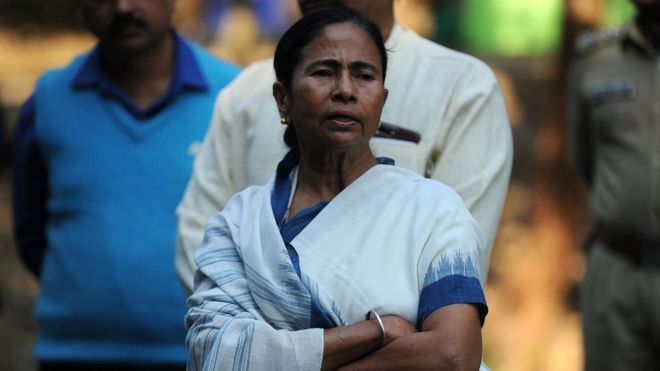
Image copyrightGETTY IMAGESImage captionMamata Banerjee is a rare firebrand woman leader who commands mass support
Imagine state policemen in the US detaining FBI agents investigating a case on state territory.
Then imagine the governor of the state starting a public protest against the FBI and the president for carrying out what she calls an act of vendetta against her government.
Now imagine federal forces being deployed to protect their offices in the state, fearing attacks by supporters of the governor.
This possibly sounds like a plot from a dystopian political novel. But it is what is happening in India.
A group of detectives belonging to India’s federal investigation agency, the CBI, arrived at the well-secured home of the commissioner of police of Kolkata (formerly known as Calcutta) in West Bengal state on Sunday evening. They said they wanted to question Rajeev Kumar in connection with a ponzi scandal. (The multi-million dollar scam, involving businessmen, politicians, journalists and film producers, defrauded a large number of small investors.)
But Mr Kumar refused to meet the detectives. Instead his forces detained the agents – who are recruited from the police forces themselves – and took them away to a police station. They were freed after a few hours, and returned without being able to question Mr Kumar.
Mr Kumar had led the early local investigation into the scandal, before the case was taken over by the CBI under the supervision of the Supreme Court. The federal agency, say reports, unsuccessfully tried to question Mr Kumar half-a-dozen times in the past in connection with some evidence he had purportedly collected in the case. The agency believes that he is “hiding” something.
The ponzi scandal, involving at least two small investment companies, came to light in 2013 under the watch of the leader of West Bengal state. In India’s male-dominated politics, Mamata Banerjee is a rare firebrand woman leader who commands mass support. She took power in 2011, ending 34 years of communist rule in the state. (The following year, she was named one of Time magazine’s 100 most influential people in the world.) The feisty Ms Banerjee has ruled West Bengal ever since.
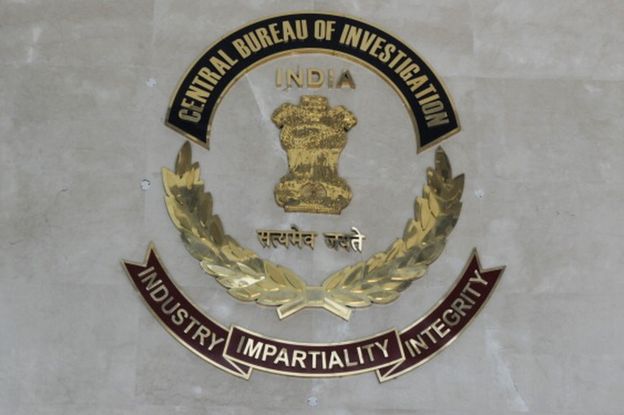
Image copyrightAFPImage captionThe Central Bureau of Investigation is India’s top investigation agency
Ms Banerjee has a testy relationship with the federal government, run by Prime Minister Narendra Modi’s Bharatiya Janata Party (BJP). This is, in part, because Mr Modi’s party is trying to make inroads into Bengal, using its usual mix of development promises and sectarian rhetoric.
Downtown Changchun in China’s northeastern Jilin province was rocked by a series of explosions on Friday afternoon.
The Changchun fire department confirmed it received a call at about 3.13pm saying a car had exploded in the basement of a Wanda Shopping Plaza building.
Three minutes later, another blast erupted in a room on the 30th floor of the same building.
One person was found dead and another injured at the scene.
The police are treating the explosions as a “criminal case”.
Earlier, the municipal government confirmed a blast on the 30th floor and said one person had been found dead so far.
A witness dining at a restaurant in the plaza on Hongqi Street said people were asked to evacuate the buildings immediately, Beijing Youth Daily reported. Firefighters are clearing the area for investigation.
“There must have been more than 20 explosions. The shopping mall asked people over the public address system to leave right away, and we ran for our lives,” the woman, identified only by her family name Zhang, was quoted as saying.
She said she saw sparks around her as she ran out.
A video clip circulating online, which the South China Morning Post cannot independently verify, showed a bright beam of light accompanied by a bang from a room in a higher floor of the Wanda building, and another explosion and heavy smoke on the ground, with people running for safety.








 CHINDIA ALERT: You'll be living in their world, very soon
COMMENTS: 4