Archive for ‘Censorship’

29/09/2019

China anniversary: The deep cuts of 70 years of Communist rule

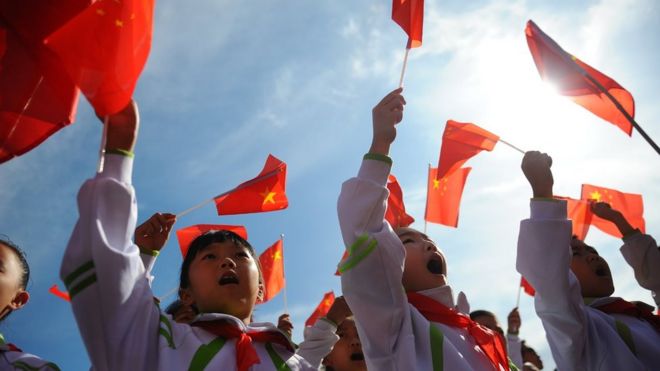
Children waving Chinese flagsImage copyright GETTY IMAGES
Image caption China’s version of its past is a story of prosperity, progress and sacrifice for the common good

China’s extraordinary rise was a defining story of the 20th Century, but as it prepares to mark its 70th anniversary, the BBC’s John Sudworth in Beijing asks who has really won under the Communist Party’s rule.

Sitting at his desk in the Chinese city of Tianjin, Zhao Jingjia’s knife is tracing the contours of a face.

Cut by delicate cut, the form emerges – the unmistakable image of Mao Zedong, founder of modern China.

The retired oil engineer discovered his skill with a blade only in later life and now spends his days using the ancient art of paper cutting to glorify leaders and events from China’s communist history.

“I’m the same age as the People’s Republic of China (PRC),” he says. “I have deep feelings for my motherland, my people and my party.”
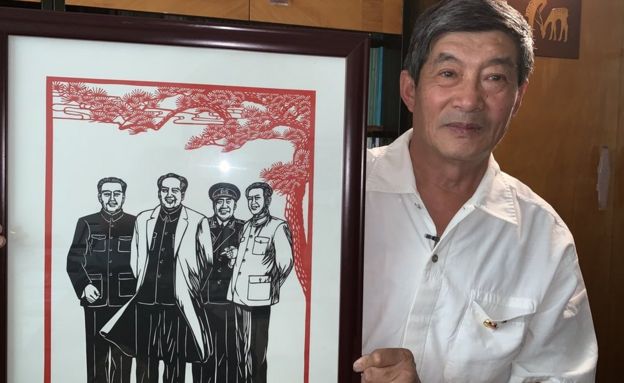
Zhao Jingjia with a paper cut of Mao Zedong
Image caption For people like Zhao Jingjia, China’s success outweighs the “mistakes” of its leaders

Born a few days before 1 October 1949 – the day the PRC was declared by Mao – Mr Zhao’s life has followed the dramatic contours of China’s development, through poverty, repression and the rise to prosperity.

Now, in his modest but comfortable apartment, his art is helping him make sense of one of the most tumultuous periods of human history.

“Wasn’t Mao a monster,” I ask, “responsible for the deaths of tens of millions of his countrymen?”

“I lived through it,” he replies. “I can tell you that Chairman Mao did make some mistakes but they weren’t his alone.”

“I respect him from my heart. He achieved our nation’s liberation. Ordinary people cannot do such things.”

On Tuesday, China will present a similar, glorious rendering of its record to the world.

The country is staging one of its biggest ever military parades, a celebration of 70 years of Communist Party rule as pure, political triumph.

Beijing will tremble to the thunder of tanks, missile launchers and 15,000 marching soldiers, a projection of national power, wealth and status watched over by the current Communist Party leader, President Xi Jinping, in Tiananmen Square.

An incomplete narrative of progress

Like Mr Zhao’s paper-cut portraits, we’re not meant to focus on the many individual scars made in the course of China’s modern history.

It is the end result that matters.
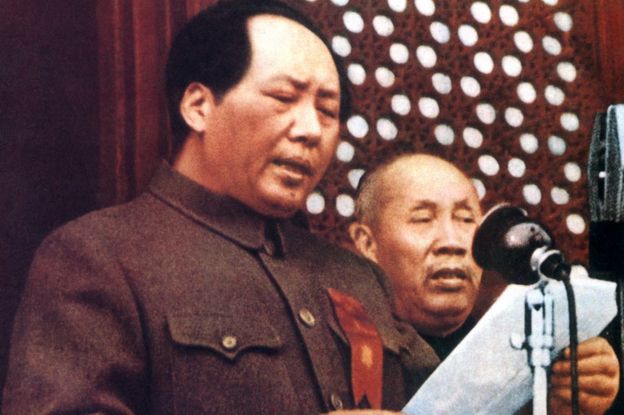
Mao Zedong declares the People's Republic of China in Beijing on 1 Oct 1949Image copyright XINHUA/AFP
Image caption Mao Zedong pronounces the dawn of the People’s Republic of China on 1 October 1949

And, on face value, the transformation has been extraordinary.

On 1 October 1949, Chairman Mao stood in Tiananmen Square urging a war-ravaged, semi-feudal state into a new era with a founding speech and a somewhat plodding parade that could muster only 17 planes for the flyby.

This week’s parade, in contrast, will reportedly feature the world’s longest range intercontinental nuclear missile and a supersonic spy-drone – the trophies of a prosperous, rising authoritarian superpower with a 400 million strong middle class.

It is a narrative of political and economic success that – while in large part true – is incomplete.

New visitors to China are often, rightly, awe-struck by the skyscraper-festooned, hi-tech megacities connected by brand new highways and the world’s largest high-speed rail network.
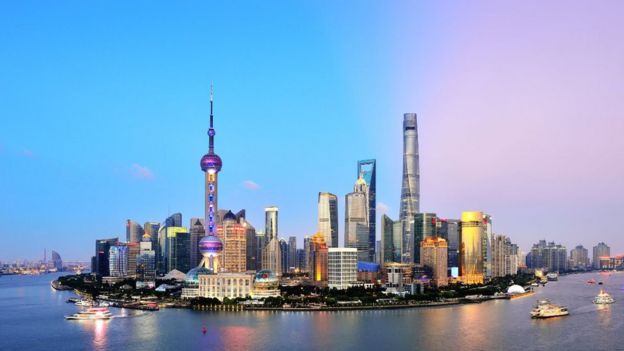
Shanghai skylineImage copyright GETTY IMAGES
Image caption Those in China’s glittering cities may accept the trade-off of political freedom for economic growth

They see a rampant consumer society with the inhabitants enjoying the freedom and free time to shop for designer goods, to dine out and to surf the internet.

“How bad can it really be?” the onlookers ask, reflecting on the negative headlines they’ve read about China back home.

The answer, as in all societies, is that it depends very much on who you are.

Many of those in China’s major cities, for example, who have benefited from this explosion of material wealth and opportunity, are genuinely grateful and loyal.

In exchange for stability and growth, they may well accept – or at least tolerate – the lack of political freedom and the censorship that feature so often in the foreign media.

For them the parade could be viewed as a fitting tribute to a national success story that mirrors their own.

But in the carving out of a new China, the knife has cut long and deep.

The dead, the jailed and the marginalised

Mao’s man-made famine – a result of radical changes to agricultural systems – claimed tens of millions of lives and his Cultural Revolution killed hundreds of thousands more in a decade-long frenzy of violence and persecution, truths that are notably absent from Chinese textbooks.
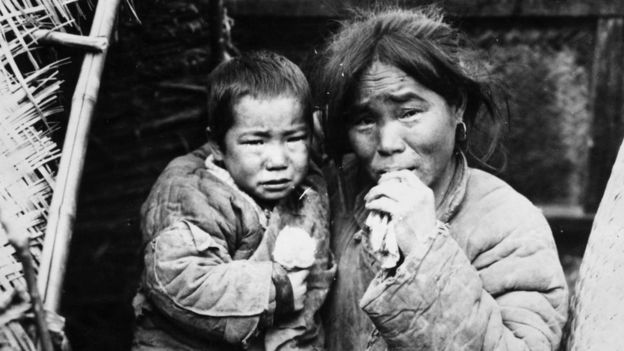
Archive image of a starving woman and child during the famine in ChinaImage copyright GETTY/TOPICAL
Image caption Tens of millions starved to death under Mao, as China radically restructured agriculture and society

After his death, the demographically calamitous One Child Policy brutalised millions over a 40-year period.

Still today, with its new Two Child Policy, the Party insists on violating that most intimate of rights – an individual’s choice over her fertility.

The list is long, with each category adding many thousands, at least, to the toll of those damaged or destroyed by one-party rule.
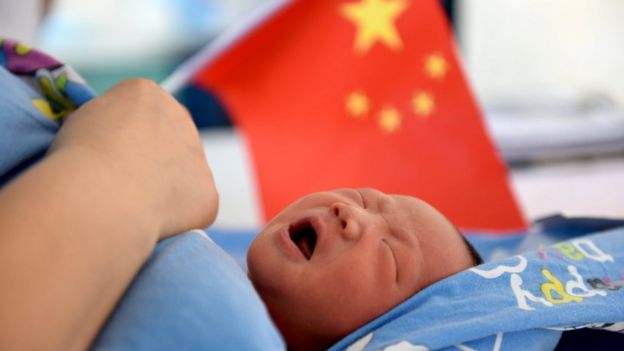
Chinese baby in front of Chinese flagImage copyright GETTY IMAGES
Image caption Beijing still regulates how many children families can have

There are the victims of religious repression, of local government land-grabs and of corruption.

There are the tens of millions of migrant workers, the backbone of China’s industrial success, who have long been shut out of the benefits of citizenship.

A strict residential permit system continues to deny them and their families the right to education or healthcare where they work.

And in recent years, there are the estimated one and a half million Muslims in China’s western region of Xinjiang – Uighurs, Kazakhs and others – who have been placed in mass incarceration camps on the basis of their faith and ethnicity.

China continues to insist they are vocational schools, and that it is pioneering a new way of preventing domestic terrorism.

The stories of the dead, the jailed and the marginalised are always much more hidden than the stories of the assimilated and the successful.

Viewed from their perspective, the censorship of large parts of China’s recent history is not simply part of a grand bargain to be exchanged for stability and prosperity.

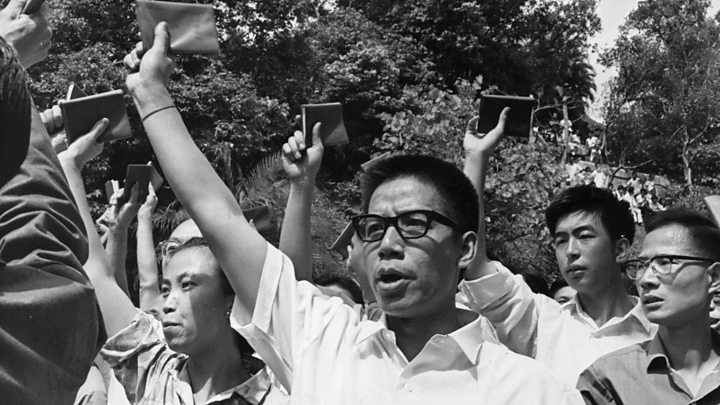
People holding pictures of Mao and the Little Red Book in Tiananmen Square, 1966

Getty
Timeline of modern China

  • 1949 Mao declares the founding of the People’s Republic of China
  • 1966-76 Cultural Revolution brings social and political upheaval
  • 1977 Deng Xiaoping initiates major reforms of China’s economy
  • 1989 Army crushes Tiananmen Square pro-democracy protests
  • 2010 China becomes the world’s second-largest economy
  • 2018 Xi Jinping is cleared to be president for life
It is something that makes the silence of their suffering all the more difficult to penetrate.

It is the job of foreign journalists, of course, to try.

‘Falsified, faked and glorified’

But while censorship can shut people up, it cannot stop them remembering.

Prof Guo Yuhua, a sociologist at Beijing’s Tsinghua University, is one of the few scholars left trying to record, via oral histories, some of the huge changes that have affected Chinese society over the past seven decades.

Her books are banned, her communications monitored and her social media accounts are regularly deleted.

“For several generations people have received a history that has been falsified, faked, glorified and whitewashed,” she tells me, despite having been warned not to talk to the foreign media ahead of the parade.

“I think it requires the entire nation to re-study and to reflect on history. Only if we do that can we ensure that these tragedies won’t be repeated.”
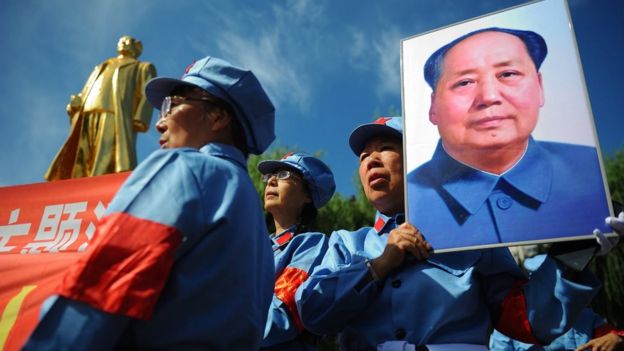
People with poster of Mao ZedongImage copyright GETTY IMAGES
Image caption Can progress really be attributed to the leadership?

A parade, she believes, that puts the Communist Party at the front and centre of the story, misses the real lesson, that China’s progress only began after Mao, when the party loosened its grip a bit.

“People are born to strive for a better, happier and more respectful life, aren’t they?” she asks me.

“If they are provided with a tiny little space, they’ll try to make a fortune and solve their survival problems. This shouldn’t be attributed to the leadership.”

‘Our happiness comes from hard work’

As if to prove the point about how the unsettled, censored pasts of authoritarian states continue to impact the present, the parade is for invited guests only.
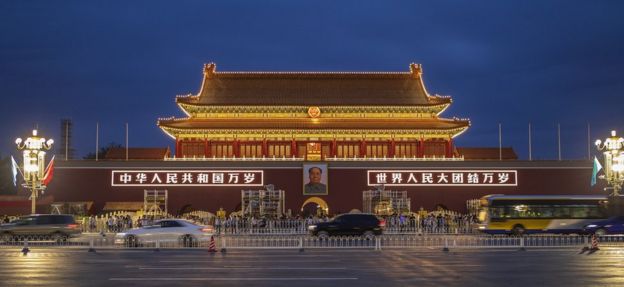
Mao's portrait hanging in Tiananmen SquareImage copyright GETTY IMAGES
Image caption Mao’s portrait will, as it always is, be watching over the events in Tiananmen Square

Another anniversary, of which Tiananmen Square is the centrepiece, is also being measured in multiples of 10 – it is 30 years since the bloody suppression of the pro-democracy protests that shook the foundations of Communist Party rule.

The troops will be marching – as they always do on these occasions – down the same avenue on which the students were gunned down.

The risk of even a lone protester using the parade to mark a piece of history that has largely been wiped from the record is just too great.

With central Beijing sealed off, ordinary people in whose honour it is supposedly being held, can only watch it on TV.
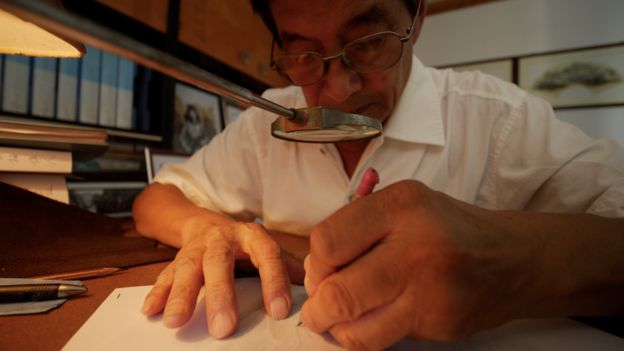
Zhao

Back in his Tianjin apartment, Zhao Jingjia shows me the intricate detail of a series of scenes, each cut from a single piece of paper, depicting the “Long March”, a time of hardship and setback for the Communist Party long before it eventually swept to power.

“Our happiness nowadays comes from hard work,” he tells me.

It is a view that echoes that of the Chinese government which, like him, has at least acknowledged that Mao made mistakes while insisting they shouldn’t be dwelt on.

“As for the 70 years of China, it’s extraordinary,” he says. “It can be seen by all. Yesterday we sent two navigation satellites into space – all citizens can enjoy the convenience that these things bring us.”
Media caption What was China’s Cultural Revolution?

Source: The BBC

24/09/2019

China 70th anniversary: Pigeon ban and lockdowns as countdown begins

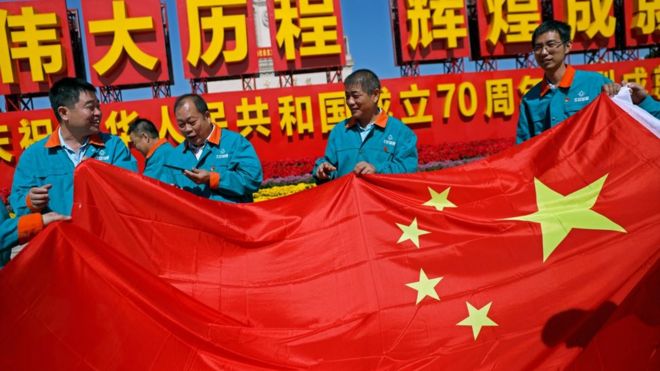
Chinese workers with Chinese flagImage copyright EPA
Image caption China is getting dressed up for its big birthday party

One week from now, the People’s Republic of China will mark its 70th anniversary with celebrations on a scale not seen in China in decades.

Beijing is pulling out all stops and 1 October will be flush with fireworks, fanfare and a huge military parade.

To ensure it goes smoothly, authorities have been ramping up security in the capital – and online – for weeks.

But with yet more protests expected in Hong Kong, the territory might just rain on China’s parade.

What is it all about?

The birth of modern China was declared on 1 October 1949, after the communists under Mao Zedong won the civil war that followed World War Two.

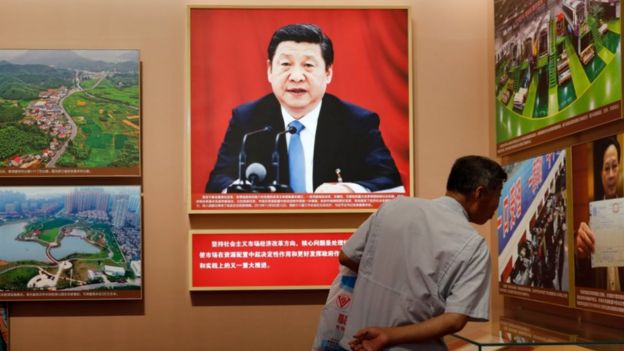
Portrait of Xi JinpingImage copyright EPA
Image caption Exhibitions are highlighting the achievements of the Communist Party

The date is marked every year, but celebrations for this 70th anniversary are expected to eclipse previous events.

It’s the first big anniversary since China has emerged as a global power. While 10 years ago China was a superpower in the making, it is now the world’s second largest economy, almost eye-to-eye with the United States.

What to expect?

The main celebrations will take place in the capital, Beijing, where there will be a grand military parade with “advanced weapons” on display, followed by a “mass pageant”.

President Xi Jinping – considered the most powerful Chinese leader since Mao – will address the Chinese people. His speech is expected to celebrate China’s rapid growth and which will be closely watched for any indication of the country’s direction in the coming years.

The president will also hand out honours for contributions to the country and in the evening there will be a grand gala and fireworks show.

All official Chinese celebrations are carefully choreographed and the success of this one is particularly important to the government.

The Dos and Don’ts

The parade – open to invited guests only – will take place around Tiananmen Square in central Beijing. The surrounding area will be practically under lockdown, and in fact has been so several times already.

During rehearsals leading up to the big day, hotels near Tiananmen Square told guests that for several hours each day, no-one would be able to leave the hotel or return to it should they be out, leading to much travel chaos and rebookings.

Many shops and restaurants in the centre are also closed or have shortened hours and some subway stations are temporarily shut.

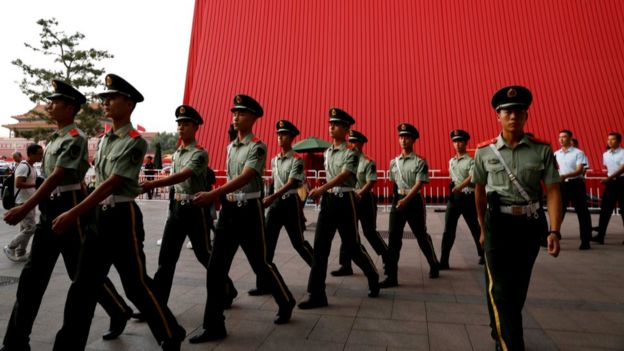
Chinese paramilitary policeImage copyright EPA
Image caption Security is tight ensure the party goes to plan

Trains to Beijing are running numerous safety checks on their passengers and vehicles going into the city are also being tightly watched.

On the big day itself, areas around Tiananmen Square will be blocked and guarded. Local residents will need to identify themselves if they want to pass.

To ensure the sun will shine brightly on the celebration in notoriously polluted Beijing, several coal plants and construction sites in and around the city have been ordered to stop work for the duration.

There’s also a ban on any low-flying aerial vehicles in place. That means anything from light aircraft to drones, balloons and even racing pigeons.

Censorship galore

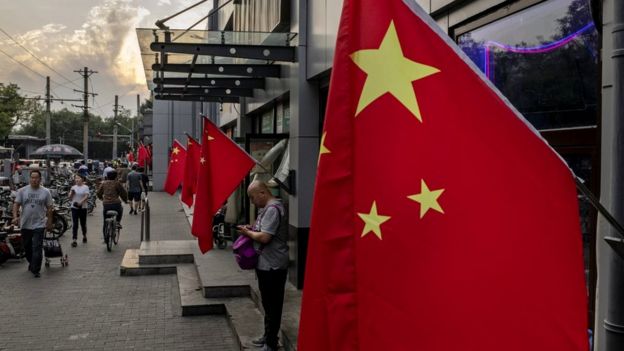
Across much of the city centre, there are national flags set up at every door. Voluntary inspectors are monitoring the streets and locals have told the BBC they’re being questioned after having even brief conversations with foreigners

One person said she was asked by an inspector: “Who were those foreigners? Why were they here?”

The tight control naturally extends online as well. Popular social media platform Weibo said it was deleting content that “distorts” or “insults” the country’s history ahead of the anniversary.

Chinese flags outside a row of shopsImage copyright GETTY IMAGES
Image caption Every house and every shop is sporting a national flag

Chinese journalists are always expected to toe the party line anyway, but starting in October they will have to pass an extra test to prove they are versed particularly in Xi Jinping’s teachings, officially called Xi Jinping Thought on Socialism with Chinese Characteristics, which has been written into the constitution.

Whether or not they pass the exam will then determine whether they’ll be accredited as journalists.

“The fundamental point with this ‘training’ and indoctrination process isn’t so much about the content,” David Bandurski of China Media Watch told the BBC.

“It is about reinforcing the message and understanding among journalists that they work, first and foremost, for the Chinese Communist Party, and serve its agenda.”

So not only will the events be choreographed – the domestic coverage of them will also be tightly guarded.

What about Hong Kong?

Despite Beijing’s determination to let its achievements shine on 1 October, there’s a good chance Hong Kong will pull focus.

Anti-Beijing protests always take place in Hong Kong on China’s National Day, but this time, the activists know that the world is watching.

Anti-government protests have rocked the city for months and the situation shows no sign of dying down.

Clashes between police and activists have been becoming increasingly violent, with police using tear gas and activists storming parliament.

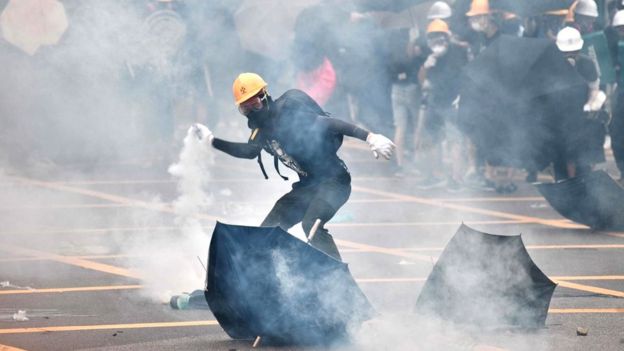
Protester throwing a tear gas can back at the policeImage copyright AFP
Image caption The protests have often escalated into violent clashes

That means two things for 1 October: official celebrations in the territory are being toned down to avoid clashes – the annual fireworks display has been cancelled – while at the same time, activists are planning to step up their protests.

On Sunday 29 September, a “Global Anti Totalitarianism March” is scheduled to take place at various locations around the world in support of Hong Kong.

On 1 October itself, a march in central Hong Kong is planned with everyone asked to wear black.

If the past weeks’ demonstrations are anything to go by, the smiles and celebrations in Beijing will be competing for media space with pictures of tear gas and angry young protesters in Hong Kong.

Source: The BBC

11/05/2014

Chinese elite push for release of jailed Nobel laureate | Reuters

A group of “princelings“, children of China’s political elite, has quietly urged the Communist Party leadership to release jailed Nobel laureate Liu Xiaobo on parole to improve the country’s international image, two sources said.

Workers prepare the Nobel Peace Prize laureate exhibition ''I Have No Enemies'' for Chinese dissident Liu Xiaobo at the Nobel Peace Center in Oslo December 9, 2010. REUTERS/Toby Melville

Liu‘s release is not high on the agenda of the party, which is trying to push through painful economic, judicial and military reforms amid the most extensive crackdown on corruption in over six decades, the sources with ties to the leadership said, requesting anonymity.

But the back channel push for Liu’s parole shows that a debate is taking place among leaders about damage to China’s reputation caused by his jailing. It also suggests the ruling elite are not monolithic when it comes to views on dissent.

Liu, 58, a veteran dissident involved in the 1989 Tiananmen Square pro-democracy protests crushed by the army, was jailed for 11 years in 2009 on subversion charges for organizing a petition urging an end to one-party rule. He won the Nobel Peace Prize the following year.

“For many princelings, the pros of freeing Liu Xiaobo outweigh the cons,” one of the sources said. “Liu Xiaobo will definitely be freed early. The question is when.”

He is eligible for parole after serving half his term.

via Chinese elite push for release of jailed Nobel laureate | Reuters.

Enhanced by Zemanta
07/05/2014

China detains five activists before 25th anniversary of Tiananmen crackdown | Reuters

China on Tuesday detained five rights activists, three lawyers and a rights group said, after they attended a weekend meeting that called for a probe into the suppression of pro-democracy protests in Tiananmen Square in 1989.

Chinese lawyer Pu Zhiqiang (R) speaks to journalists outside a courthouse in Chongqing municipality, December 28, 2012. REUTERS/Stringer

Among those held was Pu Zhiqiang, a prominent free-speech lawyer, who has represented many dissidents, including artist Ai Weiwei and an activist of the “New Citizens’ Movement”, a group that urges Chinese leaders to disclose their assets. He was detained on a charge of “causing a disturbance”, two lawyers said.

He has also opposed the system of forced labor camps, which the government has abolished, and featured prominently in state media for that campaign – unusual for a government critic.

Also detained were dissident Liu Di and Xu Youyu, a professor with the Chinese Academy of Social Sciences, a government think-tank, rights lawyer Shang Baojun said, citing conversations he had with family members of Liu and Xu.

Shang said he did not know what charge Liu and Xu would face as the families have not received their detention notices.

Dissident Hu Shigen and Hao Jian, who teaches at the Beijing Film Academy, were also detained, according to Chinese Human Rights Defenders, a China-based rights advocacy group.

The detentions raised the stakes in a crackdown on dissent and underscored the sensitivity of Chinese leaders to criticism ahead of the 25th anniversary of the crushing of demonstrations around Tiananmen Square in Beijing on June 4, 1989.

via China detains five activists before 25th anniversary of Tiananmen crackdown | Reuters.

Enhanced by Zemanta
02/05/2014

Freedom of information: Right to know | The Economist

IN THE summer of 2013 Wu Youshui sent an open government information (OGI) request to every provincial-level government in China. Mr Wu, a lawyer based in the eastern city of Hangzhou, wanted to know about the fines imposed on violators of the one-child policy. Each year provincial governments collect billions of yuan from couples who have too many children, but how this money is spent is not public knowledge. That leaves the system vulnerable to corruption, says Mr Wu. To expose misconduct and spur public debate, he used the legal mechanism of the OGI regulations, China’s version of a freedom of information act.

When the regulations took effect in 2008 it marked, on paper at least, the beginning of a profound change in how the Chinese government handles some kinds of information. A culture of secrecy had for decades been the mainstay of the authoritarian state. But in the modern era absolute opacity can cause discontent that threatens stability. The government’s failure to disclose information about the spread of SARS, a respiratory disease, in 2003 hurt its standing at home and abroad. A government operating in “sunshine”, as state media have put it, could regain citizens’ trust and, the party hoped, help ease tensions.

The OGI regulations set up two ways of accessing government information. Government offices at local and central level had to issue findings of interest, such as plans for land requisitions or house demolition. The information was to be published on official websites and community bulletin boards and in government journals. Departments also became answerable to citizens. A response to a public request had to come within 15 days. This created a new way for people to contact and monitor the government, says Jamie Horsley of the China Law Centre at Yale Law School. At the last nationwide count, in 2011, roughly 3,000 requests had been filed to central-government departments and 1.3m others to offices at the provincial level. Over 70% led to the full or partial release of information, on everything from pollution to food safety to the tax on air fares. “It is as if there has been a pent-up demand and now people are pushing for the information,” Ms Horsley says.

In an important case in 2012 the All-China Environment Federation, a non-profit organisation with links to the government, took an environment-protection bureau in Guizhou province to court. The bureau had twice failed to give a good answer to an OGI request about a dairy farm that was discharging waste. The court ordered the release of the information within ten days. Such rulings against government departments, once rare, are becoming more common. In 2010 the chance of a citizen winning an OGI-related lawsuit in Beijing was 5%, according to research from Peking and Yale Universities. In 2012 courts ruled with the plaintiff in 18% of cases.

On April 1st the State Council, China’s cabinet, issued new guidelines, requiring that officials pay more attention to disclosing information. The guidelines come as the government is curtailing freedom of expression online and in the press.

Inevitably, plenty of information remains off limits. Article Eight of the regulations says disclosure must not endanger state, public or economic security or social stability, an open-ended list that prompts utmost caution from compliers. State and commercial secrets—however vaguely defined—are out-of-bounds. Last June Xie Yanyi, a Beijing lawyer, applied to the public security ministry for information about the surveillance of citizens. He received a note saying such details were not covered by the law. China’s regulations are more restrictive than those elsewhere. In America a request in the public interest suffices. In China, people must prove a personal need.

Government departments, at all levels, still do not release everything they should. But Mr Wu, the lawyer, found they are less able to opt out without a good reason. Guangdong province’s Health and Family Planning Commission initially rebuffed his OGI request, saying “internal management issues” prevented compliance. Mr Wu tried again. On April 1st Guangzhou Intermediate Court ruled in his favour. The commission was ordered to reprocess his request. He awaits word of its decision.

via Freedom of information: Right to know | The Economist.

Enhanced by Zemanta
01/11/2013

China plea paper ‘to be overhauled’ – BBC News

A Chinese newspaper that made a front-page appeal for the release of a reporter accused of defamation is to be overhauled, a press regulator says.

Journalist Chen Yongzhou, in handcuffs, is escorted by police officers at the Changsha Public Security Bureau detention centre in China

The Guangzhou-based New Express made a rare public plea for the release of journalist Chen Yongzhou.

But Mr Chen subsequently admitted on television that he had taken bribes to fabricate stories about a part state-owned company.

Now the New Express is to undergo \”full rectification\”, the regulator said.

via BBC News – China plea paper ‘to be overhauled’.

24/10/2013

In rare move, China regulator voices concern for detained reporter | Reuters

So public protests sometimes works. See also – https://chindia-alert.org/2013/10/23/china-paper-in-detained-journalist-plea-bbc-news/

“China’s central publishing regulator, in a rare acknowledgement of the rights of journalists, expressed concern on Thursday about a detained reporter, a case that has stirred outrage after a newspaper pleaded with police on its front page to let him go.

Chen Yongzhou was detained after writing more than a dozen stories criticizing the finances of a major state-owned construction equipment maker, a move that coincides with new curbs on journalists, lawyers and internet users in China.

“The General Association of Press and Publishing (GAPP) resolutely supports the news media conducting normal interviewing and reporting activities and resolutely protects journalists\’ normal and legal rights to interview,” the China Press and Publishing Journal, which is overseen by the association itself, said, citing an association official.

“At the same time, it resolutely opposes any abuse of the right to conduct interviews.”

The article said the association was paying “close attention” to the matter.”

via In rare move, China regulator voices concern for detained reporter | Reuters.

23/10/2013

China paper in detained journalist plea – BBC News

A Chinese newspaper has published a rare front-page plea for the release of one of its journalists held by police.

A screen shot of New Express front page

The New Express, based in Guangzhou, called for Chen Yongzhou, who was detained last week, to be freed.

The paper said Mr Chen\’s detention was linked to reports he wrote about a part state-owned construction equipment company based in Hunan.

Police in Hunan have confirmed the journalist has been detained for \”damage to business reputation\’\’.

Earlier this year, Mr Chen wrote several reports about Zoomlion, which is partly owned by the Hunan provincial government.

Zoomlion issued a statement after one New Express article, which alleged it had improperly accounted for sales, caused its share price to drop.

In a statement to the Hong Kong stock exchange in late May, the company called the claims \”false, groundless and misleading\”.

via BBC News – China paper in detained journalist plea.

05/10/2013

China employs two million microblog monitors state media say – BBC News

More than two million people in China are employed by the government to monitor web activity, state media say, providing a rare glimpse into how the state tries to control the internet.

Sina Weibo

The Beijing News says the monitors, described as internet opinion analysts, are on state and commercial payrolls.

China’s hundreds of millions of web users increasingly use microblogs to criticise the state or vent anger.

Recent research suggested Chinese censors actively target social media.

The report by the Beijing News said that these monitors were not required to delete postings.


China’s internet is one of the most controlled and censored in the world.

Websites deemed to be subversive are blocked. Politically sensitive postings are routinely deleted . Even the name of the former Prime Minister Wen Jiabao was censored when rumours were circulating on the internet that his family had amassed a fortune while he was in power.

But with the rapid growth of internet users, the ruling Communist Party has found itself fighting an uphill battle.

The Beijing News, while reporting the story of microblog monitors, has admitted that it is impossible for the government to delete all “undesirable” postings.

The more postings deleted, the more they appear, it says.

China seldom reveals details about how it monitors and controls the internet. The government even does not acknowledge that it blocks web sites.

But the report does offer a rare glimpse into this opaque world.

They are “strictly to gather and analyse public opinions on microblog sites and compile reports for decision-makers”, it said. It also added details about how some of these monitors work.

Tang Xiaotao has been working as a monitor for less than six months, the report says, without revealing where he works.

“He sits in front of a PC every day, and opening up an application, he types in key words which are specified by clients.

“He then monitors negative opinions related to the clients, and gathers (them) and compile reports and send them to the clients,” it says.

The reports says the software used in the office is even more advanced and supported by thousands of servers. It also monitors websites outside China.

China rarely reveals any details concerning the scale and sophistication of its internet police force.

It is believed that the two million internet monitors are part of a huge army which the government relies on to control the internet.

The government is also to organise training classes for them for the first time from 14 to 18 October, the paper says.

via BBC News – China employs two million microblog monitors state media say.

See also: https://chindia-alert.org/2012/04/26/understanding-social-media-in-china/

14/05/2013

* China launches new crackdown on internet celebrities

My personal view is that “the genie is out of the bottle” or that you cannot shut “Pandora’s box” with the Internet and social media.

Telegraph: In its latest bid to contain the often riotous jumble of news and rumour on the Chinese internet, the Communist party has decided to bring the most high-profile and influential voices to heel.

China launches new crackdown on internet celebrities

Before his account was removed, Mr Hao had 1.85 million followers

On Saturday, Hao Qun, a famous 39-year-old novelist and frequent government critic who goes by the pen name Murong Xuecun, found his account on Sina Weibo, China’s version of Twitter, deleted. He tried to open another account but failed.

Before his account was removed, Mr Hao had 1.85 million followers and his postings on the site often went viral.

The world of Weibo, which had 368 million registered users last year, operates much like Speaker’s Corner. Its most famous inhabitants command huge followings and have the power to steer debate in a way that is often uncomfortable for the Communist party.

The deletion of Mr Hao’s account follows a series of actions against other high-profile users.

He Bing, the vice president of the law school at China’s Political Science and Law university was suspended last week “for deliberately spreading rumours”. Prof He, who had close to 500,000 followers, had posted a snippet of news, which later turned out to be false, claiming that there had been a mass stabbing in a hospital in Hefei.

Since the Chinese media is carefully controlled, Weibo has developed into the country’s most important source of news.

And since newspapers and television stations are not allowed to report on many of the topics that are voiced on the internet, rumours often go unchecked and develop their own momentum.

“Some of the [high profile users] have become rumour relay stations,” noted the Global Times in an editorial last week. “Any frequent Weibo user knows that rumours cannot be widely spread unless there is a [high-profile user] helping to spread it,” it added.

“Theoretically they have the right of speech on the internet, but they should also have an equal responsibility. Currently they have no moral responsibility or legal liability for what they post.”

Kaifu Lee, the former head of Google in China, who has more followers (40 million) than Barack Obama does on Twitter (33 million), said he was careful to verify information before posting it on Weibo.

“I realise with the number of followers I have that I need to make sure the messages I forward are legitimate,” he said. “With great power comes great responsibility,” he added.

However, he noted that Weibo already has inbuilt checks that should prevent false news from gaining traction.

“If you suggest something that is clearly false and do not retract it, your reputation (online) will suffer. I think the social ecosystem should largely be self-reinforcing,” he said, adding that Sina already has a type of tribunal system that can rule over the veracity of certain posts.

Mr Lee said he did not know what the purpose of the new government “internet management” campaign was. There already exists a sophisticated censorship system that filters posts and deletes sensitive topics. “I am not in the government, so I cannot say why the government is doing this,” he said.

Zhang Lifan, a historian with almost 270,000 followers said the attempt to control high-profile users would be fruitless. “Shutting them down will not make much difference. For each account they silence, other people will speak up,” he said.

“Of course people should not spread rumours, but the government is using a double standard,” he said. “CCTV (China’s state television station) also sometimes reports the wrong news.”

The campaign appears to have sent a firm message however. Yao Bo, a commentator and restaurateur with close to 900,000 followers said a number of his friends had seen their accounts shut down. “Some of the accounts are shut down for criticising government policy, others for reporting bits of information. I now feel I need to watch what I say before I post something,” he said.”

via China launches new crackdown on internet celebrities – Telegraph.

Law of Unintended Consequences

continuously updated blog about China & India

ChiaHou's Book Reviews

continuously updated blog about China & India

What's wrong with the world; and its economy

continuously updated blog about China & India