Chindia Alert: You’ll be Living in their World Very Soon
aims to alert you to the threats and opportunities that China and India present. China and India require serious attention; case of ‘hidden dragon and crouching tiger’.
Without this attention, governments, businesses and, indeed, individuals may find themselves at a great disadvantage sooner rather than later.
The POSTs (front webpages) are mainly 'cuttings' from reliable sources, updated continuously.
The PAGEs (see Tabs, above) attempt to make the information more meaningful by putting some structure to the information we have researched and assembled since 2006.
TAIPEI (Reuters) – Taiwan cannot accept becoming part of China under its “one country, two systems” offer of autonomy , President Tsai Ing-wen said on Wednesday, strongly rejecting China’s sovereignty claims and likely setting the stage for an ever worsening of ties.
China responded that “reunification” was inevitable and that it would never tolerate Taiwan’s independence.
In a speech after being sworn in for her second and final term in office, Tsai said relations between Taiwan and China had reached an historical turning point.
“Both sides have a duty to find a way to coexist over the long term and prevent the intensification of antagonism and differences,” she said.
Tsai and her Democratic Progressive Party won January’s presidential and parliamentary elections by a landslide, vowing to stand up to China, which claims Taiwan as its own and says it would be brought under Beijing’s control by force if needed.
“Here, I want to reiterate the words ‘peace, parity, democracy, and dialogue’. We will not accept the Beijing authorities’ use of ‘one country, two systems’ to downgrade Taiwan and undermine the cross-strait status quo. We stand fast by this principle,” Tsai said.
China uses the “one country, two systems” policy, which is supposed to guarantee a high degree of autonomy, to run the former British colony of Hong Kong, which returned to Chinese rule in 1997. It has offered it to Taiwan, though all major Taiwanese parties have rejected it.
China’s Taiwan Affairs Office, responding to Tsai, said Beijing would stick to “one country, two systems” – a central tenet of Chinese President Xi Jinping’s Taiwan policy – and “not leave any space for Taiwan independence separatist activities”.
“Reunification is a historical inevitability of the great rejuvenation of the Chinese nation,” it said. “We have the firm will, full confidence, and sufficient ability to defend national sovereignty and territorial integrity.”
China views Tsai as a separatist bent on formal independence for Taiwan. Tsai says Taiwan is an independent state called the Republic of China, its official name, and does not want to be part of the People’s Republic of China governed by Beijing.
TAIWAN OPEN TO DIALOGUE
China has stepped up its military drills near Taiwan since Tsai’s re-election, flying fighter jets into the island’s air space and sailing warships around Taiwan.
Tsai said Taiwan has made the greatest effort to maintain peace and stability in the narrow Taiwan Strait that separates the democratic island from its autocratic neighbour China.
“We will continue these efforts, and we are willing to engage in dialogue with China and make more concrete contributions to regional security,” she added, speaking in the garden of the old Japanese governor’s house in Taipei, in front of a socially-distanced audience of officials and diplomats.
Taiwan has become a rising source of friction between China and the United States, with the Trump administration strongly backing Taiwan even in the absence of formal diplomatic ties.
U.S. Secretary of State Mike Pompeo sent his congratulations to Tsai on Tuesday, praising her “courage and vision in leading Taiwan’s vibrant democracy”, in a rare high-level message from Washington direct to Taiwan’s government.
China’s Foreign Ministry condemned Pompeo’s remarks, and said the government would take “necessary countermeasures”, though did not elaborate.
China cut off a formal talks mechanism with Taiwan in 2016 after Tsai first won election.
Yao Chia-wen, a senior adviser to Tsai, told Reuters the chance of talks with China were small given ongoing tensions.
“We are ready to engage with them any time, but China is unlikely to make concessions to Taiwan,” he said. “In the next four years there’s little chance for the cross-strait relationship to improve.”
NEW DELHI (Reuters) – Hundreds of foreign companies are actively procuring components for India and Pakistan’s nuclear programmes, taking advantage of gaps in the global regulation of the industry, according to a report by a U.S.-based research group.
Using open-source data, the nonprofit Centre For Advanced Defense Studies (C4ADS) report provides one of the most comprehensive overviews of networks supplying the rivals, in a region regarded as one of the world’s most dangerous nuclear flashpoints.
“India and Pakistan are taking advantage of gaps in global non-proliferation regimes and export controls to get what they need,” said Jack Margolin, a C4ADS analyst and co-author of the report.
It is seldom possible to determine whether individual transactions are illegal by using publicly available data, Margolin said, and the report does not suggest that companies mentioned broke national or international laws or regulations.
But past reports by the think tank, whose financial backers include the Carnegie Corporation and the Wyss Foundation, have often led to action by law enforcement agencies.
Spokesmen from the offices of India’s Prime Minister Narendra Modi, and Pakistan’s Prime Minister Imran Khan did not respond to requests for comment. Pakistan’s military, which plays a major role in decision-making for the nuclear weapons programme, also declined to comment.
To identify companies involved, C4ADS analysed more than 125 million records of public trade and tender data and documents, and then checked them against already-identified entities listed by export control authorities in the United States and Japan.
Pakistan, which is subject to strict international export controls on its programme, has 113 suspected foreign suppliers listed by the United States and Japan. But the C4ADS report found an additional 46, many in shipment hubs like Hong Kong, Singapore and the United Arab Emirates.
“In Pakistan’s case, they have a lot more stringent controls, and they get around these by using transnational networks… and exploiting opaque jurisdictions,” Margolin said.
The father of Pakistan’s atomic bomb, AQ Khan, admitted in 2004 to selling nuclear technology to North Korea, Iran and Libya. He was pardoned a day later by Pakistani authorities, which have refused requests from international investigators to question him.
India has a waiver that allows it to buy nuclear technology from international markets. The Indian government allows inspections of some nuclear facilities by the International Atomic Energy Agency, but not all of them.
Neither India or Pakistan have signed the international Treaty on the Non-Proliferation of Nuclear Weapons, adhered to by most nuclear powers. Consequently, they are not obliged to submit to IAEA oversight over all of their facilities.
C4ADS identified 222 companies that did business with the nuclear facilities in India that had no IAEA oversight. Of these, 86 companies did business with more than one such nuclear facility in India.
“It’s evidence that more needs to be done, and that there needs to be a more sophisticated approach taken to India,” Margolin said. “Just because the product is not explicitly bound for a military facility, that doesn’t mean that the due diligence process ends there.”
India and Pakistan have gone to war three times – twice over the disputed Kashmir region – since they won independence from British colonial rule in 1947.
Having for years secretly developed nuclear weapons capability, the two declared themselves nuclear powers following tit-for-tat atomic tests in 1998.
A few years later, in 2002, the two foes almost went to war for a fourth time, following an attack by Pakistan-based militants on the parliament in New Delhi. And a year ago, a suicide attack by a Pakistan-based militant group in a part of Kashmir controlled by India sparked another flare up in tensions.
Both countries are estimated to have around 150 useable nuclear warheads apiece, according to the Federation of American Scientists, a nonprofit group tracking stockpiles of nuclear weapons.
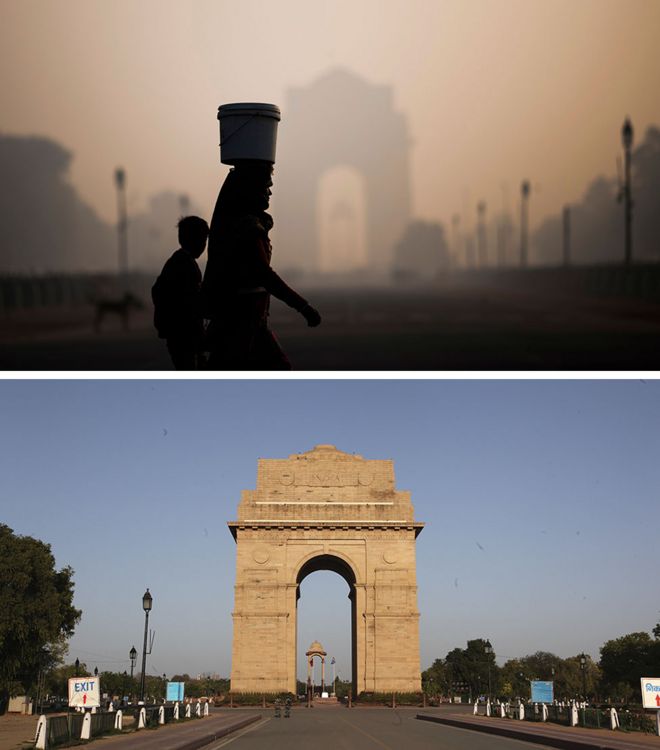
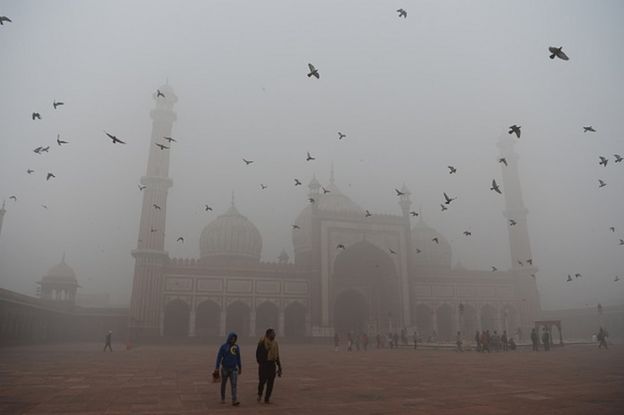
Image copyright GETTY IMAGESImage caption Delhi’sair quality has improved remarkably during the shutdown
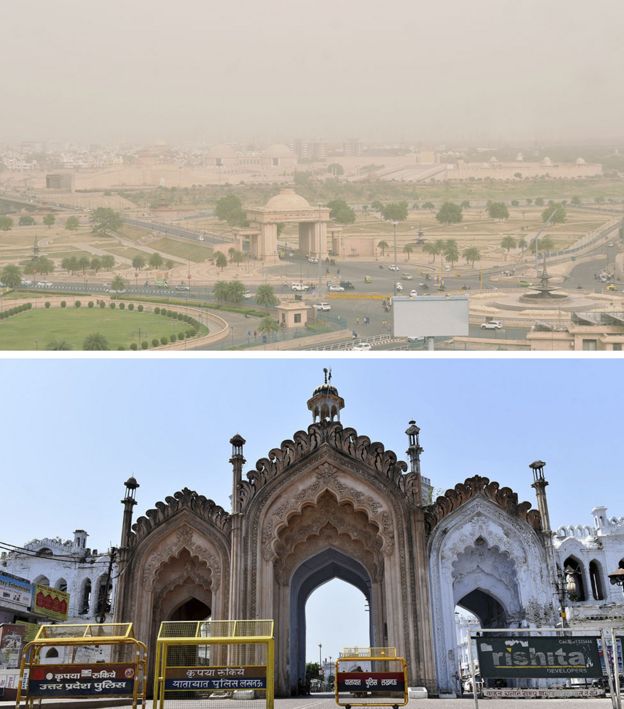
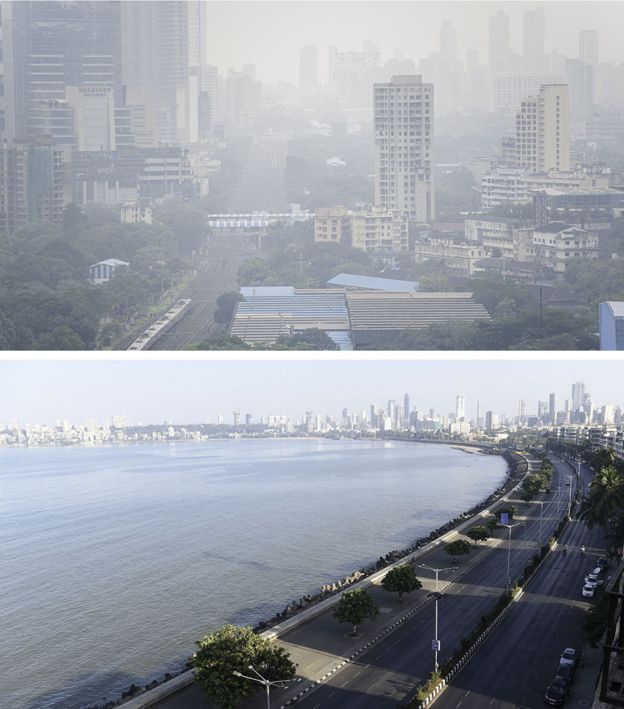
When India shut down last month and suspended all transport to contain the spread of coronavirus, the skies over its polluted cities quickly turned an azure blue, and the air, unusually fresh.
As air pollution plummeted to levels unseen in living memory, people shared pictures of spotless skies and even Himalayan peaks from cities where the view had been obscured by fog for decades.
On one social messaging group, a resident of the capital, Delhi, which regularly records some of the foulest air in the world, celebrated the city’s “alpine weather“. Politician and author Shashi Tharoor wrote that the “blissful sight of blue skies and the joy of breathing clean air provides just the contrast to illustrate what we are doing to ourselves the rest of the time”.
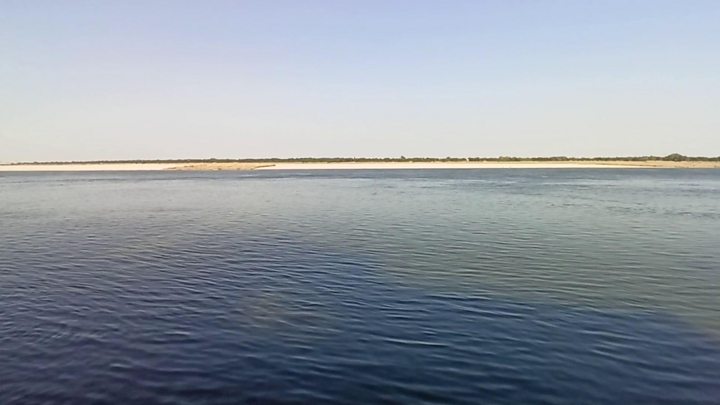
Media caption India coronavirus lockdown cleans up Ganges river
Less than six months ago, Delhi was gasping for breath. Authorities said air quality had reached “unbearable levels”. Schools were shut, flights were diverted, and people were asked to wear masks, avoid polluted areas and keep doors and windows closed.
Delhi and 13 other Indian cities feature on a list of the world’s 20 most polluted. It is estimated that more than a million Indians die every year because of air pollution-related diseases. Industrial smoke, vehicular emissions, burning of trash and crop residue, and construction and road dust are the major contributors.
As urban Indians gazed at the skies and breathed clean air inside their homes, researchers hunkered down to track data on how the grinding lockdown – now extended to 3 May – was impacting air pollution across the country.
Image copyright GETTY IMAGESImage caption Lucknow is another city on the top 20 world’s most polluted list
“This was an unprecedented opportunity for us to take a close look at how air pollution levels have responded to an extraordinary development,” Sarath Guttikunda, who heads Urban Emissions, an independent research group that provides air quality forecasts, told me.
Dr Guttikunda and his team of researchers looked at the data spewed out by the 100-odd air quality monitoring stations all over India. They decided to concentrate on the capital Delhi and its suburbs – a massive sprawl called the National Capital region, where more than 20 million people live. Last winter, air pollution here had reached more than 20 times the World Health Organization’s safe limit.
Image copyright HINDUSTAN TIMESImage caption The financial capital Mumbai also seems very different
The deadliest particle in Delhi’s foul air is the tiny but deadly PM 2.5, which increases the likelihood of respiratory and cardiovascular diseases. They primarily come from combustion – fires, automobiles and power plants.
Urban Emissions found the levels of PM 2.5 in Delhi during the lockdown plummeted to 20 micrograms per cubic metre with a 20-day average of 35.
To put this into context, between 2017 and 2019, the monthly average of PM 2.5 in the capital was up to four times higher. (The national standard is set at 40, and the WHO has an annual average guideline of just 10 micrograms per cubic metre.)
“If 35 is the average lowest available PM2.5 with limited local emissions, it means that at least 70% of the pollution is locally generated,” Mr Guttikunda told me.
Media caption India coronavirus lockdown cleans up Ganges river
His study also found a marked dip in PM 10, caused mainly by road and construction dust, and nitrogen dioxide, which comes mainly from vehicular emissions, and nearly 90% of vehicles are off the road.
“The current crisis has shown us that clear skies and breathable air can be achieved very fast if concrete action is taken to reduce burning of fossil fuels,” says Sunil Dahiya, of the Centre for Research on Energy and Clean Air, which has also been tracking air pollution levels during the lockdown.
But will this prompt change? After all, urban Indians’ and the media’s panic and outrage during the deadly winter pollution every year soon gets lost in the fog of summer heat and concerns over monsoon rains and droughts.
“We don’t yet have a democratic demand for clean air,” Arunabha Ghosh, Chief Executive Officer of the Council on Energy, Environment and Water, a leading climate think tank, told me. Orders to clean up the air have almost always come from the courts, responding to pleas by NGOs.
Image copyright GETTY IMAGESImage caption Pollution in Delhi peaks during winter
However, Dr Ghosh still hopes that “the experience of blue skies and fresh air could be a trigger to create a democratic demand for clean air in India”.
Crises often trigger life changing reforms. A fatal four-day “pea-souper” that engulfed London in 1952 and killed thousands provoked the passing of the Clean Air Act to reduce the use of smoky fuels.
China tried to clean up its air several times before hosting marquee international events – like the Beijing Olympics in 2008, the World Expo in Shanghai and the Guangzhou Asian Games in 2010 – before sliding back to grey, smoky skies.
But many believe the 2014 Apec meeting in Beijing, when China hosted 21 heads of Asia-Pacific economies, was a turning point. The rare blue skies over Beijing spawned the phrase ‘Apec blue‘. In a rush to clean its air, China introduced a set of far-reaching measures. Over the next four years, this resulted in a 32% drop in average pollution across major Chinese cities.
So could a lockdown to prevent the spread of a pandemic, which has imperilled the health and livelihoods of millions, trigger similar policy changes to clean up India’s air?
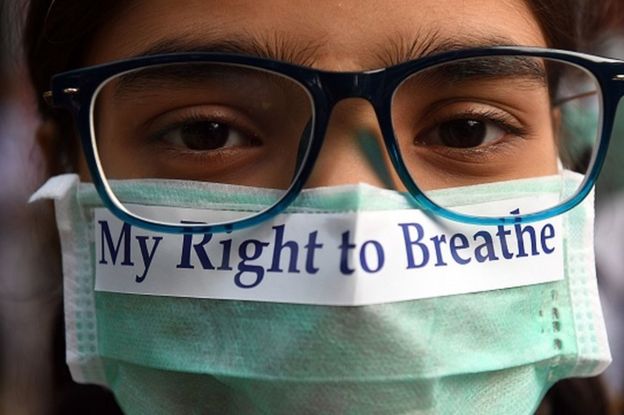
Image copyright GETTY IMAGESImage caption The movement for clean air has been sporadic and mainly pushed by NGOs
Could it move to a shift in reducing traffic on the road by asking people to work from home in shifts now that millions have experienced clean air for the first time in years? (Facing energy shortages after the loss of the Fukushima nuclear power plant, Japan unleashed a Cool Biz campaign to cut down air conditioning in workplaces and reduce carbon emissions by asking office workers to shed their suits.)
Or can India use some of the money from an inevitable stimulus to help kick-start the economy go towards helping green industries? Renewables, experts say, creates more jobs than coal: India has already created nearly 100,000 jobs in solar and wind energy firms.
Can the country use the windfall revenues accruing from the steep decline in oil prices – most of India’s oil is imported – to provide rebates to polluting factories to set up much-needed emission control equipment?
“We have to learn lessons to deploy the economic recovery from the pandemic. We need growth, jobs and sustainable development,” says Dr Ghosh. Cleaning up the air could be the key. For too long, India – and Indians – have ignored their right to breathe easy.
What’s more, if China can reduce air pollution by 32% in four-and-a-half years, why can’t India pledge to reduce pollution by 80% in 80 cities by 2027, which is our 80th anniversary of Independence? asks Dr Ghosh.
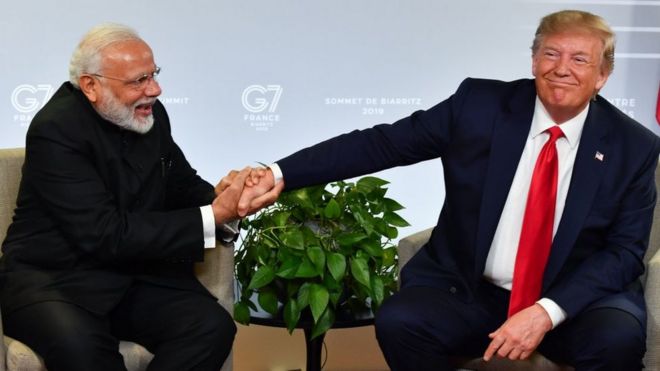
Image copyright GETTY IMAGESImage caption Mr Trump is making his first official visit to India
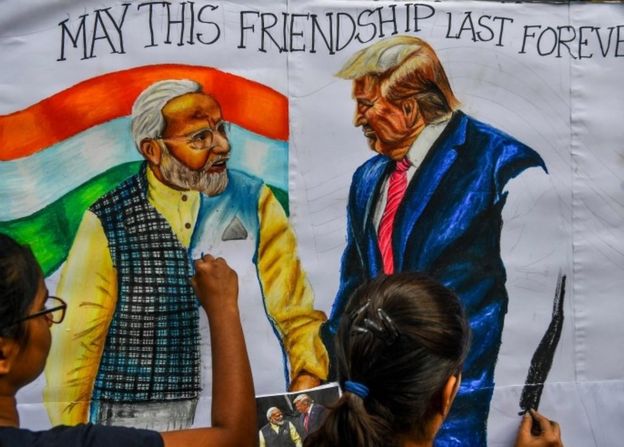
US President Donald Trump is expecting a raucous welcome on his first official state visit to India on Monday and Tuesday.
He follows a long line of leaders who have made the journey. Some of his predecessors were greeted enthusiastically; others stumbled through diplomatic gaffes; one even had a village named after him.
Can history be a guide to how this diplomatic tryst might go? Here’s a brief look at past visits, ranked in order of how they went.
The good: President Eisenhower
Let’s begin at the beginning.
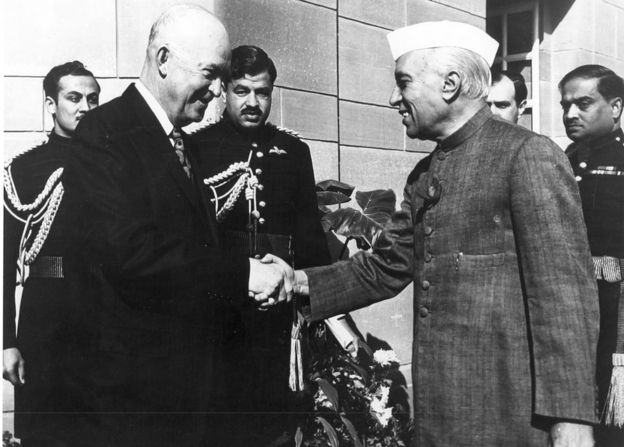
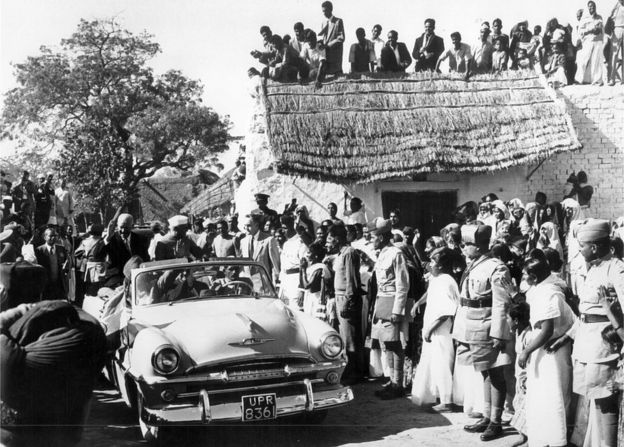
Dwight D Eisenhower, the first US president to visit India, was greeted with a 21-gun salute when he landed in the national capital, Delhi, in December 1959. Huge crowds lined the streets to catch a glimpse of the World War Two hero in his open-top car – Mr Trump is expecting a similar reception in Ahmedabad city, where he will be doing a road show.
Image copyright US EMBASSY ARCHIVESImage caption Dwight D Eisenhower, pictured with Prime Minister Jawaharlal Nehru, was the first US president to make the trip
The warmth between President Eisenhower and Indian Prime Minister Jawaharlal Nehru helped during what was a rocky phase in US-India ties. This was early in the Cold war, when the US and Pakistan had become become close allies, and India insisted on staying neutral or “non-aligned”. Like today, relations with China were at the core of the India-US equation, with Washington pressuring Delhi to take an aggressive stance with Beijing on the issue of Tibet.
But, on the whole, Eisenhower’s four-day trip was billed a success. And nearly every US president on a state visit to India has emulated his itinerary: he laid flowers at Mahatma Gandhi’s memorial, took in the splendour of the Taj Mahal, addressed parliament and spoke at Delhi’s iconic Ramlila grounds, which, according to one news report, attracted one million people.
When he left, Nehru said he had taken with him “a piece of our heart”.
Image copyright US EMBASSY ARCHIVESImage caption President Eisenhower was greeted by large crowdsThe game-changer: Bill Clinton
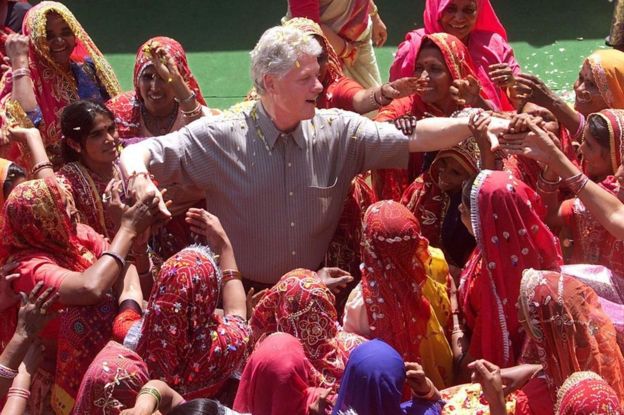
If there was a game-changing visit, it would be Bill Clinton’s in March 2000 with Prime Minister Atal Bihari Vajpayee. Mr Clinton’s arrival came after a two-decade lull – neither Ronald Reagan nor George Bush Snr made the journey East. It came at a tricky time as Washington had imposed sanctions on Delhi following its 1999 test of a nuclear bomb.
But, according to Navtej Sarna, a former Indian Ambassador to the US, the five-day trip was “a joyous visit”. It included stops in Hyderabad, a southern city that was emerging as a tech hub, and Mumbai, India’s financial capital. “He came and saw the economic and cyber potential of India, and democracy in action,” says Mr Sarna.
Image copyright GETTY IMAGESImage caption Bill Clinton’s visit was described as “joyous”Mr Clinton also danced with villagers, took a tiger safari and sampled Delhi’s famously creamy black dal (lentils) at a luxury hotel that has since been associated with the president.
The country’s reaction is perhaps best expressed in this New York Times headline: “Clinton fever – a delighted India has all the symptoms.”
The nuclear deal: George W Bush
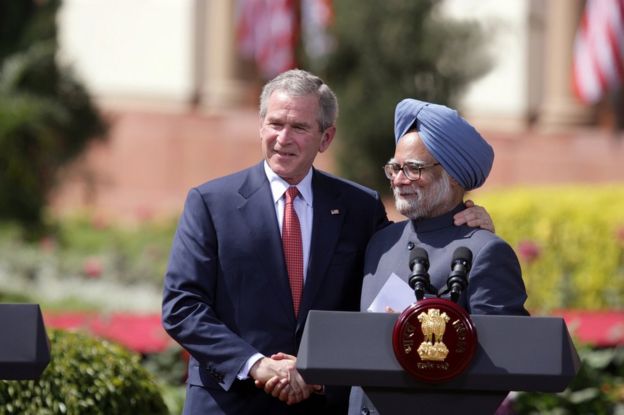
George W Bush, as Forbes magazine once put it, was the “best US president India’s ever had”. His three-day visit in March 2006 was a highlight in the two countries’ strategic relationship – especially in matters of trade and nuclear technology, subjects they have long wrangled over. His strong personal dynamic with Prime Minister Manmohan Singh was hard to miss – after he left office, Mr Bush, a keen artist, even painted a portrait of Mr Singh.
The two leaders are credited for a historic but controversial nuclear deal, which was signed during Mr Bush’s visit. It brought India, which had for decades refused to sign the Nuclear Non-Proliferation Treaty (NPT), out of isolation. Energy-hungry India got access to US civil nuclear technology in exchange for opening its nuclear facilities to inspection.
Image copyright US EMBASSY ARCHIVESImage caption George W Bush and Manmohan Singh had a very good relationshipHowever, while the visit was substantive, it was not as spectacular as others – there was no trip to the Taj, nor an address to parliament. But the timing was important. Anti-US sentiment over the invasion of Iraq was running high – left-wing MPs had staged a protest against Mr Bush’s visit, and there were demonstrations in other parts of India.
Double visit: Barack Obama
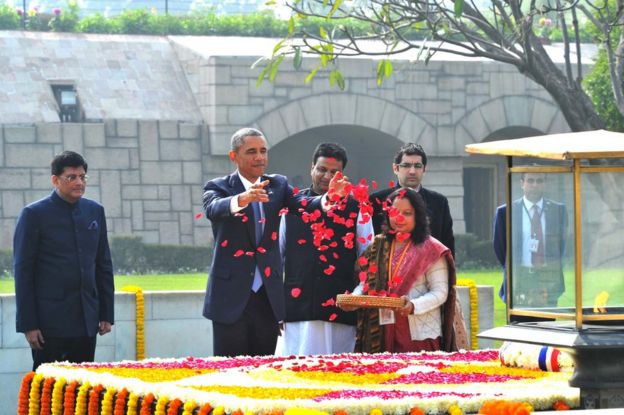
Barack Obama was the only president to make two official visits. First, in 2010 with Prime Minister Manmohan Singh, and then in 2015 with Prime Minister Narendra Modi.
On his first visit – in a break from the past – he landed in Mumbai, instead of Delhi, with a large trade delegation. This was not just about economic ties but a show of solidarity following the Mumbai terror attacks of 2008, which killed 166 people. Mr and Mrs Obama even stayed at the Taj Mahal hotel, one of the main targets.
It was significant that the US president declared support for India to join a reformed and expanded UN Security Council, says Alyssa Ayres, a former US deputy assistant secretary of state for South Asia. “That all these years later nothing has changed in the UN system is another matter, but that was a major policy shift for the United States.”
Image copyright US EMBASSY ARCHIVESImage caption Barack Obama visited India twiceMr Obama returned in 2015 as chief guest at India’s Republic Day celebrations, at PM Modi’s invitation. Trade, defence and climate change were at the heart of the talks. The trip also emphasised an Indo-Pacific strategy, where both leaders expressed unease over Beijing’s provocations in the South China Sea.
The not-so-good: Jimmy Carter
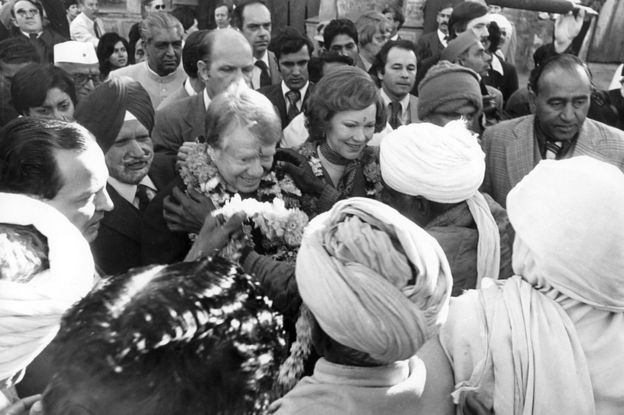
Although Jimmy Carter’s two-day visit in 1978 was a thaw in India-US relations, it was not free of hiccups.
With some 500 reporters in tow, Carter followed a packed itinerary: he met Prime Minister Morarji Desai, addressed a joint session of parliament, went to the Taj Mahal, and dropped by a village just outside Delhi.
The village, Chuma Kheragaon, had a personal connection: Carter’s mother, Lillian, had visited here when she was in India as a member of the Peace Corps in the late 1960s. So when Carter and his wife, Rosalynn, made the trip, they gave the village money and its first television set. It was even renamed “Carterpuri”, a moniker it still holds.
Image copyright US EMBASSY ARCHIVESImage caption Jimmy Carter being greeted by villagers of ‘Carterpuri’But beyond the photo-ops, India and the US were sparring. India was building its nuclear programme, and had conducted its first test in 1974. The US wanted India to sign the NPF, which sought to stop the spread of nuclear weapons. But India refused, saying the agreement discriminated against developing countries.
In a leaked conversation that made headlines and threatened to derail the visit, Mr Carter promised his Secretary of State, Cyrus Vance, a “very cold and very blunt” letter to Desai. The two leaders signed a declaration, promising greater global co-operation, but Carter left India without the assurances he had hoped for.
The ugly: Richard Nixon
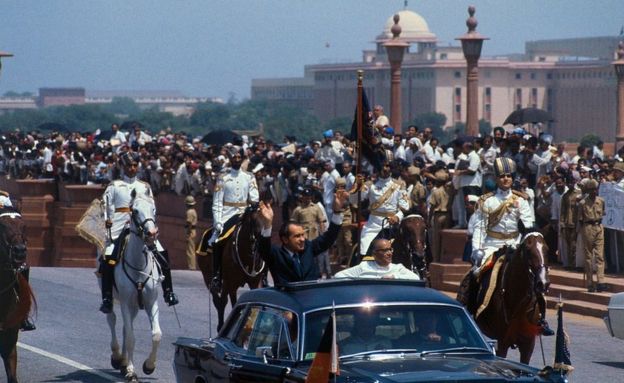
Richard Nixon was no stranger to India when he arrived in August 1969 for a day-long state visit. He had been here as vice-president in 1953, and before that on personal trips. But, by all accounts, he wasn’t a fan.
“Nixon disliked Indians in general and despised [Prime Minister] Indira Gandhi,” according to Gary Bass, author of Blood Telegram: Nixon, Kissinger and a Forgotten Genocide. And, he adds, the feeling was said to be mutual.
This was also at the height of the Cold War, and India’s non-alignment policy “appalled” American presidents. Mr Bass says that under Gandhi, India’s neutrality had turned into a “noticeably pro-Soviet foreign policy”.
Image copyright GETTY IMAGESImage caption Richard Nixon waves to the crowds alongside Mohammad Hidyatullah, India’s acting presidentThe relationship only turned frostier after the trip as India backed Bangladesh (then East Pakistan) in its fight for independence from Pakistan, a close American ally. The differences were laid bare when Gandhi visited the White House in 1971. Declassified state department cables later revealed that Nixon referred to her as an “old witch”.
And the future: Donald Trump
The US and India have certainly had their ups and downs, but during the last official visit in 2015, Mr Obama and Mr Modi signed a declaration of friendship: “Chalein saath saath (Let’s move forward together)…” it began.
President Trump’s visit will take the relationship forward, but it’s unclear how.
Image copyright AFP
His arrival in Ahmedabad, the main city in PM Modi’s home state of Gujarat, followed by a big arena event, is expected to draw a massive crowd. It will echo President Eisenhower’s rally in Delhi years ago, perhaps cementing the personal ties between the two leaders.
But while Mr Trump’s trip will be packed with pageantry, it could be light on policy. Unlike other presidential visits, this one is not expected to yield concrete agreements, with the trade deal Mr Trump so badly wants looking unlikely.
Image copyright AFPImage caption The majority of the 7,100 cheetahs left in the world are in Africa
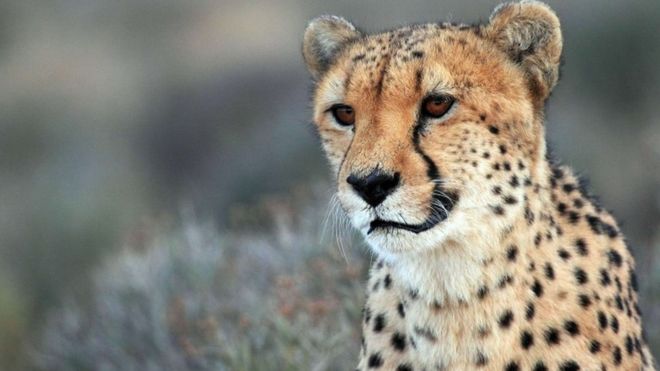
India’s top court has said cheetahs can be reintroduced in the country, 70 years after they were wiped out.
Responding to a plea by the government, the Supreme Court said African cheetahs could be introduced to the wild in a “carefully chosen location”.
Cheetahs are an endangered species, according to the Convention on International Trade in Endangered Species (Cites).
Only 7,100 cheetahs are left in the wild, almost all of them in Africa.
The Asiatic cheetah, which once roamed parts of India, is now only found in Iran, where there are thought to be about 50 left.
India’s Supreme Court said the animal would have to be introduced on an experimental basis to find out if it could adapt to Indian conditions.
Studies show that at least 200 cheetahs were killed in India, largely by sheep and goat herders, during the colonial period. It is the only large mammal to become extinct after the country gained independence in 1947.
India’s former environment minister Jairam Ramesh welcomed the decision to reintroduce the animal.
Delighted that Supreme Court has just given OK to reintroducing cheetah from Namibia. This was something I had initiated 10 years ago. Cheetah which derives from the Sanskrit ‘chitra’ (speckled) is the only mammal hunted to extinction in modern India.
For more than a decade, wildlife officials, cheetah experts and conservationists from all over the world have discussed the reintroduction of the spotted big cat to India and have agreed that there is a strong case for it.
But leading conservationists have harboured doubts about the plan. They fear that in its haste to bring back the cheetah, India will end up housing the animals in semi-captive conditions in huge, secured open air zoos rather than allowing them to live free.
They add that without restoring habitat and prey base, and given the high chances of a man-animal conflict, viable cheetah populations cannot be established.
They have also pointed to India’s chequered record of reintroducing animals to the wild.
Lions were reintroduced in the Chandraprabha sanctuary in northern Uttar Pradesh state in the 1950s, but were then poached out of existence.
You may also be interested in…
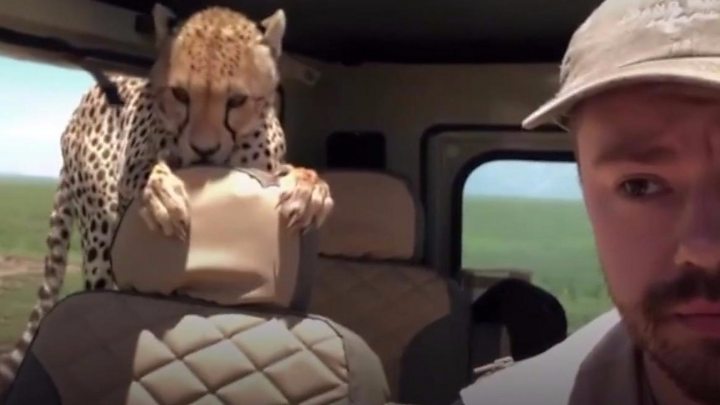
Media caption Curious cheetah joins safari group in Tanzania
However, conservationists who have led the initiative insist that these fears are unfounded. They say a decision will only be taken after shortlisted sites are fully examined for habitat, prey and potential for man-animal conflict.
The first cheetah in the world to be bred in captivity was in India during the rule of Mughal emperor Jahangir. His father, Akbar, recorded that there were 10,000 cheetahs during his time.
Much later, research showed that were at least 230 cheetahs in India between 1799 and 1968 – and the cat was reportedly sighted for the last time in the country in 1967-68.
HONG KONG (Reuters) – China’s People’s Liberation Army (PLA) soldiers in shorts and t-shirts made a surprising appearance in some Hong Kong streets on Saturday, briefly helping residents clean up debris after anti-government protests blocked roads, witnesses said.
The presence of PLA troops on the streets, even to help clean up roads near their base, could stoke further controversy over the Chinese-ruled territory’s autonomous status.
Hong Kong has been rocked by more than five months of demonstrations by protesters angry at perceived Communist Party meddling in the former British colony, which was guaranteed its freedoms when it returned to Chinese rule in 1997.
Beijing denies interfering and has blamed the unrest on foreign influences.
Clashes between protesters and police have become increasingly violent. China has warned that any attempt at independence for Hong Kong will be crushed, but troops have remained inside their base.
RELATED COVERAGE
China’s PLA soldiers seen helping clean up streets after Hong Kong protests – RTHK
Saturday’s clean up followed some of the worst violence seen this year, after a police operation against protesters at the Chinese University of Hong Kong on Tuesday.
The authorities have since largely stayed away from at least five university campuses that had been barricaded by thousands of students and activists who stockpiled petrol bombs, catapults, bows and arrows and other weapons.
Many protesters appeared to have left the campuses by late Saturday, though some remained behind to man makeshift barricades. Hong Kong’s Cross-Harbour Tunnel was still blocked by protesters occupying Polytechnic University.
Earlier, hundreds of pro-China demonstrators gathered by the city’s legislature and police headquarters, waving Chinese and Hong Kong flags. Some held up posters reading “Police we stand with you”, while others chanted “Support the police”.
Pro-China protests have so far attracted much smaller numbers than those angry at Beijing.
RARE TROOP PRESENCE
By late afternoon, the PLA soldiers had left the streets outside Baptist University, beside their barracks in leafy Kowloon Tong.
Chinese troops have appeared on local streets only once since the 1997 handover, to help with cleanup operations after a typhoon in late 2018. It was not immediately clear how many were involved on Saturday.
Calls to the PLA Hong Kong garrison office and a media liaison officer went unanswered.
Demosistō, a pro-democracy organisation, said Saturday’s cleanup operation could set a “grave precedent” if the city’s government invites the military to deal with internal problems.
In August, Beijing moved thousands of troops across the border into Hong Kong in what state news agency Xinhua described as a routine “rotation”.
Foreign envoys and security analysts estimate up to 12,000 troops are now based across Hong Kong — more than double the usual garrison number.
Standing beside a black flag with the slogan “Liberate Hong Kong, Revolution of our Times,” James Wong, 23, was among a handful of protesters still manning a bridge at Baptist University.
“We didn’t want to confront the people and the PLA troops directly,” he told Reuters. “We are not directly against the PLA, but rather the government. But the PLA should not leave their base because this is Hong Kong territory.”
Wong said even after the campus fortifications have been dismantled “Hong Kong will keep resisting until the government responds to our demands”.
Hundreds of residents moved in to help clear barricaded roads near several universities.
Clashes on Saturday saw at least one petrol bomb thrown before anti-government protesters at the campuses retreated. No soldiers appeared to have been involved in the confrontations.
“We just want our lives to continue,” said one resident who was helping clear streets near HKU. “There are many elderly who need to go the hospital and children who need to go to school. I am very sad to see what is happening in my community.”
PRO-POLICE DEMONSTRATION
Saturday’s rally to denounce the anti-government violence drew a mix of young and elderly.
“From the bottom of our hearts, we believe it is the correct thing to support the police in fighting the rioters for Hong Kong citizens,” said a 49-year-old housewife surnamed Kong.
“A lot of people keep silent, afraid of the rioters. It’s time for all the people who are silent to step up and say that’s enough.”
A 70-year-old street cleaner died on Thursday after being hit on the head by one of several bricks police said had been thrown by “masked rioters”. On Monday, police blamed a “rioter” for dousing a man in petrol and setting him on fire. The victim is in critical condition.
On the same day, police shot a protester in the abdomen. He was in a stable condition.
Many pro-police protesters laid white flowers outside the government office to pay their respects to the cleaner. Others applauded and cheered the police, some bowing and giving thumbs up as they walked past riot police on duty.
Authorities said on Saturday that a highway blocked by anti-government protesters on Friday had reopened after being cleared of debris and petrol bombs.
Train services suspended earlier in the week were gradually resuming, metro operator MTR Corp (0066.HK) said.
NEW DELHI (Reuters) – India and Pakistan are set to sign an agreement on Indian pilgrims visiting a Sikh shrine in Pakistan, rare cooperation between the nuclear-armed neighbours at a time of tension that has brought exchanges of fire on their disputed border.
The pact will introduce visa-free access from India to the Pakistani town of Kartarpur, home to a temple that marks the site where the founder of Sikhism, Guru Nanak, died.
India’s foreign ministry said in a statement late on Monday an understanding had been reached on most issues and India was prepared to sign the agreement on Wednesday.
Pakistani officials were not immediately available for comment but Pakistan’s Dawn newspaper cited a foreign ministry spokesman as saying agreement had been reached and the two sides would sign the pact soon.
The Sikh minority in India has long sought easier access to the temple in Kartarpur, which is just over the border in Muslim-majority Pakistan.
The collaboration comes at a time of tension between the rivals, with Pakistan particularly aggrieved over recent Indian government measures in its part of the divided Muslim-majority region of Kashmir.
Both countries claim the Himalayan region in full but rule it in part.
India in August revoked special autonomy in Indian-controlled Kashmir, which was accompanied by a crackdown on dissent by India’s security forces there, angering Pakistan.
The dispute over Kashmir has bedevilled relations since their independence in 1947 and sparked two of their three wars.
India said on Sunday two soldiers and a civilian were killed in cross-border shelling in Kashmir while Pakistan said one of its soldiers and three civilians had been killed.
In February, they came close to war following a suicide bombing in Indian Kashmir that killed 40 paramilitary soldiers. In response, India launched an air strike on the Pakistani side and Pakistan shot down an Indian aircraft.
The new crossing will be inaugurated in early November, just before the 550th birthday of Sikhism’s founder on Nov. 12, officials from both sides have said.
The shrine is about 4 km (2-1/2 miles) from the border. The crossing and corridor, including a road, bridge over the Ravi River and immigration office, will replace a drawn-out visa process and circuitous journey through Pakistan.
But there is still disagreement over a $20 fee that Pakistan wants to charge each visitor.
India “has consistently urged Pakistan that in deference to the wishes of the pilgrims, it should not levy such a fee”, India’s foreign ministry said.
SRINAGAR, India (Reuters) – India and Pakistan blamed one another for cross-border shelling in the disputed Kashmir region which killed and injured soldiers and civilians on both sides and made it one of the deadliest days since New Delhi revoked Kashmir’s special status in August.
India said there was heavy shelling by Pakistan across the border in northern Kashmir’s Tangdhar region late on Saturday night, killing two Indian soldiers and one civilian. Islamabad said one of its soldiers and three civilians died after India violated the ceasefire, according to the spokesman for the Pakistani Armed Forces.
Kashmir has been a disputed subject between the two nuclear-armed neighbours since they both got independence in 1947, and they have fought two of their three wars over the region.
Tensions between the two countries have flared and there has been intermittent cross-border firing since Aug. 5 when New Delhi flooded Indian Kashmir with troops to quell unrest after it revoked the region’s special autonomous status.
Islamabad has warned that changing Kashmir’s status would escalate tensions but India says the withdrawal of special status is an internal affair and is aimed at faster economic development of the territory.
Reuters was unable to independently verify the claims made by both sides on the shelling, which marks an escalation from the small arms fire usually exchanged by the two armies.
There was an unprovoked ceasefire violation by Pakistan, said Indian defence spokesman Colonel Rajesh Kalia.
“Our troops retaliated strongly causing heavy damage and casualties to the enemy,” Kalia said.
An Indian army source said the shelling was cover to assist militants enter India because of which a “calibrated escalation of area weapons was undertaken”. The Indian army “retains the right to respond at a time and place of it’s choosing” if the Pakistani army continues to do this, he said.
Pakistan, meanwhile, also claimed that India’s attack was unprovoked and deliberately targeted at civilians.
Major General Asif Ghafoor, a spokesman for the Pakistan Armed Forces, said Pakistan responded “effectively,” killing 9 Indian soldiers, injuring several others and destroying 2 bunkers.
“The Indian army shall always get a befitting response,” he said.
Indian forces in Kashmir have gone “berserk”, Raja Farooq Haider, prime minister of Pakistan’s Azad Kashmir region, said, adding that six civilians died and 8 were injured.
“This is the height of savagery. The world must not stay silent over it. #KashmirNeedsAttention,” he said in a tweet.
Beijing joins global condemnation of attack launched by Ankara on Kurdish fighters after US President Donald Trump decided to pull out troops
Foreign ministry spokesman says issue should be resolved with ‘political solutions’ and the operation may result in a revival of Islamic State
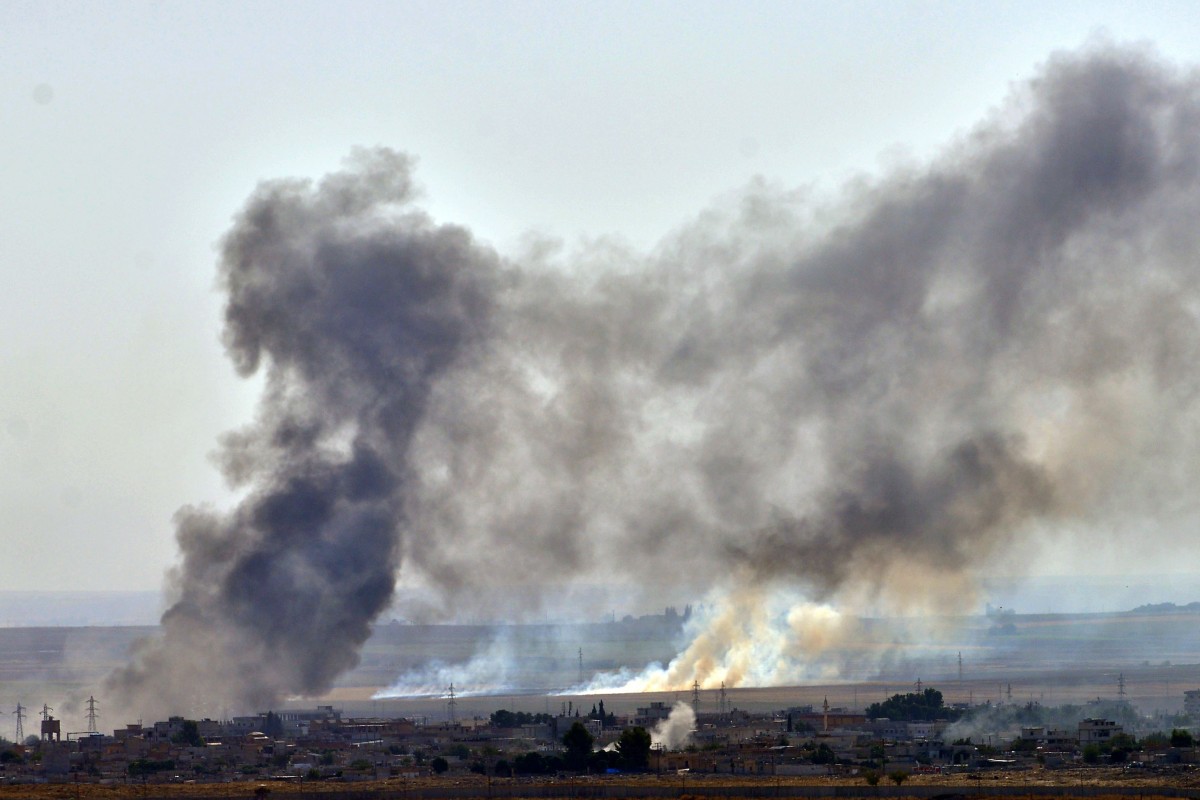
Turkey launched the attack on Kurdish fighters in northeastern Syria last week. Photo: Xinhua
China has urged Turkey to stop the military offensive it began in northeastern Syria last week and “return to the right track”.
Beijing is the latest to join global condemnation of the cross-border attack launched by Ankara on Kurdish fighters last Wednesday following US President Donald Trump’s decision to withdraw US troops from the region.
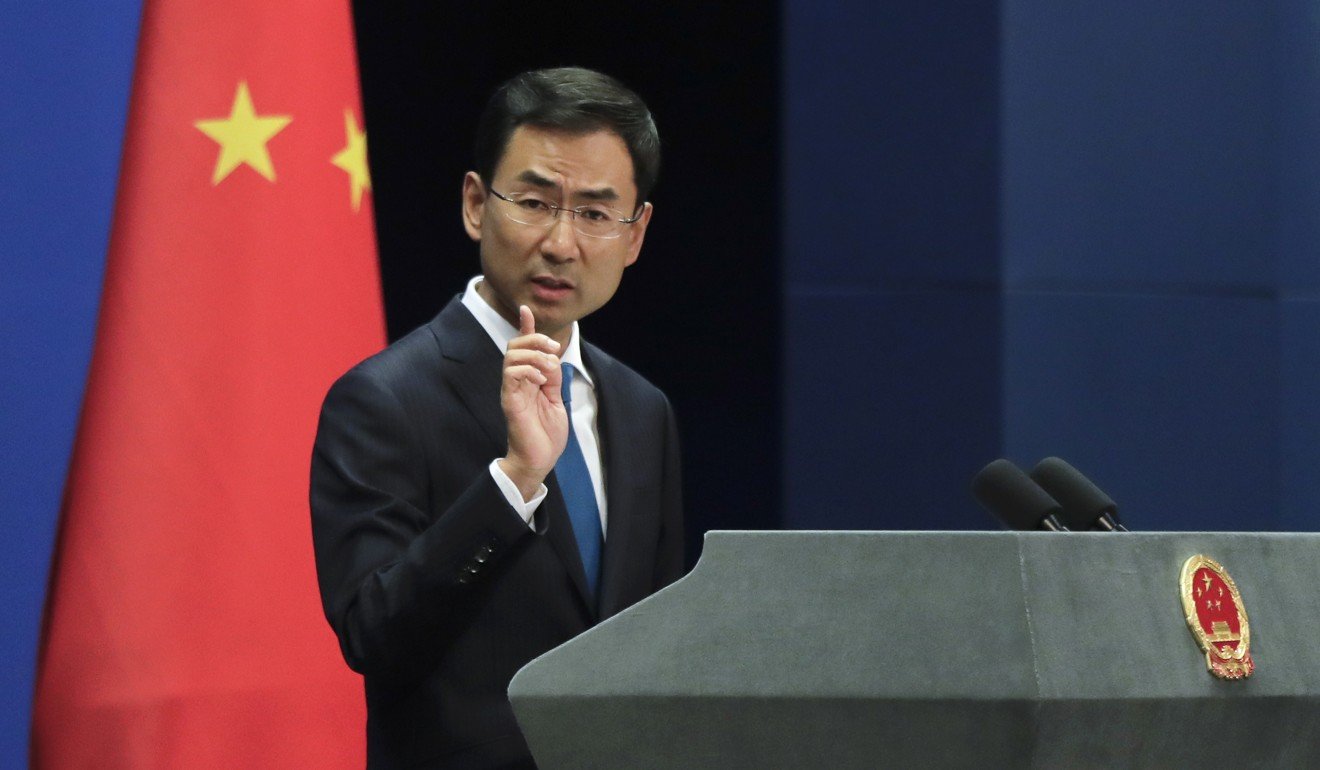
Foreign ministry spokesman Geng Shuang on Tuesday called for a ceasefire.
“The Chinese side has always opposed the use of force in international relations and has advocated for adherence to the Charter of the United Nations, and to resolve problems through political and diplomatic channels,” Geng said during a regular press briefing, when asked about Beijing’s position on the situation.
“Sovereignty, independence, unification and territorial integrity should be respected and protected,” he said. “We urge Turkey to halt military action and to return to the right track, resolving the issue with political solutions.”
Chinese foreign ministry spokesman Geng Shuang called on Turkey to “work with the international community in fighting against terrorism”. Photo: AP
Geng also said the “anti-terrorism situation in Syria is still severe”, and the military operation could result in a comeback by Islamic State.
“We urge Turkey to take responsibility and work with the international community in fighting against terrorism,” he said.
Explained: why are Syria’s Kurds accusing the US of betrayal?
Trump’s move has drawn sharp criticism from around the world. Critics say he has abandoned the allies that helped fight against Isis, and that withdrawing troops could pave the way for a resurgence of the jihadist group whose violent takeover of Syrian and Iraqi land five years ago was the reason US forces went in.
The US president said about 1,000 US troops who had been partnering with local Kurdish fighters to battle Islamic State in northern Syria were leaving the country. He said they would remain in the Middle East to “monitor the situation” and to prevent a revival of Isis – a goal that even Trump’s allies say has become much more difficult as a result of the US pull-out.
Turkey says the offensive aims to remove the Kurdish-led Syrian Democratic Forces from the border area and create what it calls a “safe zone” to relocate 1 million Syrian refugees.
on Turkey, halted bilateral trade negotiations and called for an immediate ceasefire.
Vice-President Mike Pence also said Trump was sending him to the Middle East because the president was concerned about instability in the region.
Beijing has long worried that conflict in the region could spill over to Chinese soil after thousands of Uygurs – the Turkic-speaking Muslim minority from far western China – travelled to Syria to train and fight as jihadists.
President Tsai Ing-wen also vowed in a National Day speech to defend Taiwan’s sovereignty, saying her government would safeguard freedom and democracy as Beijing ramps up pressure on the self-ruled island it considers a wayward province.
Tsai, who is seeking re-election in January amid criticism of her policy towards China, referred to the arrangement for the return of the former British colony of Hong Kong to Chinese rule in 1997 as a failure.
Hong Kong has been hit by months of anti-government protests triggered by widespread resentment of what many city residents see as relentless efforts by Beijing to exert control of their city despite the promises of autonomy.
China has proposed that Taiwan be brought under Chinese rule under a similar arrangement, but Tsai said Beijing’s policies towards the island were a danger to regional stability.
“China is still threatening to impose its ‘one country, two systems’ model for Taiwan. Their diplomatic offensives and military coercion pose a serious challenge to regional stability and peace,” Tsai said.
“When freedom and democracy are challenged, and when the Republic of China’s existence and development are threatened, we must stand up and defend ourselves,” Tsai said, referring to Taiwan by its official name.
“The overwhelming consensus among Taiwan’s 23 million people is our rejection of ‘one country, two systems,’ regardless of party affiliation or political position.”
Taiwan’s National Day, marking the anniversary of the start of a 1911 uprising that led to the end of dynastic rule in China and the founding of a republic, was celebrated in Taipei with singing, dancing and parades.
Cold War hostility between the island and the mainland had eased over the past decade or so as both sides focused more on expanding business ties, but relations have cooled considerably since Tsai took office in 2016.
China suspects Tsai and her independence-leaning Democratic Progressive Party of pushing for the island’s formal independence, and this year threatened it with war if there was any such move.
Tsai denies seeking independence and reiterated that she would not unilaterally change the status quo with China.
FLASHPOINT
Despite her assurances, Beijing has stepped up pressure on the island to seek “reunification” and backed up its warnings by flying regular bomber patrols around it.
Beijing also says Taiwan does not have the right to state-to-state relations and is keen to isolate it diplomatically.
Seven countries have severed diplomatic ties with the Taiwan and switched allegiance to Beijing since Tsai coming to power. It now has formal diplomatic ties with just 15 nations.
But Tsai said Taiwan was undaunted.
“The determination of the Taiwanese people to embrace the world has never wavered,” she said, adding that Taiwan must work with “like-minded countries” to ensure peace and stability across the Taiwan Strait.
Tsai said under her watch Taiwan has boosted its combat capabilities with the purchase of advanced weapons and development of home-made aircraft.
Taiwan unveiled its largest defence spending increase in more than a decade in August, aiming to purchase more advanced weapons from overseas.
The island has long been a flashpoint in the U.S.-China relationship.
In July, the United States approved the sale of an $2.2 billion worth of weapons to Taiwan, angering Beijing.
The United States has no formal ties with Taiwan but is bound by law to help provide it with the means to defend itself.







 CHINDIA ALERT: You'll be living in their world, very soon