Archive for ‘Politics’

26/06/2013

College Grads: The PLA Wants You!

BusinessWeek: “Over the past decade, China has invested significantly in higher education—and roughly quadrupled the number of students graduating college annually, to about 7 million. Unfortunately, demand for diploma-holders in China hasn’t kept pace, and the bleak job prospects of the class of 2013 are a frequent source of lament on Weibo, China’s Twitter. Even the state-run Global Times newspaper, usually known for patriotic boosterism, recently printed a depressing chart suggesting that the number of available new positions for graduates has actually been declining.

Delegates from Chinese People's Liberation Army pose for photos outside the Great Hall of the People

One institution is expanding its efforts to recruit college graduates: the People’s Liberation Army. The Beijing News has reported on a change in hiring policy that took effect on June 24. In addition to increased financial compensation, army recruits who have graduated from universities in Beijing will be eligible for permanent Beijing residence cards, called hukous, after they complete their tours of duty and find other jobs in the city. The sought-after hukou is required to purchase an apartment or send children to school in Beijing—in short, to set down permanent roots in the city. In recent years the government has been allocating fewer new hukous for private employers to grant employees in China’s over-crowded capital.

The PLA is aiming to upgrade the caliber of recruits. “Many of the skills and specialties that the PLA needs can only be obtained by attracting civilian college graduates,” says Andrew Scobell, an expert on China’s military at RAND. While joining the army has long been an appealing option for rural students with limited schooling or career choices, it’s been a hard sell among educated urbanites. “The PLA continues to have a tough time attracting well-educated recruits with skills the military needs,” says Scobell. “These new [hiring] policies underscore this ongoing challenge” and also “take advantage of the opportunities presented by the tougher job market for college graduates.”

Beijing is home to China’s leading universities, including Peking University and Tsinghua University—often dubbed the Harvard and MIT of China, respectively. Whether or not the PLA’s recruitment policy will be extended to students in other cities remains to be seen.

via College Grads: The PLA Wants You! – Businessweek.

See also: https://chindia-alert.org/2013/02/10/as-graduates-rise-in-china-office-jobs-fail-to-keep-up/

26/06/2013

Chinese Leader Xi Jinping’s Rare Scolding of Top Communist Party Leaders

WSJ: “After telling the lower ranks of the Communist Party to shape up and make a clean break from past practice, Chinese leader Xi Jinping has taken aim at a new target:  the Party leadership itself.

And he’s done so with authority and openness from the highest pulpit of politics in China–the Politburo, the very place where the senior leaders sit and make policy.

In a speech at the conclusion of a three-day special meeting that was covered across Party media and took up nearly half of the evening newscast on Tuesday evening, Xi proclaimed that senior members of the Party needed “to play an exemplary role,” and that they had to be “broad-minded enough to reject any selfishness…to adhere to self-respect, self-examination and self-admonition” in their work (in Chinese).

It’s extremely rare for Politburo proceedings to be spoken of in such detail and openness.  And it’s unprecedented in modern times for the Party boss to start taking swings at his colleagues at the top by so directly reminding them of their responsibilities—a move that suggests he might be planning something even stronger soon.

Having just admonished lower-level cadres in a salvo last week, some observers might think that Xi is simply putting on a show here. After all, it’s difficult to demand improvement in the work-styles of the rank and file without at least paying lip-service to the idea that those at the top could stand to do a little better themselves.

But the tone of Xi’s comments and the play they’ve received in the state media suggest this is far more than just rhetorical window dressing.  It wasn’t enough for high officials to “strictly abide by party discipline and act in strict accordance with policies and procedures,” Xi said. Those at the top must also “strictly manage their relatives and their staff and refrain from abuse of power.”

“The sole pursuit” of senior members of the Party, Xi insisted, should be tied to “the Party’s cause and interests” – in other words, “to seek benefits for the Chinese people as a whole.”

Whether it’s misuse of official license plates or the high-end looting of state assets (in Chinese), Xi knows that corruption is not always confined to lower-level cadres.

Xi was careful to concede that there have been some positive developments in the ways by which the Politburo and other Party bodies operate, such as “improvements in research and reporting.”  Meetings have been shortened and presentations streamlined, “enhancing the majority of party members’ and cadres’ sense of purpose, as well as the view of the masses” towards the Party leadership, he noted.

But it’s clearly morality at the top — not the way that decisions are made — that concerns Xi and his allies the most.   As Xi’s speech noted, “as long as Politburo comrades always and everywhere set an example, they can continue to call the shots, for that will have a strong demonstration effect, and the Party will be very powerful.”

via Chinese Leader Xi Jinping’s Rare Scolding of Top Communist Party Leaders – China Real Time Report – WSJ.

26/06/2013

Violence in China’s Xinjiang ‘kills 27’

BBC: “Riots have killed 27 people in China’s restive far western region of Xinjiang, Chinese state media report.

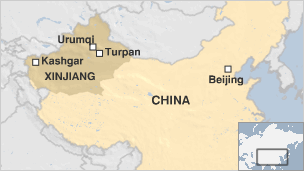
Map

The violence broke out in Turpan prefecture early on Wednesday.

Police opened fire after a mob armed with knives attacked police stations and a local government building, Xinhua news agency quoted officials as saying.

There are sporadic outbreaks of violence in Xinjiang, where there are ethnic tensions between Muslim Uighur and Han Chinese communities.

Confirming reports from the region is difficult because information is tightly controlled.

China’s state media have been quick to issue an official version of events regarding the latest round of violence in Xinjiang, but it will be tough to verify those reports.

Xinjiang lies on China’s remote north-west border and it is difficult for foreign media to travel there. Many people on both sides of the conflict are reluctant to speak to visiting journalists for fear of reprisals if they dispute the government’s stance.

Unfortunately Xinjiang usually hits international headlines when violence flares between the region’s minority ethnic Uighur Muslims and the majority Han Chinese. Many Uighurs contend that their language and religion are being smothered by an influx of Han Chinese migrants.

Xinjiang is a large geographic area rich in oil and gas deposits. Soon it will also become a major supplier of coal to China’s energy-hungry cities. The region’s fertile land also grows produce that is shipped to the rest of the country. The Han Chinese who move to Xinjiang hope to benefit from the region’s untapped resources.

The violence occurred in Turpan‘s remote township of Lukqun, about 200km (120 miles) south-east of the region’s capital, Urumqi.

The Xinhua news agency report, citing local officials, said rioters stabbed people and set police cars alight.

Seventeen people, including nine security personnel and eight civilians, were killed before police shot dead 10 of the rioters, it said.

At least three others were injured and were being treated in hospital, it added.

The Xinhua report did not provide any information on the ethnicity of those involved in the riot or on what sparked it.

But Dilxat Raxit, a spokesperson for the World Uighur Congress, an umbrella organisation of Uighur groups, told the Associated Press news agency the violence had been caused by the Chinese government’s “sustained repression and provocation” of the Uighur community.

In 2009 almost 200 people – mostly Han Chinese – were killed after deadly rioting erupted in Urumqi between the Han Chinese and Uighur communities.

In April an incident in the city of Kashgar left 21 people dead.

Uighurs and Xinjiang

Uighurs are ethnically Turkic Muslims. They make up about 45% of the region’s population; 40% are Han Chinese

China re-established control in 1949 after crushing short-lived state of East Turkestan. Since then, large-scale immigration of Han Chinese. Uighurs fear erosion of traditional culture.

The government said the violence began when “terrorists” were discovered in a building by officials searching for weapons.

But local people told the BBC that the violence involved a local family who had a longstanding dispute with officials who had been pressurising the men to shave off their beards and the women to take off their veils.

Uighurs make up about 45% of Xinjiang’s population, but say an influx of Han Chinese residents has marginalised their traditional culture.”

via BBC News – Violence in China’s Xinjiang ‘kills 27’.

See also: https://chindia-alert.org/political-factors/chinese-tensions/

22/06/2013

Russia, China sign ‘unprecedented’ $270 bn oil deal

Fox News: “Russian oil giant Rosneft and Chinese state firm CNPC signed Friday a $270 billion deal to supply China with oil over 25 years as Russian President Vladimir Putin pushes to diversify the country’s energy customer base away from Europe.

photo_1371814073854-2-HD.jpg

The agreement between Russia, the world’s largest energy producer and China, the world’s largest energy consumer — one of the biggest deals in the history of world oil industry — was signed by Rosneft chief executive Igor Sechin and CNPC head Zhou Jiping in the presence of Putin.

“An estimated value of the contract in current market parameters is absolutely unprecedented — 270 billion dollars,” Putin said in a speech to investors at the annual Saint Petersburg International Economic Forum after overseeing the signing of the deal together with visiting Chinese Vice Premier Zhang Gaoli.

Under the deal, the heavily-indebted Rosneft is slated to receive an upfront payment of around $70 billion, Putin said.

Under another deal, CNPC will acquire 20 percent in an Arctic liquified natural gas project in which France’s Total has 20 percent and Russian independent gas firm Novatek holds the rest.

Putin has made a priority of stabilising Russia’s sometimes prickly relations with its giant eastern neighbour at a time when its ties with the West are becoming ever more problematic.

Russia wants to diversify its base of energy customers away from crisis-hit Europe and is aware it has not fully exploited the colossal potential of Asian markets, China in particular.

“Consumption will be growing in China. And in Japan consumption will be growing, too,” Putin said. By contrast, he added: “Europe is going through some certain difficulties.””

via Russia, China sign ‘unprecedented’ $270 bn oil deal | Fox News.

21/06/2013

China’s Communist party takes page from Mao’s playbook

FT: “China’s Communist party has unleashed a rectification campaign of a scale and tone not seen in more than a decade as the leadership seeks to address frustration over corrupt officials while avoiding bold political reforms.

A China Communist party flag wavesd among soldiers and policemen at the opening ceremony of a revolutionary song singing concert

As investors wait for party chief Xi Jinping to initiate long-delayed economic reforms and liberals in China push for political change, Mr Xi is taking a page out of the playbook of Mao Zedong, the charismatic but dictatorial politician who led China through a sequence of mass campaigns.

Mr Xi, in a speech on Tuesday, exhorted the party that it must embrace the “mass line” to avoid its extinction. Every cadre, demanded Mr Xi, must “look in the mirror, tidy your attire, take a bath and seek remedies” to clean the party from formalism, bureaucratism, hedonism and extravagance.

All cadres from county level upwards have to attend study and criticism sessions during the year-long campaign. State media are blanketing the public with interpretations of the “mass line” – the concept that the party must remain close to the people to understand and address their needs.

“This is a very big thing for the party’s style. There has been nothing like it for at least the past decade,” says Wang Wen, the former commentary head of the party tabloid Global Times who now leads a think-tank at Renmin university.

via China’s Communist party takes page from Mao’s playbook – FT.com.

21/06/2013

Tibet policy: Bold new proposals

Finally some one with a new idea for Tibet. Hopefully some progress will be made.

The Economist: “FEW outside China think the Communist Party’s strategy for Tibet is working. A combination of economic development and political repression was meant to reconcile Tibetans to Chinese rule and wean them off their loyalty to the Dalai Lama, the exiled spiritual leader. Instead disaffection is still rife, especially among the young. And all across Tibetan areas of China, Tibetans still display the Dalai Lama’s portrait, sometimes openly. Since March 2011 more than 100 Tibetans—especially in Tibetan areas of provinces bordering what China calls the Tibet Autonomous Region (TAR)—have set themselves on fire. Most have done so in part to call for the Dalai Lama’s homecoming. An overwhelming security presence and the Dalai Lama’s commitment to non-violence mean that the unrest is easily contained. Hence little has suggested that China’s leaders are concerned about the bleak implications for the future: that their rule in Tibet can be maintained only by the indefinite deployment of massive coercive force.

So for a Chinese scholar, Jin Wei, who is director of ethnic and religious studies at the Central Party School in Beijing, to call for a “creative” new approach is startling. For her to do so publicly, in an interview this month with a Hong Kong magazine, Asia Weekly, suggests that she has high-level backing. A report from a Beijing think-tank in 2009 challenged the official line that rioting in Tibet the year before was instigated from abroad. But Robert Barnett, a professor of Tibetan studies at Columbia University in New York, describes Ms Jin’s intervention as a sign that, after two decades, “debate has re-emerged within China about the government’s hard-line policies in Tibet”. Ms Jin even accused former party chiefs in Tibet of being “biased against the practice of religious affairs”. This, she said, “foreshadowed the accumulation of grievances today.”

Bold new proposals

One former party secretary in Tibet (from 1988-92) was Hu Jintao, who went on to head the party nationally for ten years until last November, when he gave way to Xi Jinping. Those who have forecast that Mr Xi might prove a bolder reformer than the cautious Mr Hu have so far seen little to back them up. Here, on Tibet, is at least a hint of a crack in the hardline consensus. Some have detected another in the appointment of Yu Zhengsheng to head the party’s main policy group on Tibet and Xinjiang, a Muslim-majority region in the north-west. Mr Yu is the head of an advisory body designed to promote national unity. Previous heads of the group have been security specialists.

This is new

Ms Jin’s analysis, though couched in the terminology of party orthodoxy, is similar to that of many foreign observers. She argues that, by demonising the Dalai Lama, and viewing any expression of Tibetan culture as potentially subversive, the party has turned even those Tibetans sympathetic to its aims against it. The struggle has evolved from “a contradiction between the central government and the Dalai Lama separatist clique into an ethnic conflict between Han Chinese and Tibetans”.

She is not advocating a new soft approach to “political” issues, such as the Dalai Lama’s call for greater autonomy for Tibet and Tibetans’ hankering after a “greater Tibet”—ie, within its historic borders, beyond the TAR. But in fact, most protests in Tibet are not about “politics”, defined like this. Many have been sparked by anger at Chinese repression—of Tibetan culture, language and tradition, or of individual protesters. It is a vicious circle, made worse by anger at the large-scale immigration into Tibet of Han Chinese.

Ms Jin has ideas on how to break the impasse. Talks with the Dalai Lama’s representatives, stalled since the most recent of nine fruitless rounds in 2010, should resume, she says. They should concentrate on “easy” issues first, setting contentious debate about Tibet’s status to one side for now. China should consider inviting the Dalai Lama to visit one of its semi-autonomous cities, Hong Kong or Macau, and eventually allowing him back to Tibet. It should also try to defuse the crisis his death will bring by agreeing with him on a chosen reincarnation from inside China’s borders. Otherwise, China risks having to deal with two incarnations: one it endorses and one in exile who is more likely to be revered by most Tibetans.”

via Tibet policy: Bold new proposals | The Economist.

20/06/2013

China’s Latest Discount Product: Drones

Will the availability of drones add to or decrease tensions? Will it reduce or increase the chances of open conflict? Wish I knew the answers.

19/06/2013

China’s next food scandal: honey laundering

SCMP: “China‘s National Television has brought another case of “food forgery” to the spotlight in a country where fake eggs, beef and tofu have become staple items in national news coverage.

china_bees_pek52_4100931.jpg

Police in Chongqing‘s Hechuan district have discovered a production site for fake honey and confiscated about 500 kilograms of the fake nectar, the national broadcaster said in a report on Sunday.

“The artificial honey contained zero per cent real honey,” the report said, showing a chemical analysis report according to which the honey contained 187 milligrams of aluminium residue to every kilogram of honey.

The report has gone viral on Chinese microblogs, where it has been shared more than 300,000 times, making it one of the most trending topics on Wednesday. Newspapers have followed up with reports on how to identify fake honey.

“Artificial honey has a chemical odour, it either has a pungent or a fruity smell, whereas real, pure honey has a subtle scent of flowers,” one report reads.”

via China’s next food scandal: honey laundering | South China Morning Post.

18/06/2013

Chinese censors target Winnie the Pooh and Tigger

The Telegraph: “Chinese censors target Winnie the Pooh and Tigger

China’s army of internet censors have picked an unusual target in their battle to wipe dissent from the country’s computer screens: Winnie the Pooh and Tigger.

The two images were published side by side this week on the Twitter-like Chinese social media site Weibo. Photo: REUTERS

The two images were published side by side this week on the Twitter-like Chinese social media site Weibo.

Following the recent California summit between Barack Obama and Chinese president Xi Jinping, Chinese micro-bloggers picked up on an uncanny resemblance between a photograph of the two presidents strolling through the Sunnylands estate and a cartoon image of A. A. Milne’s cartoon creations.

The two images were published side by side this week on the Twitter-like Chinese social media site Weibo.

But the posts were almost immediately “harmonized”, as censors appeared to take exception to the comparison between their president and a podgy bear who once roamed Sussex’s Ashdown Forest.

Hong Kong’s South China Morning Post said over-zealous censors had “nipped in the bud what could have been a positive PR campaign tailor-made for President Xi Jinping.”

The Communist Party’s internet censors often appear determined to delete even the slightest hint of government criticism from social media sites.

Earlier this month, authorities targeted a photo-shopped image – also on Weibo – of the famous Tiananmen Square photograph in which a lone protester faces down a line of tanks. The image – in which the tanks were replaced with giant rubber ducks – irritated authorities enough that not only did they remove the picture itself, they also blocked all internet searches related to the squeaky bath toys.

The Weibo Photoshopped image which caused irritated Chinese authorities to block all internet searches related to rubber ducks. (WEIBO)”

via Chinese censors target Winnie the Pooh and Tigger – Telegraph.

18/06/2013

Mao’s birthday: Party time

The Economist: “THERE was a time, just a few months ago, when some analysts were speculating that new leaders preparing to take over in China wanted to abandon Mao. If it ever seemed likely then, it is looking far less so now. The new helmsman, Xi Jinping, has been showing no sign of squeamishness about the horrors of that era. Preparations are under way for big celebrations of Mao’s 120th birthday on December 26th. Mr Xi will likely use the occasion to pay fulsome homage.

On June 5th the party chief of Hunan, Xu Shousheng, paid a visit to one of his province’s most-visited attractions: Mao’s rural birthplace in Shaoshan village (the Hunan Daily’s report is here, in Chinese). There he laid a wreath before a bronze statue of the late chairman. Mr Xu has good economic reasons for showing obeisance. Last year the province earned nearly $4.6 billion from “red tourism”, as pilgrimages to historic Communist sites are known (a local newspaper, in Chinese, describes hopes to boost this by more than 20% in 2013). But Mr Xu made clear he was not there just to drum up business for Hunan. The central leadership, he said, was attaching “great importance” to the birthday celebrations. The entire nation, he said, was paying “great attention”.

Hunan officials are pulling out all the stops. In September it was reported that Xiangtan prefecture, which governs the village, was planning to spend 15.5 billion yuan ($2.5 billion) on 16 projects described as “presents” for Mao (see here, in Chinese). These include the refurbishing of a Mao museum in Shaoshan, a new road around the tourist area, a new drainage system for nearby Shaoshan city and the building of a new community called Hope Town for local farmers (described here). Shaoshan village is organising cultural performances, an academic conference and a “big gathering” to mark the anniversary, as well as the usual handout of free “happiness and longevity noodles” to visitors on the big day (see here, in Chinese, for a list of this year’s events in Shaoshan and here, in English, for some of the traditional ones).

It is all but certain that Mr Xi will feature prominently in the celebrations. His two immediate predecessors both gave speeches in praise of Mao on similar occasions: Hu Jintao in 2003, on the 110th anniversary (here, in Chinese), and Jiang Zemin in 1993, on the 100th (here, in Chinese). The signs are that Mr Xi will strike a similar tone. In January he told colleagues in the ruling Politburo that the achievements of the post-Mao era should not be used to negate those of the earlier years of Communist rule, and vice versa. In May a Beijing newspaper revealed that Mr Xi had also quoted Deng Xiaoping as saying that repudiation of Mao could lead to chaos (see here, in Chinese).

But in the coming months Mr Xi might be wary of overdoing the adulation. In the autumn he will preside over a crucial meeting of the party’s central committee that he apparently hopes will approve plans for wide-ranging economic reforms. Encouraging Maoists could play into the hands of what liberals in China call “interest groups”, such as large state-owned enterprises, that stand in the way of reform.

Fuelling Maoist fervour could also make it more difficult to handle the case of Bo Xilai, a Politburo member who was expelled from the party in November for alleged abuses of power, including complicity in the murder of a British businessman. Mr Bo is a darling of die-hard Maoists who believe that, for all the party’s lip-service to Mao, the country has fallen prey to the worst excesses of capitalism. He is widely expected to be put on trial in the coming months. Mr Xi does not want to encourage supporters of Mr Bo.”

via Mao’s birthday: Party time | The Economist.

Law of Unintended Consequences

continuously updated blog about China & India

ChiaHou's Book Reviews

continuously updated blog about China & India

What's wrong with the world; and its economy

continuously updated blog about China & India