Archive for ‘Politics’

28/10/2019

Putin accepts Duterte invite, just before Manila-Beijing South China Sea oil talks. Coincidence?

  • The president is set to become the first Russian leader to make a state visit to the Philippines for more than 40 years, according to a former envoy
  • Moscow is aware of China’s entry into the Philippines, and could have its eye on some projects there, while the US is also watching developments
Russian President Vladimir Putin and Philippine President Rodrigo Duterte shake hands during a 2016 meeting in Peru. Photo: EPA
The timing of Moscow’s announcement over the weekend that President Vladimir Putin
has accepted an invitation to visit Manila has raised eyebrows, as it comes on the eve of crucial bilateral talks between the Philippines and China on joint oil exploration in the

South China Sea

.

In a statement immediately welcomed by the Philippine presidential palace, Igor Khovaev, Russia’s ambassador to the Philippines, on Saturday told reporters Putin had accepted Duterte’s invitation “with gratitude”.

No date has been set for the visit, with Khovaev only saying Moscow would “do our best to arrange this meeting as soon as possible”.

A steering committee with representatives from both Manila and Beijing is set to meet this week to discuss the joint oil exploration deal. China has proposed a 60 per cent-40 per cent split in favour of the Philippines, according to Hermogenes Esperon, 

Courting Russia with South China Sea oil is a ‘dangerous gamble’ for Duterte

Neither side has clarified if the split refers to ownership or revenue, and no other details were disclosed.

After an August meeting with Duterte, Chinese President Xi Jinping said the countries could take a “bigger step” in jointly developing oil and gas resources if they could properly handle their sovereignty dispute in the South China Sea.

But defence and security analysts say the Philippine president took a “dangerous gamble” on a visit to Russia last month, when he invited the Russian state oil company Rosneft to explore for oil in Philippine waters – which include parts of the South China Sea claimed by China.

The timing of Moscow’s announcement has not gone unnoticed.
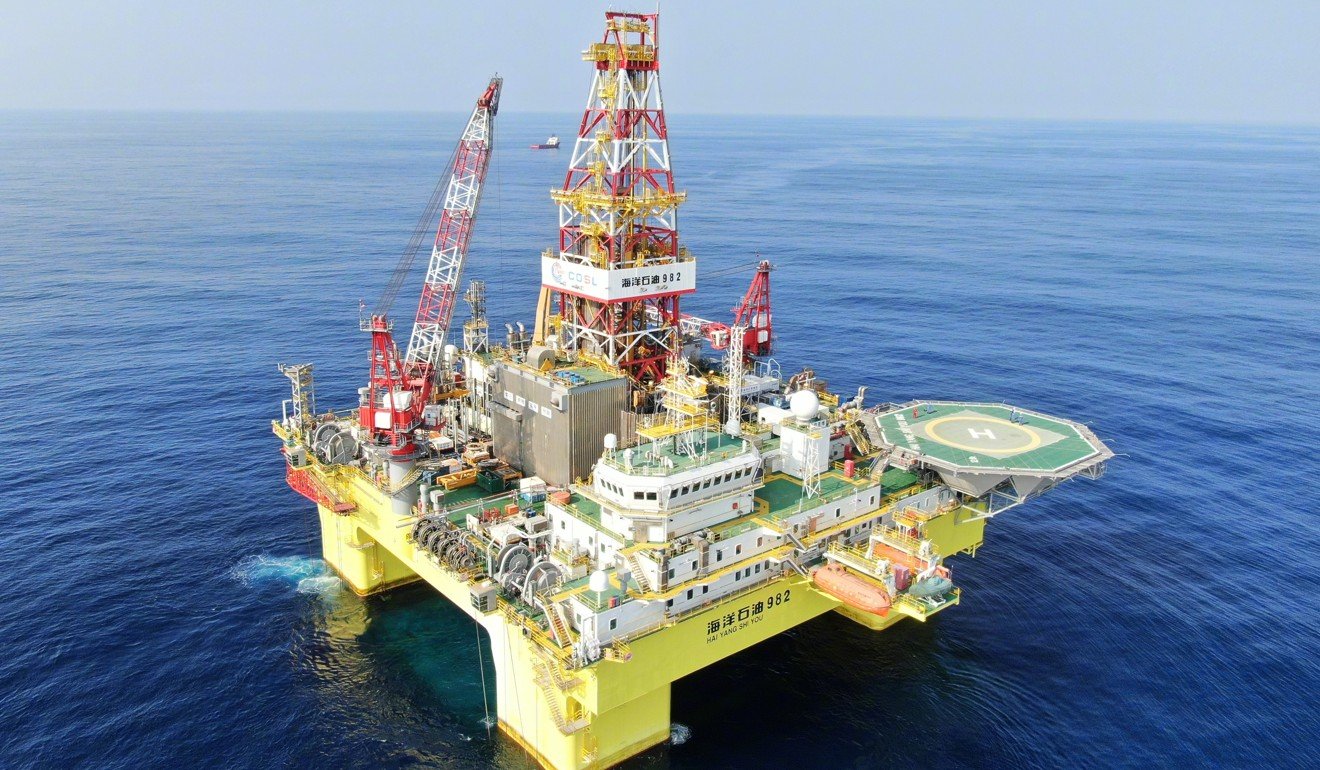
A Chinese deepwater oil rig in the South China Sea. Photo: Weibo

“It’s a welcome and historic development. Some wise guy in the Duterte government thought about timing [the invitation to Putin around the oil talks with Beijing],” said retired Philippine ambassador Lauro Baja, who once served as president of the United Nations Security Council.

Baja told the Post that no Russian president had visited the Philippines during his more than 40 years with the Department of Foreign Affairs.

“The Philippines then was almost a nonentity as far as Russia was concerned, [but] maybe now Russia recognises the strategic importance of the Philippines [in terms of] regional politics,” he said.

Baja said Moscow was aware of China’s entry into the Philippines, and could have its eye on some projects there.

“For all their so-called alliance, China and Russia are fierce competitors for influence and other benefits. And I think Russia has some objectives in mind like selling armaments and [forging] technological agreements,” he said, while cautioning that the situation remained “nebulous”.

New Philippines military chief sees no ‘shooting war’ in South China Sea despite disputes

“It’s a fascinating development but things are still early … For now, this is [just] an invitation extended by Duterte and accepted in principle by Putin.”

The United States will also be monitoring developments in the Philippines, according to Greg Poling, director of the Washington-based Centre for Strategic and International Studies’ Asia Maritime Transparency Initiative.

“Russia is eager to boost its influence in the region, and doubtless doing so with a long-standing US ally is seen as a bonus by Moscow,” he said. “There is nothing that prevents the Philippines from engaging in security cooperation with Russia, but the devil will be in the details.”

Poling added that the US would be concerned if Russia-Philippine cooperation involved acquiring military platforms that were incompatible with the shared platforms and doctrines used by Washington and Manila, as well as the latter’s other major security partners, namely Australia, Japan and South Korea.
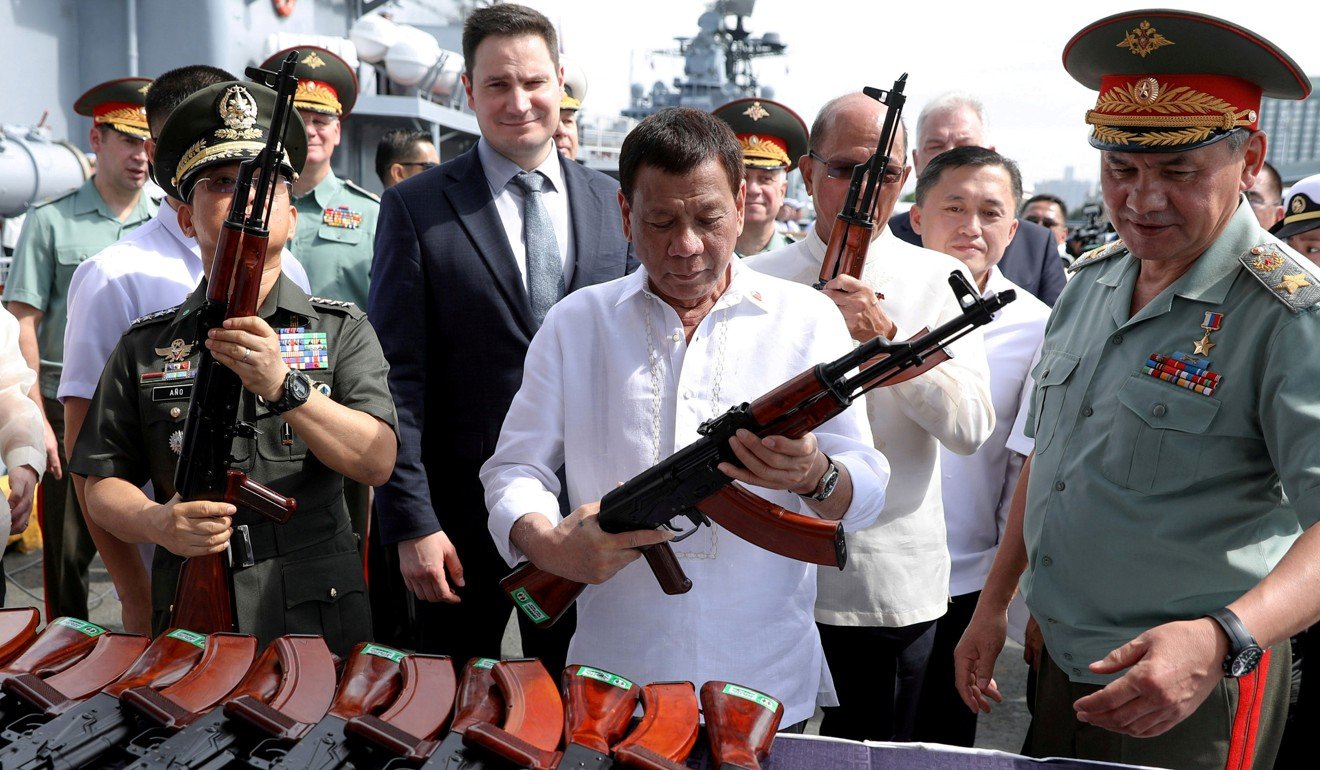
Philippine President Rodrigo Duterte inspects firearms donated by Russia in 2017. Photo: Reuters

“The US will also be concerned if any acquisitions or cooperation with Russia might threaten information security or intelligence cooperation between the US and the Philippines,” he said.

“And finally, any major platforms acquired from Russia would likely require the US to impose sanctions on the Philippines unless a waiver is granted, and the US government has been very stingy about awarding those waivers because they undermine the effectiveness of the sanctions regime.”

Moscow last week offered to help the Philippines produce its own arms for both domestic use and export with the help of Russian technology. Max Montero, an Australia-based Filipino security consultant, viewed that offer as “a swipe at the US”.

“Imagine a US stronghold and long-time ally and former colony becoming a manufacturing hub for Russian arms. And it makes it worse if [the Philippine armed forces] buys them too,” he said.

“Weakening the US alliances in Asia will benefit Russia [as it is] one of the US’ competitors in arms sales and geopolitics.”

Russia offers arms technology to the Philippines with ‘no conditions’ as US ties falter

The Philippines, Montero said, would benefit from such an arrangement since it is “a laggard in defence technology”. However, he pointed out that the country’s armed forces continue to buy weapons from the US and receive American arms as grants, potentially limiting the domestic market for Russian arms.

Navy cooperation has also been on the agenda, as Moscow and Manila discussed signing a new naval pact in March, while warships from each country have visited the other this year. Philippine naval vessels made their first-ever visit to Russia in October, while three Russian ships docked in the Philippines for a goodwill visit in January.

Russia is the top supplier of arms to Southeast Asia, and the No 2 global arms supplier, behind the US. Southeast Asia bought US$6.6 billion of Russian arms between 2010 and 2017, or more than 12 per cent of Russia’s sales, according to the Stockholm International Peace Research Institute, a Swedish think tank that publishes global arms tracking data.

Source: SCMP

27/10/2019

China’s secret ‘women only’ language

Young Chinese girls in Hunan province used Nushu, a language that no men could read, to communicate with one another. Now a new film aims to tell us more about it
2011, SNOW FLOWER AND THE SECRET FAN
 Gianna Jun and Binbing Li, in the film Snow Flower and the Secret Fan. Photograph: Fox Searchlight Pictures/Sportsphoto Ltd/Allstar

decade ago Chinese-American author Lisa See was researching an article on footbinding when she found a reference to Nushu, the world’s only “women’s writing”. Though the origins were murky, the script revealed a culture of women’s relationships and sparked the idea for her novel, Snow Flower and the Secret Fan, the film of which, co-produced by Rupert Murdoch’s wife Wendi Deng, is released tomorrow.

After having their feet bound at around the age of seven, girls in Jiangyong County in Hunan province would live indoors – first in the “women’s chamber” of their own homes, and later in the homes of their husband’s family. To ease their isolation and offer support in their pain, girls from the same village were brought together as “sworn sisters” until their weddings. But a more serious relationship, almost akin to marriage and expected to last for life, could be arranged between two girls by a matchmaker, with a formal contract, if the pair shared enough of the same “characters” (being born on the same day, for example). In See’s book she writes: “A laotong relationship is made by choice for the purpose of emotional companionship and eternal fidelity. A marriage is not made by choice and has only one purpose — to have sons.”

Women used Nushu – a script unique to the area – to write to their laotongs after they “married out” into different villages. Yet until the 1960s few outside the province knew about it, and no men could read it, says See. “In the mid-60s an old woman fainted in a station,” she says. “The police went through her things to see who she was and found a piece of paper with what looked like a code, so she was arrested on suspicion of being a spy.” In the midst of the cultural revolution, the experts who finally identified the script were sent to labour camps, not emerging to study the writing until the 80s. Following the success of See’s book, the film aims to allow people to learn more.

Source:The Guardian

25/10/2019

Chinese vice president visits Japan to promote ties

Chinese Vice President Wang Qishan (L) attends a banquet held by Japanese Emperor Naruhito and Empress Masako in Tokyo, Japan, Oct. 22, 2019. Chinese Vice President Wang Qishan on Friday rounded off a fruitful friendly visit to Japan. During the five-day visit as Chinese President Xi Jinping’s special envoy, Wang attended the enthronement ceremony of Japanese Emperor Naruhito. (Xinhua)

SAPPORO, Japan, Oct. 25 (Xinhua) — Chinese Vice President Wang Qishan on Friday rounded off a fruitful friendly visit to Japan, with the two neighbors pledging continued efforts to foster a relationship that fits the needs of the new era.

During the five-day visit as Chinese President Xi Jinping’s special envoy, Wang attended the enthronement ceremony of Emperor Naruhito, and met separately with Prime Minister Shinzo Abe and Deputy Prime Minister and Finance Minister Taro Aso.

On Tuesday, when Emperor Naruhito officially proclaimed his enthronement, Wang conveyed to him and Empress Masako the sincere congratulations of Xi and his wife, Peng Liyuan, and asked the emperor and empress to pass on Xi and Peng’s cordial greetings to Emperor Emeritus Akihito and Empress Emerita Michiko.

Emperor Naruhito, for his part, asked Wang to communicate to the Chinese president and his wife the genuine gratitude and best wishes of the imperial couple as well as of the emperor emeritus and empress emerita.

In his meeting with Abe, Wang conveyed to him the cordial greetings of Xi and Chinese Premier Li Keqiang, and expressed sympathies over the serious casualties and losses caused by Typhoon Hagibis, an unusually monstrous tropical cyclone that recently wreaked havoc in Japan.

The vice president recalled that Xi and Abe met in the Japanese city of Osaka in June and reached a series of important consensus on pushing for a China-Japan relationship that fits the needs of the new era, creating new opportunities for the development of bilateral ties.

The two sides, he added, should abide by the principles set forth in the four political documents between China and Japan, properly address such issues as history and Taiwan, and ensure that their relations will move forward along the right track of peace, friendship and cooperation.

China stands ready to work with Japan to continuously cement political mutual trust, deepen practical cooperation, expand people-to-people exchanges and build a constructive security relationship, said Wang.

He also called on the two countries to join hands to act as defenders of multilateralism, promoters of open cooperation, and practitioners of cross-civilization dialogue, and make positive contributions to advancing global and regional peace, stability and development.

Noting that Xi has accepted in principle Abe’s invitation for a state visit to Japan next spring, Wang said he hopes that the two sides will maintain close contact and coordination, so as to create a favorable environment and a conducive atmosphere and ensure that the visit will materialize smoothly and achieve complete success.

The Japanese prime minister once again extended congratulations on the 70th anniversary of the founding of the People’s Republic of China (PRC), and thanked Xi for sending Wang as his special envoy to attend Emperor Naruhito’s enthronement ceremony and pay a friendly visit to Japan.

Japan and China have a long history of exchanges and boast a solid traditional friendship, Abe said, adding that today the two countries enjoy steadily deepening cooperation on economy and trade, deal with international affairs side by side, and shoulder great responsibility for peace and prosperity in Asia as well as the whole world.

As both countries are entering a new era, and the Osaka meeting has facilitated a full return of Japan-China relations to normal development, the two sides have huge potential in future cooperation, added the Japanese prime minister.

The Japanese side, he said, earnestly looks forward to Xi’s state visit to Japan in the coming spring, and is willing to properly handle the Taiwan question and other sensitive issues.

He added that his country stands ready to make concerted efforts with China to enhance top-level planning for bilateral relations, maintain the momentum of high-level exchanges, and build a Japan-China relationship that is beautiful, harmonious, future-oriented and vigorous.

In his meeting with Aso, Wang said China and Japan, as important countries in Asia and major economies in the world, should more consciously perceive and handle their relationship against the backdrop of the world and the times, and manage and plan it from long-term, strategic perspectives.

In the new era, the two countries have broader common interests and more common concerns, and the strategic value of their relationship is growing ever more prominent, noted the Chinese vice president.

China, he said, stands ready to work with Japan to effectively seize the opportunities and, with their eyes set on the future and the big picture, comprehensively strengthen coordination and communication in various areas including financial cooperation, so as to lift bilateral ties to a higher level.

Aso said that boosting candid, open and constructive exchanges between the two countries is conducive to bilateral relations, and that Japan supports open market and free trade, and is willing to step up communication and cooperation with China in the financial realm.

The Japanese side, added the deputy prime minister, is actively making preparations in order to foster a conducive atmosphere for Xi’s planned visit next year.

Also during his stay in Japan, Wang held separate meetings with Chief Cabinet Secretary Yoshihide Suga, former Prime Minister Yasuo Fukuda, Secretary General Toshihiro Nikai of the ruling Liberal Democratic Party, and Governor Naomichi Suzuki of the Hokkaido prefecture.

In addition, he met with Pakistani President Arif Alvi in Tokyo.

Source: Xinhua

22/10/2019

India, Pakistan set to sign pilgrim corridor pact amid Kashmir tension

NEW DELHI (Reuters) – India and Pakistan are set to sign an agreement on Indian pilgrims visiting a Sikh shrine in Pakistan, rare cooperation between the nuclear-armed neighbours at a time of tension that has brought exchanges of fire on their disputed border.

The pact will introduce visa-free access from India to the Pakistani town of Kartarpur, home to a temple that marks the site where the founder of Sikhism, Guru Nanak, died.

India’s foreign ministry said in a statement late on Monday an understanding had been reached on most issues and India was prepared to sign the agreement on Wednesday.

Pakistani officials were not immediately available for comment but Pakistan’s Dawn newspaper cited a foreign ministry spokesman as saying agreement had been reached and the two sides would sign the pact soon.

The Sikh minority in India has long sought easier access to the temple in Kartarpur, which is just over the border in Muslim-majority Pakistan.

The collaboration comes at a time of tension between the rivals, with Pakistan particularly aggrieved over recent Indian government measures in its part of the divided Muslim-majority region of Kashmir.

Both countries claim the Himalayan region in full but rule it in part.

India in August revoked special autonomy in Indian-controlled Kashmir, which was accompanied by a crackdown on dissent by India’s security forces there, angering Pakistan.

The dispute over Kashmir has bedevilled relations since their independence in 1947 and sparked two of their three wars.

India said on Sunday two soldiers and a civilian were killed in cross-border shelling in Kashmir while Pakistan said one of its soldiers and three civilians had been killed.

In February, they came close to war following a suicide bombing in Indian Kashmir that killed 40 paramilitary soldiers. In response, India launched an air strike on the Pakistani side and Pakistan shot down an Indian aircraft.

The new crossing will be inaugurated in early November, just before the 550th birthday of Sikhism’s founder on Nov. 12, officials from both sides have said.

The shrine is about 4 km (2-1/2 miles) from the border. The crossing and corridor, including a road, bridge over the Ravi River and immigration office, will replace a drawn-out visa process and circuitous journey through Pakistan.

But there is still disagreement over a $20 fee that Pakistan wants to charge each visitor.

India “has consistently urged Pakistan that in deference to the wishes of the pilgrims, it should not levy such a fee”, India’s foreign ministry said.

Source: Reuters

20/10/2019

Indian soldiers, Pakistani civilians among dead in Kashmir clash

SRINAGAR, India (Reuters) – India and Pakistan blamed one another for cross-border shelling in the disputed Kashmir region which killed and injured soldiers and civilians on both sides and made it one of the deadliest days since New Delhi revoked Kashmir’s special status in August.

India said there was heavy shelling by Pakistan across the border in northern Kashmir’s Tangdhar region late on Saturday night, killing two Indian soldiers and one civilian. Islamabad said one of its soldiers and three civilians died after India violated the ceasefire, according to the spokesman for the Pakistani Armed Forces.

Kashmir has been a disputed subject between the two nuclear-armed neighbours since they both got independence in 1947, and they have fought two of their three wars over the region.

Tensions between the two countries have flared and there has been intermittent cross-border firing since Aug. 5 when New Delhi flooded Indian Kashmir with troops to quell unrest after it revoked the region’s special autonomous status.

Islamabad has warned that changing Kashmir’s status would escalate tensions but India says the withdrawal of special status is an internal affair and is aimed at faster economic development of the territory.

Reuters was unable to independently verify the claims made by both sides on the shelling, which marks an escalation from the small arms fire usually exchanged by the two armies.

There was an unprovoked ceasefire violation by Pakistan, said Indian defence spokesman Colonel Rajesh Kalia.

“Our troops retaliated strongly causing heavy damage and casualties to the enemy,” Kalia said.

An Indian army source said the shelling was cover to assist militants enter India because of which a “calibrated escalation of area weapons was undertaken”. The Indian army “retains the right to respond at a time and place of it’s choosing” if the Pakistani army continues to do this, he said.

Pakistan, meanwhile, also claimed that India’s attack was unprovoked and deliberately targeted at civilians.

Major General Asif Ghafoor, a spokesman for the Pakistan Armed Forces, said Pakistan responded “effectively,” killing 9 Indian soldiers, injuring several others and destroying 2 bunkers.

“The Indian army shall always get a befitting response,” he said.

Indian forces in Kashmir have gone “berserk”, Raja Farooq Haider, prime minister of Pakistan’s Azad Kashmir region, said, adding that six civilians died and 8 were injured.

“This is the height of savagery. The world must not stay silent over it. #KashmirNeedsAttention,” he said in a tweet.

Source: Reuters

19/10/2019

China’s door will ‘only open wider’, Xi Jinping tells delegates at Qingdao Multinationals Summit

  • ‘Only when China is good, can the world get better,’ president says in congratulatory letter read out at launch of event to promote global trade
  • Summit opens two weeks after South Korean giant Samsung closes its last factory in mainland China with the loss of thousands of jobs
Xi Jinping has praised multinational companies for the role they have played in China’s opening up over the past four decades. Photo: AFP
Just a day after China reported its slowest ever quarterly economic growth,

President Xi Jinping

on Saturday reiterated his promise to keep opening up the nation’s markets to companies and investors from around the world.

“The door of China’s opening up will only open wider and wider, the business environment will only get better and better, and the opportunities for global multinational companies will only be more and more,” he said in a congratulatory letter read out by Vice-Premier Han Zheng at the inaugural Qingdao Multinationals Summit in the east China city.
The two-day event, which ends on Sunday, was organised by China’s commerce ministry and the provincial government of Shandong with the aim, according to its website, of giving multinational companies “the opportunity to articulate their business values and vision” and “promote cooperation with host countries”.

In his letter, Xi praised multinational companies for the role they had played in China’s opening up and reform over the past four decades, describing them as “important participants, witnesses and beneficiaries”.

China was willing to continue opening up to benefit not only itself but the world as a whole, he said.

“Only when the world is good, China is good. Only when China is good, can the world get better.”

Despite its upbeat tone, Xi’s message comes as Beijing is facing intense scrutiny from the international business community over its state-led economic model – one of the main bones of contention in its trade war with the US – and its attempts to prevent foreign firms from speaking out on issues it deems too sensitive, from Hong Kong to human rights.
Foreign firms have also long complained about the barriers they face when trying to access China’s markets and the privileged treatment it gives to state-owned enterprises. Even though Beijing has promised to reform its state sector, foreign businesses have complained of slow progress, and just last month the European Union Chamber of Commerce urged the EU to take more defensive measures against China’s “resurgent” state economy.
Xi promised “more and more” opportunities for global firms. Photo: AP

Sheman Lee, executive director of Forbes Global Media Holding and CEO of Forbes China, said at the Qingdao summit that foreign firms were facing a difficult trading environment in the world’s second-largest economy.

“Multinationals have seen their growth in China slow in recent years because of the growing challenge from local firms, a gradually saturating market and rising operation costs,” he said.

Craig Allen, president of the US-China Business Council, said that many multinational companies were reluctant to release their best products in China out of fear of losing their intellectual property.

China still not doing enough to woo foreign investment

In his letter, Xi said that over the next 15 years, the value of China’s annual imports of goods would rise beyond US$30 trillion, while the value of imported services would surpass US$10 trillion a year, creating major opportunities for multinational companies.

China would also reduce tariffs, remove non-tariff barriers and speed up procedures for customs clearance, he said.

Commerce Minister Zhong Shan said at the opening ceremony that China would also continue to improve market access and intellectual property protection.

The country supported economic globalisation and would safeguard the multilateral trade system, he said, adding that it was willing to work with the governments of other countries and multinational corporations to promote economic globalisation.

Xi Jinping says the value of China’s annual goods imports will rise beyond US$30 trillion over the next 15 years. Photo: Bloomberg
The promise to continue to open up China’s markets came after the State Council
– the nation’s cabinet – made exactly the same pledge at its weekly meeting on Wednesday.
After the latest round of trade war negotiations in Washington, Beijing said it had achieved “substantive progress” on intellectual property protection, trade cooperation and technology transfers, all of which have been major bones of contention for the United States.
Despite its pledge to welcome multinational companies into its market, China is in the process of creating a list of “unreliable foreign entities” it considers damaging to the interests of Chinese companies. The roster, which is expected to include FedEx, is seen as a response to a similar list produced earlier by the United States.
Xi’s gesture would also appear to have come too late for South Korean multinational 
Samsung Electronics

, which announced on October 4 it had ended the production of smartphones at its factory in Huizhou, Guangdong province – its last in China – with the loss of thousands of jobs.

Source: SCMP
19/10/2019

China expected to ramp up South Pacific push at economic forum in Samoa

  • Vice-Premier Hu Chunhua will lead delegation at two-day summit that is expected to be attended by 400 officials and 200 businesspeople
  • Observers say it is Beijing’s latest effort to regain momentum in the region and will be closely watched in the US
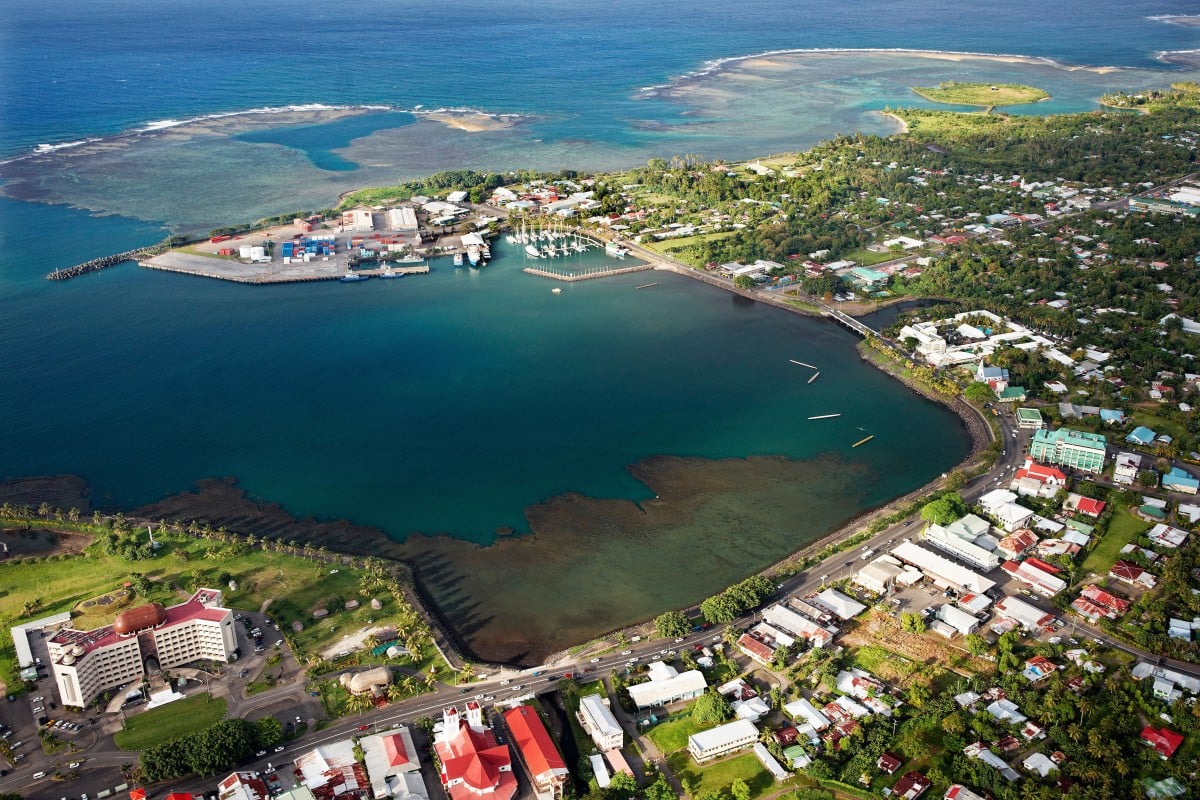
Samoan capital Apia will host the third China-Pacific Island Countries Economic Development Cooperation Forum, which begins on Sunday. Photo: Alamy

China will seek to expand its economic and diplomatic influence in the South Pacific at a forum this weekend, amid growing concern from the US and its allies over Beijing’s push in the strategically important region.

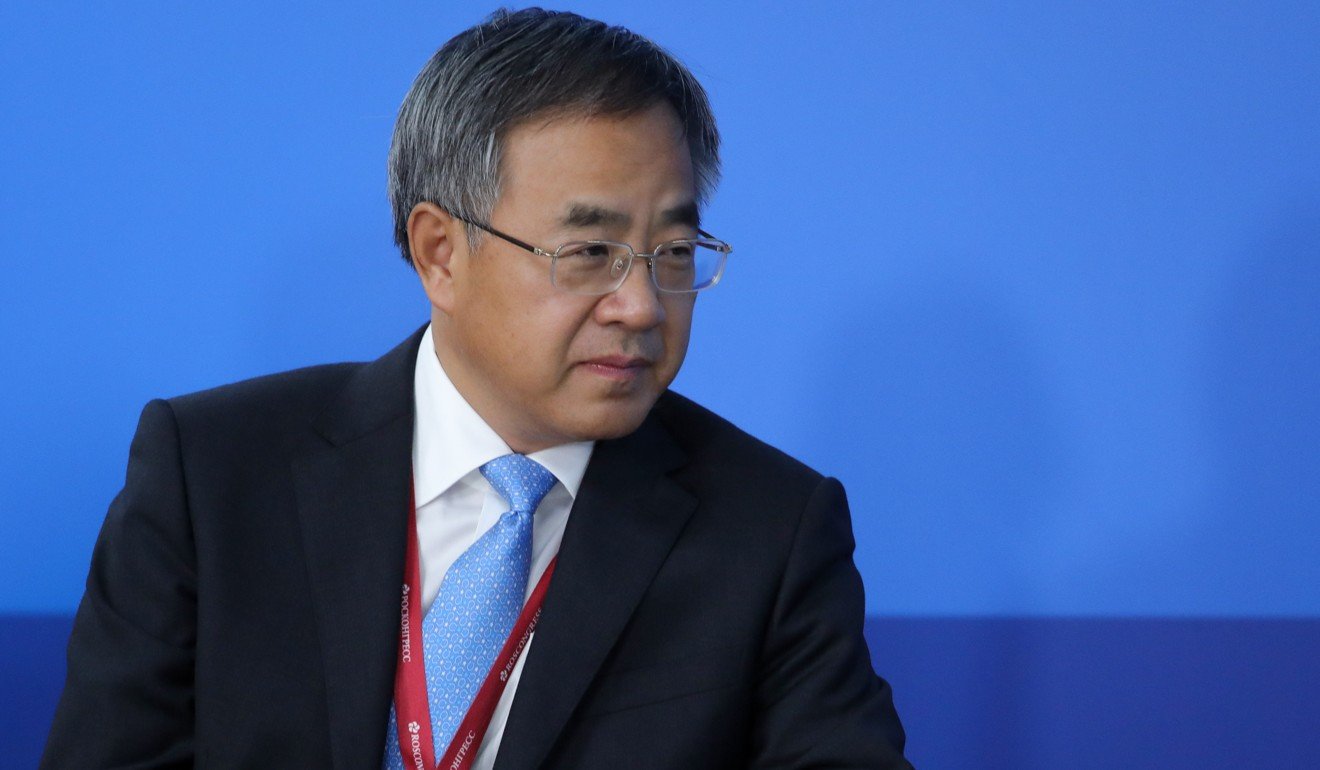
Vice-Premier Hu Chunhua will lead the Chinese delegation at the third China-Pacific Island Countries Economic Development Cooperation Forum in the Samoan capital Apia, which begins on Sunday. It is expected to be attended by 400 officials and more than 200 businesspeople.

Hu, the former Communist Party chief of China’s manufacturing powerhouse Guangdong who now overseas commercial and agricultural affairs, is expected to deliver a keynote speech at the opening ceremony.

Beijing sees the two-day forum as “timely” and “a good opportunity to deepen mutually beneficial cooperation between China and the Pacific”, a commerce ministry spokesperson told the official Economic Daily newspaper.

Trade, agriculture and fisheries, as well as tourism, infrastructure and climate change were at the top of the agenda for the forum, the spokesperson said.

Leaders of all the Pacific nations – except the four that do not have formal diplomatic ties with Beijing – are expected to attend the forum. Australia, which has “observer status” at the summit, will send Ewen McDonald, deputy secretary of the Department of Foreign Affairs and Trade and the head of its Pacific office.

Vice-Premier Hu Chunhua will lead the Chinese delegation at the forum. Photo: EPA-EFE

The forum comes after China hailed a “new breakthrough” in the region following the decision last month by the Solomon Islands and then Kiribati – despite warnings from the US – to cut diplomatic ties with Taipei and switch to Beijing.

They are the latest of Taipei’s allies to be poached by Beijing as it ramps up pressure on the self-ruled island that it sees as a renegade province to be reunited with the mainland, by force if necessary.
Observers said this weekend’s forum was Beijing’s latest effort to regain momentum in the Pacific.

“Having one of China’s top 25 officials visit the region so soon after [Chinese President] Xi Jinping spent close to three days in Papua New Guinea last November is certainly significant,” said Jonathan Pryke, director of the Pacific Islands programme at the Lowy Institute in Sydney, referring to Hu’s position in the 25-member Politburo.

“It shows clearly China’s attempt to recapture momentum after the West, and in particular Australia, have redoubled their efforts in maintaining and building relationships in the Pacific,” he said.

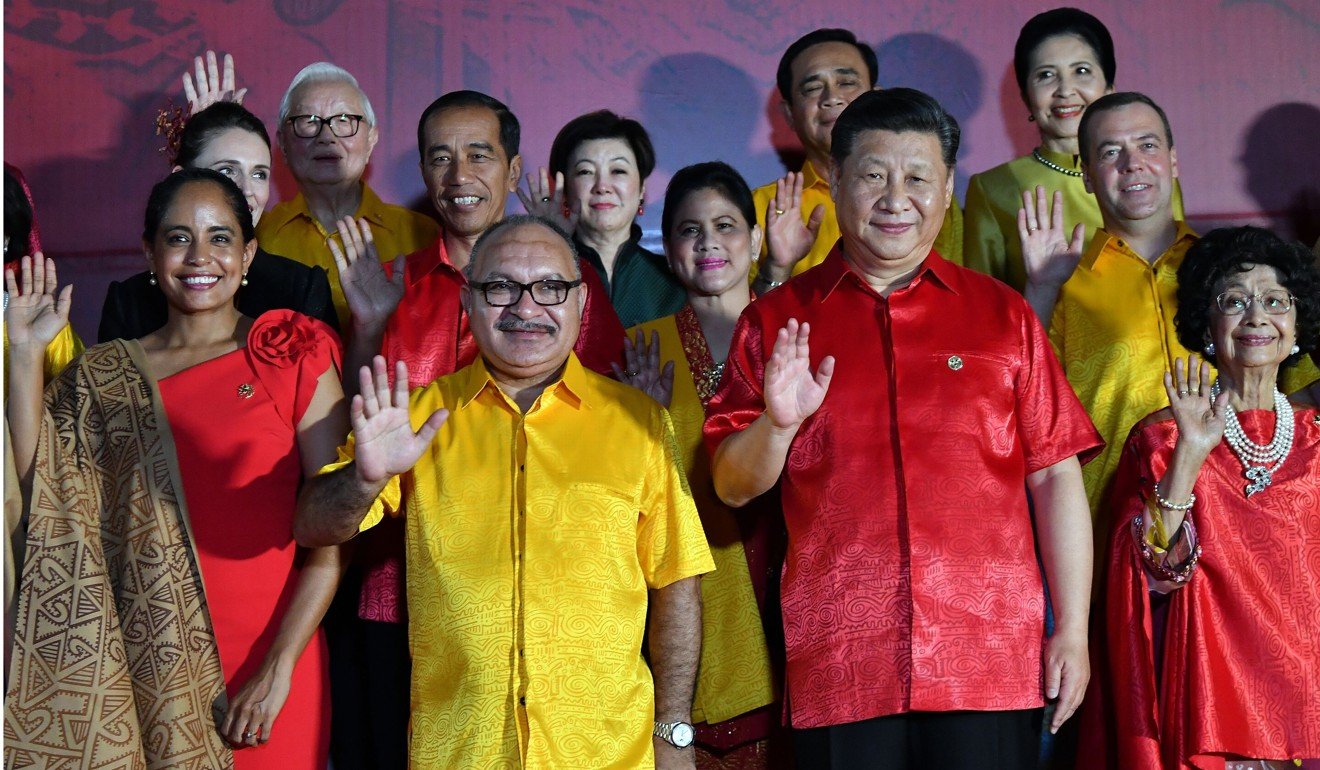
Papua New Guinea’s Prime Minister Peter O’Neill (second from left) and Chinese President Xi Jinping (second from right) pose for a photo during Xi’s visit in November. Photo: AFP

First held in Fiji in 2006, the forum is part of China’s efforts to expand its reach in the resource-rich region.

Back then, premier Wen Jiabao announced 3 billion yuan of concessional loans to Pacific nations and promised to facilitate more trade, medical aid and tourism with the countries. Chinese capital has been pouring into the region – particularly from the mining and fisheries sectors – ever since.

Of note was a 440 million yuan investment, supported by loans from the Export-Import Bank of China, to build a central business centre at Nuku’alofa, the capital of Tonga.

US and allies sideline China in PNG’s Bougainville by helping fund independence vote

As China’s influence grows, the South Pacific – a region traditionally under US hegemony, and on Australia’s doorstep – has “increasingly become a major power that cannot be neglected” and “an important part of China’s greater strategic landscape”, according to Shi Chunlin, an associate professor at Dalian Maritime University.

Trade has increased between China and the eight Pacific nations that have diplomatic ties with Beijing, rising to a combined US$4.32 billion last year – up 25 per cent from 2017.

China has also become the largest trading partner of new ally the Solomons, the second-largest to Papua New Guinea and Fiji, and the third-largest to Samoa.

China’s direct investment in the region has also jumped, reaching US$4.53 billion last year, a more than fourfold increase from the US$900 million of 2013.

Pryke said Beijing was expected to offer new support and loans to the Pacific nations.

“But the Pacific are much more picky about how they want to engage with all partners than they were a decade ago,” he added.

Returning from a trip to China earlier this month, Solomon Islands Prime Minister Manasseh Sogavare confirmed Beijing would provide a US$74 million grant to build a new stadium for the 2023 Pacific Games in the capital Honiara – something its former ally Taipei had committed to fund.

China Sam Group also reportedly signed an agreement on September 22 to lease the island of Tulagi in the Solomons, the site of a former Japanese naval base. The agreement mentioned the development of a refinery on the island, but critics said it could also potentially be used as a military base.

China is now the second-largest donor in the region, only after Australia, which has viewed Beijing’s financial largesse with suspicion.

Last year, in an apparent effort to counter China’s rising influence in the region, Australian Prime Minister Scott Morrison announced that Pacific countries would be offered up to US$2.18 billion in grants and cheap loans to build infrastructure.

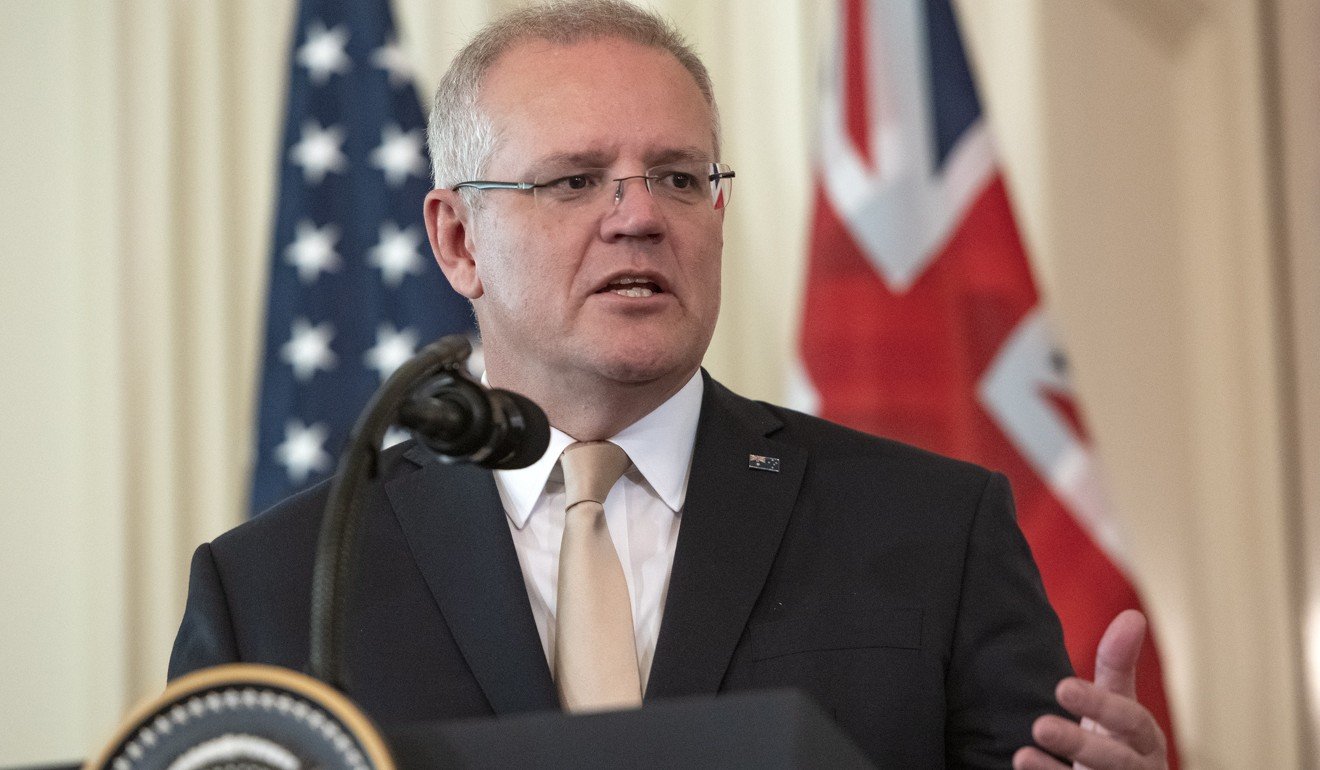
Australian Prime Minister Scott Morrison last year announced up to US$2.18 billion in grants and cheap loans for infrastructure in Pacific nations. Photo: EPA-EFE

The US, meanwhile, has also been wary of China’s push in the Pacific, amid an escalating geopolitical competition between the world’s two largest economies across many fronts – from trade to tech supremacy and security. The US has long maintained exclusive defence access in the region through its Guam military base and security pacts with the Federated States of Micronesia, the Marshall Islands and Palau.

Derek Grossman, a senior defence analyst with the US-based Rand Corporation, said this year’s forum in Samoa was likely to be higher profile than previous years after Beijing lured away two more diplomatic allies from Taipei.

He said it would be “closely watched in the US for how Beijing continues to leverage sweet economic deals via its Belt and Road Initiative to potentially entice others to switch”.

“The US, along with close friends Australia, Japan and New Zealand, are becoming increasingly concerned over the prospects for China to one day curry enough influence in these small island states to gain port access that could be used for new naval bases,” he said.

The most important issue at the forum, he said, would be “whether the West assesses that China is making further inroads with these states”.

“The likely answer will be that it is, suggesting that the US and its partners will have to compete with China in this region to ensure that it remains ‘free and open’, per the US Indo-Pacific strategy,” he said.

Source: SCMP

17/10/2019

Xi Jinping to open Military World Games in China as PLA goes on charm offensive

  • Soldiers from 140 countries are expected to take part in 10-day sporting event in Wuhan, Hubei province
  • It coincides with the Xiangshan Forum, where Beijing may seek to reinforce its position on issues like the South China Sea and US arms sales to Taiwan
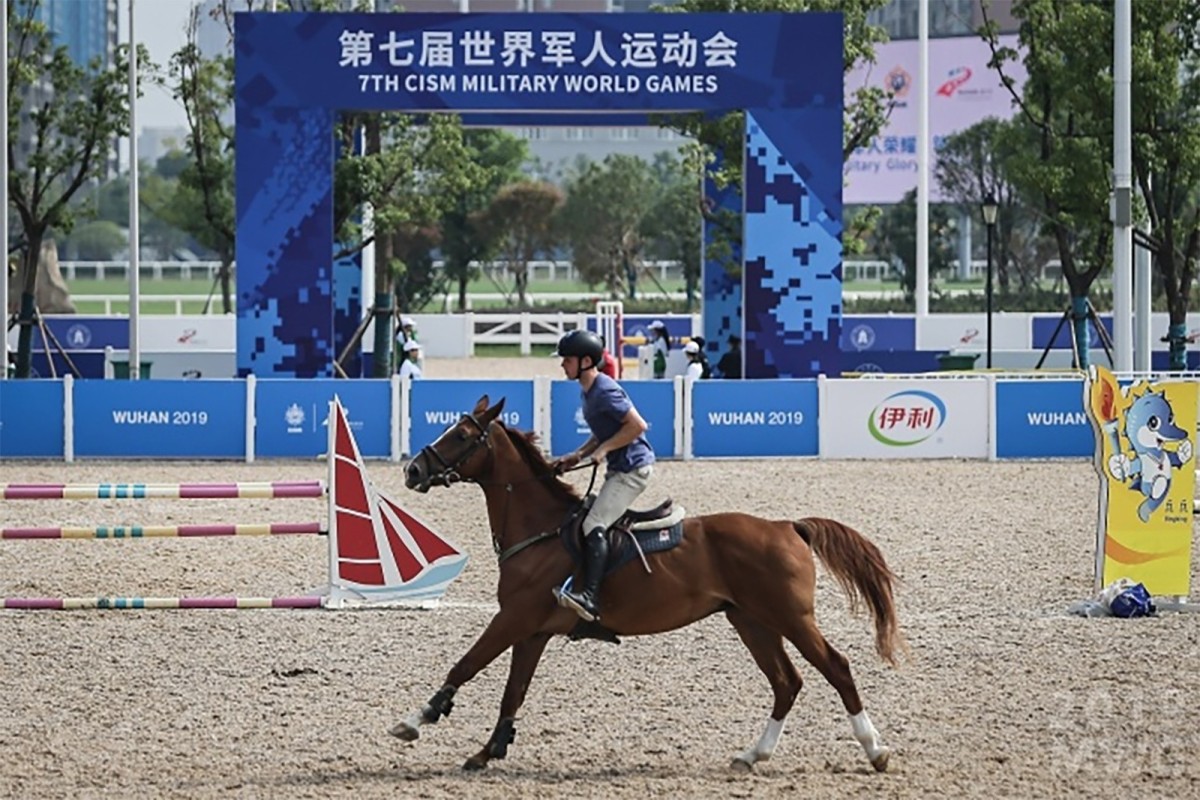
More than 100 horses have arrived in Wuhan for the equestrian and modern pentathlon events of the Military World Games, which begin on Friday. Photo: Handout
President Xi Jinping is expected to open the Military World Games in central China on Friday, setting the stage for a People’s Liberation Army charm offensive as it seeks to strengthen ties with foreign forces and exert its influence.
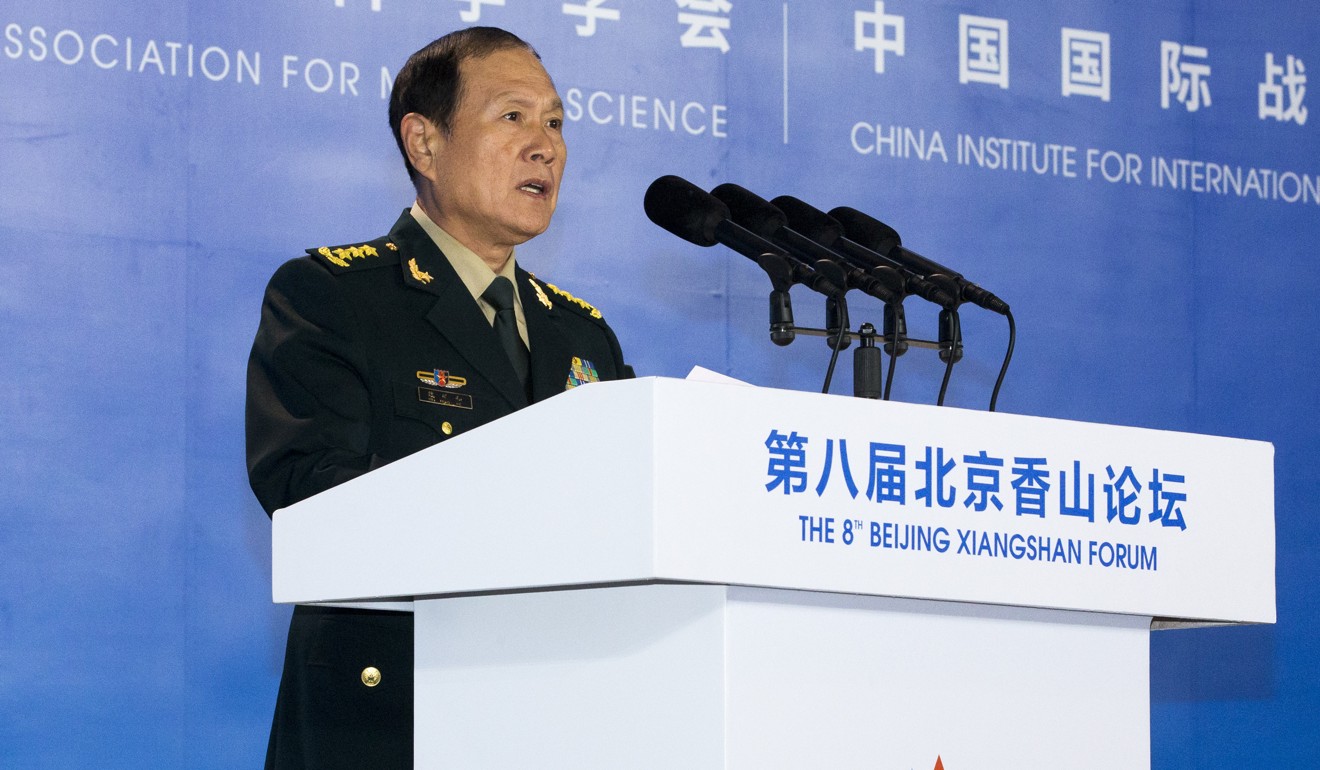
China is hosting the 10-day sporting event in Wuhan, Hubei province, and soldiers from 140 countries are expected to take part. It will coincide with the three-day Xiangshan Forum – China’s equivalent of the Shangri-La Dialogue in Singapore – to be held on the outskirts of Beijing from Sunday.
It comes after China staged a lavish military parade in Beijing to celebrate the 70th anniversary of the People’s Republic on October 1, showcasing some of the PLA’s most advanced weapon systems and strategic weaponry.
A Chinese military insider on Tuesday said Xi was expected to kick off the games in Wuhan – a symbolic move by the president as he seeks to boost the PLA’s international profile.
China has built a new athletes’ village in Wuhan that can accommodate 10,000 people. Photo: Handout

“[China sees] the Military World Games as a platform to promote international military diplomacy and an opportunity for the PLA to build its international image through sporting events,” the insider said.

It will be the first time China hosts the Military World Games, which is the second-biggest multi-sport event after the Olympics and is also held every four years.

To host the mega event, China has built a new athletes’ village in Wuhan that can accommodate the 10,000 military athletes who will compete. This year’s games will have the largest number of events ever, with badminton, table tennis, tennis and men’s gymnastics included for the first time.

The US Armed Forces will send about 300 athletes to Wuhan, according to state-run Xinhua. One of them is Mark Juliano, an archer and taekwondo player, who told the news agency: “You developed world-class venues and I can’t wait to experience the games.”

The Chinese president has high hopes for the PLA athletes at this year’s Military World Games, according to an insider. Photo: Handout

The military insider said Xi had high hopes that the PLA would win gold in some of the events.

“The Russians are known to be very good at some sports but the PLA has yet to earn a reputation in any particular sport,” the insider said. “Xi hopes that the home ground advantage will give the PLA the edge this time.”

Another Beijing-based military source said the top brass had put great emphasis on the success of three events this year – the National Day parade, Military World Games and the Xiangshan Dialogue.

The source said it would be the biggest Xiangshan Forum since China began holding the event more than a decade ago, and dozens of senior foreign defence officials and military leaders invited to the games in Wuhan would also take part in the forum.

How robots are revolutionising China’s firework factories

Set up in 2006, China uses the forum to play host to foreign military experts and leaders and discuss security and defence issues in the Asia-Pacific region. It is widely seen as an effort by Beijing to compete with the Asia Security Forum in Singapore, also known as the Shangri-La Dialogue after the hotel where it is staged.

The theme of this year’s Xiangshan Forum is “Maintaining international order and promoting peace in the Asia-Pacific”. Military observers said Beijing was likely to use it as an opportunity to reinforce its position on issues like the South China Sea and US arms sales to Taiwan.

Defence Minister Wei Fenghe criticised the US for damaging ties with China at last year’s Xiangshan Forum. Photo: Xinhua
During his speech at the event last year, Chinese Defence Minister Wei Fenghe criticised the US for damaging ties with China and pushing its containment strategy against the country.

Yao Yunzhu, a retired PLA major general and a delegate at the forum, said this year’s event would give the PLA an opportunity to explain its strategy to foreign militaries, including the US.

“The relationship between the PLA and its American counterpart has been stable over the past year despite tensions between Beijing and Washington over issues such as trade,” Yao said.

“But that military relationship has been stable thanks to the efforts of the two militaries to keep their communication open, as well as improving their crisis management mechanism,” she added.

Another forum delegate, Zhu Feng, dean of the international relations school at Nanjing University, said smaller countries in the region would use the forum to raise their concerns over the impact of tensions between China and the US on the region’s long-term stability.

Source: SCMP

17/10/2019

China’s Type 001A aircraft carrier sets off on latest sea trial as navy prepares to commission ship ‘within months’

  • Country’s first home-grown carrier may soon be ready for service but observers warn a few glitches may still need to be ironed out
The Type 001A will be China’s second carrier and the first home-grown one. Photo:ifeng

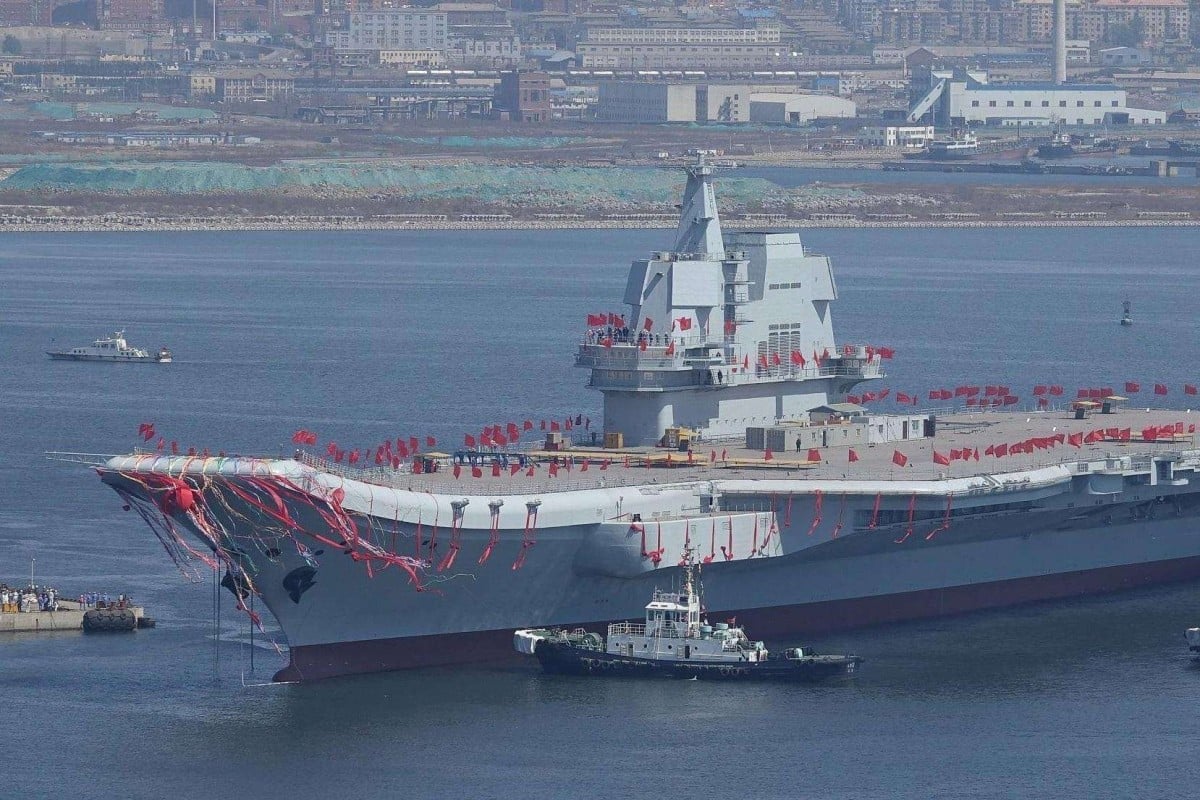
China’s first home-grown aircraft carrier, Type 001A, will be commissioned within months, according to military observers.

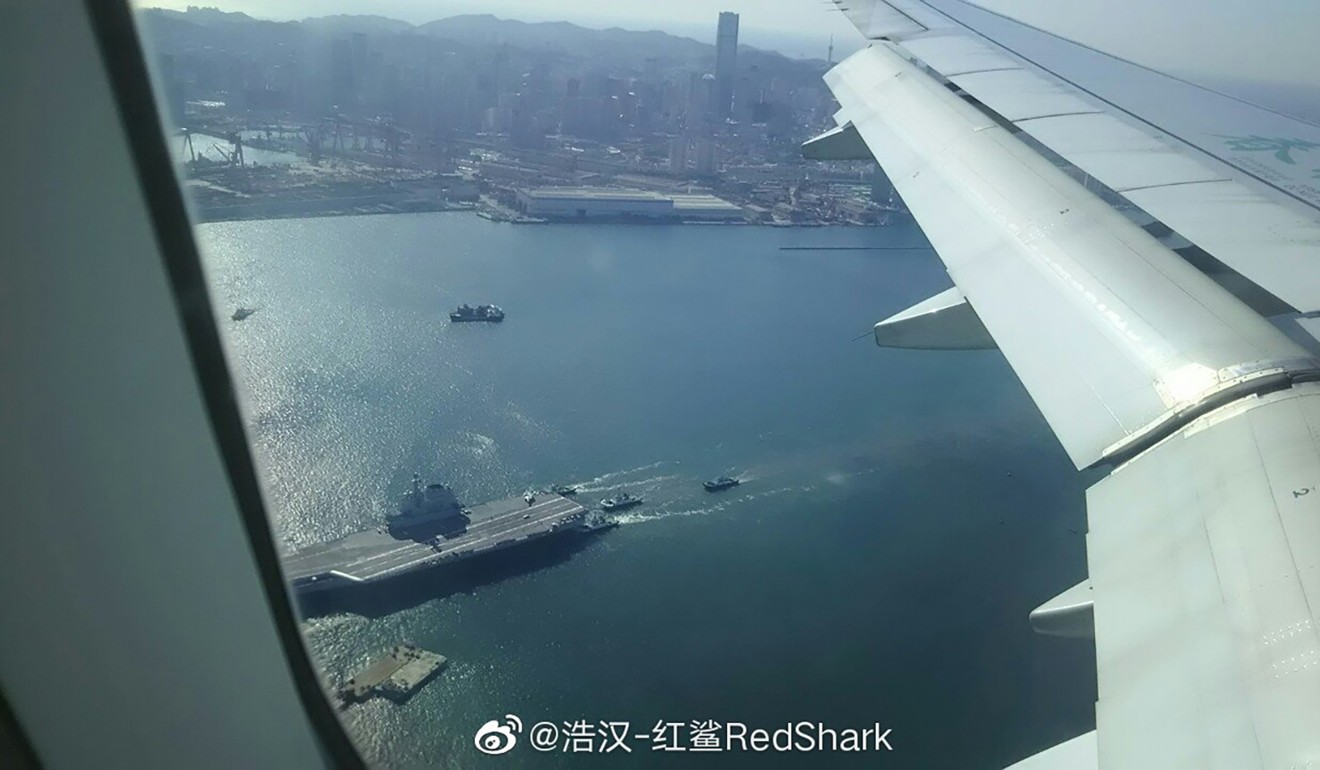
The ship appeared to have set off on its eighth sea trial on Tuesday after photographs taken by a plane flying over a restricted area showed a carrier, with a warplane on deck, leaving the Dalian Shipyard, where the carrier is being built.

The timing coincided with a notice issued by China’s Maritime Safety Administration, saying an area of the Bohai Sea, near the yard would be cordoned off for military activities.

While the commissioning would mark an advance in China’s naval capacity, some analysts noted that the trial phase was taking longer than expected.

A photo shows a carrier leaving the Dalian shipyard on Tuesday. Photo: Weibo

Global Times, a tabloid affiliated to Communist Party mouthpiece People’s Daily, quoted naval observer Li Jie as saying that the Type 001A was likely to be undertaking its eighth sea trial after solving problems discovered in the previous trials.

In August the Type 001A identified technical problems that required immediate attention
during its seventh trial, a fairly common occurrence in the processes.

Zhou Chenming, a Beijing based military expert, said that the Type 001A’s commissioning had already been postponed and the major problem now was a lack of shipborne aircraft and problems with the flight control system.

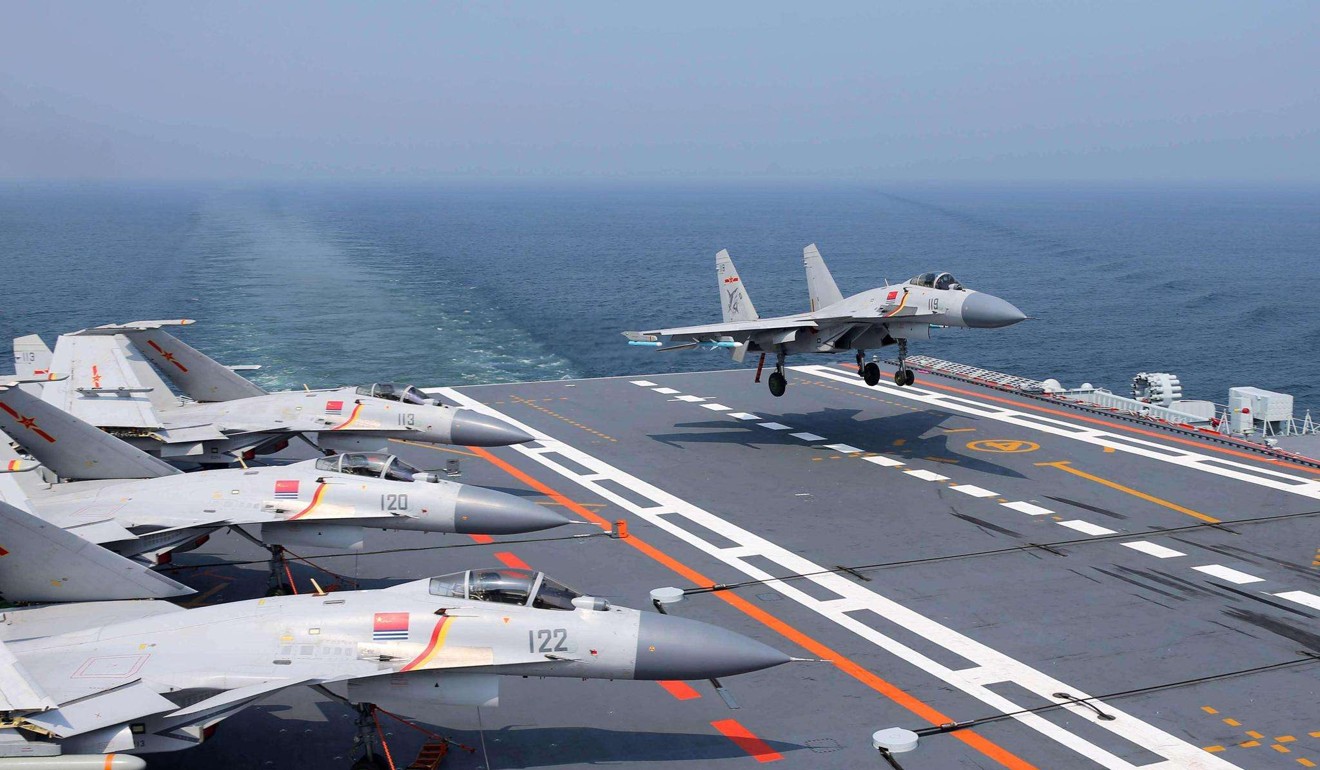
Zhou said the control system worked with J-15 fighters, which will be the primary jets used on the ship, but “is not yet compatible with other aircraft, which hinders the aircraft carrier’s final commissioning”.

Once commissioned, the ship will join the country’s first carrier, the Liaoning, at sea, boosting the country’s naval capacity.

Collin Koh, a research fellow at the Institute of Defence and Strategic Studies from Singapore’s Nanyang Technological University, said: “With two aircraft carriers, the PLA Navy will have greater chances to hone its carrier capabilities – conducting more missions, training, and all of these contributing to the accumulation of expertise and know-how.

“This means qualitatively improving [its] carrier capability, including human capital.

“For long-term strategic significance, it means an expanding power projection capability of the PLAN that allows it to promote presence in regions where Beijing asserts national interests.”

Once ready the ship will carry 32 J-15 fighters. Photo:ifeng

The Type 001A’s trial phase has taken longer than some military observers had expected. The aircraft carrier set out for its first sea trial in May 2018, some 17 months ago.

By comparison, the Liaoning, a former Soviet Kuznetsov-class vessel underwent 10 sea trials over a 13-month period before it was commissioned.

The Type 001A is a modified version of the design that features upgraded radar and bridge systems and will carry 36 J-15s compared with the Liaoning’s capacity of 24
.

The ship also features a ski-jump deck for take-offs, has a displacement of 70,000 tonnes and will be able to carry a total of 40 aircraft.

Source: SCMP

16/10/2019

China’s former ambassador to India joins team dedicated to fight against climate change

  • Luo Zhaohui, who was credited with helping to resolve 2017 Doklam stand-off peacefully, joins group set up to tackle global warming
Luo Zhaohui previously served as China’s ambassador to India. Photo: Handout

China’s former ambassador to India Luo Zhaohui has joined a national team in charge of fighting climate change, the Chinese government website has announced.

The team, led by Premier Li Keqiang, will be responsible for coming up with proposals to tackle the problem, develop proposals for energy conservation and analyse the impact of climate change on socio-economic development.

China is currently the world’s largest polluter, accounting for a quarter of the world’s total emissions, making it crucial in the effort to curb global warming.

The US withdrawal from the Paris Climate Agreement in 2017 also makes China the largest single economy committed to the efforts to limit emissions.

As well as taking up the position on the National Leading Group Dealing with Climate Change, Energy Conservation and Emissions Reduction, Luo was also promoted to the position of deputy foreign minister in late May.

In this post, Luo is in charge of Beijing’s relations with its Asian neighbours, replacing Kong Xuanyou, who was named China’s new ambassador to Japan.

Luo was credited by diplomatic observers as having helped bring relations with India back on track after the 2017 Doklam stand-off, one of the worst border disputes in decades between the two sides.

In July 2017, Luo told media in New Delhi that the Chinese people were deeply angry over the “occupation” by Indian troops of its sovereign territory but helped to resolve the situation through diplomatic means, paving the way for an informal summit between President Xi Jinping and Prime Minister Narendra Modi in Wuhan last year.

Luo, 57, has also served in diplomatic missions in Singapore and the US and was head of the foreign ministry’s department for Asian affairs.

He previously served as ambassador to Pakistan and Canada before being posted to the embassy in New Delhi in India in 2016.

Source: SCMP

Law of Unintended Consequences

continuously updated blog about China & India

ChiaHou's Book Reviews

continuously updated blog about China & India

What's wrong with the world; and its economy

continuously updated blog about China & India