Archive for ‘President Xi Jinping’

22/05/2019

China’s top legislator seeks to tap cooperation potentials with Austria

AUSTRIA-VIENNA-LI ZHANSHU-AUSTRIAN PRESIDENT-MEET

Li Zhanshu (L), chairman of the Standing Committee of the National People’s Congress (NPC), meets with Austrian President Alexander Van der Bellen in Vienna, Austria, on May 20, 2019. China’s top legislator Li Zhanshu paid an official friendly visit from May 18 to 21 to Austria, where he met with Austrian leaders on promoting bilateral ties and expressed China’s stance on upholding multilateralism and free trade. (Xinhua/Shen Hong)

VIENNA, May 21 (Xinhua) — China’s top legislator Li Zhanshu paid an official friendly visit from May 18 to 21 to Austria, where he met with Austrian leaders on promoting bilateral ties and expressed China’s stance on upholding multilateralism and free trade.

EXCHANGING VIEWS ON TIES AND GLOBAL ISSUES

In meeting with Austrian President Alexander Van der Bellen, Li, chairman of the Standing Committee of the National People’s Congress (NPC), conveyed Chinese President Xi Jinping’s greetings.

He said during the Austrian president’s state visit to China in April last year, the two countries’ heads of state jointly established a new orientation for bilateral ties, which pushed forward the ties to usher in a new stage.

“China is willing to work together with the Austrian side to implement the important consensus of the two heads of state and promote the in-depth development of cooperation in various fields,” said Li.

During the meeting, Li and Van der Bellen also exchanged in-depth views on issues of common concerns, including free trade, climate change, and the Iranian nuclear issue.

Li said China always adheres to the principle of mutual respect, equal treatment, mutual benefit and common development in dealing with the relationship between countries.

“Maintaining multilateralism and free trade is the common responsibility of the international community. Unilateralism and trade protectionism are not in line with the world trend,” said Li, adding that unilateral withdrawal and unilateral sanctions will not only harm other countries but also harm the interests of the countries which take the moves.

Li said China advocates that economic and trade differences should be resolved through negotiation and consultation. In the meantime, people who conduct negotiations must follow a bottom line and some principles, conform to international trade rules, adhere to equality, mutual benefit, and non-discrimination, and resolutely oppose “long-arm jurisdiction”.

China is willing to work with countries including Austria to uphold multilateralism and free trade, work together to address global challenges, and promote the building of a community of shared future for the mankind, said Li.

For his part, Van der Bellen spoke highly of the development of bilateral ties, and highly appreciated China’s positive role in global affairs. He said that the Austrian side shares the same or similar position with China on many issues.

The two sides should strengthen communication and coordination in international and regional affairs, support liberalization and facilitation in trade and investment, jointly address climate change, and promote friendly cooperation to yield more results, the president said.

TO FURTHER TAP COOPERATION POTENTIALS

When meeting with Austrian Chancellor Sebastian Kurz, Li said jointly building the “Belt and Road” has become a new growth point for bilateral cooperation. The two sides should adhere to the principle of extensive consultation, joint contribution and shared benefits, and continuously explore and tap the potential of cooperation.

Li called on the two countries to deepen cooperation in fields like high-end manufacturing, energy conservation, environmental protection, ecological agriculture, tourism, and finance. And the two sides are expected to actively explore innovative cooperation in such area as the Internet, big data, artificial intelligence and 5G technology.

Noting China is preparing for the 2022 Beijing Winter Olympic Games, Li said China will learn from Austria’s experience, and carry out cooperation in athlete training, winter sports education and research, and winter sports equipment.

“China always regards Europe as a comprehensive strategic partner and an important global power which is indispensable,” said Li, adding that China is happy to see Europe maintain unity, stability, openness and prosperity, and supports the integration process in Europe.

Kurz said that the Belt and Road Initiative has set up a new platform for equal cooperation among the countries in the world. China is Austria’s largest trading partner in Asia, and the two countries have strong economic complementarities.

Noting the two sides share strong aspiration of deepening cooperation, Kurz said the cooperation potential is huge, and more investment from Chinese companies as well as more Chinese tourists are welcome to Austria.

TO ENHANCE EXCHANGES BETWEEN LEGISLATIVE BODIES

In his respective talks with Austrian National Council President Wolfgang Sobotka and Federal Council President Ingo Appe, Li said the cooperation between the two countries’ legislative bodies should “closely follow the pace of development of state-to-state relations,” through cementing mutual understanding and exchanging experience on such areas as legislative supervision in regular visits, so as to create a good law environment for pragmatic cooperation.

Noting that people-to-people and cultural exchanges have always been the most active part of China-Austria relations, Li called on the legislative bodies to “respond to the voices of the people” by promoting cooperation in art, music, sports, and local areas, and advancing exchanges among young people.

The two leaders of the Austrian parliament expressed the willingness to strengthen exchanges and cooperation with the National People’s Congress of China, saying the Austrian side highly values the development of ties between the two countries. They will promote the implementation of the bilateral cooperation agreement, and forge ahead personnel and culture exchanges between the two countries.

During his stay in Austria, Li also met with regional officials from Salzburg to discuss cooperation between local areas of the two countries. Li and Van der Bellen also attended a ceremony in which a giant panda from China was officially handed over to the Austrian side.

After wrapping up his tour in Norway on May 18, Li’s stay in Austria marked the second lag of his 10-day tour in Europe, which will also take him to Hungary.

Source: Xinhua
19/05/2019

Brazil’s vice-president Hamilton Mourao heads to China to mend relations

  • General will spend five days meeting top Chinese leaders including President Xi Jinping
  • Mission seeks to patch up wounds caused by Brazilian President Jair Bolsonaro’s anti-China rhetoric
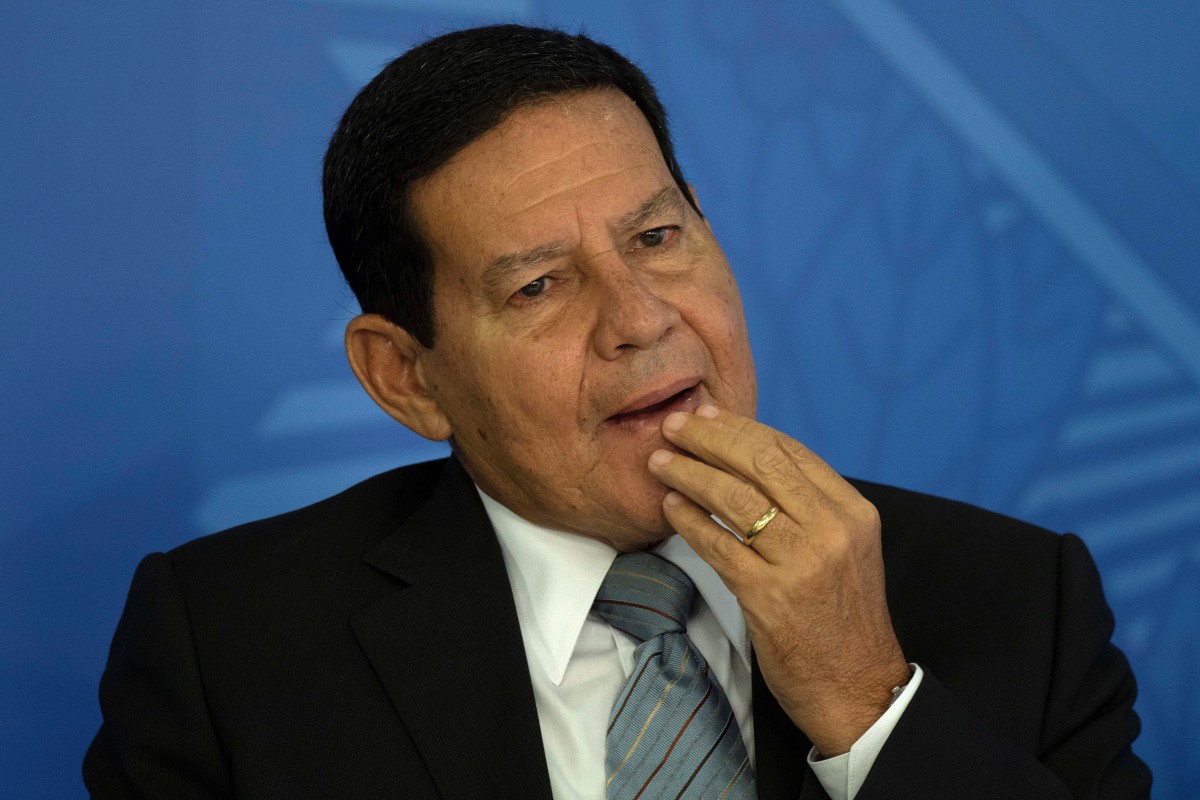
Hamilton Mourao favours maximising engagement with China. Photo: EPA-EFE
Brazil’s vice-president is expected to land in Beijing on Sunday on a mission to patch up wounds caused by President Jair Bolsonaro’s lacerating anti-China rhetoric.
General Hamilton Mourao will spend five days in China rubbing shoulders with some of the country’s most powerful leaders, culminating in an audience with President Xi Jinping, in an effort to shore up the relationship between the two emerging market giants. Bolsonaro himself is due to visit later this year, while Xi is due to visit Brasilia in November for the BRICS summit.
China – Brazil’s most important trading partner for the past decade – remains a sensitive subject in the Bolsonaro administration. While Mourao and the other business-oriented members of government favour maximising engagement with the Asian giant, Bolsonaro and his more radical appointees view China with a high degree of suspicion, as a predatory economy that wishes not merely to invest in Brazil, but to own it.

“The Chinese can buy in Brazil, but they can’t buy Brazil,” the president said at a breakfast with journalists last month.

Brazilian President Jair Bolsonaro said last month that the “Chinese can buy in Brazil, but they can’t buy Brazil”. Photo: AFP

Still, in comparison with his pre-election criticism of China as “heartless”, Bolsonaro in office has dialled down his anti-Beijing sentiment. Mourao’s visit is part of an effort to reset that relationship.

“The Chinese understand that Mourao plays a central role in toning down Bolsonaro’s rhetoric,” said Oliver Stuenkel, a specialist on BRICS – an association of five major emerging economies, namely Brazil, Russia, India, China and South Africa – at the FGV business school. “They know that the Mourao-China relationship will be fundamental.”

Should China be worried about Bolsonaro’s bromance with Trump?

Speaking to reporters recently, Mourao recognised the need to balance the Bolsonaro administration’s desire to pivot towards the United States with practical considerations of China’s economic significance.

“The US are the champions of democracy and freedom and our government has left it very clear what this represents,” the vice-president said. “But on the other side we have to be sufficiently pragmatic to understand the importance of China for Brazil’s economic development.”

Chinese investment in Brazil reached almost US$134 billion between 2003 and 2018, Brazilian government figures showed.

Chinese President Xi Jinping is expected to meet the visiting Brazilain vice-president. Photo: AP

While the trade war between the US and China may offer Brazil some short-term gains, particularly for its agricultural sector, the downsides outweigh the benefits, according to Renata Amaral, a foreign trade analyst at Barral MJorge consultancy.

“In truth this war is no good for anyone,” she said.

Mourao said that Brazil was monitoring the situation “critically and cautiously”.

Why US-China trade war could be good for Brazil
From the Chinese perspective, Beijing is looking for Brazil’s formal support for its “Belt and Road Initiative” – Chinese President Xi Jinping’s signature global infrastructure megaproject. Asked whether Brazil might sign up to the programme, Mourao said that any agreement would have to be approved by Bolsonaro in the second half of the year.
After trips to the Great Wall of China and the Shanghai Stock Exchange, Mourao will meet Xi, in a clear sign of Brazil’s importance to China. “The visit of vice-president Mourao will reinforce mutual political confidence, deepen our friendly cooperation and add new dimensions to our strategic partnership,” according to Chinese foreign ministry spokesman Geng Shuang.
With Beijing both uncertain about the direction of Brazilian foreign policy under Bolsonaro and eager to strike deals on infrastructure and food security, it makes sense for the Chinese to roll out the red-carpet for Mourao, according to Hussein Kalout, a specialist in foreign policy and a researcher at Harvard.
China trade vs economic growth: the dilemma for Brazil’s president
While the federal government remains ambivalent about its relationship with China, some of Brazil’s powerful state governors are seeking to develop their own relationship with the Asian country. One of them is Carlos Massa Ratinho Junior, the governor of the southern state of Parana, who travelled to China recently to discuss agriculture and railroad projects.
“We’re open to talk with any country that wants to and understands that the state of Parana is the best to place to invest in Brazil,” the governor said in an interview, adding that his actions did not conflict with the federal government’s stance towards Beijing.

But in a sign of the domestic pressure Bolsonaro is under not to abandon entirely his sceptical attitude to China, Luiz Philippe de Orleans e Braganca, the vice-president of the lower house’s foreign affairs committee and a lawmaker from Bolsonaro’s own party, said the government should set limits to the partnership.

“It’s good to talk to China, but it depends what is being discussed,” he said. “For example, the 5G network set up by China is dangerous because it will give the Chinese more information about Brazilian citizens than the Brazilian government.”

Source: SCMP

16/05/2019

Xi sends congratulatory letter to World Intelligence Congress

TIANJIN, May 16 (Xinhua) — President Xi Jinping sent a congratulatory letter to the Third World Intelligence Congress, which opened in northern China’s Tianjin municipality Thursday.

In the letter, Xi expressed his sincere welcome to renowned international entrepreneurs, industry leaders and Turing Award winners who attended the congress.

Noting that artificial intelligence (AI) is casting significant and far-reaching impacts on economic development, social progress and global governance, Xi said China attaches high importance to innovative development and takes new-generation AI as the driving force for scientific and technological development, industrial optimization and upgrading, as well as increasing productivity, striving to achieve high-quality development.

Xi expressed hope that participants of the congress could further exchanges, enhance consensus and step up cooperation to promote the healthy development of the new-generation AI.

Having read out Xi’s letter at the opening ceremony, Li Hongzhong, secretary of the Tianjin Municipal Committee of the Communist Party of China, said Tianjin would embrace a new era of intelligence, create a new intelligence-based economy, step up cooperation with other countries in the field of AI and speed up building “intelligent Tianjin.”

Source: Xinhua

01/05/2019

China Focus: Xi holds talks with Lao president to promote ties

CHINA-BEIJING-XI JINPING-LAO PRESIDENT-TALKS (CN)

Xi Jinping (R), general secretary of the Communist Party of China (CPC) Central Committee and Chinese president, holds talks with Lao President Bounnhang Vorachit, who is also general secretary of the Lao People’s Revolutionary Party Central Committee, in Beijing, capital of China, April 30, 2019. (Xinhua/Li Xueren)

BEIJING, April 30 (Xinhua) — Xi Jinping, general secretary of the Communist Party of China (CPC) Central Committee and Chinese president, held talks here Tuesday with Lao President Bounnhang Vorachit, who is also general secretary of the Lao People’s Revolutionary Party Central Committee.

The two leaders agreed to forge ahead with the efforts in building a community with a shared future for the two countries and work together to usher in a new era for bilateral ties.

After the talks, the two leaders inked an action plan between the CPC and the Lao People’s Revolutionary Party on building a community with a shared future for the two countries.

Noting that this year marks the 10th anniversary of the establishment of the comprehensive strategic cooperative partnership between China and Laos, Xi said as bilateral ties now stand at the best stage in history, China will work with Laos to take the opportunity of signing the action plan to jointly cultivate the bilateral relationship in the new era.

Xi said China and Laos should take strengthening the leadership of the CPC and the Lao People’s Revolutionary Party as guidance and grasp the correct direction of the development of bilateral ties in the new era.

He said the two parties must strengthen their strategic self-confidence and sense of urgency, uphold party leadership and ensure the long-term stability of the two countries, so as to contribute to the development of the socialist cause.

Noting the two sides should maintain close high-level exchanges, Xi said he would like to carry on the good tradition of conducting annual meetings with Bounnhang.

Xi also called on the two sides to deepen theoretical exchanges and strengthen exchanges between their cadres.

China and Laos should accelerate the synergy of each other’s development strategies, promote the construction of economic corridors, expand the radiation and demonstration effects of major projects such as the China-Laos railway, so as to contribute more to regional connectivity, common development and prosperity, Xi said.

The two sides should also closely coordinate and cooperate within multilateral mechanisms such as the United Nations, East Asian cooperation and the Lancang-Mekong cooperation, said the Chinese president.

Bounnhang spoke highly of China’s great achievements in Party and state building and hailed China’s successful experience in poverty alleviation.

He said it is an unshakable policy of Laos to develop its traditional friendship with China. Laos appreciates China’s long-term support and will work with China to give further play to the leading role of the inter-party ties in the development of the state-to-state relationship, and maintain regular high-level meetings between the two parties.

Regarding the Belt and Road initiative, Bounnhang said Laos will continue to accelerate cooperation in major projects, so as to further promote the prosperity of the two countries and the region.

Concerning the action plan, Xi said this is the first time for China and Laos to sign a cooperation document on building a community with a shared future on the bilateral level, which will not only benefit the two parties, countries and peoples, but also serve as a significant exploration in advancing humanity.

Bounnhang said the signing of the action plan will further promote the building of a community with a shared future for humanity.

The two leaders also watched the signing of a series of cooperation documents after the talks.

Source: Xinhua

29/04/2019

China to hold gathering to mark centenary of May Fourth Movement

BEIJING, April 28 (Xinhua) — China will hold a gathering to mark the centenary of the May Fourth Movement at 10:30 a.m. on Tuesday at the Great Hall of the People in Beijing.

President Xi Jinping, also general secretary of the Communist Party of China Central Committee and chairman of the Central Military Commission, will attend the event and deliver an important speech.

The event will be broadcast live by China Media Group and on http://www.xinhuanet.com. It will also be rebroadcast simultaneously on major news websites including people.com.cn, cctv.com and china.com.cn as well as on news apps run by People’s Daily, Xinhua News Agency and China Central Television.

Source: Xinhua

Note: https://en.wikipedia.org/wiki/May_Fourth_Movement – (May 1919, student protest that resulted in massacre).

29/04/2019

Cambodian PM says China ready to help if EU imposes sanctions

PHNOM PENH (Reuters) – China will help Cambodia if the European Union (EU) withdraws special market access over its rights record, Cambodian Prime Minister Hun Sen said on Monday as he announced a 600 million yuan ($89 million) Chinese aid package for his military.

Hun Sen, who is on a five-day trip to China to attend a Belt and Road Initiative (BRI) forum in Beijing, held bilateral talks with President Xi Jinping and signed several agreements with Cambodia’s most important ally.

Cambodia benefits from the EU’s “Everything But Arms” trade scheme which allows the world’s least developed countries to export most goods to the EU free of duties.

But Cambodia risks losing the special access to the world’s largest trading bloc over its human rights records.

During a meeting with Chinese Prime Minister Li Keqiang, Li pledged to help Cambodia if the EU withdraws the market access, according to a post on Hun Sen’s official Facebook page.

“In this regard … Prime Minister Li Keqiang also confirmed his efforts to help Cambodia,” the post said.
China is Cambodia’s biggest aid donor and investor, pouring in billions of dollars in development aid and loans through the Belt and Road initiative, which aims to bolster land and sea links with Southeast Asia, Central Asia, the Middle East, Europe and Africa.
Unlike Western countries, China does not question Cambodia’s record on rights.
The EU, which accounts for more than one-third of Cambodia’s exports, including garments, footwear and bicycles, in February began an 18-month process that could lead to the suspension of the special market access.
Among the agreements Hun Sen struck in China was one for Huawei Technologies to help Cambodia develop a system for 5G technology. The Chinese tech giant has ambitions to build the next generation of data networks across the world and boasts 40 commercial 5G contracts worldwide.
China also agreed to import 400,000 tonnes of Cambodian rice, according to Hun Sen’s Facebook page.
“China will continue to support the national defence sector in Cambodia, and in this regard, the Chinese president announced that China will provide 600 million yuan to Cambodia’s defence sector,” the post said.
Source: Reuters
25/04/2019

Belt and Road: China showcases initiative to world leaders

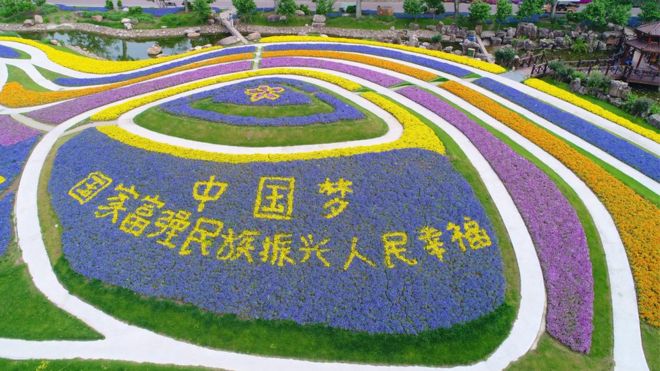
Aerial view of flower beds reading 'Chinese Dream' at Zhouji Green Expo Garden to welcome the 2nd Belt and Road Forum for International Cooperation on April 24, 2019 in Nantong, Jiangsu Province of China.Image copyright GETTY IMAGES
Image caption Flower beds reading ‘Chinese Dream’ welcome delegates to the Belt and Road forum in Beijing

World leaders are gathering in Beijing from Thursday for a summit on China’s Belt and Road initiative amid growing criticism of the project.

The sweeping infrastructure project aims to expand global trade links.

The initiative has funded trains, roads, and ports in many countries, but has left some saddled with debt.

Some see it as a bold bid for geopolitical influence, with the US particularly critical of China’s so-called “debt diplomacy”.

Chinese officials have tried to address concerns surrounding President Xi Jinping’s project, which is expected to involve more than $1 trillion (£774.9bn) in investments.

At the first day of the forum in Beijing, Chinese Finance Minister Liu Kun said China aims to make the Belt and Road initiative sustainable and to prevent debt risks.

Last year, Foreign Minister Wang Yi said in a speech Belt and Road was not a “geostrategic concept” but was part of efforts to build “a community with a shared future for mankind together with countries around the globe.”

Leaders from 37 countries and dozens of officials are due to attend the three-day summit, including Russian President Vladimir Putin and Italian Prime Minister Giuseppe Conte.

Italy recently became the first developed economy to sign up to China’s Belt and Road programme, raising concerns among its allies.

Western governments, and particularly the US, are increasingly wary of China’s growing influence.

The US, which has fought a trade war with China over the past year, has been particularly critical of the project.

Vice President Mike Pence said in a speech last year China was using “debt diplomacy” to expand its influence around the world.

Debt trap?

Other countries that are set to benefit from the project also seem to be growing more cautious.

Sri Lanka, Malaysia and Pakistan have all expressed concerns about the programme. Recipient countries worry about debt accumulation and increased Chinese influence.

Sri Lanka has been particularly affected – it had to hand over control over of a port to China in 2017 to help repay foreign loans.

Tom Rafferty, China economist at The Economist Intelligence Unit, said China is using this week’s summit to “reposition and, it hopes, revive the initiative after it lost its way in 2018 amid project delays and a slowdown in associated lending.”

Mr Rafferty said the Chinese government “wants to convince the international community that the Belt and Road Initiative is inclusive and policy concessions in areas such as debt sustainability” are likely.

Source: The BBC

20/04/2019

Commentary: China proves socialism best way to eradicate poverty

BEIJING, April 19 (Xinhua) — In the countdown to China’s deadline to eradicate absolute poverty by 2020, the socialist system is playing a crucial role.

“Socialism means development. Development must serve the common prosperity for everyone,” President Xi Jinping called for greater efforts to win the battle against poverty on time during a recent inspection tour to southwest China’s Chongqing Municipality.

China’s socialist system has made it possible to pool resources for its aims and stick to its targets from start to finish, especially when it comes to tasks concerning people’s livelihoods.

Thanks to consistent hard work, more than 700 million Chinese people have been lifted out of poverty in the past four decades, with poverty rate in rural areas lowered from 97.5 percent in 1978 to 1.7 percent in 2018.

The Communist Party of China (CPC) in 2017 pledged to eliminate poverty in all poor counties and regions by 2020, waging a final war on poverty to realize its goal.

Under the leadership of the CPC, poverty alleviation has become a strategic task for the country. Governments at every level have taken steps to ensure the task is completed on time.

Party members have been dispatched to impoverished villages across the country to assist poverty reduction work, including government officials, ex-servicemen and college graduates, all working to fully implement the central government policy.

China has made it crucial to adopt customized measures based on local conditions to ensure resources are used in the right place at the right time.

With only two years until the deadline, the country is at a critical juncture in finishing off the final, and most difficult tasks, in its poverty reduction campaign. The socialist system will continue to show its strength in the final battle.

Source: Xinhua

11/04/2019

U.S., China agree to establish trade deal enforcement offices – Mnuchin

WASHINGTON (Reuters) – The United States and China have largely agreed on a mechanism to police any trade agreement they reach, including establishing new “enforcement offices,” U.S. Treasury Secretary Steven Mnuchin said on Wednesday.

Mnuchin, speaking on CNBC television, said that progress continues to be made in the talks, including a “productive” call with China’s Vice Premier Liu He on Tuesday night. The discussions would be resumed early on Thursday, Washington time, he added.

“We’ve pretty much agreed on an enforcement mechanism, we’ve agreed that both sides will establish enforcement offices that will deal with the ongoing matters,” Mnuchin said, adding that there were still important issues for the countries to address.

Mnuchin declined to comment on when or if U.S. tariffs on $250 billion worth of Chinese goods would be removed. Although President Donald Trump said recently that a deal could be ready around the end of April, Mnuchin declined to put a timeframe on the negotiations, adding that Trump was focused on getting the “right deal.”

“As soon as we’re ready and we have this done, he’s ready and willing to meet with President Xi (Jinping) and it’s important for the two leaders to meet and we’re hopeful we can do this quickly, but we’re not going to set an arbitrary deadline,” Mnuchin added.

The United States is demanding that China implement significant reforms to curb the theft of U.S. intellectual property and end forced transfers of technology from American companies to Chinese firms.

Washington also wants Beijing to curb industrial subsidies, open its markets more widely to U.S. firms and vastly increase purchases of American agricultural, energy and manufactured goods.

The Chinese commerce ministry on Thursday confirmed that senior trade negotiators from both countries discussed the remaining issues in a phone call following the last round of talks in Washington.

“In the next step, both trade teams will keep in close communication, and work at full speed via all sorts of effective channels to proceed with negotiations,” Gao Feng, the ministry’s spokesman told reporters in a regular briefing in Beijing.

Mnuchin did not address whether the enforcement structure would allow the United States a unilateral right to reimpose tariffs without retaliation if China fails to follow through on its commitments.

People familiar with the discussions have said that U.S. negotiators are seeking that right, but that China is reluctant to agree to such a concession. Alternatively, the United States may seek to keep tariffs in place, only removing them when China meets certain benchmarks in implementing its reforms.

Mnuchin said he and U.S. Trade Representative Robert Lighthizer, who is leading the negotiations, are focused on “execution” of drafting the documents in the trade agreement.
The two sides are working on broad agreements covering six areas: forced technology transfer and cyber theft, intellectual property rights, services, currency, agriculture and non-tariff barriers to trade, according to two sources familiar with the progress of the talks.
“Some of the chapters are close to finished, some of the chapters still have technical issues,” Mnuchin said.
Source: Reuters
02/04/2019

Patriot games: Xi Jinping’s dream of Chinese World Cup begins with thousands of footballing toddlers

  • President wants China’s provinces to develop world-class talent from early age
  • Game’s national governing body revealed plans for 10,000 kindergartens
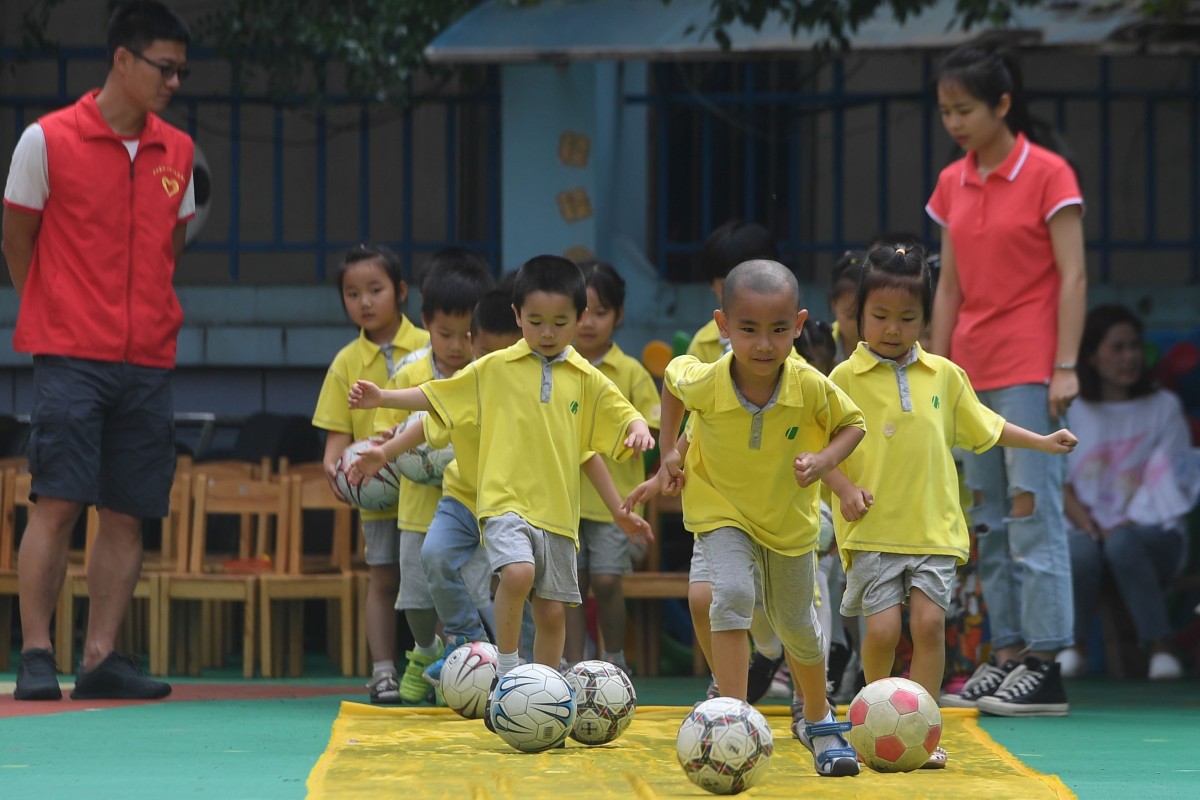
Xi Jinping’s hopes for China as a world footballing force begin with children such as pupils at the Central Kindergarten in Changxing county, eastern Zhejiang province. Photo: Xinhua
President Xi Jinping has vowed to make China a world footballing force and is prepared to go to great lengths to do it, sending thousands of toddlers to “football-focused” kindergartens.
China, which has a population of 1.4 billion but has underachieved in football, will kick the kindergartens scheme off this year, state media said.
Xinhua news agency, quoting education ministry officials, said that “each provincial-level region” will have 50 to 200 football-focused kindergartens.
“The pilot programme aims to cultivate interest in football in children and create an atmosphere favourable for football culture to grow,” Xinhua said, citing a ministry directive.
“Various physical activities tailored for kids will be held, during which children are encouraged to run, jump, climb, throw and shoot balls.”

Li Jianli, director of a kindergarten in the Chinese capital, told the Global Times: “We have soccer coaching for kids who are over five and many other kindergartens in Beijing run soccer programmes, too.”

In October, the Chinese Football Association announced plans for 10,000 kindergartens across the country.

Football-fan president Xi has expressed ambitions for China’s Dragons to qualify for, host and win the World Cup.

Chinese Football Association wants naturalised players to have ‘patriotic feelings’ and learn about the party

So far, China has qualified for the World Cup only once, in 2002, when the team failed to win a point or score a goal.

China languishes at 72nd in the Fifa world rankings, between North Macedonia and El Salvador, and have lost their last three matches on the trot.

The government is dedicating resources to grass roots football, but a study recently revealed how the game was awash at the lower levels with unqualified coaches.

President Xi Jinping wants a generation of Chinese toddlers to aspire to play football on the world’s biggest stage. Photo: AP
Law of Unintended Consequences

continuously updated blog about China & India

ChiaHou's Book Reviews

continuously updated blog about China & India

What's wrong with the world; and its economy

continuously updated blog about China & India