18/04/2020
- Young people starting out in the jobs market face a hit to their prospects that could endure years after the Covid-19-induced downturn has run its course
- A generation of angry youth raises the spectre of political instability
Freelance filmmaker Anita Reza Zein had grown used to jam-packed production schedules requiring her to put in long hours and run on little sleep. Until Covid-19 struck.
Today, the talented Indonesian is suddenly free. With five projects on hold and many more potentially cancelled, she now spends her time working on a personal project, doing research for her work and occasionally going for a ride on a bicycle.
“I feel calm and patient although I’m jobless. Maybe because it’s still the third week [of social distancing] and I still have enough savings from my previous work,” said the 26-year-old, who is from Yogyakarta. “But I imagine life will become tougher in the next few months if the situation gets worse.”
Like her, millions of youths are now part of a job market in Southeast Asia that has been ravaged by the coronavirus pandemic. They are the unlucky cohort of 2020 whose fortunes have changed so drastically, so quickly.
Freelance filmmaker Anita Reza Zein now spends most of her time at home as her projects have all been frozen due to the spread of Covid-19. Photo: Anita Reza Zein
Just three months ago, many eager graduates were about to partake in a strong economy and possibly land decent pay cheques.
Today, job offers are being withdrawn and hiring halted, leading to a spike in regional youth unemployment in the short term. In the long term, the effects on the Covid-19 cohort could lead to wider social and political problems.
JOB MARKETS SHUT
The virus’ impact on economies and the job market in the region has been swift and devastating. Borders have been slammed shut, workers ordered to stay at home, and thousands of companies closed every week.
The biggest problem is the lack of certainty about how long this will last – the longer the governments keep their countries on lockdown, the worse the economic impact.
In
Indonesia, for example, the virus has caused almost 2.8 million people to lose their jobs, according to the Manpower Ministry and the Workers Social Security Agency. Likewise, in
Malaysia, an estimated 2.4 million people are expected to lose their jobs, going by data from the Malaysian Institute of Economic Research (MIER).
is bracing itself for a 5.3 per cent contraction in GDP for the full year, the worst since the Asian financial crisis in 1997.
“We think about seven million jobs have been lost already, and the figure will hit 10 million if the outbreak drags on for two to three more months,” said Kalin Sarasin, council member and head of the Thai Chamber of Commerce.
Lockdown for 34 million people in capital Jakarta as Indonesia fights surge in coronavirus deaths
For young jobseekers, the outbreak of the Covid-19 pandemic could hurt even more, with companies unwilling to open up new jobs for them.
“My clients who were open to fresh graduates previously have realigned searches [for candidates] who have at least one year of experience, as it’s a lot faster for someone with experience to scale up quickly and contribute,” said Joanne Pek, a recruiter at Cornerstone Global Partners’ Singapore office.
For many small and medium-sized enterprises (SMEs) such as Singapore-based restaurant chain The Soup Spoon, saving jobs – rather than recruiting – is the priority.
“We don’t want to let anyone go during this period, so we’re focused on protecting jobs,” said co-founder and director Benedict Leow, who employs some 250 workers.
THE COVID-19 COHORT
The looming economic downturn could have distinct consequences for the Class of 2020 that will outlast the economic downturn itself.
For one thing, the paucity of jobs could result in the Covid-19 cohort becoming a “lost generation” of sorts, said Achim Schmillen, a senior economist at the World Bank Social Protection and Jobs Global Practice.
“Research from around the globe shows that graduating in a recession can have significant and long-lasting impacts that can affect the entire career. In particular, it can lead to large initial earnings losses which only slowly recede over time,” he said.
Coronavirus: why there’s no quick fix for a Covid-19 vaccine
Economics professor Jeff Borland of the University of Melbourne said that international studies showed that what happened to people when they first entered the labour market would affect them for the rest of their working lives.
“Many international studies have shown that trying to move into employment during a major economic downturn cuts the probability of employment and future earnings for a decade or more.
“Why this occurs is less well-established. Reasons suggested include being forced to take lower-quality jobs, losing skills and losing psychological well-being,” he said in a piece published on The Conversation website.
Malaysia sets up Covid-19 test zones in the capital to hunt for ‘hidden’ coronavirus cases
This could create “lasting scarring” on the graduates this year, said labour economist Walter Theseira.
“If their careers start badly, it would affect their earnings for a number of years because they would lack the same experience as peers who started in a more secure position,” the associate professor of economics at Singapore University of Social Sciences said.
Shrinking salaries and the downsizing of companies mean that graduates might have to seek out professions outside their areas of study to survive, said Grace Lee Hooi Yean, head of the Economics Department at Monash University, Malaysia.
She said youth unemployment in the country, which stands at 11.67 per cent, could rise sharply.
“This looming crisis could trap a generation of educated and capable youth in a limbo of unmet expectations and lasting vulnerability if the graduates are not ready to face reality and adapt to the new challenges,” she said.
How long will a coronavirus vaccine take? A Q&A with Jerome Kim
This is fast becoming the reality for final-year medical student Rebecca K. Somasundaram, who has been left without a job due to the pandemic.
After being offered a residency programme at a top specialist hospital in Kuala Lumpur, she was notified a month ago that her placement had been made void until further notice. This has thrown the 24-year-old’s plans into disarray as she was hoping to enter the workforce soon to pay off her student debts. Her plans to get married next year have also been put on hold temporarily.
“I am in constant talks with the hospital to see if there is any way I can join them soon but seeing how things are unfolding so quickly, I am slowly losing hope,” she said.
Over in Indonesia, the pandemic will trigger job losses on a national scale. To combat this, the government would need to introduce strong fiscal measures and beef up its social protection policies, said the country’s former minister of finance Muhamad Chatib Basri.
Many people on lower incomes tend to work in the extraction industry, such as mining and palm oil, and these are the first industries hit due to the global slowdown.
“The rich will be able to brave the storm, but the poor have no means to do so,” he said.
Singapore migrant workers under quarantine as coronavirus hits dormitories
SPECTRE OF 1997
With partial lockdowns imposed in the capital of Jakarta, more needs to be done to ensure that vulnerable citizens have access to food and financial support.
Without government intervention, economic woes could soon translate into political instability, a scenario last seen in the Asian financial crisis.
In 1997, waves of discontent sparked racial riots in Indonesia that toppled the country’s long-time strongman Suharto, while in Thailand a political crisis created the conditions for populist leader Thaksin Shinawatra to rise.
Rising discontent could have serious implications at the ballot boxes, warned Basri, who said young voters were a key voting bloc for President Joko “Jokowi” Widodo.
Coronavirus: food security, Asia’s next battle in a post-Covid world
In last year’s general elections, Jokowi proved a hit among the lower-educated youth who had benefited from the creation of largely unskilled jobs during his tenure.
“With more young people expected to become unemployed in the coming months, things will only get worse from here,” said Basri, who added that the country’s youth unemployment stood at almost 20 per cent in 2018.
Indonesia, which has 268 million people and is Southeast Asia’s largest economy, had 133 million workers as of last August, according to official data.
Close to 10 per cent or about 12.27 million are university graduates but among this group, about 5.67 per cent or some 730,000 were unemployed. This was higher than the country’s overall unemployment rate at that time, which was 5.28 per cent.
‘Ghosts’ deployed to scare Indonesians into staying home to slow spread of the coronavirus
GETTING IT RIGHT
Economists say, however, that all is not lost. Much will depend on policy and how governments focus on battling the virus on the public health and economic fronts. They point to Singapore, which has launched a robust response to the crisis.
On April 6, the Singapore government announced its third budget in two months to help companies and households tide over the crisis. In all, Singapore’s total stimulus package, which aims to save jobs and keep funds flowing to companies, will cost the government a massive S$59.9 billion (US$42 billion).
The Singapore government was also preparing for a labour market that would be reluctant to hire fresh graduates on a full-time basis, said Theseira.
“There are plans to implement large-scale subsidised traineeships, which may be more palatable to companies which are worried about taking on permanent headcount this year,” he noted. “As the economic situation improves, they can be converted to permanent positions.”
The next coronavirus: how a biotech boom is boosting Asian defences
While jobs were being created for fresh graduates, many would still have to temper their expectations, such as taking jobs with lower starting pay, said DBS Bank economist Irvin Seah.
“There are still some jobs to go around. There are still some companies that may need workers. But they will need to be realistic,” he said.
For instance, despite the downturn, Singapore telco Singtel expects to recruit over 300 fresh graduates for various permanent positions this year, according to Aileen Tan, the company’s Group Chief Human Resources Officer. Many of the new hires will be in new growth areas such as the Internet of Things, analytics and cloud.
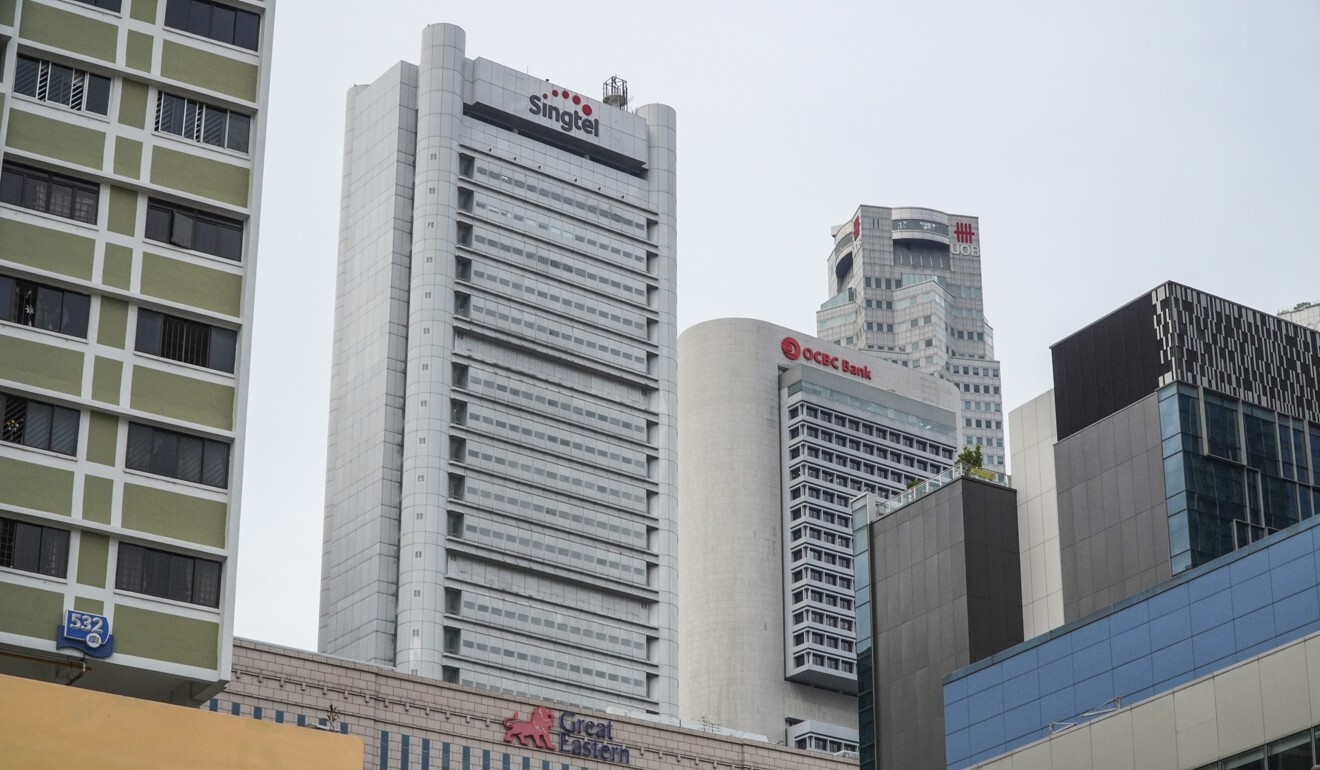
The Singtel Comcentre building in Singapore. Photo: Roy Issa
Other companies that continue to hire include those in tech across the region, including e-commerce giant Shopee, food-delivery service Foodpanda and Amazon.
In Australia, Borland suggested helping young people to remain plugged into the labour market through government-funded paid internships, or even offering them loans to go for further studies and prevent a spell of unemployment.
For now, while some young jobseekers are taking a wait-and-see approach, the reality is hitting hard for others.
Final-year National University of Singapore student H.P. Tan had all but secured a job at a public relations firm last month, after three rounds of interviews.
The Faculty of Arts and Social Sciences undergraduate was rejected via an email from the agency, which said that they could no longer hire after Covid-19 started to drastically cut business.
“When I got that rejection, it was a turning point. I didn’t think I would be directly impacted,” said the 23-year-old.
“I also applied to a few other agencies but the response has been slow, so I am now freaking out at the possibility of not being able to find a job after graduation.”
Source: SCMP
Posted in 1997, 2020, a hit, affect, after, ago, although, Amazon, analytics, angry youth, approach, around the globe, Asian financial crisis, Australia, Bicycle, biggest problem, borders, bracing, cancelled, capital, changed, class, closed, cohort, Comcentre building, companies, contraction, Cornerstone Global Partners’, coronavirus, Coronavirus pandemic, could endure, countries, COVID-19, Covid-19-induced, decent, devastating, dormitories, downturn, drastically, e-commerce giant, eager, earnings losses, Economic, economic downturn, economics professor, economies, Economists, economy, effects, enough, entire career, estimated, every, example, extraction industry, Face, Faculty of Arts and Social Sciences, feel calm, few, filmmaker, five, food and financial support, food-delivery service, Foodpanda, fortunes, free, Freelance, full year, further studies, GDP, generation, gets worse, government's, graduates, graduating, Group Chief Human Resources Officer, grown, growth areas, halted, her, her time, hiring, Home, imagine, impact, impacts, imposed, Indonesia, initial, international studies, internships, Jakarta, jam-packed, job market, JOB MARKETS, job offers, jobless, jobs market, jobseekers, keep, lack of certainty, land, large, lead, leading, life, Likewise, little sleep, loans, lockdown, lockdowns, long hours, long term, long-lasting, longer, lost generation, Malaysia, Malaysian Institute of Economic Research (MIER), Manpower Ministry, many, many more, Maybe, migrant workers, millions, mining, months, National University of Singapore, next, occasionally, office, on hold, ordered, over time, Palm oil, partake, partial, particular, Patient, pay cheques, personal project, political instability, poor, possibly, post-coronavirus, potentially, President Joko “Jokowi” Widod, prevent, previous, priority, production, projects, put in, quarantine, quickly, raises, ravaged, recede, Recession, recruiting, region, regional, requiring, research, rich, ride, run, run its course, saving jobs, savings, schedules, Shopee, short term, showed, shut, significant, since, Singapore, Singapore University of Social Sciences, Singapore-based, Singtel, situation, slammed shut, slowly, small and medium-sized enterprises (SMEs), social and political problems, Social distancing, Southeast Asia, spectre, spell, spends, spike, starting out, stay, storm, strong, struck, suddenly, Suharto, swift, talented, telco, Thai Chamber of Commerce, Thailand, Thaksin Shinawatra, The Conversation, The Soup Spoon, their prospects, third, Thousands, Three, Today, tougher, Uncategorized, under, unemployment, University of Melbourne, unlucky, Until, used to, virus’, wait-and-see, website, week, wider, will last, withdrawn, workers, Workers Social Security Agency, working, World Bank Social Protection and Jobs Global Practice, worse, worst, years, Yogyakarta, young people, youth unemployment, youths |
Leave a Comment »
06/04/2020
SHENYANG, April 5 (Xinhua) — Huo Chunlei, who runs a hotpot restaurant in Shenyang, capital of northeast China’s Liaoning Province, said he did not lay off any of his staff, although the restaurant is having difficulties for reopening after two months of closure in China’s nationwide measures of coronavirus control.
A few weeks after Chinese provincial-regions with low risk of the novel coronavirus gradually resumed work and production, shops and eateries have reopened, and roads become bustling again, as hundreds of millions of people confined at home for weeks in compliance with epidemic prevention rules get back to a normal life.
Huo’s restaurant has been in operation for a week. Only half of the tables are filled at dinnertime. The revenue is barely enough to cover the expenses of the house rent and employee wages, he said.
However, he said his business is able to survive because of the government’s bailout policies. For example, the approval of deferred payment of social insurance premiums for his employees alone can save him 80,000 yuan (about 11,250 U.S. dollars) a month.
“The staff are willing to stay, as we are all confident in tiding over the difficulties together,” he said.
The local governments at all levels have rolled out a slew of measures to shore up the catering business, including cutting taxes, reducing house rent as well as water and electricity fees.
The governments in Liaoning, Shandong, Jiangsu and Zhejiang provinces have issued coupons with a value ranging from 10 million yuan to 100 million yuan to encourage people to spend on dining out.
Before the production resumption, there were some consumer councils’ surveys showing that consumers had suppressed consumption desire for dining out and shopping as well as going to movie theaters, gymnasiums and tourist spots after the epidemic crisis ends.
“The so-called retaliatory consumption has not yet appeared in the catering industry, as people are still wary about the infection risk, but there will be a gradual recovery growth,” said Chen Heng, executive director of Hainan Hotel and Catering Industry Association in the southernmost Chinese province of Hainan.
“Before reopening, we increased the distances between tables, but with reduced tables, there are still many empty tables at dinner time. My restaurant used to have all seats full and even queues,” said Huo.
Like Huo, Lin Lunheng, founder of the Fuzhou Super Dinner Co. Ltd. in southeast China’s Fujian Province, is also worried about business.
“Although the chain stores have reopened, revenues have decreased by 70 percent compared with that before the epidemic. This is a big blow to restaurants,” said Lin.
The Italian style chain restaurant has offered e-coupons to draw customers.
As the spring weather is getting more and more pleasant, consumers’ desire for dining out and travel is growing. According to a survey report jointly released by the China Travel Academy and Trip.com Group on March 19, Chinese are longing for tours across the country, with Yunnan, Hainan and Shanghai among the top destinations.
Source: Xinhua
Posted in bailout, Business, bustling, catering business, China Travel Academy, compliance, coronavirus control, coupons, crisis, cutting taxes, dining out, dinnertime, eateries, electricity fees, employee, epidemic, expenses, Fujian Province, Fuzhou Super Dinner Co. Ltd., Government, gymnasiums, Hainan Hotel and Catering Industry Association, Hainan Province, house rent, industry, Italian style chain restaurant, jiangsu province, Liaoning province, local governments, movie theaters, nationwide, novel coronavirus, offers, prevention rule, production, reducing, reopened, Restaurant, resumed work, Revenue, roads, shandong province, Shanghai, Shenyang, shopping, shops, social insurance premiums, staff, stimulate, suppressed consumption, survive, top destinations, tourist spots, Uncategorized, voucher programs, wages, water, Yunnan Province, Zhejiang |
Leave a Comment »
31/03/2020

Chinese Vice Premier Sun Chunlan, also a member of the Political Bureau of the Communist Party of China Central Committee, visits a tea farm in Huangjingtang Village in Xianning City, central China’s Hubei Province, March 31, 2020. Sun, who is leading a central guiding group to oversee the epidemic control work in Hubei, inspected spring plowing and production resumption in Xianning on Tuesday. (Xinhua/Li He)
WUHAN, March 31 (Xinhua) — Chinese Vice Premier Sun Chunlan Tuesday called for efforts to organize spring plowing and help enterprises resume work and production.
Leading a central guiding group to oversee the epidemic control work in Hubei Province, the previous epicenter of the COVID-19 epidemic, Sun, also a member of the Political Bureau of the Communist Party of China Central Committee, made the remarks while inspecting spring plowing and production resumption in the Hubei city of Xianning.
The group visited a tea farm and two enterprises in the city.
While ensuring the epidemic control, efforts should also be made to capitalize on the window for spring plowing, Sun said, urging strengthened farm management, detailed technical guidance for farmers, convenient transportation for agricultural materials and more help for Hubei to sell farm products.
Sun also stressed that during this critical period to resume work and production, the supporting measures for industries should be improved to provide more driving forces for enterprises.
Preferential policies for micro, small and medium-sized enterprises should be fully implemented, Sun noted, adding that the problems of local authorities and enterprises should be solved in a timely manner.
Source: Xinhua
Posted in Chinese Vice Premier, COVID-19 epidemic, epicenter, hubei province, member of the Political Bureau of the Communist Party of China Central Committee, production, resumption, spring plowing, Uncategorized, urges, Xianning |
Leave a Comment »
29/03/2020
- Chinese president is fighting ‘two tough battles’ to reboot industry and defeat Covid-19, Xinhua says
- Choice of industrial powerhouse for official visit shows the importance Xi gives to reviving the economy, observers say
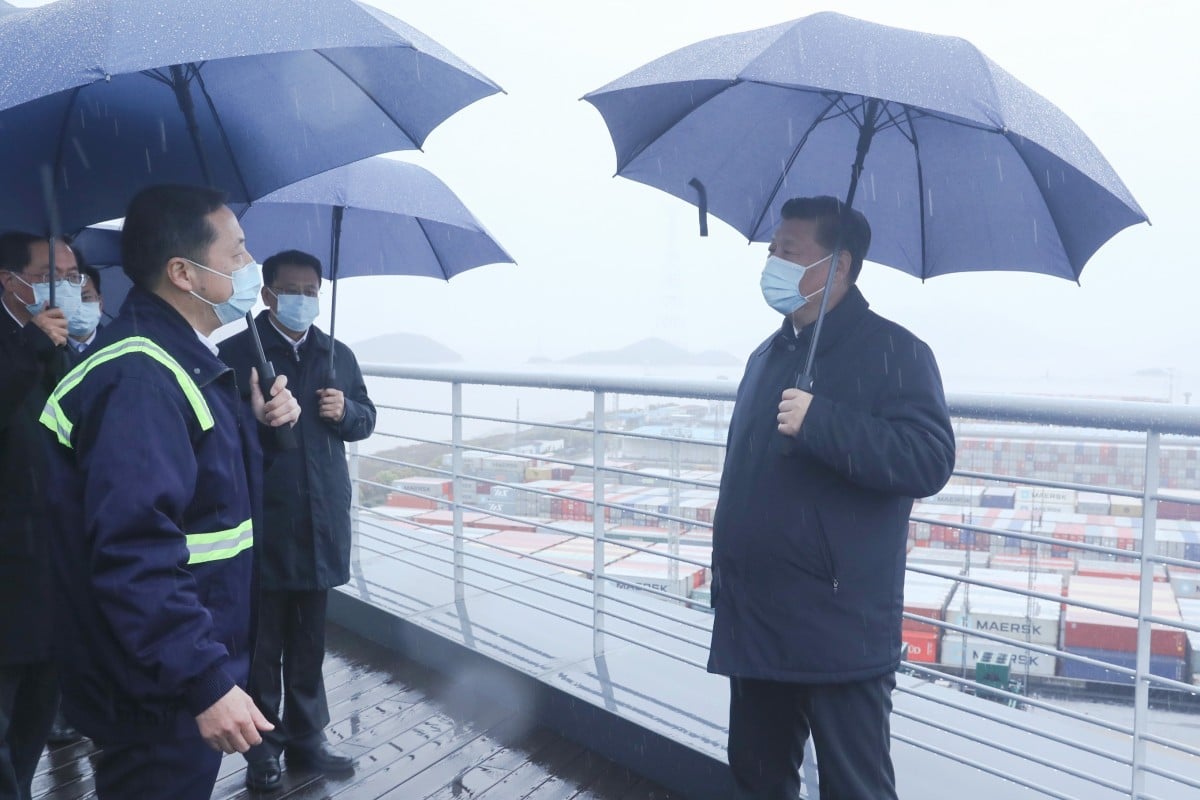
Chinese President Xi Jinping chats to workers and officials at Ningbo port in east China on Sunday. Photo: Xinhua
visited the industrial powerhouse of Zhejiang province on Sunday in a move state media described as a clear message the country was ready to get the economy back on track amid the “new normal” of dealing with the coronavirus.
The trip, to Ningbo – one of the world’s busiest ports and a trade hub for eastern China – was Xi’s first outside Beijing since he visited Wuhan, the initial epicentre of the Covid-19 outbreak, earlier in the month.
As well as a visiting the port, he spoke to workers at an industrial zone for car part manufacturers, where he learned about the latest efforts to restart production, Xinhua said in a brief report.
The visit came after two months of almost total lockdown in many parts of the country that disrupted businesses, transport and people’s daily lives, and ground the economy to a near standstill.
While local transmissions of the coronavirus in China appear to be under control, Beijing has implemented strict measures to prevent imported cases, including slashing international flights and banning most foreigners from entering the country.
In a separate report, Xinhua said Xi’s visit sent “a clear message” that China was resuming its industrial production and social activities, and described the fight against the coronavirus as the “new normal”.
Reviving the economy and battling a deadly disease were Xi’s “two tough battles”, it said.
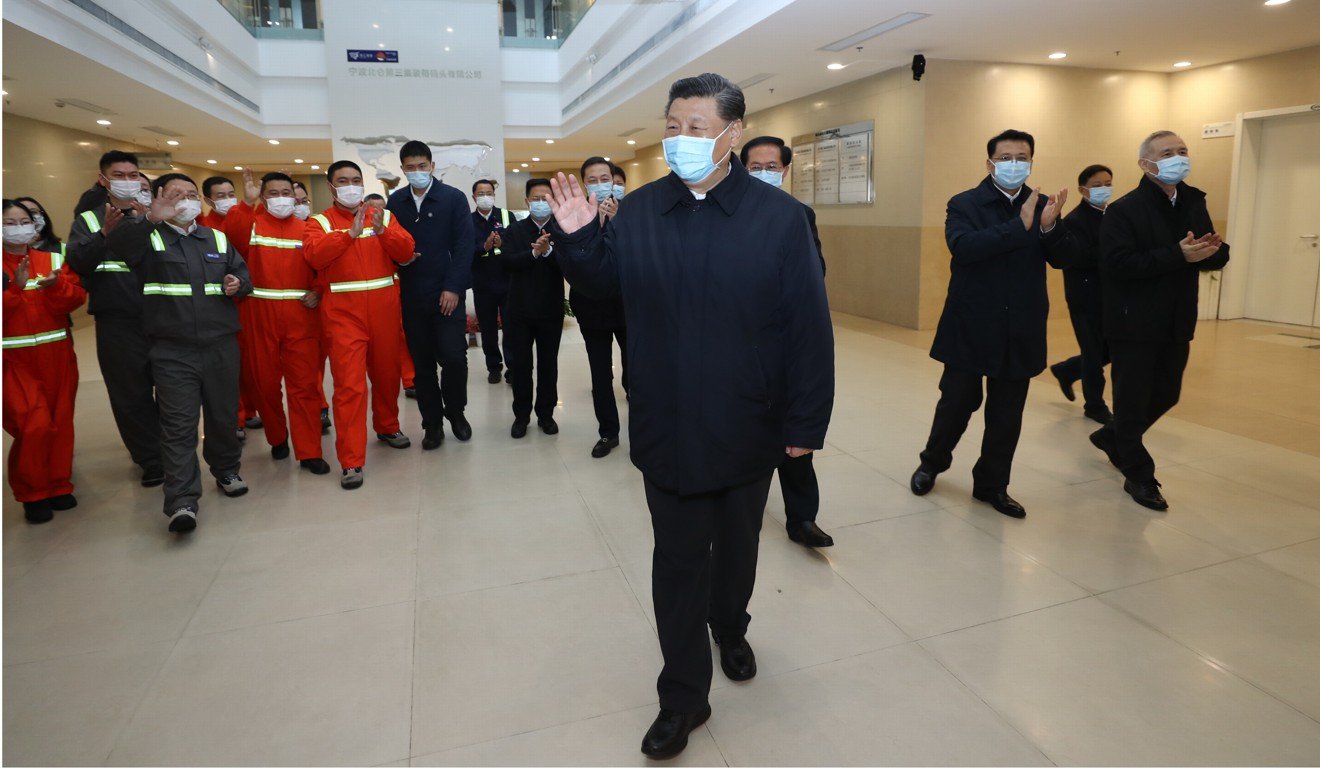
Xi’s choice of destination was a clear message that restarting the economy is a top priority. Photo: Xinhua
Zhejiang is something of a power base for Xi, who spent nearly five years there during his climb through the ranks of the Communist Party.
One of the country’s biggest trading hubs, the province generated 3 trillion yuan (US$423.2 billion) in foreign trade last year, or more than 13 per cent of the national total, according to official figures.
“It’s a highly export-oriented economy … which has made it crucial not only to China’s development plan but also to safeguarding the stability of the global supply chain,” Xinhua said.
Observers said Xi’s visit was evidence of Beijing’s determination to get the economy back up and running as soon as possible.
Zhao Xijun, an economics professor at Renmin University, said Ningbo was a key part of the export economy and a base for many local and foreign entrepreneurs.
“It is a clear signal that China, after getting domestic infections under control, is now prioritising economic growth,” he said.
“It also shows the country will keep developing its economy and opening up its markets.”
But hopes of a quick recovery for the Chinese economy have been dashed by the spread of the coronavirus across Europe and the United States, causing a sharp decline in demand for Chinese goods.
Xi spent five years in Zhejiang while climbing the ranks of the Communist Party. Photo: Xinhua
In a meeting on Friday, the Communist Party’s Politburo said it would step up macroeconomic policy adjustments and pursue a more proactive fiscal policy while optimising measures to control the coronavirus to speed up the restoration of production, doing whatever it could to “minimise the losses caused by the epidemic”.
“China has successfully reopened much of its economy from the extremes of the coronavirus lockdown, but now faces a new problem: an impending collapse in demand for its exports as its customers go into lockdowns of their own,” Gavekal Dragnomics said in a research report.
“That shock to industry and manufacturing employment means that China will not enjoy the hoped-for V-shaped recovery in growth.”
Source: SCMP
Posted in 'total lockdown', ‘clear message’, ‘two tough battles’, back on its feet, banning, Beijing, Beijing’s, busiest ports, businesses, car part manufacturers, Chinese economy, Chinese goods, Communist Party, Communist Party’s Politburo, coronavirus, Country, COVID-19 outbreak, dashed, decline, defeat Covid-19, demand, determination, disrupted, economics professor, economy, employment, entering, epicentre, Europe, export-oriented, Foreigners, Gavekal Dragnomics, global, global supply chain, growth, industrial powerhouse, industrial zone, industry, international flights, it’s time, local transmissions, macroeconomic policy, Manufacturing, Ningbo, observers, optimising measures, people’s daily lives, power base, proactive fiscal policy, production, reboot industry, Renmin University, restart, Safeguarding, sends, stability, standstill, trade hub, Transport, Uncategorized, United States, V-shaped recovery, visit, workers, Wuhan, Xi, Xi Jinping’s, Xinhua, zhejiang province |
Leave a Comment »
25/03/2020
HARBIN, March 24 (Xinhua) — After climbing an iron ladder and mounting a 10-meter-high drilling platform, Ge Yifan, a driller in the Daqing Oilfield, keeps a close eye on the control room screen and uses a microphone to instruct his workmates cleaning mud off the platform.
Ge works in the 1205 Drilling Team in Daqing Oilfield, the country’s largest oil production base in northeast China’s Heilongjiang Province.
“Since the oilfield resumed production on Feb. 11, we have been working around the clock to speed up oil production to mitigate the effects caused by the epidemic,” said Zhang Jing, head of the drilling team.
Discovered in 1959, the oilfield has produced about 2.4 billion tonnes of crude oil over the past 60 years. Its overseas business projects have covered 26 countries and regions, with overseas market revenue exceeding 10 billion yuan (around 1.4 billion U.S. dollars) and overseas equity output exceeding 9 million tonnes.
“While fighting against COVID-19, our domestic and overseas colleagues have been making efforts to promote the resumption of oil production to ensure the domestic and global supply,” said Xie Yuxin, manager of the market development department of the Daqing Oilfield of the China National Petroleum Corporation (CNPC).
Since the epidemic outbreak, Daqing Oilfield has taken stringent prevention measures to contain the spread of the deadly virus in the work areas.
Visitors who enter an oil extraction plant on the oilfield production base are asked to get disinfected and have their body temperatures measured at the entrance.
“Start the No. 1 oil pump.” “Roger.” In a dehydration pump room of the plant, the only worker, Wang Zhongying, operates equipment following instructions from the command room.
“We have carried out information technology updates on equipment operations over the past years,” said Zhao Shiqing, a worker of the plant. “It plays a significant role in reducing the gathering of employees during the epidemic.”
“In the fight against COVID-19, everyone is a soldier. We will stick to our posts and make every effort to help secure the global oil supply chain,” said Wang Hongchen, a project manager of Daqing Oilfield of CNPC in Indonesia.
Source: Xinhua
Posted in China National Petroleum Corporation (CNPC), COVID-19, Daqing Oilfield, Drilling Team, epidemic, Harbin, Heilongjiang province, Indonesia, Largest oilfield, production, revs up, secure, supply, Uncategorized |
Leave a Comment »
06/03/2020

People work on the production line of YTO Group in Luoyang, central China’s Henan Province, March 5, 2020. About 94.8 percent of industrial enterprises above designated size in Luoyang have resumed production so far. (Xinhua/Li Jianan) Source: Xinhua
Posted in designated size, Henan province, Industrial enterprises, Luoyang, production, Uncategorized, YTO Group |
Leave a Comment »
10/02/2020
SHANGHAI (Reuters) – China’s smartphone sales may plunge by as much as 50% in the first quarter, as many retail shops have closed for an extended period and production has yet to fully resume due to the fast spread of a new coronavirus, according to research reports.
The virus outbreak, which has killed more than 900 people and roiled China’s manufacturing industry, comes as top smartphone vendors such as Huawei had hoped China’s 5G rollout plans this year would help the world’s biggest smartphone market rebound after years of falling sales.
“Vendors’ planned product launches will be canceled or delayed, given that large public events are not allowed in China,” research firm Canalys said in a note last week.
“It will take time for vendors to change their product launch roadmaps in China, which is likely to dampen 5G shipments.”
Canalys expects China’s smartphone shipments to halve in the first quarter from a year ago, while IDC, another research firm that tracks the tech sector, forecasts a 30% drop.
Apple Inc said last week it is extending its retail store closures in China and has yet to finalise opening dates, as Foxconn, which assembles iPhones, struggles to fully resume factories.
Foxconn received government approval on Monday to resume production at a plant in the city of Zhenghzou, but its major plant in Shenzhen remain unopened.
Huawei, China’s biggest smartphone vendor, said its manufacturing capacity is “running normally” without specifying further. But like many other local peers, Huawei relies heavily on third-party manufacturers for production.
If factories cannot resume production to full capacity on time, this could delay brands’ ability to bring their newest products to market, analysts said.
Xiaomi Corp, Huawei, and Oppo, three of China’s top Android brands, are all expected to announce flagship devices in the first half.
Oppo told Reuters that while the impact of the virus will affect operations at some local factories, “manufacturing capacity can be guaranteed effectively” thanks to its plants overseas.
Xiaomi did not respond to requests for comment.
“The delays in reopening factories and the labour return time will not only affect shipments to stores, it will also affect the product launch times in the mid- and long-term,” Will Wong, an IDC analyst, said.
Globally, smartphone production will decrease by 12% in the March quarter to a five-year low of 275 million units, research firm TrendForce said on Monday. It revised down iPhone production by 10% to 41 million units, while Huawei’s output forecast was cut by 15% to 42.5 million phones.
Samsung Electronics Co, the world’s top smartphone maker, is seen the least affected by the virus outbreak as its main production base is in Vietnam, the report said, lowering its production forecasts by just 3% to 71.5 million units.
Source: Reuters
Posted in 5G rollout, android, Apple Inc., brands, China's, closed, coronavirus, devices, extended period, first-quarter, flagship, Foxconn, halve, Huawei, IDC, iPhones, manufacturing industry, plans, production, resume, retail shops, Reuters, Sales, samsung electronics co, Shanghai, Shenzhen, smartphone, TrendForce, Uncategorized, vendors, virus outbreak, Xiaomi Corp., Zhenghzou |
Leave a Comment »
07/02/2020
TOKYO (Reuters) – Toyota Motor Corp (7203.T) on Friday said production at all of its China plants would remain suspended through Feb. 16, joining a growing number of automakers facing stoppages due to supply chain issues as the coronavirus spreads.
The Japanese automaker, which operates 12 vehicle and components factories in China, said it would extend its production stoppage “after considering various factors, including guidelines from local and region governments, parts supply, and logistics.
“For the week of Feb. 10, we will be preparing for the return to normal operation from Feb. 17 and beyond,” it said in a statement.
The decision extends Toyota’s initial plans to suspend operations through Sunday, and comes as the threat from the coronavirus crisis closes in on the global auto industry.
South Korea’s Hyundai Motor (005380.KS) and affiliate Kia Motors (000270.KS) said on Friday that they plan to restart production at their Chinese factories on Feb. 17, from a previously planned Feb.9.
“We will take preventive measures against infection at factories,” a spokeswoman said.
A growing number of car makers, including those who do not make cars in China, are flagging the possibility that their global operations could take a hit if they cannot access parts supplies from the country, where there are transportation bans to stop the virus spreading.
Suzuki Motor Corp said it was looking at the possibility of procuring “made in China” car parts from other regions if it cannot access parts due to ongoing stoppages.
The Japanese automaker does not produce or sell any cars in China, but procures some components there for its plants in India, where it controls around half of the passenger vehicle market via its local unit Maruti Suzuki India Ltd (MRTI.NS).
Fiat Chrysler Automobiles NV (FCHA.MI) on Thursday said one of its European plants could close within two to four weeks if Chinese parts suppliers cannot get back to work soon, while Hyundai Motor Co (005380.KS) earlier this week suspended production at its South Korean plants due to a shortage of China-made parts.
Parts made in China are used in millions of vehicles assembled elsewhere, and China’s Hubei province – the epicentre of the coronavirus outbreak – is a major hub for vehicle parts production and shipments.
To limit the spread of the virus, Chinese authorities have announced an extended holiday period in Hubei and 10 other provinces, which account for more than two-thirds of the country’s vehicle production.
IHS Automotive projects plant closures through Feb. 10 would result in a 7% cut in vehicle production in China for the first quarter.
In a note, its analysts said extended closures into March may result in lost production of over 1.7 million vehicles for the period, a decline of roughly one-third of pre-virus output expectations.
“If the situation lingers into mid-March, and plants in adjacent provinces are also idled, the China-wide supply chain disruption caused by parts shortages from Hubei, a major component hub, could have a wide-reaching impact,” they said.
Other industry experts said suppliers had built up a cushion of parts in inventory and in-transit ahead of the long Lunar New Year holiday in late January. Those will start to run out if factories cannot get back to work next week, or if flights to and from China remain limited.
Toyota said its plants outside China were operating as normal for the moment but it has said it was also considering the possibility of manufacturing parts commonly made in China in other regions.
Source: Reuters
Posted in affiliate, automakers, bans, China, coronavirus, epicentre, factories, Fiat Chrysler Automobiles NV (FCHA.MI), global operations, hits, hubei province, Hyundai Motor Co (005380.KS), IHS Automotive, keeps, logistics, Lunar New Year holiday, Made in China, major hub, manufacturing parts, Maruti Suzuki India Ltd (MRTI.NS), output, parts production, Plant, procuring, production, restart, shipments, South Korea, spreads, stoppages, stopped, supply, supply chain issues, suspended, Suzuki Motor Corp, Tokyo, transportation, Uncategorized, vehicle, Virus |
Leave a Comment »
01/09/2019
- The manufacturing purchasing managers’ index, released by the National Bureau of Statistics on Saturday, was 49.5 in August
- Figure adds to a month of woe for policymakers in Beijing, even ahead of planned US tariff increases on September 1, October 1, and December 15
China’s manufacturing purchasing managers’ index fell by 0.2 points in August as the trade war continued to bite. Photo: Xinhua
As the trade war with the United States continues to gather pace, manufacturers in China remain gloomy about their prospects, with the sector activity contracting for the fourth successive month in August.
The manufacturing purchasing managers’ index (PMI), released by the National Bureau of Statistics (NBS) on Saturday, stood at 49.5 in August, down from a reading of
, and below analysts’ expectations. The median result of a survey of analysts by Bloomberg expected a reading of 49.6.
The PMI is a gauge of sentiment among factory operators, with 50 being the demarcation line between expansion and contraction in sector activity. In the survey, manufacturers are asked to give a view on business issues such as export orders, purchasing, production and logistics.
That the index has remained in contractionary territory for six of eight months this year shows that the effects of US tariffs are resonating through the Chinese economy. The manufacturing PMI only showed expansion in March and April of this year.
New and higher US tariffs scheduled to enter force on September 1, October 1 and December 15 could provide some very temporary boost to Chinese exports and therefore manufacturers, should they inspire American buyers to make early purchases to pay lower tariff rates. However the long term trajectory is negative, with many manufacturers scoping out or already relocating to production sites outside the world’s second largest economy.
Also released on Saturday was the official non-manufacturing PMI, a survey of the construction and services sectors. This stood at 53.8, up from 53.7 in July, showing that these sectors have remained more robust in the face of a general slowdown in China’s economy. The Bloomberg survey of analysts had expected non-manufacturing PMI in August to remain unchanged.
Composite PMI, a combined reading of both manufacturing and non-manufacturing, was 53, down from 53.1 in July.
The August PMI decline “indicates downward pressure on the economy,” said Zhang Liqun, an analyst with the China Federation of Logistics and Purchasing, which produces the index with the NBS.
“Corporations’ forecasts of the market outlook were quite poor while being cautious on their production operations,” Zhang said. The PMI indicated a drop in new orders, which also reflected a lack of domestic demand. Given that the US is escalating tensions with China, downward pressure on external demand is also apparent, Zhang said.
August was a month to forget for policymakers in Beijing, with a series of negative data highlighting the serious economic challenges facing the nation. With the trade war threatening to tip the global economy into a recession, China remains heavily exposed.
The trade war is having a significant impact on Chinese manufacturing. Photo: Xinhua
While exports grew by 3.3 per cent in July, a sign of front-loading, imports fell by 5.6 per cent, emphasising the issues with consumption in China. This problem was also clear in retail sales figure, which came in at a disappointing 7.6 per cent for July, down from 9.8 per cent growth in June.
, a measure of output in China’s manufacturing and mining sectors, grew by just 4.8 per cent in July, the lowest reading since February 2002.
Gross domestic product in China for the second quarter of 2019 grew at 6.2 per cent, the lowest rate since NBS quarterly records began in 1992.
Source: SCMP
Posted in Beijing, Bloomberg, China Federation of Logistics and Purchasing, China’s manufacturing, Chinese economy, Escalating trade war, export orders, factory operators, gross domestic product (GDP), hit, Industrial production, logistics, national bureau of statistics, National Bureau of Statistics (NBS), policymakers, production, purchasing, purchasing managers’ index (PMI), Uncategorized, United States, US tariff, Xinhua |
Leave a Comment »
29/07/2019
BHUBANESWAR (Reuters) – Members of Indian Prime Minister Narendra Modi’s Bharatiya Janata Party (BJP) have mounted protests that have paralysed production at one of India’s biggest coalfields following a deadly accident last week.
The BJP workers have been staging sit-down protests and waving flags at state-run Coal India Ltd’s mines in the eastern state of Odisha, demanding a safety audit of all mines in the region.
Rescue officials said they have recovered the bodies of three workers who were trapped inside the mine in Odisha’s Angul district after a landslide on Tuesday, and are trying to recover another body from inside the mine.
Kalandi Samal, a local BJP leader who is leading the protests, said the demonstrations will continue until authorities ensure safety measures to prevent such tragedies and ensure adequate compensation to the victims.
“We demand specific guidelines on safety audits of mines,” Samal said.
Production at Odisha state’s Talcher coalfields, which account for at least an eighth of Coal India’s annual production, has not resumed after the accident, said Dikken Mehra, a spokesman for Mahanadi Coalfields Ltd, a unit of Coal India.
State-run Coal India has a near monopoly on the coal industry in India, producing more than four-fifths of the country’s coal output.
“The forced stoppage of all the mines at Talcher has resulted in a cumulative loss of 842,000 tonnes of coal production,” Mehra told Reuters, adding that the company has suffered a loss of about 856.8 million rupees (£10 million).
Srinivas Khuntia, a senior leader at BJP-affiliated trade union Bharatiya Mazdoor Sangh, called the protests “unjustified, especially when its own government is in power”.
“There is no justification why you would stop all the mining operations,” Khuntia told Reuters.
Though deaths at coal mines in India have come down over time, it remains one of the most dangerous countries to be a coal miner, with one worker dying every seven days on average in state-run mines in 2018.
In addition, thousands of workers, including children, have been killed in illegal rat-hole mines that are notorious for their poor safety record, with many accidents going unreported.
“We are in talks with all the stakeholders to resolve the issues as soon as possible,” Mehra said, without divulging details on the timeframe for resumption of production.
Coal India is trying to divert supplies from elsewhere to ensure coal availability at utilities and companies that normally rely on the Odisha coalfields.
Those entities include state-owned NTPC Ltd, India’s biggest electricity generator, as well as the state-owned National Aluminium Company Ltd (NALCO).
“Production will be affected if the mines remain shut for more days,” said Tapan Kumar Chand, chairman of NALCO.
Source: Reuters
Posted in Bharatiya Janata Party (BJP), Coal India, coalfields, electricity generator, Indian Prime Minister Narendra Modi, Mahanadi Coalfields Ltd, mines, National Aluminium Company Ltd (NALCO), NTPC Ltd, Odisha, paralyse, production, protests, Uncategorized, worker deaths |
Leave a Comment »







 CHINDIA ALERT: You'll be living in their world, very soon