Chindia Alert: You’ll be Living in their World Very Soon
aims to alert you to the threats and opportunities that China and India present. China and India require serious attention; case of ‘hidden dragon and crouching tiger’.
Without this attention, governments, businesses and, indeed, individuals may find themselves at a great disadvantage sooner rather than later.
The POSTs (front webpages) are mainly 'cuttings' from reliable sources, updated continuously.
The PAGEs (see Tabs, above) attempt to make the information more meaningful by putting some structure to the information we have researched and assembled since 2006.
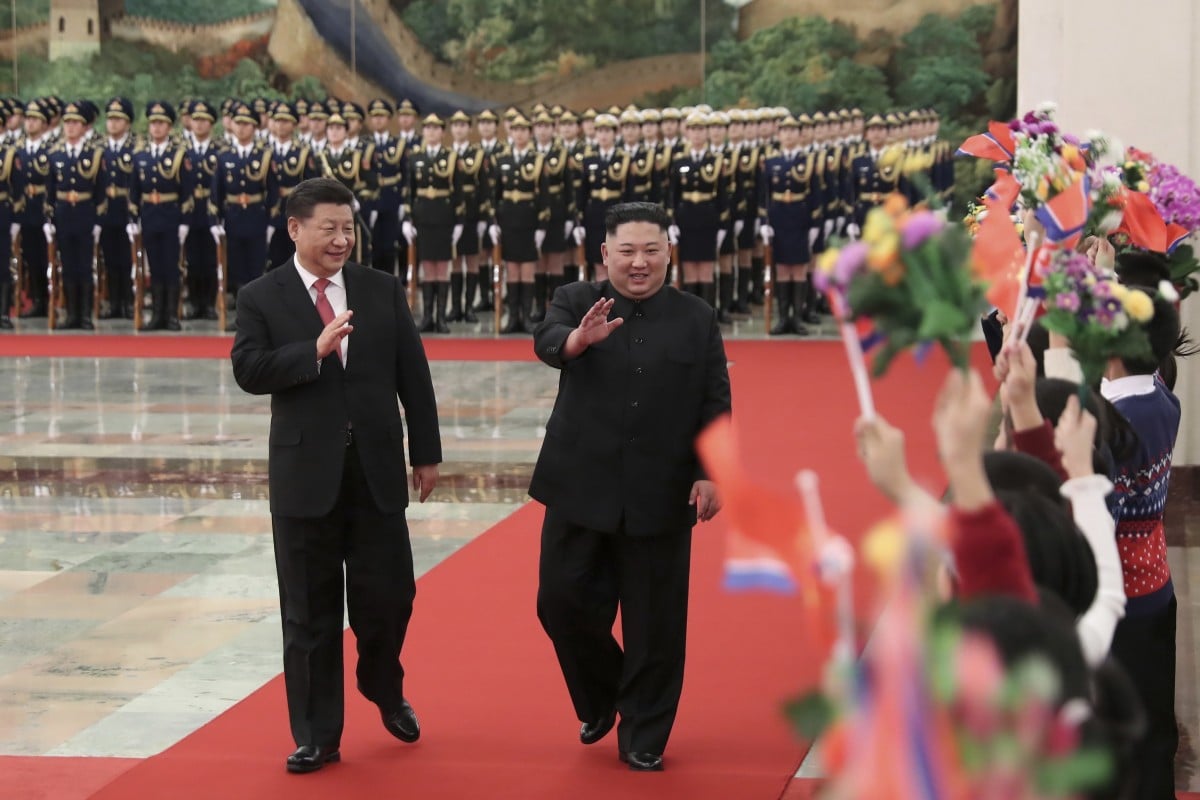
In his “verbal message of thanks”, Mr Xi said he highly appreciated Mr Kim’s support during China’s outbreak and “showed his personal attention to the situation of the pandemic and people’s health” in North Korea, according to state media.
Mr Xi called for more efforts to strengthen co-operation in preventing the spread of the coronavirus, and said China was “willing to continue to provide assistance within its own capacity for [North Korea] in the fight against Covid-19”.
On Friday, North Korean state media reported that Mr Kim had sent a verbal message to the president that “congratulated him, highly appreciating that he is seizing a chance of victory in the war against the unprecedented epidemic”.
Image copyright REUTERSImage caption Kim Jong-un disappeared from public view for 20 days, before visiting a factory on 2 May
Mr Kim recently went 20 days without appearing in public, and missed the celebration of his grandfather’s birthday – one of the biggest events of the year.
Some media reports claimed he was “gravely ill”, or even dead.
But he then appeared at a fertiliser factory on 2 May – apparently in good health.
On Wednesday, South Korea’s National Intelligence Service told a parliamentary committee that there had been no signs the health rumours were true.
“He was performing his duties normally when he was out of the public eye,” a member of the committee, Kim Byung-kee, told reporters afterwards.
The lawmaker said the North Korean leader’s absence could have been down to a Covid-19 outbreak that the authorities in Pyongyang had not reported.
Analysis
By Celia Hatton, Asia Pacific Editor, BBC World Service
For months, North Korea-watchers have questioned Pyongyang’s claims that it has managed to isolate itself from Covid-19.
Admittedly, North Korea was the first country to suspend travel in response to the virus. There are unconfirmed reports that North Korean guards have been ordered to shoot at those who try to cross the lengthy border the North shares with China. However, it will be difficult to completely seal that dividing line for long. North Korea’s underground economy relies on illicit trade with Chinese entrepreneurs.
Beijing has a few good reasons for wanting to help North Korea. On a practical level, China needs to suppress a possible Covid-19 outbreak there if it wants to keep its own population healthy. Beijing also worries about what might happen inside North Korea if the virus takes hold. The North’s decrepit health system would quickly be overwhelmed by an outbreak of Covid-19, and that could threaten the fragile Kim Jong-un regime. Beijing has been Pyongyang’s biggest aid donor for decades, and it will continue to do what it can to keep Mr Kim in power. The alternatives to Kim Jong-un are much riskier for China, which does not want change on its doorstep.
China’s global political interests are also at play. Diplomatically, Mr Xi’s public exchange with Kim Jong-un underlines the seemingly close ties between China and North Korea. Pyongyang has been slow to accept public offers of help from the United States, and peace talks with Washington have stalled. If North Korea appeared to accept Beijing’s help, China would reassert itself as North Korea’s “true” ally in a time of need.
South Korea itself reported 18 new confirmed cases of Covid-19 on Saturday.
Seventeen of them are linked to a 29-year-old man who tested positive after spending time at five nightclubs and bars in Seoul’s Itaewon leisure district last weekend, the Yonhap news agency said.
Mayor Park Won-soon ordered nightclubs, bars and hostess venues across the capital to suspend business in response.
“Carelessness can lead to an explosion in infections – we clearly realised this through the group infections seen in the Itaewon club case,” Mr Park said.
Health officials have urged people who have visited the five venues in Itaewon to self-isolate and get tested to prevent additional transmissions. At least 1,500 people signed their entry logs, according to Yonhap.
The new infections brought the nationwide total to 10,840, while the death toll remained unchanged at 256.
SEOUL (Reuters) – South Korean and Chinese officials on Tuesday cast doubt on reports North Korean leader Kim Jong Un was ill after media outlets said he had undergone a cardiovascular procedure and was in “grave danger”.
Daily NK, a Seoul-based speciality website, reported late on Monday, citing one unnamed source in North Korea, that Kim was recovering after undergoing the procedure on April 12. The North Korean leader is believed to be about 36.
CNN cited a U.S. official with direct knowledge of the matter as saying Washington was “monitoring intelligence” that Kim was in grave danger after surgery. Bloomberg quoted an unnamed U.S. official as saying the White House was told that Kim took a turn for the worse after the surgery.
However, two South Korean government officials rejected the CNN report without elaborating on whether Kim had undergone surgery. The presidential Blue House said there were no unusual signs coming from the reclusive, nuclear-capable state.
Kim is the unquestioned leader of North Korea and the sole commander of its nuclear arsenal. He has no clear successor and any instability in the country could be a major international risk.
RELATED COVERAGE
Factbox: Questions hang over North Korea succession amid reports on Kim health
The state KCNA news agency gave no indication of the whereabouts of Kim in routine dispatches on Tuesday, but said he had sent birthday gifts to prominent citizens.
An official at the Chinese Communist Party’s International Liaison Department, which deals with North Korea, told Reuters the source did not believe Kim was critically ill. China is North Korea’s only major ally.
Chinese foreign ministry spokesman Geng Shuang said Beijing was aware of reports about the health of Kim, but said it does not know their source, without commenting on whether it has any information about the situation.
South Korean shares exposed to North Korea tumbled and the Korean won fell on the reports. The won traded down more than 1% against the dollar even as South Korean government sources said Kim was not gravely ill.
U.S. stock futures were trading 0.5% lower, but it was not clear how much of that weakness was owing to the collapse in U.S. oil prices and consequent concerns over global demand.
Daily NK said Kim had been admitted to hospital on April 12, just hours before the cardiovascular procedure, as his health had deteriorated since August due to heavy smoking, obesity and overwork.
It said he was now receiving treatment at a villa in the Mount Myohyang resort north of the capital Pyongyang.
“My understanding is that he had been struggling (with cardiovascular problems) since last August but it worsened after repeated visits to Mount Paektu,” a source was quoted as saying, referring to the country’s sacred mountain.
Accompanied by senior North Korean figures, Kim took two well-publicised rides on a stallion on the snowy slopes of the mountain in October and December.
KIM’S HEALTH KEY TO STABILITY
An authoritative U.S. source familiar with internal U.S. government reporting on North Korea questioned the CNN report that Kim was in “grave danger”.
“Any credible direct reporting having to do with Kim would be highly compartmented intelligence and unlikely to leak to the media,” a Korea specialist working for the U.S. government said on condition of anonymity.
Japan’s top government spokesman, Yoshihide Suga, declined to comment on the reports of Kim’s health.
“We are regularly gathering and analysing information about North Korea with great concern,” he said. “We will keep gathering and analysing information regarding North Korea by collaborating with other countries such as the U.S.”
Kim’s potential health issues could fuel uncertainty over the future of the reclusive state’s dynastic rule and stalled denuclearisation talks with the United States, issues in which Kim wields absolute authority.
With no details known about his young children, analysts say his sister and loyalists could form a regency until a successor is old enough to take over.
Speculation about Kim’s health first arose following his absence from the anniversary of the birthday of its founding father and Kim’s grandfather, Kim Il Sung, on April 15.
On April 12, North Korean state media reported that Kim Jong Un had visited an airbase and observed drills by fighter jets and attack aircraft.
Two days later North Korea launched multiple short-range anti-ship cruise missiles into the sea and Sukhoi jets fired air-to-surface missiles as part of military exercises.
The missile launches were part of the celebrations for Kim’s grandfather, Seoul officials said, but there was no North Korea state media report on his attendance or the tests.
Reporting from inside North Korea is notoriously difficult, especially on matters concerning the country’s leadership, given tight controls on information. There have been false and conflicting reports in the past on matters related to its leaders.
Kim is a third-generation hereditary leader who rules North Korea with an iron-fist, taking over the titles of head of state and commander in chief of the military since late 2011.
In recent years Kim has launched a diplomatic offensive to promote both himself as a world leader and his hermit kingdom, holding three meetings with U.S. President Donald Trump, four with South Korean President Moon Jae-in and five with China’s President Xi Jinping.
He was the first North Korean leader to cross the border into South Korea to meet Moon in 2018. Both Koreas are technically still at war, as the Korean War of 1950-53 ended in an armistice, not a peace treaty.
Kim has sought to have international sanctions against his country eased, but has refused to dismantle his nuclear weapons programme, a steadfast demand by the United States.
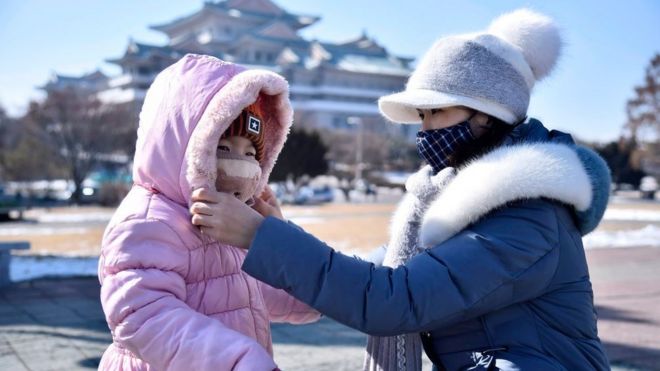
Image copyright GETTY IMAGESImage caption North Korea says not a single person has the virus
North Korea’s claim that “not a single person” in the country has been infected with the coronavirus is facing growing scepticism.
It has credited strict containment measures and the shutting down of its borders for this success.
But the top US military commander in South Korea has said this is “untrue”, calling it an “impossible claim”.
A North Korean expert told the BBC it was likely there were cases but unlikely a mass outbreak had happened.
There are currently more than one million coronavirus cases across the world and 53,069 deaths, according to a Johns Hopkins University tally.
Pak Myong-su, a director at North Korea’s Central Emergency Anti-epidemic headquarters, told news agency AFP on Friday: “Not one single person has been infected with the novel coronavirus in our country so far.”
“We have carried out pre-emptive and scientific measures such as inspections and quarantine for all personnel entering our country and thoroughly disinfecting all goods, as well as closing borders and blocking sea and air lanes.”
Could this be true?
US General Robert Abrams, head of the US military forces in South Korea, has said it is untrue that North Korea has no virus cases.
“I can tell you that is an impossible claim based on all of the intel that we have seen,” he said in a joint interview with news sites CNN and VOA.
However, he said he could not say exactly how many cases there were, not confirm where the information came from.
Oliver Hotham, managing editor of specialist news site NK News, agreed that North Korea has probably had cases.
“It’s very unlikely that it has seen no cases because it borders China and South Korea. [Especially with China], given the amount of cross border trade and the economic relationship I really don’t see how its possible they could have prevented it,” he said.
However, he adds that it is “unlikely” there is a full scale outbreak.
“They really did take precautions early. I think it’s possible they’ve prevented a full on outbreak.”
How has North Korea reacted to the crisis?
North Korea has indeed moved much more quickly against the virus than many other countries in the region.
In late January, it sealed off its borders and later quarantined hundreds of foreigners in the capital Pyongyang. During that time, the number of cases in China were growing exponentially.
An NK News report also suggests that up to 10,000 citizens had been placed under isolation in the country – around 500 still remain in quarantine.
Are those in North Korea even aware of the virus?
Most people in North Korea are “really aware” of what’s going on, says Mr Hotham.
“There’s been so much media coverage. Almost every day you have a whole page about the efforts the country is taking domestically and also the international situation,” he told the BBC.
Fyodor Tertitskiy, a senior researcher at Kookmin University, also adds the country is currently running an “ongoing propaganda campaign teaching people how to prevent the spread of the virus”.
The answer is, according to experts – better than you would think – depending on where in North Korea you are.
Mr Tertitsky says the North’s healthcare system is “much, much better than other countries with a similar GDP per capita”.
“What they did was to train a large number of doctors who, although less qualified and infinitely paid less than their colleagues in the West, can still provide basic healthcare to the population,” he told the BBC.
Mr Hotham agrees, but says that the number of doctors in North Korea enables the country to deal with basic illnesses, but perhaps not so much more serious illnesses which also need more healthcare equipment.
Sanctions have also restricted North Korea’s ability to obtain advanced medical equipment.
Mr Hotham adds that the care you receive largely depends on where you are. The capital, Pyongyang, for example, has various medical facilities, but those in rural areas might not be so lucky.
“Some provinces are desperately underfunded, where you’ll have hospitals with no running water or stable power.”
Image copyright GETTY IMAGESImage caption Some international experts say North Korea’s health system is appalling
Why might North Korea be trying to cover up cases?
For North Korea to admit they have cases now could be a sign of “defeat”.
“The state has put a lot of stock into its response and there has been so much propaganda about how well they’re doing,” said Mr Hotham.
“I think for them to admit now that there were cases is essentially to admit defeat. I think it would also cause panic and people would freak out. If you have large movements of people trying to get away, that could create instability and even more infections.”
Mr Tertitskiy also puts this down to North Korea trying to preserve its self-image.
“The country is very paranoid about giving away any information that may make it look bad. Their basic rule is to say nothing unless there is a good reason to do otherwise.”
In the Chinese city of Wuhan, where the virus emerged, the authorities earlier announced that some non-residents would be allowed to leave if they showed no symptoms of the virus.
However, local officials now say that order was made without authorisation and has been revoked.
The city has been in lockdown since January 23, with authorities cutting off transport links in and out of the city.
More than 2,500 people have died from the virus in mainland China, with some 77,150 cases confirmed cases reported.
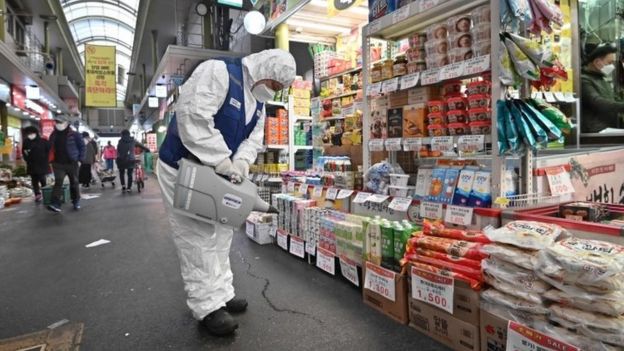
Image copyright AFPImage caption A worker sprays disinfectant to help prevent the spread of the novel coronavirus at a market in Seoul
What is the situation in North Korea?
North Korea has not confirmed any cases but the country shares a long and often porous border with China. There are concerns that North Korea, which is subject to international sanctions, lacks the health infrastructure to test and treat those infected and that any outbreak could quickly spread unchecked.
At the moment, all foreigners coming into the country must be quarantined for 30 days.
There are relatively few foreigners in North Korea, and only around 200 Westerners, according to one expert.
North Korean authorities have also cancelled the annual Pyongyang marathon, which typically sees people from all over the world participating.
Around 3,000 people in North Pyongan province – a north-western region bordering China – are also now under monitoring for reportedly showing suspected symptoms, said state media.
What about South Korea?
Media caption People in Daegu have voiced concern over the spread of the virus
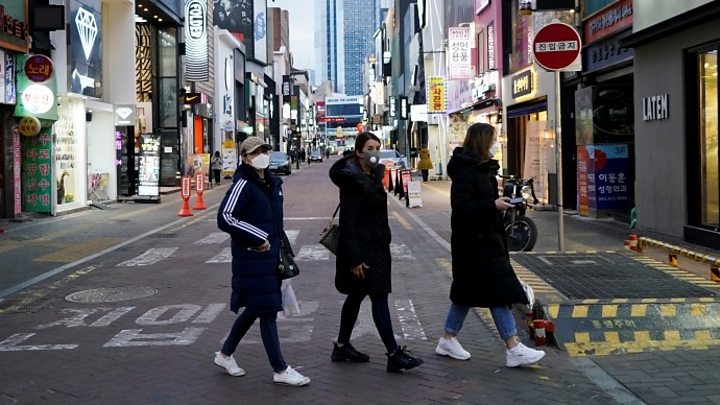
South Korea has the largest number of confirmed cases outside China, after a huge spike in the past week.
Before last Wednesday, the country had recorded just 31 cases. That number has now jumped to 763.
Eight new cases of the virus have been reported in the army, and one in the navy, air force and marine corps – bringing the number to 11.
But the biggest virus clusters have been linked to a hospital and a religious group near the south-eastern city of Daegu.
A handful of South Korea airlines, including Korean Air Lines – the country’s biggest airline – has suspended flights going to Daegu, which has a population of around 2.5m.
Korean Air says the suspension will last until March 27
What’s happening in Italy?
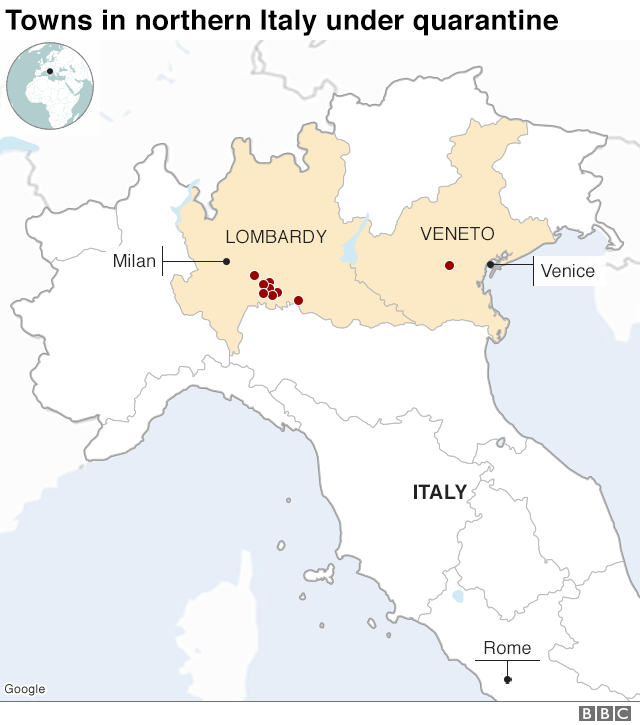
Italian officials have introduced sweeping measures to control what is now the worst outbreak of the coronavirus in Europe – at least three people have died and more than 150 cases confirmed.
In the regions of Lombardy and Veneto, a lock-down is in place in several small towns. For the next two weeks, 50,000 residents will not be able to leave without special permission.
Even outside the zone, many businesses and schools have suspended activities, and sporting events have been cancelled – including several top-flight football matches.
Officials have yet to find the first carrier of the virus in the country.
World edges closer to coronavirus pandemic
Analysis by Fergus Walsh, medical correspondent
The combined situation in South Korea, Iran and Italy points to the early stages of pandemic. This means a global outbreak, with the coronavirus spreading in the community in multiple parts of the world.
In each of these countries we are seeing spread of the virus with no connection to China. The lockdown efforts in Italy mirror those that have happened in China.
The situation in Iran is especially worrying, because the health authorities have reportedly said the virus has spread to multiple cities, and it appears the first case in Lebanon is linked to a traveller from Iran.
If we have a pandemic, it will still be important to limit the speed of spread of the virus.
If countries could hold it somewhat at bay until the end of winter, there is a hope that warmer temperatures will reduce the time the virus can survive in the air, as we see with seasonal flu. But this may not be certain.
What’s the latest from Iran?
Iran said on Sunday it had 43 confirmed cases of the virus, most of them in the holy city of Qom. Eight of those infected have died, the highest number of deaths outside China.
Iraq, Pakistan, Armenia and Turkey have closed their borders with Iran, and Afghanistan has suspended air and road travel to and from Iran.
What about China, where the outbreak started?
China’s President Xi Jinping has described the outbreak as the “largest public health emergency” in the country’s recent history.
Speaking on Sunday, he acknowledged “shortcomings” in China’s response and said lessons must be learned.
China reported 409 new infections on Monday, the bulk of which were from Wuhan.
But outside China, cases with no clear link to that country or other confirmed cases continue to rise, prompting concern from the World Health Organization (WHO).
Summit between Chinese, South Korean and Japanese leaders could yield results for future of Korean peninsula, analyst says
North Korea has promised an unwelcome “Christmas present” if the US does not show the “right attitude” for talks. Photo: KCNA
Chinese President Xi Jinping has again stressed the need for tensions on the Korean peninsula to be resolved through dialogue, as the deadline looms in North Korea’s threat to give the United States an unwelcome “Christmas gift”
.
With just over a week to go until Pyongyang’s year-end deadline for Washington to change what it says a policy of hostility, Xi held separate talks with South Korean President Moon Jae-in and Japanese Prime Minister Shinzo Abe in Beijing on Monday.
Moon and Abe will also join Chinese Premier Li Keqiang for a trilateral summit in Chengdu, Sichuan province, on Tuesday.
The first trilateral leadership talks took place in 2008, but were not held in 2013 and 2014, or in 2016 and 2017.
Xi said China and South Korea “both insist on maintaining peace and stability on the peninsula, and advocate solving problems through dialogue and consultation”, state news agency Xinhua reported on Monday.
“China supports South Korea in continuing to improve its relationship with
and injecting impetus for the Korean peninsula peace talks,” the report said.
Moon said the suspension of talks between the US and North Korea and heightened tensions along the peninsula “are not beneficial to both our countries and North Korea”, according to South Korean news agency Yonhap.
Moon also said that China had played an “important role” in efforts for the denuclearise the peninsula, the report said.
North Korea has signalled impatience over the stalled talks with the US, and the fading hopes for an end to Washington’s economic sanctions.
In April, North Korean leader Kim Jong-un said that he would “wait” until the end of the year to decide whether the US had the “right attitude” to allow a resumption of negotiations, but no signs of further talks have emerged.
Then earlier this month Pyongyang warned that Washington would receive a “Christmas gift”, and US actions would determine whether the present would be good or bad.
In an apparent sign of frustration with the US, North Korean news agency KCNA reported on Sunday that Kim held a meeting of the Workers’ Party of Korea to “bolster the overall armed forces of the country” to deal with the “the fast-changing situation”.
The US imposed crippling sanctions on North Korea’s economy in 2017, though many countries, including China, South Korea and Japan, have also tightened measures against the North.
South Korea and Japan both scaled back people-to-people links in 2016, China banned coal exports to the North in 2017. Earlier this year, Trump thanked China and Russia for maintaining sanctions against Pyongyang.
As diplomats make last-ditch attempts to stop renewed confrontation, US special envoy for North Korea Stephen Biegun shuttled around the region last week, meeting senior officials in China, South Korea and Japan. Biegun urged North Korea to return to negotiations, and said the US “does not have a deadline” for talks.
China and Russia also proposed last week that the United Nations Security Council
Xi’s meeting with Moon also comes as Beijing tries to mend ties with Seoul to prevent neighbouring nations from getting closer to Washington.
Relations between China and South Korea deteriorated in 2017 after Seoul deployed a US-led missile defence system known as THAAD, which Beijing deemed as a security threat to its own territory.
On Monday, both Xi and Moon said in their meeting that they looked forward to improving relations between their countries.
“We have been friends and partners that have continued close cooperation,” Xi said. “We have a wide range of common understandings in various fields, including on further developing bilateral relations, facilitating regional peace, stability and prosperity, and defending multilateralism and a free trade system.”
Sun Xingjie, a North Korea specialist at Jilin University, said the US signal was “very clear” in Beigun’s comments.
“They still want to continue discussions,” he said.
Sun also said the talks in Chengdu on Tuesday would likely play an important role in the future of resolving problems on the Korean peninsula.
“After returning to the platform these last couple years, I believe this will become an important, normalised place for discussions. Whatever problems they run into, the platform should continue to move forward,” Sun said.
BEIJING (Reuters) – The spectre of new confrontation between Pyongyang and Washington hangs over meetings between China, Japan and South Korea this week, with growing risks North Korean actions could end an uneasy detente and upend recent diplomatic efforts.
South Korean President Moon Jae-in and Japanese Prime Minister Shinzo Abe are expected to meet Chinese President Xi Jinping separately on Monday. They will then travel to the southwestern city of Chengdu for a trilateral meeting with Chinese Premier Li Keqiang. Though they are expected to discuss various economic matters, North Korea appears likely to dominate the agenda.
Pyongyang has grown increasingly frustrated that its halt of nuclear and long-range missile tests has not ended the crippling economic sanctions against it. It set a Dec. 31 deadline for the United States to make concessions, but Washington has been unmoved.
Some experts believe North Korea may be readying to test an intercontinental ballistic missile launch soon, which would likely end the 2018 agreement struck by its leader, Kim Jong Un, and U.S. President Donald Trump.
“Safeguarding the stability and peace of the Korean Peninsula and pushing for a political solution to the Korean Peninsula issue are in the interests of China, Japan and South Korea,” Chinese Vice Foreign Minister Luo Zhaohui told reporters on Thursday at a briefing on the trilateral meetings.
U.S. special envoy for North Korea Stephen Biegun met with two senior Chinese diplomats during his two-day visit to Beijing this week, following similar meeting in South Korea and Japan days earlier, as diplomats make last-ditch attempts to prevent new confrontation.
North Korea has not responded to his public call to resume dialogue, however.
“The silence, even after Biegun’s speech in Seoul, makes me concerned,” Jenny Town, managing editor at the North Korea monitoring website 38 North, said on Twitter.
Beijing, jointly with Russia, proposed on Monday that the United Nations Security Council lift some sanctions in what it calls an attempt to break the current deadlock and seeks to build support. But it’s unclear whether Beijing can convince Seoul and Tokyo to break ranks from Washington, which has made its opposition clear and can veto any resolution.
Though South Korea sees China as instrumental in reviving negotiations, it has so far sidestepped questions on whether it supports the new proposal by Beijing and Moscow. Japan, which has historically been a staunch supporter of sanctions against North Korea, has also refrained from commenting on the proposal.
“With the (2020 Tokyo) Olympics coming up, North Korea going wild would pose a problem for Japan,” said Narushige Michishita, professor at Japan’s National Graduate Institute for Policy Studies.
“But bilateral talks with North Korea, for example, will probably be a better approach for Japan than easing UN sanctions.”
Leaders exchange congratulatory messages on 70th anniversary of diplomatic relations amid speculation that Kim Jong-un will visit China soon
It comes after Pyongyang’s denuclearisation negotiations with Washington broke off in Stockholm without any breakthroughs
North Korean leader Kim Jong-un (left) may soon visit China again. He last met Xi Jinping during the Chinese leader’s trip to Pyongyang in June. Photo: AFP
China and North Korea on Sunday vowed to continue strengthening their ties that have “stood the test of time”, hours after another squabble broke out between Pyongyang and Washington over the breakdown of their first nuclear talks in eight months.
Chinese President Xi Jinping exchanged congratulatory messages with North Korean leader Kim Jong-un on the 70th anniversary of diplomatic ties, according to state media in both countries, amid speculation that Kim will soon pay another visit to China.
Observers said the communist neighbours’ warm exchanges and Kim’s possible visit showed Beijing and Pyongyang shared mutual interests and needed each other in their respective geopolitical plans to counter Washington – especially as they both come under pressure from US President Donald Trump.
The two countries are said to be preparing for Kim to visit China as early as Sunday, which would be his fifth China trip since March last year and the first since Xi’s state visit to Pyongyang in June.
But given Pyongyang’s denuclearisation negotiations with Washington on Saturday – which broke off in Stockholm without any breakthroughs – China and North Korea may need to reconsider or delay Kim’s visit to avoid criticism of Beijing’s role in the nuclear talks, one expert suggested.
“The triangular ties between China, the United States and North Korea are of immense importance in finding a solution to the nuclear issue on the Korean peninsula and Beijing’s role in the talks has always been sensitive, especially in the eyes of the US and its allies,” said Wang Sheng, a North Korea specialist at Jilin University.
“While China will almost certainly reiterate its stance to support continued dialogue and talks between Pyongyang and Washington, it may not be a good time for Kim’s high-profile visit just a day after their talks broke down, which would inevitably make it more difficult for China to play a mediating role,” he said.
On Sunday, Xi said the traditional friendship between the two countries had “stood the test of time and changes in the international landscape, growing stronger with the passage of time” and “made important and positive contributions to regional peace and stability”, according to Chinese state news agency Xinhua.
Citing his five recent meetings with Kim, Xi said bilateral ties had entered a new era and China would promote “long-term, healthy and stable” relations with North Korea.
Kim also hailed the special relationship between the two countries, which he said had been forged “at the cost of blood” and “weathered all tempests while sharing weal and woe with each other”, the Korean Central News Agency reported.
North Korean mouthpiece Rodong Sinmun meanwhile said in a commentary that bilateral ties with Beijing were “fully in accordance” with the interests of the two sides and would develop “regardless of the international situation”, according to South Korea’s Yonhap news agency.
The lavish praise for Sino-North Korean relations comes as a group of working-level officials from North Korea are working with the Chinese side for a possible visit by Kim in the next few days, according to South Korea’s Dong-A Ilbo.
China and North Korea have set aside their differences as both countries come under pressure from US President Donald Trump. Photo: AFP
North Korea was among the first countries to recognise the People’s Republic of China
70 years ago and Xi has exchanged three messages with Kim in the past month, repeatedly pledging to move closer despite lingering grievances over Pyongyang’s nuclear brinkmanship.
In the face of Trump’s increasingly antagonistic approach, the former communist allies – whose relationship deteriorated over Beijing’s support for the UN sanctions against the North, led by Washington – have set aside their differences to patch up ties in recent months.
Meanwhile, Pyongyang’s first nuclear talks with Washington in eight months ended on Saturday with the two sides offering conflicting assessments of their first formal discussion since the failed Trump-Kim summit in Vietnam in February.
North Korea’s top negotiator Kim Myong-gil expressed his “great displeasure” with the discussions, blaming Washington and urging the Trump administration to correct its course and keep the talks alive or “forever close the door to dialogue”, according to Yonhap.
North Korean negotiator Kim Myong-gil expressed his “great displeasure” with the discussions on Saturday. Photo: AP
But the US State Department issued a rebuke hours later, claiming the negotiators had a “good discussion”. State Department spokeswoman Morgan Ortagus said in a statement that the US had put forward “creative ideas” and “a number of new initiatives that would allow us to make progress in each of the four pillars of the Singapore joint statement”.
The two countries were not expected to “overcome a legacy of 70 years of war and hostility on the Korean peninsula through the course of a single Saturday”, she said, adding that Washington would return for more discussions with Pyongyang in two weeks at Sweden’s invitation.
As Trump administration enters survival mode, foreign policy moves are anyone’s guess
Wang from Jilin University said the breakdown of another round of talks had again laid bare the huge gap between the two sides over a long list of issues, from the definition of denuclearisation to their vastly different, often conflicting, demands and interests.
“It’s very likely that Washington has again rejected some of Pyongyang’s key demands in the recent talks, such as providing a security guarantee for Kim’s regime and a range of economic sanctions relief,” he said.
And with North Korea a polarising issue in the looming US presidential poll for Trump as he seeks to score diplomatic points for his re-election bid, it might become even more challenging for the two sides to narrow their differences.
“The breakdown of the talks should not be seen as a failure,” Wang said. “It simply underscores the difficulty of reaching any consensus in the nuclear talks, which still have a long way to go.”
BEIJING, Oct. 2 (Xinhua) — China on Wednesday said it welcomes the statements of the Democratic People’s Republic of Korea (DPRK) and the United States to resume dialogue and hopes the two sides will grasp the opportunity to strive for positive outcomes.
Foreign Ministry spokesperson Hua Chunying made the comments in a press statement issued Wednesday night.
“We have noticed the statements made by both the DPRK and the United States on resuming contact and dialogue. We welcome that,” said Hua.
China has always supported the DPRK-U.S. dialogue and a political settlement of the Korean Peninsula issue, said Hua.
“Under current circumstances, we hope both the DPRK and the United States will grasp the opportunity and meet each other halfway to achieve positive results from the dialogue,” she said.
DPRK First Vice Foreign Minister Choe Son Hui said in a statement on Tuesday that Pyongyang and Washington have agreed to have preliminary contact on Oct. 4 and hold working-level talks on Oct. 5. It is said the U.S. has confirmed this.
The denuclearization talks between Pyongyang and Washington have hit a stalemate since the second summit between top DPRK leader Kim Jong Un and U.S. President Donald Trump in Hanoi in February ended without any agreement.
TOKYO (Reuters) – China’s growing military might has replaced North Korean belligerence as the main security threat to Japan, Tokyo’s annual defence review indicated on Thursday, despite signs that Pyongyang could have nuclear-tipped ballistic missiles.
The document’s security assessment on China comes after a section on Japan’s ally, the United States, the first time Beijing has achieved second place in the Defence White Paper and pushing North Korea into third position.
Russia, deemed by Japan as its primary threat during the Cold War, was in fourth place.
“The reality is that China is rapidly increasing military spending, and so people can grasp that we need more pages,” Defence Minister Taro Kono said at a media briefing.
“China is deploying air and sea assets in the Western Pacific and through the Tsushima Strait into the Sea of Japan with greater frequency.”
China’s Foreign Ministry expressed displeasure with the report.
China will not accept Japan’s “groundless criticism” of its normal national defence and military activities, spokesman Geng Shuang said at a press briefing in Beijing.
Japan has raised defence spending by a tenth over the past seven years to counter military advances by Beijing and Pyongyang, including defences against North Korean missiles which may carry nuclear warheads, the paper said.
North Korea has conducted short-range missile launches this year that Tokyo believes show Pyongyang is developing projectiles to evade its Aegis ballistic missile defences.
To stay ahead of China’s modernising military, Japan is buying U.S.-made stealth fighters and other advanced weapons.
In its latest budget request, Japan’s military asked for 115.6 billion yen ($1.1 billion) to buy nine Lockheed Martin (LMT.N) F-35 stealth fighters, including six short take-off and vertical landing (STOVL) variants to operate from converted helicopter carriers.
The stealth jets, U.S.-made interceptor missiles and other equipment are part of a proposed 1.2% increase in defence spending to a record 5.32 trillion yen in the year starting April 1.
By comparison, Chinese military spending is set to rise this year by 7.5% to about $177 billion from 2018, more than three times that of Japan. Beijing is developing weapons such as stealth fighters and aircraft carriers that are helping it expand the range and scope of military operations.
Once largely confined to operating close to the Chinese coast, Beijing now routinely sends its air and sea patrols near Japan’s western Okinawa islands and into the Western Pacific.
China has frequently rebuffed concerns about its military spending and intentions, including an increased presence in the disputed South China Sea, and says it only desires peaceful development.
The Defence White Paper said Chinese patrols in waters and skies near Japanese territory are “a national security concern”.
The paper downgraded fellow U.S. ally, South Korea, which recently pulled out of an intelligence sharing pact with Japan amid a dispute over their shared wartime history. That could weaken efforts to contain North Korean threats, analysts said.
Other allies, including Australia, the Association of Southeast Asian Nations (ASEAN) and India, feature more prominently in the defence paper.
South Korean government officials took issue with the White Paper’s reference to ownership of an island in the Sea of Japan that is also claimed and controlled by South Korea. The outcrop is known as Dokdo in Seoul and Takeshima in Tokyo.
“Our government strongly protests Japan’s repeated claim. The Japanese government should acknowledge that it is not helpful for bilateral relations,” South Korea’s foreign ministry said.
Stalled denuclearisation talks also expected to be on the agenda when Chinese president meets Kim Jong-un this week
Analysts say Korean peninsula has become intense diplomatic battleground between Beijing and Washington
North Korean leader Kim Jong-un (right) attends a welcome ceremony in Beijing with Chinese President Xi Jinping in January. Xi will begin a visit to Pyongyang on Thursday. Photo: AP
will be a state visit – a higher status than the last trip to the hermit kingdom by a Chinese president, highlighting the close bilateral ties between Beijing and Pyongyang.
, is the first by a Chinese president to North Korea in 14 years and comes just a week before he is due to meet US President Donald Trump for talks on the sidelines of the Group of 20 summit in Japan.
“Leaders of the two countries will review the development of the bilateral relationship and carry out an in-depth exchange of opinions on the development of Sino-North Korean relations in the new era, and chart the future course of development,” state news agency Xinhua reported on Tuesday.
Xi’s predecessor, Hu Jintao, went to North Korea in October 2005 on a three-day trip described as an “official goodwill” visit.
Speaking at a regular press briefing in Beijing on Tuesday, foreign ministry spokesman Lu Kang said Xi’s visit aimed to “inject new impetus” into relations in the year the two countries marked the 70th anniversary of establishing diplomatic ties, and to give stalled denuclearisation talks a much needed push.
“Regarding the progress on denuclearisation, as I said, the result of the Hanoi leaders’ meeting in February was indeed a little unexpected. But after that, everyone actually looks forward to the resumption of dialogue in a good direction,” Lu said, referring to the failed talks between Trump and North Korean leader Kim Jong-un in the Vietnamese capital four months ago.
Trump hinted at the possibility of another meeting with Kim after receiving what he called “a beautiful letter” from the North Korean leader last week. On Tuesday, South Korea’s chief nuclear negotiator, Lee Do-hoon, said the US had been in contact with the North.
Life in North Korea the ‘admiration and envy’ of others, state media says
Washington will also send US Special Representative for North Korea Stephen Biegun to South Korea next week, days after Xi’s visit to Pyongyang, to fully align its position on North Korea with its ally.
Meanwhile, Trump confirmed he would meet Xi for talks in Osaka next week, saying in a tweet on Tuesday they had “a very good telephone conversation” and would hold “an extended meeting” at the G20 summit, where they are
Had a very good telephone conversation with President Xi of China. We will be having an extended meeting next week at the G-20 in Japan. Our respective teams will begin talks prior to our meeting.
Analysts said the Korean peninsula had become an intense diplomatic battleground between Beijing and Washington.
Cha Du-hyeogn, a visiting research fellow at the Asan Institute for Policy Studies in Seoul, said China and the US were competing for influence over the peninsula.
“The US and China are seeking a greater sphere of influence in the region. After the Singapore summit between Trump and Kim last year, the US and North Korea are the only key players on peninsula matters. China may want to restore its influence and become a major player,” Cha said.
“But China is less likely to have a so-called strategic competition with the US – that is to say, it won’t challenge the US-led sanctions regime and its goal in achieving North Korea’s denuclearisation. In fact, it is likely to persuade Kim to come to the negotiating table for complete denuclearisation.”
Chinese tourists flood North Korea as Beijing remains Pyongyang’s key ally
Pyongyang has demanded the lifting of sanctions imposed on the regime following its nuclear and missile tests, while Beijing has said the livelihoods of North Koreans should not be affected. But Washington insists full sanctions should remain in place.
The US has also voiced scepticism about Chinese compliance with the sanctions. At a security summit in Singapore earlier this month, US acting Pentagon chief Patrick Shanahan – who on Wednesday stepped down from his role
– presented his Chinese counterpart Wei Fenghe with photographs and satellite images of North Korean ships transferring oil near China’s coast.
Analysts said Xi would seek to use the visit to boost China’s diplomatic leverage on the North Korean nuclear front, strengthening its hand in dealing with the US.
Exports from North Korea to China, which account for the bulk of its trade, plunged 87 per cent last year from 2017, and the country has faced other economic problems at a time when Kim has vowed to deliver on the economy.
A diplomatic source said China was expected to offer a large amount of humanitarian assistance, such as food and fertiliser, to North Korea, which could weaken the impact of sanctions.
China’s goal of denuclearisation on the Korean peninsula is unwavering and will not changeLu Chao, North Korean affairs expert at Liaoning Academy of Social Sciences
Communist Party mouthpiece People’s Daily on Tuesday said via its social media account that Xi would discuss economic and trade cooperation with Kim during the visit.
Quoting Zheng Jiyong, director of the Centre for Korean Studies at Fudan University in Shanghai, the newspaper said Pyongyang had taken steps to reform its economy and introduced China’s industrial manufacturing blueprint.
In September, Beijing proposed building a rail link from the city of Dandong, in China’s northeastern Liaoning province, to Pyongyang and then on to Seoul and Busan in the South, as well as a new road between Dandong and Pyongyang through Sinuiju.
Lu Chao, a North Korean affairs expert at the Liaoning Academy of Social Sciences, said large-scale economic cooperation between China and North Korea was unlikely because of the sanctions, but smaller moves were possible.
Chinese tourists flood North Korea as Beijing remains Pyongyang’s key ally
“For example, China may export daily necessities to North Korea. And if it’s needed, China is very likely to provide [food] assistance to North Korea,” Lu said. “I believe the UN sanctions on North Korea should change, because it has shown a more substantive approach to [achieving] denuclearisation.”
But analysts said Beijing remained firm on the need for Pyongyang to honour its pledges so that denuclearisation could be achieved.
“China’s goal of denuclearisation on the Korean peninsula is unwavering and will not change … China supports [North Korea] and the US continuing to hold talks,” Lu said.
Beijing also had an important part to play in the peace process, according to Boo Seung-chan, an adjunct professor at the Yonsei Institute for North Korean Studies in Seoul.
“China can have a positive role as a mediator to facilitate the peace process on the Korean peninsula,” Boo said.


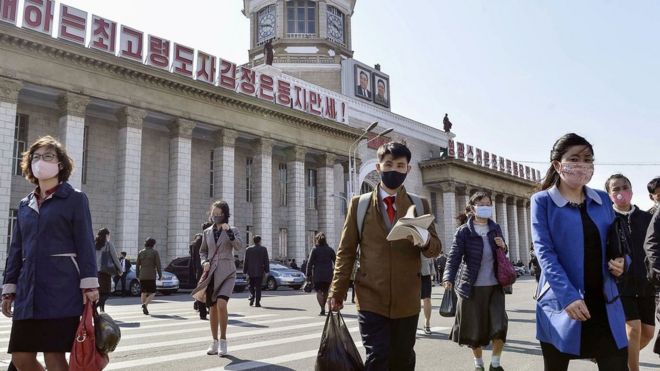 Image copyright REUTERS
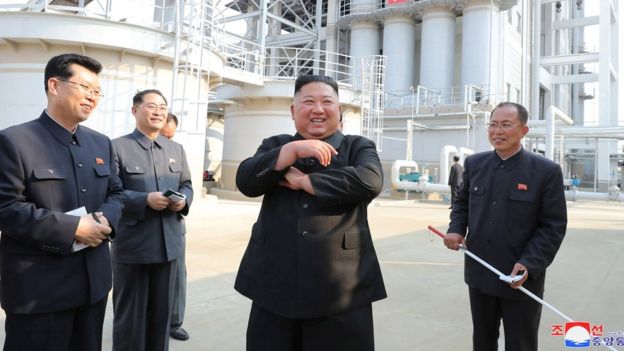 Image copyright REUTERS









 CHINDIA ALERT: You'll be living in their world, very soon
South Korea, China cast doubt on reports North Korean leader Kim gravely ill
SEOUL (Reuters) – South Korean and Chinese officials on Tuesday cast doubt on reports North Korean leader Kim Jong Un was ill after media outlets said he had undergone a cardiovascular procedure and was in “grave danger”.
Daily NK, a Seoul-based speciality website, reported late on Monday, citing one unnamed source in North Korea, that Kim was recovering after undergoing the procedure on April 12. The North Korean leader is believed to be about 36.
CNN cited a U.S. official with direct knowledge of the matter as saying Washington was “monitoring intelligence” that Kim was in grave danger after surgery. Bloomberg quoted an unnamed U.S. official as saying the White House was told that Kim took a turn for the worse after the surgery.
However, two South Korean government officials rejected the CNN report without elaborating on whether Kim had undergone surgery. The presidential Blue House said there were no unusual signs coming from the reclusive, nuclear-capable state.
Kim is the unquestioned leader of North Korea and the sole commander of its nuclear arsenal. He has no clear successor and any instability in the country could be a major international risk.
RELATED COVERAGE
The state KCNA news agency gave no indication of the whereabouts of Kim in routine dispatches on Tuesday, but said he had sent birthday gifts to prominent citizens.
An official at the Chinese Communist Party’s International Liaison Department, which deals with North Korea, told Reuters the source did not believe Kim was critically ill. China is North Korea’s only major ally.
Chinese foreign ministry spokesman Geng Shuang said Beijing was aware of reports about the health of Kim, but said it does not know their source, without commenting on whether it has any information about the situation.
South Korean shares exposed to North Korea tumbled and the Korean won fell on the reports. The won traded down more than 1% against the dollar even as South Korean government sources said Kim was not gravely ill.
U.S. stock futures were trading 0.5% lower, but it was not clear how much of that weakness was owing to the collapse in U.S. oil prices and consequent concerns over global demand.
Daily NK said Kim had been admitted to hospital on April 12, just hours before the cardiovascular procedure, as his health had deteriorated since August due to heavy smoking, obesity and overwork.
It said he was now receiving treatment at a villa in the Mount Myohyang resort north of the capital Pyongyang.
“My understanding is that he had been struggling (with cardiovascular problems) since last August but it worsened after repeated visits to Mount Paektu,” a source was quoted as saying, referring to the country’s sacred mountain.
Accompanied by senior North Korean figures, Kim took two well-publicised rides on a stallion on the snowy slopes of the mountain in October and December.
KIM’S HEALTH KEY TO STABILITY
An authoritative U.S. source familiar with internal U.S. government reporting on North Korea questioned the CNN report that Kim was in “grave danger”.
“Any credible direct reporting having to do with Kim would be highly compartmented intelligence and unlikely to leak to the media,” a Korea specialist working for the U.S. government said on condition of anonymity.
Japan’s top government spokesman, Yoshihide Suga, declined to comment on the reports of Kim’s health.
“We are regularly gathering and analysing information about North Korea with great concern,” he said. “We will keep gathering and analysing information regarding North Korea by collaborating with other countries such as the U.S.”
Kim’s potential health issues could fuel uncertainty over the future of the reclusive state’s dynastic rule and stalled denuclearisation talks with the United States, issues in which Kim wields absolute authority.
With no details known about his young children, analysts say his sister and loyalists could form a regency until a successor is old enough to take over.
Speculation about Kim’s health first arose following his absence from the anniversary of the birthday of its founding father and Kim’s grandfather, Kim Il Sung, on April 15.
On April 12, North Korean state media reported that Kim Jong Un had visited an airbase and observed drills by fighter jets and attack aircraft.
Two days later North Korea launched multiple short-range anti-ship cruise missiles into the sea and Sukhoi jets fired air-to-surface missiles as part of military exercises.
The missile launches were part of the celebrations for Kim’s grandfather, Seoul officials said, but there was no North Korea state media report on his attendance or the tests.
Reporting from inside North Korea is notoriously difficult, especially on matters concerning the country’s leadership, given tight controls on information. There have been false and conflicting reports in the past on matters related to its leaders.
Kim is a third-generation hereditary leader who rules North Korea with an iron-fist, taking over the titles of head of state and commander in chief of the military since late 2011.
In recent years Kim has launched a diplomatic offensive to promote both himself as a world leader and his hermit kingdom, holding three meetings with U.S. President Donald Trump, four with South Korean President Moon Jae-in and five with China’s President Xi Jinping.
He was the first North Korean leader to cross the border into South Korea to meet Moon in 2018. Both Koreas are technically still at war, as the Korean War of 1950-53 ended in an armistice, not a peace treaty.
Kim has sought to have international sanctions against his country eased, but has refused to dismantle his nuclear weapons programme, a steadfast demand by the United States.
Source: Reuters
Posted in 1950-53, 2018, 36, about, absence, absolute, accompanied, admitted, after, air-to-surface missiles, airbase, ally, analysts, anniversary, anonymity, anti-ship, April, armistice, arose, attack aircraft, attendance, August, authoritative, authority, aware, “grave danger”, “monitoring intelligence”, before, Beijing, believed, Birthday, birthday gifts, Bloomberg, Blue House, border, capital, cardiovascular, cardiovascular problems, cast, celebrations, China, China's President Xi Jinping, China’s, Chinese Communist Party’s International Liaison Department, chinese foreign ministry spokesman, Chinese officials, cited, citing, Citizens, clear, CNN, collaborating, collapse, coming from, commander-in-chief, comment, commenting, compartmented, concerning, concerns, condition, conflicting, consequent, controls, Country, country’s, critically ill, cross, Daily NK, deals, December, declined, demand, denuclearisation, details, deteriorated, difficult, diplomatic offensive, Direct, dismantle, dollar, doubt, drills, dynastic rule, eased, elaborating, enough, especially, exposed, false, fighter jets, fired, first, five, following, founding father, four, future, given, global demand, government officials, government spokesman, grandfather, gravely, head of state, health, heavy smoking, hereditary, hermit kingdom, himself, Hospital, hours, ill, indication, information, Instability, intelligence, international, international risk, iron-fist, issues, Japan’s, KCNA news agency, Kim, Kim Il Sung, Kim Jong Un, knowledge, Korean, Korean War, launched, leader, leadership, leak, lower, loyalists, Major, matter, matters, media, media outlets, meetings, Military, military exercises, Monday, Mount Myohyang, Mount Paektu, Mountain, multiple, North, North Korean leader, notoriously, nuclear arsenal, nuclear weapons, nuclear-capable, obesity, observed, October, Official, old, one, only, overwork, owing, part, peace treaty, President Moon Jae-in, presidential, procedure, programme, prominent, promote, Pyongyang, quoted, receiving, reclusive, recovering, refused, regency, rejected, repeated, report, reported, reports, Resort, Reuters, rides, routine dispatche, routine dispatches, rules, sacred mountain, sanctions, saying, sea, senior, sent, Seoul, shares, short-range, sister, situation, snowy slopes, sole commander, source, South Korea, South Korean, speciality, speculation, stalled, stallion, state, steadfast, still at war, struggling, succession, successor, Sukhoi jets, surgery, take over, taking, talks, technically, tests, Third-generation, Three, tight, titles, told, top, trading, treatment, Tuesday, tumbled, turn for the worse, two, U.S. official, U.S. oil prices, U.S. President Donald Trump, Uncategorized, uncertainty, undergoing, undergone, United States, unlikely, unnamed, unquestioned, unusual signs, urn for the worse, villa, visited, visits, Washington, weakness, website, well-publicised, whereabouts, whether, White House, wields, without, won, world leader, worsened, young children | Leave a Comment »