Chindia Alert: You’ll be Living in their World Very Soon
aims to alert you to the threats and opportunities that China and India present. China and India require serious attention; case of ‘hidden dragon and crouching tiger’.
Without this attention, governments, businesses and, indeed, individuals may find themselves at a great disadvantage sooner rather than later.
The POSTs (front webpages) are mainly 'cuttings' from reliable sources, updated continuously.
The PAGEs (see Tabs, above) attempt to make the information more meaningful by putting some structure to the information we have researched and assembled since 2006.
US President Donald Trump has described the coronavirus pandemic as the “worst attack” ever on the United States, pointing the finger at China.
Mr Trump said the outbreak had hit the US harder than the Japanese bombing of Pearl Harbor in World War Two, or the 9/11 attacks two decades ago.
His administration is weighing punitive actions against China over its early handling of the global emergency.
Beijing says the US wants to distract from its own response to the pandemic.
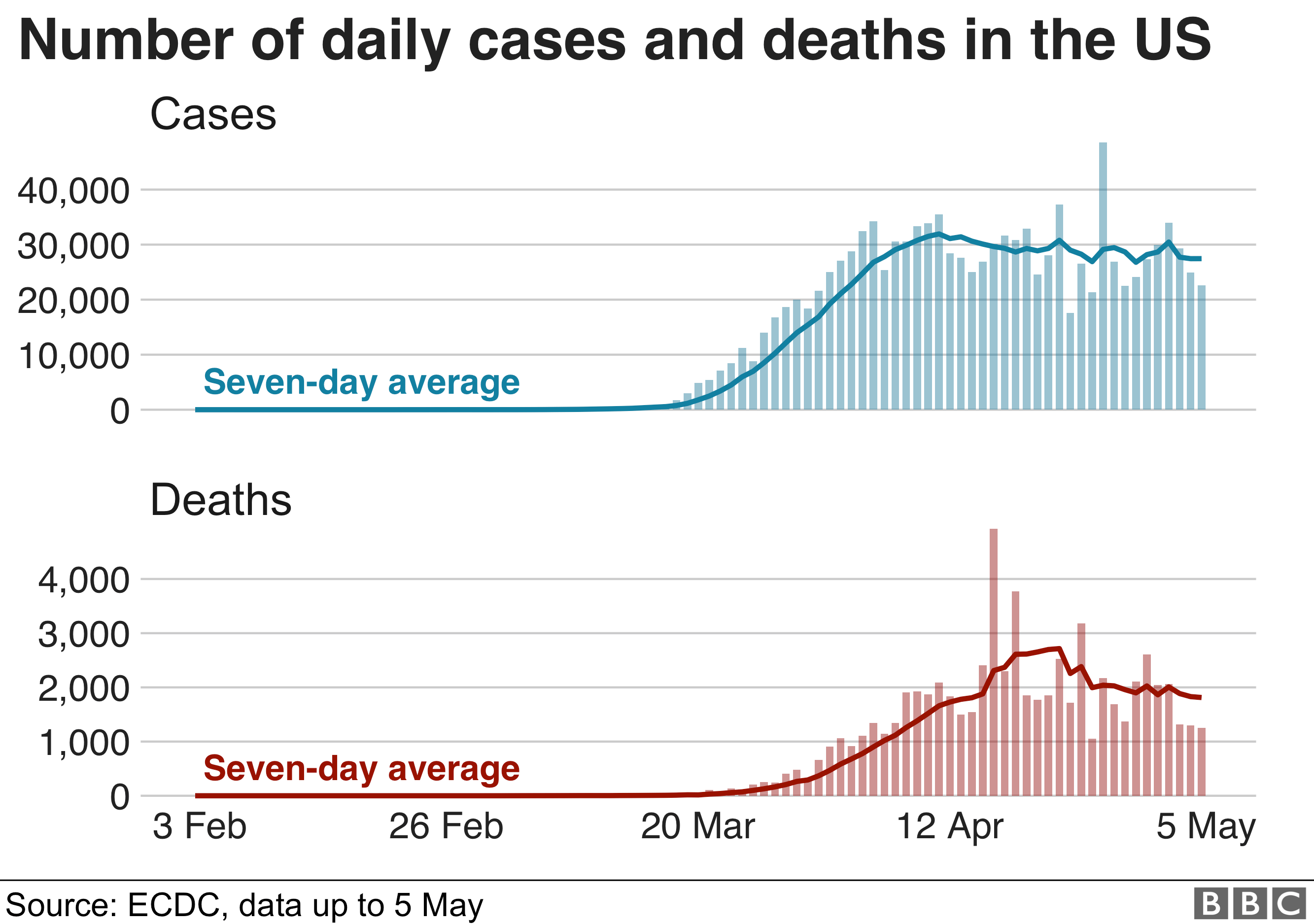
Since emerging in the Chinese city of Wuhan in December, the coronavirus is confirmed to have infected 1.2 million Americans, killing more than 73,000.
Speaking to reporters in the Oval Office of the White House on Wednesday, Mr Trump said: “We went through the worst attack we’ve ever had on our country, this is worst attack we’ve ever had.
“This is worse than Pearl Harbor, this is worse than the World Trade Center. There’s never been an attack like this.
“And it should have never happened. Could’ve been stopped at the source. Could’ve been stopped in China. It should’ve been stopped right at the source. And it wasn’t.”
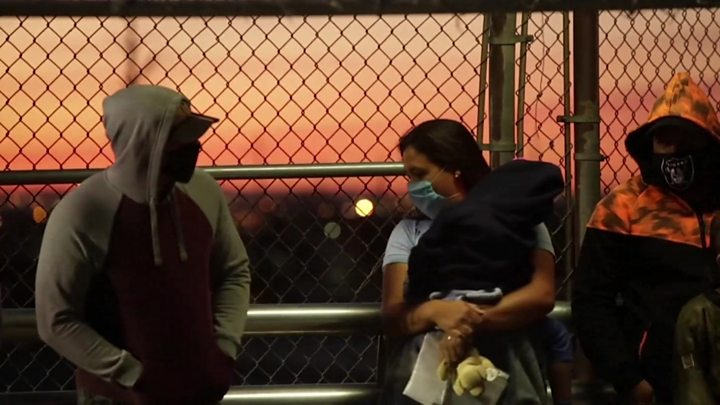
Media caption Life for asylum seekers in lockdown on the US-Mexico border
Asked later by a reporter if he saw the pandemic as an actual act of war, Mr Trump indicated the outbreak was America’s foe, rather than China.
“I view the invisible enemy [coronavirus] as a war,” he said. “I don’t like how it got here, because it could have been stopped, but no, I view the invisible enemy like a war.”
Media caption US shopping centres re-open: ‘This is the best day ever’
Who else in Trump’s team is criticising China?
The deepening rift between Washington and Beijing was further underscored on Wednesday as Secretary of State Mike Pompeo renewed his rhetoric against China, accusing it of covering up the outbreak.
He stuck by his so far unsubstantiated charge that there is “enormous evidence” the coronavirus hatched in a Chinese laboratory, even while acknowledging there is still uncertainty about its origins.
“Those statements are both true,” America’s top diplomat told the BBC. “We don’t have certainty and there is significant evidence that it came from a lab.”
One of the most trusted US public health experts has said the best evidence indicates the virus was not made in a lab.
Dr Anthony Fauci, a member of Mr Trump’s coronavirus task force, said on Monday the illness appeared to have “evolved in nature and then jumped species”.
Why is the US blaming China?
President Trump faces a tough re-election campaign in November, but the once humming US economy – which had been his main selling point – is currently in a coronavirus-induced coma.
As Mr Trump found his management of the crisis under scrutiny, he began labelling the outbreak “the China virus”, but dropped that term last month days before speaking by phone with Chinese President Xi Jinping.
Both Mr Trump and his likely Democratic challenger, Joe Biden, appear to be fastening on to China’s unpopularity as an election issue, with each accusing the other of being a patsy for America’s primary economic competitor.
As the coronavirus began spreading in the US back in January, Mr Trump signed phase one of a trade deal with China that called a truce in their tariff war. The US president’s hopes of sealing a more comprehensive phase two deal are now in limbo because of the pandemic.
WASHINGTON (Reuters) – President Donald Trump said on Wednesday he believes China’s handling of the coronavirus is proof that Beijing “will do anything they can” to make him lose his re-election bid in November.
In an interview with Reuters in the Oval Office, Trump talked tough on China and said he was looking at different options in terms of consequences for Beijing over the virus. “I can do a lot,” he said.
Trump has been heaping blame on China for a global pandemic that has killed at least 60,000 people in the United States according to a Reuters tally, and thrown the U.S. economy into a deep recession, putting in jeopardy his hopes for another four-year term.
The Republican president, often accused of not acting early enough to prepare the United States for the spread of the virus, said he believed China should have been more active in letting the world know about the coronavirus much sooner.
Asked whether he was considering the use of tariffs or even debt write-offs for China, Trump would not offer specifics. “There are many things I can do,” he said. “We’re looking for what happened.”
RELATED COVERAGE
China says it has no interest in meddling in U.S. election
“China will do anything they can to have me lose this race,” said Trump. He said he believes Beijing wants his Democratic opponent, Joe Biden, to win the race to ease the pressure Trump has placed on China over trade and other issues.
“They’re constantly using public relations to try to make it like they’re innocent parties,” he said of Chinese officials.
He said the trade deal that he concluded with Chinese President Xi Jinping aimed at reducing chronic U.S. trade deficits with China had been “upset very badly” by the economic fallout from the virus.
A senior Trump administration official, speaking on condition of anonymity, said on Wednesday that an informal “truce” in the war of words that Trump and Xi essentially agreed to in a phone call in late March now appeared to be over.
The two leaders had promised that their governments would do everything possible to cooperate to contain the coronavirus. In recent days, Washington and Beijing have traded increasingly bitter recriminations over the origin of the virus and the response to it.
However, Trump and his top aides, while stepping up their anti-China rhetoric, have stopped short of directly criticizing Xi, who the U.S. president has repeatedly called his “friend.”
Trump also said South Korea has agreed to pay the United States more money for a defense cooperation agreement but would not be drawn out on how much.
“We can make a deal. They want to make a deal,” Trump said. “They’ve agreed to pay a lot of money. They’re paying a lot more money than they did when I got here” in January 2017.
The United States stations roughly 28,500 troops in South Korea, a legacy of the 1950-53 Korean War that ended in an armistice, rather than a peace treaty.
Trump is leading a triage effort to try to keep the U.S. economy afloat through stimulus payments to individuals and companies while nudging state governors to carefully reopen their states as new infections decline.
Trump sounded wistful about the strong economy that he had enjoyed compared with now, when millions of people have lost their jobs and GDP is faltering.
“We were rocking before this happened. We had the greatest economy in history,” he said.
He said he is happy with the way many governors are operating under the strain of the virus but said some need to improve. He would not name names.
Trump’s handling of the virus has come under scrutiny. Forty-three percent of Americans approved of Trump’s handling of the coronavirus, according to the Reuters/Ipsos poll from April 27-28.
But there was some good coronavirus news, as Gilead Sciences Inc said its experimental antiviral drug remdesivir was showing progress in treating virus victims.
Trump has also seeking an accelerated timetable on development of a vaccine.
“I think things are moving along very nicely,” he said.
At the end of the half-hour interview, Trump offered lighthearted remarks about a newly released Navy video purportedly showing an unidentified flying object.
“I just wonder if it’s real,” he said. “That’s a hell of a video.”
Health official Debbie Birx appointed as ‘coronavirus response coordinator’ under Vice-President Mike Pence
Facing outbreak threat a month ago, US president said ‘we have it totally under control’. This week, under fire, he changed course
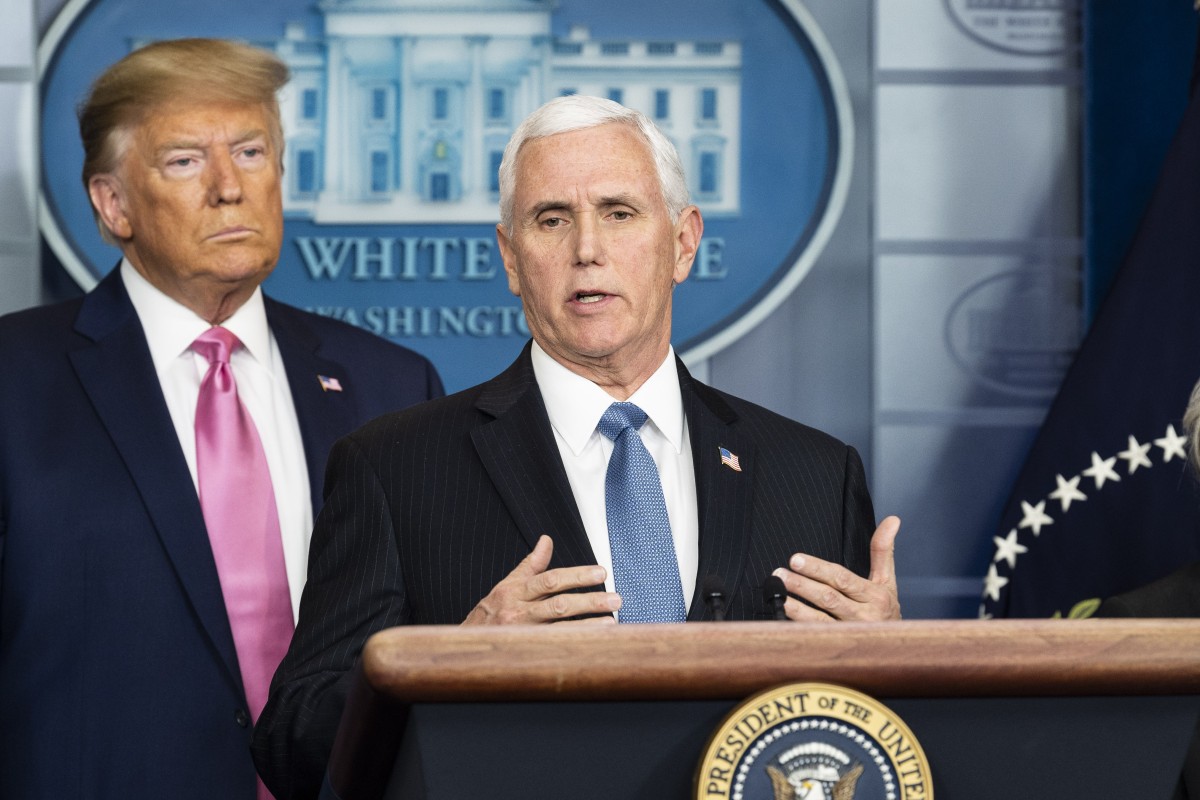
US Vice-President Mike Pence (right) speaks alongside US President Donald Trump during a press conference about the coronavirus at the White House on Wednesday. Photo: dpa
This story is published in a content partnership with POLITICO. It was originally reported by Adam Cancryn, Quint Forgey and Dan Diamond on politico.com on February 27, 2020.
In the end, US President Donald Trump got a coronavirus tsar – without having to call it a tsar.
Vice-President Mike Pence, whom Trump appointed on Wednesday to lead his coronavirus response, announced a global health official as the “White House coronavirus response coordinator” – installing a tsar-like figure under him to guide the administration’s response to the outbreak after a protracted public dance around how to display the power of the federal bureaucracy to the American people.
The move marked the administration’s latest attempt to show it is in control of the spreading global threat after weeks of fumbled messaging, rising market jitters and mounting backlash from lawmakers on both sides of the aisle.
Coronavirus: New cases outside China outnumber those inside for first time since start of epidemic
The two-day journey of upgrading the federal government’s public response highlighted a sharp contrast between Trump’s political instincts to play down the virus risk in an election year and calls from health officials and lawmakers to show the government in command of a deadly and frightening threat.
The new role will put Ambassador Debbie Birx, who has served since 2014 as the US government’s leader for combating HIV/Aids globally, at the centre of what now appears to be three leaders of the government response.
Trump revealed in a news conference on Wednesday evening that Pence would head up the administration’s management of the coronavirus, overseeing a task force nominally led by Health and Human Services Secretary Alex Azar. Birx will report to Pence but serve on the task force that Azar chairs.
Over three decades of public health experience, Birx “has been utilising the best science to change the course of the HIV pandemic and bring the pandemic under control”, the White House said in a statement, adding that she “will bring her infectious disease, immunologic, vaccine research and inter-agency coordinating capacity to this position”.
Speaking at the Conservative Political Action Conference on Thursday, Pence said “we are ready for anything” to fight coronavirus.
Trump faces ‘black swan’ threat to economy and re-election
25 Feb 2020
“I promise you, this president, this administration, is going to work with leaders in both parties. We’ll work with leaders across this nation, at the state and local level. And this president will always put the health and safety of America first.”
Birx’s appointment marked the latest swerve by the White House in assigning responsibility to tackle the burgeoning public health crisis.
At the World Economic Forum in Davos last month, Trump said “we have it totally under control” and maintained “it’s going to be just fine”. The virus has since exploded globally from China to nearly 50 countries, with more worries emerging inside the US.
A week after Trump’s Davos comments, the White House announced a task force to handle the widening outbreak. A month later, Trump was forced to vastly upgrade the response when his bold predictions proved to be wrong.
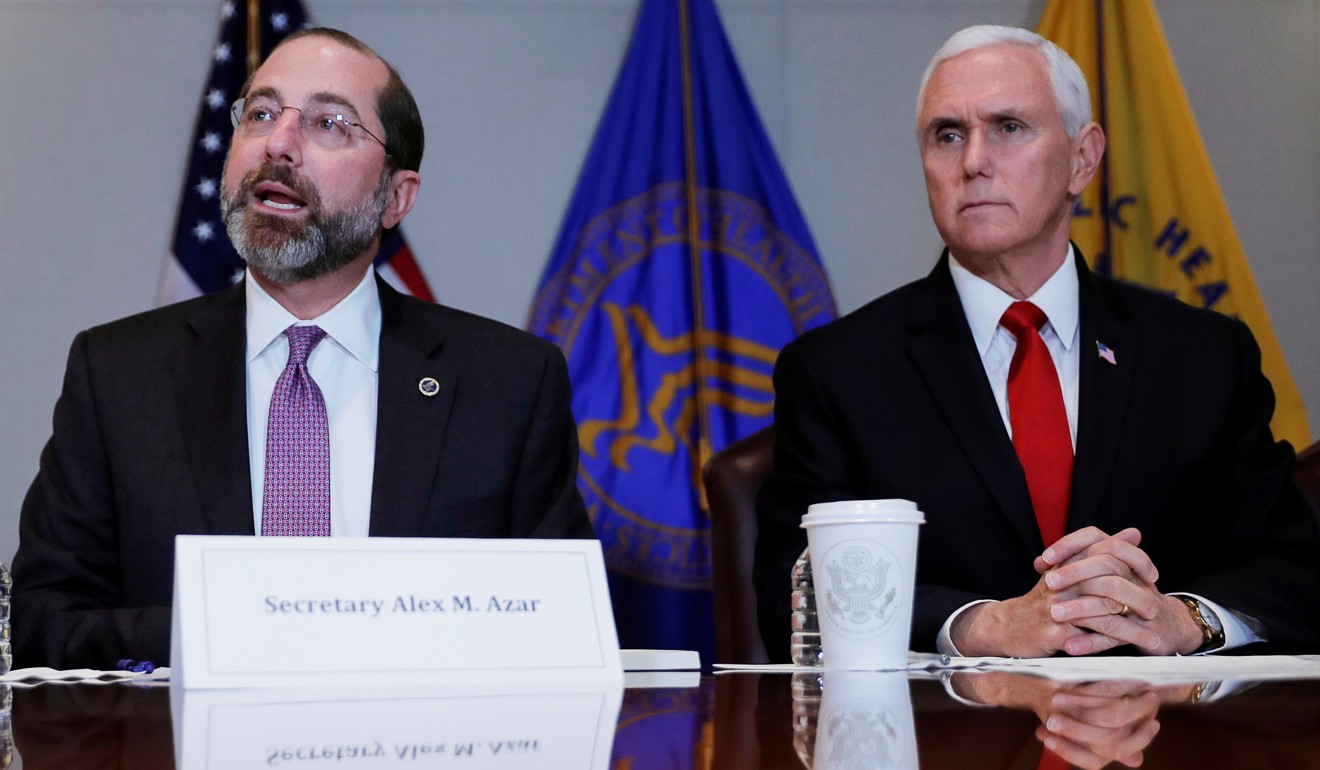
US Health and Human Services Secretary Alex Azar (left) speaks as US Vice-President Mike Pence listens during a coronavirus task force meeting in Washington on Thursday. Photo: Reuters
Appointing a “coordinator” allowed Trump to fulfil an increasingly urgent call from lawmakers to put a trusted public health official at the centre of the White House response as a tsar.
Some administration officials had opposed appointing a tsar – a move President Barack Obama used in 2014 during the Ebola threat – because it could be perceived as an admission of failure up to this point, while others have been criticising Azar for months for his work on the president’s health initiatives far beyond coronavirus.
On Wednesday, Azar told lawmakers “I serve as the lead” on coronavirus efforts, and he denied a POLITICO report stating that the White House was weighing whether to appoint a tsar to coordinate its response to the spreading epidemic.
The leadership change – putting Pence in charge – was a shock to Azar and his team, four people familiar with the matter said, coming soon after the health secretary returned from his full day of congressional testimony.
Facebook cancels its big annual developers event due to coronavirus
28 Feb 2020
Azar had reason to be confident: Trump had reassured him earlier in the day that he was doing a good job atop the task force and would not be replaced. And technically, he was not, even though he has lost ultimate authority over the federal response.
Azar insisted at Trump’s Wednesday news conference, however, that he would remain the chair of the White House task force, indicating Pence would play a supervisory role. That was before Thursday morning’s coronavirus “coordinator” announcement, which Trump hinted at the prior night.
At a congressional hearing on Thursday, Azar downplayed the significance of Pence’s appointment, calling it a “a lot of continuity” of the administration’s response to date.
“What the vice-president will do is actually a function very similar to what acting chief of staff Mick Mulvaney has been doing very ably for me,” he told the House Ways and Means Committee, describing the role largely as ensuring alignment across the government and coordinating decision-making outside the health care arena.
“The vice-president’s involvement and leadership across the whole of government brings just the weight of the office of the vice-president to that task.”
Why the WHO isn’t labelling Covid-19 a pandemic and how the world coped with past global diseases
Azar later insisted that he was consulted and involved in the decision to put Pence in charge, telling lawmakers that he was supportive as soon as the suggestion was made. “I said, quote, that’s genius,” he said.
Azar also told reporters after the hearing that he was “involved” in the decision Wednesday to name Birx.
“She’s a terrific leader. And she will do wonderful work helping us with just the internal processes,” he said. As for Pence’s new role, Azar said “the vice-president helps me, in terms of heft within the executive agency” but maintained that he’s still leading the inter-agency task force work among a slew of other responsibilities as the nation’s health chief.
The compromise position allows the White House to respond to frustration inside and outside the administration while allowing Azar to save face. Trump remains pleased with his health secretary and had reassured him as recently as Wednesday that he was happy with his work on the coronavirus, people close to the White House said.
The White House is battling bipartisan criticism from members of Congress sceptical of the administration’s response and emergency funding request, which some lawmakers have slammed as insufficient to counter the growing threat.
US lawmakers push White House for more aggressive coronavirus preparations
27 Feb 2020
The administration’s disjointed messaging about the severity of the threat earlier this week frustrated even Republicans on Capitol Hill, especially after White House National Economic Director Larry Kudlow declared the containment effort as nearly “airtight” at nearly the same time CDC officials were warning of its “inevitable” spread.
An exasperated Senator John Kennedy aired his concerns directly to Trump on Tuesday, after the Louisiana Republican struggled to extract basic answers about the disease from acting Homeland Security Secretary Chad Wolf.
“We had one story from the classified briefing, we had another story from one Cabinet secretary, then we had another story from another Cabinet secretary,” said Kennedy, who on Thursday praised the decision to elevate Pence. “[Trump] said, I hear what you’re saying, I’m gonna get this straight.”
The announcement of Birx’s latest role within the administration came hours after news broke in California of the first potential case of coronavirus spreading within the US.
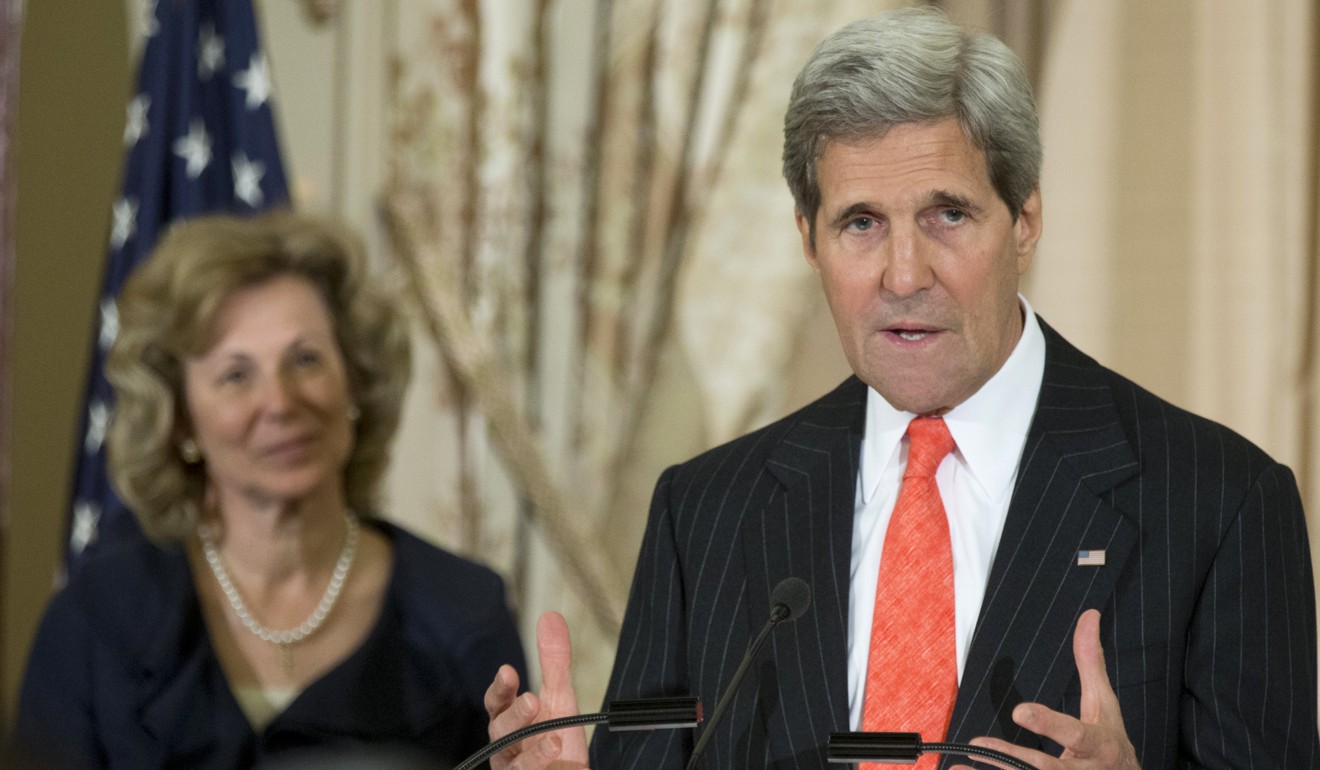
Secretary of State John Kerry speaks during an April 2014 swearing-in ceremony for Debbie Birx (left) as ambassador-at-large and coordinator of US government activities to combat HIV/Aids. Photo: AFP
It also follows intense scrutiny of Pence’s record as governor of Indiana overseeing a massive HIV outbreak in the state that public health experts deemed preventable – an episode that House Speaker Nancy Pelosi raised directly with the vice-president on Thursday morning.
“I expressed to him the concern that I had of his being in this position,” she said during her weekly press conference.
Birx brings bipartisan credibility to the job, having won widespread praise from Democrats in the run-up to her 2014 confirmation as head of the Obama administration’s global HIV/Aids office.
Senate Foreign Relations Committee Democrat Ben Cardin in 2014 called her “one of the most well-qualified nominees that has ever come before the US Senate for confirmation,” ahead of a unanimous vote to install her in the job.
Trump asks Congress for US$2.5 billion to fight coronavirus
25 Feb 2020
Congressman Eliot Engel, now the top Democrat on the House’s Foreign Affairs Committee, similarly lauded her as a “dedicated force in efforts to eliminate the global scourge of HIV/Aids”.
Yet despite her Obama-era appointment, Birx is a Republican and could be characterised as a conservative, one person who knows her said.
This person added that she’d be “good on camera” and has already worked closely with several of the administration’s current top public health officials – including Centres for Disease Control and Prevention director Robert Redfield, with whom she served as an Army doctor.
Most notably, this person said, she aided Redfield’s candidacy to become CDC chief in 2018, serving as a reference and advocating for him within the administration.




 CHINDIA ALERT: You'll be living in their world, very soon