30/04/2020
– The last nine poverty-stricken county-level regions in east China’s Anhui Province have been removed from the country’s list of impoverished counties.
– This marks that all county-level regions in the Yangtze River Delta, consisting of Shanghai and the provinces of Jiangsu, Zhejiang and Anhui, have been officially lifted out of poverty for the first time in history.
HEFEI, April 29 (Xinhua) — Sitting in front of his smartphone, Zhang Chuanfeng touts dried sweet potatoes to viewers on China’s popular video-sharing app Douyin, also known as TikTok.
“These are made from sweet potatoes I grew myself. They are sweet and have an excellent texture,” said Zhang while livestreaming in Tangjiahui Township of Jinzhai County in east China’s Anhui Province. Tucked away in the boundless Dabie Mountains, the township used to have the biggest poor population in the county.

Aerial photo taken on April 16, 2020 shows residential buildings in Dawan Village of Jinzhai County, east China’s Anhui Province. (Xinhua/Liu Junxi)
Jinzhai County is among the last nine county-level regions in Anhui that have been removed from the country’s list of impoverished counties, according to an announcement issued by the provincial government Wednesday. They are also the last group of county-level regions that bid farewell to poverty in the Yangtze River Delta.
E-COMMERCE
Zhang might seem like a typical e-commerce businessman reaping success in China’s booming livestreaming industry. But his road to success has been a lot bumpier: he suffers from dwarfism.
A little more than 1.4 meters tall, Zhang has a babyface, making him “look like a junior school student,” he said. But the man, 38, is the father of a nine-year-old boy.
For Zhang, life was tough before 2014. “Nobody wanted me because of my ‘disabilities’ when I went out to look for jobs,” he said. “I was turned down again and again.”
Zhang was put on the government’s poverty list in 2014 as China implemented targeted poverty-relief measures. With the help of local officials, he got a bank loan of 10,000 yuan (about 1,400 U.S. dollars) and bought 22 lambs. He tended the animals whole-heartedly and seized every opportunity to learn how to raise them more professionally.

Zhang Chuanfeng feeds his lambs in Zhufan Village of Jinzhai County, east China’s Anhui Province, April 26, 2017. (Xinhua/Zhang Duan)
Within a year, the number of his lambs expanded to hundreds. In 2016, Zhang’s earnings exceeded 100,000 yuan, more than enough for him to cast off poverty.
Riding on this success, Zhang began to seek new opportunities. He rented a shop and started selling products online to embrace an e-commerce strategy the local government introduced in 2017.
More than 100 online shops, including Zhang’s, in the county have helped more than 7,000 poverty-stricken households sell about 73 million yuan worth of local specialties since 2018. Zhang alone earned 500,000 yuan from a sales revenue of 5 million yuan last year.

A villager arranges local specialties for sale at Dawan Village of Jinzhai County, east China’s Anhui Province, April 17, 2020. (Xinhua/Liu Junxi)
WICKERWORK SUCCESS
About 100 km north of Jinzhai lies Funan, a place that used to be vulnerable to constant floods.
Zhang Chaoling, who lives by the Huaihe River in Funan County, had to flee her hometown at a young age due to floods, but has flourished on a willow plantation along the river later.
“The land is largely covered by silt following continual flooding in the past. It is an ideal place to plant willows and make wickerwork,” Zhang said.
Zhang left her hometown for Guangzhou in 1993 and found a job in a garment factory. A few years later, she founded a trading company with her husband in Guangzhou, selling wickerwork products from her hometown to other countries.
Zhang returned to her hometown and set up a wickerwork production base in 2011. Funan is famous for its delicate wickerwork. Skilled craftsmen traditionally use local willow as a raw material to weave products such as baskets, furniture and home decorations.

A villager arranges wickerwork products in Funan County, east China’s Anhui Province, April 15, 2020. (Photo by Zhou Mu/Xinhua)
“The flood is well controlled now. I remember the last huge flood came in 2007,” Zhang said.
Taking advantage of the fertile land along the Huaihe River, she plants over 130 hectares of willow trees and employs hundreds of locals mostly in their 50s and 60s.
“I can process 100 to 150 kg of willow twigs per day, from which I make around 80 yuan,” said Geng Shifen, who peels willow twigs with a clamp next to the plantation.
A total of 130,000 people are engaged in the wickerwork industry in Funan, creating an output of nearly 9 billion yuan in 2019, and helping 15,000 locals shake off poverty, local statistics showed.
POVERTY REDUCTION FEAT
The Anhui provincial government Wednesday announced that its last nine county-level regions including Jinzhai and Funan are removed from the country’s list of impoverished counties.
This marks that all 31 impoverished county-level regions in Anhui have shaken off poverty, echoing China’s efforts to eradicate absolute poverty by the end of 2020.
With the announcement, all county-level regions in the Yangtze River Delta have been officially lifted out of poverty for the first time in history.

A bus runs on a rural road in Jinzhai County, east China’s Anhui Province, April 17, 2020. (Xinhua/Liu Junxi)
Covering a 358,000-square-km expanse, the Yangtze River Delta, consisting of Shanghai and the provinces of Jiangsu, Zhejiang and Anhui, is one of the most populated and economically dynamic areas in China, contributing one-fourth of the country’s GDP.
Anhui had a population of 63.65 million as of 2019, official data showed. The poor population in the province had decreased from 4.84 million in 2014 to 87,000 in 2019, and the poverty headcount ratio had been reduced from 9.1 percent to 0.16 percent during the period, according to the provincial poverty relief office.
A county can be removed from the list if its impoverished population drops to less than 2 percent, according to a national mechanism established in April 2016 to eliminate poverty in affected regions. The ratio can be loosened to 3 percent in the western region.
By the end of 2019, 5.51 million people in China were still living in poverty.
“We will continue our work to prevent people from returning to poverty, and help the remaining poor population shake off poverty by all means,” said Jiang Hong, director of the Anhui provincial poverty relief office.
Source: Xinhua
Posted in 100, 100,000, 1993, 2014, 2016, 2017, 2018, 7,000, also known as, Anhui, Anhui province, animals, announcement, £500,000, babyface, bank loan, baskets, began, bid farewell, biggest, booming, bought, boundless, boy, bumpier, businessman, cast off, China's, constant, continual, counties, country's, county, county-level, covered, Dabie Mountains, decorations, disabilities, dried sweet potatoes, dwarfism, E-commerce, e-commerce strategy, earnings, east China's, embrace, enough, exceeded, expanded, father, first time, flee, flooding, floods, flourished, following, Funan, Funan County, furniture, garment factory, Guangzhou, helped, History, hometown, households, Huaihe River, hundreds, ideal, impoverished, in front, including, industry, introduced, Jiangsu, Jinzhai County, jobs, lambs, land, last nine, last year, lifted out of poverty, list, livestreaming, Local government, local officials, local specialties, marks, more than, Nobody, officially, online, online shops, opportunity, out of poverty, past, place, Plant, plantation, poor population, popular, poverty, poverty-relief measures, poverty-stricken, products, professionally, provinces, provincial government, raise, reaping, regions, removed, rented, Revenue, Riding, River, road to success, seek, seized, selling, Shanghai, shop, silt, Sitting, Skilled craftsmen, smartphone, started, success, suffers, Tangjiahui Township, tended, TikTok, tough, touts, township, Tucked away, typically, Uncategorized, video-sharing app, viewers, vulnerable, Wednesday, whole-heartedly, WICKERWORK, willow, willows, worth, Xinhua Headlines, Yangtze River Delta, young age, yuan, Zhang, Zhang's, Zhejiang |
Leave a Comment »
15/04/2020
- Residents of nine regions, including Wuhan, Beijing and Shanghai, to be sampled using both nucleic acid and antibody tests, state media reports
- Research ‘very important as it will help us to direct our countermeasures in the future’, molecular virologist says
China is using dual testing to determine how many people have been infected with Covid-19 but recovered without showing symptoms. Photo: AP
China has begun a major survey to determine how many people might have been infected with the
coronavirus and then recovered
without ever showing symptoms, while also assessing immunity levels within different communities, state media reported.
The research will be conducted in six provinces, including Hubei which was the focus of the initial outbreak, as well as Beijing, Shanghai and Chongqing.
, the capital of Hubei and home to about 60 per cent of all infections reported in mainland China, is taking the lead in the study, which involves giving both nucleic acid and antibody tests to 11,000 of its 11 million residents, state news agency Xinhua reported on Wednesday.
Health workers collected throat swabs and blood samples from about 900 people randomly selected from eight subdistricts of the city on Tuesday, Ding Gangqiang, head of the Wuhan epidemiological survey team, was quoted as saying.
“The purpose is to learn about the immunity level in communities and provide scientific support on how we should adjust our disease control strategies,” he said.
Professor Lu Hongzhou, a specialist in infectious diseases who heads the Shanghai Public Health Clinical Centre where Covid-19 patients are being treated, said he supported the research though the collection of samples had yet to start in the city.
“We haven’t received notification from the top [to start],” he said. “The number of infections [in Shanghai] is not very big, but I think we’d better do this so as to have an idea of the scale of asymptomatic carriers.”
Professor Jin Dong-yan, a molecular virologist at the Li Ka Shing Faculty of Medicine at the University of Hong Kong, said that the use of both nucleic acid and antibody tests would enable scientists to determine those people who had been infected but recovered without medical aid and without showing symptoms.
The study into asymptomatic infections got under way in Wuhan in Tuesday. Photo: Simon Song
If a person tested positive in a nucleic acid test, it meant they were carrying the virus, and if positive in an antibodies test, it meant that they had contracted the virus and had recovered, he told the South China Morning Post.
“This is very important as it will help us to direct our countermeasures in the future,” Jin said.
“If we find, say 60 per cent, of the population has acquired immunity, then lockdowns will no longer be meaningful. If it turns out that there are many people with a high viral load but without symptoms, then we should be on high alert and take stricter measures.
“For people in Hubei, the tests can also save them from discrimination when they get back to work – those who prove to have developed immunity are very unlikely to get infected [again] for at least a year,” he said.
Wuhan hotel owners say they’re on the brink of going bust
to the nation’s daily infections tally at the start of April amid concerns that such people could trigger a second outbreak once the widespread lockdowns in cities like Wuhan and elsewhere were lifted.
China reported 103 new coronavirus infections on Wednesday, of which 39 were imported. Of the total, 57 people had no symptoms, including three of the imported cases.
Since the outbreak began, China has reported 82,295 cases, of which 95 per cent have recovered and been discharged from hospital.
Source: SCMP
Posted in antibody tests, ASYMPTOMATIC CASES, asymptomatic infections, Beijing, blood samples, China, collected, coronavirus, countermeasures, COVID-19, health workers, Hubei, immunity, infected, infectious diseases, launches, Li Ka Shing Faculty of Medicine, lockdowns, Mainland China, meaningful, molecular virologist, nine, nucleic acid, patients, People, Population, recovered, regions, research, residents, sampled, Shanghai, Shanghai Public Health Clinical Centre, shared, showing, south china morning post, state news agency, study, symptoms, throat swabs, Tuesday, Uncategorized, University of Hong Kong, without, Wuhan, Wuhan epidemiological survey team, Xinhua |
Leave a Comment »
19/11/2019
- Li Keqiang tells senior officials to step up efforts to channel water from Yangtze River to arid regions
- Impact of pollution and rising population has prompted increased efforts to improve efficiency and supply
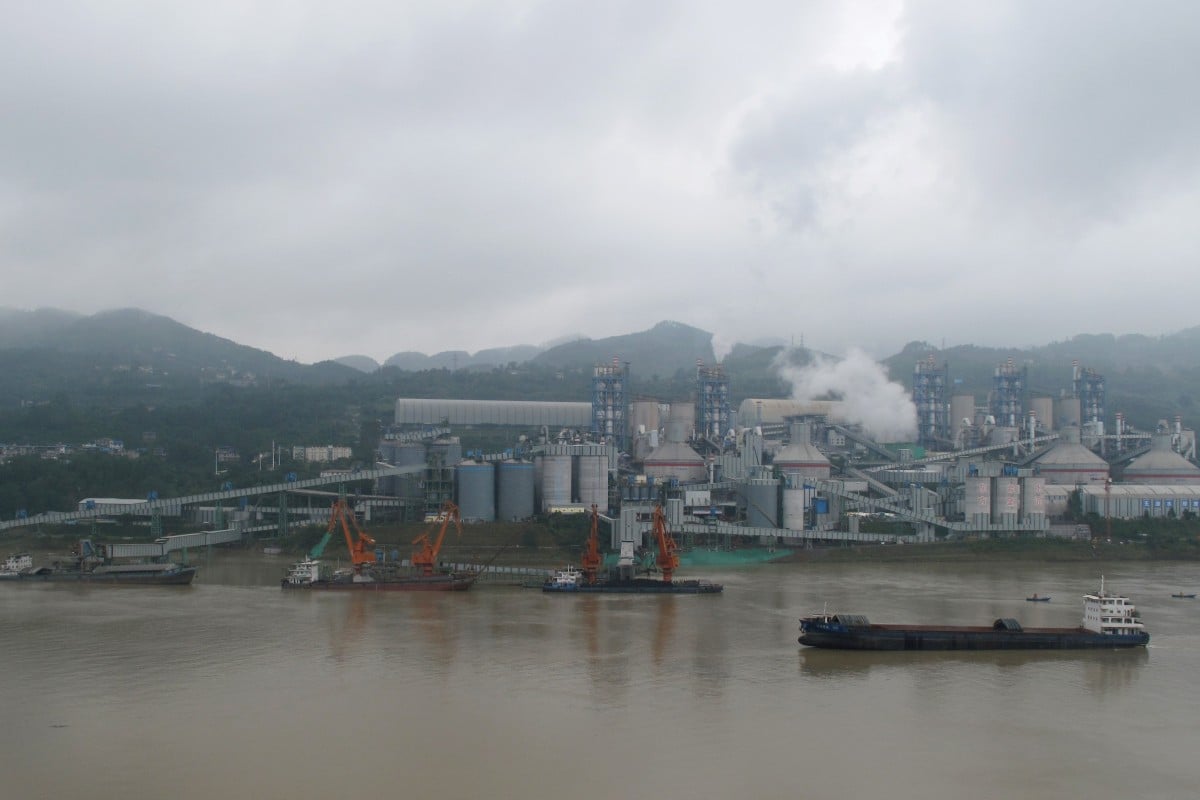
A cement plant on the banks of the Yangtze in Chongqing. The authorities are now trying to stop further development along the river. Photo: Reuters
China needs to divert more water to its arid northern regions and invest more in water infrastructure as shortages get worse because of pollution, overexploitation and rising population levels, Premier Li Keqiang has said.
China’s per capita water supplies are around a quarter of the global average. With demand still rising, the government has sought to make more of scarce supplies by rehabilitating contaminated sources and improving efficiency.
Water remained one of China’s major growth bottlenecks, and persistent droughts this year underlined the need to build new infrastructure, Li told a meeting of senior Communist Party officials on Monday. An account of the meeting was published by China’s official government website.
Local government bonds should be “tilted” in the direction of water infrastructure, he said, and innovative financing tools were also needed.
He also called for research into new pricing policies to encourage conservation.
Li said China’s water supply problems had been improved considerably as a result of the South-North Water Diversion Project, a plan to divert billions of cubic metres of water to the north by building channels connecting the Yangtze and Yellow rivers.
World ‘woefully unprepared’ for climate change’s effects on drinking water supplies drawn from mountains
He said opening up more channels to deliver water to regions north of the Yangtze River Delta would support economic and social development and optimise China’s national development strategy, according to a summary of the meeting on the government website.
China is in the middle of a wide-reaching programme to clean up the Yangtze River, its biggest waterway, and put an end to major development along its banks.
Chinese Premier Li Keqiang inspects an empty reservoir during a visit to Jiangxi province last week. Photo: Xinhua
Local governments have been under pressure to dismantle dams, relocate factories and even ban fishing and farming in ecologically fragile regions.
But experts say the ongoing campaign to divert the course of the Yangtze to other regions is still causing long-term damage to the river’s environmental health.
Many cities that had polluted their own water sources had drawn replacement supplies from the Yangtze, exceeding the river’s environmental capacity, said Ma Jun, founder of the Institute of Public and Environmental Affairs, which monitors water pollution.
Beijing already relied on diversion channels from the Yangtze to supply 70 per cent of its water, but had done little to improve conservation or reduce per capita consumption, which was higher than many Western countries, he said.
“[Diversion] has caused so much suffering and needs so many dams to keep up supply, and that has impacted biodiversity,” he said.
Source: SCMP
Posted in ban, Beijing, cement plant, China alert, Chongqing, dams, dismantle, divert, drawn, Drinking water, drought, ecologically fragile, economic and social development, empty reservoir, experts, factories, farming, fight, fishing, Institute of Public and Environmental Affairs, Jiangxi Province, Li Keqiang, local governments, more, mountains, national development strategy, needs, North, optimise, Pollution, Premier, pressure, regions, relocate, rising population, Risk, South-North Water Diversion Project, supplies, Uncategorized, under, visit, water, waterway, Yangtze River, Yangtze River Delta, Yellow River |
Leave a Comment »





 CHINDIA ALERT: You'll be living in their world, very soon