Chindia Alert: You’ll be Living in their World Very Soon
aims to alert you to the threats and opportunities that China and India present. China and India require serious attention; case of ‘hidden dragon and crouching tiger’.
Without this attention, governments, businesses and, indeed, individuals may find themselves at a great disadvantage sooner rather than later.
The POSTs (front webpages) are mainly 'cuttings' from reliable sources, updated continuously.
The PAGEs (see Tabs, above) attempt to make the information more meaningful by putting some structure to the information we have researched and assembled since 2006.
Concerns are rising that China is repeating its mistake of a decade ago by pursuing short-term debt-fuelled economic growth at the cost of long-term sustainability
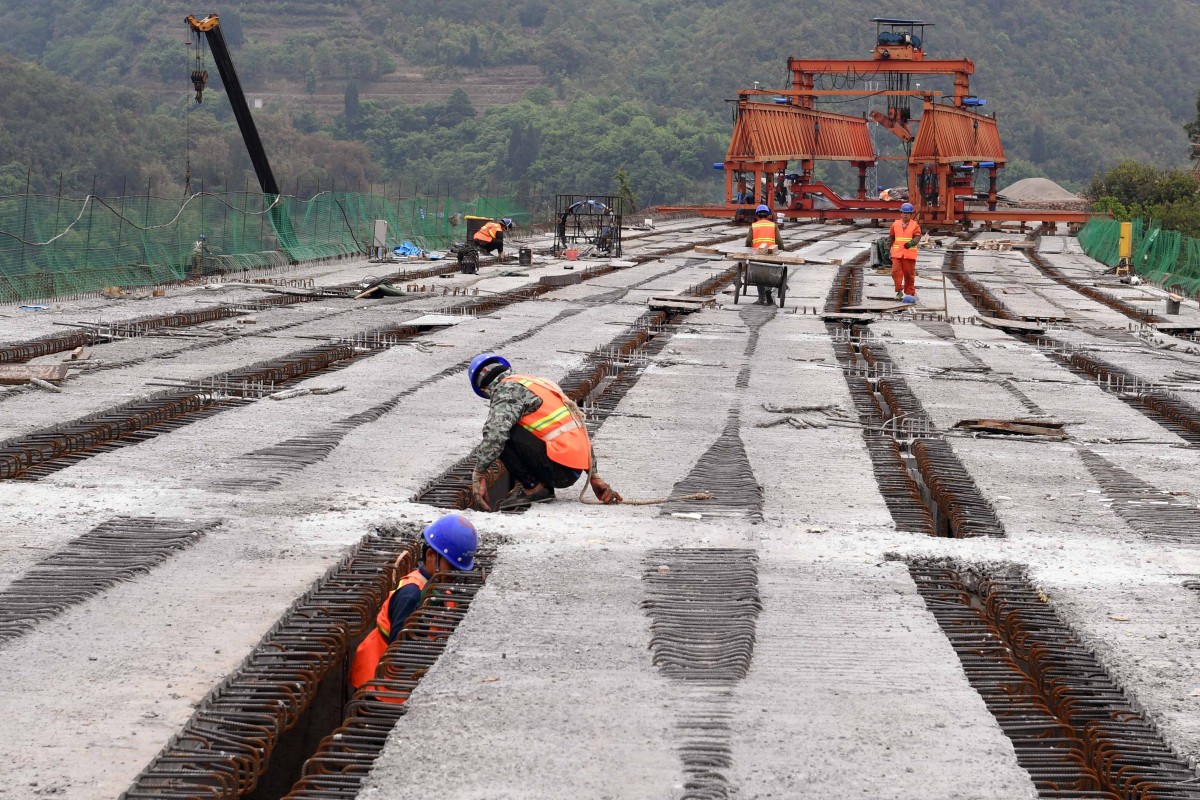
Local governments are stepping up spending on infrastructure projects in a bid to offset the slowdown caused by the coronavirus outbreak and subsequent lockdowns
Construction of high-speed railways, motorways and airports is an old tactic that Beijing dusted off after the pandemic led to a 6.8 per cent economic contraction in the first quarter. Photo: Xinhua
China’s huge stockpile of local government debt, one of the biggest “grey rhino” risks threatening the Chinese economy’s future, is set to rise steeply as local authorities rush to increase capital spending to help offset the damage caused by the coronavirus outbreak.
As Beijing discusses increasing the central government budget deficit and monetary policy easing to spur economic growth, many local governments see the situation as a golden opportunity to realise their investment ambitions, fanning concerns that China is repeating its mistake of a decade ago by pursuing short-term debt-fuelled economic growth at the cost of long-term sustainability.
In one of the latest investment drives, the southeastern province of Fujian announced on Sunday that it had signed contracts for 391 new projects with a combined investment value of 783.6 billion yuan (US$110.6 billion). Projects undertaken by central government-owned companies, which received significant lending support in the first quarter, accounted for more than half of the promised investment in Fujian, some 92 projects worth 424.5 billion yuan.
The landlocked eastern province of Anhui is also planning 2,583 new projects this year at a cost of 450 billion yuan, a third of which have been created in the last two weeks.
Construction begins for major sea crossing to link Shenzhen and Zhongshan in Greater Bay Area
In addition to work on existing construction projects, costing around 850 billion yuan, the province has also prepared a list of 3,300 reserve projects with a total investment value of 5.4 trillion yuan (US$762 billion) which could theoretically be started at any point in the future, pending government approval and funding support.
“The most powerful and effective way to offset the economic slowdown is to increase the size of investments,” Wang Qikang, an official with the Anhui economic planning office said on Friday. “[We] must quicken the pace of construction, working day and night to win back the lost time [from the coronavirus lockdowns].”
Construction of high-speed railways, motorways and airports is an old tactic that Beijing dusted off after the pandemic led to a 6.8 per cent economic contraction in the first quarter.
Infrastructure construction has already been hit hard amid the lockdowns, plunging 19.7 per cent in the first three months of the year compared to a year earlier.
Many [local governments] are still striving to achieve a high growth rate without the guidance of a national [gross domestic product] target – Liu Xuezhi
“The investment stimulus mindset has hardly been eradicated at the local level,” said Liu Xuezhi, a senior researcher with the Bank of Communications in Shanghai. “In particular, many [local governments] are still striving to achieve a high growth rate without the guidance of a national [gross domestic product] target.”
Before the start of the coronavirus outbreak, Beijing was thought to be targeting a
of around 6 per cent this year after achieving 6.1 per cent in 2019, although many local governments appear to be setting their own annual targets still using the original expected goal as a guide.
However, that target was never made public because the meeting of the
scheduled for early March, where the growth target would normally have been released, was postponed due to the virus.
The government announced on Wednesday that the NPC will be held from May 22, when a new, likely lower, growth target could be announced.
China’s first-quarter GDP shrinks for the first time since 1976 as coronavirus cripples economy
International rating agency Moody’s warned that greater infrastructure spending would result in higher debt for regional and local governments, increasing their financial risks amid a sharp slowdown in tax revenues.
“Such investments are less likely to be a main support measure [chosen by Beijing] now given the government’s focus on avoiding a rapid increase in leverage and asset price inflation,” Moody’s analysts Michael Taylor and Lilian Li said on Tuesday.
At the end of March, local government debt stood at 22.8 trillion yuan (US$3.2 trillion), according to the Ministry of Finance. But implicit liabilities, which are hidden in local financing vehicles, state firms and public-private partnership projects, are believed to be much larger, with some estimates pointing towards an additional debt of over 30 trillion yuan.
Chinese central bank governor Yi Gang, along with other officials, have already warned against excessive economic stimulus, saying it would add risks to China’s financial system.
A key risk is that local governments are front-loading China’s long-term investment plan, especially in the railway sector, with more than 357 railway projects proposed by local governments.
Shandong province, for example, is preparing to build four new railway lines, including the Shandong portion of a second high-speed railway between Beijing to Shanghai.
“There is still a chance for infrastructure investment growth to hit 10 per cent if the government releases 2 trillion yuan (US$282 billion) in funding through local special purpose bonds and special treasury bonds,” said Haitong Securities’ chief economist Jiang Chao on Monday.
However, a local government debt monitoring report issued on Tuesday by the National Institution of Finance and Development warned that China’s local government fiscal situation is worsening rapidly as expenses surge and revenues drop.
“All levels of local governments in China will face huge debt repayment pressure in five years,” warned Yin Jianfeng, deputy director of the Beijing-based think-tank.
SEOUL/BEIJING (Reuters) – China has allowed 200 employees from South Korea’s Samsung Electronics Co Ltd (005930.KS) to enter the country to work on an expansion of the firm’s NAND memory chip factory, the company said on Wednesday.
The move came after China said on Tuesday that it was in talks with some countries to establish fast-track procedures to allow travel by business and technical personnel to ensure the smooth operation of global supply chains.
China said it has reached a consensus on such an arrangement with South Korea, without elaborating on the terms, including whether individuals entering China will be subject to quarantine.
China, where the virus first emerged late last year, blocked entry last month for nearly all foreigners in an effort to curb risks of coronavirus infections posed by travellers from overseas. After bringing the local spread under control with tough containment measures, it is trying to restart its economic engines after weeks of near paralysis.
A chartered China Air Ltd (601111.SS) plane flew in the Samsung Electronics employees on Wednesday, a company spokeswoman said.
Samsung said its employees will follow the local government’s policy upon arrival, without elaborating.
Shaanxi province, where Samsung’s NAND memory chip plant is located, requires people travelling from overseas to undergo a 14-day quarantine, according to South Korea’s foreign ministry.
“Samsung employees will not be exempted from the 14-day quarantine rule imposed by the Shaanxi province. They will get coronavirus tests at the airport upon arrival and will be transported to a local hotel designated by Chinese authorities,” an official at the Consulate General of South Korea in Xi’an told Reuters.
Samsung Electronics in December increased investment at its chip factory in China by $8 billion to boost production of NAND flash memory chips.
Fu Chengyu, the former chairman of China National Offshore Oil Corporation (CNOOC), says hostility towards Beijing will increase after the coronavirus
US will try to ‘thwart China’s rise’ and economic fallout from Covid-19 will be worse than the global financial crisis, says Fu
Former Sinopec chairman Fu Chengyu says China will face a more hostile world post coronavirus. Photo: EPA
The world is set to become more hostile for China after the coronavirus as the risk of “black swan” events gathers for Beijing, a heavyweight in China’s state oil industry has warned, reflecting growing wariness about the geopolitical environment among political and business elites.
Fu Chengyu, the former chairman of both China National Offshore Oil Corporation (CNOOC) and Sinopec Group, painted an ominous picture of increasing antagonism from the United States and damaging unforeseen events, known as black swans, like Covid-19
at an online symposium organised by business magazine Caijing.
The US would “mercilessly” suppress China in the fields of economics, trade, finance and technology, and Washington was set on taking advantage of the coronavirus pandemic to “forge a less favourable international environment for” the nation, Fu said this week.
“We’ve smelled the odours and new plots against China are in formation,” he said.
After the epidemic, the external environment for our survival will be more severe – Fu Chengyu
“After the epidemic, the external environment for our survival will be more severe … we must prepare for the worst and do our best to achieve the best possible results.”
While Fu has retired from his posts at state companies, he is an influential voice in
with decades of experience and contacts in the US petroleum sector.
Fu was a counterpart of Rex Tillerson, who was chairman of ExxonMobil from 2006 to 2017, and served as US State Secretary under President Donald Trump until March 2018.
While at the helm of CNOOC in the early 2000s, he felt political heat from Washington over a US$18.5 billion takeover bid for the American oil company Unocal in 2005, which the company was subsequently forced to withdraw.
China says no evidence to suggest coronavirus virus came from Wuhan’s lab
Speaking at the event in Beijing, Fu said that the coronavirus, which has heightened tensions between Beijing and Washington, will have impacts on global value chains and the world trade landscape for years to come.
“The crisis stemming from the coronavirus pandemic won’t be over in just one or two years … the impact will last longer than the 2008 global financial crisis,” he said.
He added that China would face numerous “black swan” risks in the future.
President Xi Jinping warned in 2019 that China must be on guard for black swan risks as well as “grey rhino” events, referring to an obvious threat that is often neglected.
Geopolitics is getting worse and worse, and we need to be very careful. The US will try various ways to thwart China’s rise, and energy is an important area
To respond to the economic fallout from the coronavirus, China must do more to create a self-sustaining domestic economy, Fu said, and in particular reduce input prices for gas and electricity and boost public services such as health care and education.
“Geopolitics is getting worse and worse, and we need to be very careful,” Fu said. “The US will try various ways to thwart China’s rise, and energy is an important area.”
The US could potentially form a new oil export alliance with Saudi Arabia and Russia to make it possible to cut oil supplies to China, he said.
“China must be prepared for such a scenario, and even when supplies are cut off, we can have some basic self-protection.”
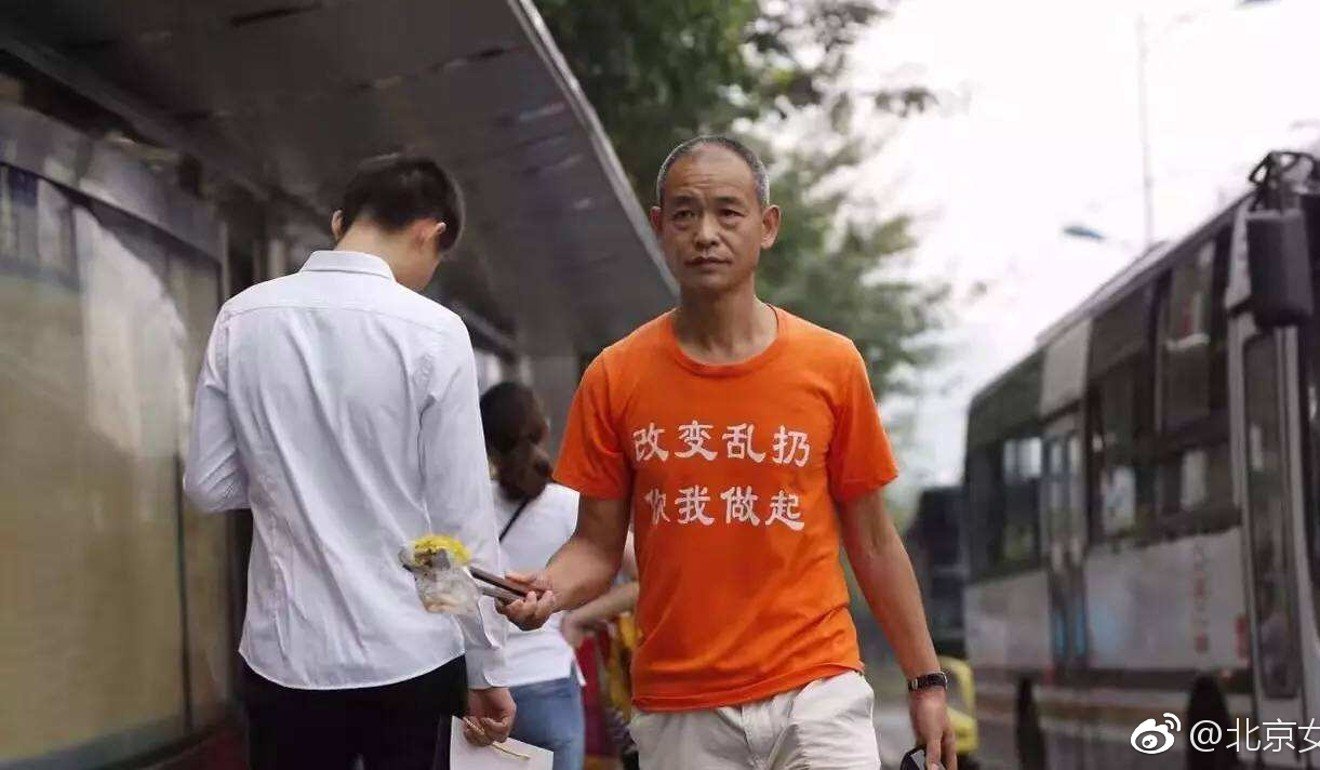
Every morning and night for the past four years, businessman Zhong Congrong has been on the streets of Chongqing to stop people dropping their litter
Admired as a welfare champion, the 54-year-old says he has been beaten and insulted for his cause
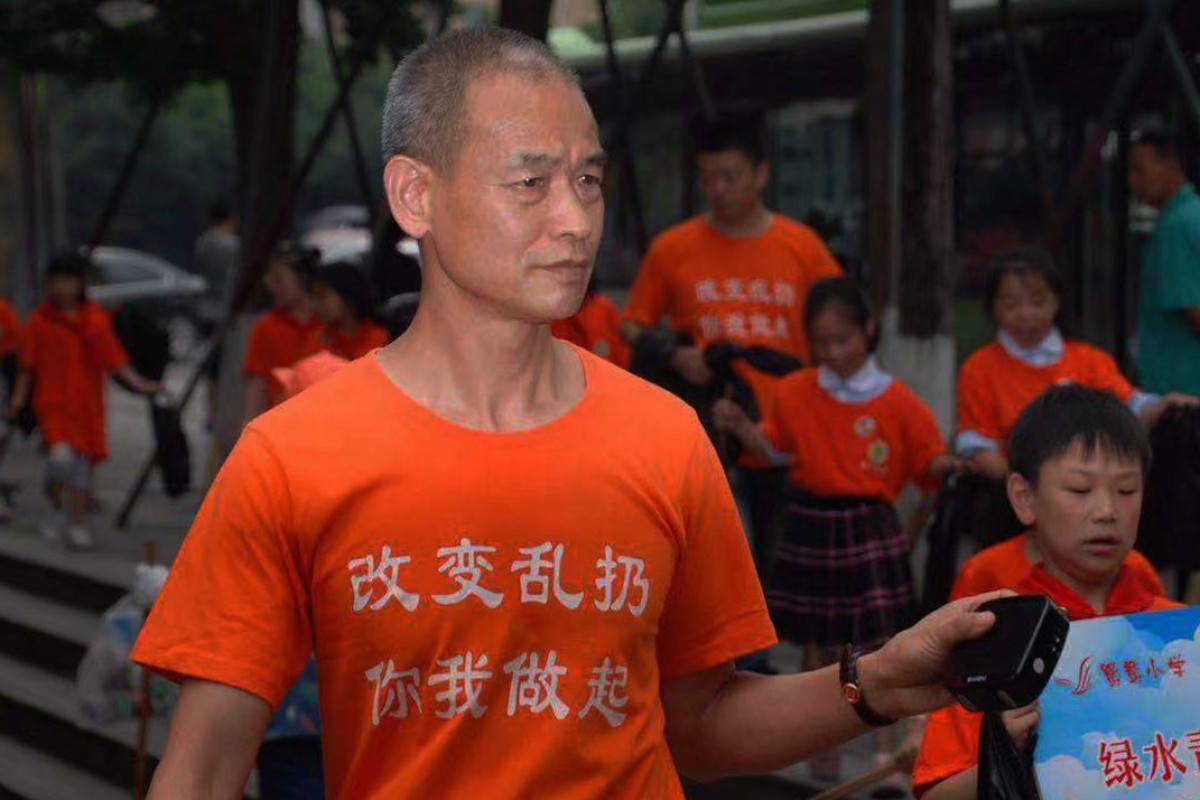
Zhong Congrong is a familiar figure on the streets of his hometown. Photo: Handout
Zhong Congrong owns three businesses in southwestern China which together are worth more than 100 million yuan (US$14.3 million), but he prefers to risk being labelled as an environment “nut” who wants to clean up Chongqing.
Every morning after breakfast and each evening after supper, the entrepreneur pulls on an orange T-shirt, gets into his Mercedes-Benz SUV and heads downtown. For one or two hours, he walks the streets, picking scraps of rubbish off the road and talking to passers-by about littering.
“It is my mission to change people’s bad habits and to raise their awareness of protecting the environment,” said Zhong, who has been on this mission for four years. It has brought the 54-year-old civic rewards, earned him a bruising or two from people who do not want to listen to his message and it nearly cost him his marriage.
Throughout it all, he has remained a persistent voice for the environment in the city of more than 30 million people and, as some of them have learned, he refuses to give up.
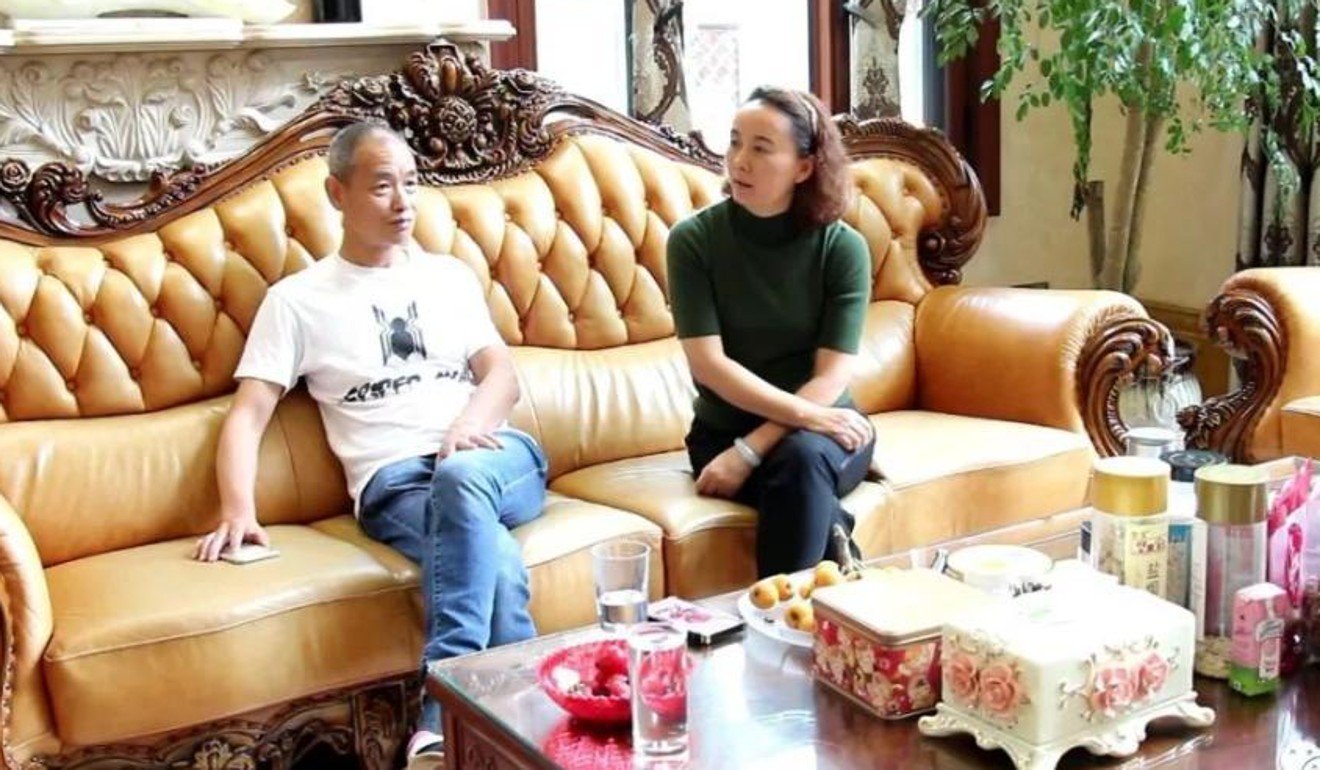
Yang Zuhui (right) has come to admire Zhong Congrong’s dedication to his litter picking mission, but she fears for her husband’s safety. Photo: Weibo
On mainland China, cities have banned littering and some hit offenders with fines as high as 200 yuan. However, the rules are rarely obeyed and feebly enforced, and while there are plenty of dustbins in public places, litter is still a nuisance.
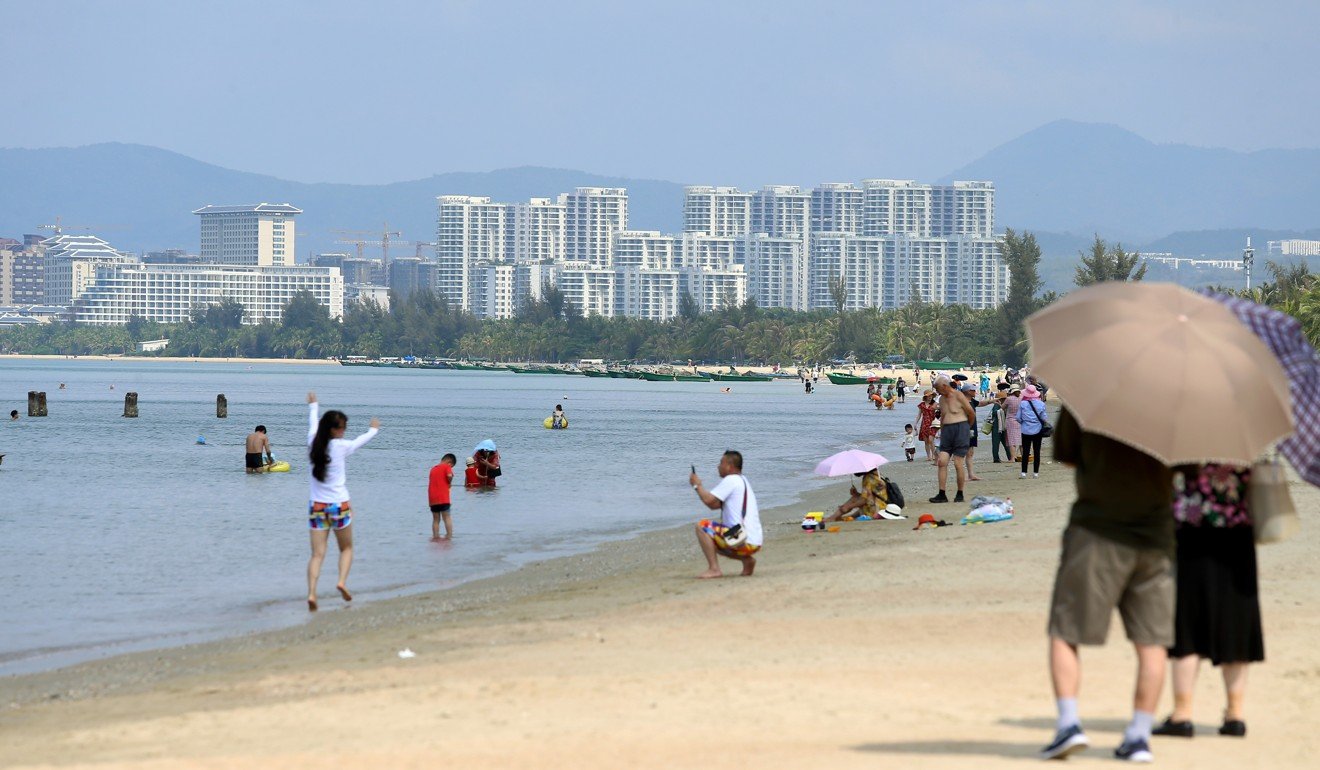
Zhong said his mission started in 2015 after he met a woman in her 70s in Sanya, the southern coastal city on the South China Sea island of Hainan. He was struck by how dedicated she and her husband were when they went litter picking each day.
“They are retired professors from a prestigious university in Beijing,” Zhong said. “I chatted a lot with her and I asked her, ‘What’s the point of collecting rubbish every day? You clean up the beach today, but tomorrow new rubbish appears’.”
The way to solve the problem was to teach people to not litter, she told him, but she said she “dared not” try to do that. Zhong said that encounter gave him his purpose and he would dare to change attitudes.
Shanghai recycling scheme slips up on 9,000 tonnes of waste
Back home, Zhong watched and learned – concluding that customers of restaurants and fast food businesses tended to be the people who dropped rubbish most.
“Perhaps it’s because when people dine in restaurants, they throw their rubbish wherever they like. Going outside, they keep on doing it,” he said.
“People in shopping malls are generally more civilised.”
Zhong says his mission began in 2015 during a holiday on the island of Hainan. Photo: Dickson Lee
While on patrol, Zhong makes himself easy to see in an orange T-shirt that bears his clean-up message. His tools include a metal pincer for picking up tissue paper, plastic bags, drinks bottles, nappies and other everyday detritus and putting it into bins.
He also carries a voice recorder that sends out an appeal to restaurant customers: “To protect our environment and not to affect our kids’ healthy growing up, dear friends, please don’t throw rubbish.”
Can China sort its household waste recycling problem by 2020?
Zhong said that at first he felt afraid and self-conscious when he stood in front of a crowd of diners with his green gospel. But time and practise taught him he had almost nothing to fear, he said.
One of the bigger challenges is getting through to the many people who do not listen to him and refuse to dispose of their rubbish the right way.
“It’s normal that our society has various kinds of people and I need to face this reality,” Zhong said. “I was prepared in my mind that I would be called ‘nut’ since this is such an arduous but fruitless cause.”
He tackles the problem with his usual persistence, so argument and persuasion is all part of the job. When Zhong insists the rule breakers take their rubbish and bin it, some ignore him and others walk away – but he is ready with an answer.
“I tell them, ‘If you don’t pick it up, I guarantee that you will lose face today. I will let passers-by see and hear what a humiliating thing you have done. Everybody will then condemn you and you will be embarrassed’,” he said.
When people tell him what they do is none of his business, Zhong replies that what he is doing is in the public interest.
Sometimes there is a heavier price. Zhong said he once watched several men in their 20s throw rubbish onto the road from their car. He set off after them in his SUV. He waylaid them and asked them to clean up after themselves – the men refused, swore at him and beat him up. Their day ended in a police station.
Zhong said he hoped his work would bring “positive energy” to the employees of his vehicle components and packaging materials companies, but his mission was not about business prestige.
However, last year, he was named as one of the top 10 public welfare figures of Chongqing by the municipal government, while his family was honoured as a Chinese good family by the semi-governmental All-China Women’s Federation, a women’s rights organisation established in 1949.
Street cleaner who found US$22,000 in rubbish refuses to accept a reward
There were trials for Zhong closer to home – his wife, Yang Zuhui, did not support his mission at first and threatened to divorce him.
“It’s OK that you picked up trash on the street and you were just another cleaner there,” she told him in an interview with Hunan Television in 2017. “But what worried me was that you tried to persuade others – physical violence [against him] was inevitable.”
She also said: “My husband is not very tall and, on many occasions, he was at a disadvantage and got beaten up. I am worried about his personal safety.”
Zhong impressed his daughter’s schoolfriends with an inspiring speech. Photo: Weibo
But two years ago, their 10-year-old daughter helped change Yang’s attitude towards her husband’s mission after a school outing.
After lunch that day, Zhong gave the adults and children who had left rubbish behind one of his lectures.
His daughter, who was embarrassed by Zhong’s speech, came to appreciate him when classmates told her: “Your father is awesome. He is like a hero who protects the Earth.”
Yang was won over because she knew her husband was a determined man and once he decided on a course of action would not change his mind.
Their son – who is in his 20s and has returned to Chongqing after studying in France – always stands by his father, Zhong said.
“My son told me that environmental voluntary work normal abroad and it is respected,” he said.
Going out to collect rubbish has become part of Zhong’s life, he said.
“In the evening, if I stay at home, my wife and daughter will ask me ‘Why don’t you go to pick up rubbish?’”
He said it was important to go litter picking every day because the more he did it the more people he could influence.
“By breaking the littering habit, Chinese people can stand tall when they travel abroad,” Zhong said.
NEW DELHI (Reuters) – Tens of thousands of runners have signed up for the Indian capital’s half marathon and other races on Sunday, officials said, despite the air quality hitting dangerous levels in one of the most heavily polluted cities in the world.
New Delhi’s air quality index was around 300 on Thursday, classified as very poor and meaning prolonged exposure can cause respiratory illness.
Delhi Chief Minister Arvind Kejriwal, who has described the city as a “gas chamber” in winter, has ordered emergency measures, including restricting the number of private vehicles on the roads under an “odd-even” scheme based on number plates.
Race organisers said pollution was a worry but they would take steps to reduce the impact on runners. Hours ahead of and throughout the race, the course will be sprayed with water.
“The air quality is a concern and will remain a concern, there is no question about it,” said Vivek Singh, joint managing director of Procam International that conducts the race sponsored by telecom operator Bharti Airtel.
“The measures that we take for those few hours to give our runners a good experience have worked in the past.”
The race has been moved this year to avoid a sharp rise in pollutants during Diwali, the Hindu festival of lights, when hundreds of thousands of firecrackers are lit.
But farmers burning crop stubble in the states north of Delhi have turned the air over Delhi toxic. The forecast for the next few days and into Sunday is “very poor”.
A record 40,633 people have signed up for the 21-km, 10-km and a 5-km races. Last year there were 34,916 runners, many of whom wore masks.
A former Olympic gold medallist, Carmelita Jeter of the United States, is the international event ambassador.
Doctors have advised citizens to restrict their outdoor activities and said runners must be made aware of the risks they are taking.
“Just two weeks before the odd-even scheme comes into play, how have the civic authorities allowed more than 30,000 people to expose themselves to toxic air?” asked said Desh Deepak, senior chest physician at the city’s Ram Manohar Lohia Hospital.
Chinese government advisers say Beijing has not reached direct intervention point but that could change if the violence continues
Military action would trigger international backlash, observers say, as US expresses concern over reported paramilitary movements and ‘erosion of Hong Kong’s autonomy’
Footage of trucks from the paramilitary People’s Armed Police in Shenzhen has circulated online. Photo: Handout
The unrest in Hong Kong does not yet warrant direct intervention by Beijing despite hardening public sentiment and calls for tougher action in mainland China, according to Chinese government advisers.
Shi Yinhong, an international relations expert at Renmin University and an adviser to the State Council – China’s cabinet – said China would risk damaging its ties with the United States and other major foreign powers, upsetting its own development and losing Hong Kong’s special status if it took the matter directly into its hands.
“I don’t think we need to use troops. Hong Kong police will gradually escalate their action and they haven’t exhausted their means,” Shi said, expressing a view shared by other mainland government advisers and academics.
But he warned that if the violence and chaos continued, it “won’t be too far away from reaching that point”.
A US State Department spokeswoman said the United States was “deeply concerned” about reports of paramilitary movements along the Hong Kong border and reiterated a US call for all sides to refrain from violence.
She said it was important for the Hong Kong government to respect “freedoms of speech and peaceful assembly” and for Beijing to adhere to its commitments to allow a high degree of autonomy for Hong Kong.
She said the protests reflected “broad and legitimate concerns about the erosion of Hong Kong’s autonomy”.
“The continued erosion of Hong Kong’s autonomy puts at risk its long-established special status in international affairs,” she said.
brought the city’s air traffic to a halt and triggered a huge backlash on the mainland
, where the public feel they have been wrongly targeted by the increasingly violent protesters. Many demanded the central government take action to end the chaos.
The tension deepened after US President Donald Trump, citing intelligence sources,
to the border with Hong Kong. Trump described the situation in the city as “tricky” and called on all sides to remain “calm and safe”.
Footage of trucks from the paramilitary People’s Armed Police rolling into Shenzhen began circulating online on Saturday.
Beijing ‘unlikely to intervene’ in Hong Kong as pressure mounts on police
But Shi and others said direct intervention would be too costly to China and would only be used when all other methods had been exhausted.
“As the trade war with the US goes on, Hong Kong’s importance to our financial system is getting bigger,” Shi said. “If Beijing intervenes with too much assertiveness, the US might revoke the preferential status of Hong Kong.”
He was referring to the US’ 1992 Hong Kong Policy Act which gives the city a special status. In June, American lawmakers introduced a bipartisan bill requiring the US government to examine Hong Kong’s autonomy annually to decide whether to extend the arrangement.
Losing that status could cripple the operations of many businesses based in Hong Kong, said Shen Dingli, a Shanghai-based international affairs expert.
A satellite image appears to show a close-up of Chinese military vehicles at Shenzhen Bay Sports Centre in Shenzhen. Photo: Maxar Technologies
Wang Yong, another specialist on international political economy with Peking University, agreed.
“There would be a lot of opposition from interest groups in the US. Hong Kong is the bridgehead for many multinational corporations and investors from Wall Street to get into the Chinese market,” said Wang, who also teaches at an academy affiliated with China’s Ministry of Foreign Affairs.
“Hong Kong and the Chinese government will need to handle this with extra care, so as not to give any ammunition to hawks in the United States.
“If Hong Kong is not handled properly, it could add tensions to the bilateral ties and ruin any prospect of a trade deal.”
China rejects requests for US warships to visit Hong Kong amid protests Pang Zhongying, an international relations specialist at Ocean University of China in Qingdao, said direct intervention could also damage China’s ties with other countries.
“The whole world is watching. Beijing has exercised restraint for two months and still hasn’t taken any clear action because this is not an easy choice,” said Pang, who is also a member of the Beijing-based Pangoal Institution, a think tank that advises several ministerial offices.
While some observers said Beijing was under political pressure to end the protests in Hong Kong before October 1 – the 70th anniversary of the founding of the People’s Republic, Shi said the central government would not lose patience so easily.
“National Day [on October 1] is an important time, but the Chinese government is not naive to believe there has to be peace under all heaven then,” he said.
“It’s only a bit more than a month from now, we can almost say for sure the trade war will still be on by then and a major turning point in Hong Kong is not likely to happen. But the celebration must go on.”





 CHINDIA ALERT: You'll be living in their world, very soon