Chindia Alert: You’ll be Living in their World Very Soon
aims to alert you to the threats and opportunities that China and India present. China and India require serious attention; case of ‘hidden dragon and crouching tiger’.
Without this attention, governments, businesses and, indeed, individuals may find themselves at a great disadvantage sooner rather than later.
The POSTs (front webpages) are mainly 'cuttings' from reliable sources, updated continuously.
The PAGEs (see Tabs, above) attempt to make the information more meaningful by putting some structure to the information we have researched and assembled since 2006.
China’s leadership has made it clear to its people that the world will become more dangerous and they must be prepared for hard times
Beijing’s relatively small stimulus response to Covid-19 suggests it wants to save its economic policy ammunition for a bigger battle
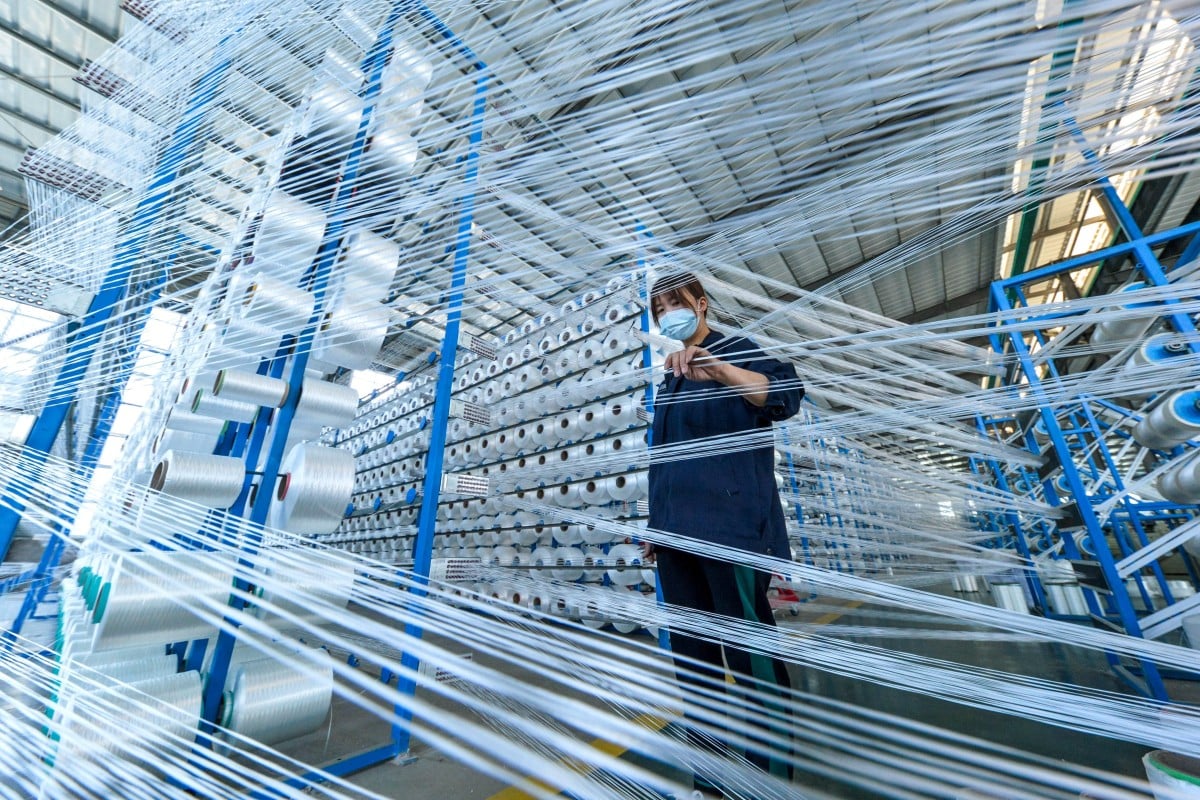
China opted not to set a GDP target for 2020. Photo: Xinhua
Beijing’s decision not to set an annual GDP target for 2020 – for the first time since 2002 – is a sign it is putting stability ahead of growth as part of its preparations for an escalating conflict with the United States.
Economic development has always been the central theme for Beijing since it established diplomatic relations with the US in 1979. But this year it has given priority to job creation and tackling poverty. The coronavirus outbreak might appear to have been the reason for the shift, but the underlying factor is the tension with the US.
Covid-19 offered a preview of what a decoupling of China and US might look like: aircraft grounded, cargo flows disrupted, value chains broken, goodwill and cooperation lost, blame games started.
Both countries have suffered heavy human and economic losses from the coronavirus, yet that did not inspire them to work together. Instead, hostility and rivalry has thrived, and neither wants to blink first.
The Chinese leadership has made it clear to its people that the world will become more dangerous and they must be prepared for hard times. As such, the government is saving its economic policy ammunition.
While the stimulus plans introduced in the US, Germany, Japan and France exceed 10 per cent of their national GDP and interest rates have been cut to the bone, Beijing stopped at just 1 trillion yuan (US$140 billion) worth of special treasury bonds and 1.6 trillion yuan of additional local government bonds. In total, about 2.6 per cent of GDP.
Interest rates in China – 2.7 per cent on 10-year bonds – are some of the highest among major economies.
China’s 6.6 per cent defence spending boost lowest in three decades
23 May 2020
China’s budget fiscal deficit has increased to 3.6 per cent of GDP for 2020, but the larger deficit is mainly from tax and fee cuts instead of increased fiscal expenses, except for an increased military spending.
Beijing is calling on provincial and local authorities to tighten their belts, which is unusual for a government that has huge assets and can increase spending at any time through quantitative easing.
So why is the government, which is known for intervening in the economy, being so restrained?
It is bracing itself for a perceived period of turbulence and hardship as its relationship with the US turns sour. It is putting jobs and social stability on top of its agenda, instead of growth.
Beijing is refraining from excessive spending, eliminating sources of potential instability, making appeals to the most vulnerable social groups, and saving its power for a bigger test.
Against that backdrop, the National People’s Congress passed the national security legislation on Hong Kong. Beijing knew the bill would anger the US, but did it anyway.
Hong Kong is known as China’s gateway to the international capital market and the largest offshore yuan market, but Beijing is ready to trade losses on the financial and economic front for potential gain on a fortified national security fence.
All this points to the suggestion that Beijing is preparing for the possibility of decoupling from the US, even if it doesn’t necessarily want to.
The threat of a new Cold War is clouding the world. The theme of life for one or two generations of people on both sides of the Pacific may shift from growth and prosperity to struggle and confrontation.
China and the US have yet to collide totally, but that moment is drawing near.
Beijing will be watching as leaders of African nations and international organisations gather for development summit in Yokohama later this month
Tokyo is expected to use the conference to articulate how its approach to aid and infrastructure is different from Chinese projects
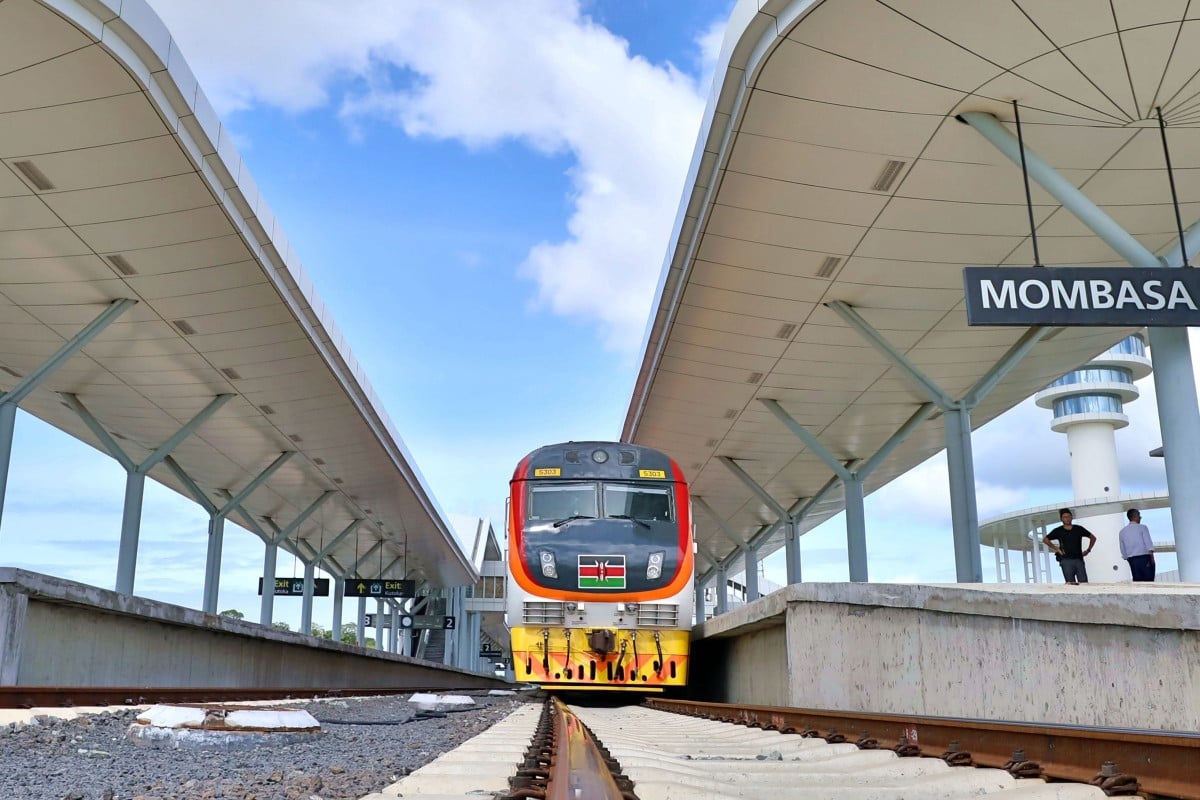
The Mombasa-Nairobi Standard Gauge Railway, funded by China, opened in 2017. Japan has criticised Chinese lending practices in Africa. Photo: Xinhua
The long rivalry between China and Japan is again playing out in Africa, with Tokyo planning to pour more aid into the continent and invest in infrastructure projects there.
Beijing – which has for decades funnelled money into the continent – will be watching as the leaders of 54 African countries and international organisations descend on Yokohama later this month for the seventh Tokyo International Conference on African Development (TICAD).
Japan reportedly plans to pledge more than 300 billion yen (US$2.83 billion) in aid to Africa during the conference. While that might not be enough to alarm China – which in recent years has been on a spending spree in the continent – it will be paying close attention.
Japan has in the past used the meetings to criticise Chinese lending practices in Africa, saying it was worried about the “unrealistic” level of debt incurred by African countries – concerns that China has dismissed.
This year, analysts expect Tokyo will use the conference to articulate how its approach to African development is substantively different from that of the Chinese.
“So, look for the words ‘quality’, ‘transparency’ and ‘sustainability’ to be used a lot throughout the event,” said Eric Olander, managing editor of the non-partisan China Africa Project.
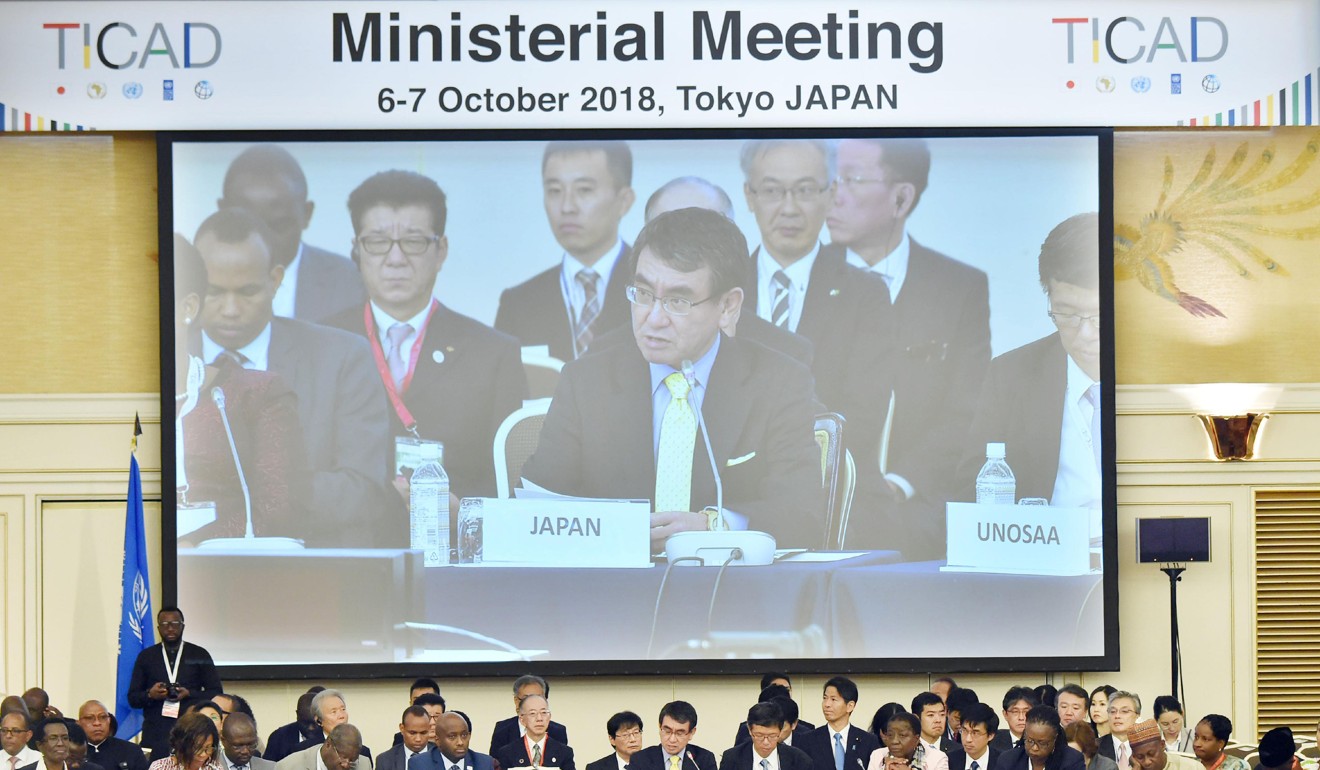
Japanese Foreign Minister Taro Kono gives a speech at the TICAD in Tokyo in October. Japan will reportedly pledge US$2.83 billion in aid to Africa this year. Photo: The Yomiuri Shimbun
Olander said Japan often sought to position its aid and development programmes as an alternative to China’s by emphasising more transparency in loan deals, higher-quality infrastructure projects and avoiding saddling countries with too much debt.
“In some ways, the Japanese position is very similar to that of the US where they express many of the same criticisms of China’s engagement strategy in Africa,” Olander said.
But the rivalry between China and Japan had little to do with Africa, according to Seifudein Adem, a professor at Doshisha University in Kyoto, Japan.
“It is a spillover effect of their contest for supremacy in East Asia,” said Adem, who is from Ethiopia.
“Japan’s trade with Africa, compared to China’s trade with Africa, is not only relatively small but it is even shrinking. It is a result of the acceleration of China’s engagement with Africa.”
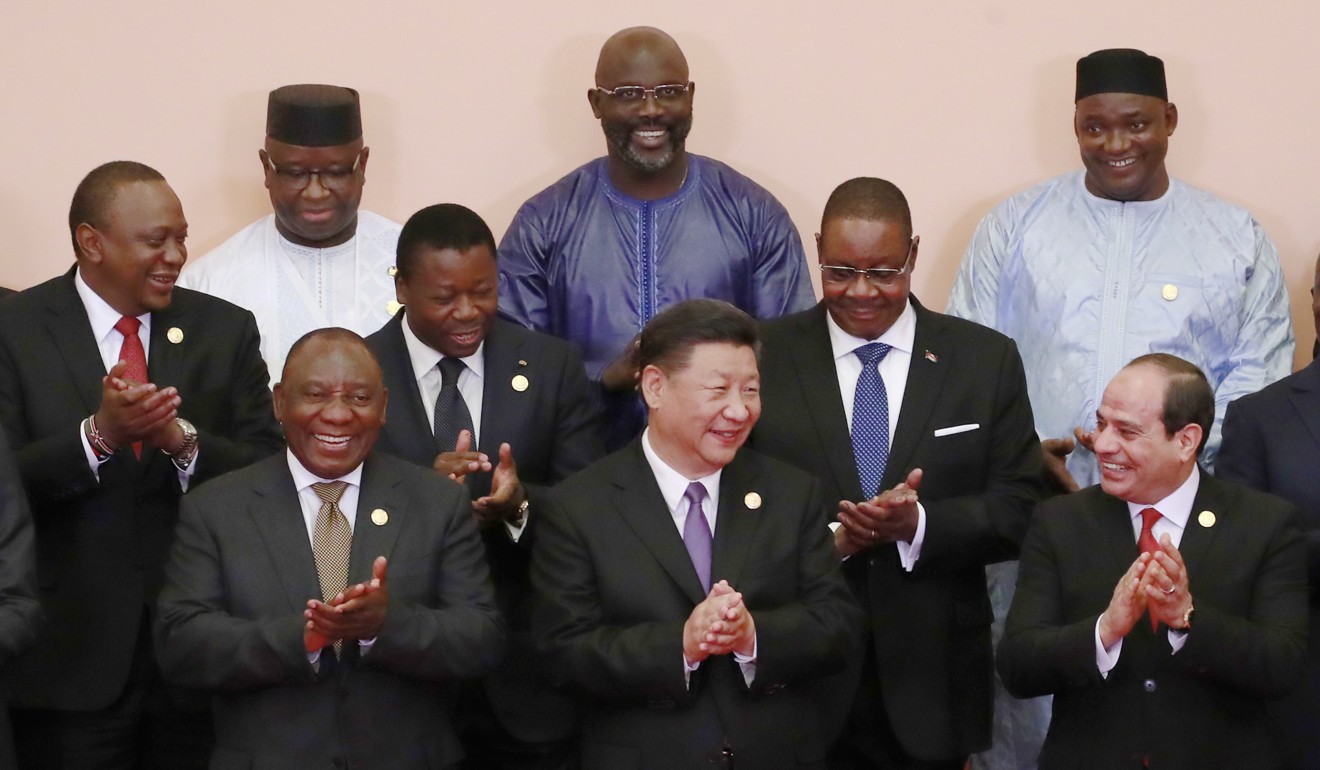
Chinese President Xi Jinping attends a group photo session with African leaders during the Forum on China-Africa Cooperation in Beijing last year. Photo: AP
Japan launched the TICAD in 1993, to revive interest in the continent and find raw materials for its industries and markets for products. About a decade later, China began holding a rival event, the Forum on China-Africa Cooperation.
It is at heart an ideological rivalry unfolding on the continent, according to Martin Rupiya, head of innovation and training at the African Centre for the Constructive Resolution of Disputes in Durban, South Africa.
“China cast Japan as its former colonial interloper – and not necessarily master – until about 1949. Thereafter, China’s Mao [Zedong] developed close relations, mostly liberation linkages with several African nationalist movements,” Rupiya said.
Beijing had continued to invoke those traditional and historical ties, which Japan did not have, he said.
“Furthermore, Japan does not command the type of resources – call it largesse – that China has and occasionally makes available to Africa,” Rupiya said.
Although both Asian giants have made inroads in Africa, the scale is vastly different.
While Japan turned inward as it sought to rebuild its struggling economy amid a slowdown, China was ramping up trade with African countries at a time of rapid growth on the continent.
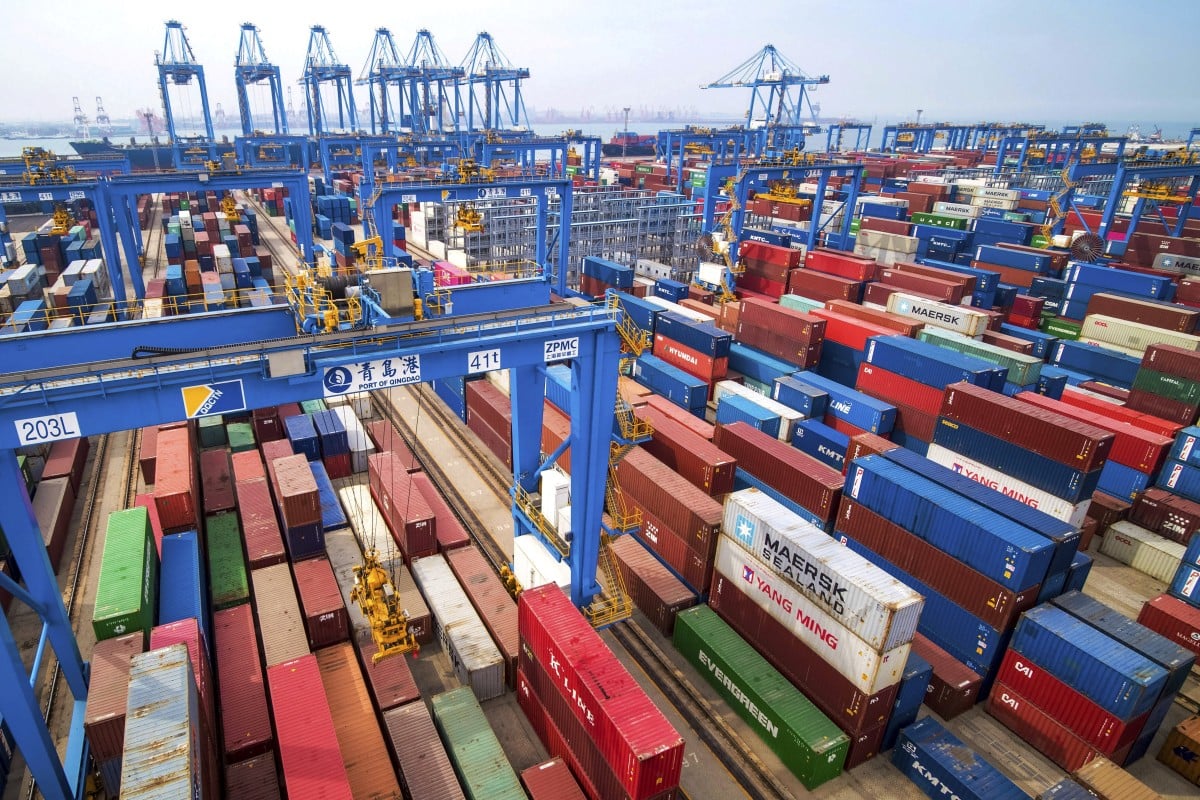
That saw trade between China and Africa growing twentyfold in the last two decades. The value of their trade reached US$204.2 billion last year, up 20 per cent from 2017, according to Chinese customs data. Exports from Africa to China stood at US$99 billion last year, the highest level since the 1990s. Meanwhile, through its Belt and Road Initiative that aims to revive the Silk Road to connect Asia with Europe and Africa, China is funding and building Kenya’s Standard Gauge Railway and the Addis Ababa-Djibouti Railway. Beijing is also building major infrastructure projects in Zambia, Angola and Nigeria.
Japan’s trade with Africa is just a small fraction of Africa’s trade with China. In 2017, Japan’s exports to the continent totalled US$7.8 billion, while imports were US$8.7 billion, according to trade data compiled by the Massachusetts Institute of Technology.
How speaking with one voice could help Africa get a better deal from China
But Japan now appears eager to get back in the game and expand its presence in Africa, and analysts say this year’s TICAD will be critical – both in terms of the amount of money Tokyo commits to African development and how it positions itself as an alternative to the Chinese model.
Ryo Hinata-Yamaguchi, a visiting professor at Pusan National University in South Korea, said the continent was “economically vital to Japan, both in trade and investments”.
“Moreover, Japan has established some strong links with African states through foreign aid,” Hinata-Yamaguchi said.
“Japan’s move is driven by both economic and political interests. Economically, Japan needs to secure and maintain its presence in, and linkages with, the African states while opening new markets and opportunities,” he said.
To counter China’s belt and road strategy, Japan has launched the Asia-Africa Growth Corridor project, an economic cooperation deal, with India and African countries.
Tokyo meanwhile pledged about US$30 billion in public-private development assistance to Africa over three years at the 2016 TICAD, in Nairobi. But China offered to double that amount last year, during its Forum on China-Africa Cooperation in Beijing.
Still, Japan continues to push forward infrastructure projects on the continent. It is building the Mombasa Port on the Kenyan coast, while Ngong Road, a major artery in Nairobi, is being converted into a dual carriageway with a grant from Tokyo.
Japan is also funding the construction of the Kampala Metropolitan transmission line, which draws power from Karuma dam in Uganda. In Tanzania, it provided funding for the Tanzania-Zambia Railway Authority (Tazara) flyover. And through the Japan International Cooperation Agency, Tokyo also helps African countries improve their rice yields using Japanese technology.
There are nearly 1,000 Japanese companies – including carmakers like Nissan and Toyota – operating in Africa, but that is just one-tenth the number of Chinese businesses on the continent.
Are Chinese loans putting Africa on the debt-trap express?
Olander said Japan’s construction companies were among the best in the world, albeit not necessarily the cheapest, and that Tokyo was pushing its message about “high-quality” construction.
XN Iraki, an associate professor at the University of Nairobi School of Business, said Japan wanted to change its approach to Africa on trade, which had long been dominated by cars and electronics.
“[It has] no big deals like China’s Standard Gauge Railway. But after China’s entry with a bang – including teaching Mandarin through Confucius Institutes – Japan has realised its market was under threat and hence the importance of the TICAD, which should remind us that Japan is also there.”
China suggests good progress made in Regional Comprehensive Economic Partnership talks after marathon 10-day negotiations in Zhengzhou
Indian Commerce Minister Piyush Goyal has opted to skip the upcoming high-level meetings, adding fuel to rumours that the country could be removed
The Association of Southeast Asian Nations (Asean) has overtaken the US to become China’s second-largest trading partner in the first half of 2019. Photo: AP
China has claimed “positive progress” towards finalising the world’s largest free-trade agreement by the end of 2019 after hosting 10 days of talks, but insiders have suggested there was “never a chance” of concluding the deal in Zhengzhou.
The 27th round of the Regional Comprehensive Economic Partnership (RCEP) negotiations closed on Wednesday in the central Chinese city.
working level conference brought over 700 negotiators from all 16 member countries to Henan province, with China keen to push through a deal which has proven extremely difficult to close.
If finalised, the agreement, which involves the 10 Asean nations, as well as China, Japan, South Korea, Australia, New Zealand, and India, would cover around one-third of the global gross domestic product, about 40 per cent of world trade and almost half the world’s population.
“This round of talks has made positive progress in various fields,” said assistant minister of commerce Li Chenggang, adding that all parties had reaffirmed the goal of concluding the deal this year. “China will work together with the RCEP countries to proactively push forward the negotiation, strive to resolve the remaining issues as soon as possible, and to end the negotiations as soon as possible.”
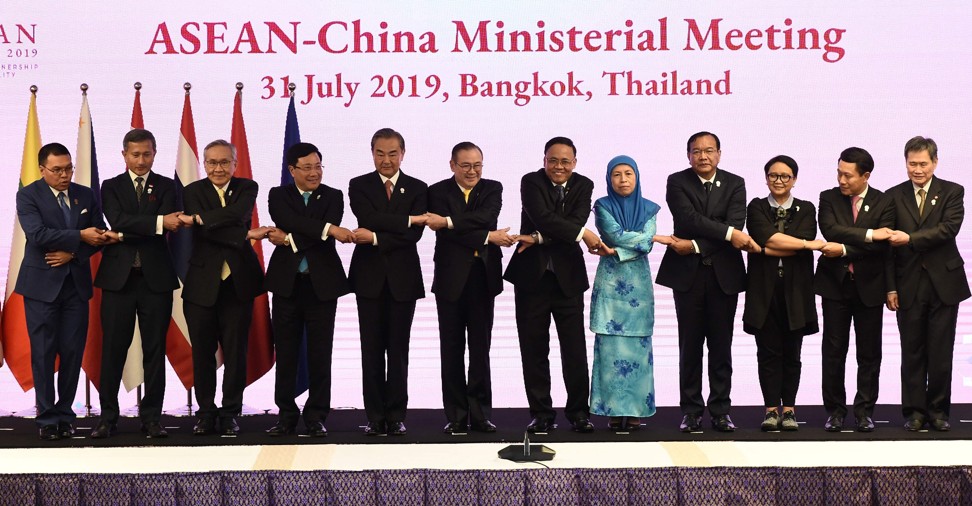
China’s Foreign Minister Wang Yi (fifth left) poses with foreign ministers from the Association of Southeast Asian Nations (Asean) countries during the ASEAN-China Ministerial Meeting in Bangkok. Photo: AFP
China is keen to complete a deal which would offer it a buffer against the United States in Asia, and which would allow it to champion its free trade position, while the US pursues protectionist trade policy.
The RCEP talks took place as Chinese and American trade negotiators resumed face-to-face discussions in Shanghai, which also ended on Wednesday, although there was little sign of similar progress.
As the rivalry between Beijing and Washington has intensified and bilateral trade waned, the Association of Southeast Asian Nations (Asean) overtook the US to become China’s second-largest trading partner in the first half of 2019. From January to June, the trade volume between China and the 10-member bloc reached US$291.85 billion, up by 4.2 per cent from a year ago, according to government data.
The Asean bloc is made up of Indonesia, Thailand, Malaysia, Singapore, Philippines, Vietnam, Myanmar, Cambodia, Brunei and Laos.
China will work together with the RCEP countries to proactively push forward the negotiation, strive to resolve the remaining issues as soon as possible, and to end the negotiations as soon as possible. Li Chenggang
RCEP talks will now move to a higher level ministerial meeting in Beijing on Friday and Saturday, but trade experts have warned that if material progress is not made, it is likely that the RCEP talks will continue into 2020, prolonging a saga which has already dragged on longer than many expected. It is the first time China has hosted the ministerial level talks.
But complicating matters is the fact that India’s Commerce Minister, Piyush Goyal, will not attend the ministerial level talks, with an Indian government official saying that he has to participate in an extended parliamentary session.
India is widely viewed as the biggest roadblock to concluding RCEP, the first negotiations for which were held in May 2013 in Brunei. Delhi has allegedly opposed opening its domestic markets to tariff-free goods and services, particularly from China, and has also had issues with the rules of origin chapter of RCEP.
China is understood to be “egging on” other members to move forward without India, but this could be politically explosive, particularly for smaller Asean nations, a source familiar with talks said.
Deborah Elms, executive director of the Asian Trade Centre, a Singapore-based lobby group, said that after the last round of negotiations in Melbourne between June 22 to July 3 – which she attended – there was “frustration” at India’s reluctance to move forward.
She suggested that in India’s absence, ministers in China could decide to move forward through a “pathfinder” agreement, which would remove India, but also potentially Australia and New Zealand.
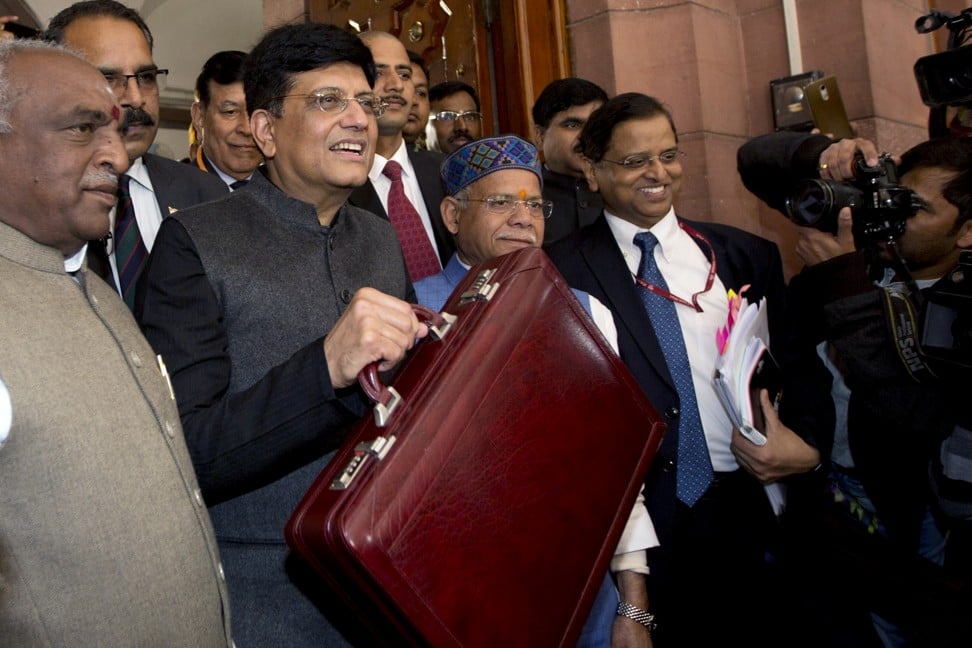
India’s Commerce Minister, Piyush Goyal, will not attend the ministerial level talks this week in Beijing. Photo: Bloomberg
This “Asean-plus three” deal would be designed to encourage India to come on board, Elms said, but would surely not go down well in Australia and New Zealand, which have been two of the agreement’s biggest supporters.
New Zealand has had objections to the investor protections sections of RCEP, and both countries have historically been pushing for a more comprehensive deal than many members are comfortable with, since both already have free trade agreements with many of the other member nations.
However, their exclusion would be due to “an unfortunate geographical problem, which is if you’re going to kick out India, there has always been an Asean-plus three concept to start with”. Therefore it is easier to exclude Australia and New Zealand, rather than India alone, which would politically difficult.
A source close to the negotiating teams described the prospect of being cut out of the deal at this late stage as a “frustrating rumour”, adding that “as far as I know [it] has no real basis other than a scare tactic against India”.
There was “never a chance of concluding [the deal during] this round, but good progress is being made is what I understand. The key issues remain India and China”, said the source, who wished to remain anonymous.
Replacing bilateral cooperation with regional collaborations is a means of resolving the disputesTong Jiadong
However, Tong Jiadong, a professor of international trade at the Nankai University of Tianjin, said Washington’s refusal to recognise India as a developing country at the World Trade Organisation could nudge the world’s second most populous nation closer to signing RCEP.
“That might push India to the RCEP, accelerating the pace of RCEP,” Tong said, adding that ongoing trade tensions between Japan and South Korea could also be soothed by RCEP’s passage.
“Replacing bilateral cooperation with regional collaborations is a means of resolving the disputes between the two countries,” Tong said.
Although the plan was first proposed by the Southeast Asian countries, China has been playing an increasingly active role, first as a response to the now defunct US-backed Trans-Pacific Partnership (TPP), and more recently as a means of containing the impact of the trade war.
China’s vice-commerce Minister, Wang Shouwen, told delegates last week that RCEP was “the most important free trade deal in East Asia”. He called on all participants to “take full advantage of the good momentum and accelerating progress at the moment” to conclude a deal by the end of the year.
East Bengal share the Salt Lake Stadium with rivals Mohun Bagan
Most people would assume an Indian sporting fixture that regularly attracts more than 100,000 people could only be one thing: a game of cricket.
But tell that to the people of Kolkata, who on Sunday gathered at the city’s Salt Lake Stadium for the latest instalment of the ‘Boro Derby’, as East Bengal took on Mohun Bagan in what might well be the most well-attended, fiercely competitive and historically significant derby you’ve never heard of.
This was the 366th meeting of the sides – it has been played 134 more times than the Merseyside derby – and consumes the city, which is regarded as the game’s spiritual home in a country of 1.3bn people.
Here, we take you inside a match steeped in tradition, watched by ‘ultras’ and regarded as a battleground for identity in India’s third-biggest city.
A game with its place in history – and the record books
Mohun Bagan, founded in 1889, are one of the oldest football clubs in Asia. Their landmark victory while playing barefoot over the East Yorkshire Regiment in 1911 was the first time a local club had defeated a European one, ending years of British dominance in the early stages of the game in India.
This victory is considered a key event in India’s fight for independence, so much so that the anniversary of the game on 29 July is recognised annually as ‘Mohun Bagan Day’.
The rivalry was born in 1920, when East Bengal were founded by a frustrated chief executive of Mohun Bagan. Complaining that his team chose not to select a star player for a big game, he decided to start a rival club in the same city, taking the player with him and forming East Bengal.
Like so many classic city rivalries, the derby’s lasting significance is rooted in the battle lines drawn off the pitch between the sides since their first meeting in 1925. The city’s native population has tended to follow Mohun Bagan, with its immigrant communities from the eastern side (modern-day Bangladesh) opting for East Bengal.
This social and political rivalry is at the derby’s heart, dividing the Bengali football population into either the green and maroon of Mohun Bagan or the yellow and red of East Bengal.
Ninety seven years later, the ‘Boro derby’ (‘boro’ meaning ‘big’ in Bengali) has created its fair share of history. Most notably, it holds the record for the highest attended sports fixture in India, with more than 130,000 people watching the 1997 derby, a 4-1 win for East Bengal.
Bhaichung Bhutia, still the only Indian to have played football in England, scored a hat-trick that day. He is the top scorer in the history of the derby with 19 goals, and has notoriously played for both teams during his career.
Bhaichung Bhutia, pictured in action for East Bengal in 2004, joined Bury in 1999
‘Today there are no good words, only bad ones’
Mohun Bagan and East Bengal play in India’s I-League, the older and more traditional of the nation’s two top-flight football divisions. With both teams in the bottom half of the table, this particular meeting was all about local pride.
“I didn’t sleep a minute last night – I never can the night before the derby,” said one of the co-founders of the East Bengal Ultras group.
“All week we’ve been preparing and planning and on the day of the game, hour by hour, it gets more and more tense. If we don’t win the derby, it’s turmoil for us.”
The Ultras unveiled their ‘Tifo’ – “we’ve been making this for the past three days and nights” – strapping the giant rolled-up banner to the roof of a car to be delivered to the stadium.
The Tifo reads: ‘need I say more?’ or ‘do you understand sir?’ and it depicts a Bengali comedian plus sugar, milk and tea. It refers to a classic jibe between the two sides.
“It’s a kind of playful insult to the Mohun Bagan fans,” he continued. “You’ll see for yourselves later on the reaction it gets.”
The derby presents the chance for the fans to compete as well as the players, with the historic identity and class differences taking centre stage.
“People are lovely here usually but on matchdays it’s different,” stated one of the fans, only half jokingly.
“Swearing and insults are part of the Bengali football culture sometimes. Today there are no good words, only bad ones.”
Another fan spoke of how important this game is not just to the Kolkatans, but to the whole identity of the game across the country.
Kolkata is a city of 4.5m people, but its footballing reach spreads across India. There are fan groups for these clubs in states around the nation, and people travel thousands of miles for the derby, not to mention the millions that tune in to live television coverage.
“These two teams are the backbone of Indian football historically, and these games still get more headlines and media coverage than anything else,” he said.
“More people care about this result than about the national team, or pretty much all of the other clubs put together.”
Kolkata becomes a sea of colour on derby day
Fans fill the streets, bringing an unplanned halt to drivers’ progress
Streets closed, insults thrown, riot police watch on
As kick-off drew nearer, the colours of the two teams became increasingly visible, flags held aloft by groups of supporters or fluttered from car windows.
It was a classic pre-match scene but everything was louder, brighter and busier. Street traders painted faces and sold replica shirts as fans shuffled towards the colossal Salt Lake Stadium, the cost of entering a modest 300 Rupees (equivalent to £3.33). Not bad for the biggest derby on the continent.
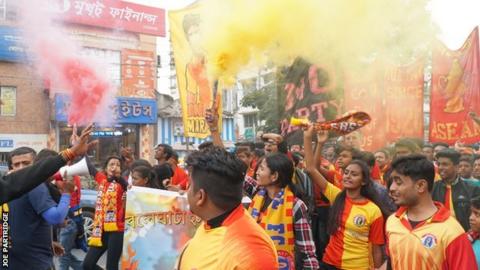
East Bengal’s Ultras completed their signature ‘Corteo’ (procession), with hundreds of fans marching down the main road in a haze of smoke and drums. The streets became unofficially closed, traffic stopping and residents gathering to witness the colourful display.
Countless flatbed trucks and jeeps cruised towards the stadium, full to the brim with standing supporters, waving flags and chanting into loudhalers.
Vehicles full of rival fans found themselves toe to toe in the traffic, exchanging songs and insults as the noise levels grew.
Hordes of riot police watched on, but the mood was one of excitement and anticipation, despite occasional tensions.
‘Who cares about the league? We’ve won the derby!’
Inside the gigantic oval stadium, East Bengal’s ‘Tifo’ drew screeches from the disapproving Mohun Bagan contingent. Everywhere you looked, there were greens, reds and yellows stuck to every surface.
A tense beginning to the game was ended by Mohun Bagan’s opening goal, a well-worked cross leaving an easy tap in for the Mariners. Their half of the ground erupted as the Bengal side fell silent, but they sought revenge swiftly, equalising from a flowing move four minutes later.
The momentum was with the Bengals as the game progressed, and their 44th-minute strike (a sublime scissor-kick finish) saw the red-and-yellow half of the stadium happier as the whistle blew, with the score 2-1 to East Bengal.
Half time was a whirlwind, a trip to the concourse offering a range of pop-up food and drink options, ranging from a blend of Indian snacks to American-style sports refreshments, not to mention replica jerseys for 500 Rupees (just over £5).
There was plenty of food but not a beer in sight as fans buzzed around beneath the stands during the break
The second half was equally frenetic, a combination of beautiful passing moves and scrappy route-one football. A skilful nutmeg from an East Bengal striker led to a scything tackle from Bagan’s captain, already on a yellow card, leaving the Mariners down to 10 men and sending the crowd into a frenzy. When East Bengal scored from the resulting free-kick, the yellow-and-red half of the stadium erupted yet again.
Despite a spirited Mohun Bagan fightback – and a second goal that ensured a nervy final 15 minutes – East Bengal held on for a 3-2 win. It was their first triumph in seven derby matches (spanning 33 months, a fan reliably informed me), and the celebrations that followed lasted long into the Kolkata night.
As the vast Salt Lake Stadium emptied, there were groups clad in red and yellow dancing, singing and embracing one another. Despite the occasional moment of tension (the presence of the police or Mohun Bagan fans often flaring tempers), it was a joyous end to a dramatic and emotional derby day.
“This is what it’s all about,” concluded one of the Ultras group. “For years this game has been the battleground for identity in this city, through times of occupation, independence, war and immigration. It gives us a chance to validate our place here.
“Football is the way we bond, and the way we fight. Who cares about the league or where we finish, because we’ve won the derby again.”
East Bengal’s win took them up to fifth in the I-League, six points adrift of leaders Chennai City
Victory gave East Bengal’s fans a rare chance to celebrate at their rivals’ expense




 CHINDIA ALERT: You'll be living in their world, very soon