Archive for ‘ruling’

29/04/2020

China parliament to open key session on May 22 as epidemic subsides

BEIJING (Reuters) – China announced on Wednesday that its parliament will open a key annual session on May 22, signalling that Beijing sees the country returning to normal after being reduced to a near-standstill for months by the COVID-19 epidemic.

During the gathering of the National People’s Congress in the capital, delegates will ratify major legislation, and the government will unveil economic targets, set defence spending projections and make personnel changes. The ruling Communist Party also typically announces signature policy initiatives.

The session was initially scheduled to start on March 5 but was postponed due to COVID-19, which has infected nearly 83,000 people and killed more than 4,600 on the mainland after emerging late last year in the central city of Wuhan.

As the epidemic has subsided, economic and social life gradually returned to normal, making it possible for the congress to convene, the official Xinhua news agency quoted the standing committee of the NPC, the legislature’s top decision-making body, as saying.

The committee also appointed Huang Runqiu as the new minister for ecology and environment, a post vacated when predecessor Li Ganjie became deputy Communist Party chief for Shandong province earlier this month, Xinhua reported.

Tang Yijun was also named as the new justice minister to replace Fu Zhenghua, who has reached the retirement age of 65 for ministers.

The Chinese People’s Political Consultative Conference (CPPCC), an advisory body to parliament, has proposed starting its annual session a day before the parliamentary session opens.

Analysts expect China to roll out additional fiscal stimulus in order to cushion the blow from COVID-19, which has developed in to a worldwide pandemic that some fear will trigger a severe global recession.

China’s economy contracted for the first time on record during the January-March period, when the government imposed severe travel and transport restriction to curb the spread of the epidemic.

Parliament is also expected to discuss the anti-government protests in Hong Kong, amid growing speculation that Beijing take steps to strengthen its grip on the city.

It is unclear how long parliament and its advisory body will meet for this time, and people familiar with the matter have told Reuters that this year’s annual sessions could be the shortest in decades due to COVID-19 concerns. Usually more than 5,000 delegates descend on Beijing from all over China for at least 10 days.

Beijing city plans to ease quarantine rules as early as Thursday, two sources familiar with the situation told Reuters, ahead of the key political meetings.

People arriving in the capital from other parts of China will no long have to be quarantined for two weeks unless they come from high-risk areas such as Heilongjiang in the north and some parts of Guangdong in the southeast, the sources said.

Source: Reuters
14/11/2019

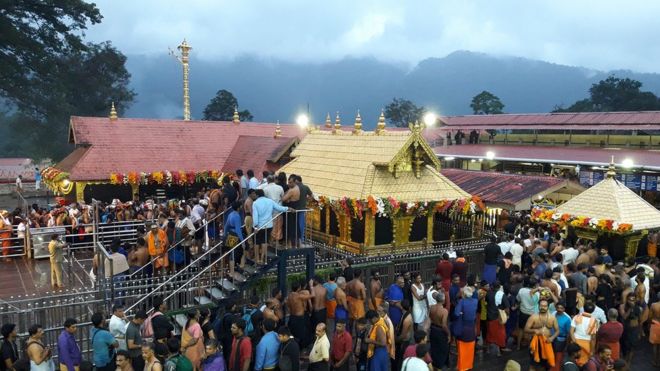
Sabarimala temple: India court to review ruling on women’s entry

Devotees inside the Sabarimala templeImage copyright KAVIYOOR SANTHOSH
Image caption Sabarimala is one of the most prominent Hindu temples in the country

India’s Supreme Court has agreed to review its landmark judgement allowing women of menstruating age to enter a controversial Hindu shrine.

A five-judge bench last year ruled that keeping women out of the Sabarimala shrine in the southern state of Kerala was discriminatory.

The verdict led to massive protests in the state.

Women who tried to enter the shrine were either sent back or, in some cases, even assaulted.

The move is likely to anger women who fought hard to win the right to enter the temple.

Hinduism regards menstruating women as unclean and bars them from participating in religious rituals.

Many temples bar women during their periods and many devout women voluntarily stay away, but Sabarimala had a blanket ban on all women between the ages of 10 and 50.

What did the court say?

On Thursday the five-judge bench, responding to dozens of review petitions challenging the court’s landmark judgement last year, said that the matter would now be heard by a larger bench.

In doing so, however, it did not stay its earlier order. This means women can still legally enter the temple.

But it’s not going to be easy for them.

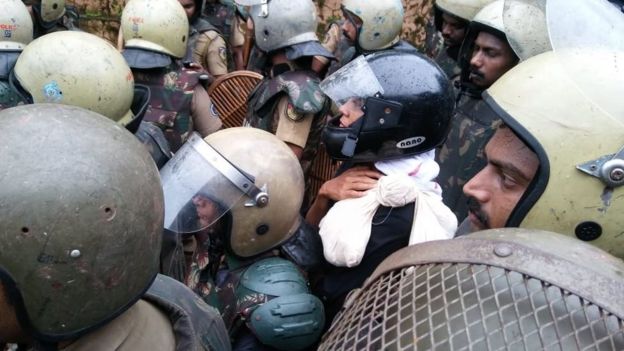
Two women trying to enter the temple in full riot gear
Image caption Some women tried to enter the temple last year

A temple official welcomed the ruling and appealed to women to stay away.

Women trying to enter the temple after the verdict last year were attacked by mobs blocking the way.

Many checked vehicles heading towards the temple to see if any women of a “menstruating age” – deemed to be those aged between 10 and 50 years – were trying to enter.

Following Thursday’s verdict, police in Kerala have appealed for calm, saying that action will be taken “against those who take the law into their own hands”. They added that social media accounts would be under surveillance and those stoking religious tensions online would be arrested.line

‘One step forward, two steps back’

Geeta Pandey, BBC News, Delhi

Today’s verdict will come as a massive disappointment to women’s rights campaigners. It’s a case of one step forward, two steps back.

In 2018, while lifting the ban on women’s entry into the shrine, the Supreme Court had said that everyone had the right to practice religion and that the ban was a form of “untouchability”.

It was seen as a hugely progressive ruling and had given hope to women that they were equal before the law and could now claim equality before the gods too. What happened in court today has taken that sense away.

The Supreme Court has not put its earlier order on hold, but with the ambiguity over women’s entry continuing, it’s very likely they could be kept out in the name of keeping peace.

With the case now to be reopened by a larger seven-judge bench, the fight will have to be fought all over again.line

Why is the temple so controversial?

Part of the violent opposition to the Supreme Court order to reverse the temple’s historical ban on women was because protesters felt the ruling goes against the wishes of the deity, Lord Ayappa, himself.

While most Hindu temples allow women to enter as long as they are not menstruating, the Sabarimala temple is unusual in that it was one of the few that did not allow women in a broad age group to enter at all.

Hindu devotees say that the ban on women entering Sabarimala is not about menstruation alone – it is also in keeping with the wish of the deity who is believed to have laid down clear rules about the pilgrimage to seek his blessings.

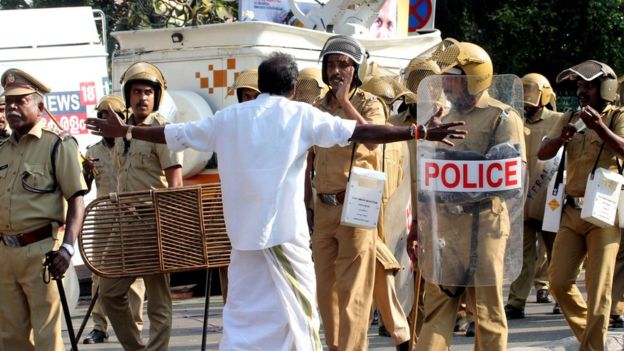
Indian Police patrol during clashes between Communist Party of India (Marxist) (CPM) and Bhartiya Janta Party (BJP) in front of the Kerala Government Secretariat in Thiruvnanthapuram on January 02, 2019Image copyright GETTY IMAGES
Image caption The entry of women into the Sabarimala temple sparked angry scenes

Every year, millions of male devotees trek up a steep hill, often barefoot, to visit the shrine. They also undertake a rigorous 41-day fast, abstaining from smoking, alcohol, meat, sex and contact with menstruating women before they begin the journey.

Women’s rights campaigners who appealed to the Supreme Court to lift the ban said that this custom violated equality guaranteed under India’s constitution. They added that it was prejudiced against women and their right to worship.

Supporters of the ban argued that the practice had been in effect for centuries, and there was no need to change it now.

So, were any women able to enter last year?

In January, two women defied protesters and entered the shrine.

Kanakadurga, 39, and Bindu Ammini, 40, made history when they entered the Sabarimala shrine – but they had to do so under heavy police protection and were also met with massive protests after.

Right-wing groups, supported by India’s ruling Hindu nationalist Bharatiya Janata Party (BJP), demanded a state-wide shutdown after, and businesses and transportation became paralysed.

Across the state hundreds were arrested, and at least one person was killed in clashes.

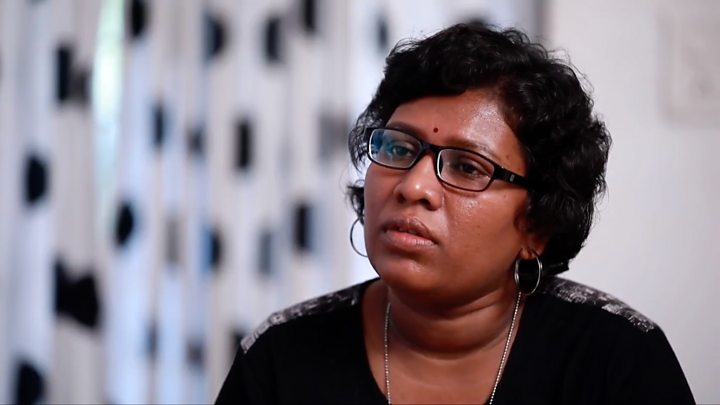
In an interview with the BBC, the women said they felt it necessary to uphold women’s rights and they weren’t afraid of mobs “enraged” by their actions.

Media caption One of the women who defied protesters to enter the Sabarimala temple says she has ‘no fear’

“I am not afraid. But every time women make any progress, society has always made a lot of noise,” Ms Kanakadurga told the BBC in January.

But their decision to enter the temple also came at heavy personal cost.

She alleged that she had been beaten by her mother-in-law and abandoned. She has since filed for divorce.

Source: The BBC

19/10/2019

After parliamentary win, India’s BJP set to sweep state elections-poll

NEW DELHI/MUMBAI (Reuters) – India’s ruling Bharatiya Janata Party (BJP) is set to sweep two state polls next week, the first since Prime Minister Narendra Modi’s landslide win in a parliamentary election in May, a leading pollster said.

The BJP is set to comfortably win elections in the western state of Maharashtra and the northern state of Haryana, leaving the main opposition Congress party trailing, according to a survey by polling agency CVoter released on Friday.

CVoter estimates that a BJP-led alliance in Maharashtra will pick up 194 of the 288 seats on offer. In Haryana, the party is predicted to win 83 of the state’s 90 seats, leaving just three for Congress.

Voting in the elections will be held on Monday with the results expected to be announced on Thursday.

Several Congress party officials conceded they had all but given up hope of posing a serious challenge to Modi and the BJP.

In particular, the resignation of Congress chief Rahul Gandhi in July, after weeks of drama following the loss to the BJP in the general election, has sown internal confusion, triggering infighting and exits, two party officials in New Delhi said.

“It’s going to be a rout, and it will deflate morale even further,” one of the officials said, referring to the state elections. “It’s like a slow-moving disaster.”

They requested anonymity because they are not authorised to speak to the media.

Pranav Jha, the secretary in charge of Congress’s communication department, said the party was undergoing a period of “cleansing and churning” and remained committed to taking on the BJP.

“The people of India…can see through the diversionary drama of the ruling party, and realise that jobs, economy and issues of farmers can only be put on track by the Congress party,” Jha told Reuters.

Modi, analysts say, has moved decisively, including withdrawing special rights for Muslim-majority Jammu and Kashmir state, and consolidating the BJP’s hold over India’s Hindu-majority electorate.

INFIGHTING, INDIFFERENCE

In Maharashtra, one of India’s most industrialised states which includes Mumbai, two Congress officials said the top leadership’s relative indifference and infighting had hurt their already weak campaign.

Congress’s state wing had asked for Gandhi, his mother and current party chief Sonia Gandhi, and his charismatic sister Priyanka Gandhi Vadra to join the campaign, one of the two officials said.

But only Rahul Gandhi came and spoke at a handful of rallies.

“Senior leaders from BJP have covered every district. They have been visiting Maharashtra for the last two months to build momentum,” said one Congress official, who is contesting the upcoming poll.

“There wasn’t any concrete effort from Congress leaders in New Delhi to give energy to our cadre,” he said.

The list of recent resignations from the party include Ashok Tanwar, Congress’s former chief in Haryana who quit earlier this month and is now campaigning against his old party.

“The state of affairs in the Congress party is so dire that the decision makers can’t win an election themselves, while the soldiers on ground who stay in touch with the masses are neglected,” Tanwar wrote in his resignation letter.

The situation has even riled Congress allies. Two leaders from the Nationalist Congress Party, which is in alliance with the Congress in Maharashtra, said their partner was slack.

“It looks like Congress is not very serious about the state elections,” one of the leaders said. “Congress is not in the picture. Congress leaders are not attacking the ruling party the way we expected.”

In New Delhi, Congress officials said there was a sense of inertia at the party headquarters, without any understanding of who will become president after Sonia Gandhi, who is only holding charge temporarily.

“Without a clear leadership, nothing is going to change,” one of the officials said, “If it continues like this, the party will fade away.”

Source:Reuters

10/12/2018

Vijay Mallya should be extradited to India, London court rules

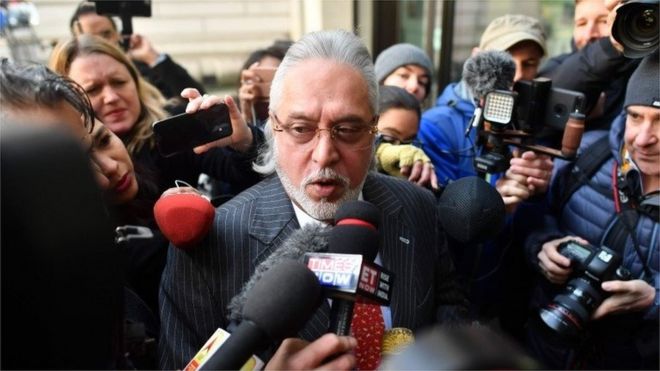
Vijay MallyaImage copyrightAFP/GETTY

Indian business tycoon Vijay Mallya should be extradited from the UK to India where he faces fraud charges, a London court has ruled.

The extradition ruling will be passed to the Home Secretary for approval.

Mr Mallya, whose business empire once included Kingfisher beer, left India in March 2016 after defaulting on debts of more than $1bn (£785m).

He denies “fleeing” from India, and says he made an “unconditional” offer to pay back the sum in full in July.

Mr Mallya attended Westminster Magistrates Court for the hearing.

The businessman’s fall from grace is being avidly tracked in India, where he was once listed as one of India’s wealthiest people.

Mr Mallya built his fortune from Kingfisher beer, before branching out into Indian cricket and Formula 1 racing. He set up the now defunct Kingfisher Airlines in 2005.

He faces a raft of charges relating to financial irregularities at Kingfisher Airlines. His monetary affairs are being investigated by India’s Central Bureau of Investigation and the Enforcement Directorate, which handles financial crimes.


Paul Blake, BBC Business Reporter, Westminster Magistrates Court

Vijay Mallya entered the court surrounded by a scrum of reporters shouting questions in English and Hindi.

As we stood in line for our turn at the x-ray machine, Mr Mallya told me that he believed “clearly this is extremely political, it’s really obvious”.

While awaiting his hearing, Mr Mallya paced around the corridors, intermittently sitting among reporters in the public gallery.

When his case was called, Mr Mallya heard a detailed judgement against him, which concluded with the judge saying he should be extradited to stand trial in India.

From the scrum to the judgement, Mallya appeared calm – relaxed even.

The case is now in the hands of Home Secretary, Sajid Javid.


In 2012, he sold a majority stake in his United Spirits group to UK drinks giant Diageo. The deal was supposed to help Mr Mallya reduce United Spirits’ debts and free up funds for Kingfisher Airlines.

But the airline, which was grounded in 2012, lost its flying permit the following year. It made annual losses for five years in a row and finally collapsed after lenders refused to give it fresh loans.

Mr Mallya’s total debts, including unpaid wages and operating costs, are estimated to exceed $1bn.

He is a high-profile figure who has in the past been called “India’s Richard Branson” and the “King of Good Times” for his lavish lifestyle.

Law of Unintended Consequences

continuously updated blog about China & India

ChiaHou's Book Reviews

continuously updated blog about China & India

What's wrong with the world; and its economy

continuously updated blog about China & India