Archive for ‘sex’

25/11/2019

Priya: India’s female comic superhero returns to rescue ‘stolen girls’

Priya Shakti riding her pet tiger SahasImage copyright PRIYASHAKTI

Comic crusader Priya, a gang-rape survivor who earlier campaigned against rape and acid attack, is back in a new avatar. This time she is fighting the trafficking of girls and women for sex.

The “modern-day female superhero” was first launched in December 2014, exactly two years after the horrific gang rape of a young woman on a bus in Delhi, to focus attention on the problems of gender and sexual violence in India.

In the first edition, Priya Shakti, the tiger-riding heroine challenges the stigma surrounding rape while in Priya’s Mirror, the second edition, she returns to fight acid attacks.

In the latest edition – Priya and the Lost Girls – she takes on the powerful sex-trafficker Rahu, the evil demon who runs an underworld brothel city where he has entrapped many women, including Priya’s sister Lakshmi.

Indian-American actor and writer Dipti Mehta, who wrote the script of the comic, draws on ancient Indian mythology to create larger-than-life fantastical characters and delivers a powerful feminist statement.

The story of Lost Girls begins when the protagonist returns home to find that there are no girls in her village.

She then mounts her flying tiger Sahas (Hindi for courage) and arrives in Rahu’s den. It’s a city ruled by greed, jealousy and lust, where women exist only to serve and please men – and those who resist are turned into stone.
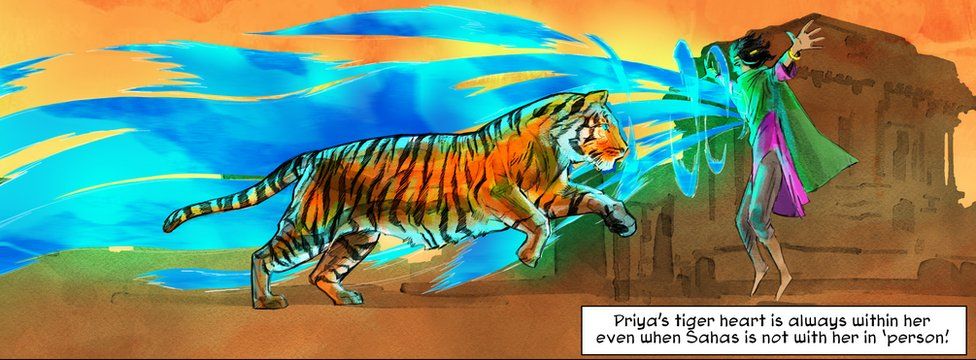
Priya with her tiger SahasImage copyright PRIYASHAKTI

Priya is threatened and attacked, a woman who works for Rahu tries to lure her into the sex trade saying: “If you work for us, you’d serve only five to six men and not 20”, but in the end, good wins over evil and she manages to vanquish Rahu and liberate her sister and all the other trafficked girls.

But victory still eludes her. The families of rescued girls refuse to take them back. The survivors are treated like “lepers”, facing stigma, scorn and ridicule.

But Priya and the other girls stand up to confront patriarchy, says Ms Mehta, “just as women have broken their silence to talk about MeToo”, the campaign against sexual harassment and abuse that started in Hollywood in October 2107 and later spread to many other parts of the world.

“I was very clear from the start that Lost Girls can’t be just another comic book where good guy wins and evil dies, it had to be much more than that,” Ms Mehta says.


Presentational grey line
Priya Shakti in the comicImage copyright PRIYASHAKTI
Presentational grey line

Ram Devineni, the Indian-American creator of the comic series, told the BBC that he had decided to focus on sex trafficking in this edition after visiting Sonagachi, India’s largest red-light area in the eastern city of Kolkata, where he met several women engaged in sex work.

“Half of them told me they had been tricked into coming there and, once there, they were forced into the sex trade. The other half said they’d agreed to do this for a living because they were dirt poor and they had no alternative.

“Often there were two to three women sharing a small dingy room, many of them had young children who lived with them, and some of them said their children slept in the same bed where they serviced clients.

“I found that really disheartening.”

Presentational grey line
Cover of Priya and The Lost GirlsImage copyright PRIYASHAKTIPresentational grey lineAccording to the United Nations Office on Drugs and Crime, human trafficking is the second largest organised criminal business in the world after the arms trade. It is even ahead of the drugs trade.

“It’s a multi-billion-dollar industry,” anti-trafficking activist Ruchira Gupta told the BBC on the phone from New York.

Ms Gupta, who supports trafficked girls and women in India through her charity Apne Aap Women Worldwide, says there are 100 million people trapped in human trafficking globally, of which 27 million are in India alone, and most of the trafficking is in girls and young women.

India, Bangladesh and Nepal, she says, make up “the epicentre” of global sex trafficking.

Ms Gupta, who collaborated on Priya and the Lost Girls, says she plans to take the comic to schools and colleges in India and the US to use it as a talking tool, “as a conversation starter on what is a very difficult topic”.

The only way to fight trafficking, she believes, is to “de-normalise” sex trade – and cinema, art and pop culture are tools that can help do that.

The comic is made to appeal to young people. After its launch, it can be downloaded for free anywhere in the world; it also has “augmented reality features”, which means people can see special animation and movies by scanning the artwork with their smartphones.
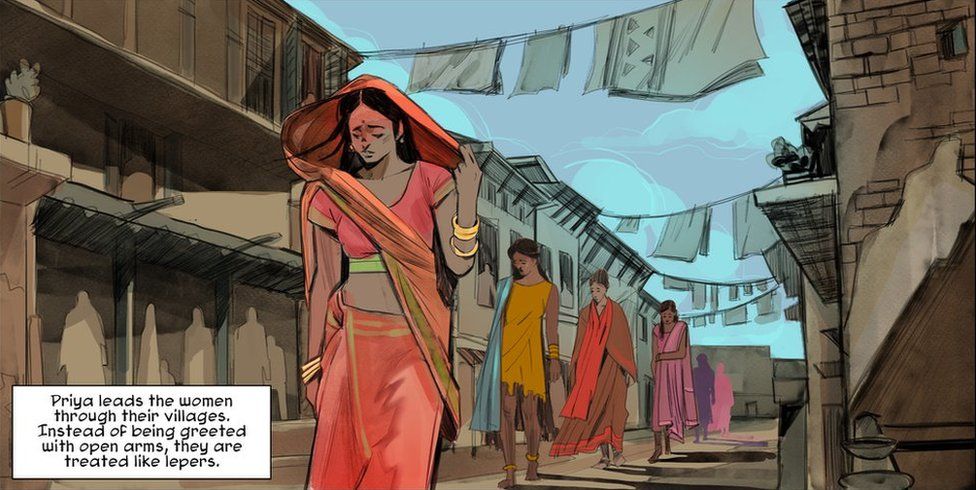
The families of rescued girls refuse to take them back, the survivors facing stigma, scorn and ridiculeImage copyright PRIYASHAKTI

“People often make flippant comments to say that prostitution is the oldest occupation in the world, but they don’t realise that trafficking is not some poor woman getting money in exchange for having sex with a man. It is the extreme exploitation of most vulnerable girls,” Ms Gupta says.

To stop this “commodification” of girls, she adds, we need to create revulsion in men’s minds about sex trade – and it’s best to catch them young.

“We must work with young boys and teenagers, 13 to 14 year olds, through storytelling and pop culture. They learn about sex from porn sites which portray sex workers as happy hookers, and no-one sees the girl behind her.

“I want to demolish that myth of the happy hooker. I want to ensure that people see the girl behind her.”

Artwork by Syd Fini and Neda KazemifarPresentational grey line

You may also be interested in…

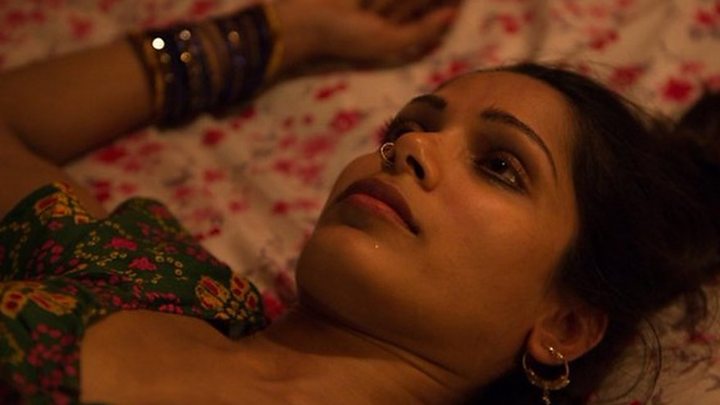
Media caption Freida Pinto: Why I made a film about sex slaves

Source: The BBC

28/12/2018

Why smartphones are skewing young Indians’ ideas of sex

  • 28 December 2018
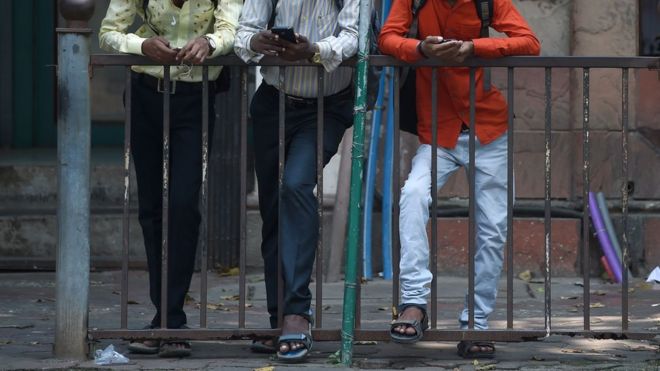
Representational imageImage copyrightGETTY IMAGES
Image captionMaking pornographic material or sharing it is illegal in India

A troubling trend of rape videos going viral in India has led many to believe that smartphones and easy access to violent porn, coupled with a lack of sex education, could fuel sexual violence. The BBC’s Divya Arya reports.

Earlier this year, a video showing a group of teenage boys trying to rip the clothes off a young woman was shared extensively on WhatsApp in India.

In it, she is urging them to stop, using the term “bhaiyya” (Hindi for brother) but they are jeering, laughing, clearly enjoying themselves.

As the video went viral, police were able to establish that it was filmed in a village in the northern state of Bihar. The accused teenagers were arrested.

The arrests caused anxiety in their village in Jehanabad, a four-hour drive from the state capital Patna, where village elders blamed the entire incident on smartphones.

Making pornographic material or sharing it is illegal in India.

But even as it becomes easier to access pornography thanks to cheap data and smartphones, there is concern that this isn’t being accompanied by any meaningful understanding of sex and relationships.

Local boys in the village freely admitted to the BBC that they watched videos of molestation and rape. One 16-year-old said he had seen more than 25 such videos, adding that his friends often shared them on their smartphones.

“Most boys in my class watch these videos together or sometimes by themselves,” another boy said. “It feels fine because everyone does it.”

Experts say this kind of introduction to sex is typical for many Indian men.

Representational image of WhatsApp logoImage copyrightGETTY IMAGES
Image captionWhatsApp is the medium often used to share such videos

“We have not grown up being given sex education or having normal adult conversations about these things,” says filmmaker and writer Paromita Vohra. She runs the website Agents of Ishq (Romance), which encourages open discussions about sex.

“When people only watch violent sexual content, it is very desensitising because they start believing that violence is the only way to get pleasure and that female consent is unimportant.”

India has 400 million smartphone users, and more than half of them use WhatsApp, which is the medium often used to share such videos.

In a statement to the BBC, WhatsApp said: “These horrendous rape videos and child pornography have no place on our platform. That’s why we’ve made it easy to report problems like these so we can take appropriate action, including banning accounts. We also respond to valid legal requests from law enforcement in India to help them investigate crimes.”

Porn ban

Concerned after a case in which some young men gang-raped a schoolgirl after allegedly watching porn on their mobile phones, a court in the northern state of Uttarakhand asked the federal government to reinstate a 2015 ban imposed by the Supreme Court on websites hosting violent pornography.

It had been revoked almost instantly due to widespread protest.

The ban only applies to some 800 websites that contain violent or abusive videos. This does not seem to have had much impact though.

Within days of being blocked, one of the largest pornography websites had already set up a mirror site with a different URL for its Indian market.

But is banning porn the answer?

Many believe it is the lack of sex education that is fuelling the appetite for violent and misogynistic videos. Often, there is no deeper understanding of what a sexual relationship or experience should be for both men and women.

This is something the government tried to change in 2009, when it began its Adolescent Education Programme (AEP). It sought to address changes in adolescence and dispel myths about gender, sexuality, sexually transmitted diseases and drug abuse.

But implementing the programme remains a challenge. At an all-girls school in Jehanabad for instance, the principal had never heard of it.

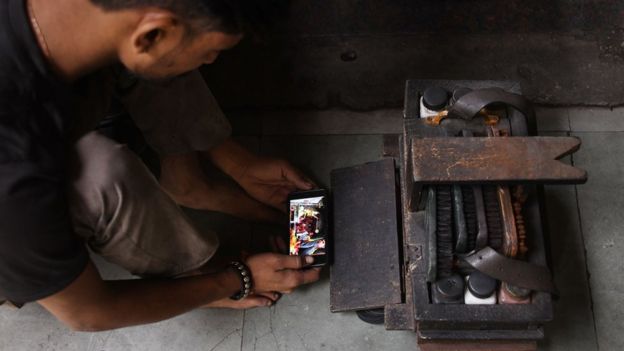
Representational image - A man in Delhi watches a movie on his smartphoneImage copyrightGETTY IMAGES
Image captionMany say it is the lack of sex education that is behind the proliferation of violent videos

Huge market

Sunita Krishnan, the founder of Prajwala, an organisation in the southern city of Hyderabad that deals with issues of sexual violence and trafficking says these violent videos reinforce the old belief that a woman’s choice is insignificant and she has no agency.

Ms Krishnan, a rape survivor herself, has also received such videos and has been campaigning to check their spread. In fact, the 2015 Supreme Court ban on porn sites was a result of her efforts.

Even though she has managed to get a few of these videos taken down, she says it can be near impossible to completely erase something from the internet.

Ranjeet Ranjan, who is one of only three women amongst Bihar’s 40 MPs, says the lack of concern about such videos is alarming.

“No-one really cares. If people had even a little respect for these girls, they would have gone to the police station instead of sharing such videos,” she said.

Ms Ranjan is also concerned by what she sees as “a competition” to make such videos.

“If these continue to circulate and we have no sex education, then it will embolden the thinking that a woman should be treated as an object, a source of entertainment.”

Law of Unintended Consequences

continuously updated blog about China & India

ChiaHou's Book Reviews

continuously updated blog about China & India

What's wrong with the world; and its economy

continuously updated blog about China & India