Chindia Alert: You’ll be Living in their World Very Soon
aims to alert you to the threats and opportunities that China and India present. China and India require serious attention; case of ‘hidden dragon and crouching tiger’.
Without this attention, governments, businesses and, indeed, individuals may find themselves at a great disadvantage sooner rather than later.
The POSTs (front webpages) are mainly 'cuttings' from reliable sources, updated continuously.
The PAGEs (see Tabs, above) attempt to make the information more meaningful by putting some structure to the information we have researched and assembled since 2006.
A Long March-11 solid propellant carrier rocket is launched from a mobile launch platform in the Yellow Sea off east China’s Shangdong Province, June 5, 2019. China successfully launched a rocket from a mobile launch platform in the Yellow Sea off Shandong Province on Wednesday, sending two technology experiment satellites and five commercial satellites into space. A Long March-11 solid propellant carrier rocket blasted off at 12:06 p.m. from the mobile platform. It is China’s first space launch from a sea-based platform and the 306th mission of the Long March carrier rocket series. (Xinhua/Zhu Zheng)
QINGDAO, June 5 (Xinhua) — China successfully launched a rocket from a mobile launch platform in the Yellow Sea off Shandong Province on Wednesday, sending two technology experiment satellites and five commercial satellites into space.
A Long March-11 solid propellant carrier rocket blasted off at 12:06 p.m. from the mobile platform. It is China’s first space launch from a sea-based platform and the 306th mission of the Long March carrier rocket series.
The rocket is also named “CZ-11 WEY” under an agreement between the China Academy of Launch Vehicle Technology, China Space Foundation and a Chinese automobile producer.
Launching a carrier rocket from an ocean-based platform has many advantages over a land launch.
The closer to the equator a rocket launch can get, the greater the speed boost it will receive. It reduces the amount of energy required to get into space and means that less fuel is required.
The launch site is flexible and falling rocket remains pose less danger. Using civilian ships to launch rockets at sea would lower launch costs and give it a commercial edge.
The seaborne launch technology will meet the growing launch demand of low inclination satellites and help China provide launch services for countries participating in the Belt and Road Initiative, according to experts.
The two satellites, developed by China Academy of Space Technology, are expected to step up all-weather monitoring of ocean wind fields and improve typhoon monitoring and accuracy of the weather forecast in China.
Among the five commercial satellites, the two satellites, developed by China Electronics Technology Group Corporation, are China’s first small satellite system based on Ka-band.
The Long March-11, developed by China Academy of Launch Vehicle Technology, is the only rocket using solid propellants among China’s new generation carrier rockets. It is mainly used to carry small satellites and can take multiple satellites into orbit at the same time.
Unveiled in Shandong, prototype will be a first step towards ground-breaking high-speed travel that will rival passenger jets, project engineer says
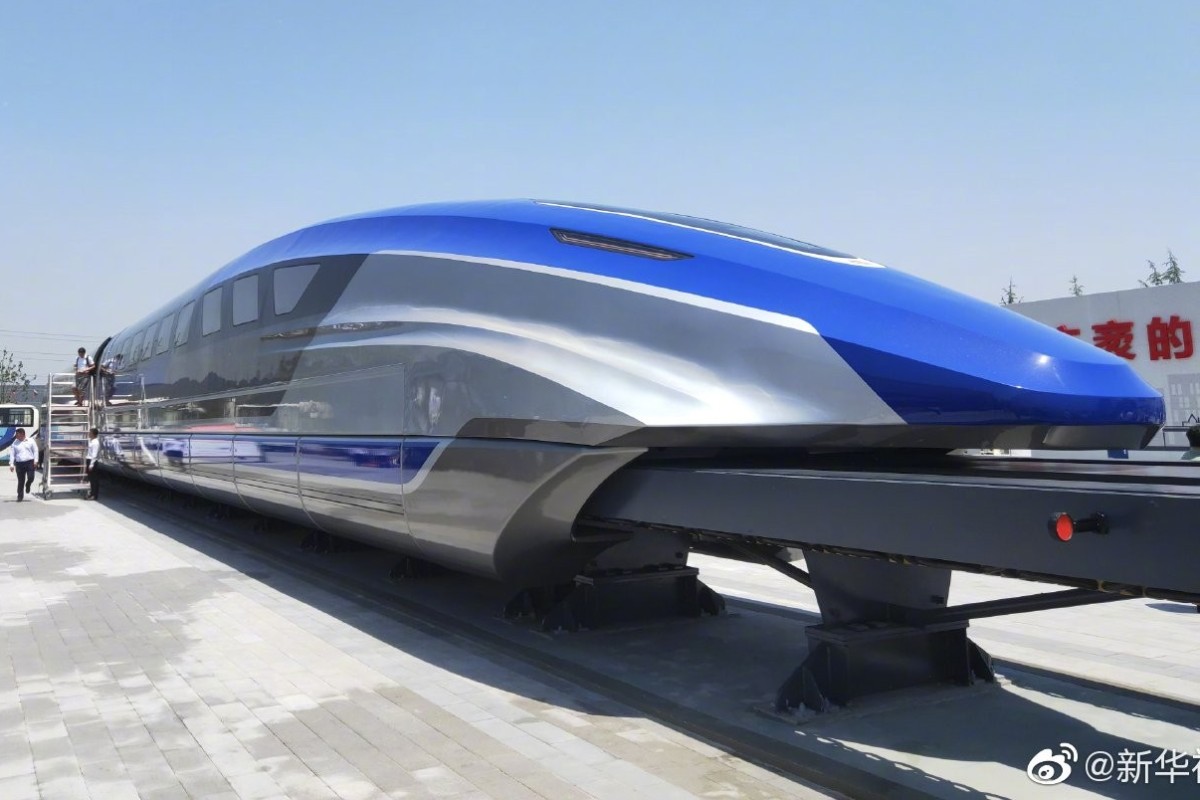
One possible future for rapid transport in China is unveiled in the form of a magnetic levitation train at Qingdao in Shandong province. Photo: Weibo
An experimental magnetic levitation train capable of travelling at 600km/h went on show at Qingdao in eastern Shandong province on Thursday, state media said.
Powerful electromagnets hold the Qingdao prototype at a thumb’s width from the rail, giving a quiet, smooth ride at speeds close to those involved in air travel, developers said.
While China operates the world’s fastest conventional train service, which can reach a speed of 350km/h, the Shanghai Maglev has been in commercial operation since the end of 2002 and can reach a top speed of 430km/h. It operates on one 30-kilometre (19-mile) line between two stations.
Ding Sansan, deputy chief engineer with developer the CRRC Sifang Corporation, said China achieved breakthroughs in maglev technology during the “three-year-battle” to build the new train that involved cooperation between more than 30 enterprises, universities and government research institutes.
The construction of a train body with ultra-lightweight, high-strength materials was a challenge, Ding said. Complex physical problems created by high speeds also needed to be solved in new ways if the Qingdao prototype was to reach peak performance.
China was a leader in technologies that included suspension, guidance, control and high-powered traction, Ding told Qingdao Daily.
“The test vehicle has been powered up and is in good order,” Ding was quoted by the newspaper as saying.
Chinese maglev train capable of travelling at 600km/h on track for 2020 test run as design completed
The prototype promised to eliminate the advantages jet passenger planes had over ground vehicles over a distance of 1,500km, he said.
Taking Beijing-to-Shanghai by plane as an example, Ding suggested: “It takes about four-and-a-half hours by plane including preparation time for the journey; about five-and-a-half hours by high-speed rail, and [would] only [take] about three-and-a-half hours by maglev.”
While earlier reports suggested the prototype was expected to begin full-scale testing by 2020, it was unclear what Thursday’s unveiling meant for this timetable.
China’s latest prototype high-speed maglev train factors the comfort of paying customers into its test operations. Photo: Weibo
More maglevs would join the development project in the coming months, the team leader was quoted as saying, while mass production of the technology was likely by 2021.
In contrast to the optimism of the team at Qingdao, Chen Peihong, professor of economics at Beijing Jiaotong University and a transport analyst, was more circumspect about the future of maglev trains.
“The market has to be bigger. Technology alone cannot make [the concept] a success,” she said.
Plane or train: as high-speed rail link connects Hong Kong to 44 mainland Chinese cities, what are cheapest and fastest ways to get where you are going?
Public transport relied heavily on economies of scale, Chen said. Chinese cities including Jinan, Hangzhou and Chongqing were considering maglev lines, but even the longest – from Jinan to Taian – would not exceed 50 kilometres.
Chen said that electromagnetic fields from maglevs were greater than those from the lines that powered high-speed trains, while environmental worries might keep maglevs out of densely-populated areas.
There was a debate in China in the early 2000s about the benefits of a developing a maglev compared to high-speed rail, researchers on that project said. Rail was preferred by the government because it was an established technology and one that was cheaper to realise.
By the end of last year, China’s high-speed rail network extended to most of the country at a distance in excess of 29,000 kilometres, according to government figures, twice as long as the rest of the world’s high-speed rail lines combined. Spain’s high-speed AVE network was the second-longest at 3,100km.
Elsewhere, researchers in Chengdu, Sichuan province, said a vehicle inside a vacuum tube powered by a superconductor coil from a maglev train – a hyperlink – was in development. They expected the vehicle to reach speeds in excess of 1,000km/h as air was pumped from the tube and resistance to the speeding object gradually eliminated.
BEIJING, May 30 (Xinhua) — Chinese and Russian military forces have maintained in-depth exchanges in 2019 to mark the 70th anniversary of the establishment of diplomatic ties between the two countries, the Ministry of National Defense said Thursday.
They have engaged in cooperation in high-level exchanges, real-combat training and military competitions, and had sound interaction and collaboration on international multilateral occasions, the ministry’s spokesperson Wu Qian said at a press conference.
Armies of the two countries have provided positive energy for safeguarding world peace and regional stability, Wu added.
Speaking of the joint naval exercise earlier this month in Qingdao, east China’s Shandong Province, Wu said the drill achieved a new high in making China-Russia joint naval exercises more real combat-oriented, information-based and standardized.
The two navies have also strengthened their capabilities of joint command and addressing maritime security threats, Wu said.
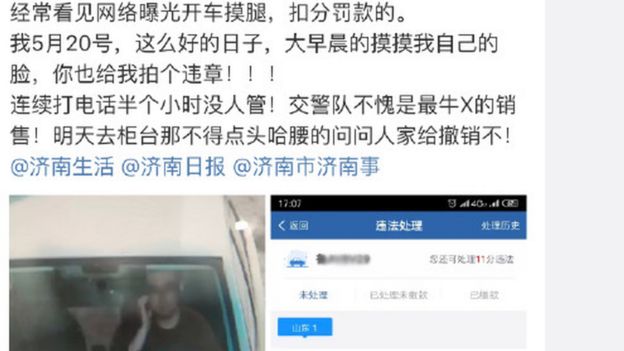
The next thing he knew, he’d received a notification instructing him that he had violated the laws of the road for “driving while holding a phone”. A surveillance picture of his “offence” was attached.
He was told that he would receive two points on his licence and was also ordered to pay a 50 yuan (£5.70; $7.25) fine.
“I often see people online exposed for driving and touching [others’] legs,” he said on the popular Sina Weibo microblog,” “but this morning, for touching my face, I was also snapped ‘breaking the rules’!”
He shared the surveillance picture of himself that he had been sent, and said that he was going to go the authorities to try to sort the situation, after “no one would help him” over the phone.
Image copyright SINA WEIBOImage caption Mr Liu shared his surveillance photograph on social media
The Global Times newspaper says that the city’s traffic authority have now cancelled his ticket, and told him that “the traffic surveillance system automatically identifies a driver’s motion and then takes a photo”, which is why his face-scratching had been mistaken for him taking a phone call.
While many online are amused by his case joking that the positioning of his hand signalled he certainly appeared to be on an “invisible” phone, some are also voicing their concerns about the level of surveillance placed on them.
“This is quite embarrassing,” says one, “that monitored people have no privacy.”
“Chinese people’s privacy – is that not an important issue?” another asks.
Many are fitted with artificial intelligence including facial recognition technology, and whereas some can read simple faces, others can estimate age, ethnicity and gender.
Parent posts photos of son’s bruised bottom and it is claimed pupils are too scared to go to school
Education authority says teacher is under investigation
The education authority said the teacher was under investigation. Photo: Shutterstock
A primary school teacher in eastern China has been sacked and detained for hitting a young boy on the bottom with a stick over 100 times, education authorities have said.
The teacher, surnamed Han, was dismissed by No 2 Experimental Primary School in Tancheng county, Shandong, the county’s education and sports bureau announced.
The boy, a first-year pupil surnamed Wang, sustained minor injuries from Han’s corporal punishment, the bureau said on Thursday in a post on Weibo, China’s equivalent of Twitter.
One of the boy’s parents posted pictures of his red and swollen bottom on social media. “It’s a shock to me,” they wrote, according to news outlet The paper. “I wish it were possible to take my son’s place to be beaten 100 times.”
Chinese kindergarten teachers arrested after camera shows beatings
A Weibo post by someone who said they lived in the county claimed the teacher had beaten the boy in a classroom on Tuesday after telling him to bend over so that he could strike the boy’s hip more easily.
One of the boy’s parents posted pictures of his bruises on social media. Photo: Weibo
“Now the students in that class are too scared to go to school,” they wrote.
The paper reported that, at a meeting between school staff and the boy’s parents, the principal blamed Han but acknowledged that the school, too, had been responsible. The principal did not say whether the school would compensate the boy, according to the report.
Han’s actions were being investigated jointly by the local police and education authorities.
Kindergarten teacher accused of stepping on child’s face, abusing two others
It is not rare for allegations to surface about mainland China’s pupils being beaten by teachers for making mistakes at school.
Last December, a primary school teacher from Huating in Gansu province was suspended and investigated for allegedly using a plastic water pipe to beat a third-year pupil who could not remember English words correctly, leaving the boy’s arms swollen and bruised, according to The Beijing News.
A maths teacher in Chenzhou, in Hunan province, was sacked and investigated in 2017 for allegedly lashing the bottom of a 10-year-old boy with a bamboo whip for three consecutive days for not finishing his homework, news portal qq.com reported.
Local officials have devised creative ways to cover up their lack of action on tackling pollution
Falsified monitoring information risks directing clean-up efforts away from where they are needed most
China’s efforts to cut pollution are being hampered by local officials who use creative methods to hide their lack of action. Photo: Simon Song
China’s notoriously lax local government officials and polluting companies are finding creative ways to fudge their environmental responsibilities and outsmart Beijing’s pollution inspectors, despite stern warnings and tough penalties.
Recent audit reports covering the past two years released by the environment ministry showed its inspectors were frequently presented with fake data and fabricated documents, as local officials – sometimes working in league with companies – have devised multiple ways to cheat and cover up their lack of action.
Local governments have been under pressure to meet environmental protection targets since Chinese President Xi Jinping made it one of his top three policy pledges in late 2017.
The performance of leading local officials is now partly assessed by how good a job they have done in cleaning up China’s much depleted environment.
According to the reports released this month by the Ministry of Ecology and Environment, pollution inspectors have found evidence in a number of city environmental protection bureaus of made-up meeting notes and even instructions to local companies to forge materials.
Cao Liping, director of the ministry’s ecology and environment law enforcement department, said many of the cases uncovered were the result of officials failing to act in a timely manner.
“In some places, local officials didn’t really do the rectification work. When the inspections began, they realised they didn’t have enough time, so they made up material,” he said.
China ‘still facing uphill struggle in fight against pollution’
While some officials are covering up their inaction, others are actively corrupt. According to Guangzhou’s Southern Weekend, since 2012 there have been 63 cases involving 118 people in the environment protection system involved in corruption.
In the southwest province of Sichuan, 32 current and former employees of Suining city’s environmental protection bureau were found to be corrupt, raking in illicit income of 6.32 million yuan (US$900,000).
Fabricated notes
The party committee of Bozhou district in Zunyi, Guizhou province in southern China, was found to have fabricated notes for 10 meetings – part of the work requirement under the new environmental targets – in a bid to cheat the inspectors.
The case was flagged by the environment ministry in a notice issued on May 10, which said party officials in Bozhou lacked “political consciousness … the nature of this case is very severe”.
Watering down results
Environmental officials in Shizuishan, in the northwest region of Ningxia, tried to improve their results in December 2017 by ordering sanitation workers to spray the building of the local environmental protection bureau with an anti-smog water cannon.
The intention was to lower the amount of pollutant particles registered by the building’s monitoring equipment.
The scheme may have gone undetected if the weather had been warmer but the next day a telltale layer of ice covered the building and the chief and deputy chief of the environmental station in the city’s Dawokou district were later penalised for influencing the monitoring results.
1 million dead, US$38 billion lost: the price of China’s air pollution
Similar tactics were deployed in Linfen, in the northern province of Shanxi in March 2017, when former bureau chief Zhang Wenqing and 11 others were found to have altered air quality monitoring data during days of heavy pollution.
The monitoring machine was blocked and sprayed with water to improve the data and Zhang was also found to have paid another person to make sure the sabotage was not captured by surveillance camera.
According to the environment ministry, six national observation stations in Linfen were interfered with more than 100 times between April 2017 and March 2018. In the same period, monitoring data was seriously distorted on 53 occasions.
Zhang was sentenced to two years in prison in May last year for destroying information on a computer.
Bad company
A ministry notice on May 11 flagged collusion by local officials and businesses in Bozhou in southeast China’s Anhui province. Companies were given advance notice of environmental inspections, with instructions to make up contracts and temporarily suspend production in a bid to deceive inspectors.
In Henan province, central China, inspectors found a thermal power company had been using a wireless mouse to interfere with the sealed automatic monitoring system. They were able to remotely delete undesirable data, eliminating evidence of excessive emissions, and only provided selective data to the environment bureau.
Officials in Shandong reprimanded for failing to cut pollution
In another case, from 2017, an environmental inspection group in Hubei province, central China, found a ceramics company had been working with the data monitoring company to alter automatically collected data on sulphur dioxide emissions.
Criminal offence
Cao said that while the cheating by grass-roots officials was serious, the involvement of companies in falsifying data was a major issue that made the work of inspectors even harder.
“Some fraudulent methods are hidden with the help of high technology, so it’s hard for us to obtain evidence. Besides, the environment officials are not totally familiar with these technologies,” he said.
The environment ministry was working on solutions to the problems, he said, adding that falsifying monitoring data was now a criminal offence.
Fake data was particularly serious, he said, because it could directly influence his department’s decisions about where to deploy resources.
Wang Canfa, an environmental law expert at the China University of Political Science and Law, said the problem of fake data could damage the government’s credibility but also prevent it from taking measures in time.
“If the water pollution or air pollution is severe in one place but the local government has said it’s not a big deal, then the investment needed to control the situation might go to other places,” he said.
Zhou Ke, a professor of environment and resources law at Renmin University, said there was an incentive for local officials to cheat because the inspection results were directly related to their career prospects.
Officials ended up cheating or forging materials to protect local interests or their own political achievements, he said.
Man hits glass with emergency hammer because ‘he had been drinking and felt ill’
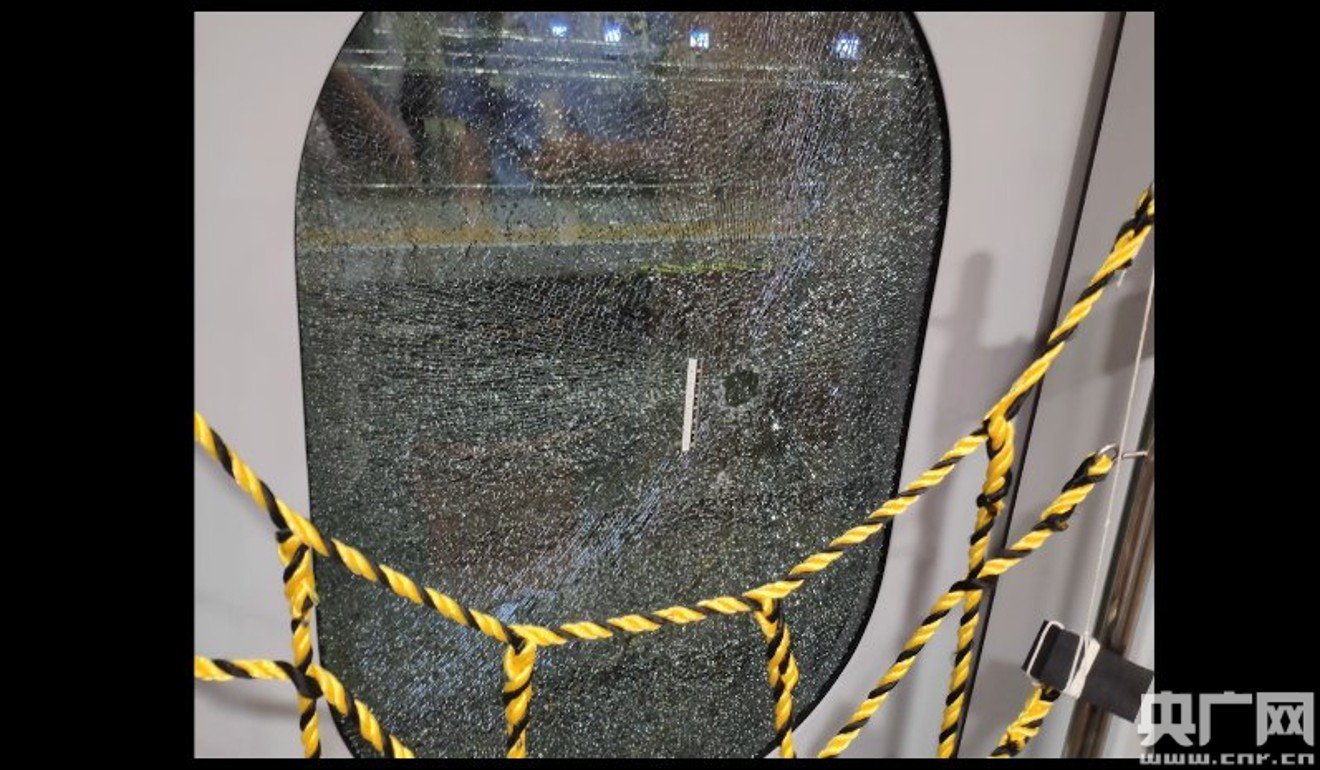
The train passenger tried to smash a hole in the door glass to let in some fresh air, according to Chinese media. Photo: CNR
Chinese railway police detained a passenger after he tried to smash the door window of a high-speed train to “get some fresh air” according to mainland media reports.
The 30-year-old man, identified only by his surname Xu, said he tried and failed to unlock the door and then decided to break the glass with an emergency hammer because he had been drinking and felt sick, China National Radio reported on Saturday.
Xu tried to smash the door after mechanical failure had forced the Beijing-bound train from Shanghai to stop at the main railway station in Jinan in Shandong province on Tuesday.
He said the train had been stranded for half an hour when he became impatient and wanted to have some fresh air, according to the report.
A Chinese train passenger attacked the door glass of a high-speed train as it was stranded in Jinan. Photo: CNR
Surveillance footage showed the man pulling on the door handle before hitting the glass with an emergency hammer mounted on a train wall.
Train staff quickly intervened and stopped Xu, who was taken into police custody after the train arrived in Beijing.
“I just smashed it once. I assumed this would allow air to come in, so I stopped,” Xu was quoted as saying.
“I felt unwell at that moment because I had been drinking at lunchtime. I did it on impulse.”
He was detained for allegedly intentionally damaging property, an offence that could lead to up to three years in jail.
The incident comes just a few months after a woman
Major highways gridlocked for hours at start of four-day break
Chaos at railway stations as ticket-holding passengers turned away
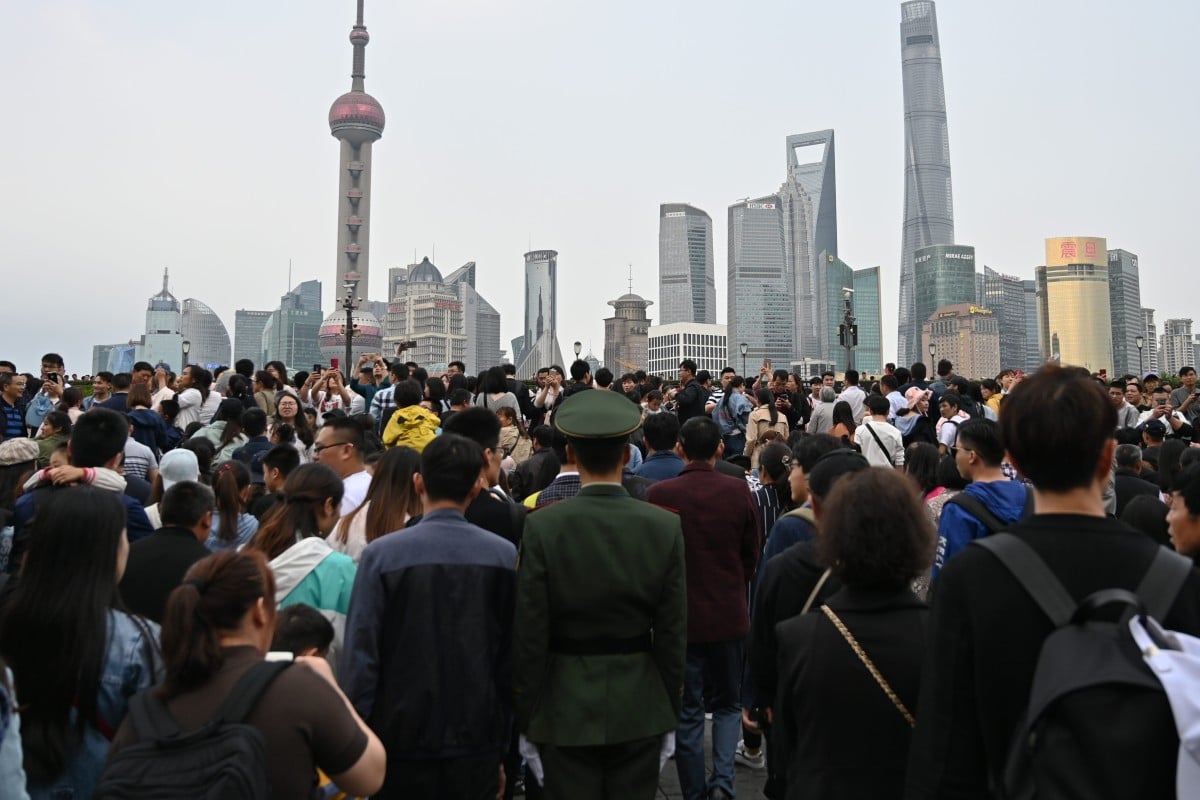
Holiday crowds pack the promenade on the Bund along the Huangpu River in Shanghai on the first day of China’s May break. Photo: AFP
China’s Labour Day holiday started on Wednesday with gridlocked roads and chaos at railway stations as millions of people took advantage of this year’s unusually long break.
Motorists reported being stuck in traffic jams which did not move for hours, while ticket-holding passengers were turned away from some trains due to severe overcrowding on the first day of the holiday.
Travel agency Ctrip estimated that around 160 million domestic tourists would be travelling over the four-day break, according to data from travel booking platforms.
Forty major highways recorded a 75 per cent spike in traffic on Wednesday, according to Xinhua, as toll fares for cars were suspended for the holiday.
Tourists enjoy the first day of China’s four-day May holiday on a beach in Haikou, Hainan province, southern China. Photo: Xinhua
Monitoring stations on major routes – including the Beijing-Tibet Expressway, the Shanghai-Shaanxi Expressway, Shanghai’s Humin Elevated Road and the Beijing section of the Beijing-Hong Kong-Macau Expressway – recorded a 200 per cent increase in traffic from Tuesday onwards, Xinhua said.
The Ministry of Public Security’s traffic management bureau has warned holiday motorists to drive safely, especially on winding mountainside routes.
Online news portal The Paper reported on Thursday that traffic jams on some major routes were so severe that the drive from Shanghai to Hangzhou, capital of neighbouring Zhejiang province, took some travellers seven hours instead of the usual two.
Passengers board the train at Chongqing North Railway Station in southwest China on Tuesday, hoping to beat the May holiday travel rush. Photo: Xinhua
Meanwhile, more than 54,000 tourists visited the popular Badaling section of the Great Wall on Wednesday, according to Beijing Youth Daily. The attraction’s management team had increased the number of volunteers, parking spaces and shuttle buses to prepare for the influx, the report said.
More than 53,000 tourists had visited the Shanghai International Tourism Resort and Shanghai Disneyland by 4pm on Wednesday, according to data from the Shanghai municipal government’s real-time visitor tracker. The Shanghai Zoo attracted more than 24,000 people, and more than 9,200 visited the Shanghai Science and Technology Museum.
Despite the crowds, no records were broken at the Shanghai attractions, which reached about 70 per cent of their maximum visitor numbers recorded, The Paper reported.
At railway stations, ticket-holding passengers were stopped from boarding trains between Nanjing and the city of Zibo in Shandong province, eastern China, due to severe overcrowding, Beijing Youth Daily reported on Wednesday.
Station staff promised full refunds to customers with pre-booked tickets who were refused entry.
Two men detained and a third wanted over destruction of formation at scenic spot that took millions of years to take shape
The men took turns to batter off the stalactite with a rock. Photo: Weibo
Police in eastern China arrested two men and are looking for a third who allegedly broke off a 4 million-year-old stalactite in 30 seconds before taking it from the cave where it had been on display.
Surveillance camera footage taken in the Natural Underground Gallery in Yishui county, Shandong province, on April 21 showed three men taking turns to hit the stalactite with a rock to break it off, news site Iqilu.com reported on Tuesday.
“We call that part of the stalactite the Lovebird, and Geography of China, a programme on China Central Television, came last year specially to report on the Lovebird,” Yang Feng, an executive at the gallery, told Shandong Business Daily.
“[The men] took a large rock to break the stalactite and caused serious damage. Now the tail of the Lovebird is gone.”
China, too, has lessons to learn from US terracotta warrior vandalism case, experts say
Yang said he could not put a monetary value on the stalactite because it took millions of years to form.
The vandals also damaged other parts of the gallery, surveillance footage showed.
The damage to the Lovebird was not discovered until the next day, when a tour guide reported that its tail was missing.
The stalactite took millions of years to form. Photo: Weibo
Yang said the damaged stalactite was less than 20cm long and 10cm wide. The gallery did not call the police until Saturday, after a geologist they consulted told them it would take millions of years for the missing section to grow back.
“We are outraged. The stalactite is precious for geological study but worth nothing to most people because the part that has been broken off will darken and become an ordinary stone,” Yang said.
In 2017, a man was caught on camera destroying a 50cm stalagmite in a cave in Songtao county, Guizhou province.
The man made three attempts to kick the stalagmite on the side of the main path in the cave and eventually knocked off a 30cm tip. He then walked away without taking it, the footage showed.
The scenic attraction’s administrators contacted police, who found the man and fined him 500 yuan (US$74).
XINING, April 16 (Xinhua) — Every morning, Sonam Tsering takes his backpack and earphones, boards the subway and arrives in a commercial bank — his workplace in Beijing.
Sonam, 30, is doing a successful job in the international business unit of the bank. His success in the capital city is inseparable from his education background.
Sonam was born in Jone County of Gannan Tibetan Autonomous Prefecture of northwest China’s Gansu Province. Thanks to China’s favorable ethnic policies, Sonam was able to study in a middle school in the northern Hebei Province.
“There were many ethnic classes in our school, and many of my classmates were from ethnic minority groups,” he said. After graduation, Sonam went for further study in Britain.
“I am from a small town, but education truly broadened my horizons,” he said.
Over the past decades, favorable policies have brought benefits for many children living in Tibetan areas.
In Sonam’s spare time, he likes watching NBA games. Sonam, who is fluent in Chinese, Tibetan and English, is also a fan of Tibetan rap, and he occasionally hangs out with friends at a bar in downtown Beijing.
When he was studying abroad, he met the love of his life. Now both Sonam and his wife are working in Beijing while raising a one-year-old baby girl.
“We plan to let our child study in Beijing,” he said. “We want her to get in touch with avant-garde thoughts, broaden her horizons and pursue a life she likes,” he said.
Like Sonam Tsering, Tsering Lhakyi also benefited from the country’s ethnic policies.
In the 1980s, due to a lack of talents and poor education foundation in southwest China’s Tibet Autonomous Region, the government decided to open classes for Tibetan children. In 1985, the first batch of Tibetan pupils went inland to study. Since then, an increasing number of Tibetan children came to pursue study in more developed areas in China.
Tsering Lhakyi, born in the 1990s, was raised in Tibet’s Nagqu Prefecture with an average altitude of at least 4,500 meters. Her parents sent her to primary school in Lhasa, the regional capital. After that, she got high scores in the entrance exam and was admitted to an inland Tibetan class. After the national college entrance exam, she applied for a university in Yantai City of eastern China’s Shandong Province because she “wanted to see the sea.”
“The inland class truly taught me a lot about many new things,” she said. As a fan of music, Tsering was once a singer in a bar and released two singles in Tibetan. She currently works for a state-own enterprise.
“After work, I love to write music with a bunch of friends,” she said.
In 2017, she went to a popular talent show called “Sing! China” and became quite a sensation in the music industry thanks to her unique style and great music. Before Tsering, there were no other Tibetan contestants on the show, she said.
“People thought Tibetan singers were all about ethnic music, but I wanted to break that stereotype,” she said.
After the show, Tsering became a celebrity, but she was quite patient in releasing new music.
“I don’t want to make music just to cater to the market,” she said. “I have been trying different styles of music recently, and I want to create something different.”
Liu Hua, with Qinghai’s ethnic and religious affairs committee, said that China’s favorable ethnic policies not only brought quality education to students in ethnic areas but also changed their lives.
“These graduates are using their wide range of knowledge and images to influence people around them and generations to come,” Liu said.














 CHINDIA ALERT: You'll be living in their world, very soon