17/09/2019
- Priority carriages on underground trains have not solved the problem of sexual harassment for female passengers
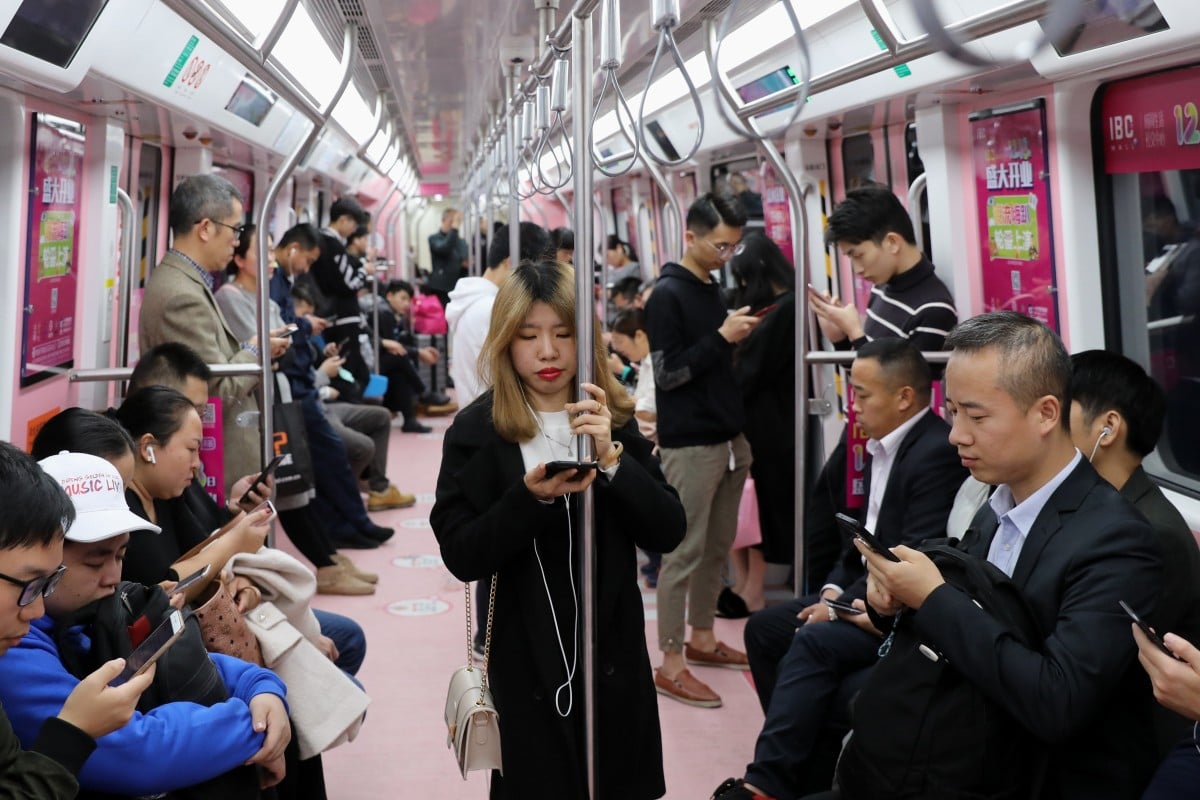
A woman is surrounded by men in a priority carriage on the Shenzhen metro. Photo: Sam Tsang
The first time Wanda was groped by a man on a Beijing bus she was a college student, travelling to school in her gym uniform on a summer’s day. Ten years – and numerous examples of sexual harassment on public transport – later, she is still haunted by the memory.
Now 31, Wanda – who asked to be identified only by her first name – remembers every detail of the incident. The bus was not crowded but the man, who appeared to be in his 40s, went straight over to stand uncomfortably close to her.
Then he pressed himself tightly against her and began making a thrusting motion with his lower body. Wanda said she froze, terrified by the encounter and unsure how to act. Just then, the bus took a sharp turn, the man was thrown aside and she quickly moved away.
“Afterwards, for a period, I looked at every adult man I saw as if he was aggressive,” she said.
Since then, Wanda said she had been flashed at in public and just last year was forced to block a man with her purse when he tried to touch her leg on a train.
118 Chinese men detained for groping women on subway trains
Wanda’s experience is not unusual but attempts to address the problem of sexual harassment on public transport in China have met with mixed results, as well as claims by feminists that they are restrictive to women.
Two major cities in southern China, for example, introduced
priority carriages for women on their underground trains in 2017.
and Guangzhou, both in Guangdong province, established two designated carriages – one at each end of the train – during peak times.
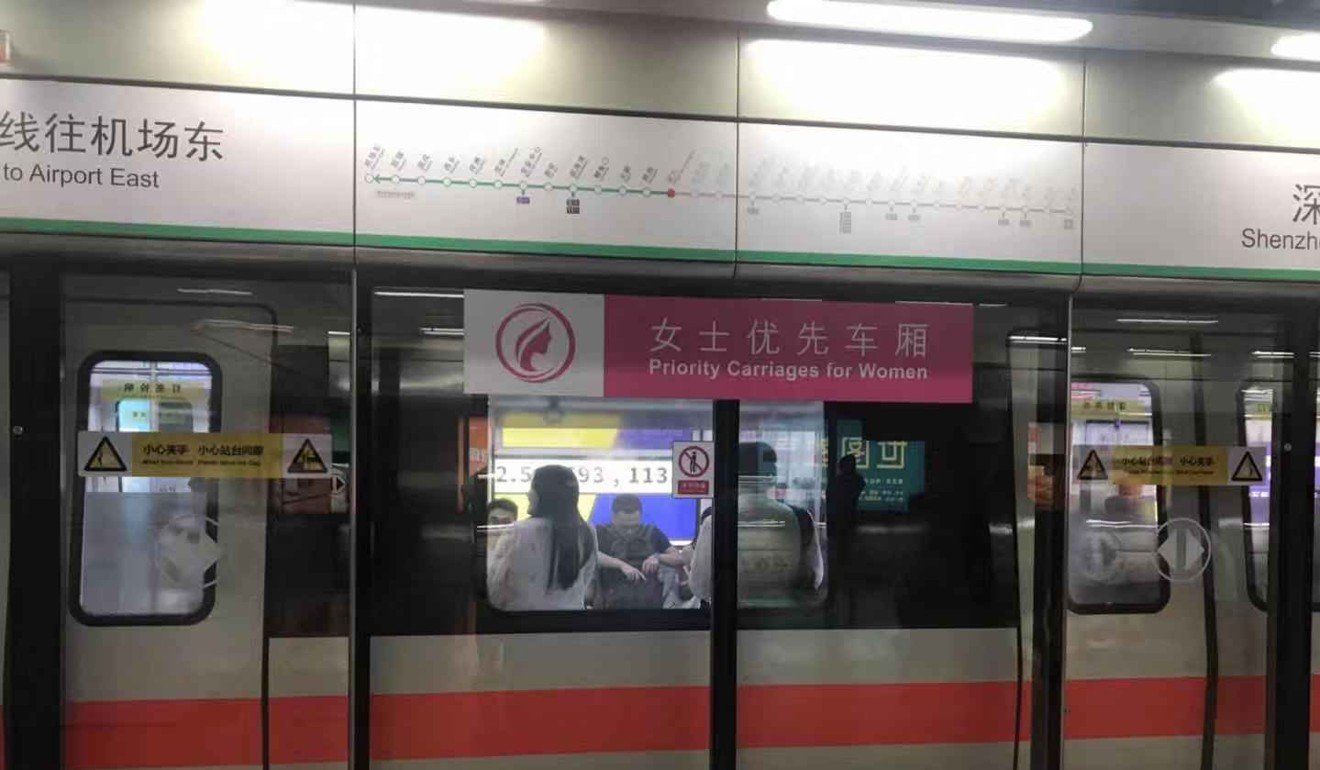
The carriages are decorated with pink stickers which say, in Chinese and English, “priority carriages for women” and while
men are not barred from using them
they are encouraged to leave them to women passengers.
While the authorities did not specifically say they were intended to prevent sexual harassment – saying only that the scheme was meant to “give more care and respect to women” – the carriages followed a precedent set by Japan and Europe for that reason.
Shenzhen is currently considering an update to its priority carriages with an amended law designating them for people with disabilities and minors, as well as women, and only during rush hour. Other passengers who do not meet these criteria can be asked to leave by rail staff.
A priority carriage for women on the Shenzhen underground system. Photo: Phoebe Zhang
But in reality the restrictions on the priority carriages are seldom enforced and they have been used by men since their launch. Furthermore, feminists say the scheme is a form of segregation, rather than an attempt to solve the cause of the issue.
One reason the priority carriages have failed in their purpose could be the size of the crowds using public transport each day. According to government data, there are roughly 5 million passenger trips on the Shenzhen underground every day and 8 million in Guangzhou.
It is also hard for staff to enforce the regulation.
“When it first came out, subway staff vehemently advocated for women to use it, so many people did,” said Zhang Ying, a piano teacher in Guangzhou. Staff would hold loud speakers and gesture for women to get on the priority carriages. But now, everybody just treats it like an ordinary carriage, she said.
Zhang said she rarely uses the priority carriages because of the inconvenience of having to walk all the way to the end of the train.
Women call for convenience in all areas, but [the government] only wants to draw you a little corner to play in.Xiao Meili, Guangzhou-based feminist
Feminists have opposed the scheme from the start.
“The logic behind the scheme is wrong to begin with,” said Xiao Meili, a Guangzhou-based feminist. “When noticing the dangers women face in public spaces, women call for convenience in all areas, but [the government] only wants to draw you a little corner to play in, signalling they still will neglect you in most places.”
Although it may appear well-intentioned, Xiao said the scheme was restricting women’s space.
“Most of the sexual harassers and rapists are men, so wouldn’t it be more effective to put these offenders in a limited space?” she asked.
In a survey of 443 people conducted by a group of feminists in Shenzhen in 2017, 42 per cent of women said they had been harassed on public transport, compared with just 6 per cent of men.
Most of the interviewees said they were dissatisfied with the police response and 65 per cent said they thought police should be most responsible for handling sexual harassment in public.
Six ways Japanese women can deter gropers on trains
Xiao and others have repeatedly written to government representatives about sexual harassment on public transport. In 2016, Xiao’s feminist group received 40,000 yuan (US$5,650) in public donations – just enough to buy an advertisement slot.
For two years, the group tried to put up anti-harassment billboards in the Guangzhou and Shenzhen underground systems, but they were repeatedly blocked by the authorities who said the advertisements would cause panic.
But in 2018 Xiao’s group spotted advertisements in the subways in Beijing, Shanghai and Chengdu, some placed by news organisations and others by local governments. One advertisement in Chengdu, put up by rail officials, said: “There’s no groping hand here.”
Another, in Beijing, said: “Prevent sexual harassment, be vocal.”
Xiao said she was happy to see the changes, but described the current policy of updating the carriages in Shenzhen as an example of “lazy politics”.
There needed to be more than a pink bumper sticker on carriage windows, she said.
Instead, policymakers needed to think about the actual mechanisms of stopping harassment and how to handle culprits once they were caught.
“Women do not demand special care as if they are a soft and weak group,” Xiao said.
“They demand the safety they deserve and the right to travel conveniently.”
Source: SCMP
Posted in authorities, Beijing, Beijing bus, Chengdu, China’s women, Chinese, culprits, dissatisfied, end, English, Europe, female passengers, feminists, getting groped, guangdong province, Guangzhou, gym uniform, interviewees, Japan, lazy politics, local governments, men, news organisations, offenders, Police, Priority carriages, problem, public transport, rapists, response, segregation, sexual harassers, Sexual Harassment, Shanghai, Shenzhen, Shenzhen metro, solved, Uncategorized, underground trains, waiting |
Leave a Comment »
15/09/2019
SHANGHAI, Sept. 14 (Xinhua) — As the 2019 Shanghai Tourism Festival opened Saturday evening, the festival, which began in 1990, has been a witness to China’s development and citizens’ consumption upgrade over the past few decades.
Twenty-five floats, which represent China’s well-known tourist destinations such as Nanjing and Suzhou cities in Jiangsu Province, and 32 performance groups from 19 countries and regions, including Germany, Switzerland and France, participated in the dance and music show in downtown Shanghai, attracting some 300,000 spectators.
The festival, which will last until Oct. 6, will feature 100 activities including some for overseas travelers. A folk culture exhibition on Belt and Road countries will also be held. Dozens of tourist sites, museums and galleries in Shanghai will offer half-price admissions during the event.
The first tourism festival in Shanghai attracted half a million tourists from home and abroad. The 2018 festival attracted 12.7 million visitors. As people’s living standards have improved remarkably, tourism is not a luxury any more, but a necessity for many citizens.
“In 1995, the company rewarded me with a trip to Hainan. I was so proud and cherished it very much,” recalled a Shanghai taxi driver surnamed Guo, 54. “Now, our income has increased a lot, travel becomes a routine for most people who are willing to pay their own money to relax.”
Thirty years ago, ideal tourism resources were lacking, said Lu Guojun, a clerk with Shanghai Huangpu River Cruise Group Co., Ltd, citing the swaths of croplands along the eastern coast of the river which flows through the city center.
In recent years, with improved infrastructure and rapid development of service economy, more companies have joined the development of the river tourism, Lu said.
Dai Bin, president of the China Tourism Academy in Beijing, said people’s aspirations for a better life lead to their high expectations of tourism quality.
In August, China issued a guideline to unleash the cultural and tourism consumption potential, urging efforts to deepen supply-side reform in cultural and tourism industries.
On Friday, Shanghai signed agreements with six cities and regions including Budapest, Phnom Penh and Bangkok to boost culture and tourism exchange.
Culture and tourism promote mutual friendship and understanding, said Yu Xiufen, head of the Shanghai Municipal Administration of Culture and Tourism.
In 2018, domestic tourists made 5.54 billion trips, up 10.8 percent year on year, and the total number of inbound and outbound tourists reached 291 million, up 7.8 percent. The total tourism revenue reached 5.97 trillion yuan (842.7 billion U.S. dollars) last year, up 10.5 percent, data of the Ministry of Culture and Tourism showed.
Source: Xinhua
Posted in Bangkok, Belt and Road countries, Budapest, consumption, croplands, culture and tourism exchange, dance and music show, folk culture exhibition, France, galleries, Germany, Hainan, jiangsu province, Ministry of Culture and Tourism, museums, Nanjing, overseas travelers, Phnom Penh, river tourism, Shanghai, Shanghai Huangpu River Cruise Group Co., Ltd, Shanghai Municipal Administration of Culture and Tourism, Suzhou, Switzerland, tourism festival, tourist destinations, tourist sites, Twenty-five floats, Uncategorized |
Leave a Comment »
15/09/2019
BEIJING, Sept. 14 (Xinhua) — The 22nd Mandarin popularization week will be held from Sept. 16 to 22 across China, highlighting a myriad of Mandarin-speaking and writing activities, according to the Ministry of Education.
Focusing on promoting Mandarin and carrying forward China’s fine traditional culture, this year’s event will start in Shanghai and conclude in the city of Kaili in southwest China’s Guizhou Province, the ministry said.
Initiated in 1998, the annual event falls on the third week of September and has become an important platform for Mandarin popularization and the promotion of fine traditional culture in society.
As of 2015, about 73 percent of Chinese people can speak Mandarin, up from 53 percent in 2000, while more than 95 percent of the literate population can use standardized Chinese characters.
Source: Xinhua
Posted in Beijing, China alert, Chinese characters, Guizhou Province, Kaili, Mandarin, Ministry of Education, promotion events, Shanghai, Uncategorized |
Leave a Comment »
13/09/2019
BEIJING, Sept. 12 (Xinhua) — China’s border check agencies are expected to see an average of 1.93 million inbound and outbound trips made by Chinese and foreign tourists per day during the three-day Mid-Autumn Festival holiday, the National Immigration Administration said Thursday.
The figure indicated a year-on-year increase of 1.6 percent, according to the administration.
It said the average daily trips at major airports in the cities of Beijing, Shanghai, Guangzhou and Chengdu are expected to reach 85,000, 109,000, 54,000 and 21,000 respectively.
The administration asked border check agencies nationwide to ensure sufficient personnel and disclose passenger flow information in a timely manner to properly handle the holiday travel surges.
It also advised passengers to avoid traveling during peak hours.
The Mid-Autumn Festival falls on Sept. 13 this year.
Source: Xinhua
Posted in Beijing, Chengdu, daily entry, exit trips, expected, Guangzhou, Holiday, Mid-Autumn Festival, National Immigration Administration, Shanghai, Uncategorized |
Leave a Comment »
11/09/2019
- Agriculture ministry says long-term goal is achievable despite the loss of a third of domestic livestock owing to impact of disease
- Observers believe foreign producers will never be able to produce enough to satisfy the world’s largest market for the meat
A pork vendor sleeps at a stall at a Beijing wholesale market. Photo: Simon Song
China will continue to strive for self-sufficiency in pork production although its farming industry has suffered a devastating blow after African swine fever wiped out about one-third of its hog herds, officials said on Wednesday.
Yu Kangzhen, a vice-minister for agriculture, said it was unrealistic for China to pin its hope on imports in meeting the country’s demand for pork.
Last year, China consumed about half of the world’s pork but more than 95 per cent was sourced from domestic supplies, which have taken a serious hit this year due to swine fever.
The disease is deadly for pigs, although not for humans, and there is currently no cure or vaccine.
“Even at its highest level, imports accounted for about 2 per cent of China’s domestic production,” said Yu at a press conference in Beijing.
“So from the statistics alone, we can see that we must adhere to the principle of self-sufficiency if we are to meet our demand for meat, and this also explains why we have put forward a 95 per cent self-sufficiency target.”
According to Yu, the total global trade in pork last year was 8 million tonnes – less than 15 per cent of China’s total production of 54 mi
Peng Shaozong, an official from the pricing department of the National Development and Reform Commission (NDRC), expressed confidence that foreign suppliers would be interested in filling any gaps in the Chinese market.
“Imports are guided by the market. If there is money to be made [in selling to China], they will definitely come,” said Peng on the sidelines of the press conference.
Pan Chenjun, from agribusiness bank Rabobank, said China’s pork production was expected to continue to fall in the coming year, putting pressure on the country’s US$140 billion pork industry.
In July, China’s pig population had fallen by 32.2 per cent from a year earlier, and was down 9.4 per cent compared with the previous month, according to latest government figures.
However, Pan said the government’s 95 per cent self-sufficiency target was in line with market realities.
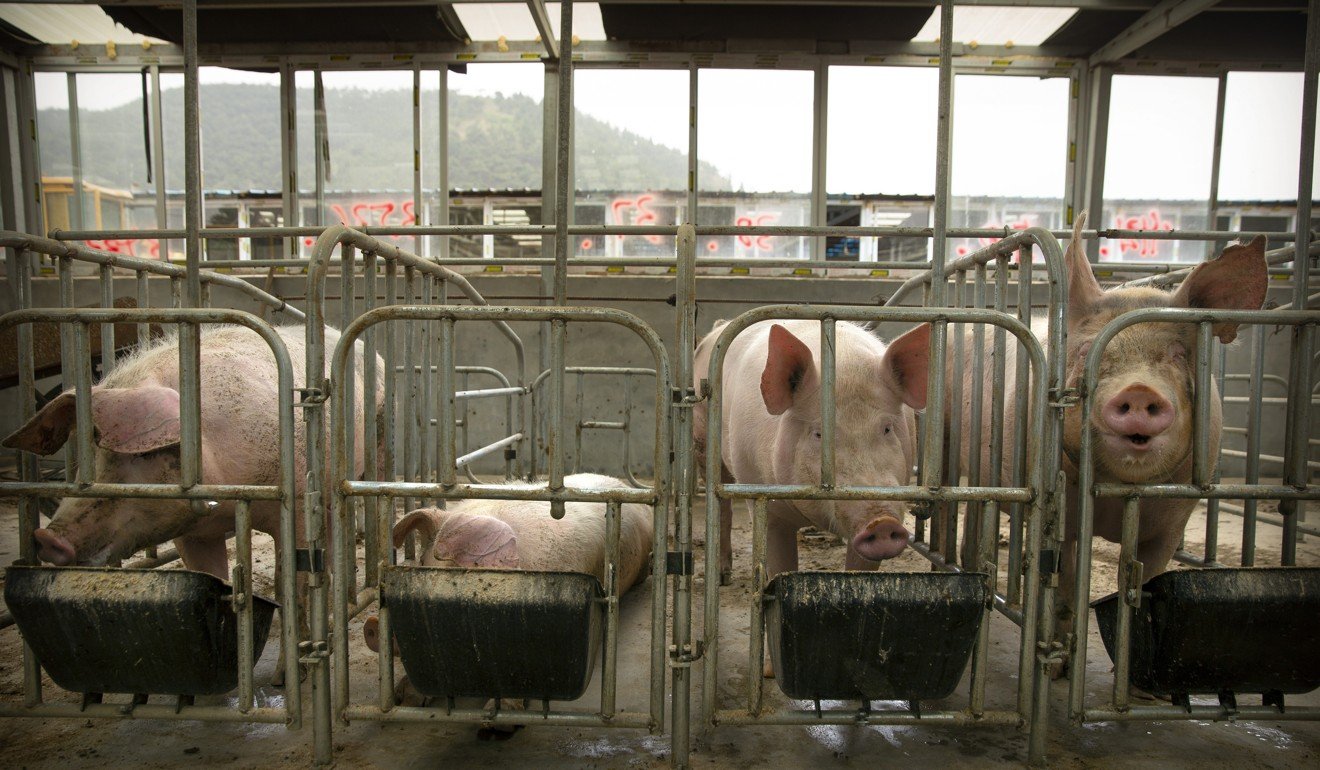
China’s domestic pig stocks have fallen by a third. Photo: AP
“In any case, the 95 per cent [self-sufficiency] goal is reasonable, as China’s pork market size is too big, and imports, despite rising this year, still represent just a small part,” Pan said.
Although China’s domestic shortfall may offer a windfall to foreign suppliers, they must obtain government approval before they could sell to China.
On Monday, Beijing approved imports from 25 Brazilian meat factories, bringing the country’s total number to 89.
On Wednesday, Danish officials completed a three-day trip to China, saying they expected to increase pork exports to China.
Danish food minister Mogens Jensen attended the opening of a new meat processing facility near Shanghai operated by Danish Crown.
China imported 230,000 tonnes of pork from Denmark in 2018, according to the country’s foreign ministry.
On Tuesday, the Chinese State Council issued a new set of guidelines to support the industry, outlining measures such as increased subsidies to boost domestic production in the face of worsening pork shortages that have sent prices to record highs.
The consumer price index released on Tuesday reinforced the bleak picture of a tight market supply as the data showed that pork prices rose by 46.7 per cent in August compared with a year earlier, almost double the 27 per cent rise witnessed in July.
Prices of pork are one of the major indicators used by Chinese citizens to gauge their well-being and, at the moment, that well-being is being eroded rapidly.
According to NDRC, China has already spent a total of 3.23 billion yuan (US$454 million) in subsidies so far this year to tackle the pork shortage crisis.
“As much as 1.1 billion yuan has been newly added under the budget of the central government, with the focus on supporting western provinces in the Yangtze River basin to carry out farm improvement works to control pollution and reduce livestock and poultry waste,” Peng from the NDRC said.
However, a report published by research firm Gavekal Dragonomics on Wednesday cautioned that the government’s plans to soften the blow on the industry might not be effective.
“As the overhaul of pig-raising practices to eliminate the disease would take years even if the government was moving more aggressively, high prices and pork shortages are going to persist,” the report said.
Source: SCMP
Posted in African swine fever, agribusiness bank, Agriculture ministry, aims, Beijing, Brazilian, China alert, Chinese State Council, cure, Danish Crown, Danish food minister, Denmark, despite, devastating blow, farming industry, Gavekal Dragonomics, meat factories, meat processing facility, Mogens Jensen, National Development and Reform Commission (NDRC), pork production, pork vendor, Rabobank, self-sufficient, Shanghai, sleeps, stall, Uncategorized, Vaccine, vice-minister for agriculture, wholesale market, Yangtze River basin |
Leave a Comment »
10/09/2019
- Deity has all the necessary travel documents for seven-day journey bringing blessings to coastal communities
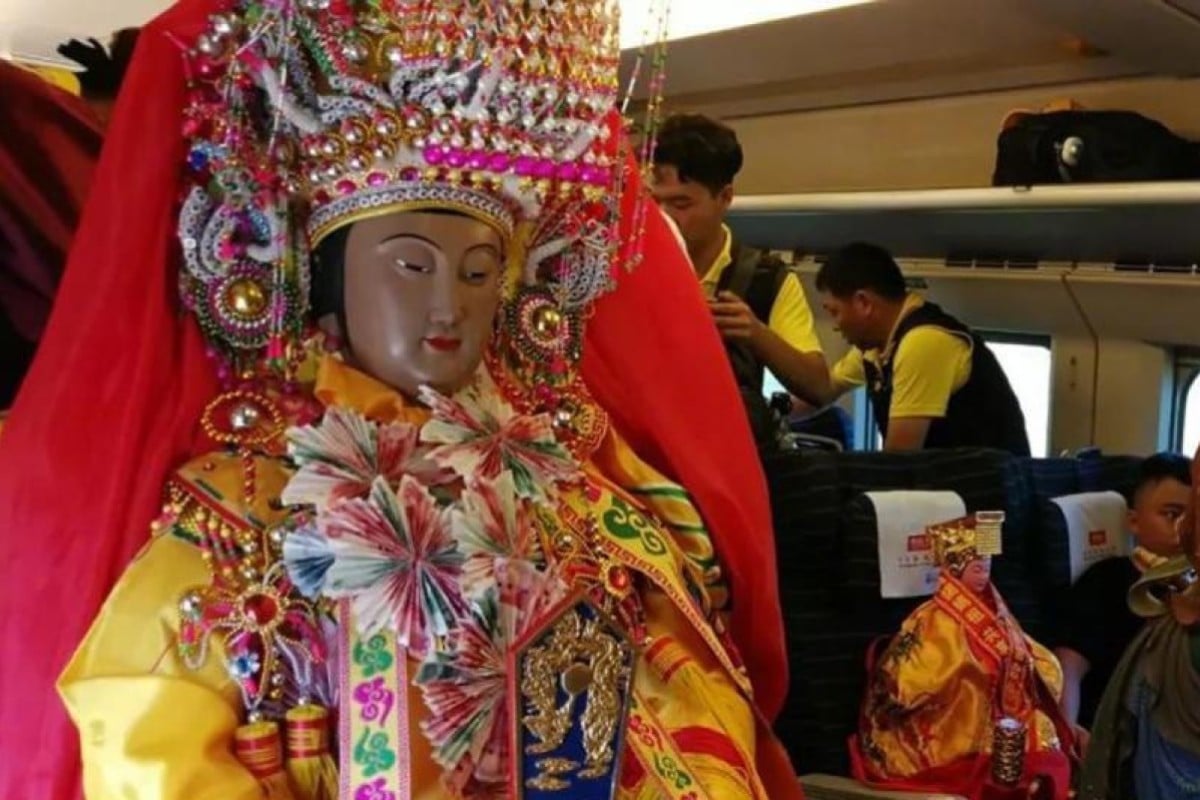
The statue of Chinese sea goddess Mazu on board the train for her seven-day tour of eastern China. Photo: Weibo
High-speed rail travellers in eastern China may find themselves in exalted company this week as one of China’s most beloved deities is on a seven-day tour.
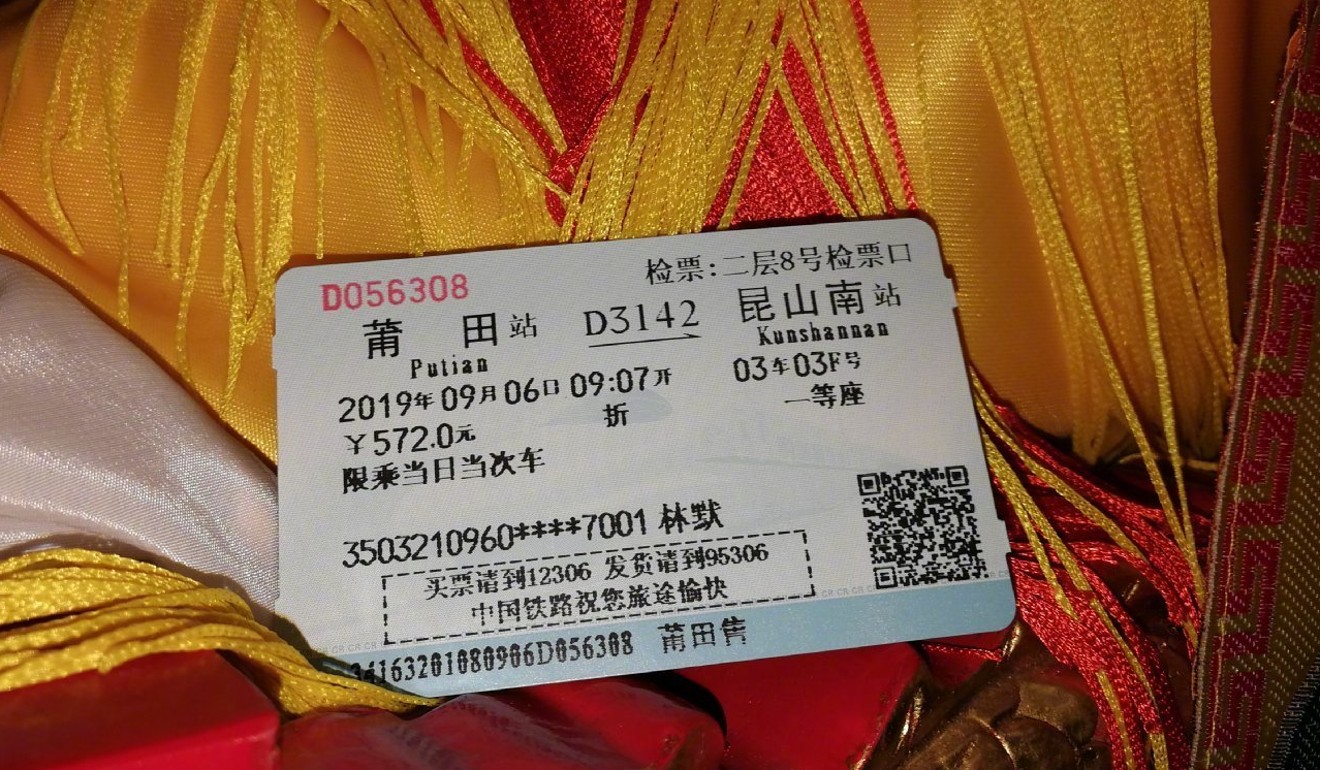
Mazu, protector of seafarers, boarded the train at Putian in Fujian province on Friday with an entourage of 230 worshippers for one of her regular “inspection tours”. And, like any modern traveller, the sea goddess had the necessary identity card and ticket for the journey.
Mazu, known as Tin Hau in Hong Kong, began life more than 1,000 years ago as a mortal named Lin Mo, according to Chinese folk belief. As a girl she is said to have saved some of her family members when they were caught in a typhoon while out fishing. In another version of the myth, Lin Mo died while trying to rescue shipwreck victims.
She fell out of favour in mainland China during the Cultural Revolution, when her ancestral temple on Meizhou Island in the southeastern province of Fujian was destroyed to make way for a People’s Liberation Army garrison. In the late 1970s the temple was rebuilt and in 2009 the beliefs and customs surrounding Mazu were recognised as an Intangible Cultural Heritage of Humanity by Unesco.
Inspectors on China’s high speed rail will find everything in order if they ask to see the goddess Mazu’s ticket during her seven-day tour. Photo: Weibo
Staff at the Meizhou Mazu Temple applied for an ID card for the goddess, in her earthly name of Lin Mo. Tickets were also organised for two other fairy figures who traditionally protect her, according to Chinese folklore.
“Not only Mazu but Thousand-Mile Eye and Wind-Accompanying Ear were all bought tickets,” a temple representative told the Southern Metropolis News.
This is not the first time the trio have been bought travel tickets. Two years ago their airfares were paid for when they visited Malaysia and Singapore and, a year later, they took a cruise ship to the Philippines.
This year’s tour includes a visit to Kunshan in Jiangsu and Shanghai, before Mazu returns to her home temple on the island of Meizhou. At each stop, devotees believe Mazu blesses the location with her presence and protects its residents from harm.
Taiwanese tycoon Gou thanks sea goddess for presidential inspiration
The tour has been organised jointly by the Meizhou Temple as well as the Huiju Mazu Temple in Kunshan and the Lugang Mazu Temple in Taiwan.
News of the celestial train journey quickly went viral on Chinese social media, with posts on Mazu receiving 460 million views on Weibo, the Twitter-like microblogging platform, since Monday. “First, respect. Second, she takes up a seat so it’s not crazy to buy her a ticket,” one comment read.
Source: SCMP
Posted in airfares, ancestral temple, blessings, celestial train journey, Chinese folk belief, Chinese social media, coastal communities, Cruise Ship, Cultural Revolution, Deity, Eastern China, exalted company, fishing, Fujian Province, garrison, High-speed rail travellers, Hong Kong, Huiju Mazu Temple, identity card, inspection tours, Intangible Cultural Heritage of Humanity, jiangsu province, journey, Kunshan, lets train, Lin Mo, Lugang Mazu Temple, Mainland China, Malaysia, Mazu, Meizhou Island, modern traveller, most beloved deities, myth, necessary, on board the train, People’s Liberation Army, Philippines, protector of seafarers, Putian, sea goddess, seven-day journey, Shanghai, shipwreck victims, Singapore, Southern Metropolis News, statue, Taiwan, Taiwanese tycoon, take the strain, Thousand-Mile Eye, ticket, Tin Hau, tour, travel documents, Typhoon, Uncategorized, UNESCO, viral, Weibo, Wind-Accompanying Ear, worshippers |
Leave a Comment »
10/09/2019
- Expensive presents are officially discouraged but have become the norm at many schools on day of appreciation for educators
Students at Yangzhou Technical Vocational College form the Chinese characters for “Hello Teacher” to mark China’s Teachers’ Day. Photo: Handout
Despite a decade of official discouragement, parents in China have been struggling with one of the biggest dilemmas of the school year – how to mark the country’s annual Teacher’s Day.
Ellen Yuan agonised for a day and a night before sending her son off to kindergarten on Tuesday with a 1,000 yuan (US$140) gift card in his bag for the teacher.
It was the boy’s second week of attendance and Yuan had given no thought to any Teacher’s Day obligations –until she learned that several of her friends had been busy over the weekend preparing gifts for their children’s teachers.
“It makes me feel that I am being a drag on my son if I don’t do so,” said Yuan, who works for a foreign company in Shanghai.
Respecting teachers has traditionally been a fundamental social norm in China but gift giving on the special day for educators has gone beyond an expression of appreciation by their students, as parents have taken over with ever more expensive gifts – and sometimes cash – which they hope will mean their kids are well taken care of while at school.
What gift, how expensive it should be, and how to deliver it have become the biggest questions for many parents in the run-up to September 10 each year, even though the education ministry and its subordinate bodies have repeatedly issued directives over the past decade to ban teachers accepting gifts.
Yuan said one of her friends had bought a body care set worth more than 600 yuan for each of her child’s three teachers, another had bought an 800 yuan gift card, while a third had given the head teacher a 1,000 yuan bottle of perfume.
Some parents had delivered the presents directly to the school, while others had asked their children to take the gifts to their teachers. Yuan’s plan was to message the teacher and tell her to take the gift card from her son’s bag.
“I know it’s bad. I don’t want my kid to know that,” Yuan said.
Hundreds of teachers protest in China over poor pay
The question of whether parents should give gifts on Teacher’s Day was one of the hottest topics on Weibo, China’s Twitter-like social media platform, attracting more than 15 million views as of Tuesday afternoon.
“Of course we should not, but I don’t dare to ignore it,” one user said, winning more than 10,000 likes.
Chu Zhaohui, a researcher at the National Institute of Education Sciences, said the gift-giving trend had been partly driven by a “keeping up with the Joneses” mentality.
“Everybody has given a gift. Would my child be specially treated if I don’t? This is a common concern,” Chu said. As a result, the purpose of gift giving on Teacher’s Day had become about protecting the children’s interests instead of a sincere expression of gratitude, he said.
But not every teacher gets presents – with gifts usually reserved for those teaching the “main subjects” of mathematics, Chinese and English, which count the most in high school and college entrance examinations.
Emily Shen, an English teacher from a middle school in Hangzhou, in the eastern province of Zhejiang, said she also prepared gifts for the teachers of her two kids. “Some chocolate for them to take to school. And I myself would give a gift card to each of those who teach the main subjects,” she said.
Zhuang Ke, a music teacher at a primary school in Jiaxing, also in Zhejiang province, admitted she was embarrassed by the parents’ different treatment of teachers of “less important” subjects like her’s. “It’s always nice to receive presents. But teachers who teach music, art and PE are often forgotten,” she said.
Chinese kindergarten teacher fired for hot sun punishment
State broadcaster CCTV said in a commentary on its website on Sunday that “all forms of behavior that attempt to ruin normal teaching order and interfere in equality by sending gifts should be resolutely abandoned”. A similar message was run by a series of official media outlets at local level.
“The most fundamental way to stop parents from sending gifts is to treat the students equally and fairly every day, so that parents conclude it makes no difference whether they give a gift,” Rednet.cn, the official news portal of Hunan province, said on Monday.
Although some teachers have made it explicit to students that they will refuse presents on Teacher’s Day, Yuan said her son’s teacher accepted the gift, as did the teachers of her three friends’ children.
Source: SCMP
Posted in Art, bag, body care set, bottle of perfume, Chinese, chinese parents, Chocolate, college entrance examination, commentary, day of appreciation, discouraged, educators, English, Expensive presents, fired, foreign company, forgotten, fundamental way, gift card, gift etiquette, Hangzhou, High school, hot sun punishment, Hunan Province, Jiaxing, keeping up with the Joneses, kindergarten, mathematics, mentality, middle school, music, music teacher, National Institute of Education Sciences, norm, official news portal, officially, PE, poor pay, primary school, Protest, Rednet.cn, schools, Shanghai, sincere expression of gratitude, state broadcaster CCTV, struggle, teacher, Teacher’s Day, Uncategorized, website, Weibo, Yangzhou Technical Vocational College, zhejiang province |
Leave a Comment »
05/09/2019
- When Kazakh actress Reyizha Alimjan arrived in Shanghai last month wearing jeans and a camisole it reignited a long-running debate over who gets a say on how Chinese women should dress
- Fashion choices that would be regarded as unremarkable in Europe or North America are often seen as outrageous in the world’s most populous nation
Kazakh actress Reyizha Alimjan’s fashion choices sparked a social media storm in China last month. Photo: Weibo
When Li Xiang broke up with her boyfriend over a selfie she posted on social media, it was not just about a woman letting a man know he wasn’t entitled to tell her how to dress in public, but a matter of personal freedom, social norms and cultural tradition.
A few weeks ago, the 24-year-old media worker from Shanghai shared a photo on WeChat that showed her posing at her bedroom door in a camisole and mini shorts. Her boyfriend said it made him very “uncomfortable”, and they quarrelled.
“‘Look how scantily clad you are, and [if] that is not enough, you shared it online,’ he said,” Li recalled.
“I got mad when he said, ‘You should go and ask other men if they’d like their girlfriends to dress like that’, as if he should decide what I wear – as if I were his appendage,” she said, referring to the archaic notion that a woman is secondary to a man in their relationship.
What clothes Chinese women should or should not wear has been the subject of intense online debate in recent weeks. Photo: EPA
Their argument was not unusual in China, especially over the past month when the online world became embroiled in a war of words about women’s freedom to dress as they please.
The controversy erupted when an article defending Reyizha Alimjan – the Kazakh actress criticised for showing too much flesh when she arrived at an airport in Shanghai in late July wearing jeans and a camisole – appeared on a WeChat movie review account called Staff of the 3rd Hall on August 12.
Reyizha Alimjan was criticised for her outfit on Chinese social media. Photo: Weibo
While that perspective was supported by many women online, others disagreed and said that society was open and tolerant but that people had the right to disagree.
By coincidence, a poll about women wearing camisoles in public was launched on August 10 by a WeChat account called Cicada Creativity. About 70 per cent of the nearly 14,000 respondents said they did not dare to do so.
More than 40 per cent avoided doing so for reasons such as thinking they were “not thin enough”, but a quarter said they said no because either their boyfriends disapproved or would not allow it, or they feared they would be harassed.
Chinese women spurn Victoria’s Secret for home-grown lingerie brands
Joy Lin, a feminist from Shanghai, said the debate was so fierce because it was not just about dress.
“It’s more about people’s judgment about one’s character and morals behind what she wears,” Lin said. “If you wear revealing clothes, they would say you are asking for harassment. If you show a little skin, you are frigid. And if you are casual, they call you ‘dama’ [Chinese slang, often derogatory, for middle-aged and elderly women].”
Some women say they are often judged by the clothes they wear. Photo: AP
In her experience, Lin said that if she appeared on the streets of Shanghai – the most cosmopolitan city in China – without a bra, there would be judgmental looks from passers-by before she had walked 10 metres (33 feet).
In contrast, she did just that in Paris in July, and, “no one stared at me or came near me at all”.
“Usually, when it comes to comments about what we wear, they’re not about whether the dress matches the hairstyle or things like that, but about our bodies, whether we’re slim or not and stuff like that,” she said. “Some [comments] can be very malicious and insulting.”
#MeToo rally accuses Hong Kong police of sexual violence against protesters
While shaming women for their clothing choices has been an issue for many years, it reached peak public awareness in China after the #MeToo movement took off in the US.
The social media campaign went viral in 2017 when dozens of women accused American film producer Harvey Weinstein of sexual assaults over a period of nearly 30 years.
The #MeToo movement took off in the US in 2017 after dozens of women accused film producer Harvey Weinstein of sexual assault. Photo: Shutterstock
Lu Peng, a researcher from the Shanghai Academy of Social Sciences, said the online debate helped encapsulate conflicts between a growing desire for freedom, gender norms and generations of tradition.
“There will hardly be a consensus on such a question about whether women have the freedom to dress,” he said. “But if this discussion can make people realise that men, not just women, also face restrictions in dressing, then it’s bringing progress.”
The simplest example was to dress for the occasion, which applies to both sexes.
“We have never been free in dressing. We’re only free within a certain extent … About what to wear in public, I don’t think we should emphasise freedom only and ignore the local culture and society,” Lu said.
Keeping a low profile has long been part of the Chinese philosophy. Photo: Xinhua
In China, there is no law banning states of dress or undress in public, nor do the Han people, who make up most of the population, have religious beliefs that restrict their mode of dress. But keeping a low profile and avoiding unwanted attention has long been part of the Chinese philosophy.
“My father will also ask me not to be ‘overexposed’, because he believes it’s increasing the risk of being harassed,” Li, the Shanghai media worker, said.
“They think they mean well, but I just want to be myself. I’m not breaking any law. I want to make my own contribution in changing this culture,” she said.
Source: SCMP
Posted in #MeToo, actress, American film producer, archaic notion, battle, bedroom door, between, bra, brands, camisole, casual, Chinese women, Cicada Creativity, City, cosmopolitan, debate, derogatory, dress, elderly women, Europe, Fashion choices, feminist, fierce, Freedom, frigid, harassment, Harvey Weinstein, home-grown, Hong Kong police, insulting, jeans, judgment, judgmental looks, Kazakh, lingerie, long-running, malicious, middle-aged, mini shorts, morals, most populous nation, North America, one’s character, outrageous, Paris, passers-by, posing, public awareness, quarrelled, reignited, relationship, reveals, Reyizha Alimjan, scantily, secondary, sexual assaults, sexual violence, shaming women, Shanghai, Shanghai Academy of Social Sciences, social media storm, tradition, Uncategorized, uncomfortable, unremarkable, US, Victoria's Secret, wear, wearing, WeChat |
Leave a Comment »
04/09/2019
- Prototype tested last month transports high-voltage power and liquefied natural gas side by side
- It could cut the high cost and waste involved in sending energy from the far west to the east coast
The 10-metre prototype line, combining high-voltage electricity and liquefied natural gas. Photo: Chinese Academy of Sciences
Chinese scientists have developed the world’s first prototype of a superconducting hybrid power line, paving the way for construction of a 2,000km (1,243-mile) line from energy-rich Xinjiang in the country’s far west to its eastern provinces.
The 10-metre, proof-of-concept wire and liquid natural gas hybrid transmission line was up and running at the Chinese Academy of Sciences’ Institute of Electrical Engineering in Beijing last month to show the feasibility of the technology.
The line contains a superconducting wire which can transmit nearly 1,000 amps of electric current at more than 18,000 volts with zero resistance.
In a further difference from a traditional power line, the gap between the superconducting wire and the power line’s outer shell is filled by a flow of slowly moving natural gas liquefied at low temperatures – between minus 183 and minus 173 degrees Celsius (minus 279 to minus 297 Fahrenheit). This allows the line to transfer electricity and fossil fuel at the same time.
Professor Zhang Guomin, the government research project’s lead scientist, told the South China Morning Post that the voltage and current could be much higher in its real-world applications.
“This technology can take the overall efficiency of long-distance energy transport to new heights,” he said.
Existing infrastructure to transfer energy from Xinjiang Uygur autonomous region to the developed eastern areas such as Shanghai has high operational costs because almost 10 per cent of the energy is lost in transmission, according to some studies.
That infrastructure includes the world’s most advanced high-voltage power line and four natural gas pipes, each thousands of kilometres long. One of the natural gas pipelines, from Xinjiang to Shanghai, cost 300 billion yuan (US$42 billion).
The superconductor and natural gas hybrid line offered a possible solution, Zhang said.
Loss of electricity over the superconducting wire would be almost zero because of the elimination of resistance to the movement of electrons, he said.
The transport of liquefied natural gas would also be efficient, because one cubic metre (1,000 litres) of it would be equivalent to 600 cubic metres of the same fuel in gas form.
The temperature needed for liquefaction of natural gas is almost identical to that required for occurrence of superconductivity, at about minus 163 degrees.
Wang Gengchao, professor of physics at East China University of Science and Technology in Shanghai, said the combination was a “smart idea”.
Superconducting materials are not new but their applications have been limited by the difficulty and cost of creating and maintaining the low-temperature environment.
“They are trying to kill two birds with one stone,” Wang, who was not involved in the study, said.
China is preparing to buy US liquefied gas and soybeans again
“But whether the technology can find a use in large-scale infrastructure depends on other things, such as safety. Not everyone will feel comfortable with the idea of putting a high-voltage electric line and flammable natural gas side by side.”
Zhang said another new prototype line, about 30 metres long, was being developed and the 2,000km project was awaiting government approval.
He said the team had solved some major technical obstacles, including reducing the risk of accidents from electrical sparks and gas leakage.
“Many problems remain to be solved, but we are confident this technology will work,” he said. “It will protect the environment. It will save a lot of land from being used for power and gas lines.”
Xinjiang has more energy resources than any other Chinese province or region. It has nearly half of the nation’s coal reserves, a third of its oil and gas, and some of the largest wind and solar farms, according to government statistics.
Source: SCMP
Posted in China alert, Chinese Academy of Sciences, coal reserves, Country, develops, East China University of Science and Technology, east coast, far west, high-voltage power, hybrid power line, Institute of Electrical Engineering, Natural gas, oil and gas, prototype, Shanghai, south china morning post, soybeans, span, superconducting, superconducting wire, transports, two birds with one stone, Uncategorized, US liquefied gas, wind and solar farms, Xinjiang, Xinjiang Uygur Autonomous Region, zero resistance |
Leave a Comment »
04/09/2019
- Two classrooms on Nanjing campus were chosen for pilot project
- Camera automatically captures students’ faces without their cooperation
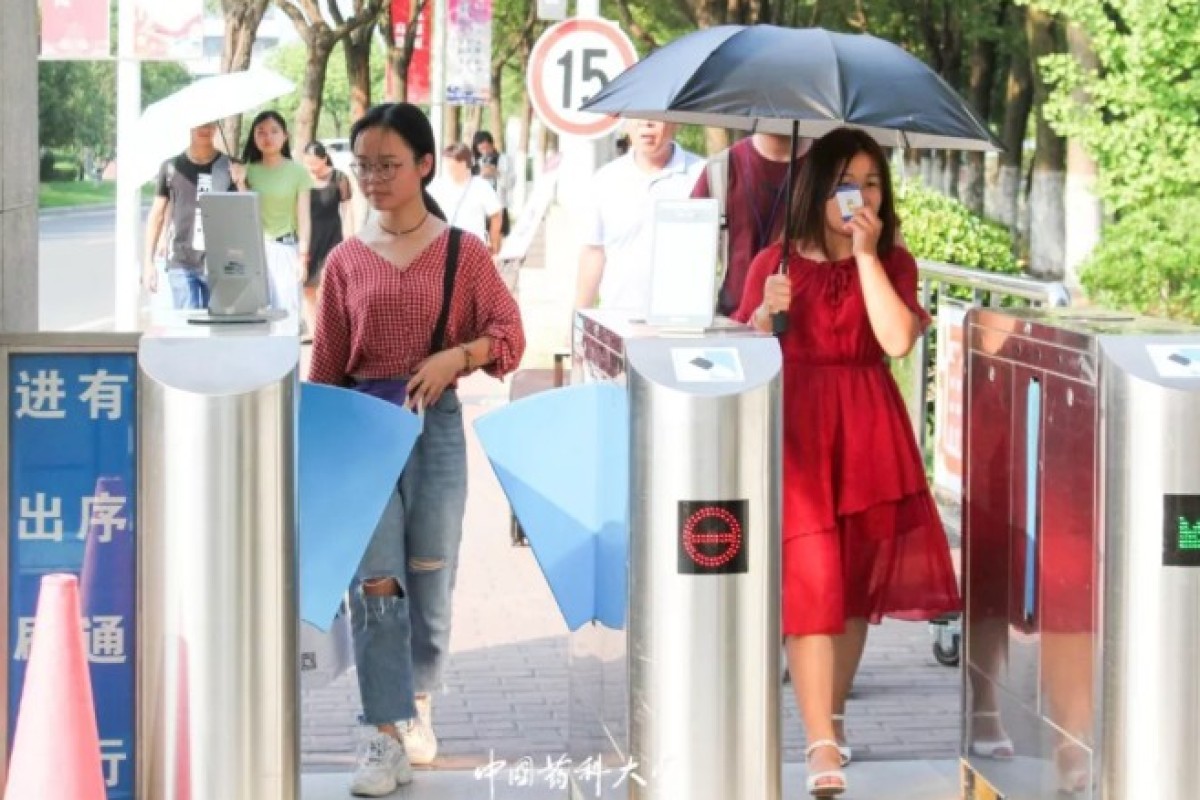
Students pass through a facial recognition turnstile at China Pharmaceutical University in Nanjing. Photo: Weibo
A university in eastern China has installed a facial recognition system at its entrance and in two classrooms to monitor the attendance and behaviour of students.
China Pharmaceutical University in Nanjing, Jiangsu province, announced on its website on Thursday that it was one of the first higher education institutions in the country to put such a system in place.
“It can effectively solve the management difficulties and low efficiencies in a traditional attendance system, and make it easier for managers to track their students,” Xu Jianzhen, director of the university’s library and information centre, told news website Thepaper.cn
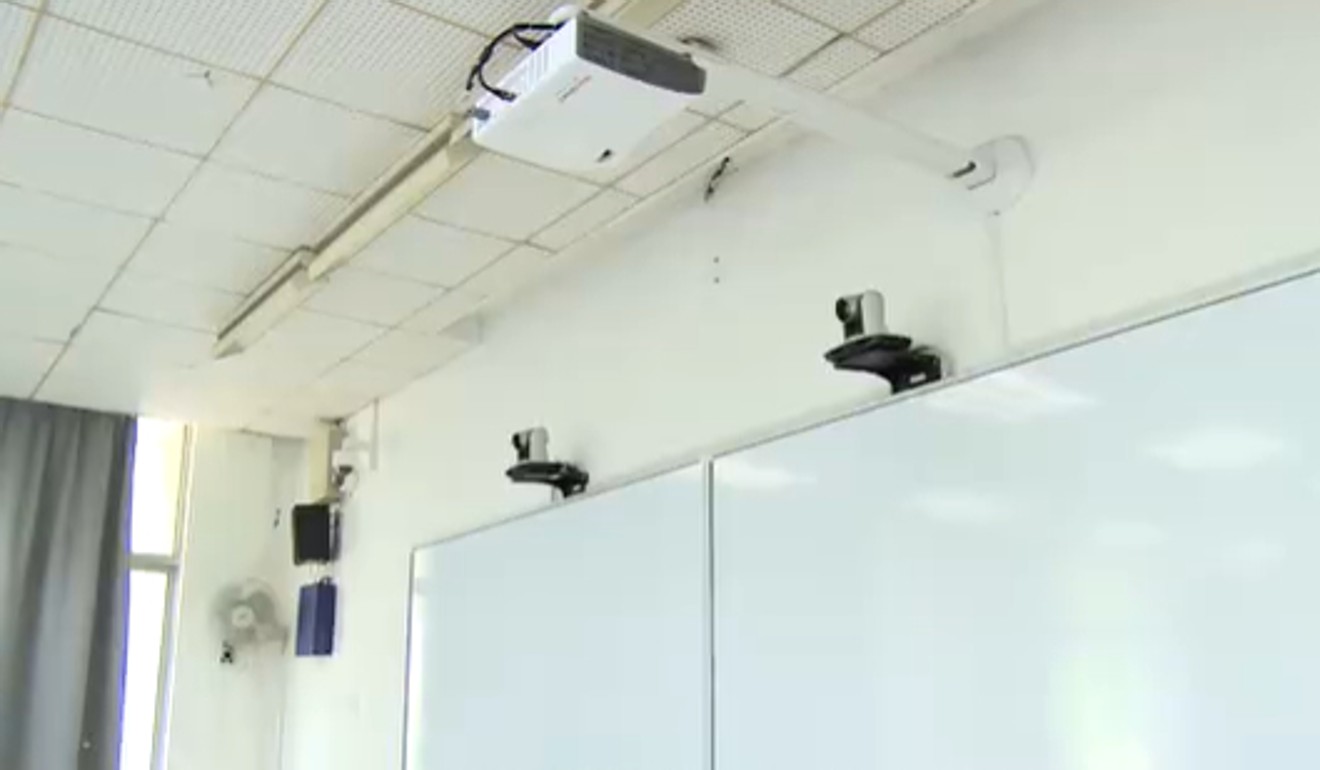
In a pilot project, two classrooms were equipped with an attendance system using facial recognition software, with a camera that automatically captured the faces of students in class without their cooperation, the university said.
“Besides attendance, the system installed in the classroom can provide surveillance of the students’ learning, such as whether they are listening to the lectures, how many times they raise their heads, and whether they are playing on their phones or falling asleep,” Xu told the news website.
“The school is taking action to cut down on students skipping class, leaving classes early, paying for a substitute to attend classes for them and not listening in class,” he said.
The plan was not well received online, with some critics raising privacy concerns for staff and students.
Why are Hong Kong protesters targeting lamp posts?
“What kind of talent are they trying to cultivate?” a user of the Twitter-style Weibo network asked. “I’ve never seen such a method.”
Another wrote: “If this system was being installed in Europe or America, they’d be sued and the school would have to close down.”
But Xu said the university had consulted the police and sought legal advice, and was told the system would not be considered an invasion of privacy as classrooms were public spaces.
“You are complaining about [a system] that’s meant to urge you to learn? Are you a student?” he told the news website.
A spokesman said China Pharmaceutical University was using a facial recognition system to improve class attendance. Photo: Weibo
The university would seek feedback from teaching staff before deciding whether to install facial recognition systems in all of its classrooms, according to the report.
In May last year, a school in Hangzhou, Zhejiang province, installed cameras to monitor pupils’ facial expressions and attentiveness in class as part of a “smart classroom behaviour management system” to give teachers real-time information on their students.
Elsewhere, facial recognition has been used to catch unlicensed drivers in the southern technology hub of Shenzhen, jaywalkers in Shanghai, and criminal suspects at public events across China.
Source: SCMP
Posted in America, attendance, attentiveness, automatically captures, Camera, China alert, China Pharmaceutical University, Chinese university, consulted, cooperation, criminal suspects, Europe, facial expressions, Facial recognition system, Hangzhou, invasion of privacy, jaywalkers, jiangsu province, legal advice, library and information centre, Nanjing, pilot project, Police, public events, Shanghai, Shenzhen, students’ faces, sued, Thepaper.cn, Uncategorized, university, unlicensed drivers, website, Weibo, without, zhejiang province |
Leave a Comment »








 CHINDIA ALERT: You'll be living in their world, very soon
Chinese parents struggle with Teacher’s Day gift etiquette
Despite a decade of official discouragement, parents in China have been struggling with one of the biggest dilemmas of the school year – how to mark the country’s annual Teacher’s Day.
Ellen Yuan agonised for a day and a night before sending her son off to kindergarten on Tuesday with a 1,000 yuan (US$140) gift card in his bag for the teacher.
It was the boy’s second week of attendance and Yuan had given no thought to any Teacher’s Day obligations –until she learned that several of her friends had been busy over the weekend preparing gifts for their children’s teachers.
“It makes me feel that I am being a drag on my son if I don’t do so,” said Yuan, who works for a foreign company in Shanghai.
Respecting teachers has traditionally been a fundamental social norm in China but gift giving on the special day for educators has gone beyond an expression of appreciation by their students, as parents have taken over with ever more expensive gifts – and sometimes cash – which they hope will mean their kids are well taken care of while at school.
What gift, how expensive it should be, and how to deliver it have become the biggest questions for many parents in the run-up to September 10 each year, even though the education ministry and its subordinate bodies have repeatedly issued directives over the past decade to ban teachers accepting gifts.
Yuan said one of her friends had bought a body care set worth more than 600 yuan for each of her child’s three teachers, another had bought an 800 yuan gift card, while a third had given the head teacher a 1,000 yuan bottle of perfume.
Some parents had delivered the presents directly to the school, while others had asked their children to take the gifts to their teachers. Yuan’s plan was to message the teacher and tell her to take the gift card from her son’s bag.
“I know it’s bad. I don’t want my kid to know that,” Yuan said.
But not every teacher gets presents – with gifts usually reserved for those teaching the “main subjects” of mathematics, Chinese and English, which count the most in high school and college entrance examinations.
Emily Shen, an English teacher from a middle school in Hangzhou, in the eastern province of Zhejiang, said she also prepared gifts for the teachers of her two kids. “Some chocolate for them to take to school. And I myself would give a gift card to each of those who teach the main subjects,” she said.
Zhuang Ke, a music teacher at a primary school in Jiaxing, also in Zhejiang province, admitted she was embarrassed by the parents’ different treatment of teachers of “less important” subjects like her’s. “It’s always nice to receive presents. But teachers who teach music, art and PE are often forgotten,” she said.
Chinese kindergarten teacher fired for hot sun punishment
State broadcaster CCTV said in a commentary on its website on Sunday that “all forms of behavior that attempt to ruin normal teaching order and interfere in equality by sending gifts should be resolutely abandoned”. A similar message was run by a series of official media outlets at local level.
“The most fundamental way to stop parents from sending gifts is to treat the students equally and fairly every day, so that parents conclude it makes no difference whether they give a gift,” Rednet.cn, the official news portal of Hunan province, said on Monday.
Although some teachers have made it explicit to students that they will refuse presents on Teacher’s Day, Yuan said her son’s teacher accepted the gift, as did the teachers of her three friends’ children.
Source: SCMP
Posted in Art, bag, body care set, bottle of perfume, Chinese, chinese parents, Chocolate, college entrance examination, commentary, day of appreciation, discouraged, educators, English, Expensive presents, fired, foreign company, forgotten, fundamental way, gift card, gift etiquette, Hangzhou, High school, hot sun punishment, Hunan Province, Jiaxing, keeping up with the Joneses, kindergarten, mathematics, mentality, middle school, music, music teacher, National Institute of Education Sciences, norm, official news portal, officially, PE, poor pay, primary school, Protest, Rednet.cn, schools, Shanghai, sincere expression of gratitude, state broadcaster CCTV, struggle, teacher, Teacher’s Day, Uncategorized, website, Weibo, Yangzhou Technical Vocational College, zhejiang province | Leave a Comment »