Chindia Alert: You’ll be Living in their World Very Soon
aims to alert you to the threats and opportunities that China and India present. China and India require serious attention; case of ‘hidden dragon and crouching tiger’.
Without this attention, governments, businesses and, indeed, individuals may find themselves at a great disadvantage sooner rather than later.
The POSTs (front webpages) are mainly 'cuttings' from reliable sources, updated continuously.
The PAGEs (see Tabs, above) attempt to make the information more meaningful by putting some structure to the information we have researched and assembled since 2006.
Man hits glass with emergency hammer because ‘he had been drinking and felt ill’
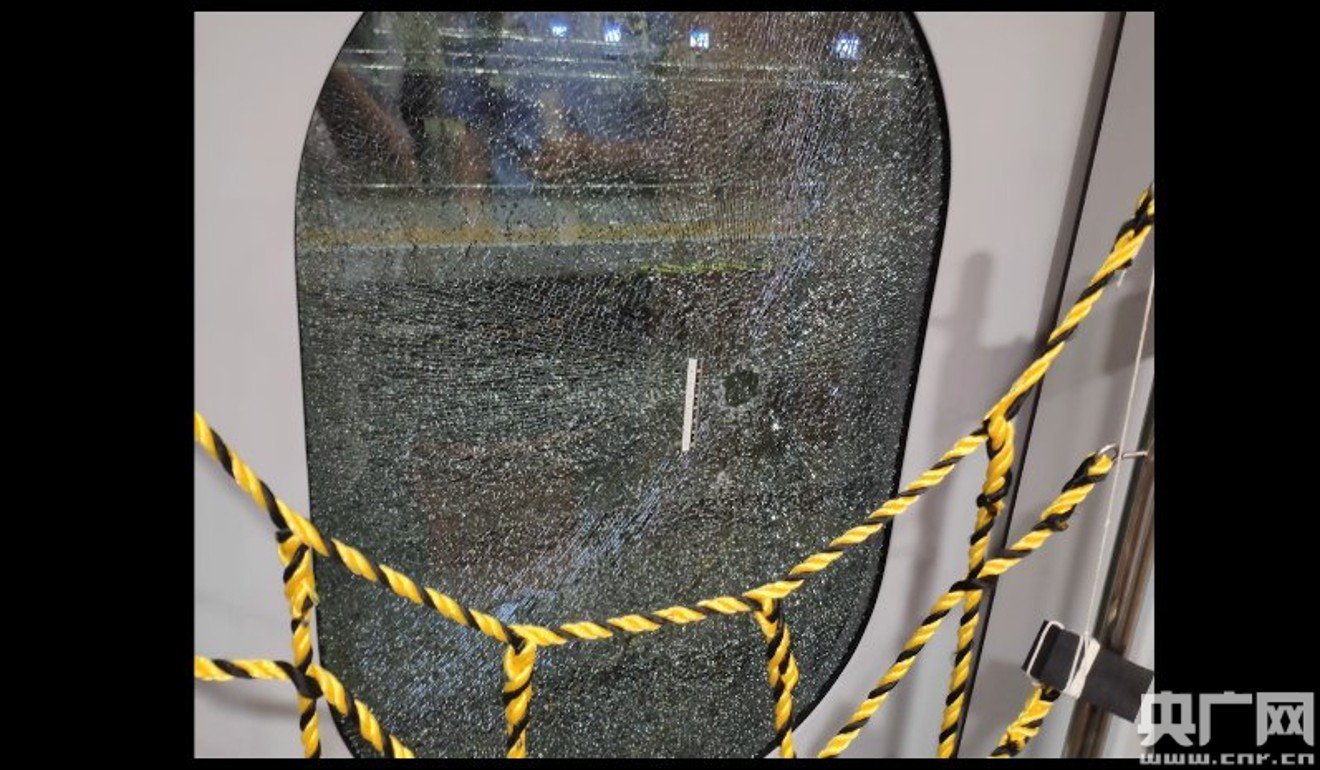
The train passenger tried to smash a hole in the door glass to let in some fresh air, according to Chinese media. Photo: CNR
Chinese railway police detained a passenger after he tried to smash the door window of a high-speed train to “get some fresh air” according to mainland media reports.
The 30-year-old man, identified only by his surname Xu, said he tried and failed to unlock the door and then decided to break the glass with an emergency hammer because he had been drinking and felt sick, China National Radio reported on Saturday.
Xu tried to smash the door after mechanical failure had forced the Beijing-bound train from Shanghai to stop at the main railway station in Jinan in Shandong province on Tuesday.
He said the train had been stranded for half an hour when he became impatient and wanted to have some fresh air, according to the report.
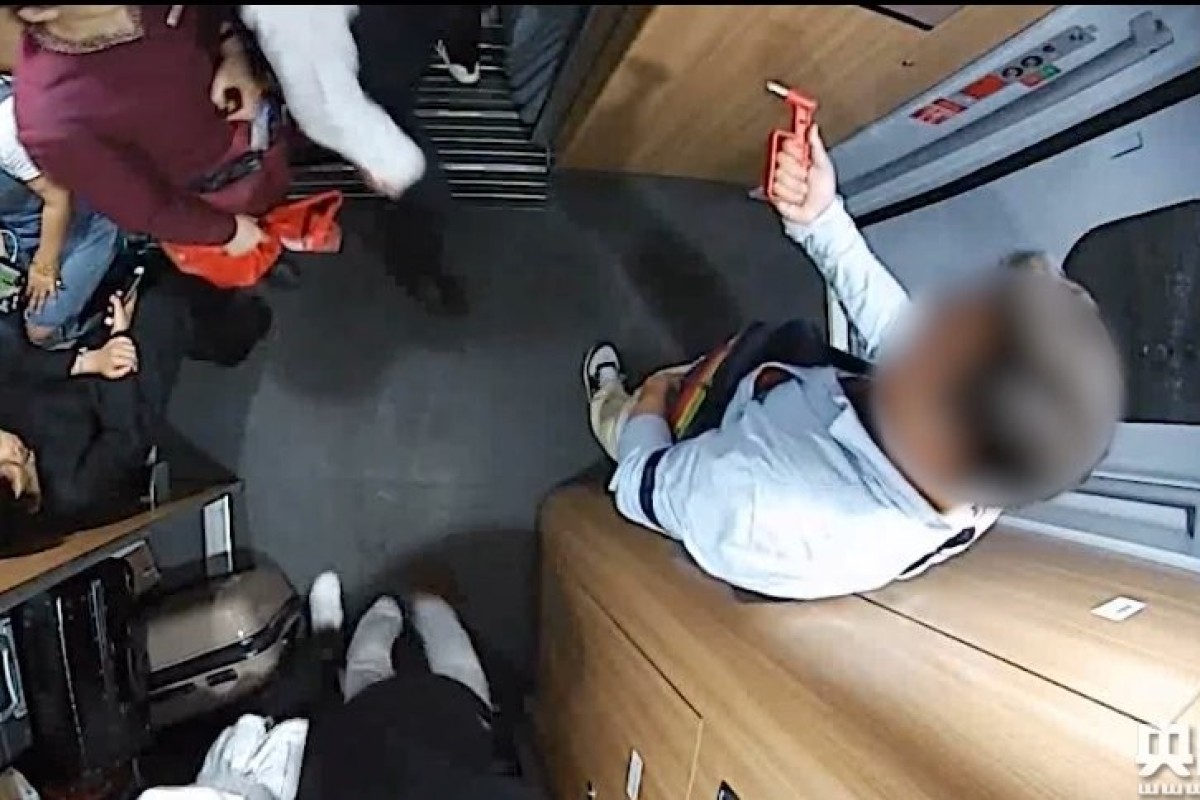
A Chinese train passenger attacked the door glass of a high-speed train as it was stranded in Jinan. Photo: CNR
Surveillance footage showed the man pulling on the door handle before hitting the glass with an emergency hammer mounted on a train wall.
Train staff quickly intervened and stopped Xu, who was taken into police custody after the train arrived in Beijing.
“I just smashed it once. I assumed this would allow air to come in, so I stopped,” Xu was quoted as saying.
“I felt unwell at that moment because I had been drinking at lunchtime. I did it on impulse.”
He was detained for allegedly intentionally damaging property, an offence that could lead to up to three years in jail.
The incident comes just a few months after a woman
“Mallory not only put our country at great risk, but he endangered the lives of [people] who put their own safety at risk for our national defence,” US attorney Zachary Terwilliger said in a statement.
“This case should send a message to anyone considering violating the public’s trust and compromising our national security,” he added. “We will remain steadfast and dogged in pursuit of these challenging but critical national security cases.”
The Justice Department said Mallory held a number of sensitive jobs with government agencies.
He had worked as a covert case officer for the CIA and as an intelligence officer for the Defense intelligence Agency (DIA).
“This case is one in an alarming trend of former US intelligence officers being targeted by China and betraying their country and colleagues,” Assistant Attorney General John Demers said following the sentencing.
He attempted to pass on information and received at least $800,000 (£600,000) for acting as a Chinese agent, the justice department said at the time.
CIA spy operation in China: Key dates
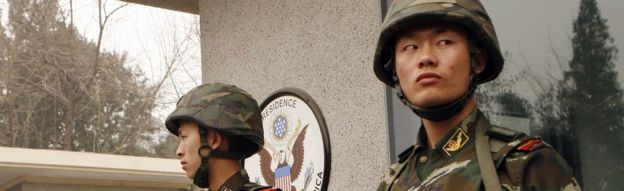
Image copyright AFPImage caption Chinese police guard the US embassy in the capital, Beijing
2010: Information gathered by the US from sources deep inside the Chinese government bureaucracy start to dry up
2011: Informants begin to disappear. It is not clear whether the CIA has been hacked or whether a mole has helped the Chinese to identify agents
2012: FBI begins investigation
May 2014: Five Chinese army officers are charged with stealing trade secrets and internal documents from US companies. Later that same month, China says it has been a main target for US spies
2015: CIA withdraws staff from the US embassy in Beijing, fearing data stolen from government computers could expose its agents
April 2017: Beijing offers hefty cash rewards for information on foreign spies
May 2017: Four former CIA officials tell the New York Times that up to 20 CIA informants were killed or imprisoned by the Chinese between 2010 and 2012
June 2017: Ex-CIA officer Kevin Mallory is arrested and charged with giving top-secret documents to a Chinese agent
January 2018: Former CIA officer Jerry Chun Shing Lee is arrested
June 2018: Former US intelligence officer Ron Rockwell Hansen is charged with attempting to spy for China
SHANGHAI, May 16 (Xinhua) — Israel’s Ministry of Tourism of signed an agreement with China’s online travel operator Ctrip during an ongoing tourism exhibition (ITB China) to strengthen tourism in the Chinese market.
More cooperation will be carried out between the two sides, mainly in terms of itineraries, big data and marketing to attract Chinese travelers, particularly young people to Israel, according to the agreement.
Some 55,000 Chinese visited Israel during the first four months of 2019, marking a 70 percent increase year on year, according to the data released by the Ministry of Tourism of Israel.
In 2018, 105,000 Chinese visited Israel, which is over a 100 percent increase from 2015.
Israel has launched a series of measures to promote tourism in China, including developing travel products with diversified themes, increasing direct flights between the two countries and providing more convenient visa policies.
Israel has also upgraded Chinese cuisine in local restaurants and hotels, set up Chinese signs in its main sites and resorts, provided Chinese-language maps, and trained more Chinese-speaking guides.
ITB China, a professional exhibition focusing on travel and tourism industry, is annually held in Shanghai. This year, 800 exhibitors from 84 countries and regions attended the exhibition lasting from May 15 to 17.
SHANGHAI, May 10 (Xinhua) — Nearly 200 domestic exhibitors are showcasing their products Friday at the 2019 China Brand Day series held in Shanghai, which focuses on the exposition of indigenous brands.
Quality goods including the latest hydrogen FCVs, smart pianos with a recording function, and gel pens made of a degradable material are showcased in 13 experience zones of consumer goods at the Shanghai Exhibition Center.
The booth area for businesses covers more than 20,000 square meters, where visitors can participate in online and offline interactive activities such as live demonstrations, virtual images, live streaming, online shopping, and interacting with celebrities.
An official with the National Development and Reform Commission, one of the hosts of the event, said this year’s China Brand Day plays an important role in the building of more brands and the forming of a strong domestic market.
The 2019 International Forum on China Brand Development and seven sub-forums will be held during the three-day event.
Established in 2017, the China Brand Day is marked on May 10 every year. The theme of this year is “China Brand, World Sharing.”
Major highways gridlocked for hours at start of four-day break
Chaos at railway stations as ticket-holding passengers turned away
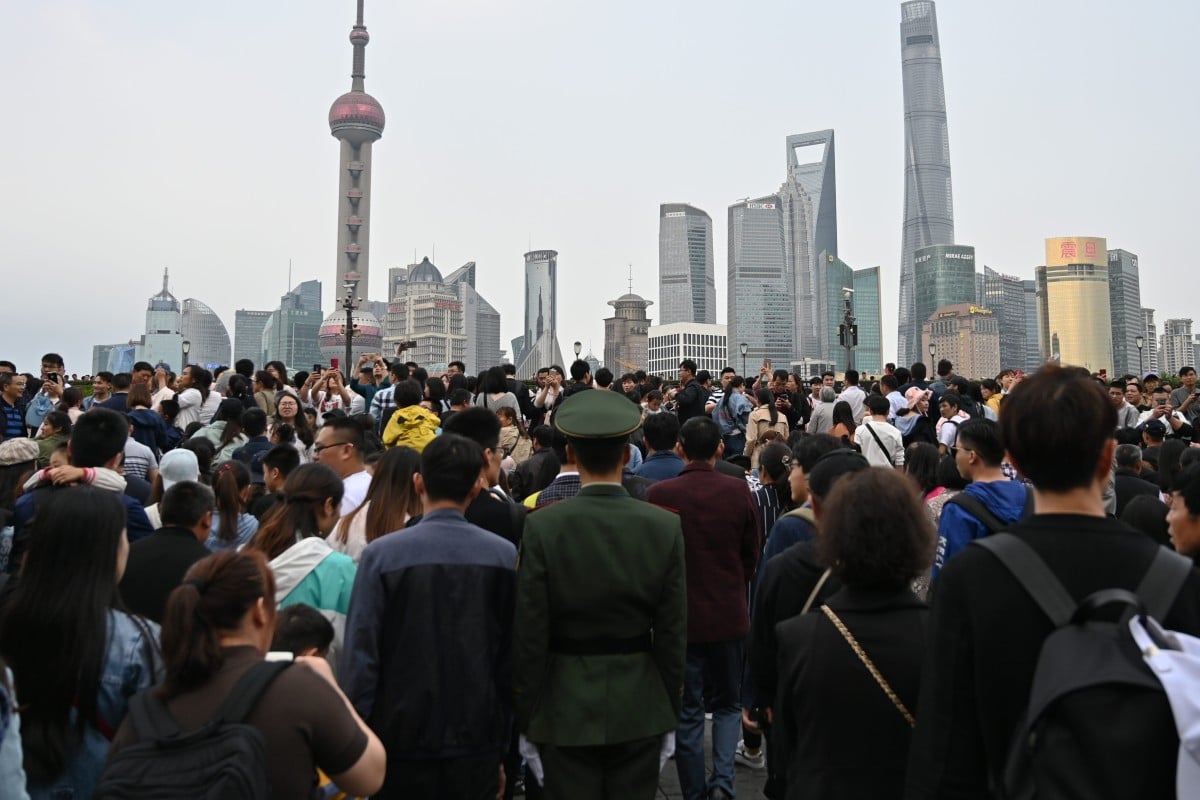
Holiday crowds pack the promenade on the Bund along the Huangpu River in Shanghai on the first day of China’s May break. Photo: AFP
China’s Labour Day holiday started on Wednesday with gridlocked roads and chaos at railway stations as millions of people took advantage of this year’s unusually long break.
Motorists reported being stuck in traffic jams which did not move for hours, while ticket-holding passengers were turned away from some trains due to severe overcrowding on the first day of the holiday.
Travel agency Ctrip estimated that around 160 million domestic tourists would be travelling over the four-day break, according to data from travel booking platforms.
Forty major highways recorded a 75 per cent spike in traffic on Wednesday, according to Xinhua, as toll fares for cars were suspended for the holiday.
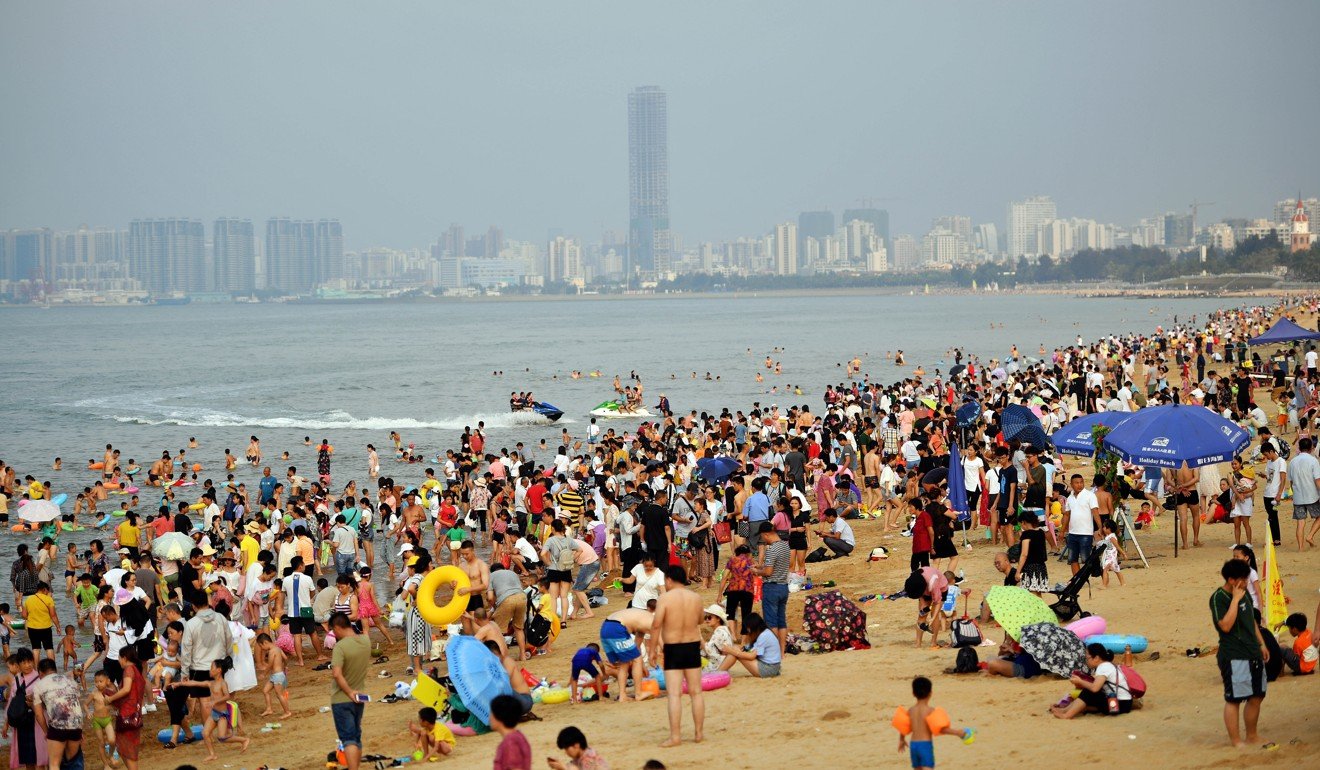
Tourists enjoy the first day of China’s four-day May holiday on a beach in Haikou, Hainan province, southern China. Photo: Xinhua
Monitoring stations on major routes – including the Beijing-Tibet Expressway, the Shanghai-Shaanxi Expressway, Shanghai’s Humin Elevated Road and the Beijing section of the Beijing-Hong Kong-Macau Expressway – recorded a 200 per cent increase in traffic from Tuesday onwards, Xinhua said.
The Ministry of Public Security’s traffic management bureau has warned holiday motorists to drive safely, especially on winding mountainside routes.
Online news portal The Paper reported on Thursday that traffic jams on some major routes were so severe that the drive from Shanghai to Hangzhou, capital of neighbouring Zhejiang province, took some travellers seven hours instead of the usual two.
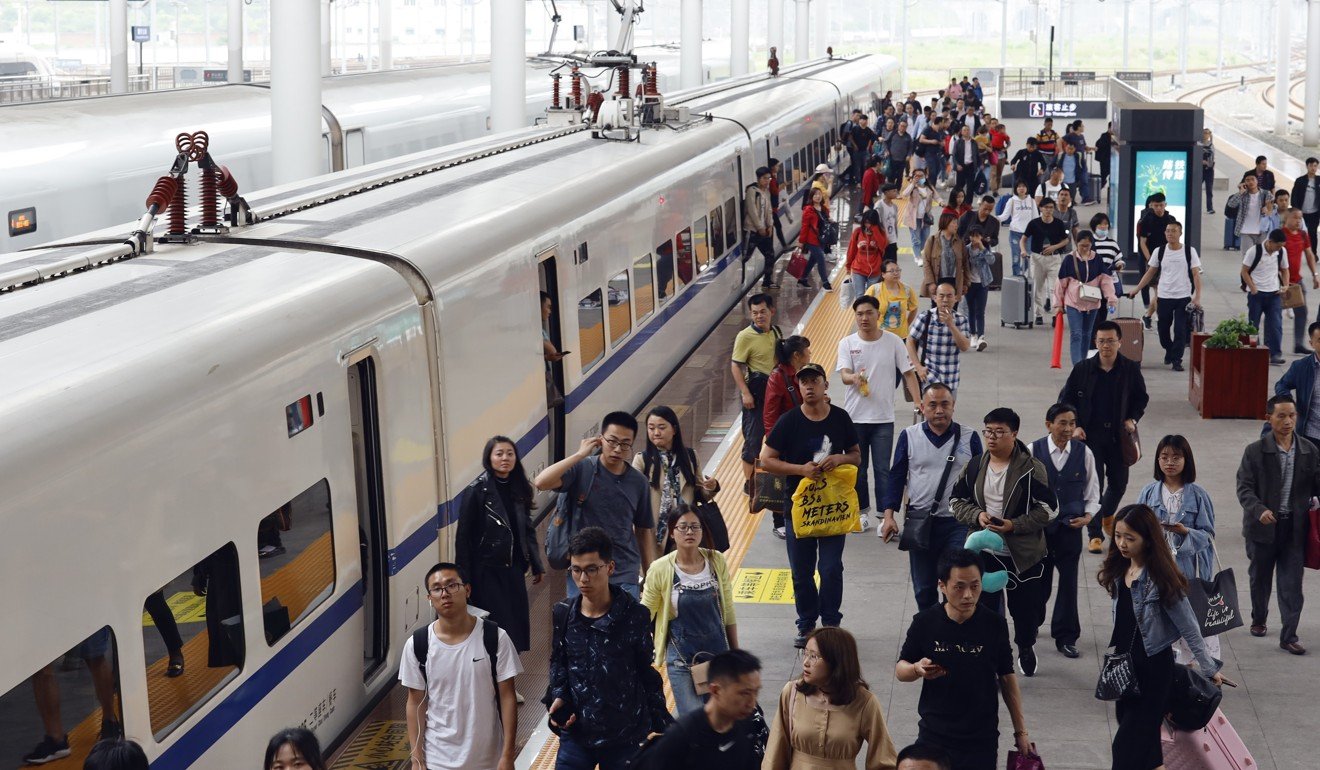
Passengers board the train at Chongqing North Railway Station in southwest China on Tuesday, hoping to beat the May holiday travel rush. Photo: Xinhua
Meanwhile, more than 54,000 tourists visited the popular Badaling section of the Great Wall on Wednesday, according to Beijing Youth Daily. The attraction’s management team had increased the number of volunteers, parking spaces and shuttle buses to prepare for the influx, the report said.
More than 53,000 tourists had visited the Shanghai International Tourism Resort and Shanghai Disneyland by 4pm on Wednesday, according to data from the Shanghai municipal government’s real-time visitor tracker. The Shanghai Zoo attracted more than 24,000 people, and more than 9,200 visited the Shanghai Science and Technology Museum.
Despite the crowds, no records were broken at the Shanghai attractions, which reached about 70 per cent of their maximum visitor numbers recorded, The Paper reported.
At railway stations, ticket-holding passengers were stopped from boarding trains between Nanjing and the city of Zibo in Shandong province, eastern China, due to severe overcrowding, Beijing Youth Daily reported on Wednesday.
Station staff promised full refunds to customers with pre-booked tickets who were refused entry.
Are increasing diplomatic tensions behind tighter inspections and cancelled orders?
Farmers switch to other crops in bid to beat barriers
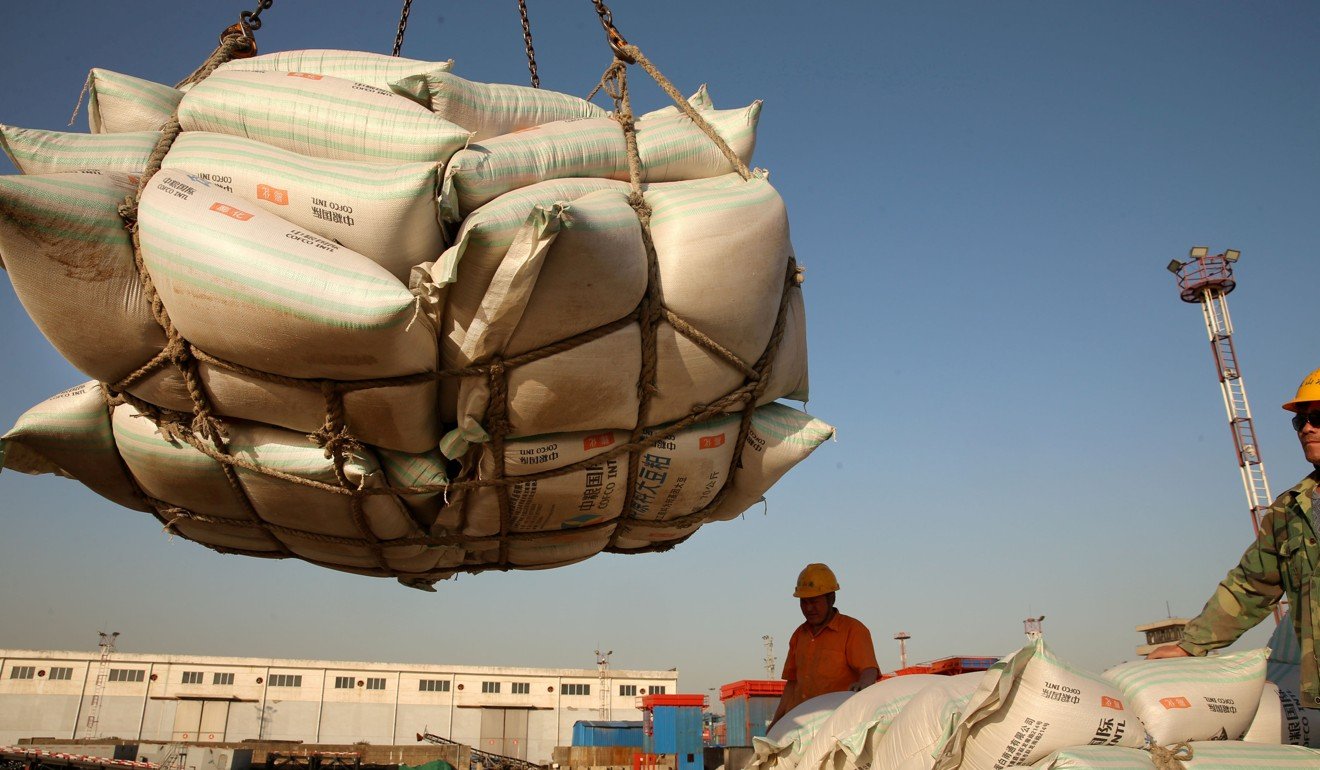
Canadian exporters of pork, soybeans and peas say they are facing delays and increased inspections at Chinese ports. Photo: Reuters
A growing list of Canadian farm exports is facing obstacles at Chinese ports, raising concerns that a bitter diplomatic dispute between the two countries may be to blame.
Sellers of Canadian soybeans and peas say they are experiencing unusual obstacles and Ottawa also warned last week that China was holding up pork shipments over paperwork issues.
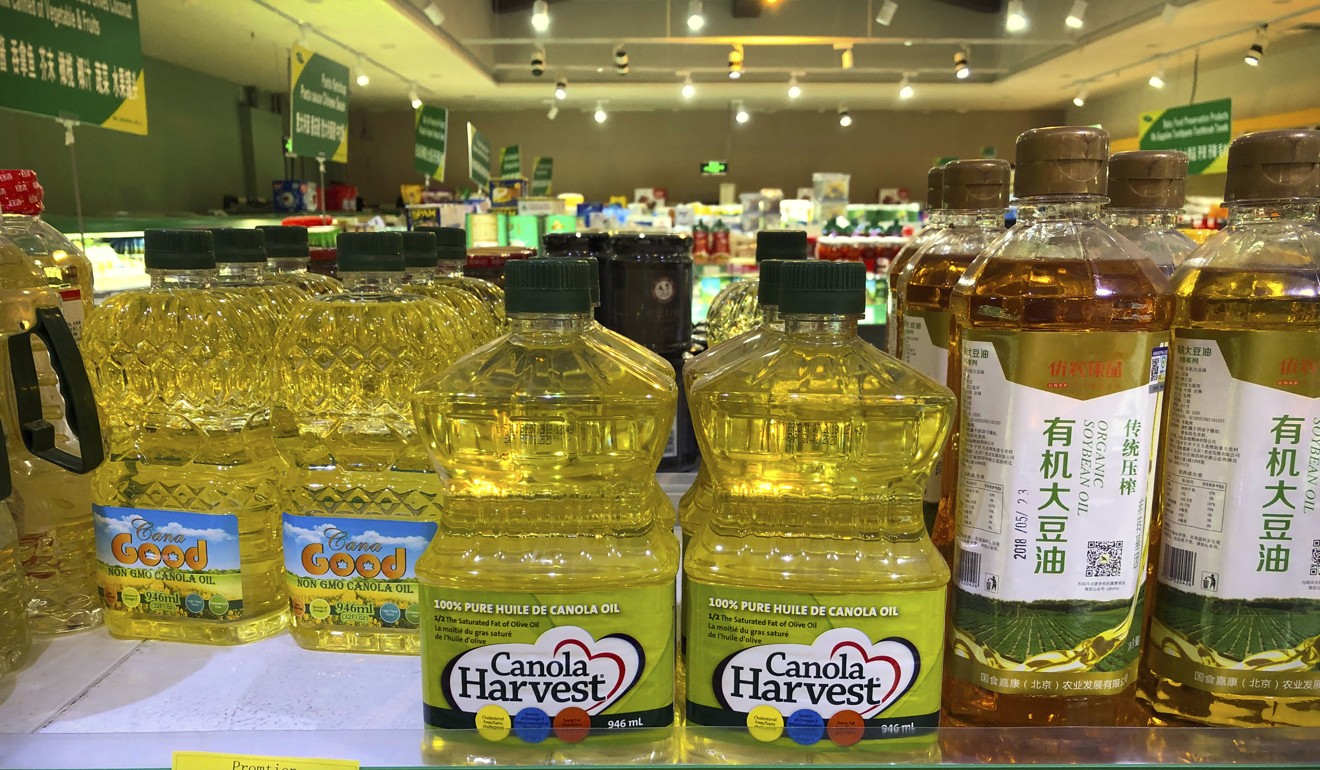
China has already blocked Canadian canola from Richardson International and Viterra, two of Canada’s biggest farm exporters, saying that shipments had pests. Other China-bound canola cargoes have been cancelled, forcing exporters to re-sell elsewhere at discount.
Canadian politicians have said the concerns are baseless, and noted that China detained two Canadians after Canada arrested an executive of Chinese telecom company Huawei Technologies Co Ltd in December at the United States’ request. China has used non-tariff barriers before during diplomatic tensions, most recently against Australian coal.
China has already blocked canola from two of Canada’s biggest farm exporters, while other China-bound canola cargoes have been cancelled. Photo: AP
Increasing tensions with China, a top buyer for most Canadian farm commodities, have forced farmers to plant other crops, such as wheat, that they hope will not face barriers.
China bought US$2.01 billion worth of Canada’s canola and $381 million worth of its pork last year.
The spread of African swine fever through China’s pig herd has reduced China’s need for canola and soybeans to process into feed ingredients but, since January, port soybean inspections that routinely take a few days now require three weeks, causing Chinese buyers to avoid Canadian products, according to Dwight Gerling, president of Canadian exporter DG Global.
“They’re basically sending out the signal, ‘You buy from Canada, we’re going to make your life difficult,’” Gerling said.
Earlier this year, a Chinese buyer told Gerling that a government inspector had found ants in 34 containers (roughly 680 tonnes) of the Canadian soybeans he shipped there.
Such a finding would be rare, since the soybeans were stored in concrete silos in Canada and shipped in sealed containers in late autumn, said Gerling, who concluded the buyer was trying to avoid the new hassles of buying from Canada.
“It’s just them playing games. (Beijing) is just going to keep putting the screws to us,” he said.
China’s General Administration of Customs did not reply to a request for comment. Government officials have said their canola ban is a regular inspection and quarantine measure to protect China’s farm production and ecological safety.
In a statement, the Canadian agriculture department said it could not confirm that China had imposed stricter measures against farm goods other than canola. Ottawa said this month it hoped to send a delegation to China to discuss the issue.
Gerling’s company has halted soybean sales to China and found other buyers in Southeast Asia.
An official at a state-owned crusher in southern China confirmed that port inspections had tightened on Canadian soybean cargoes.
“We don’t have Canadian cargoes coming in as we can’t blatantly commit such wrongdoing when the atmosphere is so intense,” the official said on condition of anonymity.
Soybeans from Canada are facing delays when they reach Chinese ports, according to traders. Photo: Reuters
Another official in northern China said his crushing plant scrapped plans to buy Canadian soybeans when the trade dispute flared.
Canada shipped $1.2 billion worth of soybeans to China in 2018, up sharply year over year, according to the Soy Canada industry group, as China and the United States fought a trade war. But sales have now slowed to a trickle.
Canola has taken the brunt of China’s measures.
Chinese buyers have cancelled at least 10 cargoes of Canadian canola in the past few weeks, according to a Singapore-based trader at a company that runs crushing facilities in China. Some cargoes, around 60,000 tonnes each, have been resold to buyers in Pakistan and Bangladesh at deep discounts, the trader said.
“It is devastating for exporters,” the trader said.
Canada gets tough with China on canola ban, demands contamination proof
Intercontinental Exchange (ICE) canola futures fell to a more than four-year low on Tuesday as supplies piled up. Growers intend to sow the smallest crop in three years.
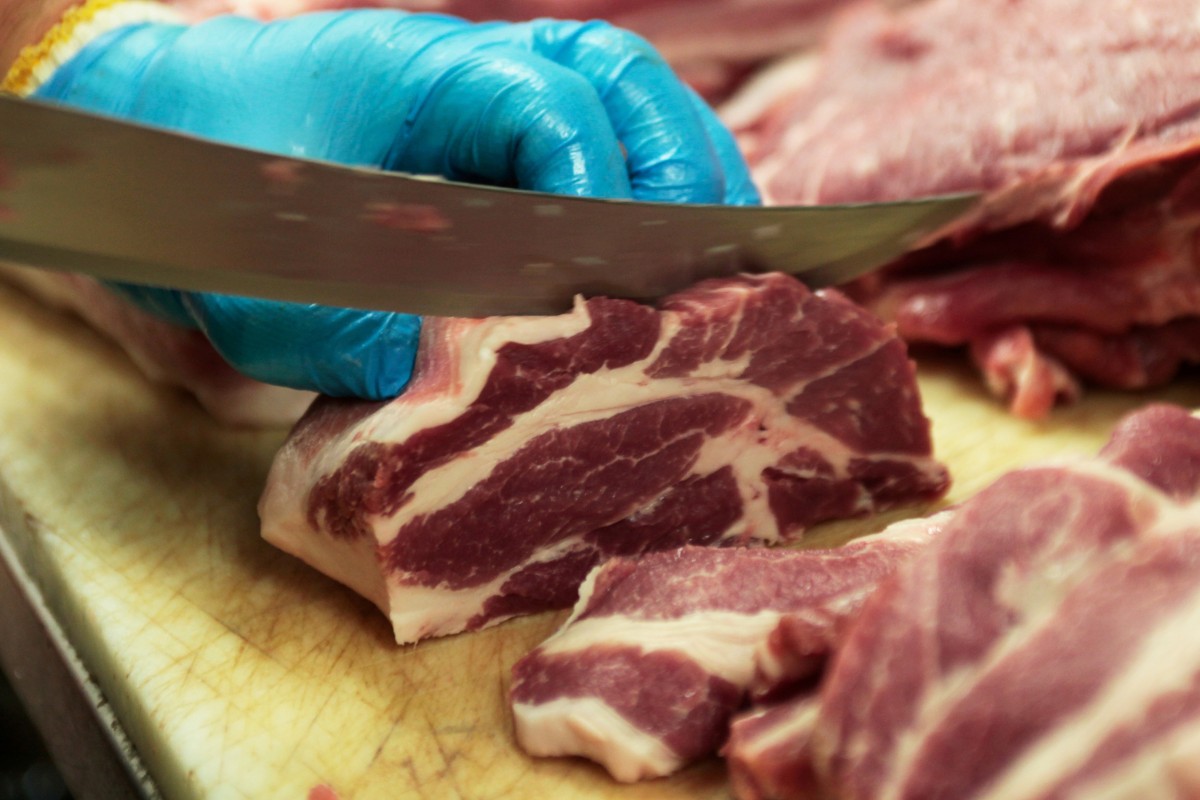
On Monday last week, Ottawa said some Canadian pork exporters used an outdated form to certify shipments to China, causing delays. Such issues arise regularly in commodity trading, but rarely with damaging consequences, said Canadian Pork Council spokesman Gary Stordy.
Canadian pea exporters fear they could be next. China imported C$533 million worth of Canadian peas in 2018, according to industry group Pulse Canada, but the pace has slowed.
Chinese authorities have begun scrutinising import documents and product samples more closely, according to Taimy Cruz, director of logistics at Toronto-based BroadGrain Commodities.
China Inspection and Quarantine Authorities now tests samples of each pea shipment before authorising it for import. They also restrict in some cases the number of soybean shipments allowed under one licence, slowing the flow, she said.
Similarly, import authorities now require soybean shipments that change vessels in Singapore and Shanghai – a routine practice called trans-shipping – to reach their destination on a single ship, she said.
While BroadGrain has not seen its cargoes turned back, it has reduced sales to China to avoid risk, concentrating on the Indian subcontinent and South America, she said.
“We have to be extra careful,” Cruz said. “They are very strict now.”
Fusion reactor built by Chinese scientists in eastern Anhui province has notched up a series of research firsts
There are plans to build a separate facility that could start generating commercially viable fusion power by 2050, official says
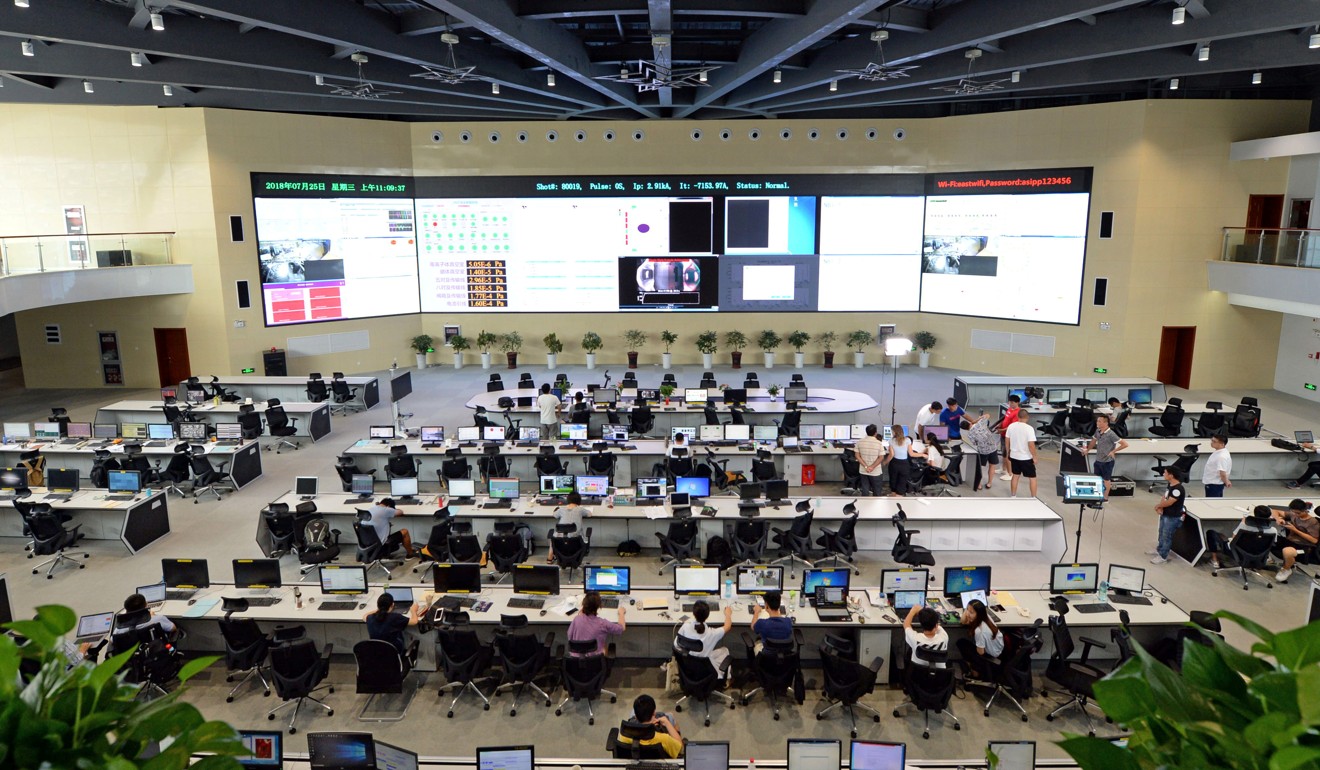
The Experimental Advanced Superconducting Tokamak (EAST) device – or “artificial sun” – in Hefei, Anhui province. Photo: AFP/Chinese Academy of Sciences
A groundbreaking fusion reactor built by Chinese scientists is underscoring Beijing’s determination to be at the core of clean energy technology, as it eyes a fully functioning plant by 2050.
Sometimes called an “artificial sun” for the sheer heat and power it produces, the doughnut-shaped Experimental Advanced Superconducting Tokamak (EAST) that juts out on a spit of land into a lake in eastern Anhui province, has notched up a succession of research firsts.
In 2017 it became the world’s first such facility to sustain certain conditions necessary for nuclear fusion for
of 100 million degrees Celsius (212 million Fahrenheit) – six times as hot as the sun’s core.
Such mind-boggling temperatures are crucial to achieving fusion reactions, which promise an inexhaustible energy source.
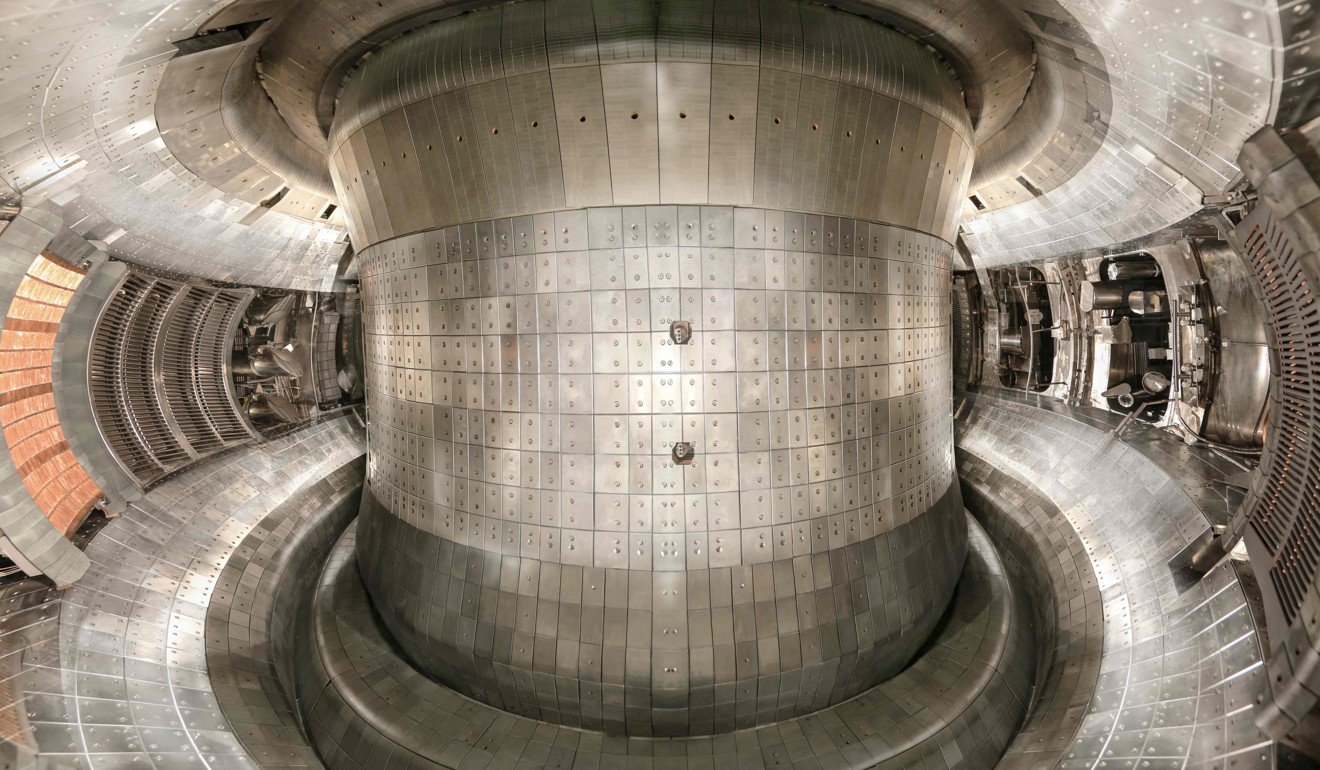
EAST’s main reactor stands within a concrete structure, with pipes and cables spread outward like spokes connecting to a jumble of censors and other equipment encircling the core. A red Chinese flag stands on top of the reactor.
A vacuum vessel inside the fusion reactor, which has achieved a temperature of 100 million degrees Celsius – six times as hot as the sun’s core. Photo: AFP/Chinese Academy of Sciences
“We are hoping to expand international cooperation through this device [EAST] and make Chinese contributions to mankind’s future use of nuclear fusion,” said Song Yuntao, a top official involved in the project, on a recent tour of the facility.
China is also aiming to build a separate fusion reactor that could begin generating commercially viable fusion power by mid-century, he added.
Some 6 billion yuan (US$891.5 million) has been promised for the ambitious project.
EAST is part of the International Thermonuclear Experimental Reactor (ITER) project, which seeks to prove the feasibility of fusion power.
Funded and run by the European Union, India, Japan, China, Russia, South Korea and the United States, the multibillion-dollar project’s centrepiece will be a giant cylindrical fusion device, called a tokamak.
Now under construction in Provence in southern France, it will incorporate parts developed at the EAST and other sites, and draw on their research findings.
China is “hoping to expand international cooperation” through EAST. Photo: Reuters
Fusion is considered the Holy Grail of energy and is what powers our sun.
It merges atomic nuclei to create massive amounts of energy – the opposite of the fission process used in atomic weapons and nuclear power plants, which splits them into fragments.
Unlike fission, fusion emits no greenhouse gases and carries less risk of accidents or the theft of atomic material.
But achieving fusion is both extremely difficult and prohibitively expensive – the total cost of ITER is estimated at €20 billion (US$22.3 billion).
Wu Songtao, a top Chinese engineer with ITER, conceded that China’s technical capabilities on fusion still lag behind more developed countries, and that US and
Japanese tokamaks have achieved more valuable overall results.
But the Anhui test reactor underlines China’s fast-improving scientific advancement and its commitment to achieve yet more.
China’s capabilities “have developed rapidly in the past 20 years, especially after catching the ITER express train”, Wu said.
In an interview with state-run Xinhua news agency in 2017, ITER’s director general Bernard Bigot lauded China’s government as “highly motivated” on fusion.
“Fusion is not something that one country can accomplish alone,” Song said.
“As with ITER, people all over the world need to work together on this.”
Embassy officials have contacted families of two Chinese nationals who were killed in the blasts on Easter Sunday, and visited five who were injured
Four of the missing were travelling to the Indian Ocean on a study trip
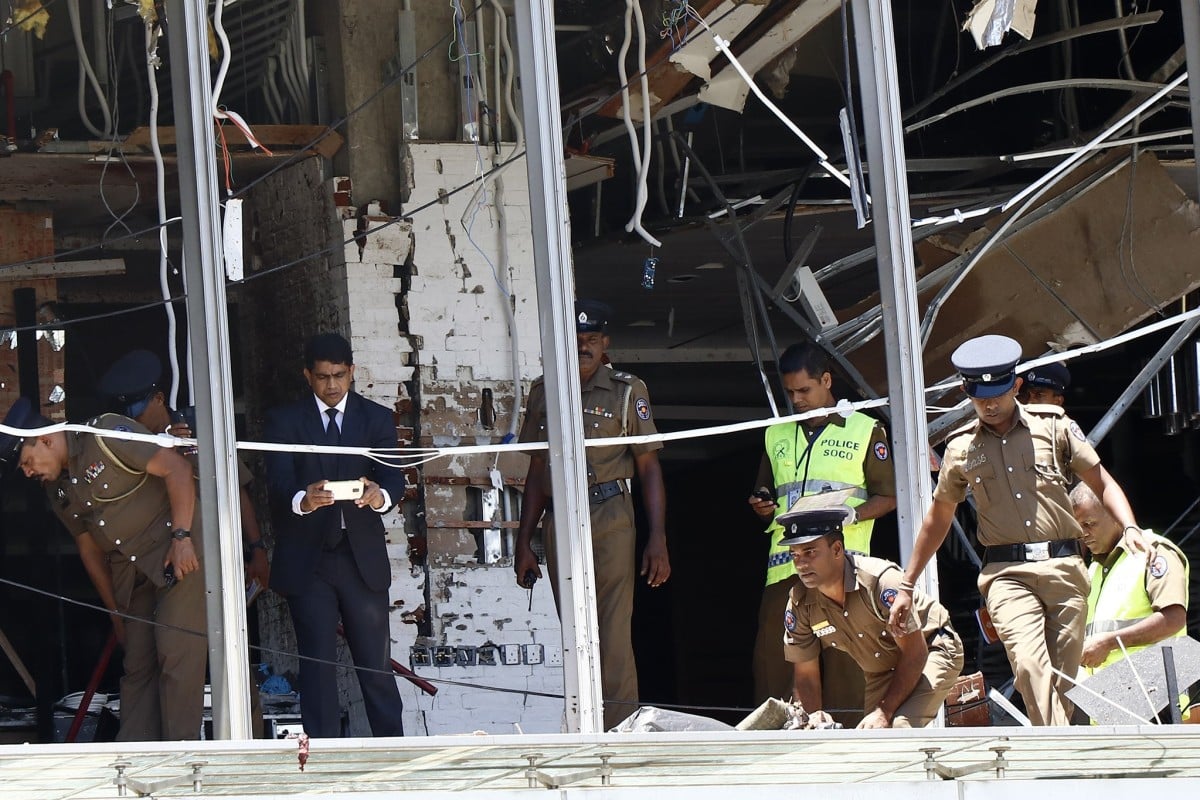
Police and investigators work at the Shangri-La Hotel blast scene in Colombo on Sunday, where the two Chinese were killed. Photo: Xinhua
Five Chinese nationals remain missing following a series of suicide bombings in hotels and churches in Sri Lanka on Easter Sunday that claimed the lives of
At least 290 people were killed and more than 500 others injured in the blasts, according to a Sri Lankan government official on Monday, who said a local militant group was behind the attacks.
The Chinese embassy in Colombo had contacted the families of the two deceased Chinese and was awaiting police confirmation on the fate of the five still missing, state-run People’s Daily reported.
Two Chinese nationals sustained serious injuries in the blasts and three others minor ones. Embassy officials had visited them several times in hospital, the report said.
“The embassy will closely monitor the situation, urge Sri Lankan police to confirm the whereabouts of the missing persons and assist Chinese citizens and families to properly handle the aftermath,” the embassy was quoted as saying.
The two Chinese who died, cousins surnamed Tan, were caught in a blast at the Shangri-La Hotel in Colombo, Red Star News quoted a Chinese businesswoman in the Sri Lankan capital as saying.
“Their families identified them at the scene,” she said.
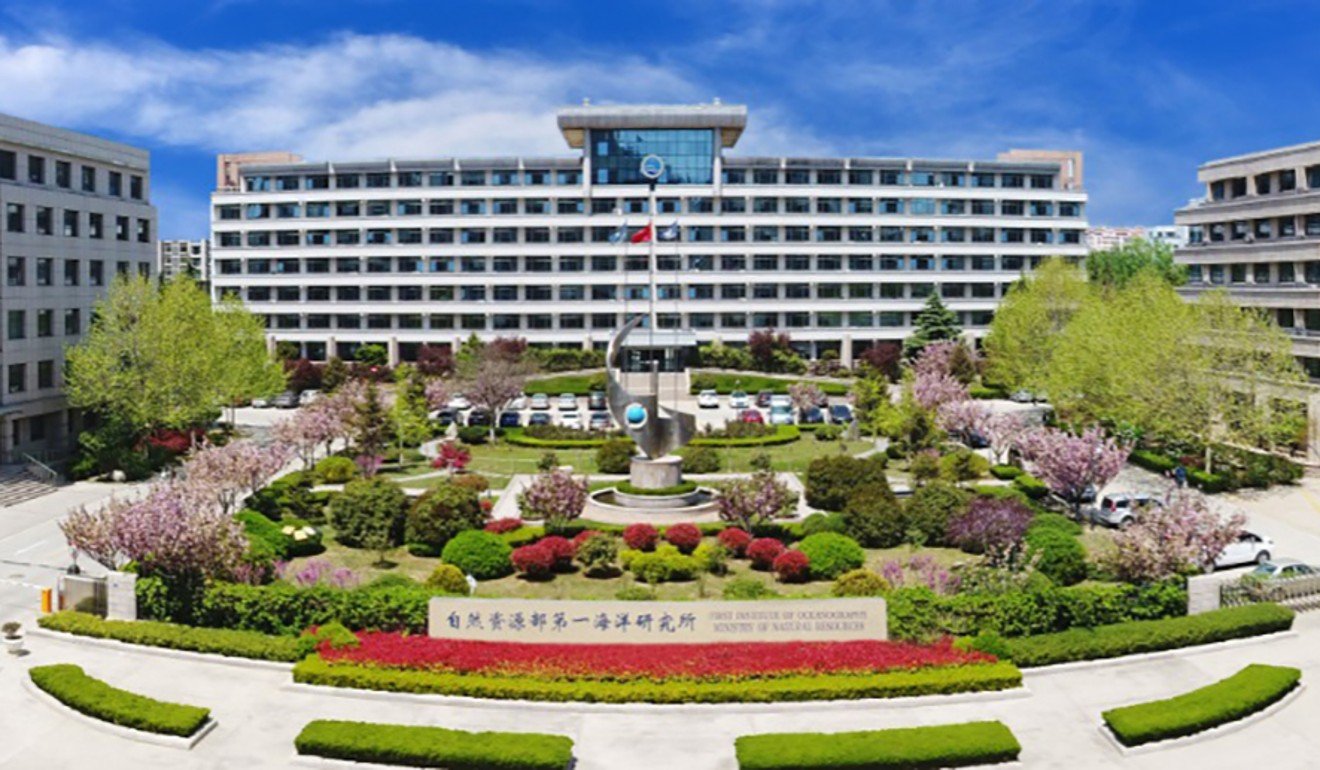
Four of the missing Chinese are students from the First Institute of Oceanography at the Ministry of Natural Resources. Photo: FIO
Four of the missing Chinese – Li Dawei, Li Jian, Pan Wenliang and Wang Liwei – are students from the Ministry of Natural Resources’ First Institute of Oceanography who were going to take part in a study in the Indian Ocean, an institute staff member told Red Star News.
Four of the five injured are students from the Chinese Academy of Sciences’ South China Sea Institute of Oceanology, who were en route to a study trip in the eastern Indian Ocean.
“It is an annual scientific expedition programme and they were on the way to replace the 10 others who had completed their rotation,” a staff member told The Beijing News. “Some sustained bruising on their legs and one could hardly hear after the blast.”
Tourists who returned to Shanghai and Chengdu, Sichuan province, told the newspaper that their trip had to be cut short as shops were closed and a curfew imposed amid tight security.
“All the private cars, coaches, vans and buses had to open their doors for inspection. There were checkpoints every 10 metres,” said one tour guide from Chengdu.
A traveller from the same city said airport security had also been stepped up. “There was a bombing 20 minutes after we left a restaurant and another one outside the airport when we were waiting there. We had to pass through three or four very strict security checks at the airport,” she said.
Back in Shanghai, another woman said: “We were not scared there but we are very glad to be back home.”
Tesla said it is investigating a video on Chinese social media that appears to show one of its vehicles bursting into flames in Shanghai.
In a statement, the carmaker said it had sent a team to investigate the matter, and that there were no reported casualties.
The video, which has not been verified by the BBC, showed a stationary car erupting into flames in a parking lot.
Tesla did not confirm the car model but social media identified it as Model S.
“After learning about the incident in Shanghai, we immediately sent the team to the scene last night,” according to a translation of a Tesla statement posted on Chinese social media platform Weibo.
“We are actively contacting relevant departments and supporting the verification. According to current information, there are no casualties.”
BEIJING (Reuters) – China’s Huawei Technologies launched on Monday what it said was the world’s first 5G communications hardware for the automotive industry, in a sign of its growing ambitions to become a key supplier to the sector for self-driving technology.
Huawei said in a statement that the so-called MH5000 module is based on the Balong 5000 5G chip which it launched in January. “Based on this chip, Huawei has developed the world’s first 5G car module with high speed and high quality,” it said.
It launched the module at the Shanghai Autoshow, which began last week and runs until Thursday.
“As an important communication product for future intelligent car transportation, this 5G car module will promote the automotive industry to move towards the 5G era,” Huawei said.
It said the module will aid its plans to start commercializing 5G network technology for the automotive sector in the second half of this year.
Huawei has in recent years been testing technology for intelligent connected cars in Chinese cities such as Shanghai, Shenzhen and Wuxi and has signed cooperation deals with a swathe of car makers including FAW, Dongfeng and Changan.
The company, which is also the world’s biggest telecoms equipment maker, is striving to lead the global race for next-generation 5G networks but has come under increasing scrutiny from Washington which alleges that its equipment could be used for espionage. Huawei has repeatedly denied the allegations.






 CHINDIA ALERT: You'll be living in their world, very soon