Archive for ‘sichuan province’

14/05/2020

China relocates villagers living in 800m-high cliffs in anti-poverty drive

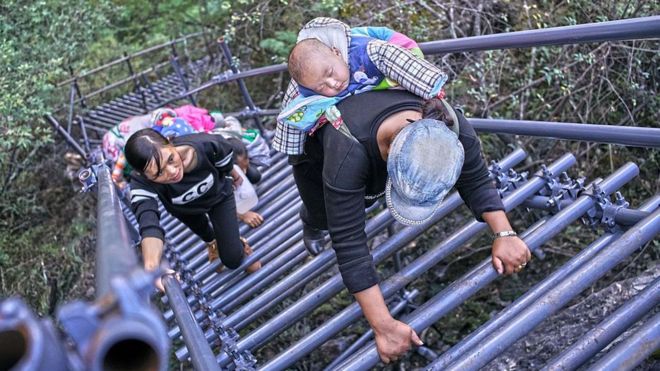
People climb on the newly-built metal ladder with hand railings to Ahtuler village on a cliff on November 11, 2016Image copyright GETTY IMAGES
Image caption The village made headlines after photos showed people scaling ladders to get home

They used to call an 800m-high cliff home, but dozens of villagers in China’s Sichuan province have now been relocated to an urban housing estate.

Atulie’er village became famous after photos emerged showing adults and children precariously scaling the cliff using just rattan ladders.

Around 84 households have now been moved into newly built flats as part of a local poverty alleviation campaign.

It’s part of a bigger national campaign to end poverty by the end of 2020.

‘So happy I got a house’

Atulie-er village made headlines in 2016 when it was revealed that its villagers had to scale precarious ladders to get home, carrying babies and anything the village needed.

Soon afterwards the government stepped in and replaced these with steel ladders.

The households have now been moved to the county town of Zhaojue, around 70km away.

They will be rehoused in furnished apartment blocks, which come in models of 50, 75 and 100 sq m – depending on the number of people in each household.

It’ll be a big change for many of these villagers, who are from the Yi minority and have lived in Atulie-er for generations.

Photos on Chinese state media showed villagers beaming, one of them telling state media outlet CGTN that he was “so happy that I got a good house today”.

‘Big financial burden’

According to Mark Wang, a human geography professor at the University of Melbourne, such housing schemes are often heavily subsidised by the government, typically up to 70%. However, in some instances families have been unable to afford the apartments despite the subsidies.

“For some really poor villages, the 30% may still be difficult for them to pay, so they end up having to borrow money – [ironically] causing them even more debt,” he told BBC News.

“For the poorest, it’s a big financial burden and so in some instances, they might have to stay.”

According to Chinese state media outlet China Daily, each person will have to pay 2,500 yuan ($352; £288) for this particular move – so for a family of four, the cost would come up to 10,000 yuan.

Villagers Living On Cliff Shop Online In LiangshanImage copyright GETTY IMAGES
Image caption This is the journey the villagers had to make to get home

This is quite a low price, says Mr Wang, as he had heard of people having to pay up to 40,000 yuan for other relocation projects.

Mr Wang says in most poverty resettlement campaigns, villagers are given a choice whether or not to move, and are not usually moved into cities from the countryside.

“In most instances it’s a move to a county town or a suburb. So it’s not like they’re moving to a big city. Not everyone wants an urban life and most of those who do would have already left these villages and moved to the big cities,” he says.

“Usually the government [puts a limit] on the resettlement distance. This is in most people’s favour because it means they can keep their farm land, so that’s very attractive.”

The Atulie’er villagers will share this new apartment complex with impoverished residents across Sichuan province.

The new apartment blocksImage copyright CGTN/YOUTUBE
Image caption The villagers will be living in these apartment buildings

Around 30 households will remain in the Atulie’er village- which is set to turn into a tourism spot.

According to Chinese state media outlet China Daily, these households will effectively be in charge of local tourism, running inns and showing tourists around.

The county government has ambitious plans – planning to install a cable car to transport tourists to the village and to develop some surrounding areas. An earlier report said there were plans to turn the village into a vacation resort, with state media saying the state would pump 630 million yuan into investment.

Though these developments are likely to bring more jobs to the area, it’s not clear what safeguards are in place to make sure that the site’s ecological areas are protected and not at risk of being overdeveloped.

Media caption Do people in China’s rural communities think poverty reduction can work?

Chinese President Xi Jinping has declared that China will eradicate poverty in China by 2020.

There’s no one standard definition of poverty across all of China, as it differs from province to province.

One widely quoted national standard is 2,300 yuan ($331; £253) net income a year. Under that standard, there were around 30 million people living in poverty across the whole of China in 2017.

But the 2020 deadline is approaching fast – and Mr Wang says the plan could be derailed by the virus outbreak.

“Even without Covid-19 it would be hard to meet this deadline and now realistically, it has made it even more difficult.”

Source: The BBC

10/04/2020

Chinese Long March-3B rocket fails during launch of Indonesian satellite

  • Malfunction happened during third stage of launch after earlier stages were completed successfully, state media says
  • Failed mission is second in less than a month after Long March-7A encountered problems after lift-off on March 16
A Long March-3B carrier rocket blasts off from the Xichang Satellite Launch Centre in Sichuan province in November. A similar launch on Thursday ended in failure. Photo: Xinhua

China’s space programme suffered another setback on Thursday night with its second rocket launch failure in less than a month.

Officials are investigating what caused a malfunction during the third stage of the Long March-3B launch after lift-off from the Xichang Satellite Launch Centre in southwest Sichuan province at 7.46pm with an Indonesian Palapa-N1 satellite, Xinhua reported.

“The first and second stages of the rocket performed well, but the third stage malfunctioned,” the report said.

“Debris from the third stage of the rocket and the satellite fell [to the ground]. The launch mission failed.”

Debris from the failed mission rained down over Guam on Thursday night. Photo: Twitter
China’s state media did not say where the rocket landed, but the office of Guam Homeland Security and Civil Defence said “a fiery object over the Marianas sky” observed on Thursday evening was likely connected to the failed launch.
Video footage of the burning debris falling from the sky was widely circulated on social media.
The setback follows another failed launch on March 16, when China’s new Long March-7A, a three-stage, medium-lift, liquid-fuel rocket, encountered an “abnormality” minutes after lifting off from its launch site in the southern island province of Hainan.
China’s BeiDou system one satellite closer to full operation
11 Mar 2020

The satellite lost on Thursday – the Nusantara 2 – was built in China for Indonesian telecommunication companies Pasifik Satelit Nusantara and Indosat Ooredoo. It was intended to replace an older satellite to provide internet and broadcasting services in Indonesia and across the Asia-Pacific region to Australia, The Jakarta Post reported earlier this month.

It is not known if the failed launch will have an impact on other Long March-3B satellite launches planned for later in the year.

Introduced in 1996, the Long March-3B – also known as the CZ-3B or LM-3B – has been the main orbital carrier rocket of China’s space programme. It was used to carry many of the satellites that make up China’s BeiDou navigation system, with the latest addition being in March.

For that launch, engineers used parachutes to control where the rocket’s boosters would land after being discarded after lift-off so as to minimise the impact on people living below, state media reported.

The latest version of the Long March-3B entered service in 2007 and is dedicated to launching heavy communications satellites of up to 5.5 tonnes into geostationary transfer orbits.

Source: SCMP

02/04/2020

China’s race to produce ‘super pigs’ destined to fail amid haphazard biosecurity, experts say

  • China’s pig herd has begun to build again after African swine fever devastated hog populations across the country 18 months ago
  • Scientists are racing to create disease-resistant pigs, but analysts say that will be undermined by basic hygiene problems in China’s pork industry
China’s pork industry has been severely dented by African swine fever disease in the past 18 months. Photo: Bloomberg

China should focus less on developing disease-resistant “super pigs” to protect its hog herd from infection and do more to improve basic biosecurity, analysts say, as several companies claim to be close to a breakthrough treatment for African swine fever.

China’s hog herd has begun to steadily rebuild after swine fever spread across the country a year and a half ago, killing or forcing the culling of 60 per cent of the pig population, according to authorities.

But poor biosecurity – including the transport of pigs in filthy trucks and a lack of disinfection at farms – still threaten the industry, observers said.

There is no commercially available vaccine for the disease – which is not harmful to humans – but a number of researchers claim they are close.

Swine fever could kill 25% of the world’s pigs, scientists say
China’s Harbin Veterinary Research Institute, the country’s top research body on animal diseases, said last month it had developed a vaccine for African swine fever (ASF) that laboratory testing showed was safe and effective. However, it did not give a timetable on when it would be available for commercial use.

Meanwhile,Shandong Landsee Genetics, a company in China’s eastern Shandong province, was reported this week to have successfully bred ASF-resistant pigs. The pigs, called Lansibai-2, are from the large white breed, one of the most common raised in China.

When approached for comment, a spokeswoman for the company said the research was confidential and she was not authorised to speak to media.

Despite the apparent progress, analysts are generally sceptical that a silver bullet to prevent the disease will be developed on a large scale any time soon.

“Because this disease has been found in many countries, I don’t think there has been major progress [when it comes to eliminating the disease],” said Chenjun Pan, senior analyst for animal protein at Rabobank. “There have been some vaccines, but the effectiveness of the vaccines is not that satisfactory. So far there haven’t been any solutions from a medical perspective.”

There have been some vaccines, but the effectiveness of the vaccines is not that satisfactory – Chenjun Pan

China’s swine fever problem was complicated by an unwillingness from local governments to diagnose and report ASF cases, said E.W. Johnson, of Enable AgTech Consulting in Beijing. It was also complicated by basic hygiene problems, he added.

“Pigs with ASF are sold to slaughter every day, and dirty trucks are going everywhere, spreading the disease as much as they did when the ASF outbreak began,” Johnson said.

“There is no doubt that people are very excited and extremely zealous about these super-pigs. [But] China seems intent on living with ASF rather than getting rid of it.”

“The most important problem now is how to control the ASF epidemic, and this is not the way to do it,” said Feng Yonghui, chief analyst at pork industry website Soozhu.com. “The whole global industry recognises that the greatest preventive measure is improving biosecurity.”

he whole global industry recognises that the greatest preventive measure is improving biosecurity – E.W. Johnson

Improved hygiene can lower the risk of disease in production, said Feng, including sickness caused by bacteria and viruses, like transmissible gastroenteritis, a coronavirus found in pigs.
“It’s a system – you can’t just do one step in the process,” he said. “The whole industry has to study it, and we still need time to improve.”
Basic controls – like keeping pig transport trucks clean, or disinfecting protective equipment used by workers on pig farms – is simple but comes at a price, and some smaller pig farms are struggling to keep up.
China’s outbreak of African swine fever pushes pork off the Lunar New Year menu
“What we’re worried about are the people on the lower rungs of the ladder who aren’t able to keep up with better practises,” Feng said. “If we are to get pig stocks back up to where they were before the outbreak within three years, this is the key issue that stands in the way.”
China’s pork industry is at a turning point in production unlike at any other time in history, he said.
“In the past, when it came to upgrading production, or when the industry went into loss, all producers big and small began again at the same starting line,” he said. “That’s because there was no threat of disease. Now, those with money get to run first.”
Pork prices in China, the world’s top consumer and producer of pork, have surged since AFS began cutting back supply, driving margins up for both domestic and imported pork.
The world’s biggest pork processor, Hong Kong-listed WH Group, reported a 32 per cent jump in profits last year as record high pork prices in China boosted the value of the company’s exports from the United States and lifted margins on its China sales.
China’s deadly African swine fever epidemic is spreading across Asia
China’s total pork production in 2019 was 42.55 million tons, a decrease of 21.3 per cent from 2018, data from the National Bureau of Statistics showed. In 2018, the total pork output was 54.037 million tons, down 0.9 per cent from 2017.
While researchers race to find a cure for swine fever, new cases keep cropping up across the country. On Wednesday, the Ministry of Agriculture and Rural Affairs said local authorities in Sichuan had detected infections in piglets transported from outside the province.
Another outbreak was recorded in Inner Mongolia, where local authorities detected the disease in a herd of 200 piglets on a farm in Ordos city, which killed 92 of the animals, according to the agriculture industry.
Authorities are also monitoring cases of ASF in piglets smuggled into the country and would launch a 60-day investigation into illegal transport of hogs this month.
Source: SCMP
30/03/2020

Emergency medical supplies donated by China arrive in Nepal to combat COVID-19

KATHMANDU, March 29 (Xinhua) — The emergency epidemic prevention materials donated by the Chinese side arrived here on Sunday to help Nepal fight the COVID-19 pandemic.

The supplies that arrived at Tribhuvan International Airport in Nepali capital city Kathmandu in the wee hours of Sunday were formally handed over to the Nepali Health Minister Bhanu Bhakta Dhakal by the Chinese Ambassador to Nepal Hou Yanqi.

Dhakal welcomed the Chinese support and expressed gratitude to the northern neighbor for helping the Himalayan country overcome the epidemic.

“I would like to thank the Chinese people and the Chinese government for supporting Nepal in this difficult time to fight the COVID-19,” the minister said during the handover ceremony.

At a time when many countries are fighting against this battle, China keeping Nepal in the priority list and sending supplies immediately is really commendable, the minister expressed, adding that Nepal expects China’s support in the coming days as well.

The donations from China’s Sichuan Province and the Chinese Embassy include different kinds of masks, thermometers, Chloroquine phosphate tablets, protective clothing and portable ventilators weighing 1.1 tons.

Similarly, the donation from Alibaba Foundation, Jack Ma Foundation includes 100,200 N95 masks and 20,064 PCR test kits weighing 1.4 tons.

“We will try our best to send other necessary supplies as soon as possible. In case of any emergency, we can send a medical expert team or arrange a video conference meeting as well to help the health workers here,” the Chinese ambassador said.

She also welcomed the national lockdown enforced by the Nepal government, stating that it has received encouraging support from the general public.

Nepal is reportedly in dire need for medical supplies as the entire situation escalates in the country. Nepal, facing the shortage of test kits and personal protective equipment for health workers, has recorded five confirmed cases of the COVID-19 so far.

But there is a growing concern over a possible spike in the cases due to the relatively low number of tests. Nepal has enforced a week-long nationwide lockdown since March 24 to prevent the spread of infection.

The health ministry said that the received support materials will be distributed to federal and provincial levels hospitals immediately and will be useful for the prevention and management of the COVID-19 in Nepal.

Mahendra Shrestha, director general at the Department of Health Services under the Health Ministry, told Xinhua on Saturday, “The procured test kits from China will help us in the situation of spike in positive cases of the COVID-19.”

Source: Xinhua

29/03/2020

China’s Wuhan reopens subway, railway station

CHINA-WUHAN-SUBWAY SERVICE-RESUMPTION (CN)

Passengers walk on the platform of the subway station connected with Hankou Railway Station in Wuhan, central China’s Hubei Province, March 28, 2020. Wuhan, a central Chinese city once at the epicenter of the COVID-19 epidemic, on Saturday resumed its subway service following more than two months of suspension due to the epidemic. Passengers for six metro lines in the capital of Hubei Province are asked to scan their health QR codes with real name information and check body temperature before entering the metro stations and wear face masks during the whole journey. (Xinhua/Xiao Yijiu)

WUHAN, March 28 (Xinhua) — Wuhan, a central Chinese city once at the epicenter of the COVID-19 outbreak, on Saturday reopened its subway and railway station following more than two months of suspension due to the epidemic.

“We clearly remember that the metro service had been suspended for 65 days,” said Li Wei, a staff worker of the Wuhan metro service operator. “I was startled when I first saw the news of shutting down the metro system as I never expected such scenario to happen one day.”

“We are excited and happy today to resume the service to serve the Wuhan residents again,” Li said.

Passengers for six metro lines in the capital of Hubei Province are asked to scan their health QR codes with real name information and check body temperature before entering the metro stations and wear face masks during the whole journey. Many were seen even wearing rubber gloves and hats that can cover the face.

The subway service operator has installed 200 infrared intelligent temperature monitoring equipment at 182 subway stations that are back to service in the initial period.

Inside the subway carriages, there are yellow signs that ask passengers to sit with an empty seat between two of them and security guards who tell people to wear masks during the whole of their trips, not to assemble and scan trip-tracking codes when getting off the subway.

The trip tracking is designed to aid the epidemic prevention and control work. To reduce potential cross-infection, the subway carriages will also be disinfected partly every day and entirely every five days.

“We are finally back. I can go to work next Monday,” said a subway passenger surnamed Yang, who just arrived in Wuhan Saturday with another two family members carrying eggs, preserved meat and vegetables from Sichuan Province.

On Saturday, the Wuhan railway station resumed the arrival service as the epidemic waned. More than 12,000 Hubei passengers returned to Wuhan by high-speed trains from all over the country on Saturday, greeted by applauses and flowers at the station.

“I earlier booked the railway ticket for Feb. 14, but the railway service was halted due to the epidemic,” said a passenger surnamed Zhang. Although the arrival was delayed by one and a half months, he felt safe and relieved to see the epidemic situation under control in his hometown, Zhang said.

“Wandering outside for such a long time, I have anticipated the return to home all the time,” Zhang said. “I finally feel at ease and calm after I step on the land of Wuhan.

“Source: Xinhua

12/03/2020

China’s determination to achieve goal of poverty elimination unwavering: official

BEIJING, March 12 (Xinhua) — China’s determination to achieve the goal of poverty elimination remains unwavering despite the impact from the novel coronavirus disease (COVID-19), according to Liu Yongfu, director of the State Council Leading Group Office of Poverty Alleviation and Development.

About 3 million more migrant workers from the poverty-stricken areas have returned to their jobs last week, said Liu. He added that one-third of the poverty-relief projects had resumed operation as of March 6, and resumption will be accelerated.

The country’s poverty alleviation tasks are near completion, as the number of impoverished people fell to 5.51 million at the end of 2019 from 98.99 million at the end of 2012, and the number of poverty-stricken counties fell to 52 in 2020.

Guidance on establishing the poverty-relief supervision and aid mechanism will be released soon to prevent people from returning to poverty after being lifted out of it, according to Liu.

Measures should be taken to ensure the quality of compulsory education as well as develop vocational, higher and pre-school education in impoverished areas to eliminate poverty from the roots, he said.

Efforts to relieve poverty will not be stopped, even after absolute poverty is eradicated, said Liu, stressing that the country would then bridge the development gap and realize common prosperity.

Liu also noted that a census targeting poor people will be launched this year to ensure the data authenticity and accuracy of the achievements of the poverty alleviation tasks.

He also praised the help from Hong Kong in the fight against poverty. Nanjiang county in southwestern China’s Sichuan province has lifted all of the poor populations out of poverty last year, with parts of the contributions made by the government of Hong Kong Special Administrative Region and all walks of life in Hong Kong.

Source: Xinhua

10/03/2020

China issues contingency plan against locust threat

BEIJING, March 9 (Xinhua) — China on Monday unveiled its contingency plan to monitor and control the spread of locusts from home and abroad, in a bid to secure grain production and ecological safety.

Regional governance and scientific prevention and control should be given priority, said the plan jointly issued by the Ministry of Agriculture and Rural Affairs, the General Administration of Customs and the National Forestry and Grassland Administration.

The plan clarified the goal of locust control, which is to ensure that desert locusts from abroad will not cause harm and domestic locust outbreaks will not turn into a plague, with no more than 5 percent of crops affected.

Local authorities are urged to prevent the invasion of desert locusts from abroad. The plan requires that monitoring stations be set up in Tibet, Yunnan and Xinjiang on the potential migration routes of the destructive pests.

To control locusts in domestic agricultural areas, chemical control methods will be adopted for areas with a high density of the pests, while medium- or low-density areas will use biological and ecological control methods, the plan noted.

The plan also requires an investigation into the hidden dangers of grasshoppers in major grasslands in Inner Mongolia, Xinjiang and Sichuan, and the strengthening of prevention and control at key points on the border between China and Kazakhstan, and that between China and Mongolia.

The rare desert locust outbreak in East Africa and Southwest Asia has posed a severe threat to local grain and agricultural production, which led to the desert locust plague warning issued by the Food and Agriculture Organization of the United Nations.

Although experts believe it is highly unlikely that desert locusts will invade China, it is still necessary to take precautions, said the plan.

Source: Xinhua

10/03/2020

China launches new BeiDou navigation satellite

(EyesonSci)CHINA-XICHANG-SATELLITE-LAUNCH (CN)

China launches a new satellite of the BeiDou Navigation Satellite System (BDS) from the Xichang Satellite Launch Center in southwest China’s Sichuan Province, March 9, 2020, only one step away from completing the whole global system. The satellite, the 54th of the BeiDou family, was sent into a geostationary orbit as planned by a Long March-3B carrier rocket. The newly launched satellite is the second geostationary earth orbit satellite of the BDS-3 system, and the last one is expected to be launched in May. (Photo by Guo Wenbin/Xinhua)

XICHANG, March 9 (Xinhua) — China launched a new satellite of the BeiDou Navigation Satellite System (BDS) from the Xichang Satellite Launch Center in southwest China’s Sichuan Province at 7:55 p.m. Monday (Beijing Time), only one step away from completing the whole global system.

The satellite, the 54th of the BeiDou family, was sent into a geostationary orbit as planned by a Long March-3B carrier rocket.

China began to construct its navigation system, named after the Chinese term for the Big Dipper constellation, in the 1990s and started serving the Asia-Pacific Region in 2012. At present, all the first generation BDS-1 satellites have ended operations, and a total of 54 BDS-2 and BDS-3 satellites have been sent into space.

Compared with other navigation systems in the world, the design of the BDS constellation is unique, including medium earth orbit, inclined geosynchronous earth orbit and geostationary earth orbit satellites.

The BDS-3 system will consist of a total of 30 satellites, including 24 medium earth orbit satellites, three geostationary earth orbit satellites and three inclined geosynchronous earth orbit satellites.

The newly launched satellite is the second geostationary earth orbit satellite of the BDS-3 system, and the last one is expected to be launched in May.

The satellite and the carrier rocket were developed by the China Academy of Space Technology (CAST) and the China Academy of Launch Vehicle Technology, respectively.

Space engineers have overcome difficulties during the novel coronavirus epidemic to ensure the success of the mission.

Monday’s launch was the 327th mission of the Long March rocket series.

The new satellite has the most functions and signals, the largest size and the longest designed life span among all the BDS-3 satellites, said Chen Zhonggui, chief designer of BDS-3 satellites from CAST.

The satellite is based on the Dongfanghong-3B platform, currently one of the largest satellite platforms being used in China, and can carry more fuels to ensure its long life, said Chen.

The satellite has integrated the functions of navigation and communication. The accuracy of dynamic positioning can reach the decimeter level, according to Liu Tianxiong, deputy chief designer of BDS-3 satellites.

It can provide services for the driverless vehicles, accurate berthing of ships, as well as takeoff and landing of airplanes. It will be widely used in the fields of communication, electric power, finance, mapping, transportation, fishery, agriculture and forestry.

The ability of short message communication has been improved 10 times on this satellite. Users can send a message of over 1,000 Chinese characters at one time as well as pictures via the satellite, quite useful in emergencies.

The satellite’s ability to receive signals has also been greatly improved, which could help miniaturize users’ terminals, said Pan Yuqian, one of the satellite’s designers.

China aims to complete the construction of the BDS constellation in May and provide high-precision, reliable positioning, navigation and timing services anywhere in the world.

Source: Xinhua

05/03/2020

Special Report – Before coronavirus, China bungled swine epidemic with secrecy

(Reuters) – When the deadly virus was first discovered in China, authorities told the people in the know to keep quiet or else. Fearing reprisal from Beijing, local officials failed to order tests to confirm outbreaks and didn’t properly warn the public as the pathogen spread death around the country.

All this happened long before China’s coronavirus outbreak, which has claimed more than 3,000 lives worldwide in less than three months. For the past 19 months, secrecy has hobbled the nation’s response to African swine fever, an epidemic that has killed millions of pigs. A Reuters examination has found that swine fever’s swift spread was made possible by China’s systemic under-reporting of outbreaks. And even today, bureaucratic secrecy and perverse policy incentives continue undermining Chinese efforts to defeat one of the worst livestock epidemics in modern history.

Beijing’s secretive early handling of the coronavirus epidemic has troubling similarities to its missteps in containing African swine fever, but with the far higher stakes of a human infection. After the coronavirus was found in December 2019 in Wuhan, the capital of Hubei province, local and national officials were slow to sound the alarm and take actions disease experts say are needed to contain deadly outbreaks. Beijing continues to gag negative news and online postings about the disease, along with criticism of the government’s response.

With swine fever, Beijing set a tone of furtiveness across government and industry by denying or downplaying the severity of a disease that the meat industry estimates has shrunk China’s 440-million-hog herd by more than half. The epidemic has taken a quarter of the world’s hogs off the market, hurt livelihoods, caused meat prices to spike globally and pushed food inflation to an eight-year high. (For a graphic on soaring China pork prices, click here)

Cover-ups across China – coupled with underfinancing of relief for devastated pig farmers and weak enforcement of restrictions on pork transport and slaughter – have enabled the spread of the livestock virus to the point where it now threatens pig farmers worldwide, according to veterinarians, industry analysts and hog producers. Since the China outbreak, African swine fever has broken out in 10 countries in Asia.

The vacuum of credible information has made it impossible for farmers, industry and government to tell how and why the disease spread so quickly, making preventive measures difficult, said Wayne Johnson, a Beijing-based veterinarian who runs Enable Ag-Tech Consulting.

“To get it under control, you have to know where it is,” Johnson said.

China’s Ministry of Agriculture and Rural Affairs said in a statement to Reuters that it has repeatedly communicated to all regions the importance of timely and accurate reporting of African swine fever outbreaks and had zero tolerance for hiding and delaying the reporting of cases.

Interviews with farmers, industry analysts and major suppliers to China’s pork sector indicate otherwise. More than a dozen Chinese farmers told Reuters they reported disease outbreaks to local authorities that never made it into Beijing’s official statistics. Those infections are going unreported to central authorities in part because counties lack the cash to follow a separate requirement from Beijing to compensate farmers for pigs killed to control the disease.

Local officials have also avoided reporting outbreaks out of fear of the political consequences. And they have routinely refused to test pigs for the virus when mass deaths are reported, according to interviews with farmers and executives at corporate producers.

A farmer surnamed Zhao, who raises a herd in Henan province, said local officials told him as much when they resisted recording the outbreak he reported on his farm, which wiped out his herd.

“‘We haven’t had a single case of African swine fever. If I report it, we have a case,’” Zhao recalled an official telling him. The local officials could not be reached for comment and a fax seeking comment went unanswered.

When the coronavirus hit, Chinese authorities reacted with a push to reassure the public that all was well. The first reported death from the virus, also known as SARS-CoV-2, came on Jan. 9 – a 61-year-old man in Wuhan. In the following days, Chinese authorities said that the virus was under control and not widely transmissible.

The assurances came despite a lack of reliable data and testing capacity in Wuhan. Testing kits for the disease were not distributed to some of Wuhan’s hospitals until about Jan. 20, an official at the Hubei Provincial Centre for Disease Control and Prevention (Hubei CDC) told Reuters. Before then, samples had to be sent to a laboratory in Beijing for testing, a process that took three to five days to get results, according to Wuhan health authorities.

During that gap, city hospitals reduced the number of people under medical observation from 739 to 82, according to data from Wuhan health authorities compiled by Reuters, and no new cases were reported inside China.

China’s top leadership has dramatically ramped up the public-health response since its early missteps. Beijing built new hospitals in days to treat the sick and launched an unprecedented blockade of the disease epicentre on Jan. 23, first quarantining Wuhan’s 11 million residents at home, then suspending transport in all major cities of Hubei province, home to about 60 million people.

Still, the initial attempts to tightly control information left many people unaware of the risks and unable to take precautions that might have prevented infection – and the suppressing of news and commentary continues today. Wuhan authorities reprimanded eight people they accused of spreading “illegal and false” information about the disease. One of them, 34-year-old doctor Li Wenliang, later died from coronavirus, triggering an angry backlash on social media.

Some critical posts were allowed during a brief and unusual period of online openness in late January. But Beijing’s censors – the Cyberspace Administration of China (CAC) – have since cracked down on posts about Li and other information that authorities deem negative, according to CAC censorship orders sent to online news outlets and seen by Reuters. One CAC notice ordered online outlets to guard against “harmful information.” Another ordered them not to “push any negative story.”

The CAC did not respond to a request for comment sent by fax.

UNREPORTED OUTBREAKS

Beijing had years to prepare for African swine fever. Veterinarians have frequently warned Chinese authorities of the risks since the disease started spreading through the Caucasus region in 2007.

Pigs infected by the virus initially suffer high fever, loss of appetite and diarrhoea. Then their skin turns red as internal haemorrhaging starts and their organs swell, leading to death in as little as a week.

With no vaccine or cure available for the disease, experts recommend that infected pigs and others housed in the same barn are culled, with the carcasses either burned or buried to prevent further infection. Farms, equipment and vehicles that could be contaminated need to be thoroughly cleaned and disinfected.

The first case in China was discovered on Aug. 1, 2018, on a farm near Shenyang, in the northeastern province of Liaoning. Just two weeks later, the virus was found more than 1,000 kilometres to the south in pigs bought by the country’s top pork processor, WH Group(0288.HK), from another northeastern province, Heilongjiang. It took Beijing another two weeks to block pig exports from the whole region, and that and other transport restrictions were poorly enforced, said Johnson and other industry experts. WH Group declined to comment.

One factor behind the epidemic: Chinese consumers prefer fresh pork – straight from the slaughterhouse, rather than chilled. This means hundreds of thousands of live pigs are moved long distances every day to supply processors in major cities. That mass movement spread the disease relentlessly.

Over the first four months of the outbreak, Beijing reported swine-fever cases almost daily as the virus spread from the northeast down through central China, west into Sichuan, and to the huge province of Guangdong by year-end. Veterinarians believe the virus spread quickly because it can survive for weeks on dirty farm equipment or livestock trucks.

And yet gaps in counting and tracking the pig disease have been routine across China. Reuters found a striking absence of reported outbreaks in some of the nation’s most productive pork regions.

For instance, almost none of the reported outbreaks have come from the major hog-raising provinces of Hebei, Shandong and Henan. The three contiguous northern provinces were the source of some 20% of the 700 million pigs China slaughtered in 2017. Many came from backyard farms, which make up a large part of China’s industry and have proven fertile breeding grounds for the disease. Yet each of the three provinces has reported just a single case of African swine fever, despite widespread anecdotal reports of outbreaks there that industry sources believe killed millions of pigs.

Neither Shandong nor Henan authorities responded to requests for comment. Hebei’s department of agriculture said it had “strictly reported and verified the epidemic” and that the disease situation was currently “stable.”

Six Henan farmers told Reuters they reported outbreaks during late 2018 and the first half of 2019. In some cases, local authorities helped deal with dead pigs, they said, but never tested for the virus.

That’s what happened when Wang Shuxi, a farmer in Henan’s Gushi County, lost more than 400 pigs in March 2019. Wang said he had no doubt that his pigs had African swine fever, even though authorities never tested them – and he couldn’t test them himself, because Beijing did not permit the commercial sale of disease test kits at the time.

His pigs showed telltale symptoms of the disease.

“The whole body went red,” he said. He injected the animals with an anti-fever medication to no avail. “At the start, they didn’t eat, and even after injections, it kept returning,” he said. “If you can’t cure it, you know it’s swine fever.”

Provincial and county governments had strong incentives to avoid verifying and reporting outbreaks because of Beijing’s rules on compensating farmers, said Huang Yanzhong, specialist in health governance with the Council on Foreign Relations in New York.

Under an African swine fever contingency plan drawn up in 2015, Beijing ordered the culling of all pigs on farms where the disease is found and on every farm within a three-kilometre radius. The central government raised compensation from 800 yuan ($115) to 1,200 yuan for every pig culled in 2018. Beijing typically promised to provide between 40% and 80% of the money, depending on the province. Localities would fund the rest.

In April 2019, the national agriculture ministry said the central government had allocated 630 million yuan to cull 1.01 million pigs to contain the disease. But that money either wasn’t sufficient or regularly did not get paid out, farmers told Reuters. None of about a dozen farmers who told Reuters they tried to report outbreaks said they had received the promised 1,200 yuan for each pig.

Many got nothing. Wang, the Gushi County farmer, said that almost a year after his pigs died, he has received no recompense. Gushi County officials could not be reached for comment.

Many farmers, eager to salvage value from their herds, have resorted to sending their pigs to slaughter at the first sign of illness – thereby thrusting the virus into the human food supply. The swine fever virus does not threaten people. But its presence in meat – where it can survive for weeks – creates a cycle of infection because many backyard farmers feed pigs with restaurant scraps that include pork.

Garbage feeding caused 23 outbreaks in 2018, Huang Baoxu, deputy director of the China Animal Health and Epidemiology Center, told reporters at a briefing in November that year. His remarks were a rare instance where the central government revealed findings about the spread of the hog virus. The centre declined to comment for this story.

Farmers visiting slaughterhouses dealing in sick pigs also likely picked up the virus on their trucks or equipment, spreading it back to their farms, Johnson said.

In the southern province of Guangxi, the disease raged through the spring of 2019 and early summer, several farmers told Reuters last year. Bobai County was hit hard.

A Bobai farmer surnamed Huang said she lost almost 500 pigs during April and May. She said she tried to report the diseased pigs to the local government but was ignored. The official she spoke to by phone never came to her farm. He told Huang that her pigs could not be saved – but that they didn’t have African swine fever. His advice, she said: “hurry and sell the pigs while they could be sold.”

Huang said she sold more than 30 pigs that she believed had the virus. They looked healthy when she sold them, she said. Others sold obviously sick pigs at very low prices. “Traders took all the pigs, including the sick ones – as long as they could walk to the trucks,” she said.

Huang buried her dead pigs daily for weeks on a relative’s land. Others simply dumped their dead pigs on the roadside or in the mountains, she said. The government provided no help.

Eventually, in late May, Bobai County reported one pig dead from the disease, official statistics show.

Authorities in Guangxi did not respond to a request for comment, and officials in Bobai county’s agriculture bureau could not be reached.

Beijing’s agriculture ministry said in a statement that it had issued an August 2019 order requiring punishments in situations where localities failed to report outbreaks. The ministry said it meted out unspecified discipline to more than 600 local personnel for what it called failures to manage the disease that were uncovered in its investigations of problem areas.

The practice of processing infected hogs has persisted despite new rules from Beijing in July that required slaughterhouses to test all batches of pigs for the virus. The agriculture ministry said in January that 5% of the more than 2,000 samples taken from slaughterhouses in November tested positive for the disease.

An Australian study in September found 48% of meat products confiscated from Asian travellers arriving at its ports and airports contained the virus.

“It showed there’s an awful lot of unrevealed infection not being reported to the authorities,” said Trevor Drew, director of the Australian Animal Health Laboratory.

One such information gap is at the top of the industry – China’s large corporate pig producers. They have also been hit hard by the disease, despite taking more extensive measures than backyard farms to disinfect trucks and require workers to change clothes and shower before and after shifts.

None of China’s top publicly traded producers have publicly announced any swine fever outbreak, but executives of major hog producers acknowledged in interviews with Reuters that their herds were hit by the disease.

Thai conglomerate C.P. Pokphand(0043.HK), one of China’s leading pig producers, has had swine-fever outbreaks on farms in Liaoning, Shandong, Henan and Jiangsu provinces, Bai Shanlin, chief executive of China operations, told Reuters in a rare admission by a listed firm. Executives at three other listed companies, also among China’s top pig producers, acknowledged outbreaks at several farms but declined to be identified.

None of the outbreaks that these large companies have confirmed to Reuters were reported by Beijing, according to a Reuters review of the agriculture ministry’s data on outbreaks.

By August 2019, a year after the first case was found in China, pork prices had passed a record set back in 2016. And they were still climbing rapidly. With a crucial national celebration approaching in October – the 70th anniversary of the founding of the People’s Republic – China’s top leaders took note. Pork is a staple of Chinese cuisine, and rising meat production has been among the many signature achievements in the Communist Party’s decades-long drive to bring prosperity to China.

In a video conference that month with officials from all 34 provinces and regions, Vice Premier Hu Chunhua issued a warning: Sufficient pork was vital to people’s lives and the country’s stability. He called for the urgent recovery of the herd as a key “political task.”

A raft of new production policies and incentives emerged from Beijing. And as the provinces rallied to replenish the nation’s herd, reports of African swine fever grew even more rare. Disease outbreaks reported by the agriculture ministry have tailed off since August. In January, Agriculture Minister Han Changfu said the situation has stabilized.

The government’s statistics are rife with contradictions, however. The ministry has reported 163 outbreaks of African swine fever since August 2018 and said 1.19 million pigs have been culled, a fraction of 1% of China’s total herd. Separate ministry data tracking the herd monthly show that, by September 2019, the herd had shrunk by 41% from the prior year. (For a graphic on the decline in China’s pig herd, click tmsnrt.rs/38lkOcx )

These official estimates of the decline are far too low, three major industry suppliers told Reuters.

“It’s at least 60%,” said Johan de Schepper, managing director of Dutch feed ingredients firm Agrifirm International. His assessment, based on sales to about 100 large pig producers, echoed those of others in the industry.

The virus is still killing pigs nationwide and the herd may still be shrinking, say farmers and industry suppliers. “Half of the herd was gone before this winter, and I think half of the rest will be gone by the end of the season,” said Johnson, the veterinarian, citing conversations with clients from across China.

The problem: Some areas were hit with a second wave of the disease.

Henan province is among them, farmers told Reuters. Last year, about 60% of Henan’s herd was wiped out, mainly in the densely farmed areas in the south and west of the province, analysts at Guotai Junan Securities wrote in an internal memo seen by Reuters. Recently, the memo noted, the virus has moved through east Henan, taking out another 20%.

The vicious disease ruined Zhao, the farmer in central China’s Henan province. The virus struck in October, causing high fever, internal bleeding, vomiting and diarrhoea in his pigs. Just two survived. The other 196 died in a week.

When Zhao tried to report the outbreak to the county veterinary authority, he said, officials strongly encouraged him to keep quiet. A local official reminded him of the national mandate to cull all pigs within three kilometres of an infected farm. That could spell disaster for his neighbours if Zhao spoke up.

“If it’s found to be African swine fever, people nearby will have to stop raising pigs,” Zhao recalled a local official telling him. Zhao decided against filing a report to protect his neighbours, he told Reuters on a recent visit to his farm.

Further up the political hierarchy, the deputy governor of Henan province was quoted by the provincial agriculture bureau as saying in December that Henan had been free of the disease for 14 months, after a single reported case in September 2018. The provincial government did not respond to requests for comment.

The disinformation game continues. Zhao says that when county officials came by his farm in January, they recorded that he still had 180 pigs. In fact, he said, he had just the two hogs that survived the October outbreak.

“The country is being kept in the dark,” he said.

Source: Reuters

23/02/2020

WHO experts travel to Wuhan for COVID-19 investigation

BEIJING, Feb. 22 (Xinhua) — Some members of the China-World Health Organization (WHO) joint expert team traveled to Wuhan Saturday to investigate the COVID-19 outbreak, the National Health Commission said.

The experts will have discussions with Wuhan’s health authorities and visit medical and health institutions, the commission said.

The joint expert team began its work in China on Feb. 16 and has finished investigation in Beijing, Guangdong Province and Sichuan Province.

Source: Xinhua

Law of Unintended Consequences

continuously updated blog about China & India

ChiaHou's Book Reviews

continuously updated blog about China & India

What's wrong with the world; and its economy

continuously updated blog about China & India