Chindia Alert: You’ll be Living in their World Very Soon
aims to alert you to the threats and opportunities that China and India present. China and India require serious attention; case of ‘hidden dragon and crouching tiger’.
Without this attention, governments, businesses and, indeed, individuals may find themselves at a great disadvantage sooner rather than later.
The POSTs (front webpages) are mainly 'cuttings' from reliable sources, updated continuously.
The PAGEs (see Tabs, above) attempt to make the information more meaningful by putting some structure to the information we have researched and assembled since 2006.
BEIJING, May 2 (Xinhua) — A total of 35 parks and scenic spots in Beijing with large passenger flows require online reservations during the May Day holiday, Beijing Gardening and Greening Bureau said Friday.
Besides making reservations on the online platforms of these attractions, visitors can also book the tickets on the official website of Beijing Gardening and Greening Bureau and its official account on WeChat and microblog Sina Weibo.
Parks and scenic spots will embrace a peak of passenger flows during the holiday from May 1 to 5, according to Ye Xiangyang, director of the park management office of the bureau.
Online reservations can help control passenger flow effectively, ensuring the stable order of these popular sites and the health of visitors, Ye said.
Parks in the capital will limit real-time tourist numbers to no more than 30 percent of their maximum tourist capacity during the holiday for the safety of visitors amid the COVID-19 epidemic.
Beijing has lowered its emergency response to the COVID-19 epidemic from the top level to the second level starting Thursday.
Image copyright TAOBAO/SINA WEIBOImage caption Taobao confirmed that this was no April Fools joke
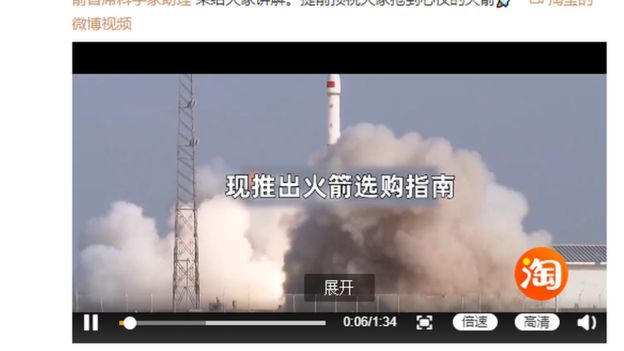
An online buyer has won an opportunity to launch a commercial rocket for 40 million yuan ($5.6m; £4.5m) in central China, it’s reported.
According to the official People’s Daily, popular online shopping platform Taobao live-streamed the sale of a commercial rocket yesterday evening.
The official China Daily said that the rocket was “a small launch vehicle” in the city of Wuhan, Hubei Province, which has already seen eight commercial launches.
Buyers were told that they could paint the body of the rocket and the launch platform, and that they could visit the launch site and control the launch.
Image copyrightT AOBAO/SINA WEIBOImage caption Celebrity sales anchor Wei Ya has more than seven million Weibo followers
Posters advertising the livestream, headed by celebrity shopping anchor Wei Ya, went viral on Wednesday 1 April, leading many to speculate they were part of an April Fools joke.
But national newspaper Global Times says that Taobao confirmed that “this is for real” in an online post.
It hints that the decision to sell a rocket experience, headed by Chinese entrepreneur Luo Yonghao, followed an earlier online poll where netizens were asked whether they’d rather win a “rocket, a satellite, a partner or a cleaning lady”.
‘How to choose the first rocket in your life?’
China Daily says that this was “the world’s first live broadcast of a rocket sale” and the livestream has attracted considerable attention online.
Media have noted that the livestream of the event, watched by millions, has been an opportunity to re-promote what Wuhan has to offer, since it made international attention as the original epicentre of the Covid-19 virus.
As well as promoting Wuhan’s Aerospace Science and Technology & Rocket Technology, the livestream was also interspersed by footage highlighting the hard-working efforts of medical workers in the city.
The name of the buyer has not been revealed, but this is not the first time that an online buyer has purchased an air vehicle for millions of dollars. In November 2017, two Boeing 747 jets were bought on Taobao in an online auction.
Image copyright TAOBAO/SINA WEIBOImage caption Taobao confirmed shoppers could buy a rocket on their platform
Education ministry says they will be held a month later than planned – on July 7 and 8 – when there is ‘a lower risk’ for students and staff
It will also give them more time to prepare after months of online learning due to school closures
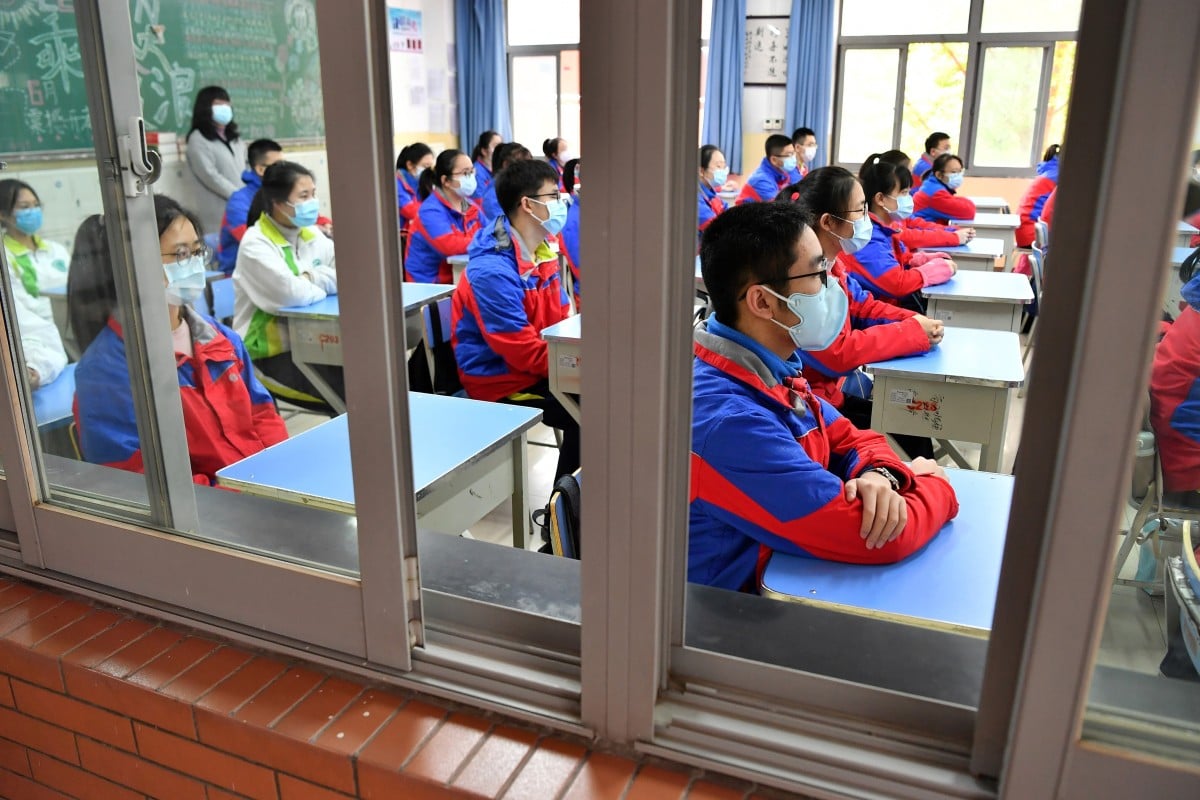
Students were back in class at the Xian Middle School in Shaanxi province on Monday after a nationwide closure because of the coronavirus outbreak. Photo: Xinhua
China’s all-important annual college entrance exams have been postponed by a month because of the coronavirus crisis – the first time they have been disrupted since the Cultural Revolution.
Universities in mainland China base enrolments solely on the results of the gruelling examinations, known as the gaokao, and they are seen as tests that can make or break a student’s future.
This year, they will be held on July 7 and 8 for most of the country – a month later than planned, the Ministry of Education announced on Tuesday.
A date has not yet been set for the capital Beijing or for Hubei, the province worst-hit by the virus. The ministry said authorities in the two places would decide later when they would hold the gaokao, based on their public health situations.
Wang Hui, a ministry official who handles the university sector, said 10.71 million students were expected to sit the exams this summer.
He said the ministry decided to postpone this year’s gaokao to put students’ “health and fairness first”.
Coronavirus: Decoding Covid-19
Wang said although the spread of the coronavirus had slowed to almost a halt in the mainland, there was still a risk of isolated cases and localised outbreaks. China’s focus now is preventing imported cases among people who arrive in the country from overseas.
“[Disease control and] prevention experts suggest that if the gaokao is postponed for a month, there will be a lower risk from … the epidemic,” Wang said.
“We must adopt the most appropriate and the least risky plan in order to protect the safety and health of the students as well as the staff involved in the tests.”
The ministry official said the delay was also about fairness, by giving students more time to study at school and prepare for the exams.
“We hope to reduce the impact of the epidemic on students, especially those from rural and poverty-stricken regions, as much as possible,” Wang said.
“Third-year high school students have had to stay home [because of the coronavirus outbreak] so their preparation for the gaokao has been affected,” he said. “The internet [access] divide between urban and rural areas means some students in rural and poorer regions have been more affected by this epidemic.”
With schools remaining closed during coronavirus outbreak, China launches national remote learning platforms
18 Feb 2020
Beijing imposed a nationwide school closure after the Lunar New Year holiday in late January as the pneumonia-like illness rapidly spread. Schools were told to postpone the new term that was due to start in mid- or late February, meaning millions of students – from primary school to university – had to turn to online learning. Several provinces began reopening schools this month and more are set to follow in early to mid-April, but authorities in Beijing and Guangdong have yet to set a date for classes to resume.
The last time the gaokao was disrupted was during the Cultural Revolution, a decade of political and social turmoil that ended in 1976. It was cancelled during this time and since it resumed in 1979 until 2002 it has been held nearly every year from July 7 to 9. From 2003, the ministry moved the gaokao forward to June 7 and 8 to avoid hot weather and potential natural disasters. The severe acute respiratory syndrome outbreak (Sars) in 2002-03 did not delay the exams.
China’s university entry exam, gaokao: elliptical, obscure and confusing
8 Jun 2018
According to an online survey conducted by microblogging website Sina Weibo on Tuesday, some 537,000 users said they were “shocked” by the ministry’s decision and were “experiencing history”.
About 282,000 people said it was a good thing for students since it gave them more time to prepare for the exams. But it was bad news for another 153,000 users, who said they would have to endure an extra month of exhausting preparation.
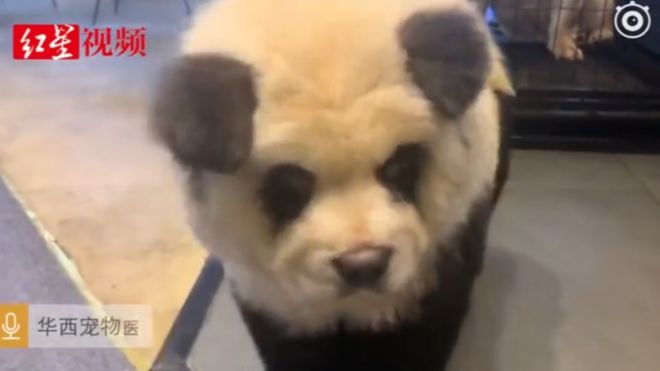
Image copyright HONGXING NEWSImage caption A pet cafe in China’s Sichuan province lets people play with dogs dyed to look like pandas.
Animal cafes have been springing up all over the world for the last two decades as a place for animal lovers to enjoy a meal alongside their furry friends.
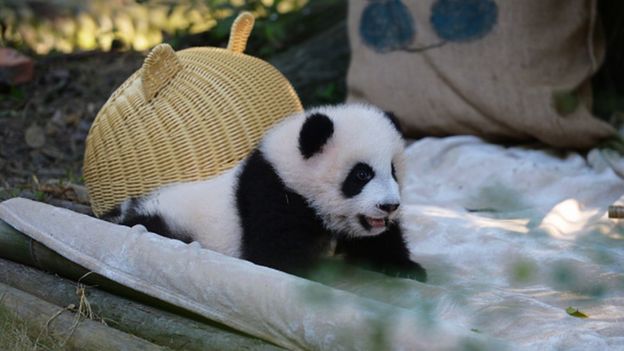
But a new “panda” cafe in Chengdu in south-western China – internationally known as the home of the giant panda – is raising eyebrows and a lot of concern.
According to the Chengdu Economic Daily, a cafe recently opened in Chengdu, seems at first glance to be home to six giant panda cubs.
But the “panda” cafe is – in fact – all bark and no bite because on closer inspection, it turns out they are actually the Chow Chow breed of dogs, which have been dyed to look like China’s national animal.
‘Could damage their fur and skin’
The owner of the cafe, Mr Huang, says that as well as serving food and drink, the cafe provides a dyeing service.
He tells Hongxing News that he imports his dye from Japan and has hired special staff for dyeing the dogs.
“Every time we dye it costs 1,500 yuan [$211; £163],” he says. “The dye is really expensive.” He says that this is to ensure the quality of the dye, and says that it in no way affects the animals.
Hongxing News says that a short video inside the cafe had raised awareness of it nationally and has boosted visitor figures.
But it has also raised a lot of concern. One vet, Li Daibing, told Hongxing News that he urged people not to dye their pets, saying: “This could damage their fur and skin.”
Image copyright VCGImage caption Chengdu has become a popular tourist site for seeing the vulnerable species, and national Chinese treasure: the giant panda.
‘Has become normal’
Dyeing pets became a full-blown craze in China in the early 2010s, first for competitions, but then amidst a domestic wave of “extreme dog pampering”.
Since, however, there has been a growing consciousness in China about animal ethics and testing. Many of the thousands of social media users commenting on the popular Sina Weibo microblog have voiced their concern about such treatments being used on animals.
Many call the idea “crazy” and note that hair dye can “damage people’s hair and scalp”, so could similarly affect a dog.
But others argue that “it’s really cute”, and say that they perceive animal dyeing “has become normal”.
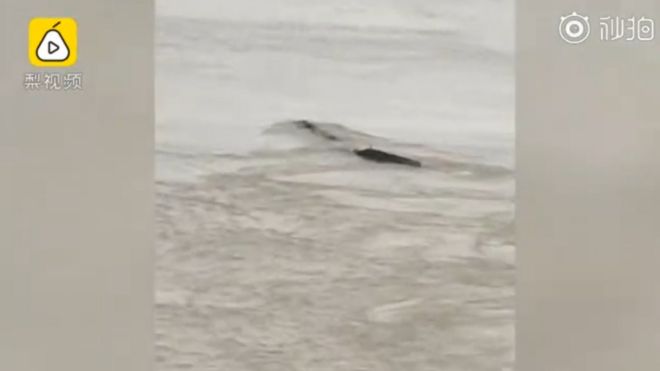
Image copyright PEAR VIDEOImage caption Grainy footage showed something that appeared to have a tail slithering back and forth in the water
Something is lurking in the deep in China’s famous Yangtze River – and social media discussion is rife over what it might be.
On Friday, footage appeared on China’s popular Sina Weibo microblog of what appeared to be a long, black creature, manoeuvring through the waters, and it has dominated online discussion ever since.
Footage has quickly racked up millions of views, and theories are rife.
Specialists have weighed in – but some think there may be a simple, and less murky, explanation.
Excitement over footage
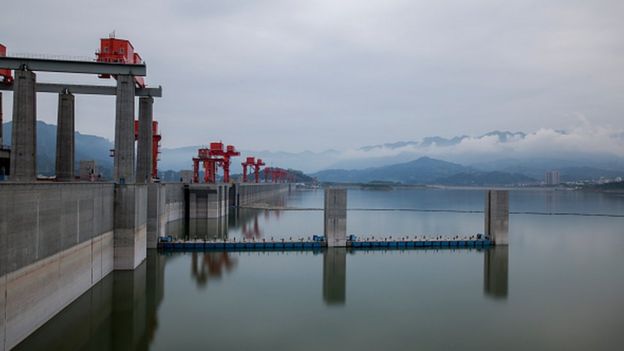
A video filmed off the coast of the city of Yichang in western Hubei province, close to the Three Gorges Dam, captured the unusual scene.
Locals are filmed watching the creature from the shore – and social media users have similarly been captivated over theories about what the creature might be.
Many have posted using the hashtag #ThreeGorgesMonsterPhotos, and specialists have begun to weigh in with their thoughts.
In an interview with Pear Video, Professor Wang Chunfang from the Huazhong Agricultural University dismissed the idea of it being a new species, saying it was likely a simple “water snake”.
Some users said that “external factors such as pollution” could have a role to play in a sea snake growing to an extraordinary size. But not everyone was convinced.
Separate footage has led some users to question whether the unidentified object is actually a living creature at all.
Image copyright THE PAPERImage caption Millions have watched footage of the item, but some think it might be a piece of simple rubbish
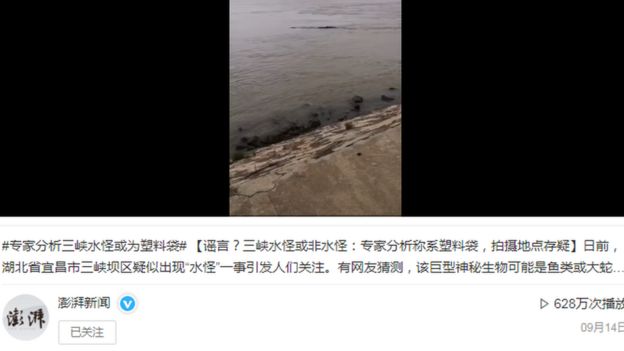
Popular news website The Paper shared separate footage of something long and black moving in the water that appeared to be less animated.
It asked if the whole thing was simply “a rumour” – and interviewed a biologist, Ding Li, who said that the object was neither a fish nor a snake, but simply “a floating object”.
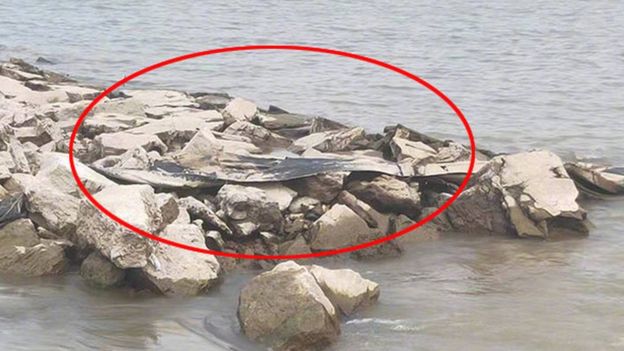
A picture has since gone viral showing a long piece of black cloth washed up on some rocks, fuelling discussion this might have been the mysterious object.
Image copyright THE PAPERImage caption The appearance of some cloth washed up on some rocks has got users asking if they were mistaken
Both have led to jokes about whether the local government was trying to attract tourism to the area, given the millions of dollars involved in building and maintaining the Three Gorges Dam.
Others have made jokes about the quality of the footage, despite the rapid development in China of high quality smartphones.
Some joked that the user obviously didn’t have a Huawei phone. Another said: “Monsters always appear only when there are few pixels.”
So what does live in the Yangtze?
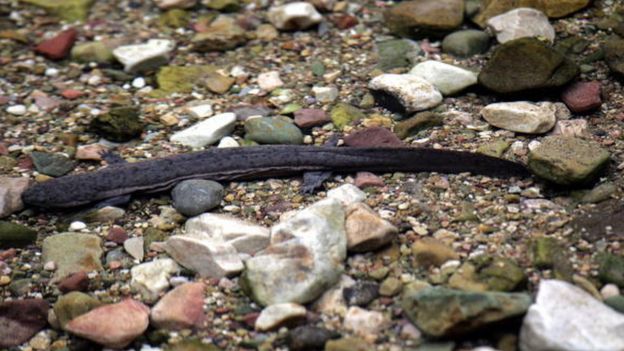
Image copyright AFPImage caption Giant Chinese salamanders live in the Yangtze river. They can grow to 1.8 metres in length
The Yangtze River is the longest river in Asia, and at 3,900 miles in length (6,300km), is the third longest in the world.
But pollution has severely affected the river in recent years, meaning that its ecosystem has become narrower, rather than wider.
The largest creature thought to exist in the waters at present is the Chinese giant salamander, which can reach some 1.8m in length.
This species is critically endangered, largely as a result of pollution.
Image copyright ZHANG PENG/GETTY IMAGESImage caption The Three Gorges Dam is the world’s latest hydroelectric dam
China’s other ‘Nessies’
China is no stranger to conspiracy theories about mythical creatures lurking in the deep.
Since 1987, questions have been asked about whether a “Lake Monster” exists in the Kanas Lake in north-western Xinjiang, following numerous reports of sightings.
However, specialists believe that this is a giant taimen, a species of salmon that can grow to 180cm long, the official China Daily said.
IEEE’s ban has ignited a backlash from its Chinese members, resulting in calls to boycott the organisation
Staff at Huawei Technologies have been banned by the Institute of Electrical and Electronics Engineers from taking part in the peer review of research papers, including serving as editors for journals, after the Chinese telecommunications equipment maker was added to a US trade blacklist. Photo: AP
The US government’s efforts to reduce the influence of Huawei Technologies, the world’s largest telecommunications equipment supplier, has extended beyond business to cover scientific research.
That development emerged as the New York-based Institute of Electrical and Electronics Engineers (IEEE) moved to ban Huawei employees from the peer review of research papers, including serving as editors for its journals, after the Chinese hi-tech champion was added to a US trade blacklist.
The decision by IEEE, the world’s biggest technical professional organisation, was leaked online across Chinese social media on Wednesday, igniting a backlash from some of the country’s leading scientists who described the move as “anti-science” and “violating academic freedom”.
Zhang Haixia, a professor with the Institute of Microelectronics at Peking University, announced on her WeChat account on Wednesday that she was quitting IEEE because the decision to comply with the trade blacklist went “far beyond the basic line of science and technology” and challenged her professional integrity.
US is waging a tech war against this district in Shenzhen
“As a professor, I do not accept this,” Zhang wrote online in a public letter addressed to IEEE president-elect Toshio Fukuda.
Her resignation letter was viewed more than 40,000 times since it was posted online. The most popular comments on its thread included calls for Chinese scientists to boycott IEEE.
In a statement on May 30, the IEEE said it must comply with its legal obligations under the laws of the US and other jurisdictions and that compliance with regulations “protects the IEEE, our volunteers, and our members”.
It said Huawei employees are only barred from the peer reviewing process and that they can continue to participate in individual membership, corporate membership, enjoy voting rights and take part in a variety of other activities, including the submission of technical papers for publication.
Huawei said it had no comment about the peer review ban.
The issue between Huawei and IEEE has come amid a raging tech war between the world’s two biggest economies, which recently escalated when the US government placed Huawei and its affiliates under the US Entity List on May 16. That bars the Chinese group from buying hardware, software and services from American hi-tech suppliers without US approval.
A succession of major American technology companies, from Google and Microsoft to Intel and Qualcomm, have suspended their dealings with Huawei to comply with the US trade ban.
Growing disquiet in China as US steps up war on tech champions
US President Donald Trump has also signed an executive order barring US companies from using telecoms equipment made by companies that pose a threat to national security.
The trade blacklist, which is maintained by the Bureau of Industry and Security under the US Department of Commerce, identifies organisations and individuals believed to be involved, or pose a significant risk of becoming involved, in activities contrary to America’s national security or foreign policy interests.
A non-profit organisation founded in January 1963, IEEE had more than 422,000 members in more than 160 countries as of December 31 last year. More than 50 per cent of its members, who are rooted in electrical and computer sciences, engineering and related disciplines, are from outside the US.
Technology is true target of US attack on China, says diplomat
It also publishes around 200 transactions, journals and magazines, and sponsors more than 1,900 conferences in 103 countries.
There is no official data on how many IEEE members are based in mainland China. Public information online, however, showed that at least 80 Huawei employees are members of the organisation.
China’s biggest chip maker to delist from NYSE as US targets tech
In a statement released on May 16, IEEE said that as a corporation organised in New York, it must comply with its legal obligation under US laws. It said the US government’s export restriction covers not only physical goods and software but also technical information.
In the leaked IEEE email, the organisation warned its members of “severe legal implications” if they continue to use Huawei staff as reviewers or editors for the peer review process of its journals.
“IEEE is registered in the US, but we should suggest experts at all levels of IEEE to move its headquarters to places such as Switzerland,” said Zhou Zhihua, a leading computer science professor at Nanjing University and an IEEE fellow, in a post on microblogging site Sina Weibo. “More importantly, let’s show more support to China-produced English-language journals.”
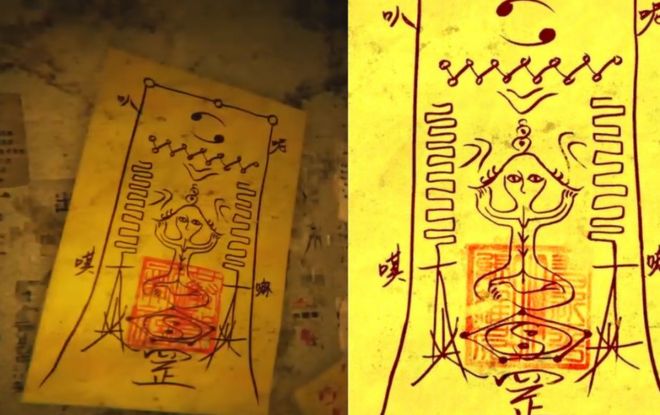
Image copyrightRED CANDLE GAMES/DEVOTIONImage captionWhen players interact with the poster (L), the poster (R) appears – with the words “Winnie the Pooh” and “Xi Jinping”
A Taiwanese games company has had its latest release pulled from mainland China, after players noticed subtle references mocking Chinese President Xi Jinping, including comparing him to Winnie the Pooh.
Red Candle Games released Devotion, a first-person horror game set in 1980s Taiwan, on games platform Steam on 19 February.
The game quickly went viral after players spotted so-called “easter eggs” and publicised them. However online discussion has since been censored.
An “easter egg” is a hidden message or joke in a computer game, normally only picked up by some players paying close attention.
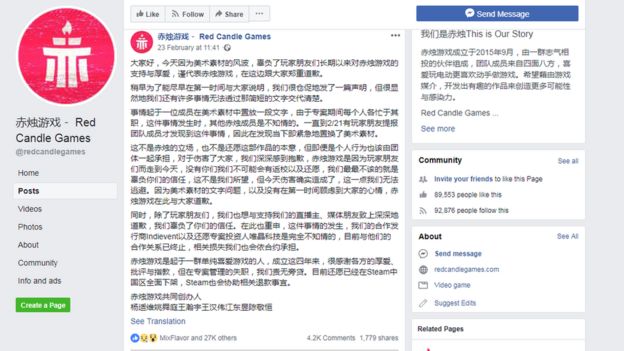
Red Candle Games has apologised, saying it will refund offended users.
Taiwan is an island that is for all practical purposes independent, but China sees it as a rebel region and insists that other countries should not have diplomatic relations with it.
Taiwan’s current president has sparred with Beijing over the island’s political future. In January, Xi Jinping said Taiwan “must and will be” reunited with China.
Hidden messages
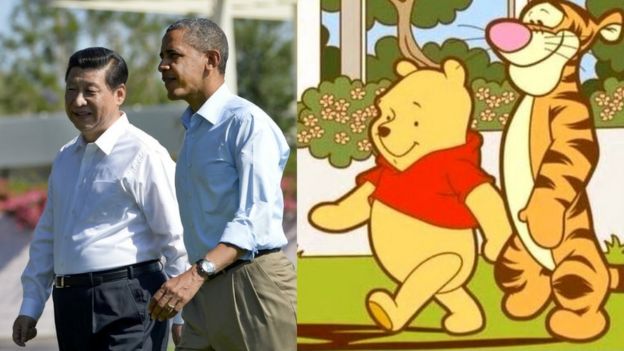
One of the easter eggs in Devotion is a poster containing the words “Xi Jinping” next to “Winnie the Pooh”, in an ancient style of writing. Winnie the Pooh has been censored on Chinese search engines and social media since 2017, after bloggers began comparing Mr Xi to the children’s story book and film character.
Gamers have also spotted an old newspaper in Devotion that refers to an individual who has received a prison sentence, nicknamed “baozi” or “steamed bun”.
Image copyrightAFP/WEIBOImage captionThis meme showing Xi Jinping and former US President Barack Obama began circulating in 2013
“Steamed bun” is another sensitive term in China, as social media users have used it to refer to the president and evade government censors.
It said that it was aware some players may have been offended by the images, and said that it was in touch with Steam to ensure that such players could obtain a full refund.
“We sincerely hope that this ends with Red Candle, and please do not take it out on all of our innocent partners.”
Taiwanese Vice Premier Chen Chi-mai has praised the game, saying: “Only in countries with democracy and freedom can creation be free from restrictions.”
Image copyrightFACEBOOKImage captionRed Candle Games apologised and confirmed the game had been removed from Steam China
Chinese online censors, meanwhile, are trying to scrub references to the game and its hidden messages.
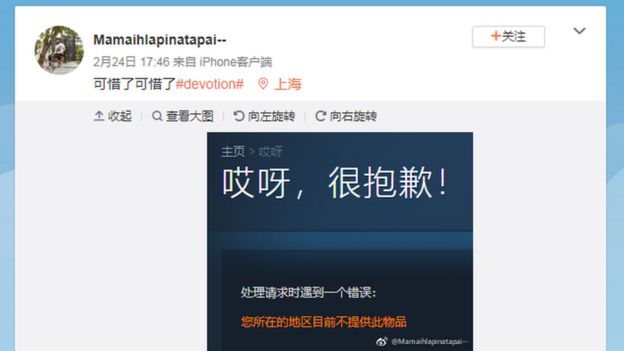
Searches for both “Red Candle Games” and “Devotion” in Chinese on Weibo are showing no results.
But on Monday, a search of the hashtag #Devotion showed only four posts, none of which refer to the game.
Posts that mention the game’s title in English, which the censors are often lax in censoring, show that China-based users are receiving messages on Steam saying that the game is “no longer available” to play in their country.
Meanwhile Red Candle’s account on China’s Twitter-like Sina Weibo service has been suspended, preventing the company from publicising its game in the mainland.
Image copyrightSINA WEIBOImage captionWeibo users shared posts saying they were no longer able to play the game
In Taiwan, where social media is not government-controlled, thousands of social media users are joking about the easter eggs.
Some on Facebook are posting pictures and gifs of Winnie the Pooh, and others are showing printouts of the offending poster.
Gaming in China
The episode has raised questions as to whether Steam will be the latest overseas online platform to be blocked in mainland China.
Technically, Steam has not gained official approval to operate in the country, but it remains accessible. Some 30m people are estimated to use it in China.
The platform allows China-based users to download and play games that have not received official authorisation.
Over the last decade, the government has banned games if their content is considered to be violent, or anti-Beijing. However many recent releases have never made it to China anyway because of a years-long backlog of games that regulators are yet to examine.
The top media regulator has also just announced that it will not be granting any new licences to gaming companies until the backlog is cleared.
The result is that wildly popular games such as PlayerUnknown’s Battlegrounds and Fortnite, both of which were released in 2017, remain neither banned, nor authorised in the country.







 CHINDIA ALERT: You'll be living in their world, very soon