Chindia Alert: You’ll be Living in their World Very Soon
aims to alert you to the threats and opportunities that China and India present. China and India require serious attention; case of ‘hidden dragon and crouching tiger’.
Without this attention, governments, businesses and, indeed, individuals may find themselves at a great disadvantage sooner rather than later.
The POSTs (front webpages) are mainly 'cuttings' from reliable sources, updated continuously.
The PAGEs (see Tabs, above) attempt to make the information more meaningful by putting some structure to the information we have researched and assembled since 2006.
Concerns are rising that China is repeating its mistake of a decade ago by pursuing short-term debt-fuelled economic growth at the cost of long-term sustainability
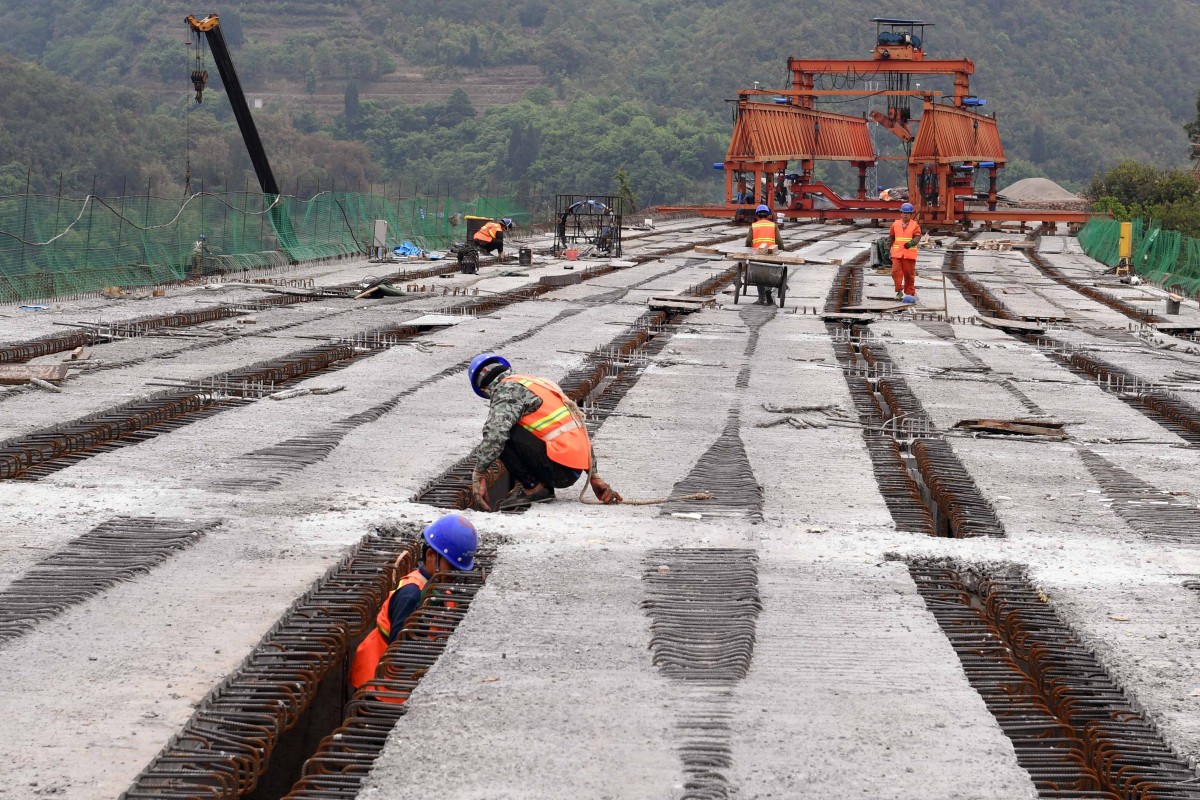
Local governments are stepping up spending on infrastructure projects in a bid to offset the slowdown caused by the coronavirus outbreak and subsequent lockdowns
Construction of high-speed railways, motorways and airports is an old tactic that Beijing dusted off after the pandemic led to a 6.8 per cent economic contraction in the first quarter. Photo: Xinhua
China’s huge stockpile of local government debt, one of the biggest “grey rhino” risks threatening the Chinese economy’s future, is set to rise steeply as local authorities rush to increase capital spending to help offset the damage caused by the coronavirus outbreak.
As Beijing discusses increasing the central government budget deficit and monetary policy easing to spur economic growth, many local governments see the situation as a golden opportunity to realise their investment ambitions, fanning concerns that China is repeating its mistake of a decade ago by pursuing short-term debt-fuelled economic growth at the cost of long-term sustainability.
In one of the latest investment drives, the southeastern province of Fujian announced on Sunday that it had signed contracts for 391 new projects with a combined investment value of 783.6 billion yuan (US$110.6 billion). Projects undertaken by central government-owned companies, which received significant lending support in the first quarter, accounted for more than half of the promised investment in Fujian, some 92 projects worth 424.5 billion yuan.
The landlocked eastern province of Anhui is also planning 2,583 new projects this year at a cost of 450 billion yuan, a third of which have been created in the last two weeks.
Construction begins for major sea crossing to link Shenzhen and Zhongshan in Greater Bay Area
In addition to work on existing construction projects, costing around 850 billion yuan, the province has also prepared a list of 3,300 reserve projects with a total investment value of 5.4 trillion yuan (US$762 billion) which could theoretically be started at any point in the future, pending government approval and funding support.
“The most powerful and effective way to offset the economic slowdown is to increase the size of investments,” Wang Qikang, an official with the Anhui economic planning office said on Friday. “[We] must quicken the pace of construction, working day and night to win back the lost time [from the coronavirus lockdowns].”
Construction of high-speed railways, motorways and airports is an old tactic that Beijing dusted off after the pandemic led to a 6.8 per cent economic contraction in the first quarter.
Infrastructure construction has already been hit hard amid the lockdowns, plunging 19.7 per cent in the first three months of the year compared to a year earlier.
Many [local governments] are still striving to achieve a high growth rate without the guidance of a national [gross domestic product] target – Liu Xuezhi
“The investment stimulus mindset has hardly been eradicated at the local level,” said Liu Xuezhi, a senior researcher with the Bank of Communications in Shanghai. “In particular, many [local governments] are still striving to achieve a high growth rate without the guidance of a national [gross domestic product] target.”
Before the start of the coronavirus outbreak, Beijing was thought to be targeting a
of around 6 per cent this year after achieving 6.1 per cent in 2019, although many local governments appear to be setting their own annual targets still using the original expected goal as a guide.
However, that target was never made public because the meeting of the
scheduled for early March, where the growth target would normally have been released, was postponed due to the virus.
The government announced on Wednesday that the NPC will be held from May 22, when a new, likely lower, growth target could be announced.
China’s first-quarter GDP shrinks for the first time since 1976 as coronavirus cripples economy
International rating agency Moody’s warned that greater infrastructure spending would result in higher debt for regional and local governments, increasing their financial risks amid a sharp slowdown in tax revenues.
“Such investments are less likely to be a main support measure [chosen by Beijing] now given the government’s focus on avoiding a rapid increase in leverage and asset price inflation,” Moody’s analysts Michael Taylor and Lilian Li said on Tuesday.
At the end of March, local government debt stood at 22.8 trillion yuan (US$3.2 trillion), according to the Ministry of Finance. But implicit liabilities, which are hidden in local financing vehicles, state firms and public-private partnership projects, are believed to be much larger, with some estimates pointing towards an additional debt of over 30 trillion yuan.
Chinese central bank governor Yi Gang, along with other officials, have already warned against excessive economic stimulus, saying it would add risks to China’s financial system.
A key risk is that local governments are front-loading China’s long-term investment plan, especially in the railway sector, with more than 357 railway projects proposed by local governments.
Shandong province, for example, is preparing to build four new railway lines, including the Shandong portion of a second high-speed railway between Beijing to Shanghai.
“There is still a chance for infrastructure investment growth to hit 10 per cent if the government releases 2 trillion yuan (US$282 billion) in funding through local special purpose bonds and special treasury bonds,” said Haitong Securities’ chief economist Jiang Chao on Monday.
However, a local government debt monitoring report issued on Tuesday by the National Institution of Finance and Development warned that China’s local government fiscal situation is worsening rapidly as expenses surge and revenues drop.
“All levels of local governments in China will face huge debt repayment pressure in five years,” warned Yin Jianfeng, deputy director of the Beijing-based think-tank.
City at centre of outbreak finally able to declare itself clear of disease after months in lockdown and thousands of deaths
Risk of infection remains, however, with some patients testing positive for coronavirus that causes disease without showing symptoms
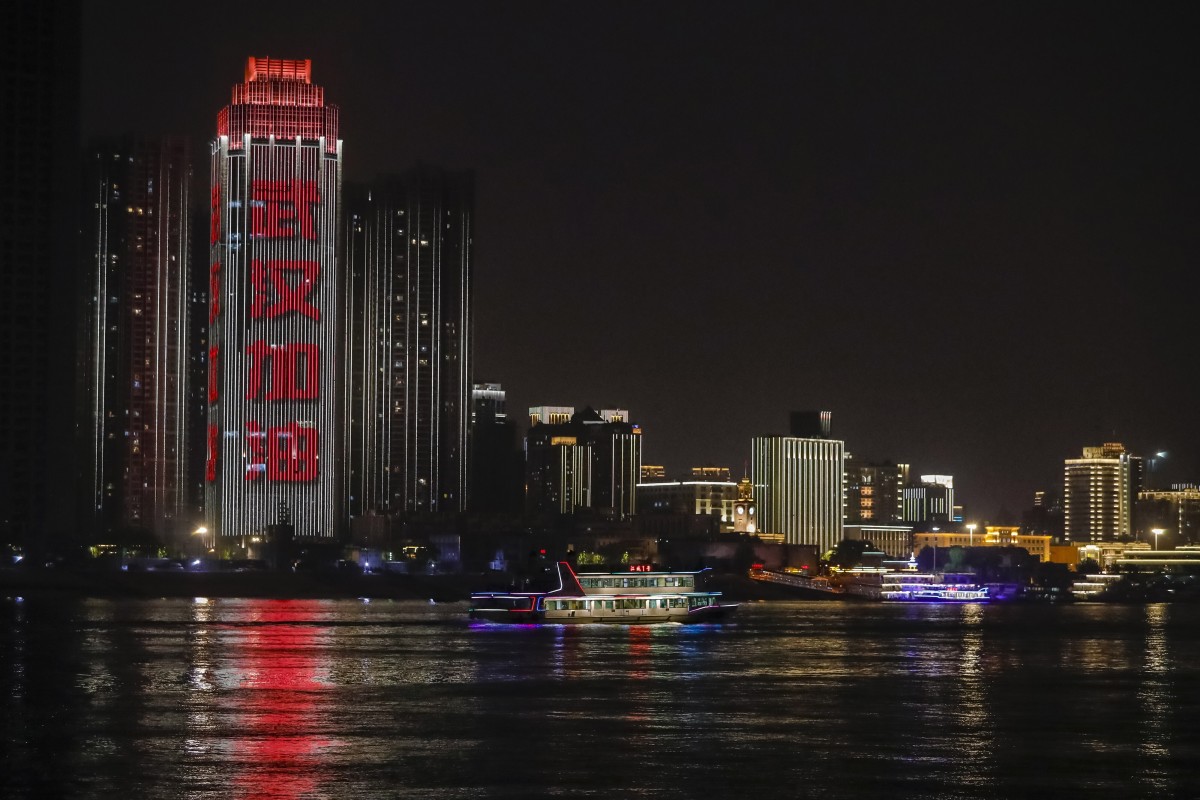
Ferries and other public transport services resumed in Wuhan last week. Photo: Xinhua
The city of Wuhan, the initial epicentre of the coronavirus pandemic, no longer has any Covid-19 patients in hospital after the last 12 were discharged on Sunday.
Their release ended a four-month nightmare for the city, where the disease was first detected in December. The number of patients being treated for Covid-19, the disease caused by a new coronavirus, peaked on February 18 at 38,020 – nearly 10,000 of whom were in severe or critical condition.
“With the joint efforts of Wuhan and the national medical aid given to Hubei province, all cases of Covid-19 in Wuhan were cleared as of April 26,” Mi Feng, a spokesman for the National Health Commission said on Sunday afternoon.
The announcement came only one day after the city discharged the last patient who had been in a severe condition. That patient also was the last severe case in Hubei province.
The last patient discharged from Wuhan Chest Hospital, a 77-year-old man surnamed Ding, twice tested negative for Sars-CoV-2, the virus that causes Covid-19, and was released at noon on Sunday.
“I missed my family so much!” Ding told Changjing Daily.
Another unidentified patient exclaimed as he left the hospital: “The air outside is so fresh! The weather is so good today!”
Wuhan faced a long journey to bring its patient count down to zero.
The city of 11 million, the capital of Hubei province and a transport hub for central China, was put under a strict lockdown on January 23 that barred anyone from entering or exiting the city without official approval for 76 days until it was officially lifted on April 8.
Coronavirus: Wuhan, Los Angeles officials discuss getting back to work after lockdown
22 Apr 2020
Residents were ordered to stay in their apartments as the city stopped public transport and banned private cars from city streets. As the epidemic worsened, more than 42,000 medical staff from across the country were sent to the city and to Hubei province to help ease the burden on the local health care system.
Wuhan was the hardest hit city in China, accounting for 50,333 of the 82,827 locally transmitted Covid-19 cases recorded in China. More than 4,600 died in the country from the disease.
On March 13, the city reported for the first time that there were no new suspected cases of the infection, and five days later there were no confirmed cases.
The number of discharged patients bottomed out at 39.1 per cent at the end of February, gradually climbing to 92.2 per cent by last Thursday.
“Having the patients in the hospital cleared on April 26 marks a major achievement for the city’s Covid-19 treatment,” the Wuhan Health Commission said in a statement.
However, having no severe cases in hospital does not mean all the discharged patients will require no further treatment as they may still need further care.
“Clearing all the severe cases marks a decisive victory for the battle to safeguard Wuhan,” health minister Ma Xiaowei told state broadcaster China Central Television on Saturday.
“Some patients who have other conditions are being treated in specialised hospitals. It has been properly arranged.”
Coronavirus: Chinese writer hit by nationalist backlash over diary about Wuhan lockdown
18 Apr 2020
Ten patients aged between 42 and 85 who have been declared coronavirus-free are still in intensive care at the city’s Tongji Hospital where they are being treated for kidney problems and other complications arising from Covid-19. Some still need ventilators to help them breathe.
These 10 patients are under 24-hour care, with 190 nurses on four-hour rotations. There are other patients in a similar condition in two other hospitals in Wuhan, according to the Hubei Broadcasting and Television Network.
However, the discharge of the last batch of Covid-19 patients does not mean that the risk of infection is gone.
The city reported 20 new cases of people testing positive for Sars-CoV-2, the official name for the coronavirus that causes the disease, but who do not yet show symptoms.
There are 535 such carriers under medical observation. Past data shows some of these asymptomatic carriers will develop symptoms, and so will be counted as Covid-19 patients under China’s diagnosis and treatment plan.
China’s coronavirus infection curve has flattened out with about 694 imported cases of Covid-19 on top of about 800 locally transmitted ones now under treatment.
The national health commission spokesman warned that people still need to be on high alert as the virus is continuing to spread around the globe, with no sign yet of a slowdown.
“[We] must not drop our guard and loosen up. [We] must discover cases in time and deal with them quickly,” Mi said, citing the continued pressure from cases imported by people returning from overseas.
“The next step will be to implement the requirements of the central government and continue to guard against imported cases and a rebound of domestic transmitted cases.”
China’s economy shrank for the first time in decades in the first quarter of the year, as the virus forced factories and businesses to close.
The world’s second biggest economy contracted 6.8% according to official data released on Friday.
The financial toll the coronavirus is having on the Chinese economy will be a huge concern to other countries.
China is an economic powerhouse as a major consumer and producer of goods and services.
This is the first time China has seen its economy shrink in the first three months of the year since it started recording quarterly figures in 1992.
“The GDP contraction in January-March will translate into permanent income losses, reflected in bankruptcies across small companies and job losses,” said Yue Su at the Economist Intelligence Unit.
Last year, China saw healthy economic growth of 6.4% in the first quarter, a period when it was locked in a trade war with the US.
In the last two decades, China has seen average economic growth of around 9% a year, although experts have regularly questioned the accuracy of its economic data.
Its economy had ground to a halt during the first three months of the year as it introduced large-scale shutdowns and quarantines to prevent the virus spread in late January.
As a result, economists had expected bleak figures, but the official data comes in slightly worse than expected.
Among other key figures released in Friday’s report:
Factory output was down 1.1% for March as China slowly starts manufacturing again.
Retail sales plummeted 15.8% last month as many of shoppers stayed at home.
Unemployment hit 5.9% in March, slightly better than February’s all-time high of 6.2%.
Analysis: A 6% expansion wiped out
Robin Brant, BBC News, Shanghai
The huge decline shows the profound impact that the virus outbreak, and the government’s draconian reaction to it, had on the world’s second largest economy. It wipes out the 6% expansion in China’s economy recorded in the last set of figures at the end of last year.
Beijing has signalled a significant economic stimulus is on the way as it tries to stabilise its economy and recover. Earlier this week the official mouthpiece of the ruling Communist Party, the People’s Daily, reported it would “expand domestic demand”.
But the slowdown in the rest of the global economy presents a significant problem as exports still play a major role in China’s economy. If it comes this will not be a quick recovery.
On Thursday the International Monetary Fund forecast China’s economy would avoid a recession but grow by just 1.2% this year. Job figures released recently showed the official government unemployment figure had risen sharply, with the number working in companies linked to export trade falling the most.
China has unveiled a range of financial support measures to cushion the impact of the slowdown, but not on the same scale as other major economies.
“We don’t expect large stimulus, given that that remains unpopular in Beijing. Instead, we think policymakers will accept low growth this year, given the prospects for a better 2021,” said Louis Kuijs, an analyst with Oxford Economics.
Since March, China has slowly started letting factories resume production and letting businesses reopen, but this is a gradual process to return to pre-lockdown levels.
Media caption Why does China’s economy matter to you?
China relies heavily on its factories and manufacturing plants for economic growth, and has been dubbed “the world’s factory”.
Stock markets in the region showed mixed reaction to the Chinese economic data, with China’s benchmark Shanghai Composite index up 0.9%.
In response to the 2008 global financial crisis, China pumped a 4 trillion yuan (US$575 billion) into its economy but it led to a mountain of local government debt
Various early indicators suggest China’s economy will slow in the first quarter of 2020, with some suggestions it will suffer a first contraction since 1976
President Xi Jinping said China must accelerate construction of “new infrastructures such as 5G networks and data centres” on top of speeding up “key projects and major infrastructure construction” in response to the economic impact caused by the coronavirus outbreak. Photo: Xinhua
China should not try to bolster its coronavirus-hit economy by again resorting to a massive debt-fuelled fiscal and monetary stimulus programme, according to a group of government advisers.
Various early indicators suggest China’s economy will slow in the first quarter of 2020, with some even suggesting it will suffer a first contraction since the end of the Cultural Revolution in 1976.
This raises the question if China will miss its key 2020 growth target, with voices on both sides of the debate discussing what stimulus policies are needed to offset the deep impact of the coronavirus.
China is already leaning towards some additional stimulus, with Premier Li Keqiang ordering the central bank pump additional money into the banking system, while President Xi Jinping has announced the need for more spending on “new infrastructure”.
Are there other ways out for China except stimulus policies?Liu Shijin
“Are there other ways out for China except stimulus policies?” rhetorically asked Liu Shijin, who previously worked closely with Vice-Premier Liu He, the top economic aide to Xi, at the Development Research Centre, the think tank attached to the State Council.
“If it really works, why can’t Japan and the United States reach a 5 per cent growth rate?”
It is believed China will need to achieve an average 5.6 per cent growth in 2020 to achieve its goal of doubling the size of its economy from 2010, which is a key goal for
China’s economy grew by 6.1 per cent in 2019, and while it was the slowest in 29 years, the US economy only grew 2.3 per cent, with Japan’s estimated to grow by 0.9 per cent.
What is gross domestic product (GDP)?
Liu Shijin, who is now a deputy head of the China Development Research Foundation and a policy adviser to the People’s Bank of China, argued that a growth rate averaging 5 per cent over the next decade is sufficient for China to meet its development goals.
Growth in 2020, though, may well be below 5 per cent given that the impact of the coronavirus is “unprecedented” and larger than both severe acute respiratory syndrome (Sars) in 2003 and the 2008 global financial crisis.
Xi said earlier this month that China must accelerate construction of “new infrastructures such as 5G networks and data centres” on top of speeding up “key projects and major infrastructure construction already included in state plans” like additional high-speed railway lines in response to the economic impact caused by the coronavirus outbreak.
But as this will mainly rely on corporate and private investment, Liu Shijin feels it will be too small to engineer a major rebound in the growth rate.
When encountering challenges, we should first push forward new reform measures to unleash growth potential. Now is the right timeLiu Shijin
“It’s a different thing compared to real [government-led] economic stabilisation,” Liu Shijin told a web seminar hosted by Peking University’s National School of Development on Wednesday.
“When encountering challenges, we should first push forward new reform measures to unleash growth potential. Now is the right time.”
Instead, to support longer-term growth, China should put its efforts into the development of its “city clusters”, which could lead to higher spending on housing construction, urban infrastructure and manufacturing, added Liu Shijin, which would increase the growth rate by up to an additional percentage point over the next decade.
China has so far refrained from the massive stimulus programme it adopted in 2008 in response to the global financial crisis, which included a 4 trillion yuan (US$575 billion) plan that pumped cheap money into government-backed projects but also created a mountain of local government debt.
Trump bans travel from Europe to the US as coronavirus pandemic hits actor Tom Hanks and the NBA
Zhang Bin, a senior researcher at the Chinese Academy of Social Sciences, said infrastructure construction will remain an important part of any plan to support growth.
“If the funding [for the 4 trillion yuan stimulus] had come solely from treasury bonds or local government bonds [rather than risky lending], there wouldn’t be so much shadow banking, unmanageable credit expansion, high leverage, implicit liabilities or financial risks,” he said.
“If the balance sheets of corporations, households and local governments can’t be repaired, it might lead to insufficient demand and a decline into a vicious [downward] cycle.”
Zhang, like Liu Shijin, is a key member of the China Finance 40 Forum, a group of state economists who advocate more structural reforms to support the Chinese economy. In particular, Zhang has set sights on reforms that would boost consumption, which accounted for 58 per cent of Chinese growth last year.
“The biggest weak link of the Chinese economy is that 200 to 300 million migrant workers can’t [legally] settle in big cities,” he said. “Only if they are able to settle in the city that China can be called a real well-off society. It will also boost the economy, lift demand for manufactured goods and unleashed consumption potential.”
Currently, most large Chinese cities only provide social services including health care and schooling to residents who have a legal permit, or hukou. Most migrant workers who come to the big cities for jobs are blocked from obtaining a hukou, meaning they have to travel back to their rural hometowns to have access to basic social services, so often do not settle in their adopted city.
In response to this idea, Xu Yuan, a professor at Peking University, called for the government to build 10 million affordable housing units annually to accommodate new urban citizens, which would address short-term economic pain and serve the nation’s long-term development.
China will release its annual growth target as well as other key goals, including the fiscal deficit ratio and local bond quota, at the National People’s Congress, although the annual parliamentary convention, previously scheduled for March 5, has been postponed, with a new date yet to be announced.
(Reuters) – Europe’s auto industry is facing a slowdown in demand for new cars, as well as disruption from the coronavirus epidemic and import tariffs between China and the United States. As a result, several companies have announced plans to cut costs and jobs.
Volkswagen said in March 2019 it would cut up to 7,000 positions and aim to deliver 5.9 billion euros ($6.7 billion) of annual savings at its core VW brand by 2023.
Volkswagen’s luxury car unit Audi (NSUG.DE) said in November it would cut one in ten jobs by 2025, up a total of 9,500, to fund its shift towards electric vehicle production.
PSA’s German unit Opel said in February it was ruling out forced redundancies until July 2025, but would reopen a voluntary leave programme for older employees.
Unions at Fiat Chrysler, which is planning a merger with PSA, said management promised to avoid redundancies and get all group employees off special furlough arrangements and back to work by 2022.
The merger aims to achieve annual savings of 3.7 billion euros.
In November, BMW management and its German labour representatives reached an agreement on changes to payout schemes and bonuses to reduce costs in Germany while avoiding “drastic measures”. BMW has said it will keep headcount stable, as hiring in software development will offset voluntary staff reductions in other areas.
In February, German business daily Handelsblatt reported Daimler (DAIGn.DE) was intensifying its cost-cutting measures and planning to cut up to 15,000 jobs. Daimler declined to comment.
Daimler Chief Executive Ola Kaellenius said in February the company would cut 1,100 leadership positions worldwide, or about 10% of its management over the next three years.
The company also said it would revamp the management of its portfolios to remove duplicate layers between Mercedes-Benz and Daimler AG.
VOLVO CARS
In July 2019, Volvo Cars announced plans to cut fixed costs by 2 billion Swedish crowns ($214 million), adding the savings drive – on which it did not provide details – would come into effect in the second half of 2019 and run into the first half of 2020.
JAGUAR LAND ROVER
In February, Britain’s biggest carmaker Jaguar Land Rover (TAMO.NS) said it would reduce or stop production on certain days at two of its British factories as it was pursuing cost-cutting measures in response to falling demand.
A month earlier, the company said it would cut around 10% of the workforce at its northern English Halewood factory, which has about 4,500 employees, as it was changing shift patterns to boost efficiency at the site.
After Renault’s first full-year loss in a decade, the French automaker said it would cut costs by 2 billion euros over the next three years and did not exclude job cuts during a performance review across its factories.
BOSCH
In January, German engineering company Bosch said it would make staff changes via shorter working hours, voluntary redundancy and severance packages, but declined to provide a global figure for headcount reductions.
German automotive supplier Continental said in November it would pare back its engine manufacturing activities, which could result in around 5,040 job losses by 2028.
HONG KONG/LONDON (Reuters) – HSBC Holdings turned in a disappointing annual profit as higher costs and a stocks rout chipped away at its trading businesses, while warning that an economic slowdown in China and Britain would throw up further hurdles this year.
Chief Executive John Flint, rounding off his first year at the helm of the company, said the bank may have to scale back investment plans in order to avoid missing a key target known as ‘positive jaws’ – which tracks whether it is growing revenues faster than costs – for a second straight year.
HSBC remains alert to the downside risks of the current economic environment, economic environment and the future path of interest rates, Flint said, adding the bank was “committed” to the growth targets announced in June.
“We will be proactive in managing costs and investment to meet the risks to revenue growth where necessary, but we will not take short-term decisions that harm the long-term interests of the business,” Flint said on Tuesday, after HSBC reported a lower-than-expected 16 percent rise in 2018 profit before tax.
In June, Flint had said HSBC would invest $15-$17 billion in three years in areas including technology and China, while keeping profitability and dividend targets little changed.
ADVERTISEMENT
“The key thing is just to moderate the pace of investments … not to cancel it or change the shape of the investments,” Flint told Reuters.
The bank said it failed to achieve positive jaws in 2018 due to the negative market environment in the fourth quarter.
A combination of U.S.-China trade tensions, central banks turning off the money taps and cooling growth in former hot spots wiped 10 percent off MSCI’s 47-country world stocks index last year, its first double-digit loss in any year since the 2008 global financial crisis.
GROWING BUT SLOWLY
Flint’s comments come as an economic slowdown in China, exacerbated by a bitter Sino-U.S. trade war, challenges HSBC’s strategy of pouring more resources into Asia where it already makes more than three quarters of its profits.
China’s economic growth slowed to 6.6 percent in 2018, the weakest in 28 years, weighed down by rising borrowing costs and a clampdown on riskier lending that starved smaller, private companies of capital and stifled investment.
Pressure on the world’s second-largest economy could increase if Beijing and Washington do not reach a deal soon to end their year-long trade dispute, which is taking a growing toll on export-reliant economies from Asia to Europe.
HSBC’s profits in Asia grew by 16 percent to $17.8 billion last year, accounting for 89 percent of the group profit.
“Clearly our customers are really more cautious and are more thoughtful around this trade war with the U.S.,” Flint said.
“It’s possible that we’ll see slightly lower growth rate this year but we are still going to see a growth rate.”
Since taking over from Stuart Gulliver last February, Flint has largely stuck to the same China-focused strategy as his predecessor while attempting to revive HSBC’s ailing U.S. franchise and putting less emphasis on its investment bank.
Europe’s biggest bank by market value is also being buffeted by headwinds from Britain, which grew at its slowest in half a year in the three months to November as factories suffered from tough global trade conditions and the approach of Brexit.
HSBC joined its London-based peer Royal Bank of Scotland in warning that uncertainties related to Brexit could drive businesses under.
“The longer we have the uncertainty the worse it’s going to be for the customers. Customers are absolutely postponing investment decisions … and that’s been the part of this slowdown that we have seen in the U.K.,” Flint said.
DISAPPOINTING PROFIT
Earlier in the day, HSBC reported a profit before tax of $19.9 billion for 2018, versus $17.2 billion the year before, but below an average estimate of $22 billion, according to Refinitiv data based on forecasts from 17 analysts.
HSBC’s Hong Kong shares dropped as much as 2.7 percent after the earnings announcement.
The stock was down 1.4 percent at 0732 GMT, while the Hong Kong market index was 0.3 percent lower.
HSBC said it would pay a full-year dividend of $0.51 per share, roughly in line with analysts’ expectations. The bank was confident of maintaining the dividend at this level, it said.
The bank’s core capital ratio, a key measure of financial strength, fell to 14 percent at end-December from 14.5 percent at end-2017, mainly due to adverse foreign exchange movements.
Build stuff or buy stuff? China has long been a believer in the former to deal with a slowdown in its economy. Now it’s trying to shift the emphasis to the latter.
This year will be a big test of how far it’s come in the transition from state-backed investment to domestic consumption as the main driver of growth.
China’s President Xi Jinping has warned of a “struggle” as his country faces an economic slowdown, the likes of which it hasn’t seen for almost 30 years.
A series of stimulus measures have been unveiled by the government not to boost the economy, but to manage the slowdown.
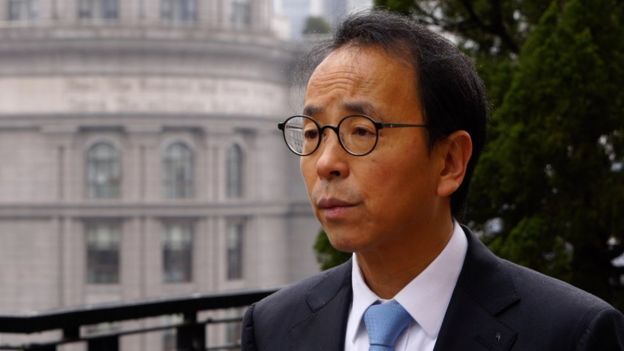
“China’s goal is not growth, it’s stability,” says economist Andy Xie.
“The option for stimulated growth again, that is not on the table. The debt level is simply too high, not like in 2008.”
‘Less room to manoeuvre’
China’s debt has doubled in the aftermath of the global financial crisis 10 years ago, to around 300% of the size of its economy.
“The level is so high now it’s not easy to move the economy,” Mr Xie says.
Image captionEconomist Andy Xie says China’s debt levels limit its options
Whether it wants to borrow more to build, or to encourage people to buy, he thinks China’s ruling Communist Party has far less room to manoeuvre.
“It’s not easy to move the needle when the base is so large,” he says.
It’s cutting some taxes, to put more money in peoples’ pockets. It’s reduced the reserve rate for banks, so they don’t have to keep as much capital in the safe, and can – in theory – lend more out and boost spending.
And yes, it is splurging cash on big infrastructure projects – railways, bridges, and a vast new city near Beijing.
‘High risk’ firms
Only one of those measures is likely to help Wu Yijian.
Mr Wu is a consumption success story. He is the co-founder of a tech start-up that makes desk top robots, in various sizes, which help China’s children play and learn.
Xiao Bai – or Little White – is powered by voice recognition and artificial intelligence that Mr Wu and his co-founders have spent 20 years developing.
As we stood in his office in Shanghai he called its name. It swivelled towards us and blinked. But private firms like his aren’t the focus of China’s stimulus efforts.
He told me sales “increased” in 2018 “but it’s not as good as we planned”.
Venture capital – private money – helped get them to where they are.
He says they won’t be turning to China’s state-owned banks – almost all of the banks here are state-owned or controlled – for help if things get tough in 2019.
Image captionWu Yijian depends on venture capital to fund projects like this robot
“Government banks have very low interest rates but that kind of money is not suitable for the company like us.”
He told me that’s because banks “hate” risk and his company is still considered “high risk”.
It’s mostly big, state controlled firms that benefit from those low interest loans. That kind of preferential treatment has long been a central tenet of a Communist government that treated private enterprise as second class.
“Traditional banks, they prefer collateral, like property. But tech companies like us we don’t have properties. The biggest assets are human resources,” Mr Wu told me.
He likes the tax cuts though. He hopes that will mean more parents buying more desk top robots.
President Xi has talked about his “two unwaverings” – an unwavering commitment to state-backed firms and the private sector.
It’s the latter after all that creates by far the most new jobs.
Song Junfu is well placed to deal with whatever 2019 throws at him.
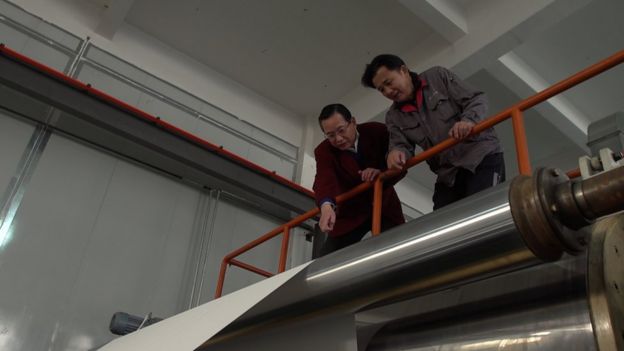
His business is paper. Most importantly, paper for the furniture industry. Mr Song’s company makes advanced paper used to imprint patterns on synthetic leather. Which is why he is based in Haining, a city developed by the government to focus on furniture.
“For our business, I would say, it won’t be affected that seriously… partially because of the advanced features of our product, [plus] there’s a big need for the product in China.”
As we stood in front of a long, green, four metre high piece of machinery at his plant he said “we feel confident in the market”.
He also has the support of the Agricultural Bank of China, one of the big four state-owned banks.
Image copyrightGETTY IMAGESImage captionSong Junfu’s company has benefitted from government support
“The support of the government can be a plus, let’s say, to help the development of the business,” he told me.
“Financially we can get support, to maybe move your project a little faster.”
Mr Song’s company is private, and it’s taken decades of first study, then development and investment to get to where it is now.
It is very far from the often inefficient, behemoth state-owned entities.
But as a manufacturer, he’s more likely to benefit from any direct stimulus measures than the robot makers of Shanghai.
He doesn’t need the help though. Even with a trade war with the US causing huge anxiety for many of China’s manufacturing exporters like him, he thinks he can absorb any hit.
There is a “big, nice margin” on the products they export to the US he told me, so “even if we make 5% or 10% less, for us it’s still good business.”
Chinese factory activity contracted for a second straight month in January, the official Purchasing Managers Index (PMI) showed.
The index ticked up to 49.5, but remained below the 50-point level that separates growth from contraction.
China reported its weakest economic expansion in 28 years in 2018, and growth is expected to slow further.
Already, a number of multinationals have said sluggish growth in China has affected their bottom line.
The manufacturing data was up slightly from the 49.4 level recorded in December.
Marcel Thieliant, economist at Capital Economics, said while the PMI didn’t weaken any further in January, “it still suggests that the economy lost momentum at the start of the year”.
Other data, such as consumer sentiment and retail sales figures, also point to weakening demand in the world’s second largest economy.
Several international companies have warned on China’s slowdown, including Apple.
Shares of industrial equipment giant Caterpillar took a beating earlier this week, after the company reported its sales slipped 4%, largely due to slow sales in China.
If the two sides cannot reach an agreement by 1 March, the US has said it will increase the tariff rate from 10% to 25% on Chinese goods worth an estimated $200bn (£154.4bn).
Image copyrightGETTY IMAGESImage captionExporters and investors will be looking at China’s GDP figures closely
Monday sees the release of China’s GDP figures, and they’ll be even more closely watched than usual.
Apple’s CEO, Tim Cook, blamed cautious Chinese consumers in part for his company’s failure to sell as many iPhones as he hoped, sending share prices down around the globe.
Car sales in the country, meanwhile, have dropped for the first time in two decades.
On the back of such evidence, investors and policymakers are becoming increasingly jittery about the state of such a crucial engine of world growth.
How concerned should they be?
Measuring an economy’s output is never easy but China’s data comes with a bigger health warning than most.
Rather than 6.5%, independent economists say the GDP figure may actually be closer to 5% – or even lower.
Xiang Songzuo, a finance professor and former chief economist of China Agriculture Bank, has claimed that 2018 growth may have been as low as 1.7%.
His online video has since been censored by authorities.
The unreliability of the official figures is one reason why other indicators such as Apple’s sales have the power to send shockwaves around global stock markets.
It may be hard to confirm the scale of the slowdown in China but it’s clear that growth has shifted down a gear.
It’s recently been revealed that activity in factories and workshops stalled for the first time in two years in November.
The month after, exports dropped 4.4% compared to a year previously. Chinese households are clearly feeling the squeeze: retail sales are growing their slowest rate in 15 years.
Is the slowdown intentional?
In part, possibly. After establishing itself as the world’s workshop over the last forty years, China’s found itself losing its competitive edge to the likes of the Philippines and Vietnam, where labour is even cheaper.
The government decided to switch focus away from exports to growing domestic demand.
However, concerns then arose about the size of China’s debt pile – and the risk of bad loans.
Between them, the country’s households, government and corporations have debts totalling almost three times the size of GDP.
A tightening of credit appears to have weighed on spending and investment. And then there’s the trade war with the US.
While there was an initial flurry of orders brought forward to evade tariffs, those latest export figures suggest those measures are now hurting Chinese producers.
While the government has introduced measures to support the economy, most economists expect China’s growth to slow further.
How much does this matter to the UK?
In terms of our exports, China’s is the UK’s 6th largest trading partner. We sold them over £22bn worth of our goods in 2017 – with cars, medicines and oil-based products forming the major part.
Politicians’ have pinned their hopes on a closer trading relationship with China in the post-Brexit era.
But demand might not be quite as strong as they’re anticipating .
Then there’s the billions of pounds Chinese companies and entrepreneurs invest in the UK every year – £20bn in 2017 alone.
Thames Water, Pizza Express and West Bromwich Albion FC are among the many which enjoy Chinese backing. That kind of investment is notoriously volatile.
Image copyrightGETTY IMAGESImage captionWest Bromwich Albion FC is one of many British organisations which has Chinese backers
And let’s not forget the concerns about bad loans. There’s a good reason why the Bank of England’s Governor Mark Carney cites China as one of the biggest risks to global financial stability.
Several large banks, not least HSBC and Standard Chartered have significant exposure to that market.
What of China’s longer-term prospects?
Since 1980, growth (if the official figures are to be believed) has averaged over 10% per year, meaning the size of the economy has surged 42-fold over that time.
China’s time in the sun, its superhuman growth spurt, may be over.
By 2030, economists say growth will have settled down to about a third of its current figure.
But even that would be enough to ensure it overtakes the US to take pole position as the world’s largest economy.









 CHINDIA ALERT: You'll be living in their world, very soon