Chindia Alert: You’ll be Living in their World Very Soon
aims to alert you to the threats and opportunities that China and India present. China and India require serious attention; case of ‘hidden dragon and crouching tiger’.
Without this attention, governments, businesses and, indeed, individuals may find themselves at a great disadvantage sooner rather than later.
The POSTs (front webpages) are mainly 'cuttings' from reliable sources, updated continuously.
The PAGEs (see Tabs, above) attempt to make the information more meaningful by putting some structure to the information we have researched and assembled since 2006.
Image copyright GETTY IMAGESImage caption Tamils argue that imposing Hindi will jeopardise their language
The Indian government has revised a controversial draft bill to make Hindi a mandatory third language to be taught in schools across the country.
The draft bill had met particularly strong opposition in the southern state of Tamil Nadu, which has always resisted the “imposition” of Hindi.
In 1965, it saw violent protests against a proposal that Hindi would be India’s only official language.
Tamil is one of the oldest languages and evokes a lot of pride in the state.
However the government decision has not calmed tensions in Tamil Nadu.
The two main political parties in the state, the DMK and AIADMK, have both said that simply revising the draft to say Hindi would not be mandatory is not enough.
The state teaches only two languages – Tamil and English – in the government school curriculum, and the parties do not want a third language introduced at all.
A DMK spokesman told the NDTV news channel that the third language clause would be used as a “back door” to introduce Hindi anyway.
Their rivals, the AIADMK, which allied with the Bharatiya Janata Party (BJP) in the general elections but lost badly in the state, had a similar view.
“Our party has always been clear in our stand. We have always followed a two-language policy. Though mandatory Hindi has been revised in the draft now, we still cannot support this three-language system. Our government will talk to the union government for our rights,” former state education minister and AIADMK spokesman Vaigaichelvan told BBC Tamil.
On Monday, #HindiIsNotTheNationalLanguage began trending on Twitter in India, which saw many from Tamil Nadu facing off against people from other parts of the country and asserting their right not to have the language “imposed” on them.
The BJP government’s real face is beginning to emerge…Hindi is being imposed on South Indians. Tamil Nadu has rebelled against BJP-Govt. Let’s join them to fight the imposition of Hindi! #HindiIsNotTheNationalLanguage
Picture speaks a thousand words! In a diverse country like India, learning a new language should be a choice and not compulsion/imposition.
Declaring any Indian language as a national language will be a joke. #HindiImposition#HindiIsNotTheNationalLanguage
“There is no opposition to actually learning Hindi. In fact with the recent IT boom in the south, so many people from the north have migrated here that its use has become more widespread here. It is true that if you know Hindi you will find it easier to get work in other parts of India, so there are also many people here who willingly learn it. But that should be their choice. What people are opposing is the imposition of it,” senior journalist and political analyst KN Arun told the BBC.
Mr Arun also warned that there was a chance that the issue could lead to further protests in the state, saying that a few hardline Tamil groups had been using the issue to whip up anger among the people.
It is also a particularly emotive issue. Politics in the state is still centred around the ideas and principles of the Dravidian movement, which among other things reveres the Tamil language and links it closely to regional identity.
“Tamil is very rich in literature and different to other languages like Hindi which branched out of Sanskrit. There is fear that the Indian government is trying to slowly introduce Hindi, which will threaten the status of Tamil,” author and journalist Vaasanthi told the BBC.
Local officials have devised creative ways to cover up their lack of action on tackling pollution
Falsified monitoring information risks directing clean-up efforts away from where they are needed most
China’s efforts to cut pollution are being hampered by local officials who use creative methods to hide their lack of action. Photo: Simon Song
China’s notoriously lax local government officials and polluting companies are finding creative ways to fudge their environmental responsibilities and outsmart Beijing’s pollution inspectors, despite stern warnings and tough penalties.
Recent audit reports covering the past two years released by the environment ministry showed its inspectors were frequently presented with fake data and fabricated documents, as local officials – sometimes working in league with companies – have devised multiple ways to cheat and cover up their lack of action.
Local governments have been under pressure to meet environmental protection targets since Chinese President Xi Jinping made it one of his top three policy pledges in late 2017.
The performance of leading local officials is now partly assessed by how good a job they have done in cleaning up China’s much depleted environment.
According to the reports released this month by the Ministry of Ecology and Environment, pollution inspectors have found evidence in a number of city environmental protection bureaus of made-up meeting notes and even instructions to local companies to forge materials.
Cao Liping, director of the ministry’s ecology and environment law enforcement department, said many of the cases uncovered were the result of officials failing to act in a timely manner.
“In some places, local officials didn’t really do the rectification work. When the inspections began, they realised they didn’t have enough time, so they made up material,” he said.
China ‘still facing uphill struggle in fight against pollution’
While some officials are covering up their inaction, others are actively corrupt. According to Guangzhou’s Southern Weekend, since 2012 there have been 63 cases involving 118 people in the environment protection system involved in corruption.
In the southwest province of Sichuan, 32 current and former employees of Suining city’s environmental protection bureau were found to be corrupt, raking in illicit income of 6.32 million yuan (US$900,000).
Fabricated notes
The party committee of Bozhou district in Zunyi, Guizhou province in southern China, was found to have fabricated notes for 10 meetings – part of the work requirement under the new environmental targets – in a bid to cheat the inspectors.
The case was flagged by the environment ministry in a notice issued on May 10, which said party officials in Bozhou lacked “political consciousness … the nature of this case is very severe”.
Watering down results
Environmental officials in Shizuishan, in the northwest region of Ningxia, tried to improve their results in December 2017 by ordering sanitation workers to spray the building of the local environmental protection bureau with an anti-smog water cannon.
The intention was to lower the amount of pollutant particles registered by the building’s monitoring equipment.
The scheme may have gone undetected if the weather had been warmer but the next day a telltale layer of ice covered the building and the chief and deputy chief of the environmental station in the city’s Dawokou district were later penalised for influencing the monitoring results.
1 million dead, US$38 billion lost: the price of China’s air pollution
Similar tactics were deployed in Linfen, in the northern province of Shanxi in March 2017, when former bureau chief Zhang Wenqing and 11 others were found to have altered air quality monitoring data during days of heavy pollution.
The monitoring machine was blocked and sprayed with water to improve the data and Zhang was also found to have paid another person to make sure the sabotage was not captured by surveillance camera.
According to the environment ministry, six national observation stations in Linfen were interfered with more than 100 times between April 2017 and March 2018. In the same period, monitoring data was seriously distorted on 53 occasions.
Zhang was sentenced to two years in prison in May last year for destroying information on a computer.
Bad company
A ministry notice on May 11 flagged collusion by local officials and businesses in Bozhou in southeast China’s Anhui province. Companies were given advance notice of environmental inspections, with instructions to make up contracts and temporarily suspend production in a bid to deceive inspectors.
In Henan province, central China, inspectors found a thermal power company had been using a wireless mouse to interfere with the sealed automatic monitoring system. They were able to remotely delete undesirable data, eliminating evidence of excessive emissions, and only provided selective data to the environment bureau.
Officials in Shandong reprimanded for failing to cut pollution
In another case, from 2017, an environmental inspection group in Hubei province, central China, found a ceramics company had been working with the data monitoring company to alter automatically collected data on sulphur dioxide emissions.
Criminal offence
Cao said that while the cheating by grass-roots officials was serious, the involvement of companies in falsifying data was a major issue that made the work of inspectors even harder.
“Some fraudulent methods are hidden with the help of high technology, so it’s hard for us to obtain evidence. Besides, the environment officials are not totally familiar with these technologies,” he said.
The environment ministry was working on solutions to the problems, he said, adding that falsifying monitoring data was now a criminal offence.
Fake data was particularly serious, he said, because it could directly influence his department’s decisions about where to deploy resources.
Wang Canfa, an environmental law expert at the China University of Political Science and Law, said the problem of fake data could damage the government’s credibility but also prevent it from taking measures in time.
“If the water pollution or air pollution is severe in one place but the local government has said it’s not a big deal, then the investment needed to control the situation might go to other places,” he said.
Zhou Ke, a professor of environment and resources law at Renmin University, said there was an incentive for local officials to cheat because the inspection results were directly related to their career prospects.
Officials ended up cheating or forging materials to protect local interests or their own political achievements, he said.
Huang Kunming, a member of the Political Bureau of the Communist Party of China (CPC) Central Committee, also head of the Publicity Department of the CPC Central Committee, speaks at the opening ceremony of the second Digital China Summit in Fuzhou, southeast China’s Fujian Province, May 6, 2019. (Xinhua/Ding Lin)
FUZHOU, May 6 (Xinhua) — China on Monday sounded another heartening note for its development of information technologies, as both companies and the government rush to harness the nationwide tech boom to raise efficiency, buoy public satisfaction and even tackle corruption.
The second Digital China Summit opened Monday in eastern China’s Fujian Province, shedding light on the latest information technologies that have penetrated the country’s government, industries and society.
The Chinese government has expected information technologies to nurture new economic engines and upgrade old industries as the country shunts from the high-speed economic growth to the path of high-quality development.
Huang Kunming, a member of the Political Bureau of the Communist Party of China (CPC) Central Committee, in a keynote speech at the summit called for advancing the building of a digital China and smart society, stressing the role of information technology in promoting high-quality development.
Huang, also head of the Publicity Department of the CPC Central Committee, said China’s advantages in internet technology innovation, technology application and as a huge market should be transformed into advantages in developing a digital economy.
The official called for achieving breakthroughs in core technologies, enhancing protection of intellectual property rights, advancing information infrastructure construction and narrowing digital gaps between urban and rural areas.
A report reviewing the country’s digital development in 2018 was also issued at the summit, pointing to rapid growth in sectors including electronic information manufacturing, software service, communications and big data.
The report published by the Cyberspace Administration of China said the country last year recorded more than 9 trillion yuan (1.3 trillion U.S. dollars) in online retail. China’s digital economy reached 31.3 trillion yuan in scale, accounting for one-third of the national GDP in 2018.
Provincial-level e-government platforms have also slashed time for getting government permits by an average of 30 percent, noted the report.
Trendy technologies from driverless vendor vehicles and facial recognition security checks to 5G networks are being used at the event in the city of Fuzhou. A number of tech companies are displaying their cutting-edge products including Baidu’s driverless vehicles, Huawei’s AI chip “Ascend” and Foxconn’s “future factories.”
Pony Ma, CEO of China’s Internet giant Tencent, said at the summit that the company, by working with Fujian police, has used its facial recognition technology to help 1,000 families find missing family members in the past two years.
Hu Xiaoming, president of Ant Financial that runs the popular online payment network Alipay, said at the event that one of every four Chinese now handles government services on Alipay, making it the country’s largest platform that offers access to government services.
E-GOVERNMENT
One of the major highlights at the summit’s exhibition area are the many e-government apps, which have mushroomed across China to incorporate a wide range of government and public services. They are part of the government’s efforts to cut red tape to benefit residents and businesses alike.
In Fuzhou, the host city of the event, a citizen’s typical day now revolves around the e-Fuzhou app, which allows users to buy bus tickets, pay tuition fees and manage social security accounts without the need of visiting government offices.
A slew of digital technology applications, including the big data credit inquiry system, the online tax bureau, and the paperless customs clearance system, have also been developed in the province over the years.
Dingxi, one of the least developed cities in west China’s Gansu Province, has a booth displaying an online monitoring platform, which it launched last year to allow villagers to scrutinize the management of poverty-relief funds and report any signs of corruption.
“We went door-to-door to teach villagers how to use mobile phones to check the subsidies they are entitled to and the sum other families actually received,” said Yang Sirun, an inspector with the city’s discipline inspection commission.
“In the past, some wealthy families feigned poverty to claim subsistence allowances, while some officials fraudulently pocketed subsidies in the names of families that had moved away. The new platform can easily expose such ‘micro corruption,'” Yang said.
The official said since its launch, over 3,400 officials and residents have voluntarily turned in their illegal gains for fear of being reported. “Many hidden problems were also found during the collation of data from different departments, which proves big data’s power in fighting corruption,” he said.
The summit from May 6 to 8 aims to serve as a platform for issuing China’s policies on IT development and displaying the achievements and experience of e-government and the digital economy.
More than 1,500 officials, company representatives and scholars are attending the event, which is co-organized by the Cyberspace Administration of China, National Development and Reform Commission, Ministry of Industry and Information Technology and Fujian provincial government.
NEW YORK, April 6 (Xinhua) — Boosted by a growing middle class population, China’s culture and entertainment industry enjoys broader prospect and is creating enormous opportunities, a group of business leaders from the United States and China said here Saturday.
Chinese society today has a growing appetite for the intellectual strength of art and music, Joseph Polisi, president emeritus and chief China officer at the Juilliard School, a renowned performing arts conservatory in the United States, said at a panel in New York.
Themed “The human connection: China and America in culture and entertainment,” the panel is part of the ongoing annual conference held by the Committee of 100 (C100), a premier U.S. organization of Chinese-American leaders from different fields.
The demand of “Chinese audiences are growing in size for western music,” he said, adding that Chinese parents have a greater request for orchestral musical training programs resulting in Chinese children being able to engage in sophisticated musical works at a young age.
Polisi, who is also an accomplished bassoonist, said that Juilliard is establishing a campus in Tianjin. Slated to open in fall 2019, the Tianjin campus offers audition-based programs on pre-college and graduate levels.
U.S. businesses have much to gain by accessing the Chinese market with the growth of the Chinese middle class and the emergence of dynamic forces including the nation’s Generation Z, small-town and rural dwellers, noted the panelists.
Their growing demand for a better life and high-quality goods will create new business opportunities.
Ben Wood, founder of Studio Shanghai Architectural Firm, who has spent 22 years in China, said bringing popular culture to China through the rapid rise of the middle class is among others behind his business success.
Gong Yu, founder and CEO of China’s leading online entertainment platform iQiyi, said his company delivers content to 200 to 300 million users daily, a remarkable achievement made in a span of only nine years thanks to the broader picture of China’s rapid development. He is confident that there will be more Chinese culture and entertainment production going global since more Chinese young people are willing to be dedicated in the industry.
Now China is home to the world’s biggest middle-income group comprised of some 400 million people, and the number is still on the rise. The country is evolving from the world’s workshop to becoming a major consumer of goods and services instead.
Chinese President Xi Jinping, also general secretary of the Communist Party of China (CPC) Central Committee and chairman of the Central Military Commission, joins deliberation with deputies from Gansu Province at the second session of the 13th National People’s Congress in Beijing, capital of China, March 7, 2019. (Xinhua/Ju Peng)
BEIJING, March 7 (Xinhua) — Chinese President Xi Jinping on Thursday called for perseverance in the fight against poverty as there are only two years left for the country to meet its goal of eradicating extreme poverty by 2020.
“There should be no retreat until a complete victory is won,” said Xi, also general secretary of the Communist Party of China (CPC) Central Committee and chairman of the Central Military Commission.
He made the remarks when deliberating with deputies from Gansu Province at the second session of the 13th National People’s Congress (NPC), China’s national legislature.
Decisive progress has been achieved in the country’s tough fight against poverty over the past years, marking a new chapter in the poverty reduction history of mankind, said Xi, stressing that the goal to eradicate extreme poverty must be achieved on time.
He warned that the tasks ahead remain arduous and hard as those still in poverty are the worst stricken.
Explaining the criteria of lifting people out of poverty, Xi said they should no longer need to worry about food and clothing while enjoying access to compulsory education, basic medical care and safe housing.
The practices of formalities for formalities’ sake and bureaucratism hamper the effective advancement of poverty reduction, he said, stressing a firm hand in rectifying malpractices in poverty relief.
Xi asked Party committees and governments at all levels to shoulder their responsibilities in the critical battle against poverty.
He ordered efforts to redress undesirable conduct of officials in a timely manner, as well as special campaigns to target corruption and bad conduct in poverty reduction.
Li Keqiang, Li Zhanshu, Wang Yang, Wang Huning, Zhao Leji and Han Zheng — members of the Standing Committee of the Political Bureau of the CPC Central Committee — on Thursday also separately joined deliberation with NPC deputies.
Premier Li Keqiang spoke of the need to replace old growth drivers with new ones and improve people’s wellbeing to advance high-quality development.
NPC Standing Committee Chairman Li Zhanshu called for efforts to adhere to green, high-quality development and link poverty alleviation with rural vitalization strategy.
Wang Yang, chairman of the National Committee of the Chinese People’s Political Consultative Conference, urged high-quality poverty alleviation work to make sure that nobody is left behind in the course of building a moderately prosperous society in all respects.
Wang Huning, a member of the Secretariat of the CPC Central Committee, said he expects Shanghai to continue to lead the reform and opening-up and to elevate the coordinated development of the Yangtze River Delta to a higher level.
Zhao Leji, secretary of the CPC Central Commission for Discipline Inspection, spoke of the need for Tianjin to take advantage of the period of strategic opportunity, enhance the capacity of innovation, and focus on developing real economy.
Vice Premier Han Zheng stressed the full implementation of the national strategy of the coordinated development of the Yangtze River Delta.
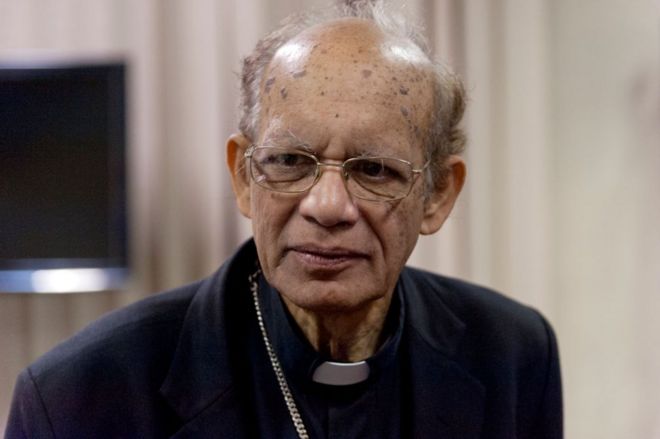
Image copyrightGETTY IMAGESImage captionCardinal Oswald Gracias told the BBC it pained him to hear accusations that he had neglected victims of alleged abuse
One of the Catholic Church’s most senior cardinals has admitted that he could have better handled sexual abuse allegations that were brought to him.
Oswald Gracias, the Archbishop of Mumbai is one of four men organising a major Vatican conference on child abuse this week.
We found two separate cases where the cardinal, who is tipped by some to possibly become the next Pope, is claimed to have failed to respond quickly or offer support to the victims.
Victims and those who supported them allege that Cardinal Gracias did not take allegations of abuse seriously when they were reported to him.
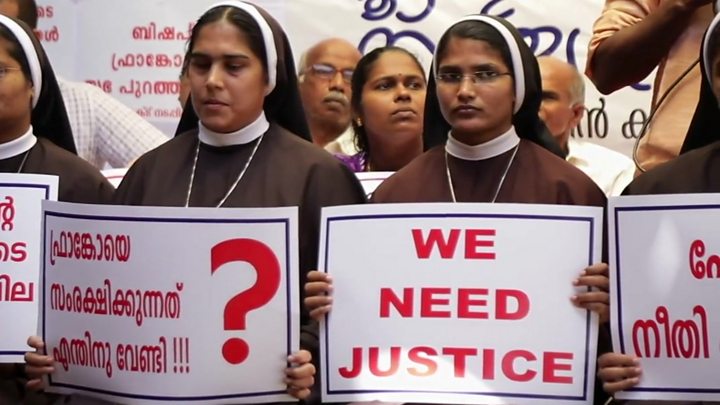
India’s Catholics say there is a culture of fear and silence in the Catholic Church about sexual abuse by priests. Those who have dared to speak out say it has been an ordeal.
A woman’s life changed when her son returned from Mass at the church and told her that the parish priest had raped him.
“I could not understand what should I do?” she said. She did not know this yet, but this event would put her on a collision course with the Catholic Church in India.
Media captionWhy is India’s Catholic church silent about sexual abuse?
The man she reached out to for help was and remains one of the most senior representatives of the Church.
It was nearly 72 hours after the alleged rape that the family briefly met Cardinal Gracias, then president of the Catholic Bishop’s Conference of India and Federation of Asian Bishops’ Conferences.
The issue of sexual abuse within the Church is being called the Vatican’s biggest crisis in modern times, and the integrity of the Catholic Church is said to ride on the outcome of this conference.
Image copyrightGETTY IMAGESImage captionPope Francis with Cardinal Oswald Gracias (fourth from left)
Over the past year, the Catholic Church has been reeling under multiple allegations of sexual abuse around the world.
But while abuse claims have made headlines in North and South America, Europe and Australia, very little is known about the problems in Asian countries. In countries such as India there is a social stigma about reporting abuse.
Among Christians, who are a minority of nearly 28 million people, a culture of fear and silence makes it impossible to gauge the true scale of the problem.
Cardinal Blase Cupich of Chicago – a colleague of Cardinal Gracias on the four-member organising committee – has promised that decisive action in Rome and in dioceses worldwide will follow after the meeting so as to safeguard children and bring justice to the victims.
Cardinal Gracias will open the second day of the summit with a conversation about accountability in the Church.
Media captionBrigitte, a survivor of child sex abuse by a chaplain, explains why she is ready to speak now
This vital role given to him during this crucial conference has made some in India unhappy.
They say his track record in protecting children and women from abusers is questionable. Those we have spoken to who have taken cases to him say they received little support from him.
The mother of the abused boy said: “I told the cardinal about what the priest had done to my child, that my child was in a lot of pain. So he prayed for us and told us he had to go to Rome…my heart was hurt in that moment.
“As a mother, I had gone to him with great expectations that he would think about my son, give me justice, but he said he had no time, he only cared about going to Rome.”
The family say they requested medical help but were offered none.
The cardinal told us it pained him to hear this, and that he was not aware that the boy needed medical help – and if he had been asked, he would have immediately offered it.
The cardinal admits he left for Rome that night without alerting the authorities.
By failing to call the police, Cardinal Gracias may have violated India’s Protection of Children from Sexual Offences Act, 2012 (POCSO).
The provisions of this law state that if the head of any company or institution fails to report the commission of an offence in respect of a subordinate under his control, they shall be punished with imprisonment for a term which may extend to one year, and with a fine.
The cardinal told us he had telephoned his bishop the next day, who told him the family had subsequently informed the police themselves.
Asked if he regretted not calling the police personally at the time, he said: “You know I’m being honest, I’m not 100% sure… but I must reflect on that. I admit whether immediately, the police should have got involved, sure.”
He says he was under a duty to evaluate the credibility of accusations by speaking to the accused man.
Emerging from that meeting, the family decided to go to a doctor.
“He took one look at my boy and said that something has happened to him. This is a police case. Either you report it or I will… so we went to the police that night,” the mother said.
A police medical examination found that the child had been sexually assaulted.
Image copyrightGETTY IMAGESImage captionIndia is home to about 19 million Catholics
A current priest who spoke to us on the condition of anonymity said this was not the first time allegations about this priest had been brought to the cardinal’s attention.
“I met him some years before this [alleged] incident,” the priest told us.
“There were strong rumours about [the accused priest] in the diocese, and like these are about abuse that is taking place. And yet he seems to be moving from one place to another, one parish to another. The cardinal told me directly that he is not aware directly of all these things.”
The cardinal says he cannot recall the conversation. He says he did not recollect any “cloud of suspicion” over the man.
‘A lonely battle’
As part of our investigation, we wanted to see if there were other allegations of the cardinal being slow to act.
We found an instance dating back almost a decade, brought to his attention just a couple of years after becoming archbishop of Mumbai.
Image captionCatholic activist Virginia Saldanha says three legal notices were sent to the cardinal, threatening court action unless took action about the claims of abuse
In March 2009, a woman approached him with accusations of sexual abuse by another priest who conducted retreats.
She says that he took no action against the priest so she reached out to a group of female Catholic activists, who say they forced the cardinal to act.
Under pressure, he finally set up an enquiry committee in December 2011. Six months after the enquiry, there was still no action and the accused priest continued working in his parish.
“We had to send the cardinal three legal notices to act, threaten to take the matter to the courts if he did not act,” said Virginia Saldanha, a devout Catholic who has worked on the women’s desk of multiple Church-affiliated positions for over two decades.
When the cardinal replied, he said: “The priest is not listening to me.”
Image captionThe family says they have been ostracised from the church and isolated within their communities since reporting the sexual assault
During the time, Saldanha said she had to leave the church because “I could not bear to see that man giving Mass in the church. I did not feel like going there.”
The priest was eventually removed from his parish, but the reasons for his departure were never made public.
The punishment, decided by the cardinal personally in October 2011, was a “guided retreat and therapeutic counselling”.
When we pressed him about the speed of process and punishment, the cardinal said it was a “complicated case”.
After a stay in the seminary, the accused priest was briefly given a parish again and still conducts retreats.
Meanwhile, the family of the allegedly raped minor feel abandoned by the institution that they had built their lives around.
“It has been a lonely battle,” the mother concedes. They say they have been ostracised from the church and isolated within their communities.
“After complaining to the police, when we would go into church, people would refuse to talk to us, to sit next to us during Mass. If I went to sit next to someone… they would get up and leave,” she said.
The hostility she encountered eventually “made us leave the church. But it got so difficult for us that we eventually had to change our home as well. We left it all behind”.
Church members say that it is this hostility that makes it harder for victims and their families to speak up.
Caught between an apparently unsupportive clergy and hostile social network, many find their voices faltering.
BEIJING, Feb. 18 (Xinhua) — The widely used new media has become an efficient tool for China’s anti-graft body to promote information transparency.
Commentary in a newspaper administrated by the Communist Party of China Central Commission for Discipline Inspection and the National Supervisory Commission said Monday netizens can find the latest information released by the top anti-graft watchdog on its website and post suggestions there.
People can report corrupt practices and other violations of disciplines and laws online, such as posting on the micro-blogging site Weibo, sending a message to anti-graft authorities’ accounts on the instant messaging tool WeChat or reporting through an app run by the top anti-graft authority.
Varied reporting channels have helped expose more officials violating disciplines and laws that were hard to be found out by anti-graft authorities in the past, the commentary said.
Improved information transparency has also helped ensure more objective and fair investigations, it added.
Anti-graft authorities can post online information of corrupt officials, including those fleeing overseas, meaning there will be more chances to capture them, said the commentary.
It also said as anti-graft authorities’ articles and video clips are reaching more people online through Weibo, Wechat and their apps, people are now able to learn about the ongoing crackdown on corruption, which also benefits the anti-graft work.
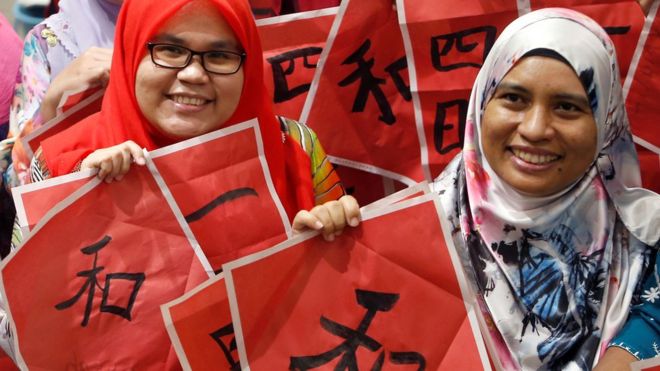
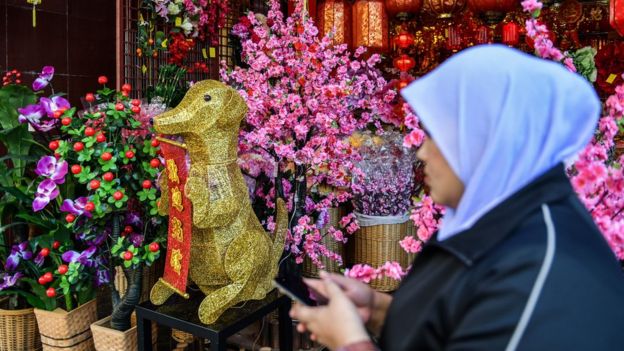
Image copyrightREUTERSImage captionMuslim teachers attend a Chinese calligraphy event in Kuala Lumpur, Malaysia to mark the Year of the Pig
Communities around the world are gearing up to celebrate the lunar new year, which this time ushers in the Year of the Pig.
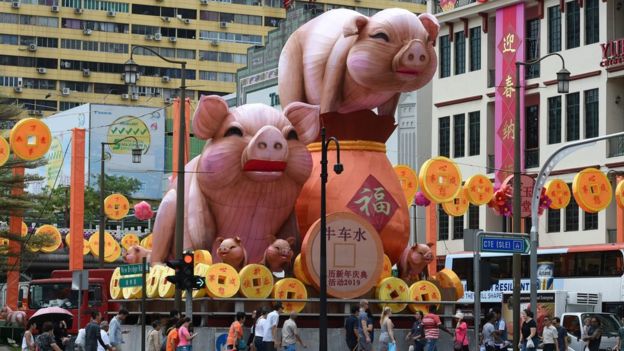
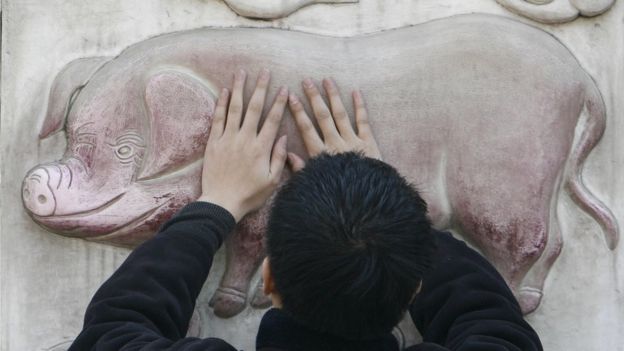
New Year celebrations usually mean the animal is depicted everywhere – in decorations, toys, gifts and advertising.
But the pig, the last animal on the Chinese zodiac calendar, is considered unclean by Muslims and a sin to consume. So does this cause problems for people celebrating lunar new year in Muslim-majority countries in South East Asia?
Like most Chinese-Malaysian families, the lunar new year is serious business for the Chow family, who live in the sleepy town of Batu Pahat in Johor, Malaysia.
This year is particularly significant because Chow Yoon Kee, his wife Stella and their daughter were all born in pig years.
“We will display lots of lucky pig ornaments at home and of course, have our relatives, friends, workers and neighbours over to visit, no matter what race or religion. Celebrations are for all,” said Mr Chow, a floor manager at a local biscuit factory.
He isn’t worried about his celebrations offending fellow residents as he believes there is no sign of new year controversy.
“There was a lot of fuss last year,” he recalls, when it was the Year of the Dog, also seen as impure animals by some Muslims.
Image copyrightAFPImage captionMalaysian authorities trod cautiously last year, being careful not to overdo the canine decorations
Malaysia is multicultural but the official religion is Islam, and there have been increasing reports of intolerance towards activities and actions considered insulting to Muslims.
So many shops and merchants avoided using images of dogs in fear of offending Muslim communities.
But Mr Chow feels local authorities have overlooked the feelings of the Chinese community, who actually celebrate the holiday.
“Malaysia is a country made up of many races, it isn’t just Malay Muslims. We have Chinese and Indian communities too, as well as other religions like Christianity, Hinduism, Taoism and Buddhism so we should be respecting each other’s beliefs and celebrations.”
But he adds that “the spirit of censorship” did not seem to carry on into the pig year.
Image copyrightAFPImage captionThat’s some pig! Celebrations are under way in Chinatown, Singapore
Each animal of the Chinese zodiac is believed to have its own unique traits and qualities. Those born in the year of the pig are said to be intelligent, compassionate and loyal.
Does it matter if one’s zodiac animal isn’t welcome?
“There’s absolutely no reason to worry,” said Kuala Lumpur-based Feng Shui consultant Joey Yap. He told the BBC there didn’t seem to be any sensitivities around celebrations in Malaysia this year, compared to last.
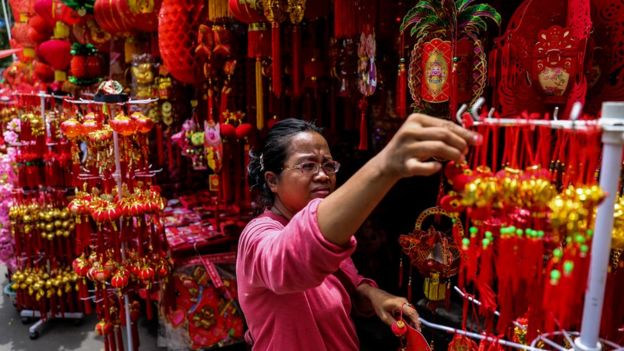
Image copyrightGETTY IMAGESImage captionRed decorations galore in Jakarta’s Chinatown
“Pigs will be fine,” he said, adding that whether you display objects or not “does not affect one’s personal luck”.
“Colours, emblems; they all aren’t important. In reality, one’s luck all boils down to one’s actions, so embrace positivity,” he said.
‘The first pigs Muslims can eat’
Even though it’s the world’s most populous Muslim nation, the lunar new year is a national holiday in Indonesia. Public celebrations are widely accepted – lanterns, colourful parades and performances are often seen in many cities.
Merry Olivia in Jakarta said her Muslim friends welcomed the image of pigs.
Image copyrightDAPUR MAMA LOEImage captionBaker Valeria Rita says her special cookies were a holiday hit with Muslim customers
“I grew up with many Indonesian Muslims so I know pigs will not make them feel uneasy,” she said, adding that the creatures looked more “festive” than other zodiac animals.
“If you compare pigs with snakes, pigs are more adorable so people would rather buy decorations embellished with them. Not many people in Jakarta like snakes.”
Baker Valeria Rita was rolling out special treats in time for the new year: pig shaped cookies with sweet pineapple jam fillings.
She said the response had been really good. “Orange or tangerine is a popular symbol for the lunar new year. This year, we decided to create pig-shaped treats and the quota for pre-orders was full within two weeks.”
Many of her customers are also Muslim.
“They buy my cookies for Chinese colleagues and friends who celebrate the holiday. Some also order for themselves because they like the pigs,” she said, sharing a joke made by her best friend, also a Muslim. “My goodies were the first pigs Muslims are allowed to eat.”
‘I don’t want to offend’
But it’s a different situation for 24-year-old Rangga Sastrajaya, from Bogor city. He bought pig toys and decorations but remains cautious in displaying them openly as he feels many Indonesians still do not accept cultural diversity.
“I could wear pig shirts or display pig-themed decorations at home but I will be quite careful in showing them off in public because I do not want to offend anyone,” he admitted.
Image copyrightAFPImage captionWill the new year spirit provoke widespread resentment among conservative Muslims?
But there are those who condemn the festivities. Forum Muslim Bogor (FMB), a conservative Islamic organisation in West Java, released a letter demanding the cancellation of festivities. They said it was “inappropriate” for Muslims because it could “undermine Islamic faith”.
Their actions follow other groups like Pemuda Pancasila (PP) and the Malayan Persatuan Forum Komunikasi Pemuda Melayu (PFKPM), who previously condemned the celebrations by Chinese communities.
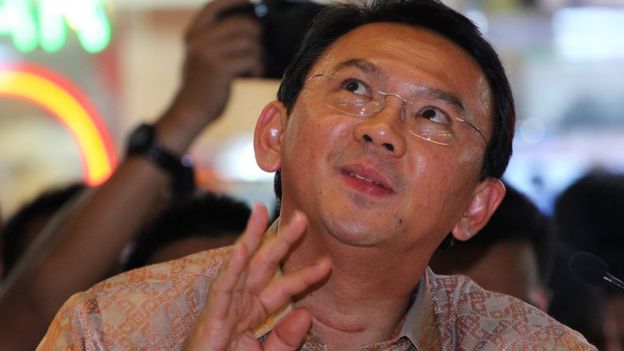
Image copyrightGETTY IMAGESImage captionIn 2017 Chinese-Christian Jakarta governor Basuki Tjahaja Purnama was jailed for blasphemy against Islam
Analyst Thung Ju-Lan from the Indonesian Institute of Science considers such sentiments the “impact of intolerant and political narratives”, the same kind which rocked Jakarta two years ago.
“It is the impact of the gubernatorial election in Jakarta, in Ahok’s case. The same sentiment has been spreading,” she told the BBC.
“The problem of intolerance continues because we have narrow understandings of what is actually happening. The more we do not understand, the more intolerant we are.”
In the case of celebrating the lunar new year, many Indonesian Muslims feel it is “more religious than cultural”.
But one politician has spoken out in defence of the Chinese community. Religious Affairs Minister Lukman Hakim Saifuddin encouraged beliefs of people from different cultures, faiths, and traditions to be respected.
“Regardless of what people understand about such celebrations, I invite all to respect tradition,” he said.
BEIJING, Jan. 30 (Xinhua) — Chinese Premier Li Keqiang and Cambodian Prime Minister Samdech Techo Hun Sen sent congratulatory messages on the launch of the China-Cambodia culture and tourism year 2019 in Phnom Penh on Wednesday, expressing hope for strengthening the bilateral friendship and ties.
In his message, Li said that China and Cambodia, both boasting a long history, rich culture and beautiful scenery, are good neighbors, friends, partners and brothers and enjoy a long-standing friendship. There are wall paintings in Cambodia’s famed Angkor Archeological Park depicting friendly exchanges between the two peoples more than 1,000 years ago.
Li said the China-Cambodia culture and tourism year is an opportunity for the two sides to promote cultural and people-to-people exchanges, so as to foster a solid ground for building a community with a shared future together.
For his part, Hun Sen said the long-standing friendship between Cambodia and China remains unshakable with closer and fruitful cooperation.
He added that the launch of the culture and tourism year benefits the bilateral friendly cooperation under the framework of the Belt and Road Initiative toward a win-win end, as well as the development of tourism in the two countries.
n a video address to Bharatiya Janata Party (BJP) booth level workers in Goa, the PM slammed the ‘mahagathbandhan’ and said that it is a “coalition of dynasts, corruption, inefficiency and inequality”.
SNS Web | New Delhi | January 20, 2019 3:08 pm
Prime Minister Narendra Modi on Sunday targeted the opposition parties who attended the so called ‘United India’ rally in Kolkata a day before. In a video address to Bharatiya Janata Party (BJP) booth level workers in Goa, the PM slammed the ‘mahagathbandhan’ and said that it is a “coalition of dynasts, corruption, inefficiency and inequality”.
“Ye mahagathbandhan ek anokha bandhan hai. Ye bandhan to naamdaaro ka bandhan hai. Ye bandhan to bhai-bhativaaj ka, bhrashtachaar ka, ghotalon ka, nakaaratmakta ka, asthirta ka, asamaanta ka bandhan hai. Ye ek adbhut sangam hai (This mahagathbandhan is a strange association. This tie-up is an association of dynasts. This association is a coming together of corruption, scams, inefficiency, uncertainty and inequality. This is a strange confluence),” the PM said.
During the interaction, the PM said that while the parties who attended the so called ‘United India’ rally had formed an alliance with each other, the BJP has allied with the people of the country.
“They’ve formed alliances with each other. We’ve formed alliance with 125 crore countrymen. Which alliance do you think is stronger?” he said expressing confidence in the victory of his party in the 2019 Lok Sabha elections to be held in a few months.
The PM said that the leaders present at the rally were either the sons of influential people or were trying to propel their own children.
“They’ve ‘dhanshakti’ (power of wealth), we’ve ‘janshakti’ (power of the people),” he said.
Accusing the Congress of indulging in corruption, the PM said that “truth cannot be hidden for long” referring to the goof up made by Loktantrik Janata Dal (LJD) leader Sharad Yadav who termed Bofors as a scam instead of Rafale while attacking the BJP.
“Jis manch se ye log desh aur loktantra ko bachane ki baat keh rahe the, usi manch par ek neta ne Bofors ghotale ki yaad dila di. (From the platform where they were talking about saving the country and democracy, one leader reminded the people of the Bofors scam),” Modi said.
“Aakhir sacchai kab tak chupti hai. Kabhi na kabhi to sach bahar aa hi jaata hai, jo kal Kolkata mein hua (After all, how can truth remain hidden. The truth always comes out, which happened in Kolkata),” Modi said.
Slamming the leaders who demanded that the Electronic Voting Machines (EVMs) should not be used in the upcoming general elections, the PM said that the parties had already started making excuses for their defeat.
“EVM is being made a villain. It’s natural that every political party wants to win the polls, but it’s worrisome when some parties take public for granted. They consider public stupid and so keep changing colours,” the PM lashed out.
National Conference (NC) chairman Farooq Abdullah had during the rally called the EVM a “chor machine” claiming that it steals votes. He had urged other political heavyweights at the rally to collectively approach the Election Commission and the President of India to call for the replacement of the EVM with ballot paper system for the sake of transparency.
Later in the day at a press conference, West Bengal Chief Minister Mamata Banerjee, who organised the massive anti-BJP opposition rally, announced that a committee comprising Abhishek Manu Singhvi (Congress), Akhilesh Yadav (Samajwadi Party), Satish Mishra (Bahujan Samaj Party) and Arvind Kejriwal (Aam Aadmi Party) will submit its recommendations regarding the use of EVMs to the EC.


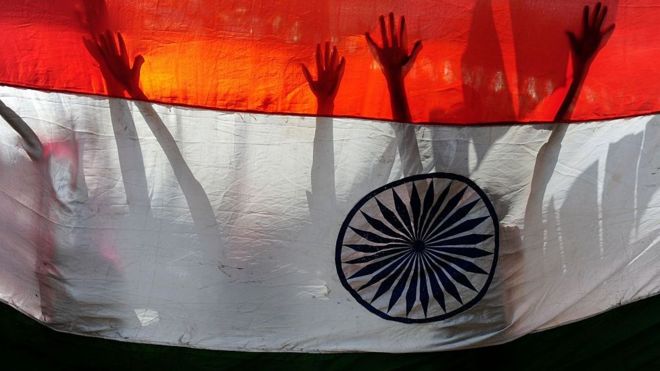 Image copyright GETTY IMAGES
 1000 Friends of the South@FriendsOfSouth
 Akahrsh Manikghantan@Akahrsh
 Akbar Hussain@AkbarHussaine
 karthik subramaniyam@iam_karthik_s
 “There is no opposition to actually learning Hindi. In fact with the recent IT boom in the south, so many people from the north have migrated here that its use has become more widespread here. It is true that if you know Hindi you will find it easier to get work in other parts of India, so there are also many people here who willingly learn it. But that should be their choice. What people are opposing is the imposition of it,” senior journalist and political analyst KN Arun told the BBC.








 CHINDIA ALERT: You'll be living in their world, very soon