Chindia Alert: You’ll be Living in their World Very Soon
aims to alert you to the threats and opportunities that China and India present. China and India require serious attention; case of ‘hidden dragon and crouching tiger’.
Without this attention, governments, businesses and, indeed, individuals may find themselves at a great disadvantage sooner rather than later.
The POSTs (front webpages) are mainly 'cuttings' from reliable sources, updated continuously.
The PAGEs (see Tabs, above) attempt to make the information more meaningful by putting some structure to the information we have researched and assembled since 2006.
Image copyright GETTY IMAGESImage caption Millions of poor Indians still defecate in the open
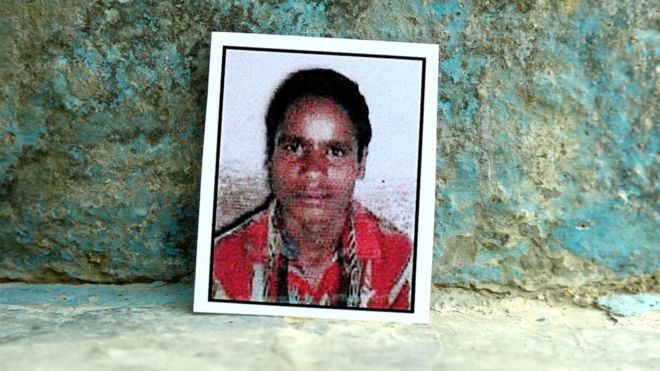
Two men in the central Indian state of Madhya Pradesh have been arrested for allegedly killing two Dalit (formerly untouchables) children who were defecating in the open, police say.
Roshni, 12, and Avinash, 10, were attacked on Wednesday while defecating near a village road, they said.
The children’s family told BBC Hindi that they have no toilet at home.
Millions of poor Indians defecate in the open, which especially puts women and children at risk.
Dalits are at the bottom of the Hindu caste system and despite laws to protect them, they still face widespread discrimination in India.
“The two children were beaten to death with sticks,” police superintendent Rajesh Chandel told BBC Hindi’s Shuraih Niazi. “We have registered a murder case against both the accused. They are being questioned.”
Within hours of the attack early on Wednesday morning, police arrested two upper-caste men – Rameshwar Yadav and Hakim Yadav.
Roshni and Avinash were cousins, but Roshni had been brought up by Avinash’s parents and lived with them.
Avinash’s father, Manoj, says that as a daily wage labourer, he cannot afford to build a toilet at his house. He also says he has been unable to access a government subsidy as part of a flagship scheme to build toilets for the poor.
Media caption The Dalits unblocking India’s sewers by hand
The Swachh Bharat Mission or Clean India programme seeks to end open defecation by increasing toilet infrastructure and improving sanitation across the country. When Prime Minister Narendra Modi launched the program in 2014, he vowed to make India “open defecation free” by 2 October 2019.
Manoj’s village – Bhavkhedi – has been declared “open defecation free”, a tag given by the government to villages and cities have successfully ended open defecation.
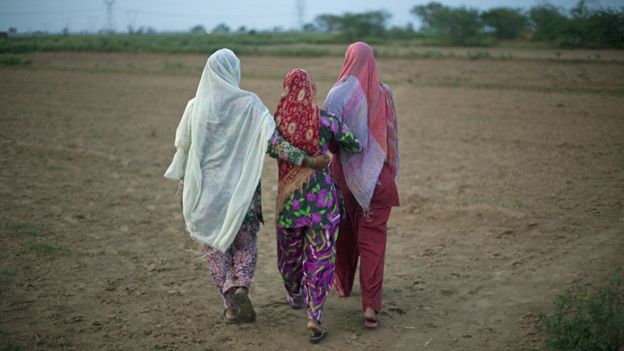
Image caption Women who go out at night to defecate are often at risk
Research has shown that while the construction of toilets has increased rapidly, lack of water, poor maintenance and slow change in behaviour have stood in the way of ending open defecation.
But many have praised Mr Modi for highlighting the issue and launching a major scheme to address it – the Bill & Melinda Gates Foundation honoured him this week, describing the Swachh Bharat Mission as “a model for other countries around the world that urgently need to improve access to sanitation for the world’s poorest.”
A Google search for basic information on India’s caste system lists many sites that, with varying degrees of emphasis, outline three popular tropes on the phenomenon.
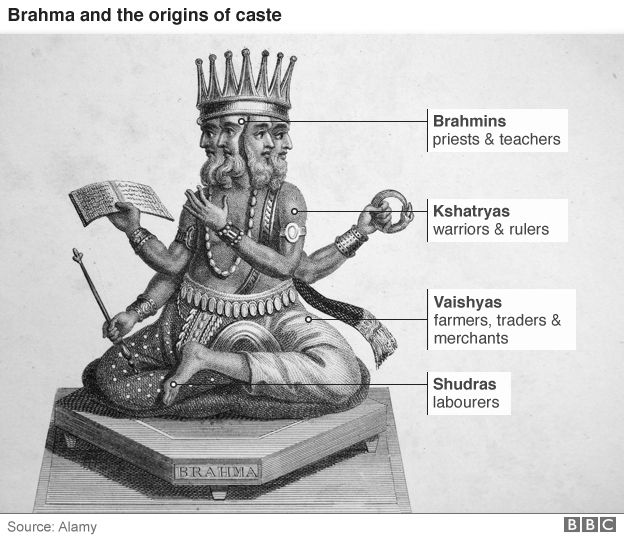
First, the caste system is a four-fold categorical hierarchy of the Hindu religion – with Brahmins (priests/teachers) on top, followed, in order, by Kshatriyas (rulers/warriors), Vaishyas (farmers/traders/merchants), and Shudras (labourers). In addition, there is a fifth group of “Outcastes” (people who do unclean work and are outside the four-fold system).
Second, this system is ordained by Hinduism’s sacred texts (notably the supposed source of Hindu law, the Manusmriti), it is thousands of years old, and it governed all key aspects of life, including marriage, occupation and location.
Third, caste-based discrimination is illegal now and there are policies instead for caste-based affirmative action (or positive discrimination).
These ideas, even seen in a BBC explainer, represent the conventional wisdom. The problem is that the conventional wisdom has not been updated with critical scholarly findings.
The first two statements may as well have been written 200 years ago, at the beginning of the 19th Century, which is when these “facts” about Indian society were being made up by the British colonial authorities.
In a new book, The Truth About Us: The Politics of Information from Manu to Modi, I show how the social categories of religion and caste as they are perceived in modern-day India were developed during the British colonial rule, at a time when information was scarce and the coloniser’s power over information was absolute.
Image caption Conventional wisdom says the caste system is a four-fold categorical hierarchy of the Hindu religion
This was done initially in the early 19th Century by elevating selected and convenient Brahman-Sanskrit texts like the Manusmriti to canonical status; the supposed origin of caste in the Rig Veda (most ancient religious text) was most likely added retroactively, after it was translated to English decades later.
These categories were institutionalised in the mid to late 19th Century through the census. These were acts of convenience and simplification.
The colonisers established the acceptable list of indigenous religions in India – Hinduism, Sikhism, Jainism – and their boundaries and laws through “reading” what they claimed were India’s definitive texts.
What is now widely accepted as Hinduism was, in fact, an ideology (or, more accurately, a theory or fantasy) that is better called “Brahmanism”, that existed largely in textual (but not real) form and enunciated the interests of a small, Sanskrit-educated social group.
There is little doubt that the religion categories in India could have been defined very differently by reinterpreting those same or other texts.
The so-called four-fold hierarchy was also derived from the same Brahman texts. This system of categorisation was also textual or theoretical; it existed only in scrolls and had no relationship with the reality on the ground.
This became embarrassingly obvious from the first censuses in the late 1860s. The plan then was to fit all of the “Hindu” population into these four categories. But the bewildering variety of responses on caste identity from the population became impossible to fit neatly into colonial or Brahman theory.
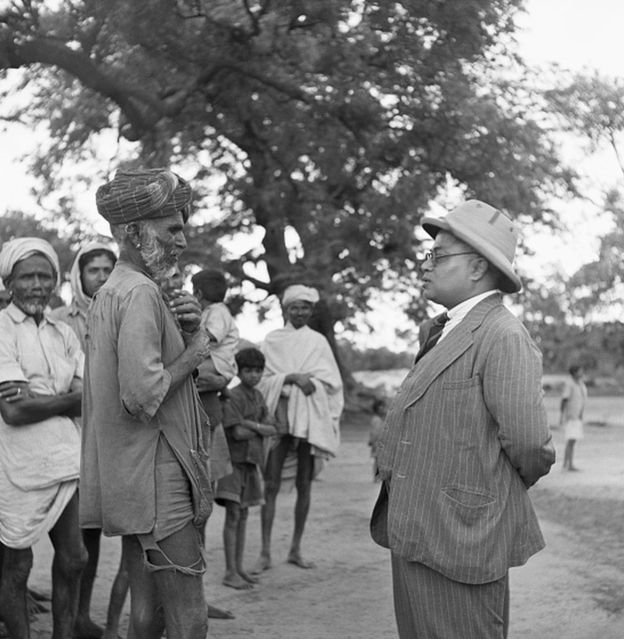
Image copyright GETTY IMAGESImage caption A leader of those formerly considered untouchable with a government official in British India
WR Cornish, who supervised census operations in the Madras Presidency in 1871, wrote that “… regarding the origin of caste we can place no reliance upon the statements made in the Hindu sacred writings. Whether there was ever a period in which the Hindus were composed of four classes is exceedingly doubtful”.
Similarly, CF Magrath, leader and author of a monograph on the 1871 Bihar census, wrote, “that the now meaningless division into the four castes alleged to have been made by Manu should be put aside”.
Anthropologist Susan Bayly writes that “until well into the colonial period, much of the subcontinent was still populated by people for whom the formal distinctions of caste were of only limited importance, even in parts of the so-called Hindu heartland… The institutions and beliefs which are now often described as the elements of traditional caste were only just taking shape as recently as the early 18th Century”.
In fact, it is doubtful that caste had much significance or virulence in society before the British made it India’s defining social feature.
Astonishing diversity
The pre-colonial written record in royal court documents and traveller accounts studied by professional historians and philologists like Nicholas Dirks, GS Ghurye, Richard Eaton, David Shulman and Cynthia Talbot show little or no mention of caste.
Social identities were constantly malleable. “Slaves” and “menials” and “merchants” became kings; farmers became soldiers, and soldiers became farmers; one’s social identity could be changed as easily as moving from one village to another; there is little evidence of systematic and widespread caste oppression or mass conversion to Islam as a result of it.
All the available evidence calls for a fundamental re-imagination of social identity in pre-colonial India.
The picture that one should see is of astonishing diversity. What the colonisers did through their reading of the “sacred” texts and the institution of the census was to try to frame all of that diversity through alien categorical systems of religion, race, caste and tribe. The census was used to simplify – categorise and define – what was barely understood by the colonisers using a convenient ideology and absurd (and shifting) methodology.
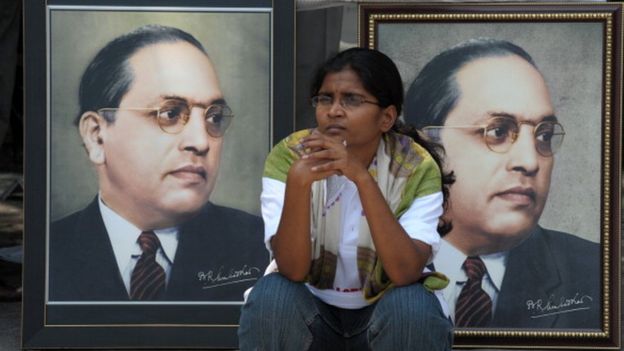
Image copyright AFPImage caption India’s constitution was written by BR Ambedkar, a member of the Dalit community which is at the bottom of the caste system
The colonisers invented or constructed Indian social identities using categories of convenience during a period that covered roughly the 19th Century.
This was done to serve the British Indian government’s own interests – primarily to create a single society with a common law that could be easily governed.
A very large, complex and regionally diverse system of faiths and social identities was simplified to a degree that probably has no parallel in world history, entirely new categories and hierarchies were created, incompatible or mismatched parts were stuffed together, new boundaries were created, and flexible boundaries hardened.
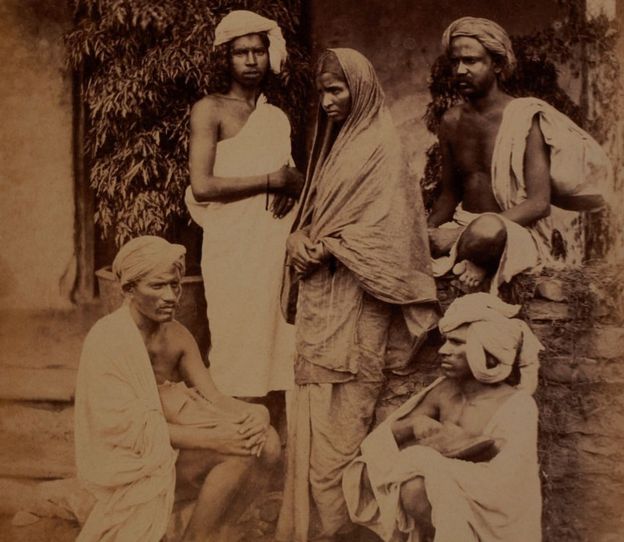
Image copyright GETTY IMAGESImage caption Dalits, or untouchables, were at the bottom of the caste system
The resulting categorical system became rigid during the next century and quarter, as the made-up categories came to be associated with real rights. Religion-based electorates in British India and caste-based reservations in independent India made amorphous categories concrete. There came to be real and material consequences of belonging to one category (like Jain or Scheduled Caste) instead of another. Categorisation, as it turned out in India, was destiny.
The vast scholarship of the last few decades allows us to make a strong case that the British colonisers wrote the first and defining draft of Indian history.
So deeply inscribed is this draft in the public imagination that it is now accepted as the truth. It is imperative that we begin to question these imagined truths.
Image caption Jitendra was a carpenter and the only breadwinner in his family
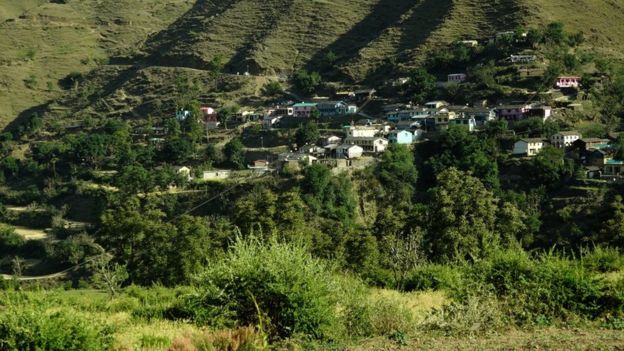
A helpless anger pervades the Dalit community in the remote Indian village of Kot.
Last month, a group of upper-caste men allegedly beat up a 21-year-old Dalit resident, named Jitendra, so badly that he died nine days later.
His alleged crime: he sat on a chair and ate in their presence at a wedding.
Not even one of the hundreds of guests who attended the wedding celebration – also of a young Dalit man – will go on record to describe what happened to Jitendra on 26 April.
Afraid of a backlash, they will only admit to being at a large ground where the wedding feast was being held.
Only the police have publicly said what happened.
The wedding food had been cooked by upper-caste residents because many people in remote regions don’t touch any food prepared by Dalits, who are the bottom of the rigid Hindu caste hierarchy.
“The scuffle happened when food was being served. The controversy erupted over who was sitting on the chair,” police officer Ashok Kumar said.
The incident has been registered under the Scheduled Castes and Scheduled Tribes (Prevention of Atrocities Act) – a law meant to protect historically oppressed communities.
It is still common to see reports of Dalits being threatened, beaten and killed for seemingly mundane reasons.
The culture that pervades their community is visible everywhere – including in Kot, which is in the hilly northern state of Uttarakhand.
Local residents from the Dalit community allege that Jitendra was beaten and humiliated at the wedding.
They say he left the event in tears, but was ambushed again a short distance away and attacked again – this time more brutally.
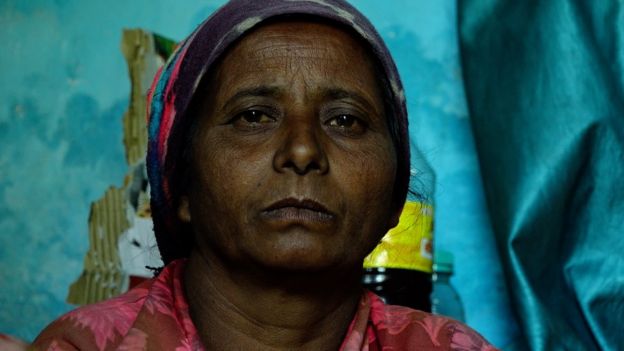
Jitendra’s mother, Geeta Devi, found him injured outside their dilapidated house early the next morning.
“He had been perhaps lying there the entire night,” she said, pointing to where she found him. “He had bruises and injury marks all over his body. He tried to speak but couldn’t.”
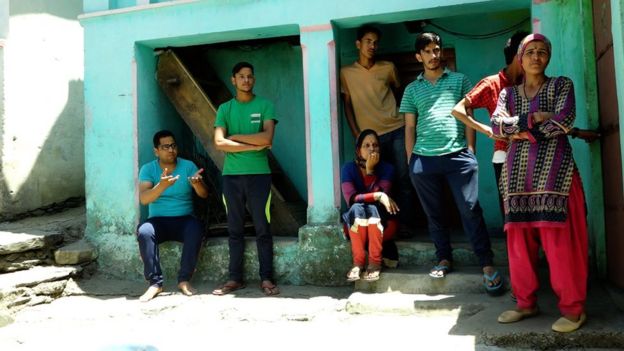
Image caption Dalits are outnumbered by upper-caste families in the village
She does not know who left her son outside their home. He died nine days later in hospital.
Jitendra’s death is a double tragedy for his mother – nearly five years ago her husband also died.
This meant that Jitendra, who was a carpenter, became the family’s only breadwinner and had to drop out of school to start working.
Family and friends describe him as a private man who spoke very little.
Loved ones have been demanding justice for his death, but have found little support among the community.
“There is fear. The family lives in a remote area. They have no land and are financially fragile,” Dalit activist Jabar Singh Verma said. “In surrounding villages too, the Dalits are outnumbered by families from higher castes.”
Of the 50 families in Jitendra’s village, only some 12 or 13 are Dalits.
Dalits comprise almost 19% of Uttarakhand’s population and the state has a history of atrocities committed against them.
Police have arrested seven men in connection with Jitendra’s death, but all of them deny any involvement.
Image caption Upper-caste villagers deny discriminating against the Dalit community
“It’s a conspiracy against our family,” said a woman whose father, uncles and brothers are among the accused. “Why would my father use caste slurs at a Dalit’s marriage?”
“He must have been embarrassed that he got beaten and popped dozens of pills that led to his death,” another local upper-caste person said.
But the Dalits in the village, who are livid over Jitendra’s death, hotly deny these claims.
They say Jitendra suffered from epilepsy, but insist there is no chance that he overdosed on his medication.
Apart from these expressions of anger, local Dalit families have largely remained silent.
“It is because they are economically dependent on families from the higher castes,” activist Daulat Kunwar said.
“Most Dalits are landless. They work the fields of their wealthy upper caste neighbours. They know the consequences of speaking out loud.”
Jitendra’s family has already experienced some of these consequences – Geeta Devi says they are under pressure to stop pushing for the truth.
“Some men came over to our house and tried to scare us,” she said. “There is no one to support us but I will never give up our quest for justice.”
No other injuries reported following accident on southern island of Hainan
Military is currently intensifying training for pilots as it looks to strengthen capabilities
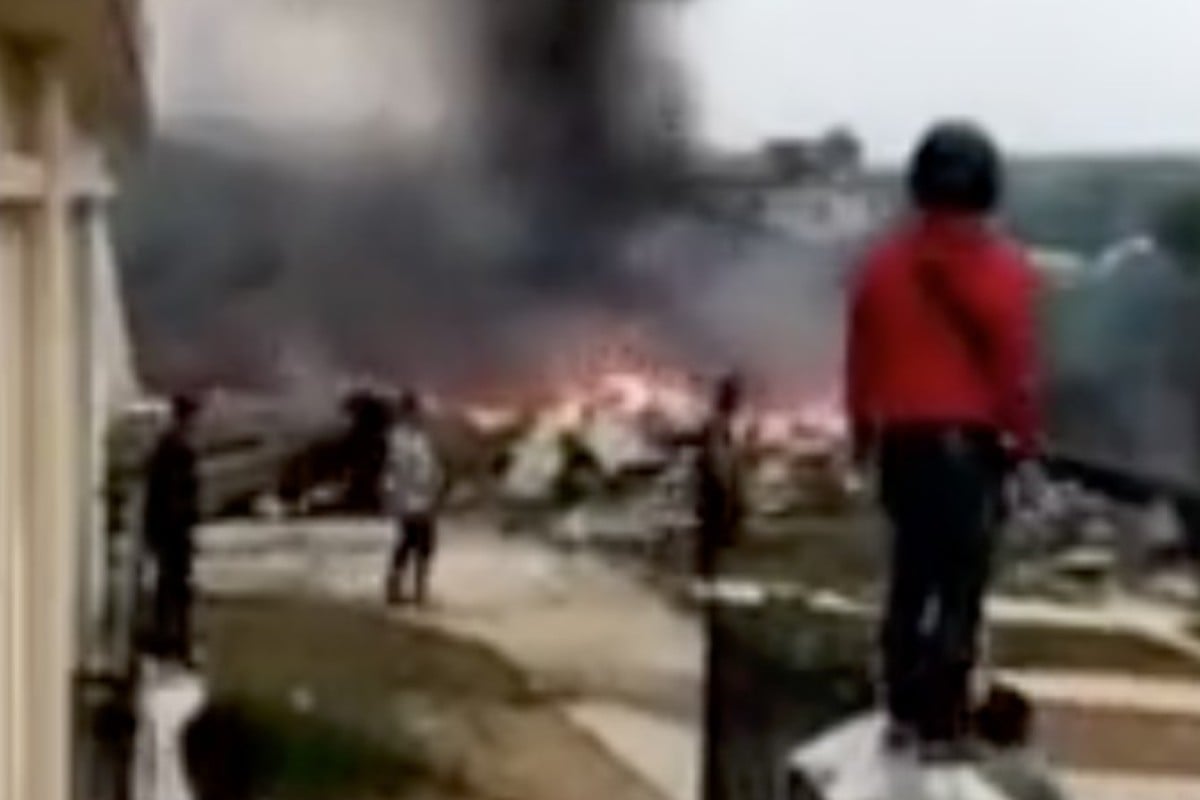
Mobile phone footage believed to be taken from the crash site. Photo: Handout
A Chinese navy plane crashed in Hainan province on Tuesday killing two crew members, the military said.
A short statement said the crash happened during a training exercise over rural Ledong county in the southern island province.
No one else was reported to have been injured after the plane hit the ground and the cause of the incident is being investigated.
Footage that purported to be taken from the crash site started circulating on social media after the accident.
The mobile phone footage, which news portal 163.com said was taken in Hainan, showed smoke rising from piles of wreckage next to a damaged water tower as bystanders gathered at the site.
Footage apparently taken at the crash site. Photo: Handout
The person who uploaded the footage said the plane had hit the water tower before crashing into the ground.
The PLA’s official statement did not specify the type plane that crashed, although unverified witness account online said it was a twin-seat Xian JH-7 “Flying Leopard”.
The JH-7, which entered service with the navy and air force in the 1990s, has been involved in a number of fatal accidents over the years.
The country’s worst military air accident in recent years happened in January 2018. At least 12 crew members died when a PLA Air Force plane, believed to be an electronic reconnaissance aircraft, crashed in Guizhou in the southwest of the country.
Between 2016 and 2017, there were at least four accidents involving the navy’s J-15 “Flying Sharks”, one of them resulting in the death of the pilot.
Military commentators have previously said that China’s drive to improve its combat readiness, which includes the building of new aircraft carriers and warplanes, has resulted in a serious shortage of qualified pilots.
To fill the vacancies the Chinese military has started a major recruitment drive and intensive training programme for pilot pilots.
One unverified report said the plane that crashed was a JH-7 “Flying Leopard”. Photo. Xinhua
Currently China has one aircraft carrier, the Liaoning, in service, which can carry a maximum of 24 J-15s as well as other aircraft.
Meanwhile, the new home-grown carrier Type 001A will soon be commissioned, which is designed to accommodate to carry eight more fighters.
In addition, construction is believed to have started on another carrier that will be able to carry heavier and more advanced warplanes.
According to figures from the end of 2016, there were only 25 pilots qualified to fly the J-15 while 12 others were in training.
Most of the Chinese navy’s pilots have been redeployed from the air force, which is itself in need of more trained pilots.
This year the navy for the first time began a nation-wide programme to scout out potential pilots.
Speaking on the sidelines of the ongoing legislative meeting in Beijing Feng Wei, a PLA pilot from the Western Theatre, said the military was currently intensifying its pilots’ training as increasing amounts of new equipment entered service.
“Personnel quality is the key to everything,” he added.
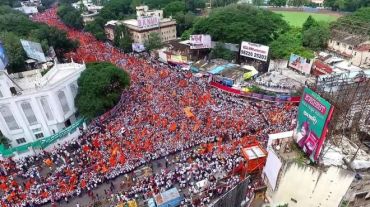
It is a unique protest: the silent marchers have no leaders; and they include the peasant and the professional. Women lead many of the marches; and politicians are not allowed to seize them. It is a sound of silence, says a commentator, that India can ill afford to ignore.
The protesters belong to the Maratha caste, one of India’s proudest – the warrior king Shivaji was one of them. Mostly farmers, they comprise more than a third of one of the population of Maharashtra, a relatively prosperous state, which is home, on one hand to Bollywood, thriving factories and farms and on the other, malnourished children and neglected tribespeople living in abject poverty.
Huge protests
The rape of a teenage Maratha girl allegedly by three low caste Dalit men triggered the silent marches in July. Then the protests expanded to include a demand for quotas in college seats and government jobs and a review of a 27-year-old federal law that protects Dalits and tribespeople from caste-related atrocities.
What is India’s caste system?
Why India’s farm communities are angryAfter more than 20 such rallies, the silent marchers – who call themselves the Maratha Revolutionary Silent Rallies – are expected to gather in the western Indian state capital, Mumbai, at the end of October. More than 10 million people are expected to participate in what could turn out to be one of largest protests in India in recent memory.
The upper-caste, largely land-owning Marathas have a handful of grumbles.
For one, they have turned their ire on the Dalits and tribespeople, alleging that the law to protect them has become a pretext to target the upper caste community, and lodge false cases against them. (The victims also get state compensation for as many as 47 offences against them.)
Image copyright VAISHALI GALIM
But this may not be an entirely truthful claim. Although dalits and tribespeople – India’s wretched of the earth – comprise 19% of Maharashtra’s population, but only 1% of the police complaints were filed by them last year, according to one report. Also the federal law was applicable in less than 40% of the complaints.
Social unrest
Clearly this disingenuous grievance masks a longer-standing demand: caste quotas in government jobs and seats in educational institutions. India’s Supreme Court has put a 50% cap on caste quotas, a limit that has already been reached in Maharashtra. Any concessions to the Marathas will mean that they will have to be officially labelled backward or less-privileged and the quotas will have to come at the expense of those for the less privileged castes. This could potentially trigger off bloody caste wars in the state.
The silent marchers of Maharashtra point to a host of structural infirmities afflicting India, which, if not resolved in time, could stoke widespread social unrest.
Growing inequity and decades of flagrant cronyism has meant that power and wealth continue to belong to a few.
The majority of colleges, cooperative banks and sugar factories in Maharashtra, for example, are owned by a clutch of politicians. According to one estimate, 3,000 families own more than 70% of all the farms in the state. The majority of the state’s 18 chief ministers have been Marathas. Half of its lawmakers belong to the community as well.
Image copyright MANSI THAPLIYAL Maratha farmers have taken their lives after they failed to repay debts
But caste and class don’t often coalesce in India, and the Marathas, like other upper caste communities have mixed fortunes: they are the educated elite and the rich farmers, but they are also the struggling small and landless farmers and farm workers. More than a third of Marathas are landless, according to one estimate.
It is the “lower and middle-rung Marathas who feel isolated, neglected, marginalised in the job market and denied opportunities in higher education,” in a fast-changing country, as commentator Kumar Ketkar points out in this perceptive essay on the ongoing protests.
The silent marches also shine a spotlight on its looming farm crisis as farmer incomes plummet due to expensive feedstuff, fertiliser, labour and erratic crop prices.
Frustration
Plot sizes have also shrunk, making farming unrewarding. Most of India’s farms are rain fed, and irregular weather changes are playing havoc with crops as rivers are drying up, and drought is common. Farmers are often left to fend for themselves and have no skills for jobs in India’s services-based economy. Aspiration is turning into frustration.
The Maratha protests also point to how India is veering towards what sociologist Andre Beteille called a “populist democracy” where social and political life are influenced by group identities and loyalties. “Problems arise when the loyalties of kinship and community are allowed to distort and override the demands of constitutional government,” wrote Professor Beteille.
Image copyright MANSI THAPLIYAL Farming is becoming an unrewarding profession
Many believe India’s quotas for seats and jobs are in a sordid mess of its own making.
It is indisputable that affirmative action is essential for communities like dalits and tribespeople who have been historically wronged. But extending it to other castes recklessly can distort matters.
How much burden of quotas can a state bear without being weakened irreparably? India needs jobs – and fast – and skills training if it has to avoid the social unrest that could blight a developing nation. Otherwise, the marchers of Maharashtra may not remain silent for long.
Prime Minister Narendra Modi on Tuesday paid tributes to to BR Ambedkar on his 124th birth anniversary, and said, “Let us pledge to dedicate ourselves to creating India that Ambedkar dreamt of…an India that will make him proud”.
“I bow to Dr. Babasaheb Ambedkar on his birth anniversary – Jai Bhim,” the prime minister said in a message.
“Dr. Babasaheb Ambedkar is a yug purush (man of the era) who lives in the hearts and minds of crores of Indians. His life is characterised by unmatched determination and a firm commitment towards social justice. He made a mark as a bright lawyer, scholar, writer and intellectual who always spoke his mind,” Modi said.
He added: “Who can forget Dr. Ambedkar’s contribution in the making of our Constitution? He served the nation and the people tirelessly and selflessly.”
“Let us pledge to dedicate ourselves to creating the India that Dr. Ambedkar dreamt of…an India that will make him proud.”
Tuesday marks the 125th anniversary of the birth of Bhimrao Ramji Ambedkar, the man who framed India’s constitution. A lawyer, he also served as the country’s first law minister after independence.
Mr. Ambedkar is remembered most for fighting to improve the social position of the Dalits, a group traditionally considered untouchable in the Indian caste system. He became an icon for the Dalit community. A few months before his death in 1956, Mr. Ambedkar converted to Buddhism. This inspired many Dalits to convert as well.
Mr. Ambedkar experienced the severe social and economic discrimination faced by Dalits from Hindus of other castes, and fought against it all his life. But although he was able to get India’s Constituent Assembly to adopt a Constitution that abolished untouchability and discrimination on the basis of caste, many such traditional practices still prevail. Mr. Ambedkar also championed the rights of other groups, including women. In 1951 , he introduced a draft Hindu Code Bill Parliament that would have provided greater rights to women but was unable to see it passed . Embittered over the lack of support for the legislation, he resigned from India’s Cabinet in 1951.
The key force driving the increasing communal polarisation in Uttar Pradesh is the scramble for Dalit votes in an attempt to weaken the Bahujan Samaj Party and deter Muslims from rallying behind it.
This strategy was evolved, and implemented, during the last Lok Sabha elections. But the competition to woo Dalits has gathered momentum ahead of bypolls to 12 assembly seats, five of which are in the western section of the state, which is often billed as the “wild west” of the Hindi heartland.
As the Indian Express reported, more than 600 incidents of communal violence have taken place in the state since May.
The Bharatiya Janata Party’s stake in the bypolls, which have yet to be scheduled, is enormous. Eleven of the 12 constituencies here had BJP MLAs, all of whom were elected to the Lok Sabha, as was the party’s ally, Apna Dal leader Anupriya Patel. The results will help measure the durability of the Modi wave, and its possible impact on the UP assembly elections in early 2017. The verdict from UP could well determine the chances of Prime Minister Narendra Modi winning a second successive term in the 2019 polls.
The need to cobble together an electoral majority is driving political parties to resort to communal mobilisation. Local disputes over land, civic amenities, and exploitative gender relations have been given a communal hue and magnified to portray a monolith Hindu community arrayed against the Muslims.
In Dharavi, a Mumbai slum, a ramshackle building houses the Bombay South Indian Adi-Dravida Sangh school, where 1,000 students from poor families take their classes in English, a language increasingly perceived as the key to a white-collar job.
Dharavi Slum in Mumbai, India (Photo credit: Wikipedia)
Tuition at the school is 400 rupees, or $6, a month, which represents about three days’ pay for the students’ parents, but they’d rather send their children here rather than to the free local public school because the quality of education is better. “We want our children to fare well, but we don’t have the capacity to put them in schools with very high fees,” said P. Ganesan, who stitches clothes at a garment factory nearby.
However, this school is in danger of being shut down because of the Right to Education Act, introduced by the Indian government in 2009. The landmark legislation, which mandated free and compulsory education for all children from the ages of 6 and 14, ordered all schools to have infrastructure like a playground and separate toilets for boys, among other requirements, by March 31.
The two-floor structure that houses the Bombay South Indian Adi-Dravida Sangh School is topped by a corrugated iron roof and lacks a playground, sports equipment and a ramp for disabled children, which are all required under the law. While the school has a library, the teachers complained that it is understocked. Of the seven computers in the school’s computer room, only one is in working condition
Many education experts argue that the Right to Education Act, while lofty in its goals, does not pay attention to the ground realities of low-budget private schools. In a study of 15 budget private schools in New Delhi by the Center for Civil Society, it was found that to comply with the infrastructure requirements in the Right to Education Act, the schools would have to have an approximately four-fold increase in their fees, making them unaffordable for the section of society they currently serve.
The Bombay South Indian Adi-Dravida Sangh School is undergoing some renovations, putting up concrete walls between classrooms and adding a second floor, but it doesn’t have the funds to make all the changes required by the Right to Education Act.
On a hot Tuesday afternoon, I walked into the recently reopened Dalit park in Noida, outside New Delhi. This is the park built by Mayawati, the 57-year-old former chief minister of Uttar Pradesh, as a memorial to the class of people long known in India as “untouchables.” A Dalit herself, Mayawati is a symbol of what traditionally oppressed classes and castes in India can do with their lives.
Of course, Mayawati has been accused by her political opponents of wasting money — lots of it. She seems like an easy target, especially when she has commissioned statues of herself. For a senior Congress politician, erecting one’s own statue was an act of ‘megalomania’. But the symbolism that this structure seeks to attach itself with — asserting Dalit identity and acknowledging “sacrifices” made by people of backward classes — is hard to miss.
The high central chamber of the Dalit park, which is a short drive into Uttar Pradesh from Delhi, draws heavily on Buddhist architecture. It houses statues of B. R. Ambedkar, who helped draft India’s Constitution; Kanshi Ram, founder of the Bahujan Samaj Party that Mayawati now heads; and the former chief minister herself with her ubiquitous handbag, an uncommon thing for a living politician to do.
The 40-metre-high structure is surrounded by 20 sculptures of elephants, 10 on either side. The remaining complex, built at a cost of nearly 7 billion rupees ($113 million), includes bronze statues of Ambedkar and other “pioneers of social transformation,” and replicas of the Ashoka Chakra.
“The Dalits fought like anybody else in the struggle against the British. She is underscoring it that it is this part of history that you have not talked about for the last 65 years,” said Sohail Hashmi, a Delhi-based historian.
The park was inaugurated by Mayawati two years ago. But when the Samajwadi Party came to power last year, led by Akhilesh Yadav, a probe was ordered into alleged irregularities in its construction. The investigation is still on but Yadav threw open the park on Oct. 2, Mahatma Gandhi’s birthday, a decision that caused controversy of its own.
Spread over some 80 acres, the “Rashtriya Dalit Prerna Sthal” (or the national Dalit memorial) is located on the banks of the Yamuna river.
One of the 4,000 visitors to visit the park in the week since it was reopened was Rajiv Prasad.
“I wanted to witness the history and achievements of our people. The history of the oppressed people that has been written gives us self-confidence. If money has been spent on this, it’s good,” said the college principal from Bihar, born in Azamgarh district of Uttar Pradesh.
Neeraja Choudhury, a political analyst, said there probably are better ways to assert the identity of India’s so-called backward classes.“If I were to do it, I would certainly go in for Dalit education because the largest group of illiterates in the world is Dalit girls. Seven hundred crores would have gone a long way in building those high quality institutions to bring about educational revolution for Dalits.”


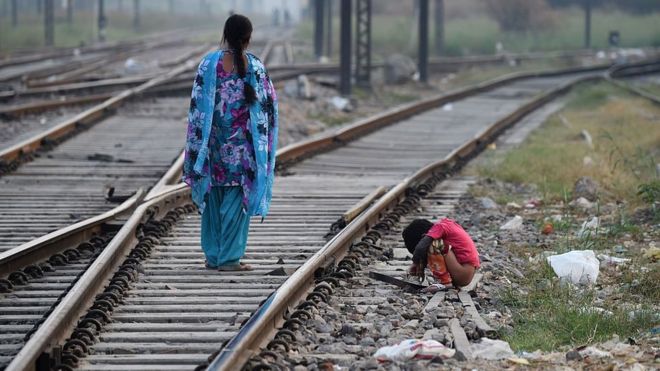 Image copyright GETTY IMAGES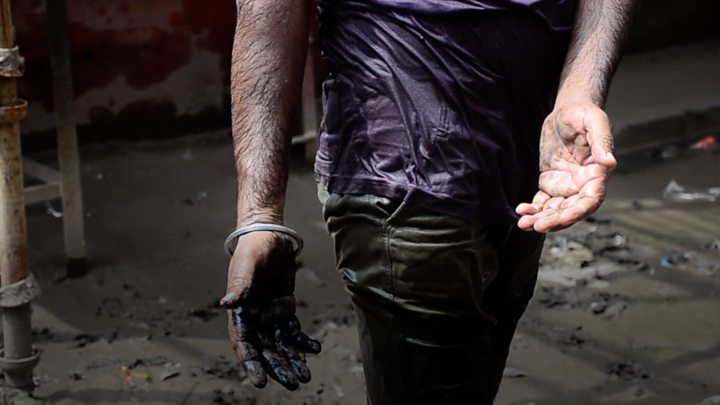







 CHINDIA ALERT: You'll be living in their world, very soon