Archive for ‘Social & cultural’

18/10/2019

Tens of thousands to run in New Delhi, one of the world’s most heavily polluted cities

NEW DELHI (Reuters) – Tens of thousands of runners have signed up for the Indian capital’s half marathon and other races on Sunday, officials said, despite the air quality hitting dangerous levels in one of the most heavily polluted cities in the world.

New Delhi’s air quality index was around 300 on Thursday, classified as very poor and meaning prolonged exposure can cause respiratory illness.

Delhi Chief Minister Arvind Kejriwal, who has described the city as a “gas chamber” in winter, has ordered emergency measures, including restricting the number of private vehicles on the roads under an “odd-even” scheme based on number plates.

Race organisers said pollution was a worry but they would take steps to reduce the impact on runners. Hours ahead of and throughout the race, the course will be sprayed with water.

“The air quality is a concern and will remain a concern, there is no question about it,” said Vivek Singh, joint managing director of Procam International that conducts the race sponsored by telecom operator Bharti Airtel.

“The measures that we take for those few hours to give our runners a good experience have worked in the past.”

The race has been moved this year to avoid a sharp rise in pollutants during Diwali, the Hindu festival of lights, when hundreds of thousands of firecrackers are lit.

But farmers burning crop stubble in the states north of Delhi have turned the air over Delhi toxic. The forecast for the next few days and into Sunday is “very poor”.

A record 40,633 people have signed up for the 21-km, 10-km and a 5-km races. Last year there were 34,916 runners, many of whom wore masks.

A former Olympic gold medallist, Carmelita Jeter of the United States, is the international event ambassador.

Doctors have advised citizens to restrict their outdoor activities and said runners must be made aware of the risks they are taking.

“Just two weeks before the odd-even scheme comes into play, how have the civic authorities allowed more than 30,000 people to expose themselves to toxic air?” asked said Desh Deepak, senior chest physician at the city’s Ram Manohar Lohia Hospital.

Source: Reuters

13/10/2019

Vice premier stresses education, healthcare for Greater Bay Area

BEIJING, Oct. 12 (Xinhua) — Chinese Vice Premier Sun Chunlan has called for efforts to boost social causes such as education and healthcare in south China’s Guangdong Province to better serve the Guangdong-Hong Kong-Macao Greater Bay Area.

Sun, also a member of the Political Bureau of the Communist Party of China Central Committee, made the remarks during a three-day research tour in Guangdong that ended Saturday.

She visited major higher education and medical institutions in the province and presided over a symposium in Shenzhen, asking local departments to make more specific policies and measures to serve the construction of the Greater Bay Area, enhance their coordination and help push the development of the area to a new level.

Sun urged efforts to optimize the structure of higher education of the Greater Bay Area and encouraged universities in Guangdong to open up their resources in scientific research to universities and research institutes in Hong Kong and Macao.

She also asked for further cooperation and exchanges of talent in medical care within the Greater Bay Area, better implementation of the policies that grant Hong Kong and Macao’s medical institutions and doctors access to the mainland, and deeper cooperation in traditional Chinese medicine.

Li Xi, a member of the Political Bureau of the CPC Central Committee and secretary of the CPC Guangdong Provincial Committee, attended the events along the tour.

Source: Xinhua

11/10/2019

Spotlight: Film, yoga, smartphone industries enhance China-India links

INDIA-CHINA-FILM-YOGA-SMARTPHONE

 People practice yoga at a park in New Delhi, India, June 21, 2019. TO GO WITH: Spotlight: Film, yoga, smartphone industries enhance China-India links (Xinhua/Zhang Naijie)

by Xinhua writers Chen Jian, Zhao Xu, Zhang Xingjun

CHENNAI, India, Oct. 11 (Xinhua) — “I would like to see a lot of collaboration between creative people from China and India, making stories that people from both countries would love to see,” said Bollywood star Aamir Khan before a film-promotion trip to China in early 2018.

As one of the most recognized Indian actors in China, Khan’s biographical sports film “Dangal” raked in nearly 1.3 billion yuan (190 million U.S. dollars) in the Chinese box office in 2017, making it the highest-grossing Indian film of all time in China.

Inspired by the real journey of an Indian wrestler, Khan acted the part of a strict father who turned his daughters into world-class athletes.

From “Dangal” and “Secret Superstar” to “Hichki” and “Thugs of Hindostan,” Bollywood hits have been immensely popular among Chinese moviegoers in recent years. Older generations were impressed by Indian films like “Awara” (1951) and “Caravan” (1971), which featured spectacular song-and-dance scenes.

Khan, who has visited China several times, said he felt Chinese and Indian people have many things in common. For example, both peoples attach great importance to family, he told Xinhua.

“Many people get to know a certain country through watching their movies. Through my work, quite a few foreign viewers start to know the sorrows and happiness of ordinary Indian people,” Khan said, adding that artists can help people with different cultural backgrounds understand each other.

Bollywood actress Rani Mukerji, whose Hindi comedy-drama film “Hichki” was screened in China last year, said Chinese audience watching her film with Chinese subtitles reacted similarly to Indian fans.

“You realize that you don’t have to know the language to connect with the film. I think that’s what makes movies so, so special … If the emotions are universal, it can connect anywhere,” she told Xinhua in an interview earlier this year.

In “Hichki,” Mukerji played the leading role of an aspiring teacher with Tourette Syndrome, who must prove herself by educating a group of underprivileged students.

Taking note of Bollywood’s developed industrial system and China’s huge film market, the Indian actress is also looking forward to India-China film co-productions.

“I am actually very keen to do India-China co-productions where I can be part of a Chinese film or Chinese actors can be part of Indian films,” she said.

YOGA IN CHINA

Before Yu Songsong, a young man from southwest China’s Guizhou Province, started to practice yoga, he knew little about India, where the practice originated.

Having spent the last six years learning yoga, he is attracted by the yoga culture and eager to travel to India.

Yu used to suffer from an emotional disorder. “It was yoga that turned me around. I was no longer lost. I’ve found a direction for my life,” he said.

Yu started to practice yoga when he was a freshman and became a vegetarian. “The physical and mental practices relieved me of psychological distress,” he said.

Through yoga, Yu is engaging in a comparative study in the philosophies of China and India, two ancient civilizations in the world.

“In the class, we discuss and compare the traditional Chinese theory that ‘man is an integral part of nature’ and the Indian idea that ‘the Buddha and I are one.’ Through this, we explore the similarities that underline the culture and civilizations of the two countries,” he said.

The China-India Yoga College, established at Kunming’s Yunnan Minzu University in June 2015, is China’s first yoga college. Fifty branches are planned to be opened in China’s major cities in the next three to five years, and are attracting batches of Indian yoga teachers to China, with 38-year-old Subbulakshmi Velusamy being one of them.

Velusamy arrived in Kunming in late 2015 and quickly adapted to the climate and life there. She said the local diet is light, which is very palatable to yoga practitioners and vegetarians.

Velusamy said teaching yoga in Yunnan was a wonderful experience as the Chinese people around her were very helpful and kind.

“They often chat with me after class and invite me to parties,” she told Xinhua in an earlier interview.

Velusamy said she was eager to learn about the ancient Chinese civilization. At the same time she introduced yoga to more Chinese as a unique and valuable Indian cultural asset.

Indian Prime Minister Narendra Modi has played a significant role in spreading yoga at home and abroad. He was instrumental in urging the United Nations to mark June 21 as International Yoga Day.

“Beyond exercise and health, yoga is about life, self-awareness and a connection with your soul. So I expect my students to understand their consciousness in today’s technologically-driven world,” said Rama Rathore, a yoga trainer in New Delhi.

CHINESE SMARTPHONE BRANDS

Smartphones are becoming easily available to everyone thanks to their affordable prices. With the exploding growth of Internet data usage and its access across the country, millions of Indians are now connected with the world thanks to their smartphones.

“It is the people’s window to the world and the growth opportunity in this sector is huge,” said Saifi Ali, a head researcher associated with a leading telecom operator located in Gurgaon on the outskirts of New Delhi.

“India has overtaken the United States in the smartphone market,” he said.

Meanwhile, Chinese smartphone brands, such as Xiaomi, Oppo and Vivo, have been successful in India’s fast growing market, according to global market research firm Canalys.

Xiaomi has been the leading smartphone brand in India for eight consecutive quarters, with a 28.3-percent market share for the second quarter of this year.

Xiaomi has become the first brand in India to sell more than 100 million smartphones within a span of five years, since the company began operations in the country in 2014.

Jobs and technical training provided by the Chinese companies have helped many Indian workers to enhance their technical skills and earn good money.

Neeraj Sharma, 25, is an Indian employee at MCM, a Noida-based Chinese company of smart terminal equipment. Sharma said he has learned a lot from the company and his technical skills have also improved.

“From here I started learning practical knowledge. Everything I know about the technology we are using here for SMT (Surface Mount Technology) and also in assembly is from this company. I started from the very lowest designation and right now I am working as a floor-in-charge there,” he told Xinhua in a recent interview.

Thanks to his stable income from MCM, Sharma, who is from the northern Uttar Pradesh state, has fulfilled his dream of buying a house in Noida, outside New Delhi.

“I came here, so at that time I had planned to buy a house here for my family. Right now I have already bought a small house. Maybe further in the future I will have a flat,” he said.

Source: Xinhua

09/10/2019

US imposes China visa restrictions over Uighur issue

Uighur protesters demonstrating in the US in FebruaryImage copyright GETTY IMAGES
Image caption Protests calling for Uighur freedom have been happening all year

The US has said it will impose visa restrictions on Chinese officials accused of involvement in repression of Muslim populations.

It follows the decision on Monday to blacklist 28 Chinese organisations linked by the US to allegations of abuse in the Xinjiang region.

US Secretary of State Mike Pompeo said the Chinese government had instituted “a highly repressive campaign”.

China has dismissed the allegations as groundless.

In a statement, Mr Pompeo accused the Chinese government of a string of abuses against Uighurs, ethnic Kazakhs, Kyrgyz Muslims and other minority Muslim groups.

These included “mass detentions in internment camps; pervasive, high-tech surveillance; draconian controls on expressions of cultural and religious identities; and coercion of individuals to return from abroad to an often perilous fate in China”.

China has rebuffed the US moves.

“There is no such thing as these so-called ‘human rights issues’ as claimed by the United States,” foreign ministry spokesman Geng Shuang said on Monday.

“These accusations are nothing more than an excuse for the United States to deliberately interfere in China’s internal affairs.”

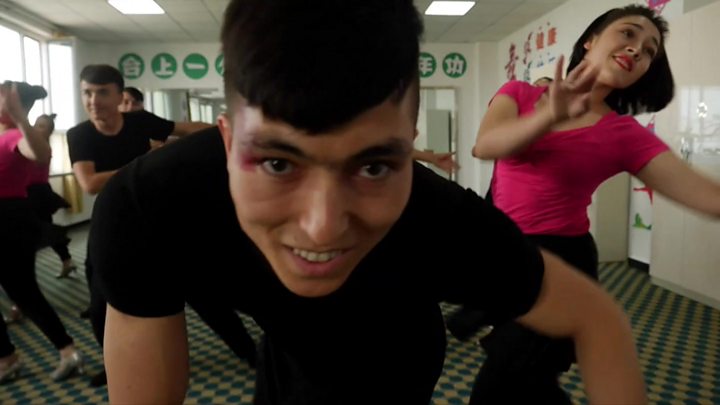
Media caption The BBC visits the camps where China’s Muslims have their “thoughts transformed”

Visa restrictions are to be imposed on Chinese government and Communist Party officials, as well as their family members.

“The United States calls on the People’s Republic of China to immediately end its campaign of repression in Xinjiang, release all those arbitrarily detained, and cease efforts to coerce members of Chinese Muslim minority groups residing abroad to return to China to face an uncertain fate,” the US statement said.

The US and China are currently embroiled in a trade war, and have sent delegations to Washington for a meeting about the tensions later this week.

What is the situation in Xinjiang?

China has been carrying out a massive security operation in Xinjiang, in its far west, in recent years.

Human rights groups and the UN say China has rounded up and detained more than a million Uighurs and other ethnic minorities in vast detention camps, where they are forced to renounce Islam, speak only in Mandarin Chinese and learn obedience to the communist government.

But China says they are attending “vocational training centres” which are giving them jobs and helping them integrate into Chinese society, in the name of preventing terrorism.

Media caption The BBC’s John Sudworth meets Uighur parents in Turkey who say their children are missing in China

There have been increasingly vocal denunciations from the US and other countries about China’s actions in Xinjiang.

Last week, Mr Pompeo alleged that China “demands its citizens worship government, not God” in a press conference in the Vatican.

And in July more than 20 countries at the UN Human Rights Council signed a joint letter criticising China’s treatment of the Uighurs and other Muslims.

Who are the Uighurs?

Uighurs are ethnically Turkic Muslims. They make up about 45% of the Xinjiang region’s population; 40% are Han Chinese.

China re-established control in 1949 after crushing short-lived state of East Turkestan.

Since then, there has been large-scale immigration of Han Chinese and Uighurs fear erosion of their culture.

Xinjiang is officially designated an autonomous region within China, like Tibet to its south.

Source: The BBC

07/10/2019

Aarey protests: Supreme Court steps in to save Mumbai trees after protests

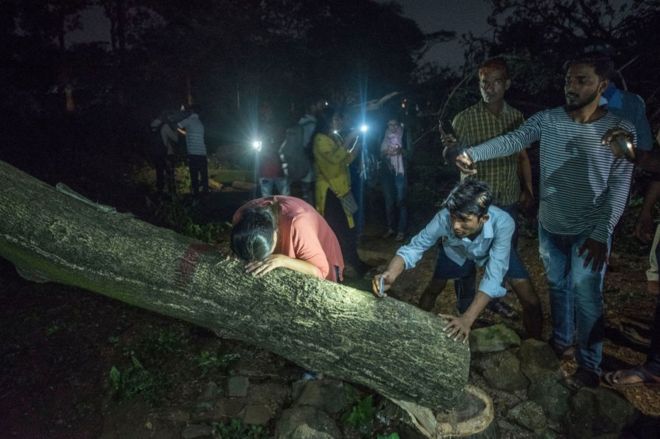
Protesters cry over felled trees in Aarey colony on October 5, 2019 in Mumbai, India.Image copyright GETTY IMAGES
Image caption Protesters cry over felled trees in Aarey colony

India’s top court has asked officials to stop cutting trees in a forested area in Mumbai city after protesters clashed with police over the weekend.

The trees, part of a green strip known as Aarey colony, were being cut to make way for a new metro rail project.

Locals have long opposed the move, and filed petitions seeking Aarey to be declared a protected area.

But a high court dismissed the petitions on Friday, sparking protests as officials began felling the trees.

They planned to cut 2,185 trees, and admitted in the Supreme Court that more than 1,500 had already been cut. But petitioners claim that officials have cut around 2,500 trees.

Local residents, students and environmental activists clashed with police on Friday as they took to the streets to stop authorities, and even broke through barricades to enter Aarey colony. More than 50 people were arrested and police imposed restrictions on public gatherings.

The protests grabbed the national spotlight over the weekend, and the Supreme Court took suo moto (without a formal complaint from any party) notice.

What did the Supreme Court say?

A special two-judge bench heard the matter on Monday after students wrote to the chief justice, asking the court to intervene and save the trees.

The court asked the state government of Maharashtra, where Mumbai is located, to not cut any more trees.

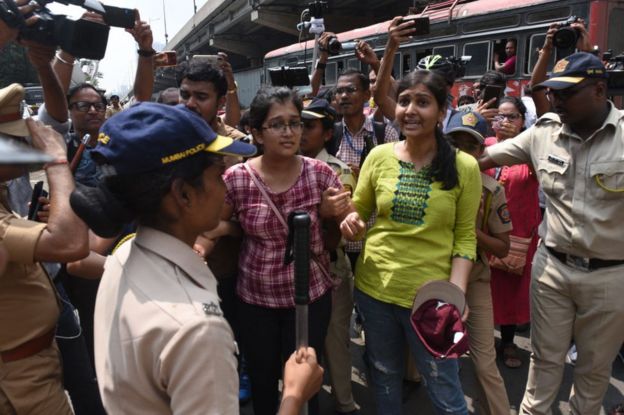
Activists were forcefully evacuated from Aarey Checknaka and taken to local Police Station at Goregaon, on October 5, 2019 in Mumbai, India.Image copyright GETTY IMAGES
Image caption Police arrested more than 50 protesters

The court also asked the government to maintain “status quo” – which means that no construction can take place – until 21 October when it will hear the matter again.

The court also ordered the release of all activists who were arrested or detained on bail.

What is Aarey colony?

Spread over 1,300 hectares (3,212 acres), Aarey is a densely forested area dotted with lakes and has the Mithi river flowing through it. It lies at the heart of Mumbai and is often referred to as its last green lung.

It’s locally known as the Aarey “milk colony” because most of the land was given to the department of dairy development in 1951. But they are allowed to grow cattle fodder only on a fraction of the land.

Activists break barricades to stop authorities from cutting at the main gate of Metro car shed , Picnic point, Aarey colony , Goregaon east, on October 5, 2019 in Mumbai.Image copyright GETTY IMAGES
Image caption Protesters broke through barricades and clashed with police on Friday

Earlier this year, officials cleared some 40 hectares of the forested area to build a zoo, complete with a night safari. And now, locals complain, another slice of it is in danger from the metro construction.

They also fear that the government will eventually clear the way for private builders to encroach on the Sanjay Gandhi National Park, which lies to the north of Aarey colony.

Officials, however, dismiss these fears as unfounded and point out that the construction for the metro only requires 30 hectares.

How crucial is the metro rail for Mumbai?

The city badly needs a “mass rapid transport system,” Ashwini Bhide, managing director of the Mumbai metro rail corporation, had told the BBC earlier.

The land in Aarey colony, she said, was “the most suitable land due to its size, shape and location”.

She has also been defending the decision to cut the trees on Twitter.

Presentational white space

India’s financial hub is congested and infamous for its crawling traffic jams.

Its colonial-era local train system ferries some 7.5 million people between the city’s suburbs and its centre on a daily basis.

Officials say that the metro will eventually carry around 1.7 million passengers every day and bring down the number of vehicles on the road by up to 650,000.

Source: The BBC

06/10/2019

Xinhua Headlines: China’s Greater Bay Area busy laying foundation for innovation

As China aims to develop its Greater Bay Area into an international innovation and technology hub, innovation and entrepreneurship resources are shared in the area to provide more opportunities for young Hong Kong and Macao entrepreneurs.

The provincial government of Guangdong has stepped up efforts to improve basic research capability, considered the backbone of an international innovation and technology hub, by building large scientific installations and launching provincial labs.

by Xinhua writers Liu Yiwei, Quan Xiaoshu, Wang Pan, Jing Huaiqiao

GUANGZHOU, Oct. 5 (Xinhua) — Hong Kong man Andy Ng was surprised his shared workspace Timetable was rented out completely only six months after it had started operation in Guangzhou, capital of south China’s Guangdong Province.

While studying economics at City University of Hong Kong, Ng set up his first business, developing an online education platform, but soon realized the Hong Kong market was too small. After earning a master’s degree in the UK in 2017, Ng returned to China and chose Guangzhou as his new base.

Timetable is now accumulating popularity and even fans in Dianping.com, China’s major online consumer guide. Ng feels lucky that his business caught the implementation of the Guangdong-Hong Kong-Macao Greater Bay Area (GBA) development plan.

The bay area, covering 56,000 square km, comprises Hong Kong and Macao, as well as nine cities in Guangdong. It had a combined population of about 70 million at the end of 2017, and is one of the most open and dynamic regions in China.

Aerial photo taken on July 11, 2018 shows the Hong Kong-Zhuhai-Macao Bridge in south China. (Xinhua/Liang Xu)

In July 2017, a framework agreement on the development of the bay area was signed. On February 18 this year, China issued the more specific Outline Development Plan for the Guangdong-Hong Kong-Macao Greater Bay Area. One of its major aims is to develop the area into an international innovation and technology hub.

OPPORTUNITIES FOR YOUTH

The plan proposes that innovation and entrepreneurship resources be shared in the bay area to provide more opportunities for young Hong Kong and Macao entrepreneurs.

An incubator for entrepreneurship, Timetable is home to 52 companies, including 15 from Hong Kong and Macao, such as Redspots, a virtual reality company that won the Hong Kong Information and Communications Technology (ICT) Awards 2019.

“I persuaded them one by one to come here,” Ng said. “I told them of my own experience that the GBA is a great stage for starting a business with ever-upgrading technologies, ever-changing consumer tastes and a population 10 times that of Hong Kong.”

Timetable is a startup base of the Guangzhou Tianhe Hong Kong and Macao Youth Association, which has assisted 65 enterprises founded by Hong Kong and Macao young people since its establishment in October 2017.

The association and its four bases provide a package of services from training and registering to policy and legal consultation, said Chen Jingzhan, one of the association founders.

Tong Yat, a young Macao man who teaches children programming, is grateful the association encouraged him to come to Guangdong, where young people enjoy more preferential policies to start their own businesses.

“The GBA development not only benefits us, but paves the way for the next generation,” Tong said. “If one of my students were to become a tech tycoon in the future and tell others that his first science and technology teacher was me, I would think it all worthwhile.”

In the first quarter of this year, there were more than 980 science and technology business incubators in Guangdong, including more than 50 for young people from Hong Kong and Macao, said Wu Hanrong, an official with the Department of Science and Technology of Guangdong Province.

INNOVATION HIGHLAND

As the young entrepreneurs create a bustling innovative atmosphere, the Guangdong government has stepped up efforts to improve basic research capability, considered the backbone of an international innovation and technology hub, by building large scientific installations and launching provincial labs.

Several large scientific facilities have settled in Guangdong. China Spallation Neutron Source (CSNS) operates in Dongguan City; a neutrino observatory is under construction in Jiangmen City; a high intensity heavy-ion accelerator is being built in Huizhou City.

Aerial photo taken on June 23, 2019 shows the construction site of the Jiangmen Underground Neutrino Observatory (JUNO) in Jiangmen, south China’s Guangdong Province. (Xinhua/Liu Dawei)

Guangdong also plans to build about 10 provincial labs, covering regenerative medicine, materials, advanced manufacturing, next-generation network communications, chemical and fine chemicals, marine research and other areas, said Zhang Yan, of the provincial department of science and technology.

Unlike traditional universities or research institutions, the provincial labs enjoy a high degree of autonomy in policy and spending. A market-oriented salary system allows them to recruit talent from all over the world, and researchers from other domestic organizations can work for the laboratories without giving up their original jobs, Zhang said.

The labs are also open to professionals from Hong Kong and Macao. Research teams from the universities of the two special administrative regions have been involved in many of the key programs, Zhang said.

For example, the provincial lab of regenerative medicine and health has jointly established a regenerative medicine research institute with the Chinese University of Hong Kong, a heart research center with the University of Hong Kong, and a neuroscience research center with the Hong Kong University of Science and Technology (HKUST).

Photo taken on July 24, 2019 shows a rapid cycling synchrotron at the China Spallation Neutron Source (CSNS) in Dongguan, south China’s Guangdong Province. (Xinhua/Liu Dawei)

Guangdong has been trying to break down institutional barriers to help cooperation, encouraging Hong Kong and Macao research institutions to participate in provincial research programs, exploring the cross-border use of provincial government-sponsored research funds, and shielding Hong Kong researchers in Guangdong from higher mainland taxes.

NANSHA FOCUS

Located at the center of the bay area, Guangzhou’s Nansha District is designed as the national economic and technological development zone and national free trade zone, and is an important pivot in building the area into an international innovation and technology hub.

The construction of a science park covering about 200 hectares started on Sept. 26. Gong Shangyun, an official with the Nansha government, said the park will be completed in 2022.

Jointly built by the Guangzhou government and the Chinese Academy of Sciences (CAS), the science park will accommodate CAS research institutes from around Guangzhou, including the South China Sea Institute of Oceanology, the South China Botanical Garden (SCBG) and the Guangzhou Institute of Energy Conversion.

Ren Hai, director of the SCBG, is looking forward to expanding the research platforms in Nansha. “We will build a new economic plant platform serving the green development of the Pearl River Delta, a new botanical garden open to the public, and promote the establishment of the GBA botanical garden union.”

Wang Ying, a researcher with the SCBG, said the union will help deepen the long cooperation among its members and improve scientific research, science popularization and ecological protection. “Predecessors of our botanical garden have helped the Hong Kong and Macao counterparts gradually establish their regional flora since the 1950s and 1960s.”

HKUST also started to build a new campus in Nansha the same day as the science park broke ground. “Located next to the high-speed rail station, the Guangzhou campus is only a 30-minute journey from the Hong Kong campus. A delegation from the HKUST once paid a visit to the site and found it very convenient to work here,” Gong said.

Chief Executive of the Hong Kong Special Administrative Region (HKSAR) Carrie Lam hoped the new campus would help create a new chapter for the exchanges and cooperation on higher education between Guangzhou and Hong Kong, and cultivate more talents with innovative capabilities.

Nansha’s layout is a miniature of the provincial blueprint for an emerging international innovation and technology hub.

“We are seeking partnership with other leading domestic research institutions and encouraging universities from Hong Kong and Macao to set up R&D institutions in Guangdong,” said Zhang Kaisheng, an official with the provincial department of science and technology.

“We are much busier now, because research institutes at home and abroad come to talk about collaboration every week. The GBA is a rising attraction to global scientific researchers,” Zhang said.

Source: Xinhua

03/10/2019

Discover China: Run-down house finds new life as deluxe hotel

FUZHOU, Oct. 3 (Xinhua) — Zheng Yangmei, 35, has mixed feelings about working as a receptionist in her childhood home, a 400-year-old country lodge that has been adapted into a luxury hotel in southeast China’s Fujian Province.

The new profession gives her a different angle to perceive the beauty of the ancestral house built sustaining Tang Dynasty (618-907) architecture style, as experts marveled.

The restoration is beyond her family clan’s imagination, which keeps the historic details of the dilapidated residence as much as possible, while replacing the interior with modern decor suitable for comfortable living.

The place of a stinky hog pen in the yard, which Zheng remembers, is turned into a tea pavilion decorated with a neutral color palette. But the lodge is still roughly what she remembers, wood carvings, stone mills and the grey-tile roofs.

Tucked away in the idyllic village of Banding, an hour’s drive north of Fuzhou, the provincial capital, the old house offers a breathtaking view in the backdrop of lush mountains and a vast expanse of paddy fields.

Named “Sanluocuo,” or three juxtaposed houses, the wood and stone complex covers an area of 3,000 square meters and consists of over 200 dark shabby rooms, where Zheng spent part of her childhood life bunking with her parents and two siblings in a 25-square-meter room.

Since the mid 16th century, it has been held by the extended Zheng family clan. Zheng remembers that there were over 200 members living in the houses when she was there.

“There was no toilet, no tap water in each house,” said Zheng, whose family moved out of the aged buildings when she was 8, as they could no longer fix the house. Instead, they built new two-story brick houses 1,000 meters away.

The old buildings were completely abandoned by all the villagers in the early 2000s, Zheng recalled.

She left the village for college study at the age of 19 and then worked as a vet in several pig farms in more prosperous towns, until 2013 when she got married and returned to the village to raise her kids.

“Villagers seldom went back to the buildings, considering the place pretty spooky, with filthy water, messy electric wires hung in the air like spider webs and cracks on walls,” said Zheng, a mother of two daughters.

Elders of the family clan called on the clan members to raise funds to fix leaky roof tiles, control termites, and straighten leaning walls to prevent the ancestral houses from completely collapsing, but nobody would imagine it can be fixed in a way that the hotel developer later did.

With the local government-initiated plan for preserving ancient folk houses, a property company came in investing 150 million yuan (20.98 million U.S. dollars) to rehab the obsolete buildings.

After two years of reconstruction, “Sanluocuo” was turned into a trendy boutique hotel with centuries-old wooden beams, garden-like atriums, earthen walls and contemporary luxury.

The transformative creation of “Sanluocuo” is among the artworks selected for the China Pavilion overseas show at the ongoing Biennale de Curitiba 2019 in Brazil, as a model for “building a future countryside.”

“We actually leased the complex from the villagers for the renovation. The old rooms were very small. So we converted the original 200 cramped rooms into 40 guest rooms to make them comfortable for living, but we pay the rents based on 200 rooms to the villagers,” said Zhang Yiwen, operations manager of the project.

Targeted at high-flown customers, the hotel rooms in “Sanluocuo” are priced on average at over 600 yuan per night even in the off season.

Visitors can touch the original wood pillars with deep cracks, and decayed rammed-earth walls with weeds, while enjoying hot bath and clean toilets with heated seats inside each room.

The hall that used to house the Zheng family shrine and warehouses have been converted to galleries, restaurants, bars and stores attached to the hotel, which help the village unleash its cultural potential, and once again become a place that villagers like hanging around in leisure time.

The project has triggered an online sensation, after visitors post their travel photos inside the hotel, showing off their cultural and stylish taste on social media.

Zhang said weeks ahead of the National Day holiday, all of the 40 rooms were booked out.

Zheng and 30 other villagers are employed in the hotel, which has also sparked an entrepreneurial enthusiasm in the village. Zhang said the hotel is willing to help villagers open small inns, eateries and stores selling souvenirs and local delicacies, to further improve the village’s tourist potential.

Zhang said the real estate developer of “Sanluocuo,” Land Shine, has leased two more clusters of such old residence from a neighboring village, as folks bear wishes that their obsolete ancestry complex could shine as well as “Sanluocuo.”

Source: Xinhua

03/10/2019

As protests rack Hong Kong, China watchdog has Cathay staff ‘walking on eggshells’

HONG KONG (Reuters) – Staff at Cathay Pacific Airways, Hong Kong’s flagship airline, are on edge.

A Cathay Pacific Boeing 777-300ER plane lands at Hong Kong airport after it reopened following clashes between police and protesters, in Hong Kong, China August 14, 2019. REUTERS/Thomas Peter
Their city has been gripped by months of anti-government protests, and their company is feeling the wrath of China’s aviation regulator after some staff members took part or expressed support.
Since an Aug.9 directive by the Civil Aviation Authority of China (CAAC) that called for the suspension of staff who supported or participated in the demonstrations, the regulator has rejected some entire crew lists without explanation, two sources with knowledge of the matter told Reuters.
The rejections have forced Cathay to scramble, pulling pilots and flight attendants off standby while it investigates social media accounts in an effort to determine which crew member has been deemed a security threat, one of the sources said.
Other disruptions have come in the form of a huge jump in the number of plane inspections upon landing, four pilots said.
The flexing of regulatory muscle has contributed to a climate of fear within the airline, with employees telling Reuters they felt Cathay’s longer-term future as an independent company was highly uncertain and subject to Beijing’s whims.
The CAAC’s labelling of employees who support the protest as a security risk and its demand that they be suspended from flying over mainland airspace has been a de facto career killer.
Around three quarters of Cathay flights use mainland airspace and due to the directive, 30 rank-and-file staff, including eight pilots and 18 flight attendants, have been fired or resigned under pressure, according to the Hong Kong Cabin Crew Federation.
Cathay CEO Rupert Hogg and his top deputy also resigned in August amid the mounting regulatory scrutiny on the 73-year-old airline, one of the region’s most high-profile brands that draws on Hong Kong’s British heritage.
“Things changed very quickly,” said Jeremy Tam, a pro-democracy lawmaker and pilot who resigned from the airline after the CAAC directive, likening the atmosphere to a political trial. “The threat is huge and it’s almost like zero to 100 in two seconds.”
Reuters talked to 14 current and former employees for this article. Nearly all declined to be identified for fear of being fired or due to the sensitivity of the matter.
The CAAC did not respond Reuters requests for comment on the rejections of crew lists or the increase in plane checks.Cathay said in a statement it must comply with all regulatory requirements. “Quite simply, this is our licence to operate; there is no ground for compromise,” it said.
The airline declined to comment on the number of employee departures, but said any terminations took into account factors such as a person’s ability to perform their role.

DEMERIT SYSTEM

Aviation regulators around the world conduct occasional plane inspections at airports to ensure an airline is in compliance with safety regulations.

But after the CAAC’s Aug. 9 directive, the once-infrequent inspections occurred almost daily and included the new and unusual step of checking phones owned by crew for anti-China photos and messages, the pilots said, adding that this had led to flight delays.

The step-up in checks has increased the likelihood of regulators finding minor issues to write up, which pilots said had included dirt on the plane’s exterior and scratches on a fire extinguisher.

Infractions can have outsized consequences under the CAAC’s strict demerit points system, they said, noting the regulator could force Cathay to reduce its number of flights, cut destinations or in a worst-case scenario, revoke the airline’s right to fly to mainland China.

Management has urged staff to do their utmost to avoid infractions.

“It is nothing less than the survival of the airline at stake,” said a senior employee. “Management have made that abundantly clear at meetings.”

Executives are particularly sensitive after seven incidents outside mainland China in the past two months in which pre-flight checks found emergency oxygen bottles for crew were depleted.

The CAAC is more public than many regulatory peers about disclosing safety violations, warnings and punishments.

In 2017, Emirates was banned from expanding its operations for six months following two safety incidents, while flag carrier Air China Ltd was ordered last year to cut Boeing Co 737 flights by 10% after an emergency descent linked to a pilot smoking an e-cigarette in the cockpit.

Cathay declined to provide information on its points under the CAAC system but said it wanted to emphasise that there had been no impact on its flight services into mainland China.

The pilots said the high frequency of airplane checks, which one described as “very intimidatory”, was starting to recede.

A THOUSAND CUTS

Employees are also feeling pressure from other regulatory bodies.

Last week, ahead of China’s National Day on Oct.1, immigration officers at some mainland airports requested photos of crew with the Chinese flag, said a pilot at regional arm Cathay Dragon who flies to the mainland regularly.

He said to his knowledge, most pilots – many of whom are expats from Western countries – had refused but Hong Kong cabin crew were “too nervous to say no” given the scrutiny on their actions by the company and the Chinese government.
“Everyone is walking on eggshells in China,” the pilot said.
Cathay did not respond to a request for comment, while China’s Ministry of Public Security, which oversees immigration, did not respond to a request for comment during a week of public holidays.
There has been no let-up in the widespread, sometimes violent, unrest that has beset Hong Kong. Triggered by a now-withdrawn extradition bill, it has morphed into an outpouring of opposition to the former British colony’s Beijing-backed government.

The crisis has also meant a sharp drop in travel demand to Hong Kong, putting more pressure on Cathay.

Cathay’s overall passenger numbers were down 11.3% in August. Flights at Cathay Dragon, which does most of Cathay’s mainland flying, were on average 60-65% full in September, down from the usual 80%, according to estimates from two pilots.

The pilots said while the sharp drop in demand was in some ways similar in scale to that weathered by Cathay during the SARS epidemic and the global financial crisis, there were key differences that felt more threatening to the company’s future.

Some state-controlled firms such as China CITIC Bank International and Huarong International have told employees to avoid flying with Cathay, and it has been attacked by Chinese state news organisations as well as by many mainland consumers on social media.

CAAC’s Aug.9 statement which called staff who supported the protests a security risk has also put Cathay’s reputation as one of the world’s safest airlines under a cloud it does not deserve, employees said.

Many acknowledged the new management team, which oversees around 33,000 employees, has few palatable options in dealing with the situation given the sway Beijing holds over the airline’s operations.

But they lamented the loss of freedom of speech and sense of job security, saying employees are afraid to speak about anything even vaguely political or voice support for protests on social media for fear of being reported by colleagues under a whistleblower policy.

“It has become a Hong Kong company with mainland employment terms,” a pilot at Cathay Dragon said. “The risk is death by a thousand cuts.”

Source: Reuters

02/10/2019

Commentary: New China turns 70, witnessing a golden age

BEIJING, Oct. 2 (Xinhua) — While turning 70 often signals the beginning of a person’s twilight years, for the People’s Republic of China (PRC) it marks a golden age full of hope and vigor.

The PRC celebrated its 70th birthday on Oct. 1. China’s transformation from an agricultural society isolated from the West into the world’s second-largest economy open wide is nothing short of a miracle.

More importantly, it has charted a new path for developing countries to modernize.

Seven decades ago, the war-ravaged country started from scratch. Observers are astonished at China’s large-scale modernization, its reduction of the number of people living in poverty and the sheer volume of its consumer market. Their heads have been turned not only because of the speed of the transition but also by the unique path taken to realize this great transformation.

Reflecting on its past and present, and through experimentation, China has identified and will continue down the right path — socialism with Chinese characteristics.

Reform is the engine of China’s miracle. There is no ready-made solution for the development issues facing China. From creating special economic zones to building free trade pilot zones, from carrying out family-based production contracts to revitalizing state-owned enterprises, China has been one of the most successful countries in piloting reforms over the past decades. Now the reform is more in-depth and more comprehensive in economic, political, cultural, social and ecological sectors.

The Chinese government stresses being effective and responsive to the public interest. Development outlines are far-sighted. For example, the five-year plans are made to deal with comprehensive aspects that concern human development: food, transportation, communication, environment, health and education. These plans are a priority for the government.

Of course these achievements could never have been realized without the leadership of the CPC.

From the people and for the people, the CPC has always upheld its principle of striving for the happiness of the people and the rejuvenation of the nation.

At a life-or-death moment, the CPC shouldered the mission of saving the nation from existential peril. After 28 years of bloody struggle, it led the Chinese people to overthrow the “three mountains” placed on their heads and put an end to the semi-colonial and semi-feudal society of old China. Gone are the days where any attempt to bully China with “fists” or “intimidation” would succeed.

Despite overseas doubts, misunderstandings and predictions that its survival would be short-lived, the CPC has stunned the world with its leadership, innovative theories and ability to unite and organize the people.

It abolished the agricultural tax that had been in place for more than 2,600 years; it established a political system in which people are masters of their own affairs; it did its utmost to help people shake off poverty and keep nearly 1.4 billion people well-off.

No ruling party in the world can match the CPC’s record of adhering to the truth, versing itself in self-reform and self-purification, and turning impossibility into certainty in the face of difficulties and challenges, again and again.

The 70-year journey was never smooth. Trials and hardships abounded. The Chinese people dealt with floods and massive earthquakes and guarded against SARS and financial tsunamis. Yet these twists and turns never blocked China’s way forward but made it more sober, determined and mature.

Today, more than at any other time in history, China is closer to, more confident and more capable of achieving the great rejuvenation of the Chinese nation. However, lofty goals are never easily reached.

The world has been undergoing tremendous changes unseen in a century. Resistant external forces and headwinds still remain. “Zero-sum game” and “superior civilization” mentalities, among others, are prevailing.

The CPC will continue to lead the Chinese people to fight trade bullying, blackmailing and hegemonism. Only the CPC can lead China to emerge as a stronger country.

It all started long ago, and the journey is far from over.

Source: Xinhua

01/10/2019

Military advances and Xi Jinping’s supreme status among the themes as Beijing celebrates National Day

  • 70th anniversary of the founding of the People’s Republic of China marked by its biggest ever military parade and huge civilian parade
  • Xi says no force can stop China ‘marching forward’ and vows to protect the long-term stability of Hong Kong
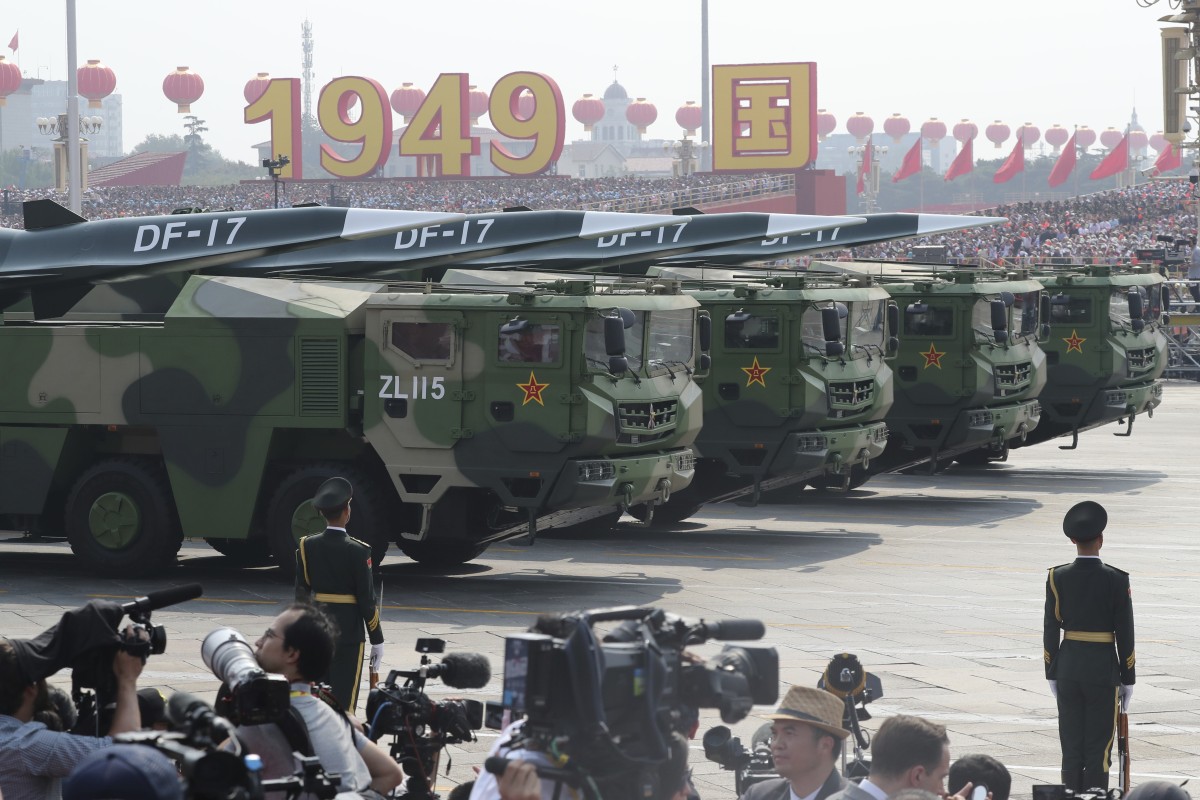
Military vehicles carry DF-17 missiles capable of reaching the US mainland during the parade to mark 70 years of the People’s Republic. Photo: AP
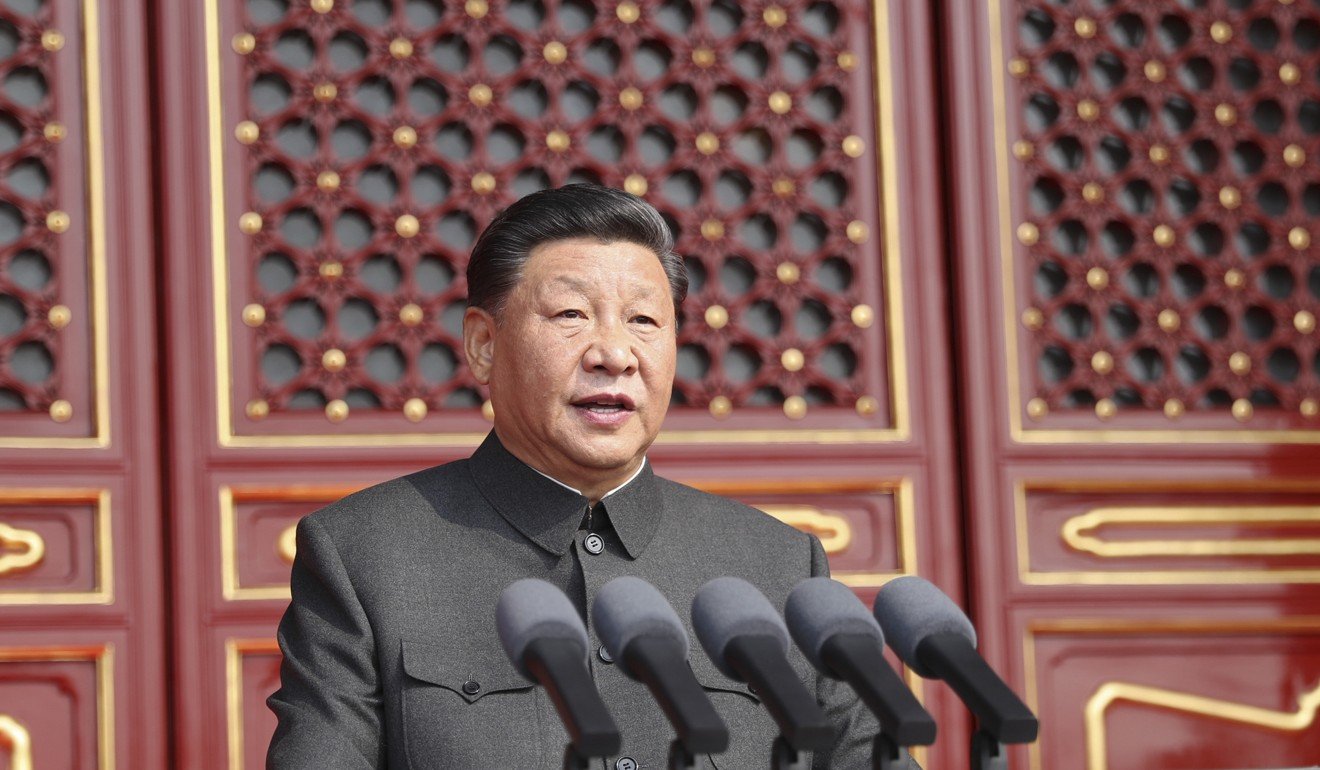
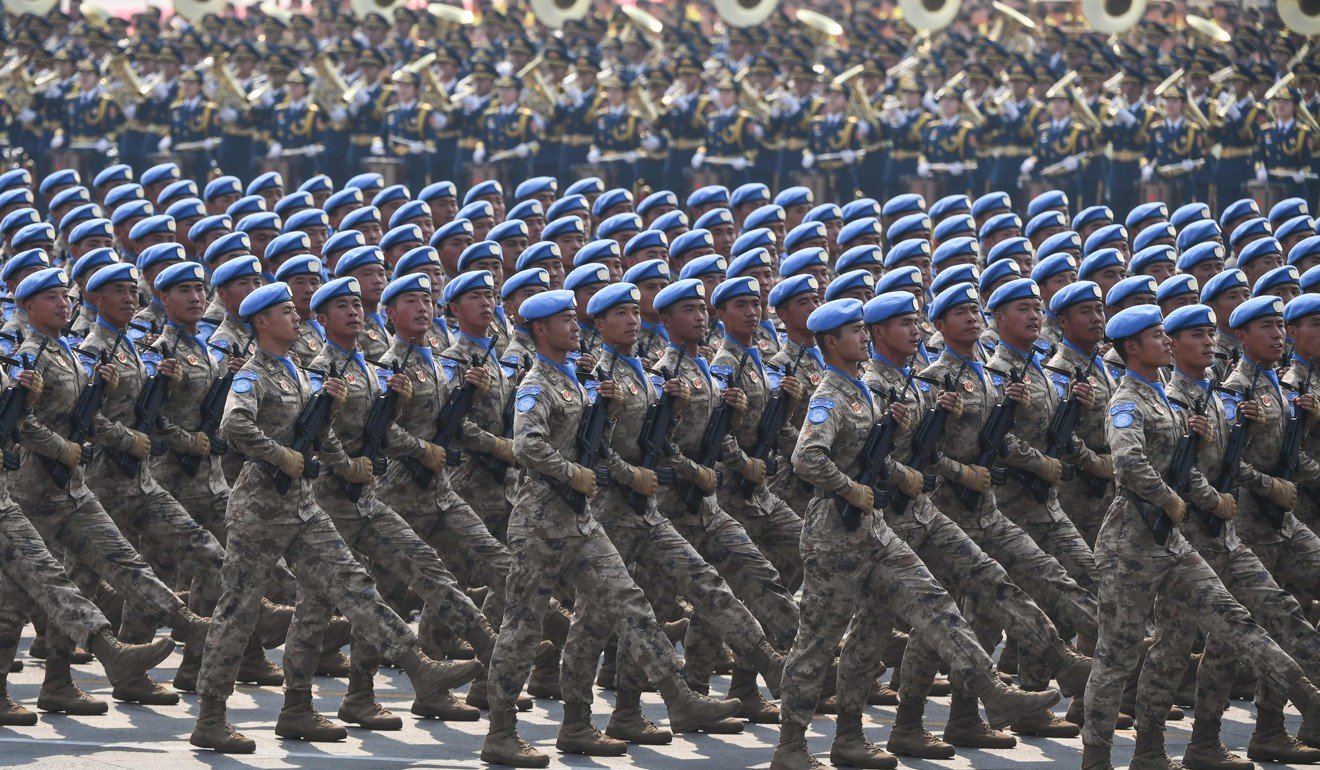
China staged a massive military parade in Beijing on Tuesday to mark the 70th anniversary of the founding of the People’s Republic, with much of the smog-shrouded capital city under a security lockdown.
President Xi Jinping inspected over 15,000 troops, more than 160 aircraft and 580 weapon systems in a show of the country’s growing military might and his drive to modernise the People’s Liberation Army.
He also delivered a bullish eight-minute speech hailing the accomplishments of seven decades of Communist rule and pledging to achieve his vision of a “Chinese dream” of national rejuvenation and global prominence.

Here are some of the key takeaways from a day of celebration in Beijing:

A show of unity

Xi presided over the ceremony in Tiananmen Square flanked by his predecessors Jiang Zemin and Hu Jintao, along with other retired and present party elders.

The rare appearance of Jiang and Hu – on the rostrum of the Gate of Heavenly Peace, where the country’s founding father Mao Zedong declared Communist rule on October 1, 1949 – was clearly aimed at projecting unity and solidarity in the face of daunting domestic and international challenges.

China’s National Day parade, as it happened
Hu had been absent from the funeral of former premier Li Peng in late July, although the ailing Jiang attended.

Former vice-president Zeng Qinghong and Song Ping, the oldest party elder in attendance, also appeared on the rostrum.

President Xi Jinping speaks in Tiananmen Square during Tuesday’s celebrations. Photo: Xinhua

But notably, while former premier Wen Jiabao was present, his predecessor Zhu Rongji was not.

‘No force can shake China’

Dressed in a Mao suit, Xi’s nationally televised speech invoked China’s “century of humiliation” and praised the achievements of its people, saying there was no force that could stop it forging ahead.

“No force can shake the status of our great motherland, and no force can stop the Chinese people and the Chinese nation from marching forward,” he said.

Chinese troops take part in the Republic’s largest ever military parade. Photo: AFP
“The People’s Liberation Army [PLA] will serve its purpose in safeguarding the sovereignty, security and development interests of the country, and world peace,” he said, at a time when Beijing has expanded its military footprint globally, including with its first overseas military base in Djibouti.
Xi called on the Communist Party and the country to unite and continue to fight for the realisation of what he called the “Chinese dream” – the nation’s rejuvenation.
One country, two systems
Amid escalating unrest in Hong Kong, which has plunged the city into a deepening crisis and threatened to overshadow the National Day celebrations, Xi vowed that the central government would uphold “one country, two systems”.
He said the central government would protect the long-term stability of Hong Kong and Macau, and stressed the goal of “peaceful reunification” with the self-ruling Taiwan, repeating a message frequently used by his predecessors, including Deng Xiaoping, Jiang and Hu.

The theme of one country, two systems later appeared in a National Day parade for the first time, with placards forming the words: “Hong Kong’s tomorrow will be better.”

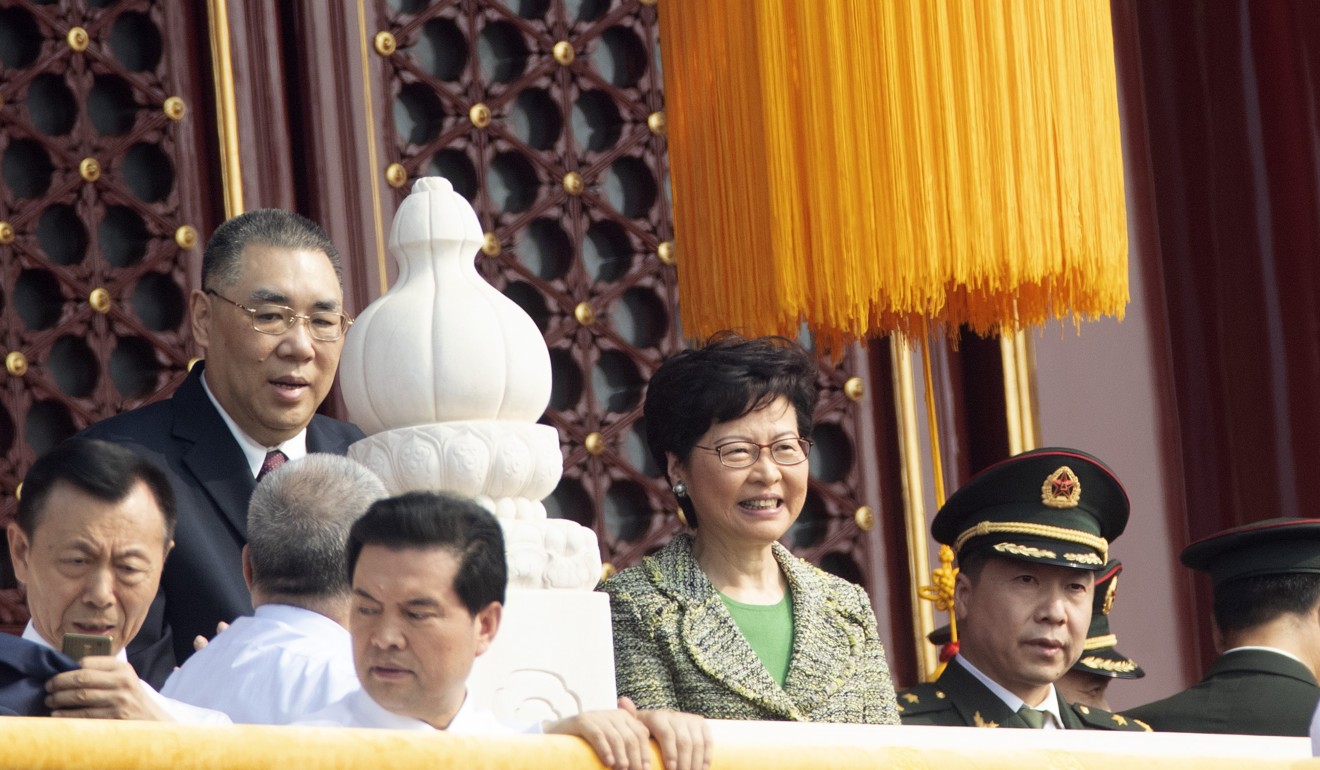
Hong Kong Chief Executive Cheng Yuet-ngor attended the ceremony, as did 10 Hong Kong police officers involved in suppressing anti-government protests in the city.
Showing off new weapons
China’s advancement in military weaponry was on full display, with almost half of the items featured being shown to the public for the first time.
Hong Kong leader Carrie Lam was among the guests in Beijing on Tuesday. Photo: AP

The morning’s celebrations included an 80-minute military parade – the biggest since the founding of the People’s Republic – in an apparent effort to showcase the prowess of the PLA, the world’s biggest military with 2 million personnel.

Among the weapons shown were DF series missiles, including the DF-17, a nuclear-capable glider that has the capacity to strike the US mainland, and the DF-41, which has a range of up to 15,000km, making it the world’s longest-range military missile.

Signalling Xi’s status

A 100,000-strong civilian parade featuring huge portraits of Xi and predecessors including Mao, Deng, Jiang and Hu wrapped up the morning celebration.

The procession was divided into three parts, representing three eras of the People’s Republic: the Mao era, Deng’s reform and opening up, and Xi’s era, which seeks global prominence on a par with that of the United States.

Xi appeared keen to project his supreme status in the party, reinforced since he abolished the constitutional term limit a year ago, allowing him potentially to remain leader for life.

He waved at his own portrait, unveiled alongside a sign reading “Carry out Xi Jinping Thought on Socialism with Chinese Characteristics for a New Era”.

Source: SCMP

Law of Unintended Consequences

continuously updated blog about China & India

ChiaHou's Book Reviews

continuously updated blog about China & India

What's wrong with the world; and its economy

continuously updated blog about China & India