Archive for ‘space programme’

28/09/2019

China restores ties with Kiribati, site of space tracking station

NEW YORK (Reuters) – China and the Pacific island state of Kiribati restored diplomatic ties on Friday after the former diplomatic ally of Taiwan abandoned Taipei.

A poor but strategic country which is home to a mothballed Chinese space tracking station, Kiribati announced last week that it was cutting relations with self-ruled Taiwan in favour of China, which claims Taiwan as a wayward province with no right to state-to-state ties.

China and Kiribati had ties until 2003, when Tarawa established relations with Taipei, causing China to break off diplomatic relations.

Up until that time, China had operated a space tracking station in Kiribati, which played a role in tracking China’s first manned space flight.

The Chinese government’s top diplomat State Councillor Wang Yi and Kiribati’s President Taneti Maamau signed a communique on restoring diplomatic relations at the Chinese mission to the United Nations in New York.

“We highly prize this important and the correct decision,” Wang told a news conference. “Let’s hope for our friendship to last forever. We will work together to grow together towards a bright and prosperous future.”

Speaking alongside Wang, Maamau said there was much to learn from China.

“I do believe that there is much to learn and gain from the People’s Republic of China and the re-establishment of our diplomatic relations is just the beginning,” he said.

There was no mention of the space tracking station at the news conference, nor in the joint communique between the two countries released by China’s Foreign Ministry.

China’s space programme is overseen by the military.

China’s Defence Ministry this week declined comment on the Kiribati facility.

Last week was difficult for Taiwan, as the Solomon Islands also ditched it for Beijing. The Solomon Islands foreign minister signed a deal on diplomatic ties in China last Saturday.

Both the Solomon Islands and Kiribati are small developing nations but lie in strategic waters that have been dominated by the United States and its allies since World War Two. China’s moves to expand its influence in the Pacific have angered Washington.

A former Taiwanese ambassador to Kiribati, Abraham Chu, told Taiwan’s Central News Agency last weekend that China had never fully removed the tracking station in Kiribati and that it “could come back at any time”.

Taiwan now has formal relations with just 15 countries, mostly small and poor nations in Latin America and the Pacific, including Nauru, Tuvalu and Palau. China has signalled it is coming for the rest of Taiwan’s allies.

Source: Reuters
07/09/2019

Chandrayaan-2: Modi proud despite Moon landing setback

Indian Prime Minister Narendra Modi told his country’s space scientists he was proud of a programme that had come so near to putting a probe on the Moon.

Contact with Chandrayaan-2 was lost moments before its Vikram module was due to touch down at the lunar south pole.

The fate of the craft is not yet known, but Mr Modi said there would be further opportunities.

India would have been the fourth nation to make a soft landing on the Moon.

“The best is yet to come in our space programme. India is with you,” said Mr Modi.

The Chandrayaan-2 approached the Moon as normal until an error occurred about 2.1km (1.3 miles) from the surface, officials said.

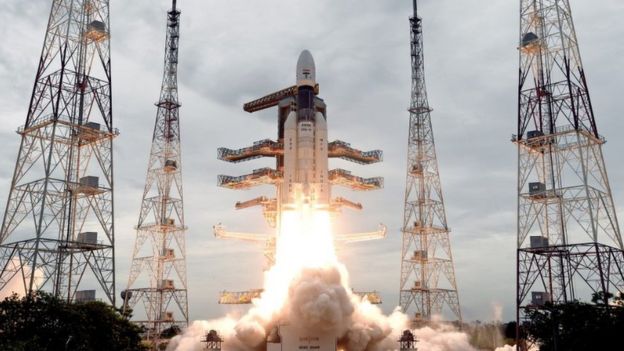
Chandrayaan-2 taking offImage copyright ISRO
Image caption The mission’s lift-off was broadcast live to an audience of hundreds of millions

India’s Space Research Organization (Isro) said it lost contact seconds before the ship was expected to land.

The country’s first Moon mission – Chandrayaan-1, in 2008 – carried out the first and most detailed search for water on the lunar surface using radars.

What happened?

Chandrayaan-2 entered the Moon’s orbit on 20 August and was due to make a controlled descent to the surface early on Saturday, Indian time, over a month after it first took off.

Staff at mission control were glued to the screens at Isro’s Bangalore space centre as the spacecraft made its descent towards the surface.

The control room burst into applause during the so-called rough breaking phase of the descent, with Prime Minister Modi watching the action from behind a glass screen.

Isro chairman Kailasavadivoo Sivan announced to staff that the ship’s initial descent had been “normal,” and that the mission’s data would be analysed.

Mr Sivan had earlier described the final descent as “15 minutes of terror”.

What was this mission all about?

Chandrayaan-2 (Moon vehicle 2) was the most complex mission ever attempted by India’s space agency, Isro. “It is the beginning of a historical journey,” Isro chief K Sivan said after launch in July.

The lander (named Vikram, after the founder of Isro) carried within its belly a 27kg Moon rover with instruments to analyse the lunar soil.

The rover (called Pragyan – wisdom in Sanskrit) had the capacity to travel 500m from the lander in its 14-day life span, and would have sent data and images back to Earth for analysis.

The mission would have focused on the lunar surface, searching for water and minerals and measuring moonquakes, among other things.

Why would it have been significant?

A soft landing on another planetary body – a feat achieved by just three other countries so far – would have been a huge technological achievement for Isro and India’s space ambitions, writes science writer Pallava Bagla.

He adds that it would also have paved the way for future Indian missions to land on Mars, and opened up the possibility of India sending astronauts into space.

For the first time in India’s space history, the interplanetary expedition was led by two women – project director Muthaya Vanitha and mission director Ritu Karidhal.

Media caption Is India a space superpower?

It is also a matter of national pride – the satellite’s lift-off in July was broadcast live on TV and Isro’s official social media accounts.

The mission has also made global headlines because it’s so cheap – the budget for Avengers: Endgame, for instance, was more than double at an estimated $356m. But this isn’t the first time Isro has been hailed for its thrift. Its 2014 Mars mission cost $74m, a tenth of the budget for the American Maven orbiter.

Source: The BBC

Law of Unintended Consequences

continuously updated blog about China & India

ChiaHou's Book Reviews

continuously updated blog about China & India

What's wrong with the world; and its economy

continuously updated blog about China & India