Chindia Alert: You’ll be Living in their World Very Soon
aims to alert you to the threats and opportunities that China and India present. China and India require serious attention; case of ‘hidden dragon and crouching tiger’.
Without this attention, governments, businesses and, indeed, individuals may find themselves at a great disadvantage sooner rather than later.
The POSTs (front webpages) are mainly 'cuttings' from reliable sources, updated continuously.
The PAGEs (see Tabs, above) attempt to make the information more meaningful by putting some structure to the information we have researched and assembled since 2006.
Image copyright GETTY IMAGESImage caption Hundreds have been leaving the mosque to be monitored or tested for the virus
Officials across India are searching for hundreds of people who attended a religious event in the capital that has set off several Covid-19 clusters.
At least six regions have reported cases that can be directly traced to the days-long congregation at a mosque.
Delhi officials are now clearing the building, where more than 1,000 people have been stranded since the government imposed a lockdown last week.
At least 24 have tested positive so far, the state health minister said.
They are among some 300 people who showed symptoms and have been moved to various hospital to be tested, he told the media. Another 700 have been shifted into quarantine centres, he added.
It is believed that the infections were caused by preachers who attended the event from Indonesia.
State officials have called for action to be taken against mosque officials, but they have denied any wrongdoing.
Local media reports say that Nizamuddin – the locality where the mosque is located – has been cordoned off and more than 35 buses carrying people to hospitals or quarantine centres.
The congregation – part of a 20th Century Islamic movement called Tablighi Jamaat – began at the end of February, but some of the main events were held in early March.
It’s unclear if the event was ticketed or even if the organisers maintained a roster of visitors as people attended the event throughout, with some staying on and others leaving. Even overseas visitors, some of them preachers, travelled to other parts of the country where they stayed in local mosques and met people.
Image copyright GETTY IMAGES
So officials have no easy way of finding out how many people attended the event or where they went. But they have already begun to trace and test.
The southern state of Telangana reported on Sunday night that six people who had attended the event died from the virus. The state’s medical officer told the BBC that more than 40 of Telangana’s 71 cases were either directly or indirectly linked to the event.
Indian-administered Kashmir reported its first death from the virus last week – a 65-year-old who had been in Delhi for the congregation. Officials told BBC Urdu that more than 40 of the region’s 48 cases could be traced back to that one patient.
A cluster has even appeared in the distant Andaman and Nicobar Islands, where six of the nine who have tested positive, had returned from the Delhi event.
The southern states of Tamil Nadu, Telangana and Andhra Pradesh have said more than 3,000 people from their states had attended the event, and Tamil Nadu has traced 16 positive patients to it.
States have also asked other people who attended to come forward for testing.
Delhi Chief Minister Arvind Kejriwal has asked for a police complaint to be registered against the head of the mosque.
However, the event’s organisers have issued a statement, saying they had suspended the event and asked everyone to leave as soon as Prime Minister Narendra Modi announced that there would be a day-long national curfew on 22 March.
While many were able to leave, they say, others were stranded because states began to seal their borders the following day, and two days later, India imposed a 21-day lockdown, suspending buses and trains.
The mosque’s premises include dormitories that can house hundreds of people.
The organisers say they informed the local police about all of this and continued to cooperate with medical officers who came to inspect the premises.
The mosque, the statement says, “never violated any provision of law, and always tried to act with compassion and reason towards the visitors who came to Delhi from different states. It did not let them violate the medical guidelines by thronging ISBTs (bus stops) or roaming on streets.”
This is not the first time religious congregations have been blamed for the spread of coronavirus.
Tablighi Jamaat events have also been blamed for spreading cases in Indonesia and Malaysia.
And in South Korea, many positive cases were linked to the Schincheonji church, a secretive religious sect, that has since apologised for its role in the outbreak.
News of his death was met with an intense outpouring of grief on Chinese social media site Weibo – but this quickly turned into anger.
There had already been accusations against the government of downplaying the severity of the virus – and initially trying to keep it secret.
Dr Li’s death has fuelled this further and triggered a conversation about the lack of freedom of speech in China.
The country’s anti-corruption body has now said it will open an investigation into “issues involving Dr Li”.
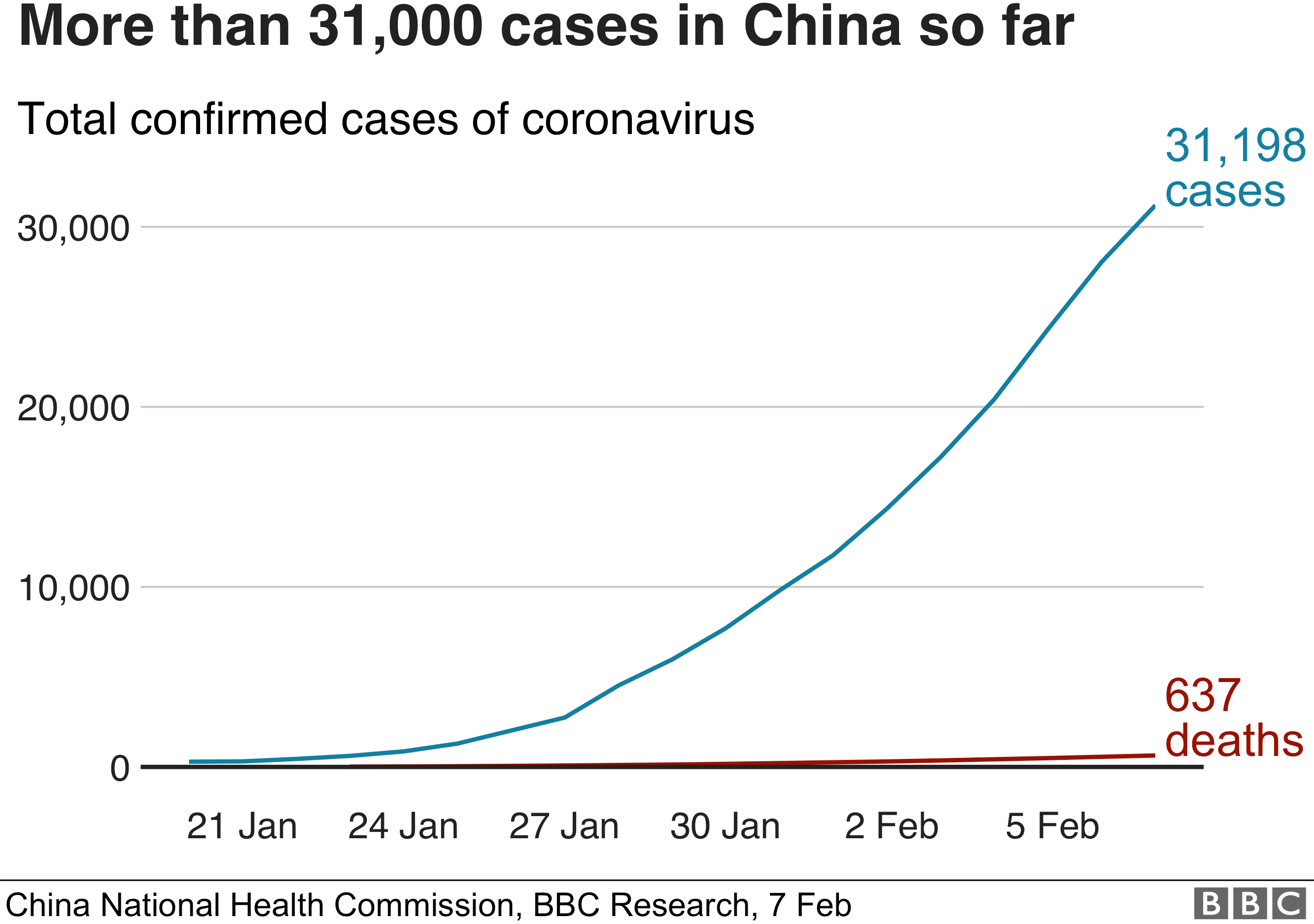
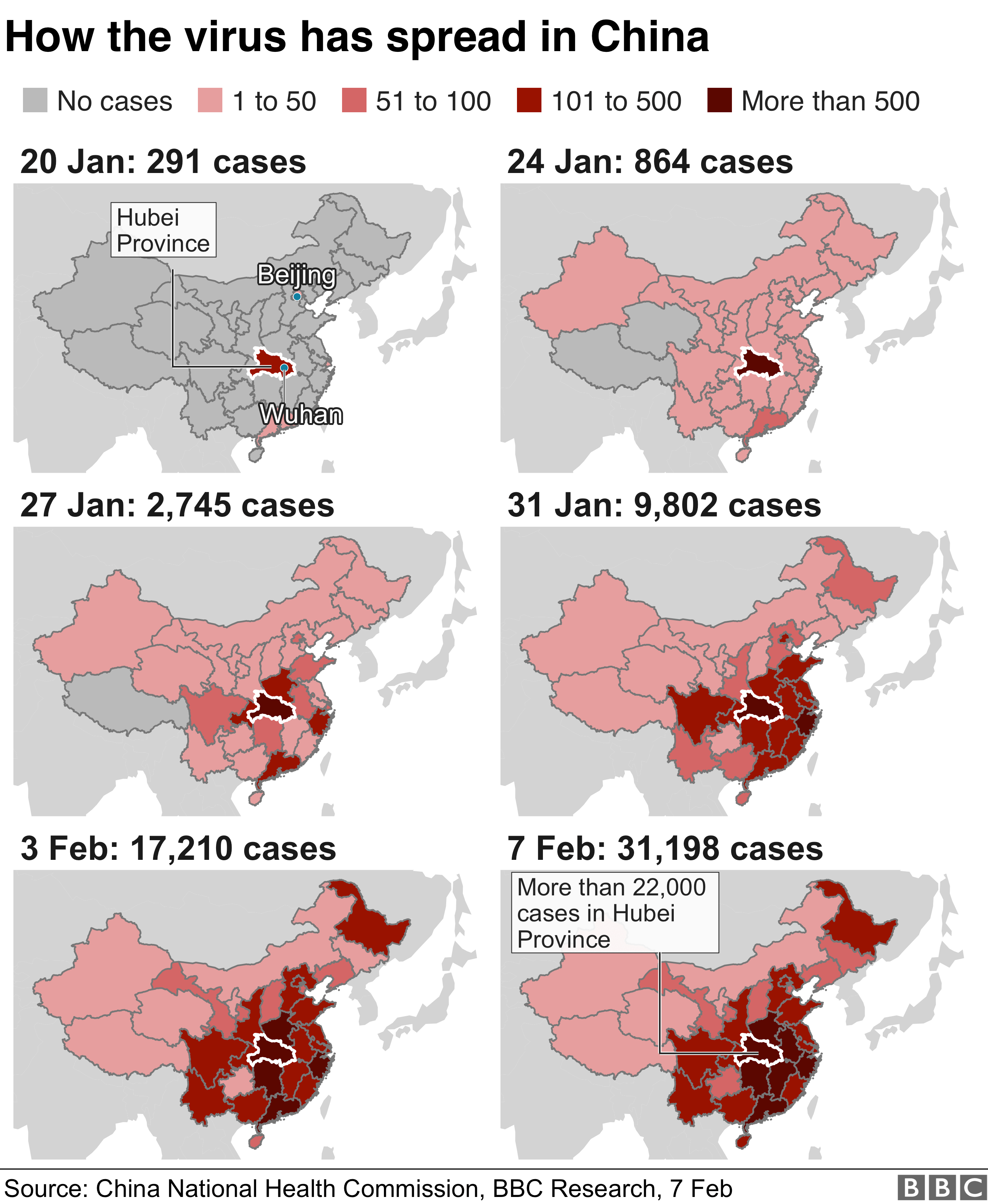
The Chinese government has previously admitted “shortcomings and deficiencies” in its response to the virus, which has now killed 636 people and infected 31,161 in mainland China.
According to Chinese site Pear Video, Dr Li’s wife is due to give birth in June.
What has the public reaction been?
Chinese social media has been flooded with anger – it is hard to recall an event in recent years that has triggered as much grief, rage and mistrust against the government.
The top two trending hashtags on the website were “Wuhan government owes Dr Li Wenliang an apology” and “We want freedom of speech”.
Both hashtags were quickly censored. When the BBC searched Weibo on Friday, hundreds of thousands of comments had been wiped. Only a handful remain.
“This is not the death of a whistleblower. This is the death of a hero,” said one comment on Weibo.
A photo circulating on Twitter reportedly sourced from messaging platform WeChat also shows a message in Chinese saying “Farewell Li Wenliang” written in the snow on a riverbank.
Many have now taken to posting under the hashtag “Can you manage, do you understand?” – a reference to the letter Dr Li was told to sign when he was accused of disturbing “social order”.
These comments do not directly name him – but are telling of the mounting anger and distrust towards the government.
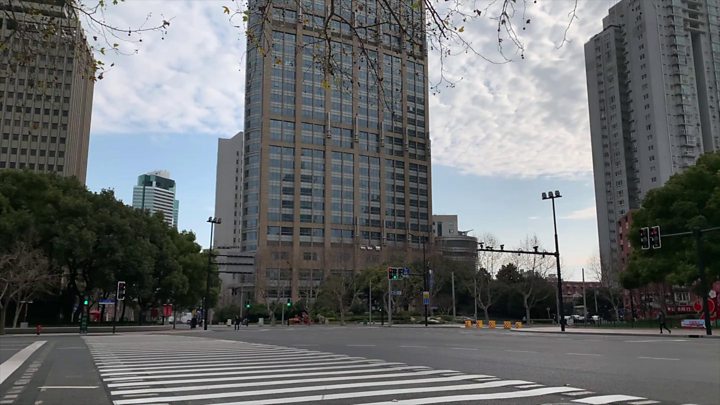
Media caption Coronavirus: Shanghai’s deserted streets and metro
“Do not forget how you feel now. Do not forget this anger. We must not let this happen again,” said one comment on Weibo.
“The truth will always be treated as a rumour. How long are you going to lie? What else do you have to hide?” another said.
“If you are angry with what you see, stand up,” one said. “To the young people of this generation, the power of change is with you.”
An epic political disaster
The death of Dr Li Wenliang has been a heart-breaking moment for this country. For the Chinese leadership it is an epic political disaster.
It lays bare the worst aspects of China’s command and control system of governance under Xi Jinping – and the Communist Party would have to be blind not to see it.
If your response to a dangerous health emergency is for the police to harass a doctor trying to blow the whistle, then your structure is obviously broken.
The city’s mayor – reaching for excuses – said he needed clearance to release critical information which all Chinese people were entitled to receive.
Now the spin doctors and censors will try to find a way to convince 1.4 billion people that Dr Li’s death is not a clear example of the limits to the party’s ability to manage an emergency – when openness can save lives, and restricting it can kill.
He was initially declared dead at 21:30 on Thursday (13:30GMT) by state media outlets the Global Times, People’s Daily and others.
Hours later the Global Times contradicted this report – saying he had been given a treatment known as ECMO, which keeps a person’s heart pumping.
Journalists and doctors at the scene said government officials had intervened – and official media outlets had been told to change their reports to say the doctor was still being treated.
But early on Friday, reports said doctors could not save Dr Li and his time of death was 02:58 on Friday.
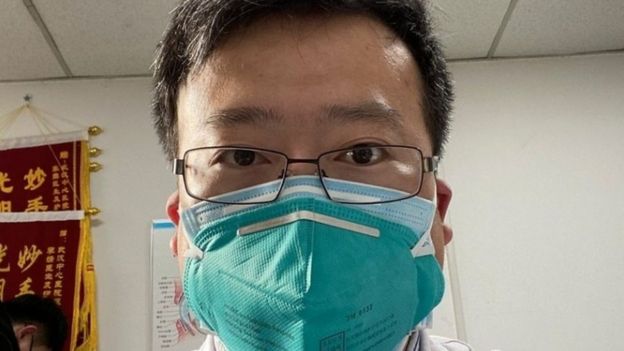
Image copyright LI WENLIANGImage caption Li Wenliang contracted the virus while working at Wuhan Central Hospital
What did Li Wenliang do?
Dr Li, an ophthalmologist, posted his story on Weibo from a hospital bed a month after sending out his initial warning.
He had noticed seven cases of a virus that he thought looked like Sars – the virus that led to a global epidemic in 2003.
On 30 December he sent a message to fellow doctors in a chat group warning them to wear protective clothing to avoid infection.
Four days later he was summoned to the Public Security Bureau where he was told to sign a letter.
In the letter he was accused of “making false comments” that had “severely disturbed the social order”. Local authorities later apologised to Dr Li.
In his Weibo post he describes how on 10 January he started coughing, the next day he had a fever and two days later he was in hospital. He was diagnosed with the coronavirus on 30 January.
Media caption The BBC’s online health editor on what we know about the virus
Singapore has raised its Disease Outbreak Response System Condition (Dorscon) level from yellow to orange. This means that the disease is deemed severe and spreads easily from person to person but has not spread widely and is being contained
Chinese President Xi Jinping has told his US counterpart Donald Trump that China is “fully confident and capable of defeating the epidemic”. The country has introduced more restrictive measures to try to control the outbreak:
The capital Beijing has banned group dining for events such as birthdays. Cities including Hangzhou and Nanchang are limiting how many family members can leave home each day
Hubei province has switched off lifts in high-rise buildings to discourage residents from going outside.
The virus has now spread to more than 25 countries. There have been more than 28,000 cases worldwide but only two of the deaths have been outside mainland China.
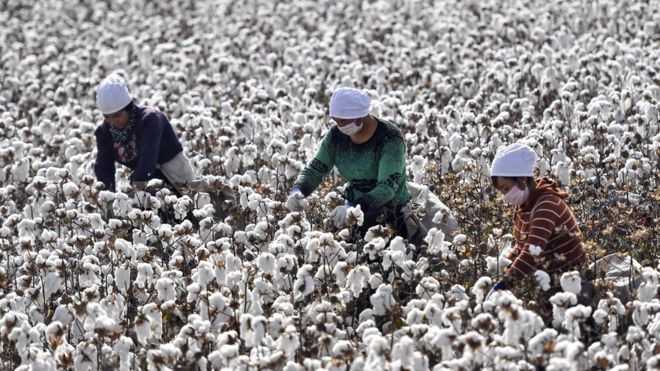
Global retailers are facing scrutiny over cotton supplies sourced from Xinjiang, a Chinese region plagued by allegations of human rights abuses.
China is one of the world’s top cotton producers and most of its crop is grown in Xinjiang.
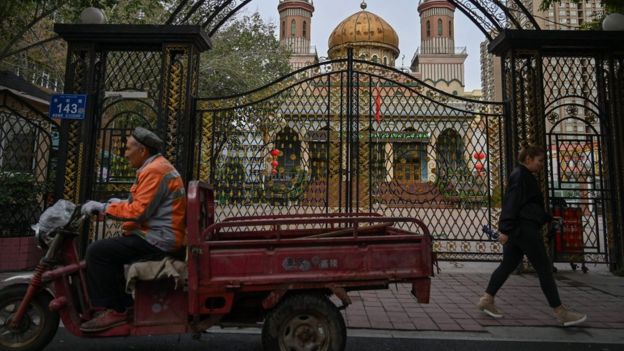
Rights groups say Xinjiang’s Uighur minority are being persecuted and recruited for forced labour.
Many brands are thought to indirectly source cotton products from the Xinjiang region in China’s far west.
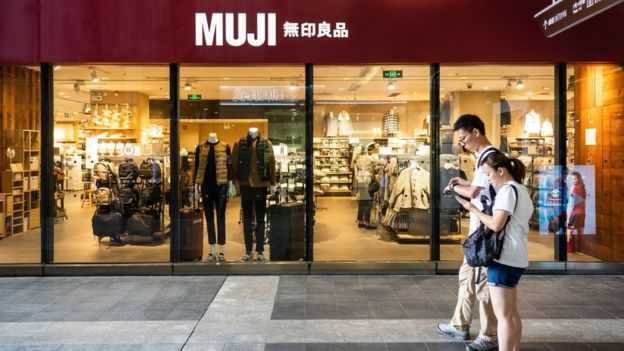
Japanese retailers Muji and Uniqlo attracted attention recently after a report highlighted the brands used the Xinjiang-origin of their cotton as a selling point in advertisements.
“You can’t be sure that you don’t have coerced labour in your supply chain if you do cotton business in China,” said Nathan Ruser, researcher at the Australian Strategic Policy Institute.
“Xinjiang labour and what is almost certainly coerced labour is very deeply entrenched into the supply chain that exists in Xinjiang.”
What is happening in Xinjiang?
UN experts and human rights groups say China is holding more than a million Uighurs and other ethnic minorities in vast detention camps.
Rights groups also say people in camps are made to learn Mandarin Chinese, swear loyalty to President Xi Jinping, and criticise or renounce their faith.
China says those people are attending “vocational training centres” which are giving them jobs and helping them integrate into Chinese society, in the name of preventing terrorism.
What is produced in Xinjiang?
The Xinjiang region is a key hub of Chinese cotton production.
Last year, 84% of Chinese cotton came from Xinjiang, the report said.
That has raised concerns over whether forced labour has been used in the production of cotton from the region.
Image copyright GETTY IMAGESImage caption The Uighurs are mostly Muslims, and number about 11 million in China’s Xinjiang region
Nury Turkel, chairman of the Uighur Human Rights Project in Washington, said the Uighurs were being “detained and tormented” and “swept into a vast system of forced labor” in Xinjiang.
In testimony to US congress, he said it was becoming “increasingly hard to ignore the fact” that the goods manufactured in the region have “a high likelihood” of being produced with forced labour.
Which brands use Xinjiang cotton?
Amy Lehr, director of CSIS Human Rights Initiative, said in many cases Western companies aren’t buying directly from factories in Xinjiang.
“Rather, the products may go through several stages of transformation after leaving Xinjiang before they are sent to large Western brands,” she said.
Some, like Muji, are very open about sourcing material from Xinjiang.
“Uniqlo does not have any production partners located in the Xinjiang region. Moreover, Uniqlo production partners must commit to our strict company code of conduct.
“To the best of our knowledge, this means our cotton comes only from ethical sources,” the spokesperson told the BBC.
Many of the companies looked into the allegations, including those without clear links to the Huafu mill.
In a statement to the BBC, Adidas said: “While we do not have a contractual relationship with Huafu Fashion Co., or any direct leverage with this business entity or its subsidiary, we are currently investigating these claims.”
“We advised our material suppliers to place no orders with Huafu until we have completed those investigations,” the Adidas spokesperson said.
Esprit, which also does not source cotton directly from Xinjiang, said it had made several inquiries earlier this year.
“We concluded that a very small amount of cotton from a Huafu factory in Xinjiang was used in a limited number of Esprit garments,” the firm said in a statement.
The company has instructed all suppliers to not source Huafu yarn from Aksu, the statement said.
H&M said it does not have “a direct or indirect business relationship” with any garment manufacturer in the Xinjiang region.
“We have an indirect business relationship with Huafu’s spinning unit in Shanyu, which is not located in the Xinjiang region, and according to our data, the vast majority of the yarn used for our garment manufacturing comes from this spinning unit,” a spokesperson for H&M said.
“Since we have an indirect business relationship with the yarn supplier Huafu, we also asked for access to their spinning facilities in Aksu. Our investigations showed no evidence of forced labor.”
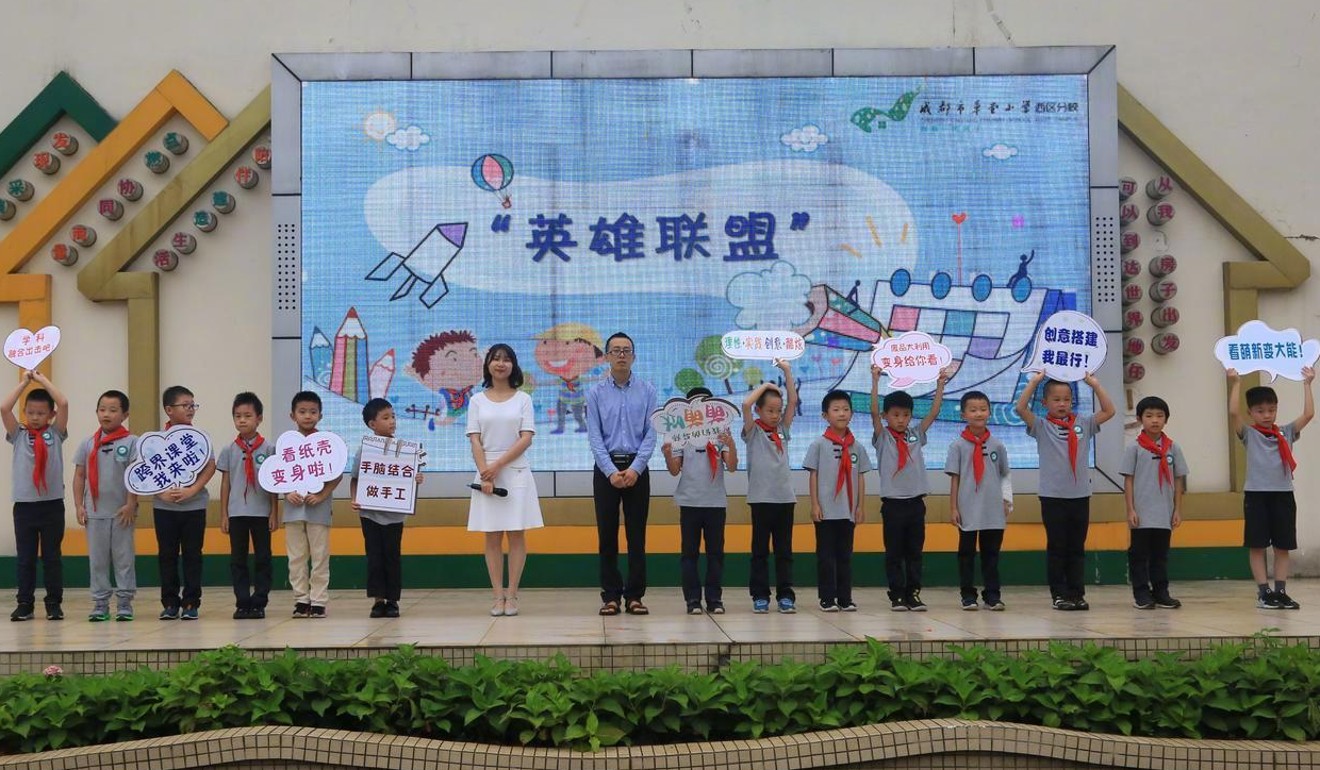
Chengdu school teaches boys to build model rockets while girls learn about knitting
Handicrafts show at school prompts question, ‘Why can’t boys knit and girls build rockets?’
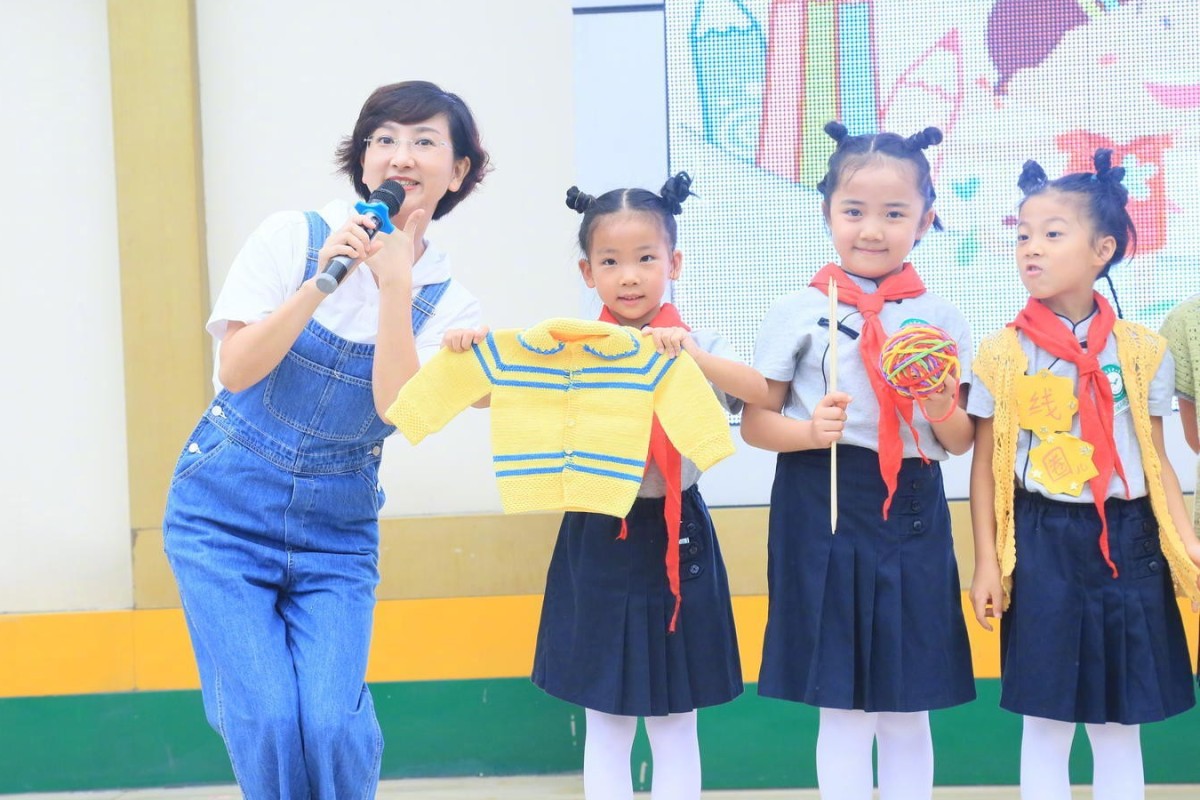
Pupils and staff at Chengdu Caotang Elementary School in Sichuan show off knitting from their Boys and Girls are Vastly Different class. Photo: Weibo
A school in southwest China that teaches boys to grow “heroically” and wants “tranquil feminine examples” for its girls has generated a heated debate about sexism.
Chengdu Caotang Elementary School in Sichuan province developed a course that teaches boys to build model rockets and girls to knit alongside mainstream subjects such as maths, languages and art, in the hope of “increasing their gender knowledge”.
The course, called Boys and Girls are Vastly Different, started last semester because school managers believed that “boys and girls have been shaped in the same way recently”, principal Fu Jin told the Chengdu Economic Daily on Monday.
That “led to boys lacking enough space to grow heroically and girls lacking gentle and tranquil feminine examples to follow, so there’s some gender dislocation”, she said.
Chengdu Caotang Elementary School wants its boys to be “heroic” and its girls to be “tranquil”. Photo: Weibo
Last semester, pupils learned the differences between female and male bodies. This semester, boys are learning how to build model planes, rockets and cars, while the girls are being taught knitting by teachers and mothers who volunteer to help out in classes.
On Monday, a show of handicrafts and jumpers hosted by the school to promote the class led to a backlash on social media, with members of the public criticising the school for sexism and enforcing gender stereotypes.
“They are tying the hands of girls when young, and when these girls grow up, people would say there are only a few female scientists because girls are born unfit for that role,” a Weibo user said.
What Chinese summer camps taught teens about gender values
“It’s typical gender discrimination,” another said. “Why can’t boys knit and girls build rockets?”
Authorities cracked down on controversial classes for Chinese children after some extreme examples of gender education. In December, a Weibo account highlighted a lurid “virtue” class where a sobbing woman was seen on video confessing to teenagers at a summer camp in Wenzhou, eastern Zhejiang province that “promiscuous women got gangrene”.
“I dressed myself up in a fashionable and revealing way, and that’s an invitation for others to insult me and rape me,” she told her audience.
“Three drops of sperm are equal to poison, and they will hurt unclean women,” she said. “I’m afraid my body will rot, will stink and ache, and they’ll have to amputate my legs.”
The camp was condemned and shut down by the local government.
Doctor who helped 13-year-old girl recover says demands on her to do well at school induced condition
Weibo poll reveals that 68 per cent of participants had hair loss in school
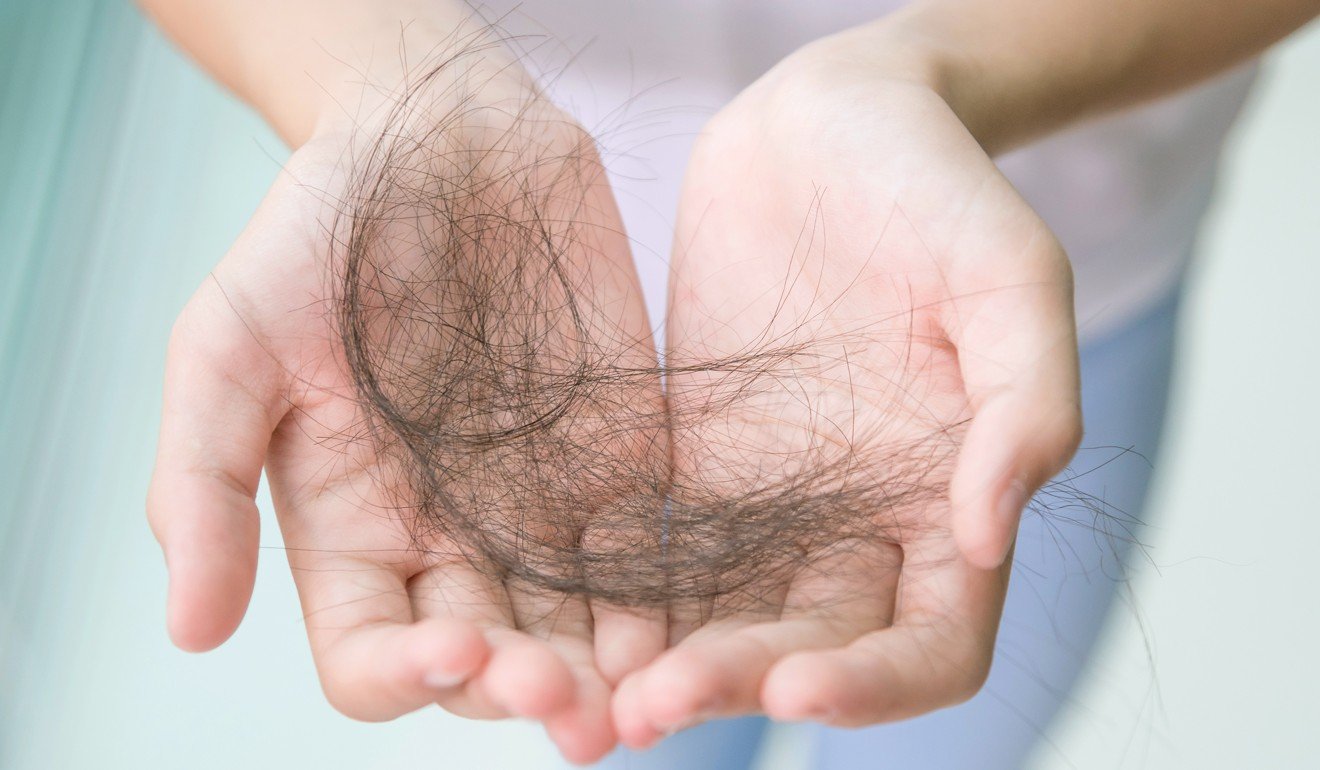
Studies and polls suggest stress leading to hair loss is a big health concern in China. Photo: Alamy
When the 13-year-old girl walked into the hospital in southern China around eight months ago, she was almost completely bald, and her eyebrows and eyelashes had gone.
“The patient came with a hat on and did not look very confident,” Shi Ge, a dermatologist at the Sixth Affiliated Hospital of Sun Yat-sen University in Guangzhou, told the Pear Video news portal.
The girl had done well in primary school but her grades dropped in middle school, Shi said.
Under parental pressure to do well, the girl pushed herself harder, but the stress resulted in severe hair loss.
With time and medical treatment, the teen’s hair grew back but her story left a lasting impression, raising awareness of the increasing number of young people in China seeking treatment for stress-induced hair loss, according to Chinese media reports.
Jia Lijun, a doctor at Shenzhen Traditional Chinese Medicine Hospital, told state-run Xinhua News Agency in May that aside from genetics, factors such as stress in work, study and life would result in endocrine imbalances which affected the cycle of hair growth.
And in January, a survey of 1,900 people by China Youth Daily found that 64.1 per cent of people aged between 18 and 35 said they had hair loss resulting from long and irregular working hours, insomnia, and mental stress.
Hits and myths: stress and hair loss
Shi said that an increasing number of young people had come to her for treatment of hair loss in recent years, and those working in information technology and white-collar jobs were the two biggest groups.
“They usually could not sleep well at night due to high pressure or had an irregular diet because of frequent business trips,” Shi said.
A Weibo poll on Wednesday revealed that 68 per cent out of 47,000 respondents said they had had serious hair loss when they were in school. About 22 per cent said they noticed after starting their careers, while only 5 per cent said it happened after they entered middle age.
More than half of the Chinese students who took part in a China Youth Daily survey said they had hair loss. Photo Shutterstock
Research published in 2017 by AliHealth, the health and medical unit of the Alibaba Group, found that 36.1 per cent of Chinese people born in the 1990s had hair loss, compared to the 38.5 per cent born in the 1980s. Alibaba is the parent company of the South China Morning Post.
The teenager’s experience sparked a heated discussion on Weibo, with users recounting similar cases and some voicing their panic.
“My niece’s hair was gone while she was in high school and has not recovered, even after she graduated from university. This makes her feel more and more inferior,” one user said.
Hong Kong’s schoolchildren are stressed out – and their parents are making matters worse
Another said: “I lost a small portion of my hair during the high school entrance exam, but that is already scary enough for a girl in her adolescence.”
“I had to quit my job and seek treatment,” said a third, who adding that he also suffered from very serious hair loss a few months ago because of high pressure.
Delicate balance for Disney in its portrayal of China’s classic tale of female heroism
Too Americanised, or pandering to a mainland Chinese audience?
Chinese-American actress Crystal Liu Yifei plays the title role in Disney’s Mulan. Photo: Disney
Since the trailer for Disney’s live-action film Mulan was released last weekend, both mainland Chinese in the East and the diaspora in the West have been abuzz about their cultural identity and its representation in Hollywood – albeit for different reasons.
Chinese viewers have, on one hand, been enthusiastic about the casting of Chinese-American actress Crystal Liu Yifei in the lead role and the chance for a seemingly more “authentic” Chinese story to be told on the global stage.
On the other hand, they have pointed out historical inaccuracies – such as the southern Chinese setting when the source material states that Mulan is from the north – and expressed concerns that the plot has been too “Americanised”.
Meanwhile, many Chinese-Americans were surprised to discover upon watching the trailer that the beloved 1998 animation had changed beyond recognition – most notably with the absence of talking dragon Mushu and male love interest Li Shang. Some also felt that the new film pandered too much to a mainland Chinese audience.
“The idea of a mythic mash-up of China [in the new film] … seems to play to the idea of a unified, singular China, an artistic representation of the one-China policy, which is troubling to me,” said Jeannette Ng, a British sci-fi author with Hong Kong heritage.
“A lot of the time, this conversation acts like the only Chinese people who matter are the ones who live in mainland China – that they are the only truly authentic ones and everyone else is too Westernised to count,” she said.
The online discussion indicates the delicate balance Hollywood interpretations of Chinese classics have to strike in portraying Chinese versus American values, as big US-China co-productions try their hardest to integrate the two for bigger global box office takings.
Despite ticket sales in China falling 3.6 per cent in the first half of 2019, owing to tightened government censorship, China is still projected to overtake the US box office next year, according to a recent report by professional services firm PwC.
Disney has tried hard to make the new film more true to its ancient Chinese source material, with a detailed – if inaccurate – historical setting featuring the ancient tulou roundhouses of the southeastern province of Fujian, and a star-studded, all-Asian cast with several icons of Chinese cinema such as Jet Li, Hong Kong actor Donnie Yen and Gong Li.
Disney’s live-action version of Mulan is truer to the ancient source material. Photo: Handout
“Disney’s tent pole movies are aiming at a global audience. That being said, given that China is the largest international market and the story is based on a Chinese folk tale, Disney will definitely take the Chinese audience’s taste into consideration,” said a Chinese film producer, who asked to remain anonymous, at a major US studio in Beijing.
“However, this is also a double-edged sword, as people tend to be more picky when they see things they are familiar with.”
Indeed, several Chinese media think pieces have questioned whether elements of the original legend had become too Americanised in the film, leading to an inauthentic representation of a beloved Chinese heroine.
For instance, the Disney trailer suggests that Mulan joins the army to escape an arranged marriage, breaking away from family traditions and establishing her independence as a woman unbound by gender roles.
But in the original folk song Ballad of Mulan, on which the film is based, she volunteers to take the place of her ageing father in the army – making her a symbol of filial piety, courage and patriotism in traditional Chinese culture.
Some critics say Mulan has been Americanised. Photo: YouTube
In a widely shared analysis discussing whether Disney’s Mulan was a feminist icon, Peking University Press wrote: “Perhaps this is a cross-cultural creative misunderstanding that reflects the core differences between Chinese and Western culture. If Mulan is seen as a feminist symbol, I fear this may be wishful thinking.”
However, both Chinese-Americans and Chinese nationals agree that the film, slated for release in March, is an inspiring tale for young girls.
“I feel like the people who are criticising the film are too attached and focused on the nostalgia factor. They are not seeing the bigger picture and the positive implications of this movie,” said Alex Diep, a 23-year-old American of Vietnamese-Chinese descent.
“They are disregarding that this film gives an opportunity for young Asian girls to look up to Mulan and see her as a role model,” he said.
Some Chinese have interpreted it as an inspiring fable of female strength and liberation, especially when ingrained patriarchal values and government initiatives such as the one-child policy have restricted women’s rights over the years.
“[Mulan] remains one of the very few fighters and not conventionally feminine figures in the Disney princess canon,” Ng said.
“[T]his is some sort of feminism education for a single-child generation in China that girls can fight like men do,” tweeted Chinese journalist Li Jing.
Chinese-Americans are also optimistic that it will be a sure-fire win for Asian representation on the big screen, especially after the success of last year’s romantic comedy Crazy Rich Asians.
“[Critics of the trailer] are disregarding the fact that this movie is another opportunity to showcase Asian people in a movie where we are not perceived as a negative stereotype,” Diep said.
Others feel that the film can help build a bridge between East and West.
“Mulan is a Chinese story. It comes from a completely different culture, one which I’m not at all convinced that Hollywood, or the West at large, truly understands yet,” said
New Yorker Jonathan Pu, who is of Taiwanese descent. He said he enjoyed the lighthearted animation, but that it did not define his expectations for the remake.
“If Disney can stay true to the source material and convey [filial piety] in a way that even just some of the audience can grasp, then it will go a long way towards building bridges,” Pu said.
Ultimately, the success of this American spin on Chinese culture will rest on box office sales, which Disney hopes will exceed the 1998 animation that flopped in mainland cinemas. Recent Disney live-action remakes have had a mixed reception in China – Dumbo flopped in March, while The Lion King did moderately well on its release last weekend.
“I’m sure there will be a mixed response when the movie is released but it should have enough buzz and do well,” said the Beijing film producer.
“I hope it will be able to convey the spirit of Mulan and inspire millions of young girls.”
Image caption Local people say having an incinerator near their homes will be dangerous
While the world’s attention has been focused on the protests in Hong Kong, another Chinese city has been witnessing unrest on a scale rarely seen on the mainland.
Thousands of citizens in Wuhan, the capital city of central Hubei province, took to the streets last week for several days.
They were angry about a planned waste incineration plant they say will bring dangerous levels of pollution to their town.
But as the protests steadily grew over the week, a censorship and public security operation kicked in to try to keep a lid on the unrest.
Why are they so angry?
Wuhan desperately needs to find ways to handle the waste generated by its 10 million residents. So it has drawn up plans for a huge incinerator, to be based in the Yangluo zone of Xinzhou district, where about 300,000 people live.
According to a city government document published in February, the incinerator would possess a daily capacity of 2,000 tonnes of rubbish.
Xinzhou district also already hosts a waste landfill, the strong smells of which, according to some locals, can be caught even when one passes the area on a bus.
But there has been public concern that badly-made incinerators can emit dioxins that are highly toxic and can damage the immune system, interfere with hormones and cause cancer. In 2013, five such plants in Wuhan city were found to be sub-standard and emitting dangerous pollutants, according to China’s state broadcaster CCTV.
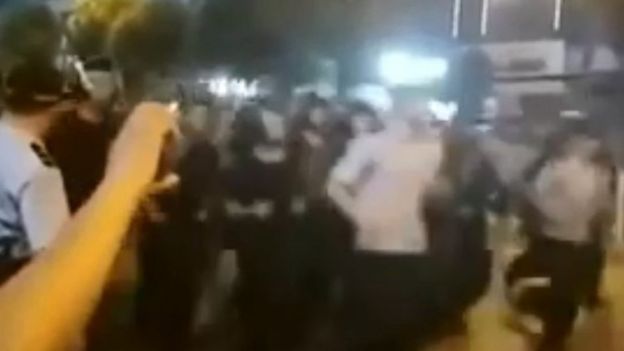
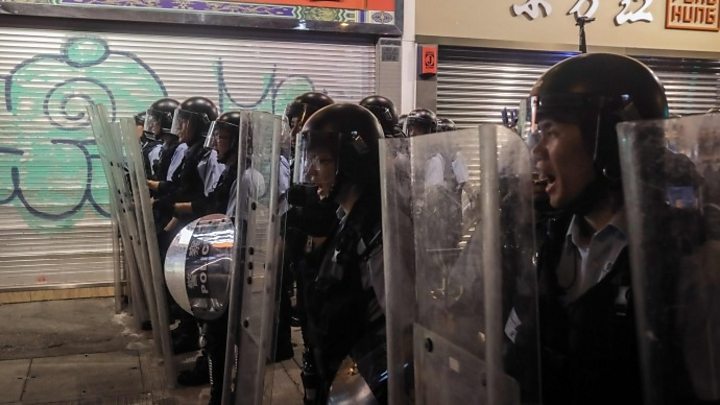
Image copyright OTHERImage caption Grainy social media footage showed huge numbers of police moving into the town
In late June, rumours began spreading that work had already started on the new plant, on a patch of land in Yangluo designated as an industrial park, close to residences and two schools.
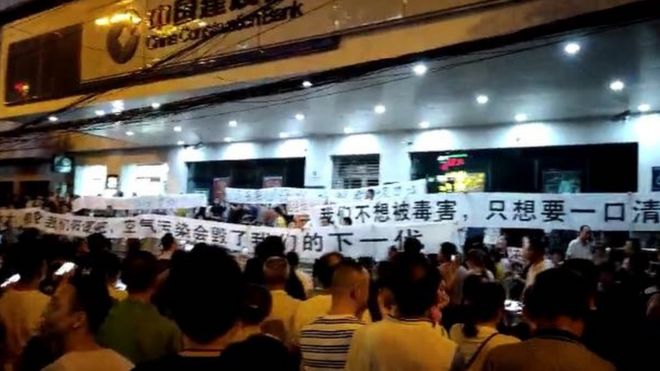
Local people took to the streets for several days, demanding that the location be re-thought. They held banners with slogans like “air pollution will damage the next generation” and “we don’t want to be poisoned, we just need a breath of fresh air”. They weren’t demanding it be scrapped completely, just that it be moved further away.
The protests grew over several days and, according to some locals, the night with the biggest crowds saw up to 10,000 people taking part.
How has the government responded?
At first the Xinzhou district government attempted to calm the unrest. It issued a statement last Wednesday denying that work had started on the incinerator. It said the project hadn’t even been registered, nor had it gone through any environmental assessment.
They said the local government would attach “great importance to the voices of the people” in its decision-making, but warned that public security authorities would crack down on any “illegal criminal acts such as malicious incitement and provocation”.
Several locals said people were detained but the exact number couldn’t be confirmed.
Over the weekend, the authorities appear to have successfully quashed the protests. Some locals said riot police were on the streets and shops around the protest sites had been ordered to shut by 6pm.
Meanwhile, China’s censors have been at work. Local voices on social media have been vanishing fast. Videos and photos of the crowded streets and clashes between the protesters and the police can be censored within hours. While there were a few reports in domestic media about the incinerator, none of them covered the protests.
Local people have said they’re not satisfied with the district government’s reassurances, because it’s the municipal authorities who have the final say.
But the municipality has kept quiet so far.
How unusual is this for China?
China often sees public protests like this, but mostly on a much smaller scale.
While the Chinese public have largely avoided protests about political reforms since the Tiananmen movement was crushed in 1989, “not in my back yard” protests related to environmental problems have become more common.
Civil movements against high-polluting projects date back to at least 2007 when a significant protest broke out in Xiamen city of Fujian province against an industrial chemical plant.
The incident became well-known at a time of lighter censorship, and the local government ended up moving the location of the project out of the city.
Media caption Hong Kong police and protesters clash
In 2015 there were protests in both Shanghai and northern Tianjin over planned manufacturing plants which locals felt put them in danger.
And in 2017, Qingyuan city in Guangdong province also saw protests over an incinerator.
During the Qingyuan protests nearly 10,000 locals took to the streets and police reportedly fired tear gas at the height of the unrest. Three days later the government cancelled the planned incinerator.
Might the Wuhan authorities learn from Qingyuan?
So far there’s no sign of that.
Even after a week of protests the city government seems deaf to public opinion.


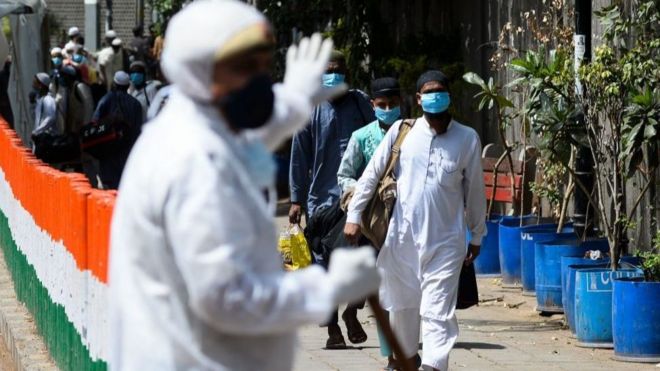 Image copyright GETTY IMAGES
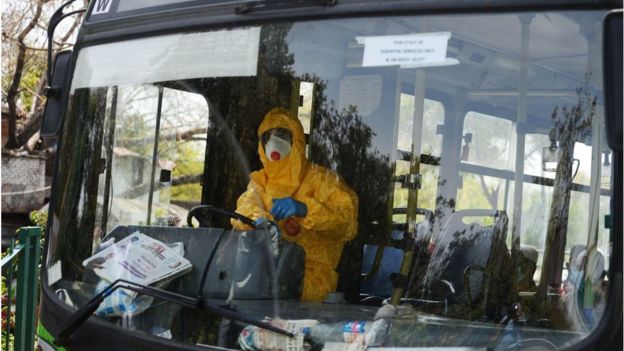 Image copyright GETTY IMAGES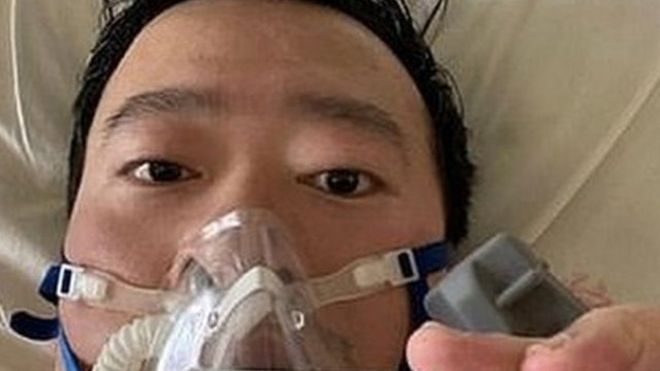










 CHINDIA ALERT: You'll be living in their world, very soon