10/04/2020
BEIJING (Reuters) – China will promote the sales of export products in domestic markets, as foreign trade faces unprecedented challenges due to the coronavirus pandemic, an assistant commerce minister said on Friday.
As the coronavirus spreads to almost all of China’s trading partners, the world’s second-largest economy is set to reach a grim milestone for full year growth, with the pace of expansion likely to be the slowest since the Cultural Revolution ended in 1976. And, the export sector is facing millions of job losses and factory shutdowns.
“Due to the rapid spread of the epidemic in the world, foreign demand has slumped and the biggest difficulty facing foreign trade companies is the plunge in orders,” said Ren Hongbin, the assistant minister at the Ministry of Commerce.
He said firms across the board have had their orders cancelled or delayed, and new orders are “very hard to sign”.
“The uncertainty about the pandemic has become the biggest uncertainty for foreign trade development.”
Forecasters expect China’s 2020 growth could be nearer the 2.0% mark – the slowest in over 40 years – due to the sweeping impact of the pandemic both at home and overseas. The economy grew 6.1% last year.
China’s overseas shipments fell 17.2% in January-February from the same period a year earlier, marking the steepest fall since February 2019. Imports sank 4% from a year earlier.
Among the government measures to support the sector, China is accelerating efforts to build online trade fairs and guiding exporters to work with e-commerce retailers for sales in domestic markets and coordinating with its trading partners to stabilise supply chains, said Ren.
The Canton Fair, China’s oldest and biggest trade fair due to take place online, will feature live-streaming services for participants, Li Xingqian, another commerce ministry official, told the same briefing. The fair was originally scheduled to begin on April 15, but was postponed due to the coronavirus outbreak.
China is willing to boost trade relations with other countries, including the United States, under the new circumstances, said Ren, adding that Beijing hopes to work together with Washington to promote bilateral trade.
Both countries have been engaged in a near two-year long trade war with tit-for-tat tariffs on each other’s goods, before negotiators called a truce with an interim trade deal in January.
Source: Reuters
Posted in 0, 1, 10, 11, 12, 13, 14, 15, 16, 17, 18, 19, 1976, 2, 20, 21, 22, 23, 24, 25, 26, 27, 28, 29, 3, 30, 31, 4, 5, 6, 7, 8, 9, April, batters, Beijing, bilateral trade, cancelled, Canton Fair, challenges, China, China’s, Commerce minister, companies, coronavirus, coronavirus outbreak, Coronavirus pandemic, Cultural Revolution, delayed, domestic markets, domestically, encourages, epidemic, export goods, export products, export sector, Factory, February, foreign demand, foreign trade, global, imports, interim trade deal, January, job losses, live-streaming services, milestone, millions, Ministry of Commerce, Negotiators, oldest and biggest trade fair, online, orders, overseas shipments, pandemic, plunge, promote, Sales, shutdowns, slumped, spreads, tit-for-tat tariffs, Trade, trade war, trading partners, Uncategorized, uncertainty, United States, unprecedented, Virus, Washington, World, world’s second-largest economy |
Leave a Comment »
09/04/2020
TOKYO (Reuters) – Uncertainty over Japan’s economic outlook is “extremely high” as the coronavirus pandemic hits output and consumption, central bank Governor Haruhiko Kuroda said, stressing his readiness to take additional monetary steps to prevent a deep recession.
While aggressive central bank actions across the globe have eased financial market tensions somewhat, corporate funding strains were worsening, Kuroda told a quarterly meeting of the Bank of Japan’s regional branch managers on Thursday.
“The spread of the coronavirus is having a severe impact on Japan’s economy through declines in exports, output, demand from overseas tourists and private consumption,” he said.
Japan recorded 503 new coronavirus infections on Wednesday – its biggest daily increase since the start of the pandemic – as a state of emergency took effect giving governors stronger legal authority to urge people to stay home and businesses to close.
In contrast to stringent lockdowns in some countries, mandating fines and arrests for non-compliance, enforcement will rely more on peer pressure and a deep-rooted Japanese tradition of respect for authority.
The balancing act underscores the difficulty authorities have in trying to contain the outbreak without imposing a mandatory lockdown that could deal a major blow to an economy already struggling to cope with the virus outbreak.
Hideaki Omura, the governor of the central Japan prefecture of Aichi, said he would declare a state of emergency for his prefecture on Friday.
Omura said Aichi, which includes the city of Nagoya and hosts Toyota Motor Corp, was talking with the central government about being included in the national state of emergency as well, but felt he could not wait any longer to restrict movement.
“Looking at things the past week and watching the situation – the rise in patients, the number without any traceable cause – we judged that it was a very dangerous situation and wanted to make preparations,” he told a news conference.
Even with less stringent restrictions compared with other countries, analysts polled by Reuters expect Japan to slip into a deep recession this year as the virus outbreak wreaks havoc on business and daily life.
Shares of Oriental Land Co (4661.T) fell on Thursday after the operator of Tokyo Disneyland said it would keep the amusement park shut until mid-May.
Entertainment facility operator Uchiyama Holdings (6059.T) said it was closing 43 karaoke shops and 11 restaurants until May 6.
“For the time being, we won’t hesitate to take additional monetary easing steps if needed, with a close eye on developments regarding the coronavirus outbreak,” Kuroda said.
Kuroda’s remarks highlight the strong concern policymakers have over the outlook for Japan’s economy and how companies continue to struggle to generate cash, despite government and central bank promises to flood the economy with funds.
At its policy meeting later this month, the BOJ is likely to make a rare projection that the world’s third-largest economy will shrink this year, sources have told Reuters.
The BOJ eased monetary policy in March by pledging to boost purchases of assets ranging from government bonds, commercial paper, corporate bonds and trust funds investing in stocks.
The government also rolled out a nearly $1 trillion stimulus package to soften the economic blow.
Source: Reuters
Posted in aggressive, Aichi, Amusement park, Arrests, authority, balancing act, branch managers, businesses, capex, Central bank, Central government, close, consumption, coronavirus, Coronavirus pandemic, corporate funding, countries, daily increase, declines, deep-rooted, demand, eased, economy, enforcement, exports, extreme, extremely, faces, financial market, globe, governor, head, Head of Japan, high, hits, infections, Japan’s, Japanese, karaoke shops, legal authority, lockdowns, mandating fines, monetary steps, non-compliance, Oriental Land Co (4661.T), outlook, output, overseas, pandemic, peer pressure, People, prevent, private, quarterly meeting, Recession, regional, rely, respect, restaurants, Reuters, severe impact, spread, spreads, state of emergency, stay home, strains, tensions, Thursday, Tokyo, Tokyo Disneyland, tourists, tradition, Uchiyama Holdings (6059.T), Uncategorized, uncertainty, Wednesday, worsening |
Leave a Comment »
30/03/2020
WUHAN, China (Reuters) – China reported a drop in new coronavirus infections for a fourth day as drastic curbs on international travellers reined in the number of imported cases, while policymakers turned their efforts to healing the world’s second-largest economy.
The city of Wuhan, at the centre of the outbreak, reported no new cases for a sixth day, as businesses reopened and residents set about reclaiming a more normal life after a lockdown for almost two months.
Smartly turned out staff waited in masks and gloves to greet customers at entrances to the newly-reopened Wuhan International Plaza, home to boutiques of luxury brands such as Cartier and Louis Vuitton.
“The Wuhan International Plaza is very representative (of the city),” said Zhang Yu, 29. “So its reopening really makes me feel this city is coming back to life.”
Sunday’s figure of 31 new cases, including one locally transmitted infection, was down from 45 the previous day, the National Health Commission said.
As infections fall, policymakers are scrambling to revitalise an economy nearly paralysed by months-long curbs to control the spread of the flu-like disease.
On Monday, the central bank unexpectedly cut the interest rate on reverse repurchase agreements by 20 basis points, the largest in nearly five years.
The government is pushing businesses and factories to reopen, as it rolls out fiscal and monetary stimulus to spur recovery from what is feared to be an outright economic contraction in the quarter to March.
China’s exports and imports could worsen as the pandemic spreads, depressing demand both at home and abroad, Xin Guobin, the vice minister of industry and information technology, said on Monday.
The country has extended loans of 200 billion yuan (22.75 billion pounds) to 5,000 businesses, from 300 billion allocated to help companies as they resume work, Xin said.
Authorities in Ningbo said they would encourage national banks to offer preferential credit of up to 100 billion yuan to the eastern port city’s larger export firms. The city government will subsidize such loans, it said in a notice.
VIRUS CONCERNS
While new infections have fallen sharply from February’s peak, authorities worry about a second wave triggered by returning Chinese, many of them students.
China cut international flights massively from Sunday for an indefinite period, after it began denying entry to almost all foreigners a day earlier.
Average daily arrivals at airports this week are expected to be about 4,000, down from 25,000 last week, an official of the Civil Aviation Administration of China told a news conference in Beijing on Monday.
The return to work has also prompted concern about potential domestic infections, especially over carriers who exhibit no, or very mild, symptoms of the highly contagious virus.
Northwestern Gansu province reported a new case of a traveller from the central province of Hubei, who drove back with a virus-free health code, national health authorities said.
Hubei authorities say 4.6 million people in the province returned to work by Saturday, with 2.8 million of them heading for other parts of China.
Most of the departing migrant workers went to the southern provinces of Guangdong and Fujian, the eastern provinces of Zhejiang and Jiangsu, and northeast China.
In Hubei’s capital of Wuhan, more retail complexes and shopping streets reopened.
Electric carmaker Tesla Inc has also reopened a showroom in Wuhan, a company executive said on Weibo.
Shoppers queued 1-1/2 metres (5 ft) apart for temperature checks at Wuhan International Plaza, while flashing “green” mobile telephone codes attesting to a clean bill of health.
To be cleared to resume work, Wuhan residents have been asked to take nucleic acid tests twice.
“Being able to be healthy and leave the house, and meet other colleagues who are also healthy is a very happy thing,” said Wang Xueman, a cosmetics sales representative.
Source: Reuters
Posted in airports, authorities, boutiques, businesses, Cartier, China's, Civil Aviation Administration of China, companies, company executive, concerns, contagious virus, control, coronavirus cases, Country, curbs, cut, daily arrivals, demand, denying entry, depressing, drop, economic contraction, economy, Electric carmaker, export firms, factories, fiscal and monetary stimulus, flu-like disease, Foreigners, Fujian, Gansu Province, gloves, Guangdong, healing, home and abroad, hubei province, indefinite period, infections, Interest rate, international flights, Jiangsu, lockdown, luxury brands, masks, national banks, National Health Commission, new, Ningbo, none, normal life, outbreak, outright, pandemic, paralysed, policymakers, preferential credit, reclaiming, reopen, reopened, residents, resume work, returning Chinese, revitalise, scrambling, second wave, second-largest economy, Showroom, spread, spreads, spur recovery, students, subsidize, Tesla Inc, the central bank, Uncategorized, unexpectedly, vice minister of industry and information technology, Virus, Weibo, world’s, worsen, Wuhan, Wuhan International Plaza, Zhejiang |
Leave a Comment »
16/03/2020
- South Africa, Kenya latest to halt arrivals from ‘high-risk’ countries as cases across the continent double over the weekend
- Concerns are growing over whether health care systems in some African nations will be able to cope
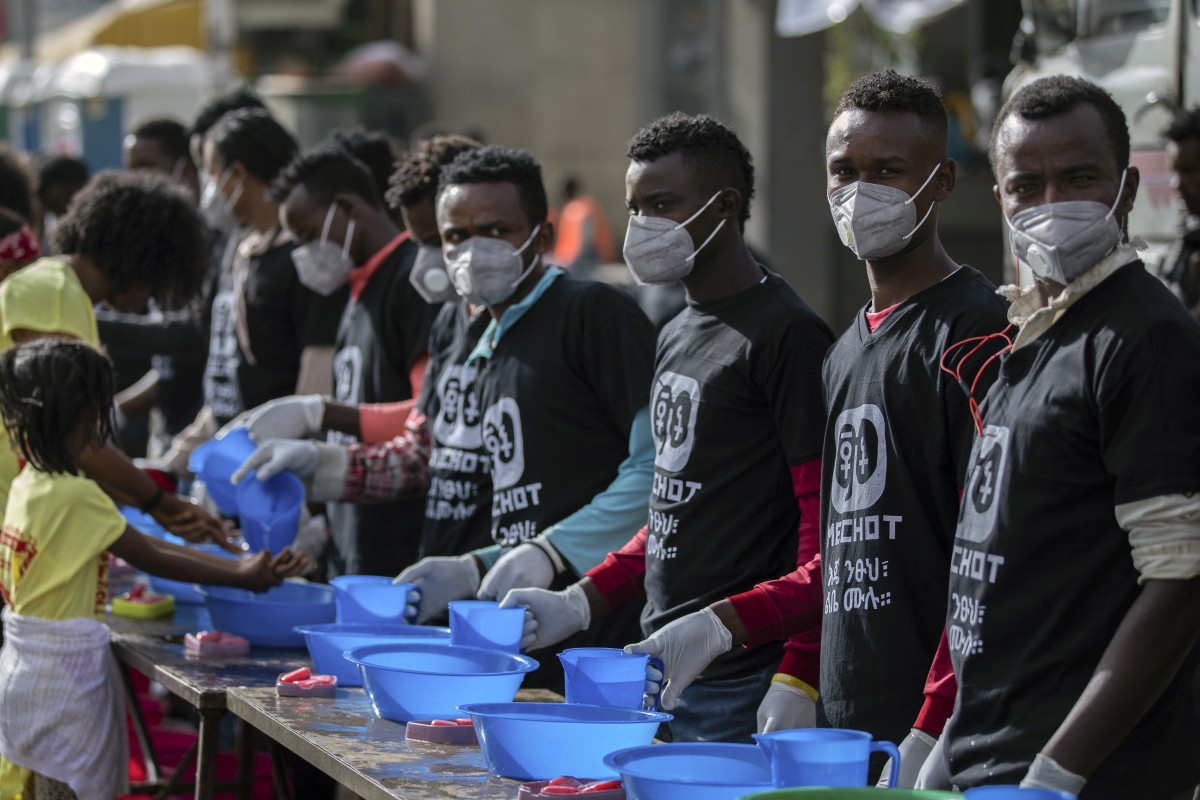
Masked volunteers provide soap and water for participants to wash their hands against the new coronavirus at a women’s 5km fun run in Addis Ababa, Ethiopia on Sunday. Photo: AP
Travel bans and school closures were announced in South Africa and Kenya on Sunday, as concerns grew over the capacity of the continent’s fragile health systems to cope with the spread of the deadly new
coronavirus, with more than a dozen countries reporting their first cases.
South African President Cyril Ramaphosa declared a national state of disaster, banning arrivals by foreign nationals from high-risk countries including Italy, Iran, South Korea, Spain, Germany, the United States, Britain and China, effective Wednesday.
“We have cancelled visas to visitors from those countries from today and previously granted visas are hereby revoked,” Ramaphosa said in a televised address on Sunday evening, adding that any foreign national who had visited high-risk countries in the past 20 days would be denied a visa.
South African schools will also be closed from Wednesday until after the Easter weekend. Gatherings of more than 100 people have been banned and mass celebrations for Human Rights Day and other events cancelled. “Never before in the history of our democracy has our country been confronted with such a severe situation,” Ramaphosa said.
In Kenya, where three cases of Covid-19 – the disease caused by the new coronavirus – have now been confirmed, President Uhuru Kenyatta suspended travel from any country with reported infections. Only Kenyan citizens and foreigners with valid residency permits would be allowed entry, provided they proceeded to self-quarantine or a government-designated quarantine facility, he said.
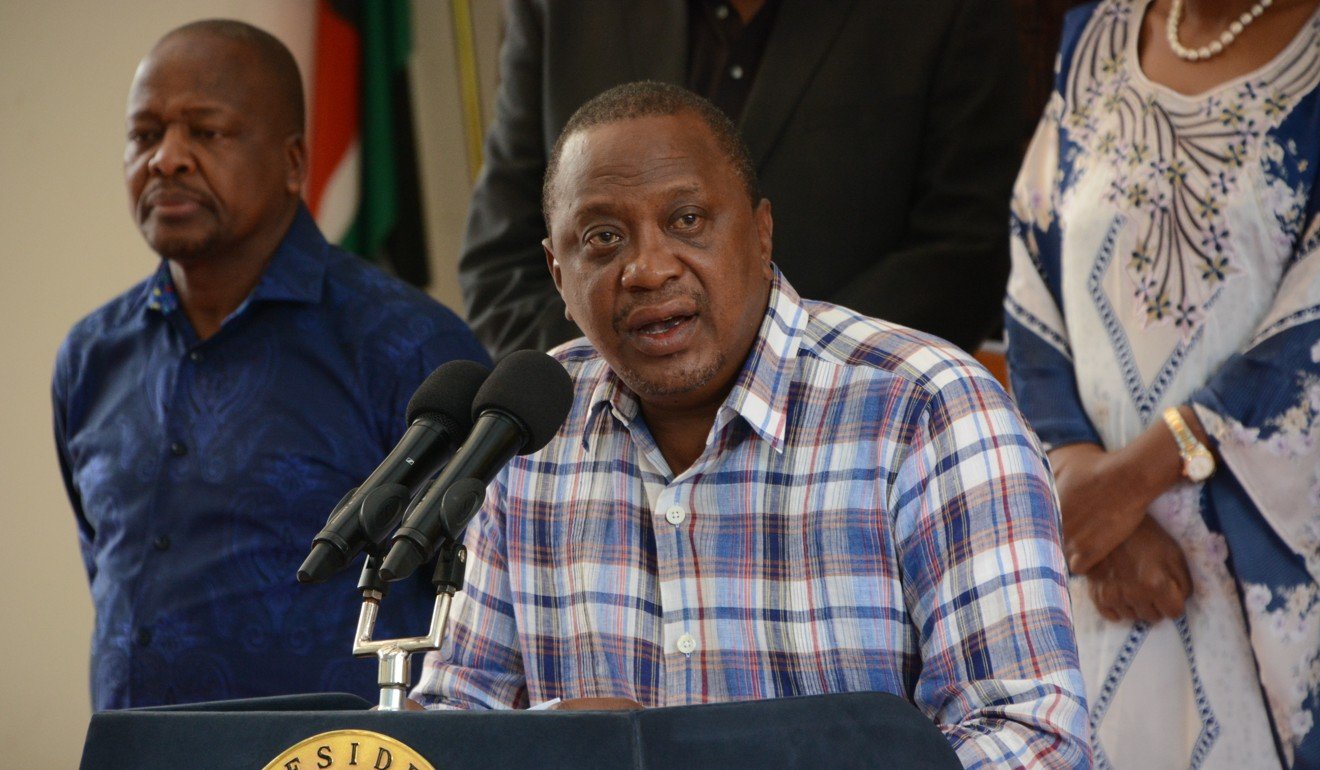
Kenyan President Uhuru Kenyatta reports two more cases of coronavirus in the country, bringing its total number of cases to three. Photo: DPA
Kenyatta also suspended learning in all educational institutions with immediate effect. “Some of the measures may cause inconvenience, but I want to assure you they are designed to ensure that we effectively contain the spread of the virus,” he said.
Kenya and South Africa join Ghana, Rwanda and Morocco in implementing travel restrictions or outright bans, while others are closing churches, museums, sporting activities, nightclubs and tourist attractions in a bid to curb the spread of the disease.
The continent was largely spared in the early days of the outbreak but has now recorded more than 300 cases and six deaths. Algeria, Morocco, Senegal and Tunisia all reported more new cases over the weekend, which saw numbers of new infections across Africa more than double in just two days.
As numbers rise, the Africa Centres for Disease Control and Prevention (CDC) has said there are around a dozen countries on the continent without the capacity to do their own testing.
They will have to send samples to countries like South Africa, which itself is struggling to contain the virus, with confirmed cases doubling to 61 on Sunday, a day after 114 of its citizens were repatriated from the central Chinese city of Wuhan, the original epicentre of the outbreak and the first to be placed in lockdown.
John Nkengasong, director of the Africa CDC, warned that the risk of other African countries detecting new cases of Covid-19 remained high. “Our strategy is clear: we want to capacitate the member states, so they can quickly detect and mitigate the effects of the disease in Africa, and, if widespread transmission occurs, prevent severe illness and death,” he said.
The World Health Organisation has already warned that critical gaps remain in the capacity of many African nations to trace, detect and treat the disease. On Friday, the WHO Africa office said it was “striving to help member states fill these gaps” but warned of global shortages in personal protective equipment (PPE) including gloves, masks and hand sanitiser.
Major coronavirus outbreak in Africa ‘just a matter of time’
WHO said its first blanket distribution of PPEs, to 24 African countries, had been completed and another wave of distributions was planned.
“With Covid-19 officially declared a pandemic, all countries in Africa must act,” said Dr Matshidiso Moeti, WHO regional director for Africa. “Every country can still change the course of this pandemic by scaling up their emergency preparedness or response.
“Cases may still be low in Africa and we can keep it that way with robust all-of-government actions to fight the new coronavirus.”
The 55 member states of the African Union have suspended meetings until May, while the six countries that make up the East African Community have suspended all planned meetings until further notice.
Coronavirus delays Nigeria’s US$1.5 billion Chinese-built rail project
In Algeria – one of the worst-hit North African countries, with 48 cases and four deaths, as of Monday morning – all schools and universities have been closed, while Senegal, with 24 cases to date, has closed schools and cancelled its Independence Day festivities on April 4, which this year marks 60 years since its independence from France. Cruise ships have also been banned from docking in Senegal.
On Sunday, Rwanda closed all its places of worship and suspended large gatherings such as weddings and sporting activities. Schools and universities in the central African country are also closed. National airline RwandAir has also suspended flights between the capital Kigali and Mumbai until April 30.
This is in addition to earlier suspensions of its routes with Tel Aviv and the southern Chinese city of Guangzhou, which remain in place until further notice.
While most African airlines have suspended flights to cities in mainland China, Ethiopian Airlines has continued flying to most of its destinations, describing its China routes as among its most profitable. Nevertheless, chief executive Tewolde GebreMariam last week said coronavirus fears had cut demand by a fifth on most of its routes.
Source: Reuters
Posted in Addis Ababa, africa, Africa Centres for Disease Control and Prevention (CDC), Algeria, Britain, capital, China, Chinese-built rail project, churches, closures, contain, continent, coronavirus, countries, COVID-19, Disease, East African Community, Ethiopia, Ethiopian Airlines, Fears, France, Germany, Ghana, gloves, Guangzhou, hand sanitiser, iran, Italy, Kenya, Kenyan president, Kigali, masks, Morocco, move, mumbai, museums, National airline RwandAir, Nigeria’s, nightclubs, pandemic, personal protective equipment (PPE), places of worship, quickly, routes, Rwanda, schools, Senegal, South Africa, South Korea, Spain, sporting activities, spreads, Tel Aviv, TRAVEL BANS, Tunisia, Uhuru Kenyatta, Uncategorized, United States, universities, Weddings, World Health Organisation, Wuhan |
Leave a Comment »
07/02/2020
TOKYO (Reuters) – Toyota Motor Corp (7203.T) on Friday said production at all of its China plants would remain suspended through Feb. 16, joining a growing number of automakers facing stoppages due to supply chain issues as the coronavirus spreads.
The Japanese automaker, which operates 12 vehicle and components factories in China, said it would extend its production stoppage “after considering various factors, including guidelines from local and region governments, parts supply, and logistics.
“For the week of Feb. 10, we will be preparing for the return to normal operation from Feb. 17 and beyond,” it said in a statement.
The decision extends Toyota’s initial plans to suspend operations through Sunday, and comes as the threat from the coronavirus crisis closes in on the global auto industry.
South Korea’s Hyundai Motor (005380.KS) and affiliate Kia Motors (000270.KS) said on Friday that they plan to restart production at their Chinese factories on Feb. 17, from a previously planned Feb.9.
“We will take preventive measures against infection at factories,” a spokeswoman said.
A growing number of car makers, including those who do not make cars in China, are flagging the possibility that their global operations could take a hit if they cannot access parts supplies from the country, where there are transportation bans to stop the virus spreading.
Suzuki Motor Corp said it was looking at the possibility of procuring “made in China” car parts from other regions if it cannot access parts due to ongoing stoppages.
The Japanese automaker does not produce or sell any cars in China, but procures some components there for its plants in India, where it controls around half of the passenger vehicle market via its local unit Maruti Suzuki India Ltd (MRTI.NS).
Fiat Chrysler Automobiles NV (FCHA.MI) on Thursday said one of its European plants could close within two to four weeks if Chinese parts suppliers cannot get back to work soon, while Hyundai Motor Co (005380.KS) earlier this week suspended production at its South Korean plants due to a shortage of China-made parts.
Parts made in China are used in millions of vehicles assembled elsewhere, and China’s Hubei province – the epicentre of the coronavirus outbreak – is a major hub for vehicle parts production and shipments.
To limit the spread of the virus, Chinese authorities have announced an extended holiday period in Hubei and 10 other provinces, which account for more than two-thirds of the country’s vehicle production.
IHS Automotive projects plant closures through Feb. 10 would result in a 7% cut in vehicle production in China for the first quarter.
In a note, its analysts said extended closures into March may result in lost production of over 1.7 million vehicles for the period, a decline of roughly one-third of pre-virus output expectations.
“If the situation lingers into mid-March, and plants in adjacent provinces are also idled, the China-wide supply chain disruption caused by parts shortages from Hubei, a major component hub, could have a wide-reaching impact,” they said.
Other industry experts said suppliers had built up a cushion of parts in inventory and in-transit ahead of the long Lunar New Year holiday in late January. Those will start to run out if factories cannot get back to work next week, or if flights to and from China remain limited.
Toyota said its plants outside China were operating as normal for the moment but it has said it was also considering the possibility of manufacturing parts commonly made in China in other regions.
Source: Reuters
Posted in affiliate, automakers, bans, China, coronavirus, epicentre, factories, Fiat Chrysler Automobiles NV (FCHA.MI), global operations, hits, hubei province, Hyundai Motor Co (005380.KS), IHS Automotive, keeps, logistics, Lunar New Year holiday, Made in China, major hub, manufacturing parts, Maruti Suzuki India Ltd (MRTI.NS), output, parts production, Plant, procuring, production, restart, shipments, South Korea, spreads, stoppages, stopped, supply, supply chain issues, suspended, Suzuki Motor Corp, Tokyo, transportation, Uncategorized, vehicle, Virus |
Leave a Comment »




 CHINDIA ALERT: You'll be living in their world, very soon